Compliances

Compliances refer to the process by which an organization ensures that it follows all applicable laws, regulations, standards, and ethical practices relevant to its operations. This includes adhering to environmental laws, maintaining fair labor practices, and upholding strong governance and transparency standards. Effective compliance helps organizations reduce legal risks, build trust with stakeholders, and operate responsibly within society. It also supports long-term sustainability by aligning business activities with regulatory requirements and ethical expectations.

Showing 12/36

25 Aug 2026

Kolkata | 25 August, 2026 India’s fashion industry is experimenting with textile recycling, cleaner production and circular retail models, but the real test is whether discarded clothes actually stay in the material loop - and whether companies can prove where they go. SummaryIndia generates about 70.73 lakh tonnes of textile waste every year, with around 58% coming from post-consumer disposal. At the same time, more than 70% of total textile waste is already being recovered through recycling, reuse, upcycling and downcycling, showing that India has an established recovery ecosystem rather than a complete absence of recycling. The bigger challenge is what happens to clothes after consumers stop wearing them. Garments can be reused, repaired, resold, downcycled or recycled, but blended and damaged textiles can be difficult to recover at their original value. Companies are responding through take-back programmes, recycled fibres, organic cotton sourcing, cleaner dyeing technologies and retail trade-ins. Yet a collection box or sustainability label does not automatically make fashion circular. The stronger test is whether companies can account for the material collected, show an audit trail for its destination, protect the workers handling discarded textiles and demonstrate measurable environmental gains against a clear baseline. Keywordstextile waste in India, circular fashion, textile recycling, sustainable fashion, textile waste management, fashion circular economy, textile circularity, post-consumer textile waste, textile waste recovery, textile recycling India, sustainable textiles, clothing waste, garment waste, textile upcycling, textile downcycling, recycled fibres, textile traceability, circular fashion supply chain, sustainable textile production, textile waste workers, informal waste workers, fashion sustainability, textile sustainability, circular textile economy, sustainable fashion India   What really happens to a T-shirt after we stop wearing it?For most of the consumers, a garment’s journey seems to end when it is placed in a donation bag, dropped into a collection box or thrown away. For the textile itself, however, that may be only the beginning.A discarded T-shirt can take several different paths. It may be worn again, repaired and resold, converted into wiping cloths or other products, or mechanically recycled into new fibres. But textiles that are heavily damaged, contaminated or made from difficult-to-separate blends can be much harder to recover and may ultimately end up as waste.This is where the idea of a circular fashion economy becomes more complex than simply collecting old clothes. India’s latest government mapping of the textile-waste value chain estimates that the country generates around 70.73 lakh tonnes of textile waste every year. About 42% is pre-consumer waste, generated during manufacturing, while the remaining 58% comes from post-consumer disposal. The study also estimates that more than 70% of total textile waste is already recovered through recycling, upcycling, downcycling or reuse. That changes the way the problem needs to be viewed. India is not starting from zero. A large share of textile waste is already finding its way back into the economy. The bigger challenge is what happens to the remaining material and whether textiles can be collected, sorted and recovered efficiently once they leave the formal manufacturing system. Collecting an old T-shirt does not, by itself, make fashion circular. True circularity begins when the garment has a clear path to its next use. FOLLOW THE FABRICConsumer discards garment↓Collection↓Sorting↓Reuse / Repair → Resale↓Recycling → New Fibre / Product↓Residual Waste → Documented Final Destination  The question: Does every kilogram collected have a documented destination? Can textile collection really make fashion circular?Post-consumer collection is becoming an increasingly visible part of sustainable-fashion efforts. Brands and retailers are encouraging consumers to return unwanted clothes through store collection points, take-back programmes and trade-in schemes. But collection numbers alone can give a misleading picture of circularity. Collecting 10 tonnes of used clothing may sound impressive, but the more important question is what happened to that material after collection.How much was reused? How much was recycled? How much was downcycled? How much was rejected? And where did the rejected material go? This is the difference between collection and actual material recovery.A credible circular-fashion programme therefore needs to maintain a clear mass balance - showing what entered the system, what was recovered, what was converted into another product and what ultimately remained as waste.India’s 2026 government assessment provides an important counterpoint. The country already has a substantial textile-recovery ecosystem, particularly for pre-consumer waste generated during manufacturing. High recovery rates in this segment show that parts of the domestic textile industry already have established systems for collecting and recovering material. The bigger challenge is what happens after a garment leaves the formal manufacturing system and enters the hands of consumers. That is where collection, sorting, logistics and end-market demand become critical to making post-consumer textiles genuinely circular. Is recycling always better than making new clothes?  Not necessarily. The environmental benefit of textile recycling depends on what material is being recycled, which technology is used and what the recovered fibre can replace. Cotton, polyester, nylon and blended fabrics behave differently during recycling. Mechanical recycling, for example, can shorten textile fibres and reduce the quality of the resulting material. More advanced recycling technologies may recover higher-quality fibres from difficult textiles, but they can also require greater investment, energy and specialised infrastructure. This creates an important competing view: Recycling is necessary, but recycling alone cannot solve the problem of overproduction and overconsumption. If brands continue producing large volumes of inexpensive clothing designed for short use, recycling systems may simply end up managing the waste created by a high-consumption model. That is why repair, reuse, resale and longer garment life need to be treated as equally important parts of the circular-fashion system. A garment that is worn for longer, repaired instead of replaced or resold to another consumer can delay the point at which recycling becomes necessary. The goal of circular fashion is therefore not simply to recycle more clothes. It is to keep garments and their materials in productive use for as long as possible. THE CIRCULARITY HIERARCHYLONGER USE↓REPAIR↓REUSE / RESALE↓RECYCLING↓DOWNCYCLING↓DISPOSALKeep the garment in use before breaking it back into material. Can fashion cut its water footprint before a garment even becomes waste?The environmental impact of clothing begins long before a garment reaches the end of its life. Processes such as dyeing and finishing during manufacturing can require significant amounts of water.This has led brands and technology companies to explore waterless and low-water dyeing technologies. Some emerging systems use alternatives such as supercritical carbon dioxide, while others use digital, foam-based or other processes designed to reduce conventional water consumption.The potential benefit is straightforward: using less water for the same production output can reduce pressure on freshwater resources while also lowering the volume of wastewater generated. But the technology still needs to pass an evidence test. A company should not simply state how many litres of water it saves per garment. It should explain what the saving is measured against and what the calculation includes.What exactly does the reported reduction cover? Is it limited to dyeing, or does it include finishing as well? Does the alternative process save water but consume more energy? Has it been proven at commercial scale? And how much has the company actually invested compared with what it originally announced? These questions matter because a technology can look highly efficient in a pilot project but deliver very different results when used across a large manufacturing operation. A water-saving technology becomes meaningful only when its environmental benefits can be demonstrated at commercial scale.Does organic cotton automatically make a garment sustainable?Organic cotton can be part of a lower-impact sourcing strategy, but the label alone cannot tell the complete sustainability story. What matters is how the cotton was produced, verified and traced through the supply chain. Companies need credible certification and traceability systems to establish whether suppliers are meeting the required environmental and production standards. There is also a crucial social question: Who is able to participate in this transition? Who are the farmers producing the cotton? What prices are they receiving? Can small producers afford certification? Who pays for compliance and verification? If sustainable sourcing requirements become too expensive or complicated, smaller farmers may find it harder to participate.Responsible sourcing therefore needs to look at both environmental performance and farmer inclusion. Certification can provide an important layer of verification, but it should be treated as a starting point for scrutiny rather than the final proof that a supply chain is sustainable.Can retail trade-ins actually make fashion more circular?Trade-in programmes are becoming another visible part of the circular-fashion model. Consumers return unwanted clothing to a retailer and receive a discount, store credit or another incentive towards a future purchase. The model can help solve one problem by giving retailers a way to bring used garments back into the system instead of allowing them to disappear into the waste stream. But there is also a potential contradiction. If a trade-in reward simply encourages consumers to buy another garment immediately, the programme could increase consumption rather than reduce it. A truly circular model would prioritise repair, resale and reuse for returned clothing, with recycling serving as the last option.The priority should be to keep the garment in use for as long as possible before breaking it down into fibre or treating it as waste.Who handles India’s discarded textiles?  India’s textile-recovery system cannot be understood without looking at the workers who already operate within it. Waste pickers, sorters, aggregators and small recycling units play an important role in collecting and recovering materials that formal systems may not reach. Yet much of this work remains invisible in corporate sustainability reporting. That raises an important CSR question: If companies want to build a circular fashion economy, what happens to the workers who are already recovering its materials? A responsible transition should consider fair wages, workplace safety, protective equipment, social-security access and stable incomes. Formalisation should not simply push informal workers out of the value chain. It should improve their working conditions, recognise their contribution and give them a more secure role in the circular economy. Organisations working with waste pickers and vulnerable communities, including Chintan and Goonj, can offer an important perspective on this issue. The worker’s voice matters because circularity cannot be considered fully sustainable if material recovery improves while the conditions of the people doing that work deteriorate.How can companies prove that their circularity claims are real?This is where the evidence test becomes the centre of the story. Saying that a company collected textiles, saved water, used organic cotton or launched a trade-in programme tells us what it did. The more important question is what difference those actions actually made.The more important question is what happened because of that activity.Companies should therefore disclose how much material was collected, how much was actually reused or recycled, what happened to rejected material, how much water was saved against a clear baseline, how much was invested and spent, who benefited and whether the programme continued after the initial funding or pilot period.The reporting boundary should also be clear. A garment collected is not necessarily a garment recycled. A garment recycled is not necessarily a garment returned to an equivalent use. And a sustainability claim is not meaningful unless the company can explain how the claimed benefit was calculated and what happened to the material afterwards. Circular fashion is ultimately not about making better claims about old clothes. It is about building a system in which materials, resources and livelihoods can be tracked from the beginning of the supply chain to what happens after the garment is no longer wanted. THE CIRCULAR FASHION EVIDENCE TEST  ClaimWhat should be proved?“We collected textiles”Total material collected and consumer/beneficiary denominator“We recycled them”Mass balance and material destination“We use recycled fibre”Fibre content and chain-of-custody evidence“We reduced water”Baseline, methodology and actual reduction“We use organic cotton”Certification and sourcing audit trail“We support waste workers”Wages, safety, income and benefit access“We invested in circularity”Budget versus actual expenditure“We reduced our footprint”Absolute and intensity results“Our programme is sustainable”Performance that continues over time This is the difference between a sustainability claim and a sustainability result. A percentage on its own does not tell the full story. Companies should clearly disclose what they measured, where they measured it, the period covered and how the improvement was calculated. A reported 30% reduction may sound significant, but the real questions are: 30% compared with what baseline? Across which facilities? Over what period? Did production increase or decrease? Was the saving measured in absolute terms or per garment? Without this context, sustainability figures can be difficult to verify or compare. Clear reporting boundaries and methodologies are therefore essential to show whether an environmental improvement represents a genuine change in performance. Can India turn textile waste into a resource without leaving its workers behind? India’s policy direction is also moving towards greater textile circularity. The Tex-Eco Initiative, announced in the Union Budget 2026–27, aims to promote globally competitive and environmentally sustainable textile and apparel manufacturing while helping the sector align with international sustainability standards and emerging green markets. Government efforts are also gradually focusing on textile-waste management, recycling technologies and value addition from discarded textiles.This creates an opportunity to move beyond isolated brand-led campaigns and build a wider circular textile system. But recycling cannot carry the entire burden. A genuinely circular apparel model would begin much earlier with durable products designed to last longer, followed by repair, reuse and resale before recycling becomes the final recovery option. That requires action across the entire value chain. Brands need to design garments that are easier to repair and recycle. Retailers need transparent take-back systems. Recyclers need reliable and traceable material flows. Governments need effective standards and enforcement. Consumers need clear information about garment durability, care and disposal. And there is one group that cannot be left out of this transition: the informal workers already collecting, sorting and recovering textile waste. They are not outside the circular economy. In many cases, they are already helping make it work. A truly sustainable textile system must therefore account not only for where the waste goes, but also who handles it, who earns from it and whether those livelihoods become safer and more secure as the system evolves.   THE REAL CIRCULAR-FASHION TESTDESIGN FOR LONGER USE↓REPAIR↓REUSE / RESALE↓COLLECT↓SORT↓RECYCLE↓TRACE THE MATERIAL↓MEASURE THE IMPACT   What should companies actually report?For CSR and corporate sustainability programmes, the most important question is not how many clothes were collected. It is what happened to those clothes afterwards, who handled them, who benefited and what environmental impact was actually avoided. A credible programme should report the total quantity of material collected, where it went and how much genuinely re-entered a productive material or product cycle. It should clearly distinguish between pre-consumer and post-consumer waste, disclose relevant certifications and audit trails, and explain how claims based on those certifications were verified. The people behind the system also need to be visible. When informal workers are involved in collecting, sorting or recycling textiles, companies should report their wages, working conditions, safety measures, access to social protection and how they are being brought into the formal circular economy. Financial reporting should be equally transparent: How much was budgeted? How much was actually spent? How much went towards collection, sorting, recycling, technology, worker protection and infrastructure? The reporting boundary must remain clear throughout. A kilogram collected is not automatically a kilogram recycled.A donated garment is not automatically a garment reused.A certified fibre is not automatically proof that the entire garment has a low environmental footprint.And a percentage reduction means little without a credible baseline and clearly defined methodology. Can fashion become circular without simply moving the waste problem somewhere else? That is the real test of India’s sustainable-fashion transition. India already has a significant textile-recovery ecosystem, with the latest government assessment indicating that more than 70% of textile waste is recovered through different pathways. But recovery alone does not equal circularity. The material still needs to be traced. Workers still need to be protected. Recycling processes still have their own environmental costs. Consumers still need to be encouraged to wear, repair, reuse and resell clothes for longer. And companies still need to demonstrate that their sustainability claims reflect what is actually happening on the ground. This is where the next phase of sustainable fashion will be decided. It will not be defined by how many collection bins a brand installs, how many take-back campaigns it runs or how many recycled garments appear in a catalogue. It will be defined by whether companies can follow a garment from the consumer’s wardrobe to its next useful life - and provide evidence for every major step along the way. Because a fashion system is not circular simply because it collects its waste. It becomes circular when materials stay in productive use, value reaches the people who make the system work, and environmental benefits can be measured and proven. That is the real standard India’s circular-fashion economy now needs to meet. Primary sources:  Ministry of Textiles — Mapping of Textile Waste Value Chain in India (2026)Covers the 70.73 lakh tonnes annual textile-waste estimate, 58% post-consumer / 42% pre-consumer split, recovery pathways, recycling technologies and post-consumer infrastructure gaps.Ministry of Textiles — Mapping of Textile Waste Value Chain in IndiaPress Information Bureau — Ministry of Textiles: Mapping of Textile Waste Value Chain in IndiaOfficial government release covering the report's headline findings, including 70.73 lakh tonnes of annual textile waste and more than 95% recovery of pre-consumer textile waste.PIB — Mapping of Textile Waste Value Chain in IndiaPress Information Bureau — Ministry of Textiles: Textile Recycling and Circular EconomyCovers the government's current textile-recycling and circular-economy initiatives, including the Tex-Eco Initiative.PIB — Textile Recycling and Circular EconomyPress Information Bureau — Ministry of Textiles: Innovative Textile Recycling TechnologiesCovers government support for textile-waste management, recycling, recycled fibres, new materials and value addition from discarded textiles under Tex-Eco.PIB — Innovative Textile Recycling TechnologiesPress Information Bureau — Environmentally Sustainable Production PracticesUseful for the article's cleaner-production, water/energy efficiency, hazardous-chemical reduction, organic textiles, natural dyeing and textile-waste management sections.PIB — Environmentally Sustainable Production PracticesCentral Pollution Control Board — Charter for Water Recycling and Pollution Prevention in Textile IndustriesPrimary regulatory material for the water-consumption, wastewater, chemical use and pollution-prevention angle.CPCB — Charter for Water Recycling and Pollution Prevention in Textile IndustriesPress Information Bureau — Textile Waste Innovation ChallengeDocuments the government's “What Is It Made Of?” Textile Waste Innovation Challenge and its focus on circularity, sustainable production and practical textile-waste solutions.PIB — Textile Waste Innovation ChallengePress Information Bureau — Union Budget 2026–27: Strengthening India's Textile Value ChainUseful for the wider policy context around Tex-Eco, sustainable manufacturing, textile modernisation and circularity.PIB — Union Budget 2026–27: Strengthening India's Textile Value ChainPress Information Bureau — Integrated Programme for the Textile SectorCovers the Budget's broader textile programme, including the Tex-Eco Initiative and sustainable textile manufacturing.PIB — Integrated Programme for the Textile SectorMinistry of Textiles — Textile Recovery Facility, Navi MumbaiParticularly useful for the newer collection, traceability and impact-measurement angle. In August 2026, the Ministry documented a proposed digital circular-textile infrastructure platform for collection, traceability and impact measurement.PIB — Textile Recovery Facility, Navi Mumbai ...Read more
24 Aug 2026

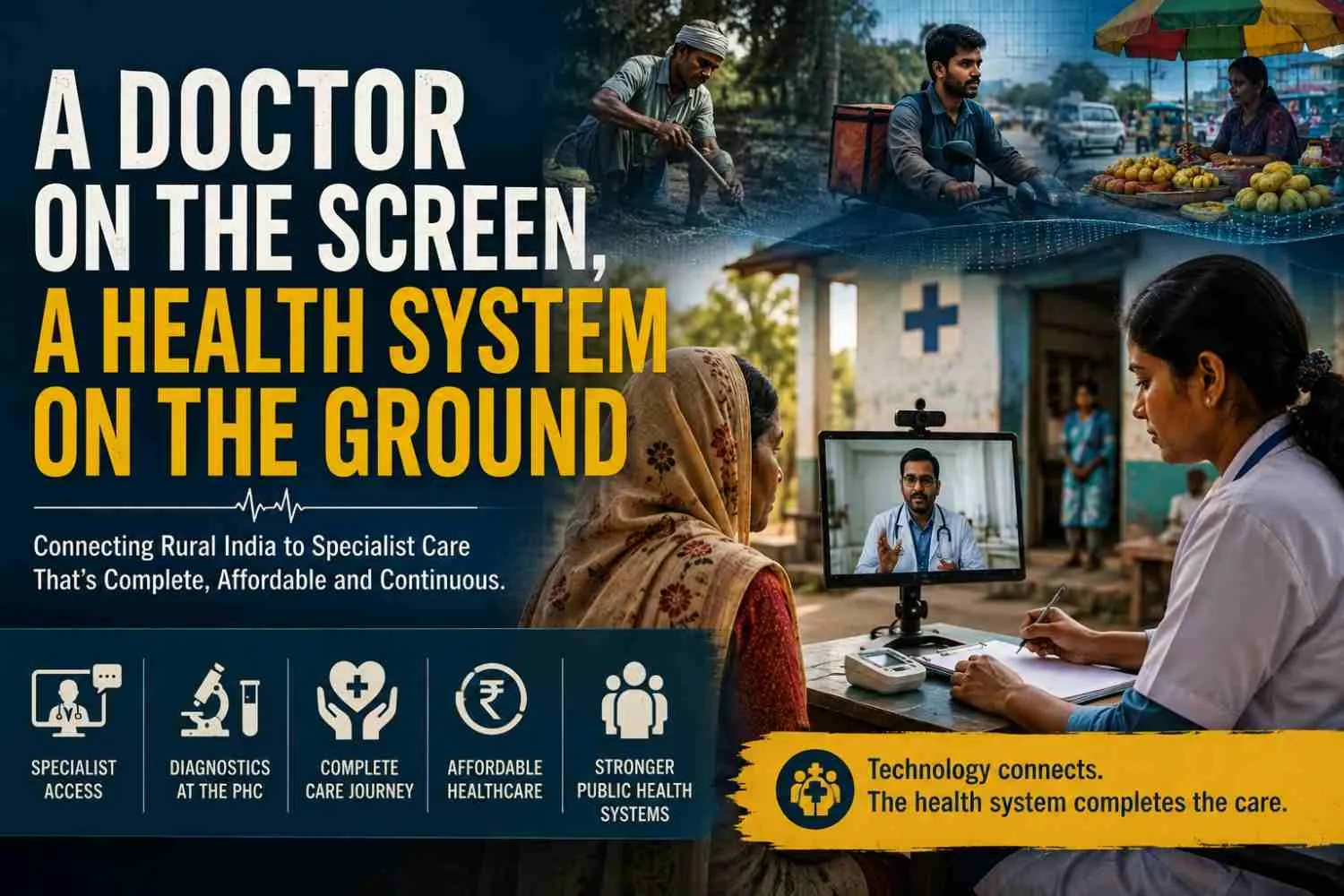
Kolkata |24 August, 2026  India’s telemedicine network is bringing specialist care closer to rural patients, but the real challenge is ensuring that a consultation leads to care that is complete, affordable and continuous. SummaryFor rural patients, seeing a specialist can mean a long journey, lost wages and repeated visits to a distant hospital. India’s telemedicine network is changing that equation by bringing specialist expertise closer to rural communities, while corporate partnerships are adding diagnostics, technology, mobile healthcare and specialist access to the mix. But a teleconsultation is only one part of the care journey. The real test is whether patients are diagnosed, treated and followed up without having to bear the same travel and financial burden. For CSR programmes, success also depends on whether public health facilities are strengthened, outcomes are measured against a clear baseline, money is actually spent as reported and systems continue functioning after corporate funding ends. KeywordsPhygital Healthcare, Rural Telemedicine, Digital Health India, eSanjeevani, Healthcare Access, Rural Healthcare, Primary Health Centres, Ayushman Arogya Mandirs, Digital Health Infrastructure, Teleconsultation, Diagnostics, Continuity of Care   Can a PHC become the gateway to a specialist hundreds of kilometres away? For many rural patients, the challenge is not simply finding healthcare. But is reaching the right doctor without travelling hundreds of kilometres, losing a day’s wages or making repeated trips to a distant hospital. India continues to face shortages and an uneven distribution of health professionals, particularly in rural and underserved areas, making specialist access a bigger challenge than simply counting the number of doctors available. Telemedicine can help change this equation by bringing specialist expertise closer to patients instead of requiring them to travel long distances for every consultation. India’s eSanjeevani platform has demonstrated the scale of this approach by connecting patients and health workers with doctors and specialists, including in rural and remote communities.But phygital healthcare cannot depend on a screen alone.The physical Primary Health Centre remains an important part of the care journey. A nurse or community health worker can examine the patient, record vital signs, conduct basic diagnostic tests, explain the specialist’s advice and help ensure that medicines, referrals and follow-up care are available. The technology can bring the specialist closer. But it is the local health system that turns a remote consultation into actual care. PHYGITAL CARE JOURNEY Village patient → Local PHC → Physical examination → Point-of-care diagnostics → Remote specialist → Treatment → Follow-up The screen connects the specialist. The PHC completes the care journey. What happens when telemedicine meets diagnostics? A specialist cannot always make a reliable diagnosis through a conversation alone. Basic diagnostic tests can provide the information needed to understand a patient’s condition and decide what treatment or referral is required. A blood-sugar or blood-pressure reading, pregnancy test, haemoglobin level or another point-of-care test can significantly change what happens after a teleconsultation. This makes diagnostics an important part of the phygital healthcare model, where digital specialist access is combined with physical healthcare services at the local level. NITI Aayog’s work across Aspirational Districts and Blocks includes healthcare interventions that bring together community outreach, frontline health workers, diagnostics and digital monitoring. The broader lesson is clear: technology works best when it is connected to the basic healthcare infrastructure patients can access locally. That means a teleconsultation should not end with a video call. It should connect to examination, diagnosis, medicines, referrals and follow-up care.Otherwise, a programme may be able to report thousands of consultations while leaving the more important question unanswered: Did those consultations actually lead to better care for patients? THE SCREEN IS ONLY ONE PART REMOTE SPECIALIST↓DIGITAL PLATFORM↓PHC / HEALTH WORKER↓DIAGNOSTICS + PHYSICAL EXAMINATION↓MEDICINES + REFERRAL↓FOLLOW-UP Technology connects the patient to expertise. Infrastructure turns that expertise into care. Can corporate partnerships strengthen the public health system? This is where corporate participation can become more than a funding exercise. Companies can bring technology, specialist networks, diagnostics, equipment, training and logistics that may help extend healthcare to communities that public facilities struggle to reach on their own.There are already examples of different approaches. Tata Trusts has worked with state governments on telehealth and mobile healthcare initiatives aimed at connecting underserved communities with doctors and specialist services. Apollo’s remote healthcare network offers another hybrid model. Its 2024–25 ESG report states that the network has delivered more than 16.5 million teleconsultations across 95 specialties, combining digital consultations with physical healthcare services. Meanwhile, Smile Foundation’s Smile on Wheels takes doctors, nurses, laboratory services and medicines directly to villages and other hard-to-reach communities through mobile medical units.These models also raise a bigger question for CSR: Should companies create separate healthcare systems of their own, or use their resources to strengthen the government facilities already serving these communities? The second approach could offer greater long-term value. Instead of creating parallel systems that may struggle to continue once funding ends, corporate partners can support existing PHCs with digital infrastructure, diagnostic equipment, specialist access, staff training and logistics, while keeping the public health system at the centre of care. The goal should not simply be to bring corporate healthcare to rural India. It should be to leave the rural healthcare system stronger than it was before the partnership began.WHO DOES WHAT? GOVERNMENT• PHCs• Health workers• Public health infrastructure• Referrals CORPORATES• Technology• Equipment• Diagnostics• Funding• Specialist networks NGOs / COMMUNITY GROUPS• Outreach• Awareness• Inclusion• Local access PATIENTS / COMMUNITIES• Care-seeking• Treatment• Follow-up• Feedback Can preventive healthcare produce a measurable social return? For CSR programmes, the focus needs to move beyond how many services were delivered to what actually changed for patients. Screening 10,000 people is an activity. Identifying patients with hypertension or diabetes, ensuring they begin treatment and helping them complete follow-up is an outcome. This distinction is particularly important when companies use technology to expand preventive healthcare. J-PAL South Asia has evaluated preventive-health interventions in India, including research on demand for hypertension screening and the impact of health camps on preventive-care investment. Its research also highlights an important limitation: technology and better monitoring systems do not automatically lead to better healthcare delivery. In Karnataka, for example, a biometric system successfully tracked the attendance of doctors at Primary Health Centres, but it did not improve attendance because the government struggled to enforce the incentives and penalties linked to the system.The lesson is relevant for corporate healthcare programmes too.A better dashboard does not automatically mean better healthcare.What matters is whether patients are being diagnosed earlier, starting treatment, completing follow-up and ultimately experiencing better health outcomes. The real measure of CSR is not the number of beneficiaries on a report, but the difference the programme makes to their lives. ACTIVITY VS OUTCOME 10,000 people reached↓7,500 screened↓2,100 diagnosed / referred↓1,600 started treatment↓1,200 completed follow-up Measure the care journey, not just the first contact. What do rural workers and migrant families need from these systems? Rural healthcare cannot be separated from the realities of work and income. For many people, accessing specialist care can mean more than a long journey. It can mean lost wages, travel costs, childcare difficulties and time away from work. A worker who has to travel to another town for a specialist consultation may lose a day’s earnings. Migrant workers may face additional barriers when their workplace and place of residence keep changing. Women may delay seeking medical care when travel, childcare responsibilities or the cost of treatment become difficult to manage. The Aajeevika Bureau’s work with migrant workers highlights how informal workers can face gaps in healthcare and social-security access, particularly when migration, low incomes and hazardous working conditions overlap. SEWA Bharat has similarly worked to improve women’s access to healthcare and social-security entitlements through community-based approaches. These experiences point to a simple principle:Healthcare technology should fit into people’s lives, rather than expect people to reorganise their lives around technology.That means rural healthcare systems also need to consider accessibility, language, affordability, mobility and physical access. These are particularly important for persons with disabilities, older people and workers who cannot easily travel. What should companies actually measure? This is where the evidence test becomes critical.Companies should report the full number of people covered, rather than using a single “beneficiaries reached” figure.If 10,000 people were enrolled, how many completed screening? How many were diagnosed? How many started treatments? And how many completed follow-ups? The baseline should be equally clear. If a programme claims that it reduced patients’ travel costs, companies should show what patients were spending before the intervention. If it claims to have improved access to specialist care, it should show how far patients previously had to travel and how that changed.The same applies to consultations. Reporting one lakh consultations does not show how many patients actually received the treatment, medicines or referrals they needed. Money also needs to be accounted for.How much was budgeted? How much was actually spent? How much went towards equipment, technology, staffing, diagnostics, training and maintenance? Companies should also report cost per outcome, rather than stopping at cost per consultation. For example, they could track the cost per completed treatment, cost per successfully screened patient or number of patients served per 1,000 people in the target population. Both absolute and intensity measures can provide a clearer picture. Absolute numbers show the scale of a programme, while intensity measures help show how efficiently resources are being used. Most importantly, the reporting boundary must remain clear.A consultation is not automatically a treated patient. A screening is not automatically a diagnosis. And a person reached by a programme cannot automatically be counted as someone whose health improved. The real evidence lies in what happened after the healthcare service was delivered. THE CORPORATE HEALTHCARE EVIDENCE SCORECARD MeasureWhat to askBeneficiary denominatorHow many people were actually covered?CompletionHow many completed screening, treatment or follow-up?OutcomeWhat changed for patients?BaselineWhat was the situation before the programme?CostHow much was actually spent?Cost per outcomeWhat did each successful outcome cost?IntensityWhat was achieved per 1,000 people or per ₹1 lakh?ContinuityWhat continued after CSR funding ended? Measure outcomes, not just activities. What happens when the CSR funding ends? This may be the most important test of any corporate healthcare partnership. A company can install telemedicine equipment, bring specialists into the system and fund diagnostics for three years. But rural healthcare needs to function long after a CSR funding cycle ends. If a programme cannot continue without corporate support, its long-term impact remains limited. So, who maintains the equipment once the funding ends? Who pays for internet connectivity? Who trains new health workers when trained staff leave? Who ensures medicines and diagnostic supplies remain available? Who manages patient referrals and follow-up? And who is responsible for the infrastructure and patient data? ESIC’s teleconsultation model offers a useful public-sector example. Its hub-and-spoke approach connects dispensaries with hospitals that act as specialist hubs, helping reduce patient travel while keeping local doctors involved in treatment and follow-up.The broader lesson is clear:Telemedicine creates lasting value when it becomes part of the regular healthcare system - not when it remains a temporary CSR project. For companies, that means the success of a partnership should be judged not only by what it delivers during the funding period, but also by what the health system is still able to deliver after the funding ends. WHAT SURVIVES AFTER CSR? DURING CSR FUNDING• Equipment purchased• Specialists connected• Staff trained• Patients reached ↓ FUNDING ENDS WHAT REMAINS?• Equipment maintained?• PHC staff still trained?• Specialist network still available?• Diagnostics still functioning?• Connectivity still paid for?• Patient follow-up still happening? CONTINUITY = REAL SYSTEM STRENGTH So, can corporate partnerships really bridge India’s rural specialist-care gap? Yes - but only if corporate healthcare moves beyond delivering services and starts strengthening the system that delivers them. India already has a network of Primary Health Centres, frontline health workers, digital platforms and an expanding telemedicine system. Corporate partnerships can add what many rural facilities struggle to access: specialists, diagnostics, technology, training, logistics and investment. But the real value of these partnerships will not be measured by how many teleconsultations were delivered or how many devices were installed. Nor should success be defined by the size of a CSR announcement.The stronger model is one in which corporate support makes the existing public health system more capable, more accessible and more sustainable. That means the evidence test has to go much further:Who was actually reached? Who completed care? How many patients received the treatment or referral they needed? What changed compared with the baseline? How much did patients save in travel, time or lost wages? What did the PHC gain? What did each successful outcome cost? And, most importantly, what continued after the corporate funding ended? These questions determine whether phygital healthcare is creating a lasting healthcare solution or simply another successful CSR activity on paper. For rural patients, however, the measure of success is much simpler.It means not having to travel hundreds of kilometres just to see the right specialist. It means being able to get basic diagnostics close to home, receive treatment without unnecessary delays and know that follow-up care will still be available.That is the real promise of phygital healthcare: bringing specialist expertise closer without leaving rural patients dependent on a screen - or on a company’s funding. The real CSR test is not whether a company can bring a doctor to a village once. It is whether its partnership can help build a rural healthcare system that continues to deliver care long after the company steps away. THE REAL TEST ACCESSCan patients reach specialist care?→ OUTCOMEDid their health actually improve?→ VALUEWas the intervention worth the cost?→ CONTINUITYDid the system survive after CSR funding? A consultation is an activity.Completed, affordable and continuous care is the outcome. The promise of phygital healthcare is not to replace the rural doctor with a screen. It is to bring specialist expertise, diagnostics and continuity of care closer to patients through the health system already in place. And ultimately, the strongest corporate partnership will not be the one that creates the biggest programme. It will be the one that leaves the rural health system more accessible, more capable and more sustainable - and less dependent on the corporate partner than it was before. Sources: Ministry of Health & Family Welfare — eSanjeevani National Telemedicine Service SourceMinistry of Health & Family Welfare — Telemedicine Services Guidelines SourceNational Health Authority — Ayushman Bharat Digital Mission (ABDM) SourceNational Health Authority — ABDM and Telemedicine FAQs SourceMinistry of Health & Family Welfare — Ayushman Arogya Mandirs, diagnostics and teleconsultation SourceMinistry of Health & Family Welfare — Annual Report 2024–25: eSanjeevani and digital health SourceMinistry of Health & Family Welfare / ABDM — eSanjeevani’s scale and assisted teleconsultation model Source Press Information Bureau — eSanjeevani integration with ABDM and continuity of care Source ...Read more

21 Aug 2026

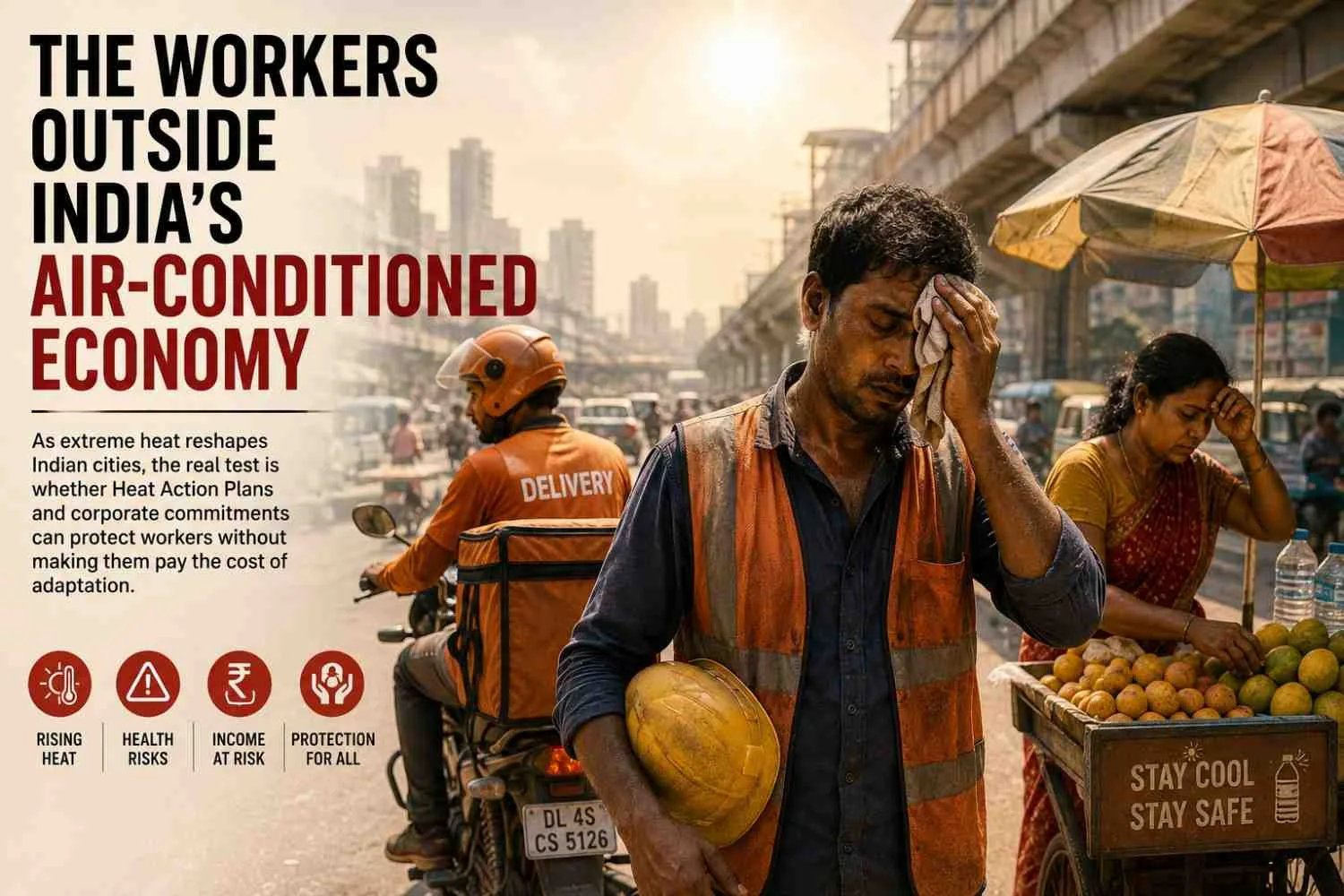
Kolkata | 21 August, 2026  As extreme heat reshapes Indian cities, delivery riders, construction workers and street vendors are being asked to keep working through conditions that can threaten both health and income. The real test is whether Heat Action Plans and corporate commitments can protect workers without making them pay the cost of adaptation. SummaryExtreme heat is becoming a workplace issue as much as a weather emergency. India now has Heat Action Plans across 23 states, 195 districts and 64 cities, while the National Disaster Management Authority has specifically advised cities to include street vendors and other informal workers through shaded vending areas, hydration facilities, cooling centres and flexible working hours. Yet the people most exposed to heat are often those who cannot simply stop working. Delivery riders lose income when they take breaks, construction workers spend hours outdoors, and street vendors depend on remaining at their locations through the hottest parts of the day. A 2026 nationwide advisory from the Ministry of Labour and Employment has urged employers and construction companies to provide drinking water, rest areas and cooling measures. Meanwhile, a proposed parametric-insurance pilot for delivery workers in Delhi-NCR is testing whether heat-triggered payouts can protect income when workers reduce labour during extreme temperatures. The larger question is whether India's heat-response system can move from warnings and advisories to enforceable protection for the workforce that keeps cities moving. Keywordsextreme heat in India, outdoor workers India, heat stress workers, heatwave workers India, workers and extreme heat, Heat Action Plans India, heat safety at workplace, worker protection from heat, heatwave labour protection, delivery riders heat, construction workers heat, street vendors heat, informal workers India, heat and labour rights, heat stress at workplace, worker income protection, climate adaptation workers, heat insurance India, parametric insurance workers, heatwave income protection, cooling centres India, workplace cooling, CSR and climate adaptation, CSR worker protection, corporate heat safety, climate resilience India, urban heat India, extreme heat and livelihoods, heat action plans and workers, labour protection climate change   Who Bears the Cost of Extreme Heat? For many city residents, extreme heat may mean discomfort or changes in their daily routine. For outdoor workers, however, cutting back on work because of the heat can directly affect their earnings. A delivery rider who delays an order may lose part of the day’s income. A street vendor who closes their stall may lose an entire day’s earnings. A construction worker may take longer breaks to cope with the heat, yet still be expected to meet daily targets.The choice is rarely simple. For many outdoor workers, protecting themselves from extreme heat can also mean risking their livelihood. India’s Heat Action Plans gradually recognise this vulnerability. The National Disaster Management Authority (NDMA) framework calls for early warnings, health preparedness and targeted protection for vulnerable groups. Recent government guidance has also identified informal workers and recommended measures such as shaded vending areas, drinking-water facilities, cooling centres and flexible working hours. The framework is in place. But the real question is whether these protections reach workers on the ground, where they face the greatest heat exposure.  Is a Heat Action Plan Enough to Protect Workers?  India’s heat-response system has expanded significantly. As of 2026, Heat Action Plans have been prepared across 23 states, 195 districts and 64 cities. These plans are intended to establish when authorities should act, identify vulnerable populations and assign responsibilities across government departments.But a plan on paper does not necessarily translate into action on the ground. CEEW’s 2026 analysis has highlighted that many urban local bodies still lack Heat Action Plans tailored to local conditions. It recommends city-specific heat thresholds, ward-level risk assessments, clearly assigned responsibilities and stronger monitoring. Heat warnings may cover an entire city, but the risks are not the same everywhere. A construction site, delivery depot and street market can expose workers to different levels of heat. The real test, therefore, is not simply whether a city has a Heat Action Plan. But it is whether that plan changes working conditions when temperatures cross dangerous levels.  What Does Extreme Heat Mean for the People Who Keep Cities Running? Heat exposure is not distributed equally across a city. An office worker may be able to respond to a heat warning by staying indoors. A delivery rider still has to travel through traffic. A construction worker cannot move a building site into the shade. A street vendor cannot simply walk away from the heat when leaving the market or roadside stall could mean losing the day’s income. The danger is not determined by temperature alone. Long hours of exposure, combined with humidity, direct sunlight, physical exertion and inadequate rest, can increase the risk of heat-related illness. Warmer nights add another layer of problem. When temperatures remain high after sunset, workers get less time to recover before another physically demanding day begins. CEEW’s recent analysis has also highlighted the growing role of humidity and warmer nights in India’s heat risk. Protecting workers from extreme heat requires more than monitoring the temperature at midday. It also means considering how long they work, how physically demanding the work is, whether they get enough breaks and water, and whether they have enough time to recover between shifts. Can Employers Be Held Accountable for Heat Safety?  Government measures are placing greater responsibility on employers to protect workers from extreme heat. In April 2026, the Ministry of Labour and Employment issued a nationwide advisory asking states to direct employers, industries and construction companies to take measures to protect workers during heatwaves. These included drinking water, rest areas and workplace cooling, with particular attention to construction workers, brick-kiln workers, daily-wage earners and casual labourers.The advisory also called on ESIC facilities and labour-welfare authorities to establish support mechanisms for heatstroke cases and maintain supplies such as ORS and ice packs. But an advisory alone does not answer a crucial workplace question:What happens when heat protection comes into conflict with productivity targets? A delivery platform may expect riders to complete a certain number of orders. A construction contractor may have a fixed daily target. In such situations, simply recommending more breaks may not protect workers if taking those breaks means losing wages, incentives or facing penalties. That makes employer responsibility closely linked to income protection. A heat-safety measure works only when workers can actually use it without being financially punished for doing so. Could Changing Work Hours Make Outdoor Work Safer? One of the simplest ways to reduce heat exposure is also one of the hardest to implement: changing when people work. NDMA guidance has recommended flexible working hours and other measures for outdoor workers during heatwaves. Earlier heatwave guidelines have also supported rescheduling working hours and providing drinking-water points and shaded areas. For construction workers, this could mean moving physically demanding tasks away from the hottest part of the day. For delivery workers, it could mean reducing pressure during peak-heat hours. For street vendors, it could involve shaded vending spaces and easy access to water and cooling facilities rather than simply advising workers to stay indoors.But changing working hours can also reduce earnings. If a worker is paid according to hours worked or deliveries completed, reducing heat exposure without compensating for lost income can simply shift the financial cost of climate adaptation from the employer to the worker.That is why heat adaptation is not only a public-health issue. It is also a labour and income-protection issue. Can Cooling Centres Reach the Workers Who Need Them? Cooling centres are becoming part of heat-response planning, but their usefulness depends on whether workers can actually access them during the working day. A delivery rider may not be able to leave a delivery route for 30 minutes. A street vendor may not be able to leave a stall unattended. A construction worker may be working far from any public cooling facility.This means cooling infrastructure should be planned around where workers live, work and move, rather than simply measured by the number of centres established. In some locations, shaded bus stops, drinking-water points, rest areas, shaded markets, construction-site cooling zones and accessible public facilities may provide more practical protection than a small number of centralised cooling centres. The more useful measure, therefore, is not simply how many cooling facilities exist, but how many vulnerable workers can actually access them when they need them. Can Heat Insurance Protect Workers’ Income? Another emerging approach is parametric insurance, which can provide a predetermined payout when specific temperature thresholds are reached.J-PAL South Asia is studying a proposed pilot for outdoor delivery workers in Delhi-NCR. Under the model, payouts would be triggered when temperatures cross defined thresholds, helping workers reduce their exposure to extreme heat without losing as much income. The research also proposes examining the effects on worker health, labour supply and platform businesses. The idea is important because it addresses a basic problem: workers should not have to choose between protecting their health and earning their income during extreme heat.But any such model needs to be tested carefully. How many workers are covered? How often are payouts triggered? How much does each worker receive? Does the payment actually compensate for lost income? And does it help reduce heat exposure?The timing of the support matters too. A payout that arrives only after a worker has already suffered serious health consequences cannot be considered an adequate heat-protection system. What should companies actually measure? THE HEAT-PROTECTION EVIDENCE TEST  Workers Exposed↓Heat Threshold Crossed↓Protection Activated↓Break / Shift Adjustment↓Income Protected↓Health & Grievance Outcome↓Protection Continues Beyond the Heatwave  Companies need to look beyond the number of worksites covered and report how many workers are actually protected.They should track whether heat-related measures affect workers’ wages, job retention, access to benefits and ability to raise complaints. Worker feedback should also be collected independently, without management present, so employees can speak honestly about whether they were allowed to take breaks, whether supervisors followed heat-safety measures and whether taking precautions affected their earnings. Transparency also matters in reporting. If a company protects its permanent employees but leaves contract workers outside its heat-safety measures, that gap should be clearly reported. The same scrutiny should apply to CSR spending. How much was promised? How much was actually spent? Where did the money go? And did it fund cooling infrastructure, worker support, insurance, training or other forms of protection?Most importantly, did these interventions actually reduce workers’ exposure to extreme heat, or did they simply add more activities and numbers to a CSR report?The responsibility for protecting workers cannot rest with one department alone. Municipal corporations manage much of the response in public spaces. Disaster-management authorities coordinate heat preparedness. Health departments respond to heat-related illness. Labour authorities oversee workplace protections. Employers determine working conditions, while delivery platforms can influence schedules, workloads and incentives. Workers experience the combined impact of all these decisions.That is why Heat Action Plans need clear responsibilities that extend beyond issuing warnings. A city can issue a heat alert, but that warning must lead to action at construction sites, markets, delivery depots and on the streets.An employer can provide drinking water, but workers must also be able to take necessary breaks without putting their income at risk. A city can build cooling centres, but the workers most exposed to heat must be able to reach and use them. And a company can fund a heat-adaptation programme, but the money should result in measurable protection - not just a list of activities completed.  Who Protects the People Who Keep Our Cities Running?  India’s urban economy relies heavily on people who work outside offices, malls and air-conditioned buildings. They deliver food and medicines, build homes and roads, sell goods, transport materials and keep neighbourhoods running.As extreme heat becomes a more persistent threat, protecting this workforce cannot remain limited to seasonal warnings and awareness campaigns. The response needs to connect heat alerts with workplace protections, income security, accessible cooling spaces and clear employer accountability.For CSR programmes, success should not be measured by how many water bottles were distributed or how many awareness sessions were conducted. The more important question is whether workers were safer, able to protect their income, able to access essential benefits and able to raise concerns when protections failed. The workers most exposed to India’s rising heat are also among those keeping its cities running.The real test is whether India can turn heat warnings into meaningful protection for the workers who keep its cities moving.WHAT TO CHECK BEFORE CALLING A HEAT CSR PROGRAMME A SUCCESS  MeasureWhat to askDenominatorHow many workers were actually covered?ExposureHow many workers face outdoor/heat-intensive work?IncomeDid workers lose wages when taking heat breaks?ProtectionWere water, shade, cooling and adjusted shifts actually available?BenefitsCould workers access medical/social-security support?GrievancesHow many complaints were raised and resolved?BaselineWhat was the situation before the intervention?OutcomeDid heat exposure or illness actually decline?SpendingWhat was budgeted versus actually spent?ContinuityDoes protection continue after CSR funding ends? Primary sources: NDMA — Guidelines for Preparation of Action Plan: Prevention and Management of Heat Wave (2019)Official national framework for Heat Action Plans, heat preparedness and response. NDMA Heat Wave GuidelinesNDMA — Heat Wave portalOfficial government guidance and heat-wave information. NDMA Heat WaveMinistry of Labour & Employment / PIB — Nationwide Heatwave Advisory (28 April 2026)This is the key primary source for your claims about employers, rescheduling working hours, drinking water, rest areas, workplace cooling, construction workers, daily-wage workers, ORS/ice packs and compliance monitoring. Ministry of Labour & Employment Heatwave Advisory, 2026CEEW — How We Build Scientific Heat Action Plans with Indian Cities (23 June 2026)Supports your points about locally calibrated HAPs, ward-level risk assessments, heat thresholds, outdoor workers, revised work schedules, rest-water-shade measures and monitoring/evaluation. CEEW: Scientific Heat Action PlansCEEW — How Extreme Heat is Impacting India: Assessing District-level Heat Risk (2025)Useful for the claims about humidity, warmer nights, heat risk and the limitations of existing HAPs. CEEW: Extreme Heat Risk in IndiaNDMA — National Guidelines for Cooling Centers (November 2025)This is the strongest primary source for the cooling-centre/infrastructure section. NDMA lists the guideline officially. NDMA: National Guidelines for Cooling CentersJ-PAL South Asia — Take-up and Impacts of Parametric Insurance for Labor Supply under Climate ChangeThis is the primary research source for your section on parametric heat insurance for outdoor delivery workers in Delhi-NCR, including predetermined temperature triggers and income protection. J-PAL: Parametric Insurance for Outdoor Delivery Workers ...Read more

20 Aug 2026

Kolkata | 20 August, 2026  Every day, millions of flowers are offered at India’s temples. Once the prayer is over, however, those flowers become part of a growing waste-management challenge. Across pilgrimage towns, municipalities, temple trusts, women’s self-help groups and private enterprises are trying to give them a second life - as incense, natural colours, compost, flower powder and other products. The bigger opportunity is not simply to prevent flowers from reaching rivers. It is to build a system where ritual waste creates reliable rural livelihoods, supports women and waste workers, and can prove every environmental claim it makes. SummaryTemple flowers can become more than biodegradable waste. They can become products, income and a reason to strengthen local circular economies. But a credible model must answer difficult questions. How much waste was actually collected? Where would it have ended up without the intervention? How much was successfully converted into usable products? Where did the remaining material go? How much did the workers earn? What did the project cost? And, most importantly, can the claimed reduction in river pollution be supported with clear evidence? The future of India’s temple economy may depend less on how many flowers are collected and more on whether the entire chain can be measured and trusted. KeywordsTemple Flower Waste, Floral Waste Management, Circular Economy India, Temple Waste Recycling, Women Self-Help Groups, Sustainable Livelihoods, Circular Economy, Waste to Wealth, River Pollution, Environmental Impact, CSR, Sustainable Communities When Devotion Becomes a Waste-Management ChallengeFor a devotee, flowers are an offering made with faith and devotion. But for temples that receive thousands of visitors every day, those offerings eventually become a large and regular source of organic waste. The problem arises when floral waste is mixed with other garbage or dumped in drains, open spaces and water bodies. Although flowers are biodegradable, that does not make them harmless when large quantities are disposed of, without proper treatment. When floral waste enters water bodies in large amounts, it can increase organic pollution, reduce dissolved oxygen and put additional stress on aquatic ecosystems. The scale of the waste can be significant. At Ujjain’s Mahakaleshwar Temple, which receives an estimated 75,000–100,000 visitors a day, around 5-6 tonnes of floral and other waste are generated daily. A processing plant with a reported capacity of three tonnes per day is part of the temple’s waste-management system, while women’s self-help groups also help turn collected floral waste into useful products. Tirupati offers another example. More than six tonnes of floral waste are reportedly handled every day, with around 150 women from self-help groups involved in recycling the material. These examples highlight an important reality: a major temple is not only a place of worship. It is also a large local ecosystem involving visitors, livelihoods, waste management and the environment. Temple floral-waste scale  Ujjain: 75,000–100,000 visitors/day | 5–6 tonnes floral + other waste/day | 3-tonne/day processing capacityTirupati: 6+ tonnes floral waste/day | 150 women involved in recyclingGulf of Mannar: 849 kg garland waste collected → 155 kg usable flower powder | 60 women involved Can Temple Flowers Become a Source of Livelihood?Floral waste is often discussed as an environmental problem, but it can also become an economic opportunity when it is collected, processed and reused properly. A model in the Gulf of Mannar Biosphere Reserve shows how this can work. Temples were used as collection points, with 15 collection drums installed across five temples, according to UNESCO. Between May and August 2025, around 849 kg of garland waste was collected and processed. After segregation and drying, 155 kg was converted into usable flower powder, while 60 women received training in processing, quality control, packaging, pricing and managing micro-enterprises. The numbers also show why waste processing cannot be measured simply by comparing what is collected with what is sold. 849 kg went into the process, while 155 kg became usable flower powder. That difference is expected. Flowers contain significant moisture, while temple offerings can also contain threads, plastic, synthetic decorations and other unwanted material. Some of the material is removed during sorting, while further losses can occur during drying and processing. Not all collected waste will necessarily be suitable for the final product. This is why credible circular-economy projects need a clear mass balance - tracking how much material enters the system, how much is recovered, how much is converted into products and how much ultimately remains as waste. Collected → segregated → processed → converted into product → sold/used → residual material → final destination. Without that chain, “X tonnes recycled” can hide what happened between collection and the final product.  Who Benefits When Temple Flowers Get a Second Life? The strongest potential of floral-waste circularity may lie in its ability to address waste while creating local livelihoods. Women’s self-help groups can take part in collection, segregation, drying, processing, packaging and sales. This can keep more of the economic value within pilgrimage centres and nearby communities, instead of sending the waste to a distant processing facility.But formalising the waste stream can also affect people who already depend on it for their livelihoods. Before a new floral-waste system is introduced, it is important to ask: Who was collecting, sorting or recovering value from this waste before the project began?Informal waste workers may already be earning an income from these activities. If a formal system replaces their work without including them, it could solve a waste-management problem while creating a new livelihood problem.A responsible circular-economy model should therefore examine whether informal workers are:included in the new system or offered alternative livelihoods;provided formal contracts or predictable payments; given appropriate protective equipment and training;included in decisions that affect their work;given opportunities to participate in higher-value stages of processing and sales; andactually, earning more or receiving a more stable income as a result.The same principle applies to women-led self-help groups. Saying that a project has “created 100 jobs” does not narrate the full story. It is important to know whether these are full-time or occasional jobs, how much workers are paid, who pays them and whether the income will continue after the pilot or CSR funding ends.A circular-economy project should create value not only from discarded flowers, but also for the people whose work keeps that system running.  VALUE-CHAIN FLOW   FLOWER OFFERED → TEMPLE COLLECTION → SEGREGATION → WOMEN/WASTE-WORKER NETWORK → PROCESSING → PRODUCT → MARKET → INCOMEWaste residue → documented destination  Can Temple Trusts Turn Faith-Based Giving into Environmental Action?India’s religious institutions already play a major role in supporting education, healthcare, food distribution, welfare and other community programmes. This gives temple trusts and endowment bodies an opportunity to extend that work into environmental management and circular-economy initiatives.Instead of leaving floral waste entirely to municipal systems, temple administrations could invest in the infrastructure needed to manage it properly, including: separate collection points;storage and transportation systems;processing equipment and facilities;training and protective equipment for workers;support for women-led enterprises;market development for products made from floral waste; andregular monitoring and independent audits. Tirumala Tirupati Devasthanams, for instance, already operates several social-service and charitable programmes through dedicated trusts and institutional structures. This established model of organised giving could be expanded to support environmental stewardship, responsible waste management and sustainable livelihood opportunities for local communities. But funding a circular-economy project is only the beginning. Temple trusts should also be able to demonstrate how that money is being used and what it is achieving. Capital expenditure, operating costs, worker payments, equipment purchases and actual programme spending should be clearly documented. A large budget announcement does not necessarily mean the money has been spent. A large processing facility does not automatically mean the system is functioning. And a finished product on a shelf does not prove that the wider floral-waste stream is being managed responsibly. The real measure of a temple’s circular-economy investment is not how much it announces or builds, but how effectively it turns waste into environmental and social value. Can Private Companies Help Take Temple-Waste Circularity to Scale?Taking temple floral-waste circularity to a larger scale will likely require more than temple trusts and municipal bodies. Private companies can bring the technology, logistics, packaging, market access, training and investment needed to build a more efficient system. Different industries can contribute in different ways. FMCG companies could support product development and distribution, while packaging companies could help create lower-impact packaging for products made from floral waste. Recyclers and producer-responsibility organisations could bring expertise in collection, traceability and material management. Companies in sectors such as automobiles, electronics and batteries could also support floral-waste initiatives through CSR funding, livelihood programmes and wider circular-economy partnerships. Businesses involved in repair and reuse can bring another useful lesson: materials retain greater value when they are kept in productive use instead of being discarded. But corporate participation should not turn floral-waste management into another branding exercise.If a company supports such a project through CSR, there should be clear answers to basic questions: How much money was committed? How much was actually spent? What was built? Who benefited? What results were achieved? And what continued after the funding ended? That transparency is what separates a CSR announcement from a functioning programme that delivers lasting environmental and social impact. Who Is Responsible for Making Temple-Waste Management Work?Temple floral waste does not exist separately from the wider urban waste-management system. In pilgrimage towns, municipal corporations are responsible for local waste collection, sanitation and supporting infrastructure. That makes coordination with temple administrations essential. Running two separate waste systems in the same town can create gaps, duplication and confusion over responsibility. The regulatory framework is equally important. The Central Pollution Control Board (CPCB) and State Pollution Control Boards play a role in pollution monitoring and environmental compliance, while the Ministry of Environment, Forest and Climate Change (MoEFCC) provides the broader policy framework. BIS may be relevant where standards apply to particular products or processes, while the Central Consumer Protection Authority (CCPA) has a role in addressing misleading environmental claims. This becomes especially important as circular-economy projects use environmental benefits as part of their public messaging. India’s 2024 Guidelines for Prevention and Regulation of Greenwashing and Misleading Environmental Claims require environmental claims to be truthful, clear and supported by evidence. Floral-waste projects should meet the same standard. If a project claims to have “saved a river,” the crucial question is whether that claim can be supported by clear, verifiable evidence. Can a Floral-Waste Project Prove Its Environmental Impact?Collecting waste does not automatically tell us how much pollution has been prevented. Suppose a project collects 1,000 kg of flowers. It cannot simply claim that 1,000 kg of waste was diverted from a river. To make that claim, the project needs to establish where that waste would have gone without the intervention. Was it entering a river or other water body? Was it being sent to a landfill? Was it already being composted? Was it being collected separately?The environmental benefit depends on the answer. A credible project should therefore report at least four things: Waste collected: How much floral waste entered the programme?Waste diverted: How much was demonstrably prevented from its documented previous disposal route?Product output: How much was converted into a usable product?Residual waste: Where did the remaining material go? The scale of the project should also be taken into account. Reporting both absolute and intensity-based results can provide a clearer picture.For example: Absolute: 10 tonnes of floral waste diverted in one year. Intensity: 10 kg of floral waste diverted per 10,000 visitors. The second measure can make comparisons between temples of very different sizes more meaningful. Is the Final Product Really the Measure of Circularity?Not necessarily.It is easy to focus on the visible end products - incense sticks, soaps, colours, compost, paper or decorative items made from flowers. But these products represent only one part of the circular-economy process.The system begins with segregation and collection and ends only when the material, money and people involved can be accounted for.That means asking: Material: Where did the collected flowers go?Money: How much was spent and how much revenue was generated?People: Who did the work, who benefited and was anyone’s existing livelihood affected?Environment: What pollution or waste was actually avoided?Market: Were the products actually sold and used, or simply produced?Longevity: Did the model continue after the initial grant, CSR funding or pilot ended?Organisations working on waste management, informal labour and environmental justice - including groups such as Chintan, Toxics Link, Waste Ventures India and Goonj - can bring an important perspective here: a circular system should not only change where waste goes; it should also improve the conditions and opportunities of the people handling it. What Would a Truly Circular Temple-Waste System Look Like?A genuinely circular temple economy would begin before the flower becomes waste.Temples would have dedicated collection systems and ensure that plastic, thread and other contaminants do not enter the floral-waste stream. Municipalities would integrate these systems into local waste-management plans. Temple trusts could support infrastructure, worker training and livelihood development. Women’s self-help groups and existing waste workers could participate across the value chain, rather than being restricted to the lowest-paid collection work. Private companies could contribute technology, logistics, packaging and market access. NGOs and waste-sector organisations could help monitor worker safety, inclusion and environmental outcomes. Regulators could ensure that environmental claims are backed by evidence. The final test is straightforward: Can the project trace the flower from the moment it is offered to its final destination? If it can, that flower becomes more than waste. It can become a product, a source of income, an opportunity for local enterprise and a measurable part of pollution prevention.But if a project cannot show where the waste went, how much became a usable product, how much workers earned, what the system actually cost or how its environmental claims were calculated, then “circularity” risks becoming little more than a label.India does not have to choose between faith and sustainability. It can build systems where faith supports environmental stewardship, environmental action creates local livelihoods and every claimed impact is supported by credible evidence. A flower offered at a shrine should not have to end its journey in a polluted river.But making that journey truly circular requires more than collecting the flowers - it requires tracking their journey and proving what happens to them at every stage.   THE CIRCULARITY TEST” SCORECARD  What a project claimWhat readers should ask“X tonnes recycled”How much was actually collected, processed and converted?“River pollution avoided”Where would the waste have gone without the project?“Women employed”How many women, doing what work, for how much income?“Waste diverted”What was the baseline disposal route?“Circular product”Where did processing residues go?“₹X crore invested”How much was actually spent and on what?“Sustainable”What evidence supports the environmental claim? Before You Call It Circular, Follow the Flower.  “849 KG → 155 KG”Use the Gulf of Mannar case as a simple mass-balance graphic:849 KG GARLAND WASTE↓SEGREGATION + DRYING + PROCESSING↓155 KG USABLE FLOWER POWDER Side panel: 60 women involved15 collection drums5 templesMay - August 2025 “Collected material ≠ final product.”   EDITORIAL EVIDENCE BOX:  For every floral-waste project studied, the reporting checklist should be:  Collection recordsWeighing/mass-balance recordsProcessing capacity vs actual throughputFinal-product quantityResidual-material destinationBaseline disposal routePollution or environmental baselineWorker numbers and actual incomeWorker safety provisionsCSR/temple/municipal budget and actual expenditureSales/market evidenceAudit or certification trailClear reporting boundaryAbsolute and intensity results  Primary sources:  PIB / Ministry of Housing & Urban Affairs — Floral Waste is boosting circularity in economy — Ujjain, Tirupati, temple trusts, SHGs, processing capacity and employment. PIB sourceUNESCO — Advancing Circular Economy and Inclusive Waste Management in the temples of Gulf of Mannar Biosphere Reserve — 5 temples, 15 collection drums, 849 kg collected/processed, 155 kg flower powder, 60 women and processing workflow. UNESCO sourcePIB — Flower Power: India’s Temple Waste Transformation — Ujjain, Siddhivinayak, Phool, HolyWaste and Aaruhi case studies. PIB featureSwachh Bharat Mission Urban — Petals to Profit — official government resource on temple floral-waste recycling and circular-economy models. Swachh Bharat Mission sourceCCPA — Guidelines/Guidance on Prevention and Regulation of Greenwashing, 2024 — substantiation, verifiable evidence and accuracy of environmental claims. CCPA sourceTirumala Tirupati Devasthanams / Andhra Pradesh Endowments material — TTD funds, donations, offerings and permitted social/institutional uses of funds. TTD Endowment Act sourceUNESCO — Phool: A Story of Change — floral waste, river-pollution context, recycling into incense and employment of marginalised women. UNESCO / Phool sourceKolkata Municipal Corporation project — 2026 — temple flowers being collected for incense and herbal aabir, with an initial employment target for 15 women. The available report quotes a senior state municipal-affairs official, so I would treat this as reported municipal information, rather than an independently audited source. Kolkata floral-waste project report ...Read more

18 Aug 2026

Kolkata| 18 August, 2026  As renewable energy, electric mobility and sustainable agriculture create new livelihood opportunities, the real test for CSR is whether women gain lasting access to skills, decent wages, finance and leadership - not just training certificates. SummaryIndia’s green transition is opening opportunities across solar energy, electric mobility, sustainable agriculture and other emerging sectors. Yet women remain underrepresented in many technical clean-energy jobs. A 2026 CEEW-NRDC analysis found that women account for only 11% of the workforce in India’s solar and wind deployment and manufacturing sectors, while more than half of the women working in these sectors are in non-technical roles. At the same time, India’s clean-energy ambitions could create more than 44 lakh full-time-equivalent jobs. The opportunity is therefore significant, but access remains uneven. CSR can help women enter technical occupations and build green enterprises by combining training with employment, finance, market access, safety and social protection. Its success, however, should be measured by wages, retention, benefits and income growth rather than the number of women trained alone. Keywords: Women in Green Economy, Green Jobs, Women in Renewable Energy, Green Skills, Women’s Employment, CSR, Clean Energy, Women Entrepreneurs, Sustainable Agriculture, EV Jobs, Gender Equality Can Women Become a Key Workforce in India’s Green Transition?India’s green economy is opening up job opportunities in areas that were once seen as highly technical or largely male-dominated. Solar installation and maintenance, electric-vehicle servicing, battery management, climate-resilient agriculture, waste management and energy-efficient construction are creating new career possibilities for women, including jobs with potential for long-term income and growth. But women are still significantly underrepresented in these roles. The latest CEEW-NRDC analysis shows that women account for only 11% of the workforce across solar and wind deployment and manufacturing. Their representation is highest in rooftop solar, at 15%, while wind manufacturing has only around 6% women workers. More than half of the women employed across the clean-energy sectors studied are still working in non-technical roles such as administration, accounting and human resources. This raises an important question for companies supporting green CSR and skilling programmes: Are they actually preparing women for technical careers, or are they mainly directing them towards support roles? India’s clean-energy targets could generate more than 44 lakh full-time-equivalent jobs. If women remain largely excluded from technical positions, a significant share of this employment opportunity could remain out of reach for them. Where Is the Missing Link?India already has programmes aimed at building a skilled renewable-energy workforce. The government’s Suryamitra programme, for instance, trains solar photovoltaic technicians in installation, operation and maintenance, with more than 51,000 Suryamitras trained by the end of 2022. But completing a training programme does not mean automatically securing a job. A woman may earn a technical certificate and still struggle to find employment because of limited transport to project sites, lack of equipment, workplace barriers or the challenge of balancing paid work with unpaid care responsibilities. This is where CSR programmes need to rethink how they measure success. Reporting that 1,000 women completed a training course shows the reach of a programme, but it does not show whether the training improved their livelihoods or not. The more meaningful questions are: How many women found jobs? How much did they earn? How many remained employed after six or 12 months? How many moved into technical roles? How many received social-security benefits? And how many were able to progress in their careers? The focus therefore needs to shift from how many women were trained to how many women are earning, staying employed and moving forward in the green economy.Can Women Turn Green Skills into Real Jobs? Women are already entering technical and clean-energy roles, showing that green-skills training can create real employment opportunities when it is linked to actual jobs and local demand. Government programmes have documented women receiving training in solar installation and maintenance, while other clean-energy initiatives are helping women from communities whose traditional livelihoods are changing to access new opportunities in the renewable-energy sector.The key lesson is clear: training creates greater impact when it is designed around the skills and jobs that are actually in demand in the local economy. For example, A CSR programme in a region experiencing rapid growth in solar installations could equip women with skills in installation, maintenance and after-sales services, helping them access emerging employment opportunities in the sector. Near an electric-mobility hub, training could focus on EV diagnostics, battery maintenance and charging infrastructure. The same approach can work in agriculture. Women farmers could be trained in climate-resilient farming, efficient irrigation, solar-powered agricultural equipment, soil management, livestock services and value-chain activities. The goal should not be to simply add more people to the list of training certificate holders. Instead, it should be to create sustainable local green livelihoods that provide a steady source of income and remain viable even after CSR funding ends. Can Green Skills Help Women Build Their Own Businesses? A job is not the only way women can participate in the green economy. For many, entrepreneurship could offer a more flexible and sustainable route to earning a livelihood. A woman trained in solar maintenance could become a local service provider. A group of women could run a farm-equipment service centre. An EV-trained technician could start a small repair business. A farmer could adopt climate-smart practices and better equipment to improve productivity and access higher-value markets. But training alone is not enough to turn these skills into viable businesses. Women also need working capital, equipment, access to credit, digital payment systems and reliable market connections. India already has a strong institutional network that can support this transition. By February 2026, DAY-NRLM had mobilised more than 10.05 crore rural women into over 90.90 lakh self-help groups, while cumulative bank credit to women’s SHGs had crossed ₹11.10 lakh crore. This creates an opportunity for CSR programmes to connect green skilling with existing women-led financial and community networks, instead of creating separate systems from scratch.The government’s SVEP model similarly supports rural entrepreneurs in setting up businesses and provides assistance until they become more stable. CSR can strengthen these existing systems by providing targeted support for green enterprises, helping women turn their skills into viable businesses, reliable incomes and long-term economic opportunities. Could Financial Inclusion Decide Whether Women Stay in the Green Economy?Access to finance can determine whether green-skills training leads to real economic independence. A woman may have the technical skills to provide solar maintenance or run a green enterprise, but without the money to purchase tools, equipment or basic business inputs, she may remain dependent on an employer. Access to small-business finance, on the other hand, can give her the opportunity to build and manage her own livelihood. But finance alone is not enough. Women also need access to markets. Providing loans without ensuring access to customers, procurement opportunities or business support can leave women with financial obligations but without a stable and sustainable source of income. This is where companies can use their own supply chains to create stronger opportunities. Large businesses in sectors such as construction, logistics, healthcare and education could create procurement opportunities for women-led enterprises providing solar maintenance, waste-management services, sustainable food supplies or energy-related solutions. Such an approach can move CSR from simply training women for employment to helping them build sustainable sources of income and participate in the wider green economy. Are Green Jobs Creating Better Work for Women?The quality of employment matters just as much as the number of women entering the green workforce. Green jobs are often presented as automatically better opportunities, but a job does not become a decent job simply because it is linked to renewable energy or sustainability. Women entering these sectors still need fair wages, safe workplaces, reasonable working conditions, effective grievance mechanisms and access to social protection. These factors also influence whether women remain in technical roles over the long term. If women leave their jobs within a few months because of low wages, unsafe working conditions or limited opportunities for career growth, a programme may appear successful on paper while failing to create lasting employment opportunities. Companies therefore need to look beyond job placements and understand what happens after women enter the workforce. Regular feedback and worker interviews, conducted independently and without management present, can help identify issues that may not appear in official programme reports - such as harassment, wage disputes, unsafe conditions, inadequate transport or difficulties accessing workplace benefits. The real measure of success is not simply whether women get green jobs, but whether those jobs provide the security, dignity and opportunity needed to build lasting livelihoods. What Should Companies Actually Measure? For women-focused green CSR programmes, measuring activities alone is not enough. The real test is whether those activities lead to meaningful and lasting improvements in women’s employment, income and economic opportunities. FROM TRAINING TO GREEN LIVELIHOOD  Women Enrolled↓Training Completed↓Job / Enterprise Started↓Wage or Business Income↓6–12 Month Retention↓Benefits + Grievance Access↓Career / Business GrowthCompanies should also report the starting point or baseline against which changes in income or employment are measured. If a programme reports an increase in women’s earnings, it should clearly establish their income levels before the intervention to demonstrate the actual change achieved. The same clarity is needed when reporting beneficiaries. For example, if an NGO trained 1,000 women, but only 400 completed the course and 180 found employment, these figures should be reported separately rather than combined into one broad “beneficiaries reached” number. Financial reporting should follow the same approach. Companies should clearly state: How much was budgeted? How much was actually spent? How much went towards training, equipment, job placement and support for women-led enterprises? Clear reporting of these numbers helps show the difference between a CSR announcement and a programme that is actually being implemented and creating results.So, Can Women Actually Lead India’s Green Economy?India’s green economy is opening up new opportunities for women, but participation alone will not be enough. The real opportunity lies in ensuring that women can enter the sector, build stable livelihoods and progress into roles with greater skills, responsibility and decision-making power. The clean-energy transition is creating a new employment landscape in India, but women are still underrepresented in the technical roles that will shape its future. CSR can help close this gap by connecting women with opportunities in renewable-energy technology, EV maintenance, sustainable agriculture and green enterprises. But the strongest programmes will not end when the training period does. Training must be the starting point - not the finish line. Its impact should continue through employment, fair wages, access to finance and markets, safe working conditions, social protection and opportunities for career progression. For companies, the real measure of success goes beyond training numbers.They need to ask whether women are earning more, staying employed, receiving workplace benefits and moving into higher-skilled and better-paid roles. For women, being part of the green workforce should only be the beginning. They should have opportunities to grow into technicians, entrepreneurs, supervisors and decision-makers who help shape India’s green future.India is preparing for a greener economy. The real CSR test is whether women are being given the skills, opportunities and support to lead it.Sources: CEEW–NRDC — Driving Energy Transition: Workforce, Skills, and Gender in India’s Renewable Energy Sector (https://www.ceew.in/publications/driving-energy-transition-workforce-skills-and-gender-in-indias-renewable-energy-sector) (CEEW)CEEW–NRDC — India’s clean energy targets could create over 44 lakh jobs by 2030 (https://www.ceew.in/press-releases/india%E2%80%99s-clean-energy-targets-could-create-over-44-lakh-jobs-2030-rooftop-solar) (CEEW)Ministry of New and Renewable Energy (MNRE) — Suryamitra Skill Development Programme (https://mnre.gov.in/en/skill-development-programme/) (Ministry of New and Renewable Energy)Ministry of Rural Development / PIB — DAY-NRLM and Self-Help Groups (https://www.pib.gov.in/PressReleasePage.aspx?PRID=2224571) (Press Information Bureau)Ministry of Rural Development / PIB — DAY-NRLM financial inclusion and SHG credit (https://www.pib.gov.in/PressReleasePage.aspx?PRID=2222697) (Press Information Bureau)Ministry of Rural Development / PIB — Start-up Village Entrepreneurship Programme (SVEP) (https://www.pib.gov.in/PressReleasePage.aspx?PRID=2205172) (Press Information Bureau)Ministry of Rural Development / PIB — Women-led enterprises and public procurement under DAY-NRLM (https://www.pib.gov.in/PressReleasePage.aspx?PRID=2229449) (Press Information Bureau)Ministry of Rural Development / PIB — DAY-NRLM outcomes and financial inclusion, 2026 (https://www.pib.gov.in/PressReleasePage.aspx?PRID=2287316) (Press Information Bureau) ...Read more

12 Aug 2026

Kolkata| August 12, 2026 An unusually thick ozone layer was detected 21–23 km above the North Bay of Bengal, giving scientists new clues about how ozone-rich air moves through the atmosphere. SummaryScientists have detected an unusually high concentration of ozone over the North Bay of Bengal at an altitude of about 21–23 kilometres. The layer was thicker and more ozone-rich than normally observed over eastern India and remained for more than 24 hours.Researchers say the event was not mainly caused by sunlight-driven chemical reactions. Instead, evidence points to ozone-rich air being transported horizontally, moving downward and becoming compressed in the lower stratosphere. The finding offers new insight into atmospheric circulation over the Indian region.  KeywordsBay of Bengal ozone surge,  unusual ozone layer, ozone enhancement,  North Bay of Bengal, ozone concentration, stratospheric ozone, ozone layer India, NetRAD-ASMA campaign, ozone research India, atmospheric circulation, ozone-rich air, lower stratosphere, ozone transport, Indian atmosphere, atmospheric research India What Made Ozone Build Up Unusually Over the Bay of Bengal? The discovery came during Phase-I of the NetRAD-ASMA campaign, a nationwide atmospheric research initiative involving scientists and institutions from across India. Researchers combined weather balloons, ozone-measuring instruments, atmospheric radars, satellite observations and atmospheric models to track the movement of gases through different layers of the atmosphere. Scientists detected the unusual ozone layer at around 21–23 km above the North Bay of Bengal, significantly lower than the altitude where ozone is typically most concentrated. Under normal atmospheric conditions, peak ozone levels are generally found higher in the stratosphere, at around 25–30 km. Researchers found that ozone levels in the unusual layer were much higher than the normal levels recorded over eastern India.  The study reported an increase of around 50 nanobars above the long-term average, with the enhanced layer extending roughly 2.1–2.4 km vertically. The increase was also not a brief event. Measurements showed that the unusually high ozone levels continued for at least 24 hours and were detected during both day and night. This suggested that sunlight-driven chemical reactions were unlikely to be the main cause of the sudden ozone build-up. So, Where Did the Ozone Come From?Scientists combined data from several sources to understand how the unusual ozone layer formed.  During the campaign, researchers used ozonesondes and radiosondes, along with a network of Stratosphere-Troposphere and Mesosphere-Stratosphere-Troposphere radars. They also analysed satellite observations from Aura MLS and INSAT-3DR, supported by atmospheric models and reanalysis data to track air movement. Together, the evidence suggested that the ozone was transported into the region from elsewhere in the atmosphere rather than being produced locally. Researchers detected a persistent downward movement of air in the lower stratosphere. Their analysis suggested that ozone-rich air had been transported into the region and then gradually moved downward. As the air mass descended and became compressed, the ozone concentration increased, creating the unusual layer observed over the Bay of Bengal. Scientists also considered the possible role of mid-latitude air moving into the region and other atmospheric processes. The location of the event was significant because the North Bay of Bengal lies in a region where different air masses and large-scale atmospheric movements can interact. The North Bay of Bengal is a key region for deep atmospheric convection and is influenced by several major circulation systems. These conditions make it an important area for understanding how ozone and other atmospheric gases move between different layers and regions of the atmosphere. The study also shows why observations from multiple locations are important. During the campaign, data were collected from Balasore, Gadanki, Nainital, Silkheda and Thiruvananthapuram, along with regular observations from other meteorological stations. Comparing measurements across these sites helped provide a broader picture of atmospheric movements rather than relying on a single location. The finding does not indicate the formation of a permanent ozone layer or an ozone hole over the Bay of Bengal. Instead, it points to a temporary and unusual increase in ozone concentration in the lower stratosphere. The significance of the event lies in what it reveals about atmospheric circulation. It offers direct evidence of how large-scale air movements can transport and redistribute ozone between different parts of the atmosphere. The study, published in Earth and Space Science, offers a deeper understanding of the Indian subtropical atmosphere and the complex ways in which large-scale air movements can redistribute ozone far from the levels where it is normally concentrated. The significance of the finding, therefore, goes beyond an unusual rise in ozone over the Bay of Bengal. It is a reminder that the atmosphere is constantly moving and reshaping the distribution of gases within it. By combining detailed observations with atmospheric modelling, scientists can better understand these unexpected changes - and what they reveal about the behaviour of our atmosphere.   Primary Sources  Das, S. S., et al. (2026). “Unusual Enhancement of Stratospheric Ozone Observed Over the North Bay of Bengal: Results Inferred from NetRAD-ASMA Campaigns-2024.” Earth and Space Science.DOI: 10.1029/2025EA004791Original research paper — Wiley Online Library Press Information Bureau, Government of India — Ministry of Earth Sciences. “Scientists Discover Unusual Ozone Layer Above North Bay of Bengal.”Source: Official Government of India release on the NetRAD-ASMA findings.Press Information Bureau — Ministry of Earth Sciences NASA/JPL — Microwave Limb Sounder (Aura MLS).Source: Satellite-observation data referenced in the ozone study.NASA Microwave Limb Sounder ...Read more

10 Aug 2026

Kolkata | August 10, 2026 Employee mental health is moving beyond the HR department as companies, regulators and investors look at wellbeing as part of the “S” in ESG. The real test, however, is whether such programmes create measurable improvements in workers’ well-being- not merely whether an activity was organised. Quick SummaryWorkplace mental health is becoming harder for companies to treat it as a private HR matter. Employee-assistance programmes, counselling access and wellbeing initiatives are gradually appearing alongside broader workforce and social disclosures, while burnout, absenteeism and attrition are gaining attention as potential business risks. But measuring workplace wellbeing remains difficult. A company can report how many employees had access to a programme without showing how many actually used it, completed it or benefited from it. The gap becomes even wider for blue-collar, contract and gig workers, who may have fewer avenues to access mental-health support. As investors pay greater attention to the social side of ESG, the question is shifting from whether a company has a wellness programme to whether it can demonstrate a meaningful outcome from it. Can Employee Wellbeing Become an ESG Metric Investors Can Trust? For years, workplace mental health was largely treated as an HR responsibility. Companies organised counselling sessions, wellness workshops and employee-assistance programmes, often presenting them as workplace benefits aimed at improving employee morale. That approach is now changing. Mental health is gradually being linked to wider business concerns such as employee retention, absenteeism, productivity, workplace safety and governance risks. For investors examining the “S” in ESG, employee wellbeing can offer valuable insight into how responsibly a company manages one of its most important assets- its people. This shift comes at a time when corporate sustainability reporting is also becoming more structured. Under India's Business Responsibility and Sustainability Reporting (BRSR) framework, workforce-related information has become part of the broader discussion on responsible business practices. This creates an opportunity for employee wellbeing to move beyond general promises and become an area that can be assessed through clear evidence. But an important question remains: What should companies actually measure? Reporting that an employee-assistance programme exists only shows that support is available. It does not reveal how many employees used the service, whether they received continued support or whether the programme led to meaningful improvements. The gap between providing access and demonstrating results could become one of the biggest tests of credibility in workplace wellbeing reporting. The same applies to spending. A large budget for wellness programmes may look impressive in a sustainability report, but the amount spent alone cannot show whether the investment reached employees who needed support or whether it produced meaningful results. The challenge becomes even greater when looking beyond corporate offices. A wellbeing programme designed for salaried employees with access to private healthcare may not work in the same way for blue-collar, contract or gig workers, who may face different working conditions, financial pressures and barriers to accessing support. The real question, therefore, is no longer simply whether Indian companies are paying greater attention to workplace mental health. But whether their ESG reporting can provide credible evidence that these efforts are actually improving employees' wellbeing and working lives. Are Companies Measuring Wellbeing or Just Counting Participation? One of the biggest challenges in bringing workplace mental health into ESG reporting is measurement.  Companies can easily count the number of wellness programmes conducted, workshops organised or employees covered by an assistance programme. But these figures do not necessarily show whether employees are actually benefiting from them or not. This distinction is important because a programme can reach thousands of employees on paper while having very little real impact. A counselling service may be available across an organisation, for example, but only a small number of employees may use it. Others may hesitate because of stigma, concerns about confidentiality or simply a lack of awareness about the support available. This makes utilisation, completion and outcomes more meaningful indicators than programme availability alone. For investors, the difference can provide a much clearer picture of a company's social performance. Saying that 90% of employees have access to mental-health support shows the scale of the programme. Reporting how many employees actually used the service, completed the intervention and continued receiving support provides a better indication of whether that investment is making a difference. The same caution applies to employee burnout and turnover. High attrition may signal problems within the workplace, but it cannot automatically be linked to mental health. Factors such as salary, workload, management practices, career growth and job security can also influence an employee's decision to leave. This is where stronger ESG reporting can provide greater insight. Companies should also establish a clear baseline before measuring change, otherwise improvements in employee wellbeing cannot be meaningfully compared over time. Rather than relying on a single indicator, companies can look at employee turnover, absenteeism, engagement, workplace safety and access to wellbeing support together. Examining these factors side by side can help identify whether workforce wellbeing is becoming a broader business risk. Another important issue is who is actually covered by the data. A company may report strong wellbeing support for its permanent employees while excluding contract workers, outsourced staff or gig workers from the same programmes and disclosures. For businesses that rely heavily on such workers, this can create a significant gap between reported performance and the reality of the workforce. The expectation, therefore, is shifting from simply counting programmes to measuring the people they actually reach and the difference they make. A credible wellbeing metric should provide a clearer picture of who received support, who used it, what outcomes followed and whether support continued when required or not. Without such evidence, workplace mental-health reporting risks becomes another list of ESG activities rather than a meaningful measure of how a company is supporting its people. Wellbeing Beyond the PayrollThe corporate conversation around mental health often focuses on employees who are easiest to reach: permanent, office-based staff with access to HR teams, digital platforms and private healthcare. But India's workforce is much more diverse, and workers facing the toughest conditions may have the least access to mental-health support. For blue-collar workers, long hours, physically demanding jobs, safety concerns and limited flexibility can add to everyday pressures. Yet counselling and employee-assistance programmes may not be as accessible to them as they are to office employees. Shift workers may struggle to attend sessions during regular hours, while language barriers, limited awareness and concerns about confidentiality can discourage them from seeking support. The challenge can be even greater for contract and gig workers. Their relationship with a company often runs through contractors, vendors or digital platforms, creating uncertainty about who is responsible for providing mental-health support. As a result, a company may report strong employee-wellbeing figures while a significant part of its workforce remains outside formal support systems. This raises an important ESG question: Who is included when companies measure employee wellbeing? A narrow reporting boundary can make a company's social performance appear stronger than the experience of its wider workforce. For businesses that depend heavily on contract or outsourced labour, credible reporting should clearly state whether these workers are included, excluded or covered through separate arrangements. There is also a barrier that participation figures cannot fully capture: stigma. Employees may avoid counselling because they fear being judged, labelled as unable to cope or treated differently by managers and colleagues. Simply providing a helpline or counselling service, therefore, does not guarantee that employees will feel comfortable using it. Closing this gap requires more than an annual wellness campaign. Support must be accessible, confidential and trusted, and it needs to reach workers across different locations, shifts and employment arrangements. This is where the difference between wellness programming and a genuine wellbeing strategy becomes important. A wellness week may create awareness for a few days, but a meaningful ESG approach asks a deeper question: can workers access support when they actually need it, and is the company also addressing the workplace conditions that contributes to stress in the first place? Absolutely. I’d make this one tighter, more analytical and mass-friendly, while keeping the ESG and impact-measurement angle clear. I’d also avoid making it sound like a conclusion. When Wellness Becomes a Box-Ticking Exercise As workplace wellbeing gains importance in corporate ESG discussions, a new concern is emerging: are companies improving employee wellbeing, or simply adding mental-health initiatives to their ESG checklist?  A wellness week, meditation session or counselling app may show that a company is taking action, but it does not necessarily prove that employees are benefiting. This is where the difference between activity and outcome becomes important. An activity-based approach records what a company has done, while an outcome-based approach looks at what has changed as a result. For investors and other stakeholders, the second measure offers a much clearer picture of social performance. A more meaningful assessment could therefore consider indicators such as participation, programme completion, repeat use of support services, absenteeism trends, employee feedback and continuity of care. None of these measures can establish a direct cause-and-effect relationship on their own, but together they can show whether wellbeing initiatives are reaching the people they are intended to support. Investment also needs closer attention. If a company spends significantly on employee wellbeing, stakeholders should be able to understand how spending relates to the number of workers covered and the support provided. Budget allocation does not necessarily mean the money was spent, and spending alone does not demonstrate impact. Stronger reporting would connect financial investment with measurable reach and longer-term outcomes. Privacy is another critical concern. Mental-health information is highly sensitive, and employees may avoid seeking help if they fear that their participation could become known to managers or affect their careers. Companies therefore need clear rules on confidentiality, data collection, storage and access to employee information. This makes governance an important part of the “S” in ESG. A wellbeing programme cannot be considered effective simply because it exists. Employees must also feel safe, respected and confident enough to use the support available to them. The wider ecosystem is also expanding beyond corporate HR teams. NIMHANS-affiliated workplace-health initiatives, mental-health organisations such as the Live Love Laugh Foundation and worker-health institutions such as ESIC are part of a broader push towards improving access to mental-health support. Their relevance to ESG, however, should be assessed through measurable reach, outcomes and continuity rather than the visibility of individual programmes. Large employers such as Infosys, TCS, Wipro, ITC, Tata Steel and JSW Steel, along with major banks and other listed companies, offer useful examples of how workplace wellbeing is being incorporated into employee policies and sustainability reporting.  However, the real comparison should not be based on who has the most visible wellness programme. It should focus on who provides wider access, protects employee privacy, measures outcomes and maintains support over time. From Wellness Activity to ESG Outcome What companies reportWhat investors should askEAP availableHow many employees actually used it?Wellness sessions conductedWhat changed afterwards?Employees coveredWho is excluded from the denominator?Counselling accessIs it confidential and accessible?Programme spendingWhat was the cost per beneficiary/outcome?Annual campaignDid support continue beyond the campaign? The credibility of workplace wellbeing reporting depends on moving beyond programme availability to measurable and sustained outcomes. What Would Make Workplace Wellbeing Credible to Investors?If mental health is becoming an important part of the “S” in ESG, companies will need to show more than the existence of a counselling service or employee-assistance programme. Investors want to know who is covered, whether employees can actually access and use the support, and what evidence shows that it is making a difference. The first requirement is clear coverage. Companies should state how many workers are included in their wellbeing programmes and whether this covers only permanent employees or also contract, outsourced and gig workers. Reporting both total figures and workforce-adjusted measures can provide a clearer picture of the programme’s actual reach. Without a defined reporting boundary, percentages can create a misleading impression of scale. The second is accessibility. A programme may be officially available but difficult to use because of working hours, location, language, limited awareness or concerns about confidentiality. For blue-collar, shift and contract workers, removing these barriers can be just as important as offering the programme itself. Then comes evidence of outcomes. Companies do not need to reduce mental health to a single score, but they can track indicators such as programme use, completion, employee feedback, absenteeism and retention trends. These measures can help show whether support is reaching employees and whether workforce wellbeing is changing over time, without claiming that one programme alone caused a particular business outcome. Continuity is another important test. Mental-health support should not disappear once a wellness campaign ends or an annual budget cycle close. Credible wellbeing strategies require sustained access, regular evaluation and safe channels through which employees can share feedback. Investors and ESG-data providers can also influence this shift. Rather than rewarding companies simply for reporting that a wellbeing programme exists, they can place greater emphasis on coverage, accessibility, outcomes and transparency. The Wellbeing Measurement ChainAccess → Participation → Completion → Outcome → Continuity Credible workplace wellbeing reporting requires companies to move from simply offering support to demonstrating sustained outcomes. For companies, the message is straightforward: strong wellbeing performance is not about having the most visible wellness programme. It is about creating a workplace where employees can seek support without stigma, access it without unnecessary barriers and trust that their personal information will remain protected. The conversation is therefore moving from “We have a wellness programme” to “Here is the evidence that our workforce is better supported.” That distinction could determine whether workplace wellbeing remains another activity listed in an ESG report or becomes a meaningful indicator of how responsibly a company manages its people. Ultimately, the wellbeing section of an ESG report should measure more than the number of workshops or campaigns conducted. It should show who is covered, who receives support, what changes and whether that support lasts or not!   Evidence Check: What Should Investors Look For?  Coverage: What percentage of the total workforce is included? Utilisation: How many employees actually used the support? Outcome: What changed after the intervention? Worker mix: Are contract, blue-collar and gig workers included? Cost: How much was actually spent per beneficiary/outcome? Continuity: Did support continue beyond the campaign or funding period? Baseline: Is there a starting point against which improvement is measured? Reporting boundary: Does the data cover the whole workforce or only selected employees?      Primary sources  SEBI — BRSR Core & ESG disclosure frameworkThis is your most important source. SEBI’s BRSR Core specifically includes employee/worker wellbeing spending and says mental-health access can be part of the reported wellbeing measures. SEBI — BRSR Core framework SEBI — Updated BRSR formatUseful for your coverage/denominator argument because the framework asks companies to report employee wellbeing benefits separately for permanent and non-permanent employees. SEBI — Updated BRSR format SEBI — BRSR Core industry reporting standardsUse this when discussing how ESG disclosures are becoming more standardised and comparable. SEBI — Industry Standards on Reporting of BRSR Core Live Love Laugh Foundation — Corporate Mental Health & Well-being ProgrammeVery useful for your wellness vs measurable outcome argument. Its programme uses employee assessments, stigma-reduction measures and utilisation of existing EAPs rather than relying only on awareness events. Live Love Laugh — Corporate Mental Health & Well-being Programme Live Love Laugh Foundation — Corporate India roadmapUse its Transforming Mental Health in Corporate India: A Roadmap for Action as a sector-specific source for burnout, workplace stress and the argument that mental health should move beyond one-off initiatives. Live Love Laugh — Corporate India Roadmap NIMHANS — Centre for Well BeingGood primary institutional source for the availability of professional mental-health support and NIMHANS' broader role in mental-health services. NIMHANS Centre for Well Being NIMHANS — Institutional informationUseful for establishing NIMHANS' role in mental-health research, care, policy and national programmes. NIMHANS ...Read more

10 Aug 2026

Kolkata | August 7, 2026 As India strengthens its position in global supply chains, responsible sourcing has become just as important as sustainable production. While companies increasingly promote ESG commitments and ethical procurement, concerns over bonded labour, migrant-worker exploitation and weak rehabilitation continue to challenge the credibility of these claims. The real question is no longer whether businesses have policies- but whether those policies protect workers on the ground. Quick SummaryIndia's ambition to become a global manufacturing and sourcing hub is placing greater attention on labour rights across supply chains. International buyers, particularly in Europe, now expect companies to prove that products are made without forced or bonded labour, making human-rights due diligence a critical part of ESG reporting. While governments have intensified anti-bonded labour campaigns and many large companies have strengthened supplier monitoring, challenges remain in sectors such as brick kilns, quarrying, textiles and construction, where migrant workers often face debt, poor working conditions and limited access to legal protections. Experts argue that rescue operations alone are insufficient unless rehabilitation, fair wages and long-term livelihood support are ensured. As global regulations become stricter, India's competitiveness will increasingly depend not only on environmental sustainability but also on how effectively it safeguards the rights and dignity of workers throughout its supply chains. Keywords Bonded Labour, Forced Labour, Human Rights, ESG, Supply Chains, Human Rights Due Diligence, Responsible Sourcing, Migrant Workers, Labour Rights, Ethical Supply Chains, Corporate ESG, India ESG, Worker Welfare, Sustainable Business, Social Sustainability, Global Trade, EU Due Diligence, ESG Compliance, Responsible Procurement, India Labour Can India Build Global Supply Chains Without Leaving Workers Behind? India's ESG journey is no longer judged only by carbon emissions, renewable energy targets or environmental commitments. Gradually, investors, regulators and consumers around the world are asking a more fundamental question: Who made the product, and under what conditions? As global supply chains become more transparent, labour rights have emerged as one of the strongest indicators of corporate sustainability. This shift comes at a critical moment for India. As the country strengthens its position as a global manufacturing hub through initiatives such as Make in India and the Production-Linked Incentive (PLI) schemes, it is attracting companies looking to diversify their supply chains. But with this opportunity comes greater scrutiny. International buyers now expect more than quality products and competitive prices- they also want assurance that goods are produced without forced labour, child labour or exploitative working conditions. At the heart of this challenge is bonded labour, one of India's oldest and most persistent labour-rights issues. Although the practice was abolished under the Bonded Labour System (Abolition) Act, 1976, cases continue to emerge across several industries. Workers caught in cycles of debt, informal employment and labour contracting arrangements often remain trapped in exploitative conditions despite legal protections. The issue goes far beyond legal compliance. Labour rights have become a key part of ESG performance. A company may reduce emissions, invest in clean energy and publish detailed sustainability reports, but if exploitation exists anywhere within its supply chain, those achievements are seen as incomplete. For global investors and responsible businesses, environmental responsibility and human rights are now inseparable. This changing landscape is also reshaping corporate practices. Large listed companies, exporters and multinational buyers are strengthening supplier checks, conducting labour audits and integrating human-rights due diligence into their procurement processes. These measures are aimed not only at meeting international expectations but also at reducing the legal, financial and reputational risks associated with unethical supply chains. However, experts caution that stronger corporate policies alone will not eliminate the problem. A large share of India's workforce remains employed in the informal sector, where monitoring is limited and many workers have little awareness of their rights or access to effective grievance mechanisms. As India seeks to expand its role in global manufacturing and trade, ensuring that economic growth is matched by stronger labour protections has become one of the country's most pressing sustainability priorities.The Hidden Reality of Bonded Labour Despite stronger laws and growing corporate commitments, bonded labour continues to exist across parts of India. Rather than disappearing, it has become less visible, often hidden within informal employment, labour contracting systems and migrant-worker networks that receive limited oversight.Some of the highest risks of bonded labour continue to be reported in sectors such as brick kilns, stone quarries, textiles, construction and small manufacturing units. In many cases, workers are recruited through middlemen who offer advance payments or small loans. What begins as financial support can soon turn into a cycle of debt, leaving workers unable to leave their jobs until the amount is repaid- a practice widely recognised as debt bondage. Migrant workers are particularly at risk. Many travel long distances in search of work without formal contracts, proper documentation or access to social security. Language barriers, dependence on labour contractors and limited awareness of their legal rights often make it difficult for them to report exploitation or seek help. According to labour experts, these conditions can lead to unpaid wages, excessive working hours and restrictions on workers' freedom, especially in labour-intensive sectors. In response, government agencies have stepped up efforts to identify and rescue bonded labourers through district administrations and Bonded Labour Vigilance Committees. States such as Telangana have expanded inspections and rescue operations, while the National Human Rights Commission (NHRC) and organisations such as International Justice Mission India (IJM India) continue to support rescue, legal action and rehabilitation. However, experts stress that rescue is only the beginning of the process. The bigger challenge is helping survivors rebuild their lives. Under the Central Sector Scheme for Rehabilitation of Bonded Labourers, rescued workers are entitled to financial assistance, skill development and livelihood support. However, implementation remains uneven across states. Delays in issuing Release Certificates, slow disbursal of rehabilitation funds and limited follow-up support often leave survivors vulnerable to returning to the same exploitative conditions. Organisations such as Aajeevika Bureau and SEWA Bharat have repeatedly pointed out that financial insecurity remains one of the biggest reasons many rescued workers return to informal employment. Without stable livelihoods, social protection and long-term support, breaking the cycle of bonded labour becomes extremely difficult. Businesses, too, are facing growing pressure to strengthen labour oversight throughout their supply chains. Companies are now expected to look beyond their immediate suppliers by scrutinising labour contractors, monitoring subcontractors and ensuring that temporary and migrant workers receive the same protections and rights as permanent employees.For many organisations, protecting labour rights is no longer just about regulatory compliance, it has become a key part of responsible business practices and long-term ESG performance. Where Labour-Risk Vulnerabilities Are Highest  Brick kilns Quarrying Textiles Construction Small Manufacturing When Human Rights Become a Trade Requirement The discussion around bonded labour is no longer confined to human rights- it has become a business priority. As global markets place greater emphasis on responsible sourcing, Indian companies are finding that labour practices now influence market access, investor confidence and brand reputation as much as product quality or pricing.A major reason for this shift is the European Union's Corporate Sustainability Due Diligence Directive (CSDDD) and other emerging international regulations. These require companies to identify, prevent and address human-rights risks across their supply chains. Global buyers are no longer satisfied with just supplier declarations. They expect evidence that workers are recruited fairly, paid properly and employed under safe and ethical conditions, particularly in sectors that have historically been linked to labour exploitation. In response, many Indian exporters and large listed companies are strengthening their human-rights due diligence processes. Supplier agreements are gradually incorporating labour-rights clauses, mandatory compliance requirements and independent audits. Businesses are also looking beyond their direct suppliers to examine labour contractors and subcontractors, where informal employment practices are often more difficult to monitor. Many companies in sectors such as manufacturing, construction, logistics and platform-based services are investing in digital worker registration, attendance systems and grievance mechanisms to improve transparency. Others are working with independent auditors and civil society organisations to assess labour conditions instead of relying solely on internal reports. These efforts are aimed not only at meeting international regulations but also at reducing legal, operational and reputational risks in an ESG-focused business environment. However, experts caution that due diligence should go beyond paperwork. Audits conducted in the presence of management, pre-announced inspections or supplier self-declarations often fail to reflect the actual conditions faced by workers. Labour-rights organisations argue that meaningful due diligence requires confidential worker interviews, regular field visits and independent grievance mechanisms that allow workers to raise concerns without fear of retaliation. The situation is particularly challenging for migrant workers employed through third-party contractors. While many companies have adopted strong ESG policies, they often have limited visibility into the working conditions of people employed beyond their direct workforce. Bridging this gap between corporate commitments and on-ground realities remains one of the biggest challenges in building truly responsible supply chains. As India strengthens its position as a global manufacturing hub, businesses are realising that long-term competitiveness will depend not only on production capacity and product quality but also on their ability to uphold human rights throughout the supply chain. For global buyers, a sustainable product begins with fair treatment of the worker long before it reaches the consumer. Progress Is Visible, But Challenges Persist Government agencies say India has made significant progress in tackling bonded labour over the past decade. Several states have stepped up rescue operations; labour inspections have become more focused and rehabilitation programmes continue to receive policy support. Authorities also point to stronger coordination between government departments, district-level vigilance committees and awareness campaigns as important steps towards identifying and protecting vulnerable workers. Businesses also highlight improvements in their labour practices. Many large listed companies now require suppliers to follow human-rights standards, conduct regular labour audits and provide grievance mechanisms for workers. ESG reporting has also broadened the focus from workplace safety to issues such as ethical recruitment, fair wages and responsible sourcing.For companies serving international markets, these measures have become essential for maintaining investor confidence and meeting global buyer expectations. However, organisations working closely with affected communities present a more cautious assessment. Groups such as Aajeevika Bureau, SEWA Bharat and International Justice Mission India (IJM India) argue that while rescue operations have improved, long-term rehabilitation remains a major challenge. Many rescued workers continue to face financial hardship, while delays in rehabilitation support, limited livelihood opportunities and difficulties in accessing government benefits often leave them vulnerable to exploitation again. Labour-rights organisations also point out that migrant workers frequently remain outside formal monitoring systems, making it difficult to identify abuse until it becomes severe. Experts also caution that corporate compliance reports do not always reflect the realities of the entire supply chain. Most audits focus on direct suppliers, while smaller subcontractors and labour contractors- where the risk of exploitation is often highest receive much less attention. Without independent worker interviews, confidential grievance mechanisms and regular field verification, important labour issues can remain hidden despite positive ESG disclosures. For this reason, many experts believe that the next stage of India's ESG journey should focus less on expanding policies and more on measuring real outcomes. The true test of progress is not the number of audits conducted or policies announced, but whether workers receive fair wages, safe working conditions, access to benefits and effective protection when their rights are violated.   Closing this gap between policy and implementation will be crucial if India has to build supply chains that meet both national labour standards and rising global expectations. From Compliance to Competitiveness Worker Rights → Responsible Supply Chains → Stronger ESG → Investor Confidence → Export Competitiveness   Why Protecting Workers Is Good for Business Labour rights are no longer seen as just a legal requirement. They have become an important measure of how companies are judged by investors, regulators and global buyers. Today, a strong ESG profile is not defined only by lower emissions or renewable energy investments- it is also shaped by how businesses treat the people working across their supply chains. This shift is changing the way companies operate. Investors are paying greater attention to labour-related risks, while international buyers expect businesses to prove that their products are made under fair and ethical working conditions. Companies that cannot demonstrate responsible recruitment, safe workplaces and effective grievance mechanisms risk damaging their reputation, losing investor confidence and facing challenges in global markets. At the same time, organisations that invest in better labour practices are discovering clear business benefits. Fair wages, transparent supply chains and safe working conditions can improve employee morale, reduce operational disruptions and build stronger relationships with customers and investors. Protecting workers is no longer just about meeting regulations- but becoming a competitive advantage. For India, this shift carries particular significance. As the country strengthen its position as a global manufacturing hub, the credibility of its supply chains will depend not only on production capacity but also on the confidence that goods are produced under fair and lawful conditions. Sustainable economic growth cannot be achieved without protecting the people who drives it. Ultimately, India's ESG journey will be judged not only by how successfully it cuts emissions or expands clean industries, but also by how effectively it safeguards the rights and dignity of its workforce. Ending bonded labour requires much more than rescue operations or compliance reports.   It demands fair wages, timely rehabilitation, secure livelihoods and supply chains where every worker is visible, protected and treated with dignity. As global markets continue to demand greater transparency, businesses that place human rights at the centre of their ESG strategies will be better positioned to earn trust, attract investment and compete internationally. In the end, India's success as a global manufacturing and sourcing destination will depend not only on what it produces, but on how well it protects the people who produce it.    Sources:  Ministry of Labour & Employment, Government of India – Bonded Labour System (Abolition) Act, labour welfare schemes and rehabilitation policies.https://labour.gov.in/ National Human Rights Commission (NHRC) – Reports and advisories on bonded labour, migrant workers and human-rights protection.https://nhrc.nic.in/ International Justice Mission (IJM) India – Bonded labour rescue, rehabilitation and survivor case studies.https://www.ijm.org/india Aajeevika Bureau – Research and policy work on migrant labour, safe migration and labour rights.https://www.aajeevika.org/ SEWA Bharat – Informal workers, women's livelihoods and labour rights.https://www.sewabharat.org/ J-PAL South Asia – Evidence-based research on labour markets, migration and public policy.https://www.povertyactionlab.org/south-asia Telangana Labour Department – State-level bonded labour rescue initiatives, inspections and rehabilitation measures.https://labour.telangana.gov.in/ Central Consumer Protection Authority (CCPA) (for broader ethical business and consumer accountability where relevant)https://consumeraffairs.nic.in/ ESIC (Employees' State Insurance Corporation) – Worker welfare, social security and benefit access.https://www.esic.gov.in/  International Labour Organization (ILO) – Global standards on forced labour, decent work and supply-chain due diligence.https://www.ilo.org/                   ...Read more

05 Aug 2026

Kolkata | August 5, 2026 Artificial intelligence is rapidly transforming how companies measure, monitor and report the impact of their CSR initiatives. From predicting school dropout risks to automating sustainability disclosures, AI promises faster insights and greater accountability. Yet as algorithms begin shaping corporate giving, questions over data quality, ethical safeguards and reporting credibility are becoming impossible to ignore. Quick SummaryCorporate Social Responsibility (CSR) is entering a new phase where artificial intelligence is reshaping how social impact is measured. Companies are increasingly moving beyond annual spreadsheets and manual surveys towards real-time dashboards, predictive analytics and automated reporting systems capable of tracking beneficiaries, identifying programme risks and simplifying Business Responsibility and Sustainability Reporting (BRSR) disclosures. While these technologies promise greater efficiency and evidence-based decision-making, they also raise concerns around algorithmic bias, privacy, data manipulation and the growing gap between digital dashboards and realities on the ground. As regulators encourage greater transparency and companies invest in AI-powered impact platforms, the debate is shifting from whether AI should be used in CSR to how it can be deployed responsibly without compromising trust or accountability. KeywordsAI in CSR, CSR Impact Measurement, Artificial Intelligence, BRSR Reporting, Responsible AI, ESG Reporting, Corporate Sustainability, CSR Technology, Predictive Analytics, Real-Time Impact Monitoring   Can artificial intelligence transform corporate giving into measurable social impact- or is technology moving faster than accountability? Not long ago, assessing the success of a Corporate Social Responsibility (CSR) project was a slow and largely manual process. Field teams travelled to project locations with paper surveys, NGOs maintained handwritten records, and corporate CSR departments often spent weeks compiling data before presenting annual impact reports. By the time the data reached the decision-makers, it was too late to make timely course corrections. That approach is changing rapidly. Today, a CSR manager overseeing a digital education initiative can monitor student attendance through live dashboards, receive alerts when learning outcomes begin to decline and identify schools at risk of higher dropout rates in real time. Healthcare programmes can track patient follow-ups digitally, livelihood projects can monitor income trends through mobile applications, and sustainability teams can use automated systems to support Business Responsibility and Sustainability Report (BRSR) disclosures. This transformation reflects a broader shift in corporate India. As companies face growing expectations to demonstrate measurable social and environmental impact rather than simply report CSR spending, artificial intelligence is emerging as an important decision-support tool. Instead of relying solely on end-of-project evaluations, organisations are beginning to use AI, predictive analytics and cloud-based platforms to monitor programmes as they unfold, enabling faster and more informed interventions. The potential benefits are significant.AI can analyse large volumes of beneficiary data within seconds, identify trends that might be overlooked through manual analysis and help organisations allocate resources more efficiently. Supporters argue that this allows CSR programmes to move beyond reactive problem-solving towards proactive decision-making, addressing challenges before they affect project outcomes. Yet the growing reliance on AI also raises an important question: Can technology fully measure social impact? Community development is influenced by trust, behaviour, local realities and human relationships-factors that cannot always be captured through algorithms or dashboards. A decline in school attendance may be visible in digital data, but technology alone cannot explain whether the cause is seasonal migration, financial hardship or inadequate school infrastructure. Similarly, a healthcare platform may accurately record beneficiary numbers while failing to reflect barriers such as accessibility, awareness or social stigma. As AI becomes more deeply integrated into corporate philanthropy, the challenge is no longer collecting larger volumes of data. But to ensure that technology strengthens accountability without creating a false sense of precision. In the end, better dashboards do not automatically lead to better decisions, and measuring social impact will continue to depend as much on human judgement as on artificial intelligence. From Reporting Projects to Predicting Outcomes The evolution of CSR reporting reflects a broader shift in corporate sustainability -  from documenting activities to demonstrating measurable impact. For years, the success of CSR initiatives was largely measured through inputs such as funds spent, beneficiaries reached and projects completed during a financial year. While these indicators met statutory reporting requirements, they revealed little about whether programmes had created lasting social or environmental value. Artificial intelligence is beginning to change that approach. Rather than being used only at the end of a project for reporting, AI is becoming part of programme implementation itself. Companies are adopting cloud-based dashboards, geospatial mapping, computer vision and machine learning to monitor projects in real time, enabling CSR teams to identify risks early, compare interventions and make timely course corrections before resources are exhausted. The impact is particularly visible in education. Instead of relying solely on annual assessments, AI-enabled systems can analyse attendance, classroom engagement, learning patterns and assessment results almost in real time. Predictive models can identify students showing early signs of disengagement, allowing implementing agencies to intervene before irregular attendance leads to permanent dropout. Similar applications are being explored in skill development programmes, where algorithms help identify trainees who may need additional mentoring or financial assistance based on participation and completion trends. Healthcare initiatives are undergoing a similar transformation. Community health workers use mobile applications to upload patient data directly from the field, while AI-assisted platforms monitor vaccination coverage, treatment adherence and disease patterns across regions. Rather than measuring success only through the number of health camps organised, organisations can now track follow-up visits, treatment outcomes and areas requiring additional intervention. Livelihood programmes are also benefiting from predictive analytics. Digital platforms monitoring self-help groups, farmer producer organisations and micro-enterprises can detect changes in income, productivity and market access, enabling implementing partners to respond before financial challenges undermine programme objectives. Instead of evaluating outcomes only after a project ends, AI is helping organisations identify emerging risks while corrective action is still possible. AI is also reshaping corporate sustainability reporting. The introduction of the Business Responsibility and Sustainability Report (BRSR) by the Securities and Exchange Board of India (SEBI) has significantly increased the volume of environmental, social and governance (ESG) data that listed companies are required to disclose. Collecting, verifying and consolidating this information across multiple business units has made manual reporting more time-consuming and complex. To address this, many organisations are adopting AI-powered reporting platforms that integrate data from operational systems, identify inconsistencies, flag missing disclosures and generate draft sustainability reports. Beyond reducing administrative effort, these systems improve reporting consistency and allow management teams to focus more on analysing performance than compiling documentation. Despite these advances, however, AI remains only as reliable as the data it receives. Artificial intelligence can identify patterns, generate insights and predict future trends, but it cannot compensate for incomplete records, inaccurate field reporting or weak verification processes. Poor-quality data inevitably leads to unreliable analysis, regardless of how advanced the technology may be. For this reason, many experts view AI not as a replacement for human oversight but as a tool that strengthens decision-making when supported by credible data, robust governance and effective monitoring systems. How AI Is Changing CSR Traditional CSR MonitoringAI-Driven CSR MonitoringAnnual surveysReal-time dashboardsManual beneficiary recordsAutomated data collectionEnd-of-project evaluationContinuous performance trackingReactive interventionsPredictive analyticsSpreadsheet reportingAutomated BRSR disclosures Key takeaway: AI is shifting CSR from measuring what happened to anticipating what could happen next.  When Algorithms Meet Accountability Artificial intelligence is transforming the way CSR programmes are monitored and evaluated, but it is also introducing a new set of ethical and operational challenges. As organisations rely on algorithms to guide decisions, an important question is emerging: Can technology strengthen accountability without compromising trust? At the heart of this debate, lies the quality of data.AI systems can only produce reliable insights when the underlying data is accurate, complete and consistent. Incomplete beneficiary records, duplicate entries or reporting errors can generate misleading conclusions that appear highly credible because they are supported by sophisticated dashboards and predictive models. Unlike manual reporting, where inconsistencies are often easier to identify, algorithm-driven analysis can sometimes conceal data quality issues behind polished visualisations. This concern is particularly relevant in CSR impact assessment. Many companies and CSR consultants now use AI-enabled platforms to consolidate data from education, healthcare, livelihood and environmental programmes. While automation has significantly improved reporting efficiency, experts caution that it should complement and not replace independent field verification. Without regular validation, inaccurate beneficiary records, duplicate entries or inconsistencies across projects can find their way into impact reports and sustainability disclosures. In many cases, these errors are not intentional. Different implementing partners often use varying reporting formats, beneficiary definitions and data collection methods. A beneficiary participating in multiple programmes may be counted more than once, while attendance, outreach and engagement may be measured using different indicators across projects. AI can process these datasets rapidly, but unless the information is standardised and verified, technology may reinforce inconsistencies rather than eliminate them. Privacy and data security have also become major considerations. AI-powered CSR platforms collect personal information such as age, location, income, educational performance and health records to improve programme design and delivery. Although this enables more targeted interventions, it also raises important questions about informed consent, data ownership and cybersecurity. Many beneficiaries, particularly in rural and digitally underserved communities, may have limited awareness of how their information is collected, stored or used. To address these concerns, experts are calling for stronger ethical safeguards around the use of AI. Greater transparency in algorithms, human oversight, robust data governance, protection of sensitive information and regular third-party audits are increasingly seen as essential for ensuring that AI strengthens accountability without creating new risks. There is also a growing recognition that not every aspect of social impact can be measured through technology. AI can efficiently analyse beneficiary numbers, attendance, training hours and financial disbursements while identifying patterns that may indicate emerging programme risks.  Affected VoicesDevelopment organisations working at the grassroots say artificial intelligence is making programme monitoring faster, but not necessarily simpler.NGOs involved in education, healthcare and livelihood projects argue that digital dashboards can highlight patterns, yet they cannot replace conversations with communities. A field worker may know why a child has stopped attending school, why a family refuses a healthcare intervention or why a self-help group is struggling despite positive financial indicators- insights that rarely appear in automated reports.Consumer and civil society organisations also caution that communities should not become passive data points. They argue that beneficiaries must understand how their information is collected, stored and used, particularly as AI systems become more integrated into social programmes. For them, responsible technology is not only about better analytics but also about protecting privacy, maintaining informed consent and ensuring that people remain at the centre of every CSR intervention. However, it remains far less effective at measuring outcomes such as community trust, behavioural change, social inclusion and local ownership- factors that often determine the long-term success of CSR initiatives. For this reason, development practitioners continue to emphasise the importance of human engagement alongside technological analysis.AI can identify that attendance in a vocational training programme is declining, but conversations with beneficiaries are often needed to understand whether transport costs, household responsibilities or seasonal employment are driving that trend. Technology can reveal patterns, but people provide the context that explains them. As AI becomes more deeply embedded in corporate philanthropy, the future of CSR impact measurement is likely to depend on balancing automation with accountability. Organisations that combine advanced analytics with transparent governance, independent verification and continuous engagement with communities will not only generate more reliable evidence but also strengthen public trust in the impact they seek to create. AI Can Measure, But Can It Understand?AI Measures Well Beneficiary numbers  Attendance and participation  Learning outcomes  Health follow-ups  Resource utilisation  Reporting efficiency  Humans Still Matter For Community trust Behavioural change Inclusion and dignity Local context Cultural realities Independent verification Key takeaway: Artificial intelligence can improve measurement- but meaningful impact still requires human judgment. When Evidence Meets ScrutinyAs artificial intelligence becomes an integral part of CSR monitoring, experts argue that the technology itself must be evaluated as rigorously as the programmes it measures. A sophisticated dashboard may present real-time insights and impressive visualisations, but its credibility ultimately depends on the quality of data, the methodology behind the analysis and the transparency of the reporting process. The first challenge lies in how impact is measured. CSR programmes often use different indicators to define success. An education initiative may focus on attendance or learning outcomes, while a healthcare project may measure beneficiary reach, treatment adherence or long-term health improvements. When AI systems analyse datasets built on different definitions and reporting standards, comparing outcomes across projects becomes difficult, even if the technology functions accurately. For this reason, development economists and impact evaluation specialists continue to emphasise the importance of establishing reliable baselines before introducing AI-driven monitoring. Without a clear starting point, it is difficult to determine whether a programme has genuinely improved people's lives or simply produced more data. An algorithm may report a significant increase in school attendance, but the finding has limited value unless it is measured against credible baseline data and tracked consistently over time. Another challenge is distinguishing the impact of a single intervention from broader social change. AI platforms can efficiently capture data generated within CSR programmes, but they cannot always account for external factors that influence outcomes. Improvements in school attendance, for example, may reflect not only a company's education initiative but also better government infrastructure, scholarship schemes or wider community participation. As a result, experts caution against treating AI-generated correlations as conclusive evidence of impact. Benchmarking presents similar limitations. Many AI platforms allow organisations to compare CSR performance across projects, districts or business units. However, such comparisons are meaningful only when programmes operate under similar conditions and pursue comparable objectives. Comparing projects with different beneficiary groups, geographies or impact indicators may produce conclusions that are statistically sound but practically misleading. This is why independent assurance remains essential. AI can quickly identify anomalies, missing records and unusual reporting patterns, but it cannot replace field verification, beneficiary feedback, external audits or independent programme evaluations. Experts argue that technology is most valuable when it strengthens existing evaluation processes rather than serving as a substitute for them. The growing investment in AI also raises important questions about transparency. Companies are allocating substantial resources towards digital CSR platforms, cloud infrastructure, analytics and cybersecurity. Yet annual reports rarely distinguish expenditure on AI-enabled monitoring from broader CSR administration or programme implementation. This makes it difficult for stakeholders to assess whether these investments are improving programme delivery or primarily enhancing reporting efficiency. Ultimately, the success of AI in CSR will not be measured by the volume of data it generates, but by the quality of the decision it supports. Technology can strengthen accountability and improve impact measurement, but only when it is backed by transparent methodologies, credible data, independent verification and meaningful human oversight. Evidence Check: Questions Every AI-Powered CSR Dashboard Should Answer   Evidence TestWhy It MattersIs the methodology publicly explained?Ensures transparency and comparability.What is the baseline?Measures real change, not isolated data points.Has the data been independently verified?Reduces reporting bias and inflation.Are reporting boundaries clearly defined?Prevents misleading impact claims.Does AI support or replace field verification?Human validation remains essential.Is investment in AI transparently disclosed?Demonstrates accountability beyond technology adoption. Key takeaway: Artificial intelligence can process information at extraordinary speed, but trustworthy CSR still depends on evidence that is transparent, independently verified and grounded in reality. Beyond the Dashboard Artificial intelligence is transforming the way companies design, monitor and evaluate their CSR initiatives. What was once driven by periodic surveys and retrospective reporting is evolving into a system supported by real-time data, predictive analytics and continuous monitoring. For businesses, this means faster decision-making and more informed resource allocation. For regulators and stakeholders, it offers the potential for greater transparency, consistency and accountability in sustainability reporting. However, technology alone cannot guarantee meaningful impact. The value of AI will ultimately depend on the quality of the data it processes, the transparency of the methodologies behind it and the governance system that ensures every insight is credible and independently verifiable. While dashboards can identify patterns and emerging risks, they cannot replace human judgement, community engagement or an understanding of the local realities that shape social outcomes. As AI becomes gradually embedded in corporate philanthropy, the conversation is shifting from whether it should be adopted to how responsibly it should be used. Its long-term success will not be measured by the sophistication of its algorithms, but by its ability to strengthen decision-making, build public trust and deliver measurable improvements where they matter the most. Ultimately, no algorithm, dashboard or report can define the success of CSR. Its true measure will always be the positive and lasting change it brings to people's lives. Evidence Check ParameterStatusMethodology disclosedPartial – Varies by platformIndependent verificationEssential but inconsistentBaseline comparisonRequired for credible impact measurementAI ethics & privacyIncreasing regulatory focusHuman field validationStill indispensableAI investment disclosureLimited in public CSR reports   Key TakeawaysAI is shifting CSR from annual reporting to real-time monitoring. Predictive analytics can identify programme risks before they escalate. BRSR reporting is accelerating AI adoption across listed companies. AI cannot replace field verification or community engagement. Transparency and independent audits remain essential for credible impact reporting. Primary Sources:  Ministry of Corporate Affairs (MCA) – Corporate Social Responsibility (CSR) Framework & Companies Act, 2013https://www.mca.gov.in/ Securities and Exchange Board of India (SEBI) – Business Responsibility and Sustainability Reporting (BRSR) Frameworkhttps://www.sebi.gov.in/ NITI Aayog – Responsible AI for All: Strategy and Discussion Papershttps://www.niti.gov.in/ Ministry of Electronics and Information Technology (MeitY) – IndiaAI Mission & AI Governance Initiativeshttps://www.meity.gov.in/ CSRBOX – CSR Intelligence, Case Studies & Impact Measurement Resourceshttps://csrbox.org/ Microsoft AI for Good – AI Applications for Social Impact and Sustainable Developmenthttps://www.microsoft.com/en-us/ai/ai-for-good World Economic Forum (WEF) – Artificial Intelligence Governance & Responsible AI Reportshttps://www.weforum.org/ J-PAL South Asia – Evidence-Based Programme Evaluation and Impact Measurementhttps://www.povertyactionlab.org/south-asia ...Read more

04 Aug 2026

CSR • ESG MAGAZINE FEATURE  |  INDIA  |  AUGUST 2026  by Prof Ujjwal K Chowdhury India's oldest philanthropy tradition is getting a modern accounting. Across temples, mosques, gurdwaras and community trusts, the ancient imperatives of Daan, Zakat, Seva and Dasvandh are being rewired for an age of Theory of Change documents, third-party audits and Schedule VII compliance. This is the story of how sacred duty and spreadsheet discipline are converging to build India's most under-leveraged social infrastructure — and what it will take to get the merger right. SHORT SUMMARYThis feature examines the collision between India's faith-based giving traditions and the formal Corporate Social Responsibility regime under Section 135 of the Companies Act, 2013. It traces how religious and community trusts — from Zakat Center India and the AMP Zakat Fund to the Akshaya Patra Foundation, the Delhi Sikh Gurudwara Management Committee, Tirumala Tirupati Devasthanams and India's Waqf Boards — are professionalising governance, adopting outcome tracking and navigating FCRA, tax and ESG requirements to qualify as credible CSR implementing partners. It closes with a practical playbook for corporates and trusts seeking to build partnerships that honour spiritual intent while meeting the non-negotiable standard of arm's-length, auditable, non-discriminatory delivery. KEYWORDSFaith-based philanthropy India, CSR Section 135, Daan Zakat Seva, religious trusts CSR compliance, FCRA compliance, outcome tracking, Zakat modernisation, temple trusts, Waqf CSR, ESG religious institutions, Schedule VII, Akshaya Patra governance, arm's-length transactions, Viksit Bharat philanthropy. HASHTAGS#FaithBasedGiving #CSRIndia #Zakat #Daan #Seva #ESG #Philanthropy #ReligiousTrusts #FCRA #Section135 #ScheduleVII #SocialImpact #ViksitBharat #SacredCapital The Invisible Giant: India's Faith Economy Before CSR Long before Parliament wrote a rulebook for corporate giving, India had already perfected the art of giving. A steel plate placed before a hungry stranger. Grain offered at a shrine. A day spent washing utensils in a community kitchen. A fixed share of annual wealth set aside for the poor. Daan, rooted in Vedic and Jain thought, treats selfless giving as a purifying duty. Zakat, one of the Five Pillars of Islam, mandates that eligible Muslims redistribute 2.5 per cent of accumulated wealth every year to the poor, the indebted and the marginalised. Seva and Dasvandh, institutionalised by Guru Nanak Dev Ji, fuse physical service with the tithing of one-tenth of income, expressed daily through the Langar — a communal kitchen that erases caste and class at the threshold of the door. Annadanam, Utsarg and a dozen other regional practices round out a philanthropic vocabulary that predates the modern NGO by centuries. The scale of this giving remains largely invisible to formal statistics. Recent household-giving research estimates India's annual informal giving market at roughly ₹54,000 crore, with religious organisations the most frequently cited recipients. Set beside this is India's formal CSR economy — companies reported close to ₹34,900 crore in CSR spending in FY 2023-24 under the mandatory 2 per cent regime created by Section 135 of the Companies Act. The two pools are not directly comparable, but the message is unmistakable: India's compassion economy may rival, and in places exceed, its statutory CSR economy. The challenge has never been a shortage of generosity. It is the leakage between good intention and measurable public benefit. Why the Wall Existed — and Why It Is Coming Down For the first several years of India's CSR mandate, faith and formal philanthropy occupied separate worlds. Schedule VII of the Companies Act explicitly excludes activities "concerned with religion," and corporate legal teams treated that clause as a blanket prohibition on anything smelling of temple, mosque or gurdwara. The 2022 CSR Amendment Rules changed the geometry. Public charitable trusts and societies — provided they carry tax-exempt status under Section 10(23C) or hold valid 12A and 80G registrations, and register on the MCA portal via Form CSR-1 — became eligible implementing agencies. The door opened; through it walked India's oldest philanthropic tradition, blinking in the fluorescent light of modern compliance. "The gods may accept faith alone. The Ministry of Corporate Affairs does not." What changed was not the spirit of giving but its accountability. Traditional daan was measured by the act itself — the giving was the merit. Modern CSR demands evidence of change: how many children stayed in school, how many families escaped debt, what the social return on every rupee actually was. Faith-based institutions that wish to access this ₹30,000-crore-plus CSR pool must now speak in baselines, Key Performance Indicators and independent impact assessments — or risk watching the capital flow instead to secular NGOs that already do. Three Pillars of the New Faith-Based CSR Pillar One — Structured Governance Traditional giving ran on trust, literally: a donor gave to a temple or community leader and funds were distributed by need, religious calendar or community consensus. That model built deep social capital but little institutional architecture. Today's professionalised trusts are changing that by publishing annual impact reports, maintaining project-wise accounting, conducting internal FCRA reviews, and keeping trust deeds strictly aligned with actual activity — audit-ready documentation that can withstand a corporate CSR committee's scrutiny. Pillar Two — Outcome Tracking The defining shift is from output to outcome. It is no longer enough to state how much was distributed; the question is what changed. Structured Zakat platforms now report exact counts of students funded, self-employment grants disbursed and families supported with food assistance — specific, countable outcomes that can be tracked year over year, mapped directly onto the UN Sustainable Development Goals, and defended in an ESG disclosure. Pillar Three — Regulatory Compliance The most complex pillar is regulation itself. Religious and charitable trusts operate under a dense web of law: the Indian Trusts Act, the Charitable and Religious Trusts Act of 1920, Sections 12A and 80G of the Income Tax Act, and — for those receiving funds from abroad — the Foreign Contribution (Regulation) Act. Tightened FCRA rules now require trusts to specify their purpose from a government-notified schedule, exclude proselytisation, and route foreign contributions through designated accounts. The stakes are real: license revocations, high-profile investigations into the political use of CSR funds, and courts clarifying the boundary between cultural and religious activity have all made compliance a survival imperative rather than a formality. Case Study: Zakat Platforms — Scaling Faith with Systems Structured Zakat platforms such as Zakat Center India and the AMP Zakat Fund illustrate how mandatory religious giving is being converted from a cash handout into what practitioners call an empowerment capital engine. Zakat Center India has built a verified-cause database spanning thousands of documented causes across education, medical assistance, livelihood support and disaster relief, allowing donors to choose recipients and locations while honouring the Islamic principle that Zakat must reach specific categories of beneficiaries. The AMP Zakat Fund's annual impact report goes further, breaking distribution down by category — education and scholarships, livelihoods and self-employment, orphan support and compassionate relief — with named outcome counts for students funded and entrepreneurs seeded, alongside cumulative multi-crore impact tracked since inception. For corporations seeking to partner with Muslim communities on CSR, these platforms offer a template: professionally managed, jurisprudentially sound, and legible to a corporate audit committee. Case Study: Akshaya Patra — The Bridge That Almost Collapsed No case illustrates the peril of faith-CSR convergence better than the Akshaya Patra Foundation. Born from an ISKCON Bangalore kitchen in 2000, it grew into the world's largest NGO-run mid-day meal programme, feeding millions of children across tens of thousands of schools, with major corporate CSR partners covering the overwhelming majority of relief costs. Then came the reckoning: internal audit findings, later reported widely in the press, alleged that the line between the charitable Foundation and its parent religious trust had blurred — kitchens built with CSR and government funds allegedly used for temple purposes, and donations meant for meals reportedly diverted toward religious construction. The lesson is not that faith-based organisations are unfit for CSR. It is that related-party transactions between a religious trust and its charitable arm are fatal. Where the arm's-length principle is violated, tax exemptions come under scrutiny and CSR funds become effectively contaminated. Akshaya Patra has since undergone governance restructuring, but the episode remains a mandatory case study for any CSR head evaluating a faith-rooted partner: compassion without accountability breeds corruption. Case Study: The Gurdwara Model — Faith as Healthcare Infrastructure If Akshaya Patra is the cautionary tale, the Delhi Sikh Gurudwara Management Committee is closer to the blueprint. Its kidney dialysis centre treats patients regardless of religion or income, and — critically — operates with enough financial transparency and programme documentation to qualify as a CSR implementing agency. A multinational chemical company has directed CSR funds to this dialysis service for three consecutive years, alongside partnerships with other established implementing agencies. The model works because the Gurudwara has built what amounts to a secular membrane around its healthcare delivery: the Langar remains sacred, but the dialysis unit maintains clinical records, follows medical protocols, and bills or waives patients through a transparent accounting system that satisfies corporate auditors. Case Study: TTD and the Waqf Opportunity The Tirumala Tirupati Devasthanams manages one of the world's richest religious institutions, receiving hundreds of crores in devotional offerings annually. Beneath the gold-plated domes sits a social-services architecture — free schools, subsidised hospitals, oncology and paediatric care, rehabilitation centres — that many state governments would envy. What TTD has not yet fully exploited is its potential as a CSR magnet: with independent trustees for its social wing and formal impact frameworks, the temple's existing infrastructure could channel far larger CSR sums into surrounding tribal belts, provided hundi receipts and CSR receipts never share the same voucher. India's Waqf Boards present a parallel, largely dormant opportunity. Controlling over six lakh properties, they are among the country's largest landowners, yet poor record-keeping and weak professional management have left much of this wealth spiritually blessed but economically idle. Corporate-waqf development models have already succeeded elsewhere in Asia, turning waqf land into hospitals, universities and microfinance institutions. In India, the Waqf mandate — education, healthcare, women's empowerment, skill development — aligns almost perfectly with Schedule VII. What is missing is the bridge: CSR-1 registration, trained professional trustees, and outcome frameworks that satisfy a corporate audit committee. The ESG Lens: Faith as Environmental, Social and Governance Capital As ESG disclosure becomes the currency of investor trust, faith-based programmes are proving relevant to all three pillars. On the Social side, education, healthcare, livelihood and relief work map directly onto goals such as No Poverty, Quality Education and Decent Work. On Governance, professionalised trusts with transparent accounting and board oversight demonstrate exactly the standards ESG investors demand. And on the Environmental side, a quieter revolution is underway: solar-powered ashrams and pilgrimage kitchens, circular-economy ventures that convert daily flower offerings into bio-fertiliser and incense rather than dumping them into rivers, and temple-led watershed restoration around ancient stepwells and tanks. Faith networks, it turns out, possess an asset money cannot buy — deep-seated social capital and moral authority that can unlock last-mile trust no corporate campaign can purchase outright. The Governance Gap: Why Arm's-Length Is Non-Negotiable The single biggest threat to faith-based CSR is not regulatory rejection — it is conflict of interest. A temple trustee who also controls the receiving charitable trust, a mosque committee that collects Zakat and CSR funds into the same account, a church NGO sharing undocumented premises with its seminary: none of these are minor technical lapses. They are existential risks that can unwind an entire partnership. The 2022 CSR Amendment Rules demand arm's-length relationships between implementing agencies and related parties, which in practice means separate legal entities for the charitable arm, independent professional board members alongside religious leadership, ring-fenced bank accounts with no cross-subsidisation of ritual activity, and documentation that translates faith language into development metrics — replacing "we feed the hungry because God commands it" with "we served fifty thousand meals and reduced absenteeism by twelve per cent." A Practical Playbook Before Anyone Signs an MoU Verify active 12A, 80G and CSR-1 registration, and review Form FC-4 returns where foreign funds are involved.Insist on a written Theory of Change with baseline data, clear KPIs and a multi-year project plan aligned to Schedule VII.Require ring-fenced, dedicated bank accounts that keep CSR capital entirely separate from ritual or unrestricted donations.Build in independent third-party impact verification and public, board-level annual reporting rather than one-off photo-op distributions.Diversify partnerships across faiths, regions and themes to avoid over-concentration and reputational risk.Invest in capacity building for trusts that have grassroots trust but not yet the technical muscle for rigorous reporting. These are not bureaucratic hurdles imposed on the sacred. They are the price of admission to formal capital — and, done well, they protect the very donors and beneficiaries the tradition was built to serve. The Road Ahead: Viksit Bharat Needs Both Mandir and Monitor India's ambition to become a developed nation by 2047 requires social-sector funding that government spending alone cannot supply, with the development funding gap estimated in the tens of lakh crores. Faith-based institutions bring three assets no corporate campaign can replicate at that scale: trust capital built over generations in villages where the state feels distant; fixed infrastructure — kitchens, halls, land — that does not need to be built, only upgraded; and volunteer networks of sevadars, Zakat collectors and congregation teachers who serve without a payroll. None of this is worth anything without an audit trail. The winning model is neither a cheque handed unconditionally to a shrine nor a CSR department dictating spirituality to a trust. It is a principled partnership in which faith supplies purpose, community supplies trust, professional management supplies execution, law supplies boundaries, and evidence supplies credibility. When Daan is tracked with data, when Zakat fuels scalable livelihoods, and when Seva powers audited healthcare and disaster response, philanthropy becomes more than charity. It becomes Sacred Capital — a force multiplying inclusive, transparent and lasting national growth.   ...Read more

04 Aug 2026

Why Disability Inclusion Must Become India Inc.’s Next Boardroom ESG KPI A ramp, a recruitment drive or an annual award cannot prove inclusion. The real test is whether employees with disabilities are hired, paid fairly, retained, promoted, protected during climate shocks, and able to secure benefits and remedies without fighting the system. BY PROF. UJJWAL K. CHOWDHURY  |  MAGAZINE FEATURE  |  INDIA, AUGUST 2026 “Inclusion should not be viewed as charity.”— Rajesh Aggarwal, at the launch of the CII Award for Excellence in Disability Inclusion, December 20241Accessibility is no longer a feel-good CSR initiative. It is a test of governance maturity, workforce quality, digital competence, operational resilience and the integrity of ESG reporting.Short SummaryThis feature examines CII-style employer awards, physical and digital audits, the hiring-versus-retention gap, disability-inclusive climate resilience, and the implications of ESIC and India’s labour-code transition. Corporate cases are used to test disclosure quality—not to confer unqualified praise.KeywordsDisability inclusion; workplace accessibility; ESG metrics; BRSR; reasonable accommodation; inclusive employment; digital accessibility; climate resilience; ESIC; labour codes; corporate governance.Hashtags #DisabilityInclusion  #WorkplaceAccessibility  #ESG  #SocialSustainability  #InclusiveEmployment  #BRSR  #ClimateJustice  #BoardroomKPI  #IndiaIncEDITORIAL EVIDENCE NOTECorporate examples below rely on official releases and public sustainability disclosures. A missing metric is identified as a disclosure gap, not proof of poor performance. Disability headcounts often depend on voluntary self-disclosure and may understate actual prevalence. The evidence standard used throughout is outcomes over intentions.THE “S” IN ESG HAS A MISSING DENOMINATORIndia’s sustainability vocabulary is fluent in carbon intensity, water positivity, renewable energy and net-zero targets. It remains far less exact about who can enter a workplace, use its systems, build a career and leave with dignity. That imbalance is no longer defensible.SEBI’s Business Responsibility and Sustainability Reporting framework has created an important starting point. It asks listed companies to disclose employees and workers with disabilities, and it separately seeks information on turnover, wages, welfare benefits, accessibility and grievances. The weakness is that many outcome tables are not disability-disaggregated. A company can report a headcount while investors still cannot see whether those employees are underpaid, concentrated at junior levels, denied benefits or leaving faster than comparable colleagues.5Accessibility must therefore become a boardroom KPI: owned by the board or a designated committee, reviewed quarterly, linked to executive accountability and tested by independent evidence. The central question is not, “Do we have a disability policy?” It is, “At every stage of work, where are people being filtered out—and what did management do about it?”AWARDS CAN MOVE MARKETS—IF THEY REWARD PROOFThe Confederation of Indian Industry has worked on disability inclusion through employer sensitisation, recruitment support, workplace guidance and the India Business and Disability Network. Its Award for Excellence in Disability Inclusion, launched in December 2024, gives the market something it badly needs: a visible benchmark. The 2026 framework recognises accessibility, disability-inclusive culture, inclusive recruitment and overall “Champion Company” performance, with separate eligibility thresholds for large enterprises and MSMEs.12Awards matter because reputation affects talent, procurement and investor confidence. But they become ESG instruments only when they reward proof. A credible CII-style award should score workforce denominators; wage and promotion parity; one- and two-year retention; accommodation response times; audit closure; benefit access; disability-inclusive procurement; grievance remedies; emergency preparedness; and actual expenditure against approved budgets.CASE STUDYPersistent Systems: recognition backed by an audit trailPersistent Systems received the 2026 CII award in the “Best Employer—Physical Accessibility” category. Its public account points to independent audits, an accessibility benchmark at its Pune facility, alignment with India’s Harmonised Guidelines, digital platforms designed toward WCAG standards, and governance ownership.The next step for the awards ecosystem is tougher verification: random site visits, confidential interviews with disabled workers without managers present, public scoring bands and evidence that audit findings were closed—not merely identified. Recognition should open the evidence file, not replace it.10 AUDIT THE EMPLOYEE JOURNEY, NOT JUST THE ENTRANCEA workplace can have an accessible entrance and still be institutionally inaccessible. A physical audit must follow the full employee journey: transport and parking; security and reception; paths, doors and lifts; tactile and visual signage; workstations and factory floors; meeting rooms, canteens, washrooms and medical rooms; employee housing; and emergency exits.In industrial settings, the audit must test whether protective equipment, alarms, control panels, evacuation chairs and safety instructions work for people with mobility, visual, hearing, cognitive and neurodivergent needs. Maintenance matters as much as design: a compliant ramp blocked by motorcycles is not accessible.The digital audit begins before employment. It must test the careers page, application form, applicant-tracking system, online assessment, interview platform and document-upload process. After joining, it should cover HRMS, attendance, payroll, leave, insurance, learning, collaboration, travel booking, procurement, appraisal and grievance portals. Automated scanners can flag technical defects, but they cannot substitute for usability testing by people with varied disabilities.For the financial sector, this is now regulatory territory. SEBI’s 2025 circular suite made digital accessibility mandatory for regulated entities, placed review responsibility with the managing director, managing partner or proprietor, required a senior nodal officer, and called for accessible grievance channels and baseline ICT standards. Banks, brokers, exchanges, mutual funds and fintech firms should treat accessibility as an employee right, a customer right and a governance risk at the same time.34CASE STUDYInfosys: a number that opens the questionInfosys reported 1,075 employees with voluntarily disclosed disabilities in FY2025–26. Against a total headcount of 328,594, that is about 0.33 per cent. The company also reports accessibility learning, an InfyAbility employee network with more than 3,900 members, accessibility living labs and accommodation support.This is useful disclosure because it gives a denominator and acknowledges voluntary disclosure. It also reveals the next frontier: applicant-to-hire conversion, probation completion, 12- and 24-month retention, pay parity by comparable grade, promotions, high-value assignments, accommodation requests, and remedies after disability-related grievances. Overall attrition cannot answer whether disabled employees are leaving at a higher rate.67 CASE STUDYTata Steel: inclusion on the industrial floorTata Steel’s FY2025–26 consolidated BRSR reported 149 employees with disabilities out of 73,215 employees—about 0.20 per cent—and separately identified 118 permanent workers with disabilities. Only nine of the 149 employees were women. The company clearly stated that European subsidiaries were excluded because those operations do not collect the data under local privacy practices.That boundary note is exemplary: it prevents a partial figure from masquerading as universal coverage. Tata Steel also describes modifications to workstations and washrooms, tailored laptops and assistive software or hardware, temporary accommodation during onboarding and workplace buddies. The unanswered ESG questions concern disability-specific wages, retention, injuries, promotion, grievance remedies and representation in production, engineering, logistics, maintenance and supervisory roles.8 HIRING MAKES HEADLINES; RETENTION PROVES INCLUSIONRecruitment drives are visible and countable. Retention is quieter—and more revealing. A serious dashboard tracks the complete funnel: applications → accessible assessment → interview → offer → acceptance → joining → probation completion → 12-month retention → 24-month retention → promotion → internal mobility. Each stage should be segmented by disability category, gender, location, employment status, occupational group and grade, with privacy safeguards and minimum reporting thresholds.The most common barriers often appear after onboarding: inaccessible internal software, delayed reasonable accommodation, transport problems, shift allocation, exclusion from travel or client-facing work, weak mentorship, biased appraisal and an absence of career pathways. Disability inclusion fails through everyday management decisions long before it appears in a legal complaint.TCS offers useful architecture. Its ENABLE Disability and Allies Network, launched in 2017, creates an employee forum, while PACT brings parents, allies and caregivers into the inclusion ecosystem. TCS also publicly emphasises accessible recruitment, workplace design, assistive technology and reasonable accommodation. Wipro, ITC, JSW Steel and major banks should be evaluated against the same outcome test: not whether policies exist, but whether disabled employees remain, advance and receive comparable rewards.9THE INCLUSION INFRASTRUCTURE: FROM MITTI CAFÉ TO V-SHESHInclusive employment is not merely a placement transaction. Mitti Café’s model combines experiential training, café and catering jobs, customer interaction, visibility and dignity. It reports more than 50 cafés in institutional and public spaces and thousands of persons with disabilities skilled, while its support model includes health insurance, food and accommodation. The transferable corporate lesson is that retention may require transport, accessible housing, coaching, nutrition, family engagement or health support—not only an appointment letter.11V-Shesh represents another part of the infrastructure. It says it supports 117 leading companies through recruitment, pre- and post-hiring services, sensitisation, policy advice, accessibility services and work trials, and reports more than 2,000 jobs facilitated. Such intermediaries help employers redesign roles instead of rejecting candidates against inherited job descriptions.12National Restaurant Association of India chapters and hospitality groups could scale common accessible-recruitment protocols, model kitchens and hotels, shared trainers, accessible customer-service standards and cross-company apprenticeships. Yet every partnership must publish conversion and retention: how many people were trained, how many received paid jobs, what they earned, how many remained, which benefits they accessed and what happened when difficulties arose.THE OVERLOOKED “E”: CLIMATE RESILIENCE THAT DOES NOT ABANDON PEOPLEA heatwave, flood, cyclone, power failure or transport shutdown does not affect every worker equally. Employees using wheelchairs, hearing aids, powered mobility equipment, ventilators, screen readers, medication refrigeration or caregiver support face risks that conventional business-continuity plans often fail to see.The evidence is alarming. UNDRR’s global survey found that only a small minority of local disaster-risk-reduction plans addressed the specific needs of persons with disabilities, while most respondents reported no participation in community-level decision-making. In India, CEEW’s 2025 heat-risk assessment found 57 per cent of districts—home to 76 per cent of the population—at high to very high heat risk. CEEW’s framework explicitly treats disability and chronic conditions as vulnerability factors. WRI India’s work on industrial transition similarly warns that green transitions do not automatically deliver inclusion without structural change.131415A disability-inclusive corporate resilience plan needs multimodal warnings using sound, text, vibration, visual signals and plain language; accessible evacuation maps, exits, drills and refuge areas; evacuation chairs and trained responders; backup electricity for assistive and medical devices; accessible shelters, transport and temporary accommodation; heat-adjusted shifts and rest periods; remote-work options during severe weather; continuity of medication and caregiver access; and equal protection for contract and outsourced workers.Disabled employees must co-design and test these systems. CSE, WRI India, CEEW and Climate Policy Initiative India can widen corporate climate-risk methodologies; IiAS, InGovern and independent academics can test board ownership, disclosure integrity and incentives. The principle is unforgiving: a climate plan that cannot protect the most exposed employee is not a resilient plan.LABOUR CODES AND ESIC: COVERAGE MUST BECOME VISIBLEIndia’s four labour codes took effect on 21 November 2025, reshaping workforce classification, social-security administration, contractor governance and reporting systems. For disability inclusion, classification is material because people can disappear between the principal employer’s payroll, staffing firms, contractors, apprenticeships, fixed-term work and platform arrangements.16Boards should receive disability-disaggregated data for permanent and fixed-term employees, permanent and contract workers, apprentices, temporary and outsourced personnel, and gig or platform workers where relevant. A consolidated headcount that excludes the most precarious categories can make inclusion look stronger than it is.ESIC is an essential protection but should not be confused with an inclusion policy. Its permanent-disablement benefit can provide lifelong payments linked to loss of earning capacity after an employment injury; permanent total disablement is generally paid at 90 per cent of average daily wages. That protection does not replace accessible recruitment, reasonable accommodation, career progression or freedom from discrimination.17The ESG test is practical: among eligible workers, how many are registered for ESIC, PF and insurance; how many claims were filed and accepted; how long settlement took; whether contractors deposited contributions; whether assistance was available in accessible formats; and what remedy followed a denial. “Covered as per law” is not evidence of access.THE BOARDROOM ACCESSIBILITY SCORECARDA credible dashboard should contain eight linked measures. It should reach the board at least quarterly; material failures should enter the annual report; and remuneration committees should consider whether senior executives delivered agreed outcomes.#KPIEVIDENCE THE BOARD SHOULD SEE1REPRESENTATIONAbsolute number and percentage of persons with disabilities; voluntary-disclosure rate; segmentation by gender, grade, site, employment status and occupational category.2EMPLOYMENT OUTCOMESApplication-to-interview and interview-to-hire conversion; probation completion; 12- and 24-month retention; promotion; internal mobility; disability-specific exit reasons.3PAY & BENEFITSMedian fixed and variable remuneration against comparable work; insurance, ESIC, PF, leave, transport, assistive devices and caregiver provisions.4ACCOMMODATIONRequests received, approved, rejected and pending; median closure time; spend; employee satisfaction; independent appeal route.5PHYSICAL & DIGITAL ACCESSPercentage of sites and critical systems independently audited; barriers by severity; closure and re-test rates; overdue actions.6VOICE, GRIEVANCE & REMEDYConfidential worker interviews without management present; complaints by issue; substantiation; corrective action; compensation; non-retaliation; recurrence.7CLIMATE & EMERGENCY RESILIENCEAccessible warnings and drills; evacuation readiness; backup power; heat and severe-weather protocols; remote-work continuity; contractor coverage.8MONEY, BOUNDARIES & ASSURANCEApproved accessibility capex and opex; money actually spent; baseline year; reporting boundary; methodology; absolute and intensity results; independent assurance scope.REGULATORS, BANKS, AUDITORS: THE ACCOUNTABILITY CHAINSEBI, MCA, RBI, the Ministry of Finance and the stock exchanges can drive convergence through stronger disability-disaggregated indicators, accessible filing and investor platforms, financial-sector enforcement, public-sector-bank leadership and credible assurance standards. The BRSR architecture should evolve from “how many?” to “what happened to them?”Audit firms and ESG-data providers must stop treating a policy, a ramp or a “yes” response as sufficient evidence. Assurance should reconcile payroll, HR, grievance, procurement, facility, IT and benefits data; test a sample of sites and systems; interview workers without management; and verify both approved budgets and money actually spent. Absolute results must be shown alongside intensity measures, because a better percentage can hide a shrinking denominator.Infosys, TCS, Wipro, ITC, Tata Steel, JSW Steel and large banks have the scale to establish sector benchmarks. CII-style awards can accelerate competition. Mitti Café, V-Shesh, organisations of persons with disabilities and disability-led experts can supply implementation intelligence. But persons with disabilities must remain the primary witnesses, auditors, designers and decision-makers—not beneficiaries photographed for annual reports.ACCESSIBILITY IS ENTERPRISE QUALITYThe next phase of disability inclusion will not be won by compassionate language. It will be won by better systems: recruitment that does not reject assistive technology; software that works with a screen reader; managers who deliver accommodations on time; factories that evacuate every worker; benefits that can actually be claimed; and grievance mechanisms that produce remedy without retaliation.A truly accessible company is easier to enter, safer to work in, simpler to transact with and more resilient under stress. It identifies process defects that inconvenience everyone, protects scarce talent, strengthens customer access and exposes governance blind spots before they become litigation, reputational damage or operational failure.Accessibility is not a CSR footnote. It is a balance-sheet issue, a resilience issue and evidence of management quality. The ramp now leads to the boardroom—and the board should be accountable for whether it reaches the door.SELECTED EVIDENCE BASE1. Confederation of Indian Industry: Launch of CII Award for Excellence in Disability Inclusion, 18 December 2024. 2. CII India Business and Disability Network: Award for Excellence in Disability Inclusion—2026 categories and eligibility. 3. Securities and Exchange Board of India: Mandatory compliance by all regulated entities under the RPwD Act, circular dated 31 July 2025. 4. SEBI: Compliance Guidelines for Digital Accessibility, circular dated 25 September 2025. 5. SEBI: Business Responsibility and Sustainability Reporting by listed entities, circular dated 10 May 2021. 6. Infosys: ESG Report 2025–26: social inclusivity, accessibility and voluntary disability disclosure. 7. Infosys: Three-year IFRS data sheet, including FY2025–26 employee headcount. 8. Tata Steel: Business Responsibility and Sustainability Report 2025–26. 9. Tata Consultancy Services: DEI framework, ENABLE and PACT; disability hiring and accessibility guidance. 10. Persistent Systems: CII Award for Excellence in Disability Inclusion—official release. 11. Mitti Café: Employment, training and inclusive café model. 12. V-Shesh: Workforce and workplace inclusion services. 13. UNDRR: Global Survey Report on Persons with Disabilities and Disasters, 2023. 14. CEEW: District-level heat-risk assessment for India, May 2025. 15. WRI India: Challenges and barriers to a fair and equitable transition in India’s SME sector, April 2026. 16. Ministry of Labour & Employment: Year End Review 2025: four labour codes effective from 21 November 2025. 17. Employees’ State Insurance Corporation: ESI Scheme benefits and Permanent Disablement Benefit.   ...Read more

01 Aug 2026

India's growing vehicle scrappage ecosystem is transforming end-of-life vehicles into valuable resources, but the success of a circular material economy will depend on formal recycling, stronger infrastructure and public participation  Kolkata | August 1, 2026:Every vehicle eventually reaches the end of its useful life. The real question is what happens next. For years, old and damaged vehicles in India were largely dismantled in informal scrapyards, where valuable materials were recovered with little environmental oversight or scientific waste management.  Today, that approach is gradually giving way to a more organised system. As India expands its vehicle scrappage programme and establishes authorised recycling facilities, end-of-life vehicles (ELVs) are beginning to play a much larger role in the country's transition towards a circular economy. The shift comes at an important moment. India is one of the world's largest automobile markets, and millions of vehicles are expected to retire from the roads over the next decade. Managing this growing volume is no longer just about disposing of ageing vehicles. It is becoming an opportunity to recover valuable resources, reduce industrial waste and strengthen sustainable manufacturing. Under the government's Vehicle Scrappage Policy, ageing and unfit vehicles are encouraged and in certain cases required- to undergo fitness assessments before being transferred to Registered Vehicle Scrapping Facilities (RVSFs). These authorised centres are designed to dismantle vehicles scientifically, safely handle hazardous components and recover reusable materials such as steel, aluminium, copper, plastics, and rubber. Experts believe this approach could significantly improve India's resource efficiency. Recovering metals from scrapped vehicles requires far less energy than extracting and processing newly mined raw materials, helping reduce both production costs and carbon emissions.Recycled steel and aluminium are also expected to become increasingly valuable as demand continues to grow across the automotive, construction and infrastructure sectors.Yet building an efficient circular material chain remains a complex task. A substantial portion of vehicle dismantling is still carried out by the informal sector, which has supported recycling activities for decades through well-established local networks. While these businesses recover a significant amount of recyclable material, environmental safeguards, worker safety standards and material traceability often remain inadequate. Integrating informal operators into a regulated recycling ecosystem is therefore seen as one of the biggest challenges facing the sector. Infrastructure presents another hurdle. Expanding the number of authorised scrapping facilities is only part of the solution. Experts say the wider ecosystem-including testing centres, dismantling capacity and supporting infrastructure- still falls short in many parts of the country.The transition also faces another obstacle: participation. Public awareness of the scrappage policy remains limited, while logistical constraints and uneven implementation across states continue to slow the growth of formal recycling systems. Experts believe that without meaningful economic incentives, encouraging wider participation from vehicle owners will remain a significant challenge. Vehicle owners are more likely to participate when scrapping offers tangible financial benefits through tax concessions, incentives or discounts on new vehicle purchases. At the same time, manufacturers stand to benefit from a more dependable supply of recycled materials, strengthening supply-chain resilience while reducing dependence on newly extracted resources. The advantages extend well beyond the automobile industry. A well-developed vehicle recycling ecosystem can reduce landfill waste, improve air quality by replacing highly polluting vehicles and create new employment opportunities across dismantling, material recovery, recycling, and secondary manufacturing. It also supports India's wider objectives of improving resource efficiency, lowering industrial emissions and promoting circular economy practices within domestic manufacturing. Environmental experts believe that transition cannot end with vehicle recycling alone.A truly circular automotive sector will require vehicles to be designed for easier recycling, valuable materials to be recovered more efficiently, battery recycling systems to expand and manufacturers to take greater responsibility for the entire life cycle of their products. As India's vehicle population continues to grow, the country's next sustainability milestone may not be measured by how many new vehicles are manufactured, but by how responsibly older ones are managed at the end of their life. The programme's success will not be measured by the number of vehicles it dismantles, but by the value it creates from them. It will be measured by how effectively yesterday's vehicles are transformed into tomorrow's resources, reducing waste, conserving raw materials and strengthening India's circular economy. The journey of a vehicle should not end at the scrapyard. In a truly sustainable economy, it should continue through the materials it leaves behind - fueling new industries, conserving natural resources and reinforcing the idea that the most valuable resources are often those already in our hands. Sources: Ministry of Road Transport and Highways (MoRTH) – Vehicle Scrapping Policy: Notifications and Ruleshttps://www.morth.gov.in/en/Circulars-Notifications-related-to-Vehicle-Scrapping-PolicyPress Information Bureau (PIB) – Vehicle Scrapping Policy: Progress of Registered Vehicle Scrapping Facilities (RVSFs)https://www.pib.gov.in/PressReleasePage.aspx?PRID=2099130&lang=2&reg=48National Government Services Portal – Registered Vehicle Scrapping Facility (RVSF) Portalhttps://services.india.gov.in/service/detail/apply-for-registered-vehicle-scrapping-facilityMinistry of Road Transport and Highways – State-wise Registered Vehicle Scrapping Facility (RVSF) Notificationshttps://www.morth.gov.in/en/rvsf-notificationsCentral Pollution Control Board (CPCB) – Environmentally Sound Management of End-of-Life Vehicleshttps://cpcb.nic.in/NITI Aayog – Reports on Circular Economy and Resource Efficiencyhttps://www.niti.gov.in/Down To Earth – Coverage on vehicle scrappage, recycling and the circular economy in Indiahttps://www.downtoearth.org.in/The Energy and Resources Institute (TERI) – Research on resource efficiency, recycling and circular economyhttps://www.teriin.org/Ministry of Steel, Government of India – Steel recycling and secondary raw materials initiativeshttps://steel.gov.in/Press Information Bureau (PIB) – Voluntary Vehicle Fleet Modernization Programme (Vehicle Scrapping Policy)https://www.pib.gov.in/newsite/erelcontent.aspx?lang=2&reg=48&relid=265928 ...Read more