Governance & ESG Reporting

Governance and ESG reporting focus on how a company is managed and how transparently it communicates its practices. It includes ethical leadership, board structure, anti-corruption measures, risk management, and accurate disclosure of ESG performance. The objective is to promote accountability, build stakeholder trust, and ensure responsible decision-making within the organization.

Showing 12

18 Aug 2026

Kolkata| 18 August, 2026  As renewable energy, electric mobility and sustainable agriculture create new livelihood opportunities, the real test for CSR is whether women gain lasting access to skills, decent wages, finance and leadership - not just training certificates. SummaryIndia’s green transition is opening opportunities across solar energy, electric mobility, sustainable agriculture and other emerging sectors. Yet women remain underrepresented in many technical clean-energy jobs. A 2026 CEEW-NRDC analysis found that women account for only 11% of the workforce in India’s solar and wind deployment and manufacturing sectors, while more than half of the women working in these sectors are in non-technical roles. At the same time, India’s clean-energy ambitions could create more than 44 lakh full-time-equivalent jobs. The opportunity is therefore significant, but access remains uneven. CSR can help women enter technical occupations and build green enterprises by combining training with employment, finance, market access, safety and social protection. Its success, however, should be measured by wages, retention, benefits and income growth rather than the number of women trained alone. Keywords: Women in Green Economy, Green Jobs, Women in Renewable Energy, Green Skills, Women’s Employment, CSR, Clean Energy, Women Entrepreneurs, Sustainable Agriculture, EV Jobs, Gender Equality Can Women Become a Key Workforce in India’s Green Transition?India’s green economy is opening up job opportunities in areas that were once seen as highly technical or largely male-dominated. Solar installation and maintenance, electric-vehicle servicing, battery management, climate-resilient agriculture, waste management and energy-efficient construction are creating new career possibilities for women, including jobs with potential for long-term income and growth. But women are still significantly underrepresented in these roles. The latest CEEW-NRDC analysis shows that women account for only 11% of the workforce across solar and wind deployment and manufacturing. Their representation is highest in rooftop solar, at 15%, while wind manufacturing has only around 6% women workers. More than half of the women employed across the clean-energy sectors studied are still working in non-technical roles such as administration, accounting and human resources. This raises an important question for companies supporting green CSR and skilling programmes: Are they actually preparing women for technical careers, or are they mainly directing them towards support roles? India’s clean-energy targets could generate more than 44 lakh full-time-equivalent jobs. If women remain largely excluded from technical positions, a significant share of this employment opportunity could remain out of reach for them. Where Is the Missing Link?India already has programmes aimed at building a skilled renewable-energy workforce. The government’s Suryamitra programme, for instance, trains solar photovoltaic technicians in installation, operation and maintenance, with more than 51,000 Suryamitras trained by the end of 2022. But completing a training programme does not mean automatically securing a job. A woman may earn a technical certificate and still struggle to find employment because of limited transport to project sites, lack of equipment, workplace barriers or the challenge of balancing paid work with unpaid care responsibilities. This is where CSR programmes need to rethink how they measure success. Reporting that 1,000 women completed a training course shows the reach of a programme, but it does not show whether the training improved their livelihoods or not. The more meaningful questions are: How many women found jobs? How much did they earn? How many remained employed after six or 12 months? How many moved into technical roles? How many received social-security benefits? And how many were able to progress in their careers? The focus therefore needs to shift from how many women were trained to how many women are earning, staying employed and moving forward in the green economy.Can Women Turn Green Skills into Real Jobs? Women are already entering technical and clean-energy roles, showing that green-skills training can create real employment opportunities when it is linked to actual jobs and local demand. Government programmes have documented women receiving training in solar installation and maintenance, while other clean-energy initiatives are helping women from communities whose traditional livelihoods are changing to access new opportunities in the renewable-energy sector.The key lesson is clear: training creates greater impact when it is designed around the skills and jobs that are actually in demand in the local economy. For example, A CSR programme in a region experiencing rapid growth in solar installations could equip women with skills in installation, maintenance and after-sales services, helping them access emerging employment opportunities in the sector. Near an electric-mobility hub, training could focus on EV diagnostics, battery maintenance and charging infrastructure. The same approach can work in agriculture. Women farmers could be trained in climate-resilient farming, efficient irrigation, solar-powered agricultural equipment, soil management, livestock services and value-chain activities. The goal should not be to simply add more people to the list of training certificate holders. Instead, it should be to create sustainable local green livelihoods that provide a steady source of income and remain viable even after CSR funding ends. Can Green Skills Help Women Build Their Own Businesses? A job is not the only way women can participate in the green economy. For many, entrepreneurship could offer a more flexible and sustainable route to earning a livelihood. A woman trained in solar maintenance could become a local service provider. A group of women could run a farm-equipment service centre. An EV-trained technician could start a small repair business. A farmer could adopt climate-smart practices and better equipment to improve productivity and access higher-value markets. But training alone is not enough to turn these skills into viable businesses. Women also need working capital, equipment, access to credit, digital payment systems and reliable market connections. India already has a strong institutional network that can support this transition. By February 2026, DAY-NRLM had mobilised more than 10.05 crore rural women into over 90.90 lakh self-help groups, while cumulative bank credit to women’s SHGs had crossed ₹11.10 lakh crore. This creates an opportunity for CSR programmes to connect green skilling with existing women-led financial and community networks, instead of creating separate systems from scratch.The government’s SVEP model similarly supports rural entrepreneurs in setting up businesses and provides assistance until they become more stable. CSR can strengthen these existing systems by providing targeted support for green enterprises, helping women turn their skills into viable businesses, reliable incomes and long-term economic opportunities. Could Financial Inclusion Decide Whether Women Stay in the Green Economy?Access to finance can determine whether green-skills training leads to real economic independence. A woman may have the technical skills to provide solar maintenance or run a green enterprise, but without the money to purchase tools, equipment or basic business inputs, she may remain dependent on an employer. Access to small-business finance, on the other hand, can give her the opportunity to build and manage her own livelihood. But finance alone is not enough. Women also need access to markets. Providing loans without ensuring access to customers, procurement opportunities or business support can leave women with financial obligations but without a stable and sustainable source of income. This is where companies can use their own supply chains to create stronger opportunities. Large businesses in sectors such as construction, logistics, healthcare and education could create procurement opportunities for women-led enterprises providing solar maintenance, waste-management services, sustainable food supplies or energy-related solutions. Such an approach can move CSR from simply training women for employment to helping them build sustainable sources of income and participate in the wider green economy. Are Green Jobs Creating Better Work for Women?The quality of employment matters just as much as the number of women entering the green workforce. Green jobs are often presented as automatically better opportunities, but a job does not become a decent job simply because it is linked to renewable energy or sustainability. Women entering these sectors still need fair wages, safe workplaces, reasonable working conditions, effective grievance mechanisms and access to social protection. These factors also influence whether women remain in technical roles over the long term. If women leave their jobs within a few months because of low wages, unsafe working conditions or limited opportunities for career growth, a programme may appear successful on paper while failing to create lasting employment opportunities. Companies therefore need to look beyond job placements and understand what happens after women enter the workforce. Regular feedback and worker interviews, conducted independently and without management present, can help identify issues that may not appear in official programme reports - such as harassment, wage disputes, unsafe conditions, inadequate transport or difficulties accessing workplace benefits. The real measure of success is not simply whether women get green jobs, but whether those jobs provide the security, dignity and opportunity needed to build lasting livelihoods. What Should Companies Actually Measure? For women-focused green CSR programmes, measuring activities alone is not enough. The real test is whether those activities lead to meaningful and lasting improvements in women’s employment, income and economic opportunities. FROM TRAINING TO GREEN LIVELIHOOD  Women Enrolled↓Training Completed↓Job / Enterprise Started↓Wage or Business Income↓6–12 Month Retention↓Benefits + Grievance Access↓Career / Business GrowthCompanies should also report the starting point or baseline against which changes in income or employment are measured. If a programme reports an increase in women’s earnings, it should clearly establish their income levels before the intervention to demonstrate the actual change achieved. The same clarity is needed when reporting beneficiaries. For example, if an NGO trained 1,000 women, but only 400 completed the course and 180 found employment, these figures should be reported separately rather than combined into one broad “beneficiaries reached” number. Financial reporting should follow the same approach. Companies should clearly state: How much was budgeted? How much was actually spent? How much went towards training, equipment, job placement and support for women-led enterprises? Clear reporting of these numbers helps show the difference between a CSR announcement and a programme that is actually being implemented and creating results.So, Can Women Actually Lead India’s Green Economy?India’s green economy is opening up new opportunities for women, but participation alone will not be enough. The real opportunity lies in ensuring that women can enter the sector, build stable livelihoods and progress into roles with greater skills, responsibility and decision-making power. The clean-energy transition is creating a new employment landscape in India, but women are still underrepresented in the technical roles that will shape its future. CSR can help close this gap by connecting women with opportunities in renewable-energy technology, EV maintenance, sustainable agriculture and green enterprises. But the strongest programmes will not end when the training period does. Training must be the starting point - not the finish line. Its impact should continue through employment, fair wages, access to finance and markets, safe working conditions, social protection and opportunities for career progression. For companies, the real measure of success goes beyond training numbers.They need to ask whether women are earning more, staying employed, receiving workplace benefits and moving into higher-skilled and better-paid roles. For women, being part of the green workforce should only be the beginning. They should have opportunities to grow into technicians, entrepreneurs, supervisors and decision-makers who help shape India’s green future.India is preparing for a greener economy. The real CSR test is whether women are being given the skills, opportunities and support to lead it.Sources: CEEW–NRDC — Driving Energy Transition: Workforce, Skills, and Gender in India’s Renewable Energy Sector (https://www.ceew.in/publications/driving-energy-transition-workforce-skills-and-gender-in-indias-renewable-energy-sector) (CEEW)CEEW–NRDC — India’s clean energy targets could create over 44 lakh jobs by 2030 (https://www.ceew.in/press-releases/india%E2%80%99s-clean-energy-targets-could-create-over-44-lakh-jobs-2030-rooftop-solar) (CEEW)Ministry of New and Renewable Energy (MNRE) — Suryamitra Skill Development Programme (https://mnre.gov.in/en/skill-development-programme/) (Ministry of New and Renewable Energy)Ministry of Rural Development / PIB — DAY-NRLM and Self-Help Groups (https://www.pib.gov.in/PressReleasePage.aspx?PRID=2224571) (Press Information Bureau)Ministry of Rural Development / PIB — DAY-NRLM financial inclusion and SHG credit (https://www.pib.gov.in/PressReleasePage.aspx?PRID=2222697) (Press Information Bureau)Ministry of Rural Development / PIB — Start-up Village Entrepreneurship Programme (SVEP) (https://www.pib.gov.in/PressReleasePage.aspx?PRID=2205172) (Press Information Bureau)Ministry of Rural Development / PIB — Women-led enterprises and public procurement under DAY-NRLM (https://www.pib.gov.in/PressReleasePage.aspx?PRID=2229449) (Press Information Bureau)Ministry of Rural Development / PIB — DAY-NRLM outcomes and financial inclusion, 2026 (https://www.pib.gov.in/PressReleasePage.aspx?PRID=2287316) (Press Information Bureau) ...Read more

05 Aug 2026

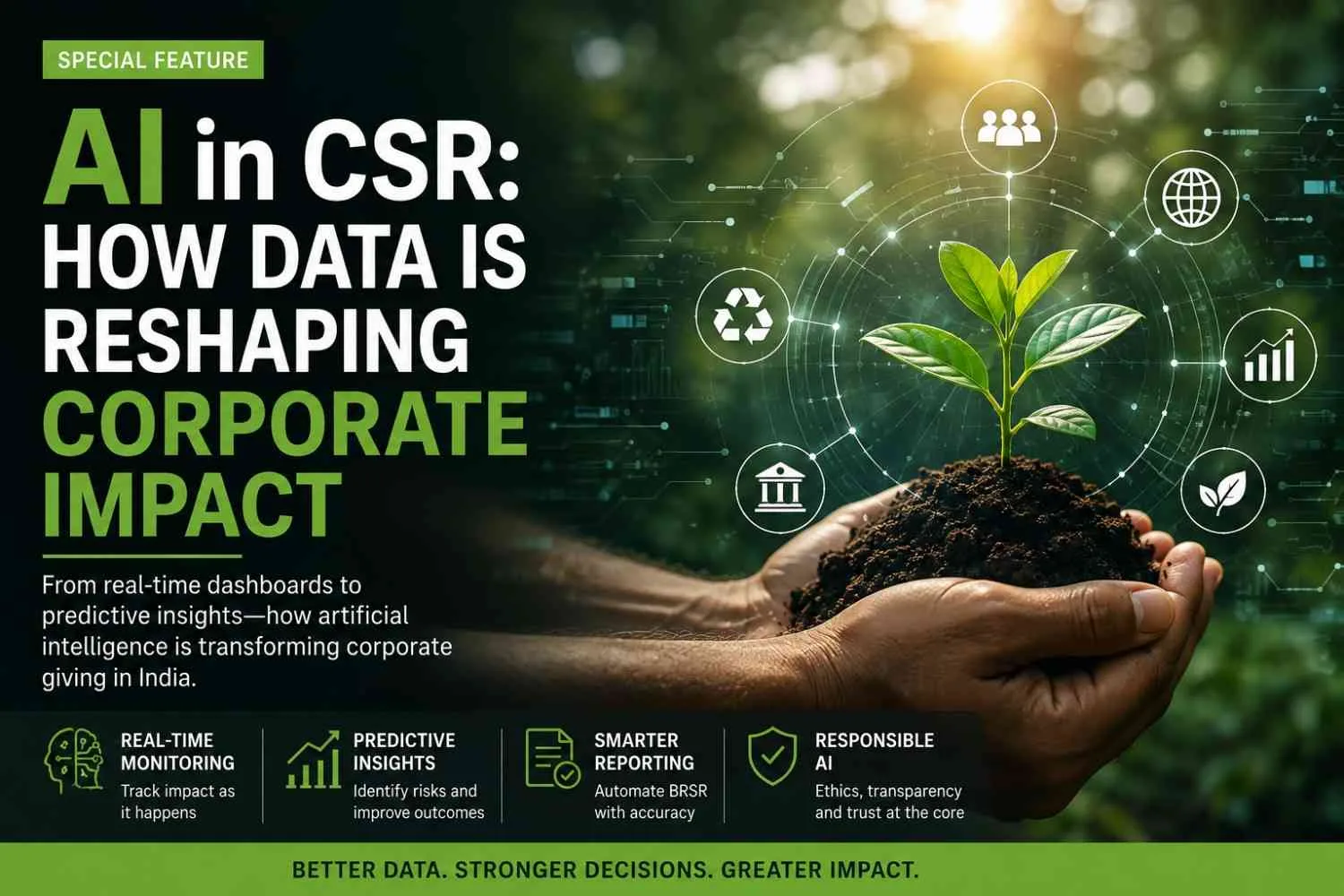
Kolkata | August 5, 2026 Artificial intelligence is rapidly transforming how companies measure, monitor and report the impact of their CSR initiatives. From predicting school dropout risks to automating sustainability disclosures, AI promises faster insights and greater accountability. Yet as algorithms begin shaping corporate giving, questions over data quality, ethical safeguards and reporting credibility are becoming impossible to ignore. Quick SummaryCorporate Social Responsibility (CSR) is entering a new phase where artificial intelligence is reshaping how social impact is measured. Companies are increasingly moving beyond annual spreadsheets and manual surveys towards real-time dashboards, predictive analytics and automated reporting systems capable of tracking beneficiaries, identifying programme risks and simplifying Business Responsibility and Sustainability Reporting (BRSR) disclosures. While these technologies promise greater efficiency and evidence-based decision-making, they also raise concerns around algorithmic bias, privacy, data manipulation and the growing gap between digital dashboards and realities on the ground. As regulators encourage greater transparency and companies invest in AI-powered impact platforms, the debate is shifting from whether AI should be used in CSR to how it can be deployed responsibly without compromising trust or accountability. KeywordsAI in CSR, CSR Impact Measurement, Artificial Intelligence, BRSR Reporting, Responsible AI, ESG Reporting, Corporate Sustainability, CSR Technology, Predictive Analytics, Real-Time Impact Monitoring   Can artificial intelligence transform corporate giving into measurable social impact- or is technology moving faster than accountability? Not long ago, assessing the success of a Corporate Social Responsibility (CSR) project was a slow and largely manual process. Field teams travelled to project locations with paper surveys, NGOs maintained handwritten records, and corporate CSR departments often spent weeks compiling data before presenting annual impact reports. By the time the data reached the decision-makers, it was too late to make timely course corrections. That approach is changing rapidly. Today, a CSR manager overseeing a digital education initiative can monitor student attendance through live dashboards, receive alerts when learning outcomes begin to decline and identify schools at risk of higher dropout rates in real time. Healthcare programmes can track patient follow-ups digitally, livelihood projects can monitor income trends through mobile applications, and sustainability teams can use automated systems to support Business Responsibility and Sustainability Report (BRSR) disclosures. This transformation reflects a broader shift in corporate India. As companies face growing expectations to demonstrate measurable social and environmental impact rather than simply report CSR spending, artificial intelligence is emerging as an important decision-support tool. Instead of relying solely on end-of-project evaluations, organisations are beginning to use AI, predictive analytics and cloud-based platforms to monitor programmes as they unfold, enabling faster and more informed interventions. The potential benefits are significant.AI can analyse large volumes of beneficiary data within seconds, identify trends that might be overlooked through manual analysis and help organisations allocate resources more efficiently. Supporters argue that this allows CSR programmes to move beyond reactive problem-solving towards proactive decision-making, addressing challenges before they affect project outcomes. Yet the growing reliance on AI also raises an important question: Can technology fully measure social impact? Community development is influenced by trust, behaviour, local realities and human relationships-factors that cannot always be captured through algorithms or dashboards. A decline in school attendance may be visible in digital data, but technology alone cannot explain whether the cause is seasonal migration, financial hardship or inadequate school infrastructure. Similarly, a healthcare platform may accurately record beneficiary numbers while failing to reflect barriers such as accessibility, awareness or social stigma. As AI becomes more deeply integrated into corporate philanthropy, the challenge is no longer collecting larger volumes of data. But to ensure that technology strengthens accountability without creating a false sense of precision. In the end, better dashboards do not automatically lead to better decisions, and measuring social impact will continue to depend as much on human judgement as on artificial intelligence. From Reporting Projects to Predicting Outcomes The evolution of CSR reporting reflects a broader shift in corporate sustainability -  from documenting activities to demonstrating measurable impact. For years, the success of CSR initiatives was largely measured through inputs such as funds spent, beneficiaries reached and projects completed during a financial year. While these indicators met statutory reporting requirements, they revealed little about whether programmes had created lasting social or environmental value. Artificial intelligence is beginning to change that approach. Rather than being used only at the end of a project for reporting, AI is becoming part of programme implementation itself. Companies are adopting cloud-based dashboards, geospatial mapping, computer vision and machine learning to monitor projects in real time, enabling CSR teams to identify risks early, compare interventions and make timely course corrections before resources are exhausted. The impact is particularly visible in education. Instead of relying solely on annual assessments, AI-enabled systems can analyse attendance, classroom engagement, learning patterns and assessment results almost in real time. Predictive models can identify students showing early signs of disengagement, allowing implementing agencies to intervene before irregular attendance leads to permanent dropout. Similar applications are being explored in skill development programmes, where algorithms help identify trainees who may need additional mentoring or financial assistance based on participation and completion trends. Healthcare initiatives are undergoing a similar transformation. Community health workers use mobile applications to upload patient data directly from the field, while AI-assisted platforms monitor vaccination coverage, treatment adherence and disease patterns across regions. Rather than measuring success only through the number of health camps organised, organisations can now track follow-up visits, treatment outcomes and areas requiring additional intervention. Livelihood programmes are also benefiting from predictive analytics. Digital platforms monitoring self-help groups, farmer producer organisations and micro-enterprises can detect changes in income, productivity and market access, enabling implementing partners to respond before financial challenges undermine programme objectives. Instead of evaluating outcomes only after a project ends, AI is helping organisations identify emerging risks while corrective action is still possible. AI is also reshaping corporate sustainability reporting. The introduction of the Business Responsibility and Sustainability Report (BRSR) by the Securities and Exchange Board of India (SEBI) has significantly increased the volume of environmental, social and governance (ESG) data that listed companies are required to disclose. Collecting, verifying and consolidating this information across multiple business units has made manual reporting more time-consuming and complex. To address this, many organisations are adopting AI-powered reporting platforms that integrate data from operational systems, identify inconsistencies, flag missing disclosures and generate draft sustainability reports. Beyond reducing administrative effort, these systems improve reporting consistency and allow management teams to focus more on analysing performance than compiling documentation. Despite these advances, however, AI remains only as reliable as the data it receives. Artificial intelligence can identify patterns, generate insights and predict future trends, but it cannot compensate for incomplete records, inaccurate field reporting or weak verification processes. Poor-quality data inevitably leads to unreliable analysis, regardless of how advanced the technology may be. For this reason, many experts view AI not as a replacement for human oversight but as a tool that strengthens decision-making when supported by credible data, robust governance and effective monitoring systems. How AI Is Changing CSR Traditional CSR MonitoringAI-Driven CSR MonitoringAnnual surveysReal-time dashboardsManual beneficiary recordsAutomated data collectionEnd-of-project evaluationContinuous performance trackingReactive interventionsPredictive analyticsSpreadsheet reportingAutomated BRSR disclosures Key takeaway: AI is shifting CSR from measuring what happened to anticipating what could happen next.  When Algorithms Meet Accountability Artificial intelligence is transforming the way CSR programmes are monitored and evaluated, but it is also introducing a new set of ethical and operational challenges. As organisations rely on algorithms to guide decisions, an important question is emerging: Can technology strengthen accountability without compromising trust? At the heart of this debate, lies the quality of data.AI systems can only produce reliable insights when the underlying data is accurate, complete and consistent. Incomplete beneficiary records, duplicate entries or reporting errors can generate misleading conclusions that appear highly credible because they are supported by sophisticated dashboards and predictive models. Unlike manual reporting, where inconsistencies are often easier to identify, algorithm-driven analysis can sometimes conceal data quality issues behind polished visualisations. This concern is particularly relevant in CSR impact assessment. Many companies and CSR consultants now use AI-enabled platforms to consolidate data from education, healthcare, livelihood and environmental programmes. While automation has significantly improved reporting efficiency, experts caution that it should complement and not replace independent field verification. Without regular validation, inaccurate beneficiary records, duplicate entries or inconsistencies across projects can find their way into impact reports and sustainability disclosures. In many cases, these errors are not intentional. Different implementing partners often use varying reporting formats, beneficiary definitions and data collection methods. A beneficiary participating in multiple programmes may be counted more than once, while attendance, outreach and engagement may be measured using different indicators across projects. AI can process these datasets rapidly, but unless the information is standardised and verified, technology may reinforce inconsistencies rather than eliminate them. Privacy and data security have also become major considerations. AI-powered CSR platforms collect personal information such as age, location, income, educational performance and health records to improve programme design and delivery. Although this enables more targeted interventions, it also raises important questions about informed consent, data ownership and cybersecurity. Many beneficiaries, particularly in rural and digitally underserved communities, may have limited awareness of how their information is collected, stored or used. To address these concerns, experts are calling for stronger ethical safeguards around the use of AI. Greater transparency in algorithms, human oversight, robust data governance, protection of sensitive information and regular third-party audits are increasingly seen as essential for ensuring that AI strengthens accountability without creating new risks. There is also a growing recognition that not every aspect of social impact can be measured through technology. AI can efficiently analyse beneficiary numbers, attendance, training hours and financial disbursements while identifying patterns that may indicate emerging programme risks.  Affected VoicesDevelopment organisations working at the grassroots say artificial intelligence is making programme monitoring faster, but not necessarily simpler.NGOs involved in education, healthcare and livelihood projects argue that digital dashboards can highlight patterns, yet they cannot replace conversations with communities. A field worker may know why a child has stopped attending school, why a family refuses a healthcare intervention or why a self-help group is struggling despite positive financial indicators- insights that rarely appear in automated reports.Consumer and civil society organisations also caution that communities should not become passive data points. They argue that beneficiaries must understand how their information is collected, stored and used, particularly as AI systems become more integrated into social programmes. For them, responsible technology is not only about better analytics but also about protecting privacy, maintaining informed consent and ensuring that people remain at the centre of every CSR intervention. However, it remains far less effective at measuring outcomes such as community trust, behavioural change, social inclusion and local ownership- factors that often determine the long-term success of CSR initiatives. For this reason, development practitioners continue to emphasise the importance of human engagement alongside technological analysis.AI can identify that attendance in a vocational training programme is declining, but conversations with beneficiaries are often needed to understand whether transport costs, household responsibilities or seasonal employment are driving that trend. Technology can reveal patterns, but people provide the context that explains them. As AI becomes more deeply embedded in corporate philanthropy, the future of CSR impact measurement is likely to depend on balancing automation with accountability. Organisations that combine advanced analytics with transparent governance, independent verification and continuous engagement with communities will not only generate more reliable evidence but also strengthen public trust in the impact they seek to create. AI Can Measure, But Can It Understand?AI Measures Well Beneficiary numbers  Attendance and participation  Learning outcomes  Health follow-ups  Resource utilisation  Reporting efficiency  Humans Still Matter For Community trust Behavioural change Inclusion and dignity Local context Cultural realities Independent verification Key takeaway: Artificial intelligence can improve measurement- but meaningful impact still requires human judgment. When Evidence Meets ScrutinyAs artificial intelligence becomes an integral part of CSR monitoring, experts argue that the technology itself must be evaluated as rigorously as the programmes it measures. A sophisticated dashboard may present real-time insights and impressive visualisations, but its credibility ultimately depends on the quality of data, the methodology behind the analysis and the transparency of the reporting process. The first challenge lies in how impact is measured. CSR programmes often use different indicators to define success. An education initiative may focus on attendance or learning outcomes, while a healthcare project may measure beneficiary reach, treatment adherence or long-term health improvements. When AI systems analyse datasets built on different definitions and reporting standards, comparing outcomes across projects becomes difficult, even if the technology functions accurately. For this reason, development economists and impact evaluation specialists continue to emphasise the importance of establishing reliable baselines before introducing AI-driven monitoring. Without a clear starting point, it is difficult to determine whether a programme has genuinely improved people's lives or simply produced more data. An algorithm may report a significant increase in school attendance, but the finding has limited value unless it is measured against credible baseline data and tracked consistently over time. Another challenge is distinguishing the impact of a single intervention from broader social change. AI platforms can efficiently capture data generated within CSR programmes, but they cannot always account for external factors that influence outcomes. Improvements in school attendance, for example, may reflect not only a company's education initiative but also better government infrastructure, scholarship schemes or wider community participation. As a result, experts caution against treating AI-generated correlations as conclusive evidence of impact. Benchmarking presents similar limitations. Many AI platforms allow organisations to compare CSR performance across projects, districts or business units. However, such comparisons are meaningful only when programmes operate under similar conditions and pursue comparable objectives. Comparing projects with different beneficiary groups, geographies or impact indicators may produce conclusions that are statistically sound but practically misleading. This is why independent assurance remains essential. AI can quickly identify anomalies, missing records and unusual reporting patterns, but it cannot replace field verification, beneficiary feedback, external audits or independent programme evaluations. Experts argue that technology is most valuable when it strengthens existing evaluation processes rather than serving as a substitute for them. The growing investment in AI also raises important questions about transparency. Companies are allocating substantial resources towards digital CSR platforms, cloud infrastructure, analytics and cybersecurity. Yet annual reports rarely distinguish expenditure on AI-enabled monitoring from broader CSR administration or programme implementation. This makes it difficult for stakeholders to assess whether these investments are improving programme delivery or primarily enhancing reporting efficiency. Ultimately, the success of AI in CSR will not be measured by the volume of data it generates, but by the quality of the decision it supports. Technology can strengthen accountability and improve impact measurement, but only when it is backed by transparent methodologies, credible data, independent verification and meaningful human oversight. Evidence Check: Questions Every AI-Powered CSR Dashboard Should Answer   Evidence TestWhy It MattersIs the methodology publicly explained?Ensures transparency and comparability.What is the baseline?Measures real change, not isolated data points.Has the data been independently verified?Reduces reporting bias and inflation.Are reporting boundaries clearly defined?Prevents misleading impact claims.Does AI support or replace field verification?Human validation remains essential.Is investment in AI transparently disclosed?Demonstrates accountability beyond technology adoption. Key takeaway: Artificial intelligence can process information at extraordinary speed, but trustworthy CSR still depends on evidence that is transparent, independently verified and grounded in reality. Beyond the Dashboard Artificial intelligence is transforming the way companies design, monitor and evaluate their CSR initiatives. What was once driven by periodic surveys and retrospective reporting is evolving into a system supported by real-time data, predictive analytics and continuous monitoring. For businesses, this means faster decision-making and more informed resource allocation. For regulators and stakeholders, it offers the potential for greater transparency, consistency and accountability in sustainability reporting. However, technology alone cannot guarantee meaningful impact. The value of AI will ultimately depend on the quality of the data it processes, the transparency of the methodologies behind it and the governance system that ensures every insight is credible and independently verifiable. While dashboards can identify patterns and emerging risks, they cannot replace human judgement, community engagement or an understanding of the local realities that shape social outcomes. As AI becomes gradually embedded in corporate philanthropy, the conversation is shifting from whether it should be adopted to how responsibly it should be used. Its long-term success will not be measured by the sophistication of its algorithms, but by its ability to strengthen decision-making, build public trust and deliver measurable improvements where they matter the most. Ultimately, no algorithm, dashboard or report can define the success of CSR. Its true measure will always be the positive and lasting change it brings to people's lives. Evidence Check ParameterStatusMethodology disclosedPartial – Varies by platformIndependent verificationEssential but inconsistentBaseline comparisonRequired for credible impact measurementAI ethics & privacyIncreasing regulatory focusHuman field validationStill indispensableAI investment disclosureLimited in public CSR reports   Key TakeawaysAI is shifting CSR from annual reporting to real-time monitoring. Predictive analytics can identify programme risks before they escalate. BRSR reporting is accelerating AI adoption across listed companies. AI cannot replace field verification or community engagement. Transparency and independent audits remain essential for credible impact reporting. Primary Sources:  Ministry of Corporate Affairs (MCA) – Corporate Social Responsibility (CSR) Framework & Companies Act, 2013https://www.mca.gov.in/ Securities and Exchange Board of India (SEBI) – Business Responsibility and Sustainability Reporting (BRSR) Frameworkhttps://www.sebi.gov.in/ NITI Aayog – Responsible AI for All: Strategy and Discussion Papershttps://www.niti.gov.in/ Ministry of Electronics and Information Technology (MeitY) – IndiaAI Mission & AI Governance Initiativeshttps://www.meity.gov.in/ CSRBOX – CSR Intelligence, Case Studies & Impact Measurement Resourceshttps://csrbox.org/ Microsoft AI for Good – AI Applications for Social Impact and Sustainable Developmenthttps://www.microsoft.com/en-us/ai/ai-for-good World Economic Forum (WEF) – Artificial Intelligence Governance & Responsible AI Reportshttps://www.weforum.org/ J-PAL South Asia – Evidence-Based Programme Evaluation and Impact Measurementhttps://www.povertyactionlab.org/south-asia ...Read more

04 Aug 2026

CSR • ESG MAGAZINE FEATURE  |  INDIA  |  AUGUST 2026  by Prof Ujjwal K Chowdhury India's oldest philanthropy tradition is getting a modern accounting. Across temples, mosques, gurdwaras and community trusts, the ancient imperatives of Daan, Zakat, Seva and Dasvandh are being rewired for an age of Theory of Change documents, third-party audits and Schedule VII compliance. This is the story of how sacred duty and spreadsheet discipline are converging to build India's most under-leveraged social infrastructure — and what it will take to get the merger right. SHORT SUMMARYThis feature examines the collision between India's faith-based giving traditions and the formal Corporate Social Responsibility regime under Section 135 of the Companies Act, 2013. It traces how religious and community trusts — from Zakat Center India and the AMP Zakat Fund to the Akshaya Patra Foundation, the Delhi Sikh Gurudwara Management Committee, Tirumala Tirupati Devasthanams and India's Waqf Boards — are professionalising governance, adopting outcome tracking and navigating FCRA, tax and ESG requirements to qualify as credible CSR implementing partners. It closes with a practical playbook for corporates and trusts seeking to build partnerships that honour spiritual intent while meeting the non-negotiable standard of arm's-length, auditable, non-discriminatory delivery. KEYWORDSFaith-based philanthropy India, CSR Section 135, Daan Zakat Seva, religious trusts CSR compliance, FCRA compliance, outcome tracking, Zakat modernisation, temple trusts, Waqf CSR, ESG religious institutions, Schedule VII, Akshaya Patra governance, arm's-length transactions, Viksit Bharat philanthropy. HASHTAGS#FaithBasedGiving #CSRIndia #Zakat #Daan #Seva #ESG #Philanthropy #ReligiousTrusts #FCRA #Section135 #ScheduleVII #SocialImpact #ViksitBharat #SacredCapital The Invisible Giant: India's Faith Economy Before CSR Long before Parliament wrote a rulebook for corporate giving, India had already perfected the art of giving. A steel plate placed before a hungry stranger. Grain offered at a shrine. A day spent washing utensils in a community kitchen. A fixed share of annual wealth set aside for the poor. Daan, rooted in Vedic and Jain thought, treats selfless giving as a purifying duty. Zakat, one of the Five Pillars of Islam, mandates that eligible Muslims redistribute 2.5 per cent of accumulated wealth every year to the poor, the indebted and the marginalised. Seva and Dasvandh, institutionalised by Guru Nanak Dev Ji, fuse physical service with the tithing of one-tenth of income, expressed daily through the Langar — a communal kitchen that erases caste and class at the threshold of the door. Annadanam, Utsarg and a dozen other regional practices round out a philanthropic vocabulary that predates the modern NGO by centuries. The scale of this giving remains largely invisible to formal statistics. Recent household-giving research estimates India's annual informal giving market at roughly ₹54,000 crore, with religious organisations the most frequently cited recipients. Set beside this is India's formal CSR economy — companies reported close to ₹34,900 crore in CSR spending in FY 2023-24 under the mandatory 2 per cent regime created by Section 135 of the Companies Act. The two pools are not directly comparable, but the message is unmistakable: India's compassion economy may rival, and in places exceed, its statutory CSR economy. The challenge has never been a shortage of generosity. It is the leakage between good intention and measurable public benefit. Why the Wall Existed — and Why It Is Coming Down For the first several years of India's CSR mandate, faith and formal philanthropy occupied separate worlds. Schedule VII of the Companies Act explicitly excludes activities "concerned with religion," and corporate legal teams treated that clause as a blanket prohibition on anything smelling of temple, mosque or gurdwara. The 2022 CSR Amendment Rules changed the geometry. Public charitable trusts and societies — provided they carry tax-exempt status under Section 10(23C) or hold valid 12A and 80G registrations, and register on the MCA portal via Form CSR-1 — became eligible implementing agencies. The door opened; through it walked India's oldest philanthropic tradition, blinking in the fluorescent light of modern compliance. "The gods may accept faith alone. The Ministry of Corporate Affairs does not." What changed was not the spirit of giving but its accountability. Traditional daan was measured by the act itself — the giving was the merit. Modern CSR demands evidence of change: how many children stayed in school, how many families escaped debt, what the social return on every rupee actually was. Faith-based institutions that wish to access this ₹30,000-crore-plus CSR pool must now speak in baselines, Key Performance Indicators and independent impact assessments — or risk watching the capital flow instead to secular NGOs that already do. Three Pillars of the New Faith-Based CSR Pillar One — Structured Governance Traditional giving ran on trust, literally: a donor gave to a temple or community leader and funds were distributed by need, religious calendar or community consensus. That model built deep social capital but little institutional architecture. Today's professionalised trusts are changing that by publishing annual impact reports, maintaining project-wise accounting, conducting internal FCRA reviews, and keeping trust deeds strictly aligned with actual activity — audit-ready documentation that can withstand a corporate CSR committee's scrutiny. Pillar Two — Outcome Tracking The defining shift is from output to outcome. It is no longer enough to state how much was distributed; the question is what changed. Structured Zakat platforms now report exact counts of students funded, self-employment grants disbursed and families supported with food assistance — specific, countable outcomes that can be tracked year over year, mapped directly onto the UN Sustainable Development Goals, and defended in an ESG disclosure. Pillar Three — Regulatory Compliance The most complex pillar is regulation itself. Religious and charitable trusts operate under a dense web of law: the Indian Trusts Act, the Charitable and Religious Trusts Act of 1920, Sections 12A and 80G of the Income Tax Act, and — for those receiving funds from abroad — the Foreign Contribution (Regulation) Act. Tightened FCRA rules now require trusts to specify their purpose from a government-notified schedule, exclude proselytisation, and route foreign contributions through designated accounts. The stakes are real: license revocations, high-profile investigations into the political use of CSR funds, and courts clarifying the boundary between cultural and religious activity have all made compliance a survival imperative rather than a formality. Case Study: Zakat Platforms — Scaling Faith with Systems Structured Zakat platforms such as Zakat Center India and the AMP Zakat Fund illustrate how mandatory religious giving is being converted from a cash handout into what practitioners call an empowerment capital engine. Zakat Center India has built a verified-cause database spanning thousands of documented causes across education, medical assistance, livelihood support and disaster relief, allowing donors to choose recipients and locations while honouring the Islamic principle that Zakat must reach specific categories of beneficiaries. The AMP Zakat Fund's annual impact report goes further, breaking distribution down by category — education and scholarships, livelihoods and self-employment, orphan support and compassionate relief — with named outcome counts for students funded and entrepreneurs seeded, alongside cumulative multi-crore impact tracked since inception. For corporations seeking to partner with Muslim communities on CSR, these platforms offer a template: professionally managed, jurisprudentially sound, and legible to a corporate audit committee. Case Study: Akshaya Patra — The Bridge That Almost Collapsed No case illustrates the peril of faith-CSR convergence better than the Akshaya Patra Foundation. Born from an ISKCON Bangalore kitchen in 2000, it grew into the world's largest NGO-run mid-day meal programme, feeding millions of children across tens of thousands of schools, with major corporate CSR partners covering the overwhelming majority of relief costs. Then came the reckoning: internal audit findings, later reported widely in the press, alleged that the line between the charitable Foundation and its parent religious trust had blurred — kitchens built with CSR and government funds allegedly used for temple purposes, and donations meant for meals reportedly diverted toward religious construction. The lesson is not that faith-based organisations are unfit for CSR. It is that related-party transactions between a religious trust and its charitable arm are fatal. Where the arm's-length principle is violated, tax exemptions come under scrutiny and CSR funds become effectively contaminated. Akshaya Patra has since undergone governance restructuring, but the episode remains a mandatory case study for any CSR head evaluating a faith-rooted partner: compassion without accountability breeds corruption. Case Study: The Gurdwara Model — Faith as Healthcare Infrastructure If Akshaya Patra is the cautionary tale, the Delhi Sikh Gurudwara Management Committee is closer to the blueprint. Its kidney dialysis centre treats patients regardless of religion or income, and — critically — operates with enough financial transparency and programme documentation to qualify as a CSR implementing agency. A multinational chemical company has directed CSR funds to this dialysis service for three consecutive years, alongside partnerships with other established implementing agencies. The model works because the Gurudwara has built what amounts to a secular membrane around its healthcare delivery: the Langar remains sacred, but the dialysis unit maintains clinical records, follows medical protocols, and bills or waives patients through a transparent accounting system that satisfies corporate auditors. Case Study: TTD and the Waqf Opportunity The Tirumala Tirupati Devasthanams manages one of the world's richest religious institutions, receiving hundreds of crores in devotional offerings annually. Beneath the gold-plated domes sits a social-services architecture — free schools, subsidised hospitals, oncology and paediatric care, rehabilitation centres — that many state governments would envy. What TTD has not yet fully exploited is its potential as a CSR magnet: with independent trustees for its social wing and formal impact frameworks, the temple's existing infrastructure could channel far larger CSR sums into surrounding tribal belts, provided hundi receipts and CSR receipts never share the same voucher. India's Waqf Boards present a parallel, largely dormant opportunity. Controlling over six lakh properties, they are among the country's largest landowners, yet poor record-keeping and weak professional management have left much of this wealth spiritually blessed but economically idle. Corporate-waqf development models have already succeeded elsewhere in Asia, turning waqf land into hospitals, universities and microfinance institutions. In India, the Waqf mandate — education, healthcare, women's empowerment, skill development — aligns almost perfectly with Schedule VII. What is missing is the bridge: CSR-1 registration, trained professional trustees, and outcome frameworks that satisfy a corporate audit committee. The ESG Lens: Faith as Environmental, Social and Governance Capital As ESG disclosure becomes the currency of investor trust, faith-based programmes are proving relevant to all three pillars. On the Social side, education, healthcare, livelihood and relief work map directly onto goals such as No Poverty, Quality Education and Decent Work. On Governance, professionalised trusts with transparent accounting and board oversight demonstrate exactly the standards ESG investors demand. And on the Environmental side, a quieter revolution is underway: solar-powered ashrams and pilgrimage kitchens, circular-economy ventures that convert daily flower offerings into bio-fertiliser and incense rather than dumping them into rivers, and temple-led watershed restoration around ancient stepwells and tanks. Faith networks, it turns out, possess an asset money cannot buy — deep-seated social capital and moral authority that can unlock last-mile trust no corporate campaign can purchase outright. The Governance Gap: Why Arm's-Length Is Non-Negotiable The single biggest threat to faith-based CSR is not regulatory rejection — it is conflict of interest. A temple trustee who also controls the receiving charitable trust, a mosque committee that collects Zakat and CSR funds into the same account, a church NGO sharing undocumented premises with its seminary: none of these are minor technical lapses. They are existential risks that can unwind an entire partnership. The 2022 CSR Amendment Rules demand arm's-length relationships between implementing agencies and related parties, which in practice means separate legal entities for the charitable arm, independent professional board members alongside religious leadership, ring-fenced bank accounts with no cross-subsidisation of ritual activity, and documentation that translates faith language into development metrics — replacing "we feed the hungry because God commands it" with "we served fifty thousand meals and reduced absenteeism by twelve per cent." A Practical Playbook Before Anyone Signs an MoU Verify active 12A, 80G and CSR-1 registration, and review Form FC-4 returns where foreign funds are involved.Insist on a written Theory of Change with baseline data, clear KPIs and a multi-year project plan aligned to Schedule VII.Require ring-fenced, dedicated bank accounts that keep CSR capital entirely separate from ritual or unrestricted donations.Build in independent third-party impact verification and public, board-level annual reporting rather than one-off photo-op distributions.Diversify partnerships across faiths, regions and themes to avoid over-concentration and reputational risk.Invest in capacity building for trusts that have grassroots trust but not yet the technical muscle for rigorous reporting. These are not bureaucratic hurdles imposed on the sacred. They are the price of admission to formal capital — and, done well, they protect the very donors and beneficiaries the tradition was built to serve. The Road Ahead: Viksit Bharat Needs Both Mandir and Monitor India's ambition to become a developed nation by 2047 requires social-sector funding that government spending alone cannot supply, with the development funding gap estimated in the tens of lakh crores. Faith-based institutions bring three assets no corporate campaign can replicate at that scale: trust capital built over generations in villages where the state feels distant; fixed infrastructure — kitchens, halls, land — that does not need to be built, only upgraded; and volunteer networks of sevadars, Zakat collectors and congregation teachers who serve without a payroll. None of this is worth anything without an audit trail. The winning model is neither a cheque handed unconditionally to a shrine nor a CSR department dictating spirituality to a trust. It is a principled partnership in which faith supplies purpose, community supplies trust, professional management supplies execution, law supplies boundaries, and evidence supplies credibility. When Daan is tracked with data, when Zakat fuels scalable livelihoods, and when Seva powers audited healthcare and disaster response, philanthropy becomes more than charity. It becomes Sacred Capital — a force multiplying inclusive, transparent and lasting national growth.   ...Read more

04 Aug 2026

Why Disability Inclusion Must Become India Inc.’s Next Boardroom ESG KPI A ramp, a recruitment drive or an annual award cannot prove inclusion. The real test is whether employees with disabilities are hired, paid fairly, retained, promoted, protected during climate shocks, and able to secure benefits and remedies without fighting the system. BY PROF. UJJWAL K. CHOWDHURY  |  MAGAZINE FEATURE  |  INDIA, AUGUST 2026 “Inclusion should not be viewed as charity.”— Rajesh Aggarwal, at the launch of the CII Award for Excellence in Disability Inclusion, December 20241Accessibility is no longer a feel-good CSR initiative. It is a test of governance maturity, workforce quality, digital competence, operational resilience and the integrity of ESG reporting.Short SummaryThis feature examines CII-style employer awards, physical and digital audits, the hiring-versus-retention gap, disability-inclusive climate resilience, and the implications of ESIC and India’s labour-code transition. Corporate cases are used to test disclosure quality—not to confer unqualified praise.KeywordsDisability inclusion; workplace accessibility; ESG metrics; BRSR; reasonable accommodation; inclusive employment; digital accessibility; climate resilience; ESIC; labour codes; corporate governance.Hashtags #DisabilityInclusion  #WorkplaceAccessibility  #ESG  #SocialSustainability  #InclusiveEmployment  #BRSR  #ClimateJustice  #BoardroomKPI  #IndiaIncEDITORIAL EVIDENCE NOTECorporate examples below rely on official releases and public sustainability disclosures. A missing metric is identified as a disclosure gap, not proof of poor performance. Disability headcounts often depend on voluntary self-disclosure and may understate actual prevalence. The evidence standard used throughout is outcomes over intentions.THE “S” IN ESG HAS A MISSING DENOMINATORIndia’s sustainability vocabulary is fluent in carbon intensity, water positivity, renewable energy and net-zero targets. It remains far less exact about who can enter a workplace, use its systems, build a career and leave with dignity. That imbalance is no longer defensible.SEBI’s Business Responsibility and Sustainability Reporting framework has created an important starting point. It asks listed companies to disclose employees and workers with disabilities, and it separately seeks information on turnover, wages, welfare benefits, accessibility and grievances. The weakness is that many outcome tables are not disability-disaggregated. A company can report a headcount while investors still cannot see whether those employees are underpaid, concentrated at junior levels, denied benefits or leaving faster than comparable colleagues.5Accessibility must therefore become a boardroom KPI: owned by the board or a designated committee, reviewed quarterly, linked to executive accountability and tested by independent evidence. The central question is not, “Do we have a disability policy?” It is, “At every stage of work, where are people being filtered out—and what did management do about it?”AWARDS CAN MOVE MARKETS—IF THEY REWARD PROOFThe Confederation of Indian Industry has worked on disability inclusion through employer sensitisation, recruitment support, workplace guidance and the India Business and Disability Network. Its Award for Excellence in Disability Inclusion, launched in December 2024, gives the market something it badly needs: a visible benchmark. The 2026 framework recognises accessibility, disability-inclusive culture, inclusive recruitment and overall “Champion Company” performance, with separate eligibility thresholds for large enterprises and MSMEs.12Awards matter because reputation affects talent, procurement and investor confidence. But they become ESG instruments only when they reward proof. A credible CII-style award should score workforce denominators; wage and promotion parity; one- and two-year retention; accommodation response times; audit closure; benefit access; disability-inclusive procurement; grievance remedies; emergency preparedness; and actual expenditure against approved budgets.CASE STUDYPersistent Systems: recognition backed by an audit trailPersistent Systems received the 2026 CII award in the “Best Employer—Physical Accessibility” category. Its public account points to independent audits, an accessibility benchmark at its Pune facility, alignment with India’s Harmonised Guidelines, digital platforms designed toward WCAG standards, and governance ownership.The next step for the awards ecosystem is tougher verification: random site visits, confidential interviews with disabled workers without managers present, public scoring bands and evidence that audit findings were closed—not merely identified. Recognition should open the evidence file, not replace it.10 AUDIT THE EMPLOYEE JOURNEY, NOT JUST THE ENTRANCEA workplace can have an accessible entrance and still be institutionally inaccessible. A physical audit must follow the full employee journey: transport and parking; security and reception; paths, doors and lifts; tactile and visual signage; workstations and factory floors; meeting rooms, canteens, washrooms and medical rooms; employee housing; and emergency exits.In industrial settings, the audit must test whether protective equipment, alarms, control panels, evacuation chairs and safety instructions work for people with mobility, visual, hearing, cognitive and neurodivergent needs. Maintenance matters as much as design: a compliant ramp blocked by motorcycles is not accessible.The digital audit begins before employment. It must test the careers page, application form, applicant-tracking system, online assessment, interview platform and document-upload process. After joining, it should cover HRMS, attendance, payroll, leave, insurance, learning, collaboration, travel booking, procurement, appraisal and grievance portals. Automated scanners can flag technical defects, but they cannot substitute for usability testing by people with varied disabilities.For the financial sector, this is now regulatory territory. SEBI’s 2025 circular suite made digital accessibility mandatory for regulated entities, placed review responsibility with the managing director, managing partner or proprietor, required a senior nodal officer, and called for accessible grievance channels and baseline ICT standards. Banks, brokers, exchanges, mutual funds and fintech firms should treat accessibility as an employee right, a customer right and a governance risk at the same time.34CASE STUDYInfosys: a number that opens the questionInfosys reported 1,075 employees with voluntarily disclosed disabilities in FY2025–26. Against a total headcount of 328,594, that is about 0.33 per cent. The company also reports accessibility learning, an InfyAbility employee network with more than 3,900 members, accessibility living labs and accommodation support.This is useful disclosure because it gives a denominator and acknowledges voluntary disclosure. It also reveals the next frontier: applicant-to-hire conversion, probation completion, 12- and 24-month retention, pay parity by comparable grade, promotions, high-value assignments, accommodation requests, and remedies after disability-related grievances. Overall attrition cannot answer whether disabled employees are leaving at a higher rate.67 CASE STUDYTata Steel: inclusion on the industrial floorTata Steel’s FY2025–26 consolidated BRSR reported 149 employees with disabilities out of 73,215 employees—about 0.20 per cent—and separately identified 118 permanent workers with disabilities. Only nine of the 149 employees were women. The company clearly stated that European subsidiaries were excluded because those operations do not collect the data under local privacy practices.That boundary note is exemplary: it prevents a partial figure from masquerading as universal coverage. Tata Steel also describes modifications to workstations and washrooms, tailored laptops and assistive software or hardware, temporary accommodation during onboarding and workplace buddies. The unanswered ESG questions concern disability-specific wages, retention, injuries, promotion, grievance remedies and representation in production, engineering, logistics, maintenance and supervisory roles.8 HIRING MAKES HEADLINES; RETENTION PROVES INCLUSIONRecruitment drives are visible and countable. Retention is quieter—and more revealing. A serious dashboard tracks the complete funnel: applications → accessible assessment → interview → offer → acceptance → joining → probation completion → 12-month retention → 24-month retention → promotion → internal mobility. Each stage should be segmented by disability category, gender, location, employment status, occupational group and grade, with privacy safeguards and minimum reporting thresholds.The most common barriers often appear after onboarding: inaccessible internal software, delayed reasonable accommodation, transport problems, shift allocation, exclusion from travel or client-facing work, weak mentorship, biased appraisal and an absence of career pathways. Disability inclusion fails through everyday management decisions long before it appears in a legal complaint.TCS offers useful architecture. Its ENABLE Disability and Allies Network, launched in 2017, creates an employee forum, while PACT brings parents, allies and caregivers into the inclusion ecosystem. TCS also publicly emphasises accessible recruitment, workplace design, assistive technology and reasonable accommodation. Wipro, ITC, JSW Steel and major banks should be evaluated against the same outcome test: not whether policies exist, but whether disabled employees remain, advance and receive comparable rewards.9THE INCLUSION INFRASTRUCTURE: FROM MITTI CAFÉ TO V-SHESHInclusive employment is not merely a placement transaction. Mitti Café’s model combines experiential training, café and catering jobs, customer interaction, visibility and dignity. It reports more than 50 cafés in institutional and public spaces and thousands of persons with disabilities skilled, while its support model includes health insurance, food and accommodation. The transferable corporate lesson is that retention may require transport, accessible housing, coaching, nutrition, family engagement or health support—not only an appointment letter.11V-Shesh represents another part of the infrastructure. It says it supports 117 leading companies through recruitment, pre- and post-hiring services, sensitisation, policy advice, accessibility services and work trials, and reports more than 2,000 jobs facilitated. Such intermediaries help employers redesign roles instead of rejecting candidates against inherited job descriptions.12National Restaurant Association of India chapters and hospitality groups could scale common accessible-recruitment protocols, model kitchens and hotels, shared trainers, accessible customer-service standards and cross-company apprenticeships. Yet every partnership must publish conversion and retention: how many people were trained, how many received paid jobs, what they earned, how many remained, which benefits they accessed and what happened when difficulties arose.THE OVERLOOKED “E”: CLIMATE RESILIENCE THAT DOES NOT ABANDON PEOPLEA heatwave, flood, cyclone, power failure or transport shutdown does not affect every worker equally. Employees using wheelchairs, hearing aids, powered mobility equipment, ventilators, screen readers, medication refrigeration or caregiver support face risks that conventional business-continuity plans often fail to see.The evidence is alarming. UNDRR’s global survey found that only a small minority of local disaster-risk-reduction plans addressed the specific needs of persons with disabilities, while most respondents reported no participation in community-level decision-making. In India, CEEW’s 2025 heat-risk assessment found 57 per cent of districts—home to 76 per cent of the population—at high to very high heat risk. CEEW’s framework explicitly treats disability and chronic conditions as vulnerability factors. WRI India’s work on industrial transition similarly warns that green transitions do not automatically deliver inclusion without structural change.131415A disability-inclusive corporate resilience plan needs multimodal warnings using sound, text, vibration, visual signals and plain language; accessible evacuation maps, exits, drills and refuge areas; evacuation chairs and trained responders; backup electricity for assistive and medical devices; accessible shelters, transport and temporary accommodation; heat-adjusted shifts and rest periods; remote-work options during severe weather; continuity of medication and caregiver access; and equal protection for contract and outsourced workers.Disabled employees must co-design and test these systems. CSE, WRI India, CEEW and Climate Policy Initiative India can widen corporate climate-risk methodologies; IiAS, InGovern and independent academics can test board ownership, disclosure integrity and incentives. The principle is unforgiving: a climate plan that cannot protect the most exposed employee is not a resilient plan.LABOUR CODES AND ESIC: COVERAGE MUST BECOME VISIBLEIndia’s four labour codes took effect on 21 November 2025, reshaping workforce classification, social-security administration, contractor governance and reporting systems. For disability inclusion, classification is material because people can disappear between the principal employer’s payroll, staffing firms, contractors, apprenticeships, fixed-term work and platform arrangements.16Boards should receive disability-disaggregated data for permanent and fixed-term employees, permanent and contract workers, apprentices, temporary and outsourced personnel, and gig or platform workers where relevant. A consolidated headcount that excludes the most precarious categories can make inclusion look stronger than it is.ESIC is an essential protection but should not be confused with an inclusion policy. Its permanent-disablement benefit can provide lifelong payments linked to loss of earning capacity after an employment injury; permanent total disablement is generally paid at 90 per cent of average daily wages. That protection does not replace accessible recruitment, reasonable accommodation, career progression or freedom from discrimination.17The ESG test is practical: among eligible workers, how many are registered for ESIC, PF and insurance; how many claims were filed and accepted; how long settlement took; whether contractors deposited contributions; whether assistance was available in accessible formats; and what remedy followed a denial. “Covered as per law” is not evidence of access.THE BOARDROOM ACCESSIBILITY SCORECARDA credible dashboard should contain eight linked measures. It should reach the board at least quarterly; material failures should enter the annual report; and remuneration committees should consider whether senior executives delivered agreed outcomes.#KPIEVIDENCE THE BOARD SHOULD SEE1REPRESENTATIONAbsolute number and percentage of persons with disabilities; voluntary-disclosure rate; segmentation by gender, grade, site, employment status and occupational category.2EMPLOYMENT OUTCOMESApplication-to-interview and interview-to-hire conversion; probation completion; 12- and 24-month retention; promotion; internal mobility; disability-specific exit reasons.3PAY & BENEFITSMedian fixed and variable remuneration against comparable work; insurance, ESIC, PF, leave, transport, assistive devices and caregiver provisions.4ACCOMMODATIONRequests received, approved, rejected and pending; median closure time; spend; employee satisfaction; independent appeal route.5PHYSICAL & DIGITAL ACCESSPercentage of sites and critical systems independently audited; barriers by severity; closure and re-test rates; overdue actions.6VOICE, GRIEVANCE & REMEDYConfidential worker interviews without management present; complaints by issue; substantiation; corrective action; compensation; non-retaliation; recurrence.7CLIMATE & EMERGENCY RESILIENCEAccessible warnings and drills; evacuation readiness; backup power; heat and severe-weather protocols; remote-work continuity; contractor coverage.8MONEY, BOUNDARIES & ASSURANCEApproved accessibility capex and opex; money actually spent; baseline year; reporting boundary; methodology; absolute and intensity results; independent assurance scope.REGULATORS, BANKS, AUDITORS: THE ACCOUNTABILITY CHAINSEBI, MCA, RBI, the Ministry of Finance and the stock exchanges can drive convergence through stronger disability-disaggregated indicators, accessible filing and investor platforms, financial-sector enforcement, public-sector-bank leadership and credible assurance standards. The BRSR architecture should evolve from “how many?” to “what happened to them?”Audit firms and ESG-data providers must stop treating a policy, a ramp or a “yes” response as sufficient evidence. Assurance should reconcile payroll, HR, grievance, procurement, facility, IT and benefits data; test a sample of sites and systems; interview workers without management; and verify both approved budgets and money actually spent. Absolute results must be shown alongside intensity measures, because a better percentage can hide a shrinking denominator.Infosys, TCS, Wipro, ITC, Tata Steel, JSW Steel and large banks have the scale to establish sector benchmarks. CII-style awards can accelerate competition. Mitti Café, V-Shesh, organisations of persons with disabilities and disability-led experts can supply implementation intelligence. But persons with disabilities must remain the primary witnesses, auditors, designers and decision-makers—not beneficiaries photographed for annual reports.ACCESSIBILITY IS ENTERPRISE QUALITYThe next phase of disability inclusion will not be won by compassionate language. It will be won by better systems: recruitment that does not reject assistive technology; software that works with a screen reader; managers who deliver accommodations on time; factories that evacuate every worker; benefits that can actually be claimed; and grievance mechanisms that produce remedy without retaliation.A truly accessible company is easier to enter, safer to work in, simpler to transact with and more resilient under stress. It identifies process defects that inconvenience everyone, protects scarce talent, strengthens customer access and exposes governance blind spots before they become litigation, reputational damage or operational failure.Accessibility is not a CSR footnote. It is a balance-sheet issue, a resilience issue and evidence of management quality. The ramp now leads to the boardroom—and the board should be accountable for whether it reaches the door.SELECTED EVIDENCE BASE1. Confederation of Indian Industry: Launch of CII Award for Excellence in Disability Inclusion, 18 December 2024. 2. CII India Business and Disability Network: Award for Excellence in Disability Inclusion—2026 categories and eligibility. 3. Securities and Exchange Board of India: Mandatory compliance by all regulated entities under the RPwD Act, circular dated 31 July 2025. 4. SEBI: Compliance Guidelines for Digital Accessibility, circular dated 25 September 2025. 5. SEBI: Business Responsibility and Sustainability Reporting by listed entities, circular dated 10 May 2021. 6. Infosys: ESG Report 2025–26: social inclusivity, accessibility and voluntary disability disclosure. 7. Infosys: Three-year IFRS data sheet, including FY2025–26 employee headcount. 8. Tata Steel: Business Responsibility and Sustainability Report 2025–26. 9. Tata Consultancy Services: DEI framework, ENABLE and PACT; disability hiring and accessibility guidance. 10. Persistent Systems: CII Award for Excellence in Disability Inclusion—official release. 11. Mitti Café: Employment, training and inclusive café model. 12. V-Shesh: Workforce and workplace inclusion services. 13. UNDRR: Global Survey Report on Persons with Disabilities and Disasters, 2023. 14. CEEW: District-level heat-risk assessment for India, May 2025. 15. WRI India: Challenges and barriers to a fair and equitable transition in India’s SME sector, April 2026. 16. Ministry of Labour & Employment: Year End Review 2025: four labour codes effective from 21 November 2025. 17. Employees’ State Insurance Corporation: ESI Scheme benefits and Permanent Disablement Benefit.   ...Read more

30 Jul 2026

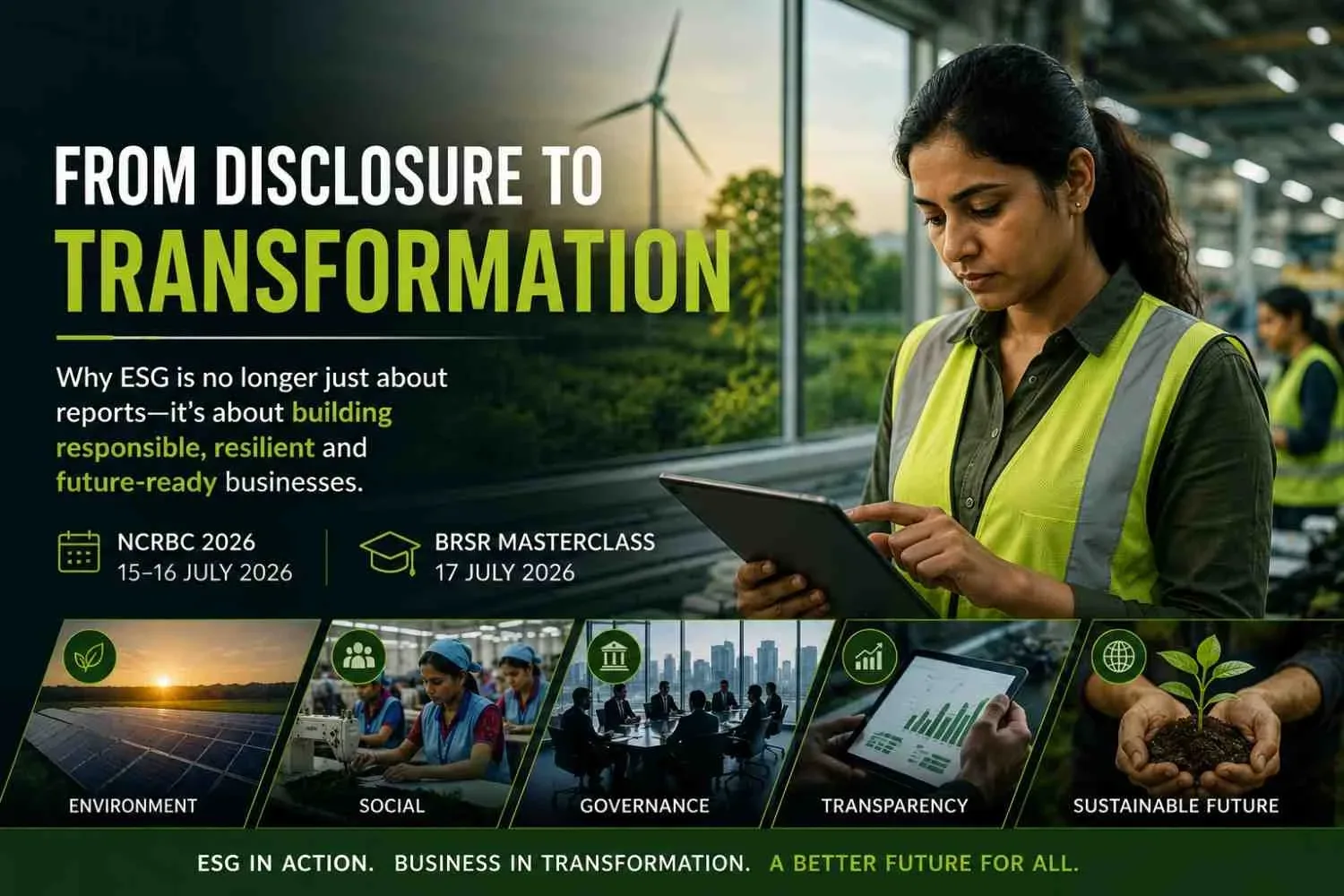
As NCRBC 2026 approaches, the conversation is shifting from sustainability reporting to building businesses that are resilient, responsible and future-ready What if the real value of sustainability is no longer measured by the report a company publishes once a year, but by the decisions it makes every day?From managing risks and attracting investment to building customer trust and securing long-term growth, sustainability is increasingly becoming part of how businesses operate.That transformation is expected to drive discussions at the National Conference on Responsible Business Conduct (NCRBC) 2026, organised by the Indian Institute of Corporate Affairs (IICA) on 15–16 July, followed by the Business Responsibility and Sustainability Reporting (BRSR) Masterclass on 17 July.The conference comes at a time when businesses across India are under growing pressure to demonstrate that sustainability is more than a corporate commitment. Gradually, Environmental, Social and Governance (ESG) practices are moving beyond annual disclosures and becoming a core element of business strategy. Why ESG Matters Beyond BusinessESG may sound like a term reserved for corporate boardrooms, but its impact reaches far beyond them. It shapes the products people buy, the conditions in which employees work and the way businesses affect the environment and local communities. Cleaner production, ethical sourcing, responsible waste management and transparent governance, influence everyday life. Public expectations are changing as well. Consumers and investors want businesses to prove that sustainability is reflected in their actions, not just their reports. In a marketplace built on trust, companies that fail to do so risk falling behind. Why Reporting Alone Is No Longer Enough For many businesses, sustainability reporting was once viewed as a way to meet regulatory requirements. Today, it is becoming a starting point rather than the final objective. India's Business Responsibility and Sustainability Reporting (BRSR) framework has strengthened ESG disclosures, but stakeholders now expect more than transparency. Investors compare ESG performance before allocating capital, banks are incorporating sustainability risks into lending decisions, global buyers are demanding responsible sourcing, and customers are rewarding businesses that demonstrate genuine environmental and social responsibility. The result is a fundamental shift: ESG is moving from an annual reporting exercise to an integral part of business strategy, financial planning and long-term growth. What Will NCRBC 2026 Focus On? The conference is expected to bring together policymakers, corporate leaders, regulators, researchers, sustainability professionals and industry experts to discuss the future of responsible business in India. The discussions are expected to cover several key areas, including Integrating ESG into core business strategy.Strengthening Business Responsibility and Sustainability Reporting (BRSR) and its implementation.Building resilient and responsible supply chains.Advancing climate action, corporate governance and ethical leadership.Preparing businesses to adapt to evolving global sustainability standards.The Business Responsibility and Sustainability Reporting (BRSR) Masterclass, scheduled for 17 July, is also expected to help organisations strengthen their sustainability reporting while encouraging companies to use ESG information as a business planning tool rather than treating it solely as a compliance requirement. The Bigger ChallengePublishing a sustainability report may mark an important milestone, but it does not guarantee meaningful change. The real challenge lies in translating commitments into everyday business practices. Many organisations continue to struggle with collecting reliable ESG data, measuring environmental impacts, engaging suppliers and embedding sustainability across their operations. Small and medium-sized enterprises (SMEs) often face additional barriers because of limited financial resources, technical expertise and dedicated sustainability teams. Experts say that achieving broader ESG adoption will require stronger policy support, capacity-building initiatives and practical guidance, particularly for smaller businesses. They also believe that continuous monitoring will become increasingly important. Businesses will need to demonstrate measurable improvements in emissions reduction, resource efficiency, employee well-being and governance practices- not just publish sustainability reports each year. Looking AheadAs India strengthens its sustainability ambitions and keeps pace with evolving global responsible business standards, platforms like NCRBC are becoming more than places for discussion. They are helping shape a future where sustainability is no longer viewed as a corporate obligation, but as a driver of innovation, resilience and long-term growth. The true success of ESG will not be measured by the number of reports released each year. It will be measured by businesses that reduce their environmental impact, strengthen governance, build resilient supply chains and earn the trust of the communities they serve. Because the future of responsible business will not be defined by what companies say in their disclosures- it will be defined by what they change in their decisions, their operations and their culture. That is the transformation ESG is ultimately expected to deliver. Sources:Indian Institute of Corporate Affairs (IICA) – NCRBC 2026 (https://iica.nic.in/esgconference/)   NCRBC 2026 Official Conference Website (https://esgconference.iica.in/)   Press Information Bureau (PIB) – NCRBC 2026 Inaugural Press Release (https://www.pib.gov.in/PressReleasePage.aspx?PRID=2285687&lang=2&reg=48)  Press Information Bureau (PIB) – NCRBC 2026 Closing Press Release (https://www.pib.gov.in/PressReleasePage.aspx?PRID=2286148&lang=2&reg=48)   Indian Institute of Corporate Affairs (IICA) – Certified ESG Professional Programme (https://iica.nic.in/esgcsr/)   Institute of Chartered Accountants of India (ICAI) – Sustainability Reporting Standards Board (https://www.icai.org/post/sustainability-reporting-standards-board) ...Read more

29 Jul 2026

Billions Are Meant to Restore Forests. But Are They Really Bringing Nature Back?   Every time forest land is diverted for highways, railways, mines or industrial projects, developers are expected to compensate by creating forests elsewhere. On paper, the principle appears simple: replace what is lost. But the debate is no longer about whether compensation is provided- it is about whether it truly replaces what has been lost. The real test of compensatory afforestation is not the number of saplings planted, but whether lost forests are truly being restored.That question has gained renewed attention after the 10th July meeting of the National Compensatory Afforestation Fund Management and Planning Authority (CAMPA), where officials reviewed the implementation of one of India's largest ecological restoration programmes. The meeting may have focused on fund utilisation and afforestation progress, but it revived a much larger question: are CAMPA funds creating resilient forest ecosystems, or are they only measuring success through plantation numbers?  Understanding CAMPA CAMPA was created around a simple principle: when forests are lost to development, the ecological cost should be invested back into restoration. Under the mechanism, developers who divert forest land for non-forest purposes contribute funds towards rebuilding forest ecosystems elsewhere.These funds support afforestation, natural regeneration, wildlife conservation, forest protection, soil and water conservation, fire prevention and improvements in forest management infrastructure. CAMPA now represents one of India's largest environmental funding pools, with tens of thousands of crores dedicated to compensating for forest loss.The challenge, however, is not only how much money is available- it is whether that money is rebuilding forests or merely adding to plantation statistics. The Bigger Question Isn't Spending- It's Ecological Recovery Much of the attention on CAMPA revolves around fund utilisation. Rather than asking how much money has been spent, experts say the more important question is what difference those investments have made on the ground.Plantation numbers may look impressive on paper, yet forests cannot be measured by saplings alone. A healthy forest supports wildlife, stores carbon, protects water and soil, and provides livelihoods for communities that depend on it. Restoration cannot be measured by plantation numbers alone. If saplings fail to survive or diverse natural forests give way to monoculture plantations, the ecological gains may remain limited despite substantial investments. Ecologists say the conversation must move beyond how much was spent to what ecological outcomes were achieved. Planting Is Easy- Growing a Forest Is Hard One of the biggest questions surrounding compensatory afforestation is what happens after the plantation drive ends. Saplings need years of monitoring, protection and maintenance before they can grow into self-sustaining forests. Without sustained care, survival rates can fall significantly, limiting the ecological value of restoration efforts. Many environmental experts argue that public reporting should go beyond the number of saplings planted and include their survival after three, five and even ten years. Such long-term monitoring would provide a more reliable measure of whether restoration efforts are creating lasting ecological benefits. Can New Plantations Replace Natural Forests? The debate extends beyond the number of trees planted. An equally important question is whether newly created plantations can truly compensate for the loss of mature natural forests. Many researchers argue that plantation figures tell only part of the story.A natural forest is far more than a collection of trees. It develops over decades or centuries, supporting biodiversity and ecological processes that cannot be recreated overnight. Compensatory plantations, often made up of fewer species, may not fully replace these functions.That is why many conservationists argue that success should be measured by ecological restoration rather than plantation targets. Restoring degraded ecosystems, conserving existing forests and planting native species are widely considered more effective ways to rebuild resilient landscapes. Restoring Forests Requires Restoring PartnershipsForest restoration is not just an ecological exercise- it is also a community effort. Many experts argue that Indigenous communities, forest-dependent households and local residents should be treated as partners rather than participants. Their understanding of local ecosystems can improve the choice of native species, strengthen long-term management and increase plantation survival. Equally important, community involvement helps maintain accountability long after the plantation drive is over. Transparency Strengthens Accountability Many experts believe that transparency is essential to improving forest restoration. They argue that district-level information on CAMPA projects- including where funds are spent, how plantations are performing and what ecological outcomes are being achieved- should be easily accessible to the public. Greater openness would allow citizens to track progress, strengthen accountability and help governments identify restoration approaches that deliver the best results. More Than Planting TreesIndia's environmental commitments have made CAMPA a critical instrument for forest restoration. But its legacy will not be determined by financial allocations or plantation statistics alone. It will be determined by whether today's investments restore ecosystems that can withstand climate change, protect biodiversity and support future generations. In the years ahead, the true measure of success will not be how many trees are planted- it will be how many forests are genuinely brought back to life.         Sources: National Compensatory Afforestation Fund Management and Planning Authority (CAMPA) – Ministry of Environment, Forest and Climate Change (MoEFCC)https://moef.gov.in/en/division/forest-and-wildlife-division/national-campa/ Compensatory Afforestation Fund Act, 2016 (CAF Act) – Government of Indiahttps://legislative.gov.inForest Survey of India (FSI) – India State of Forest Report (ISFR)https://fsi.nic.in Down To Earth – Environment and forest restoration coverage, including CAMPA implementation and afforestation debateshttps://www.downtoearth.org ...Read more

18 Jul 2026

New Delhi, July 18: Environmentalist, education reformer and climate activist Sonam Wangchuk was removed from the protest site at Jantar Mantar early on Saturday morning and taken to VMMC–Safdarjung Hospital as his indefinite hunger strike entered its 21st day. Delhi Police said Wangchuk was shifted to hospital on medical advice after concerns were raised about his deteriorating health. Protest organisers, however, alleged that he was taken away against his wishes. Supporters formed a human chain and attempted to prevent the police from removing him from the site, leading to tense scenes during the early-morning operation. According to the latest available medical update, Wangchuk was conscious, alert and clinically stable, but weak and mildly dehydrated after fasting for nearly three weeks. Doctors reportedly advised continuous observation and monitoring of his electrolyte levels and other vital parameters. His wife and fellow educationist, Gitanjali J. Angmo, questioned the manner in which he was hospitalised. She said that medical intervention should be undertaken only with Wangchuk’s informed consent and in consultation with his family and the doctors who had been monitoring him during the protest. Angmo also reportedly asked that no oral or intravenous medication be administered without proper discussion. She maintained that Wangchuk remained mentally strong and continued his fast while under observation, consuming only water with salt. Protest Against Examination Irregularities The agitation at Jantar Mantar began as a youth- and student-led protest against alleged irregularities, paper leaks and failures in the country’s examination system. Wangchuk joined the movement in solidarity with students affected by repeated examination controversies and began his indefinite hunger strike on June 28. Protesters have demanded an independent investigation into examination-related scandals, greater accountability from the education authorities and structural reforms to restore transparency and credibility to the testing process. The protest has gradually expanded beyond the immediate issue of examination irregularities. It has become a wider movement seeking accountability in education, protection of students’ futures and a more responsive democratic system. Following Wangchuk’s removal, organisers said the agitation would continue and that other participants would carry forward the hunger strike and planned protest programmes. Opposition and Civil Society Extend Support The protest has received support from a wide range of opposition parties, student organisations, farmers’ groups, academics, writers, filmmakers and civil society representatives. Leaders associated with the Congress, Aam Aadmi Party, Samajwadi Party, Trinamool Congress, Shiv Sena (Uddhav Balasaheb Thackeray), Nationalist Congress Party–Sharadchandra Pawar, Communist Party of India (Marxist) and Rashtriya Janata Dal have either visited the protest site, expressed solidarity or criticised the manner in which Wangchuk was removed. Farmer representatives and student activists have also joined the mobilisation. Several civil society figures have appealed to the Union government to open a dialogue with the protesters and address the concerns being raised. Prominent academics, authors, artists and public intellectuals have urged Wangchuk to end his fast, describing his contribution to education, environmental protection and public life as invaluable. Their appeal has also placed responsibility on the government to initiate meaningful negotiations before the situation worsens. A Lifetime Dedicated to Education and Sustainability Wangchuk’s participation in the protest must be viewed in the context of his lifelong engagement with education, ecology and democratic action. In 1988, he co-founded the Students’ Educational and Cultural Movement of Ladakh, widely known as SECMOL. The initiative emerged in response to an education system that was failing many children in Ladakh because it was disconnected from their language, culture, environment and lived realities. SECMOL developed an alternative model of education centred on practical learning, community participation, environmental responsibility and self-reliance. Students are involved in managing the campus, farming, construction, renewable-energy systems and everyday decision-making. The SECMOL campus has become internationally known for its use of solar energy, passive heating, local building materials and sustainable design. It demonstrates how education can be connected with climate responsibility and community life rather than being limited to examinations and classroom instruction. Wangchuk is also known for developing the “ice stupa” concept, an innovative method of storing winter water in the form of artificial glaciers. These structures release water gradually during the spring and early summer months, when farmers in Ladakh face severe water shortages. His work has consistently focused on protecting Ladakh’s fragile high-altitude ecosystem from climate change, unregulated construction, excessive tourism and resource-intensive development. A Gandhian Method of Protest Wangchuk has repeatedly adopted peaceful and non-violent methods to draw attention to public issues. His campaigns have included climate fasts, marches, public appeals, dialogue and community mobilisation. He has also advocated constitutional safeguards for Ladakh, protection of local land and natural resources, greater democratic representation and recognition of the rights of indigenous communities. His hunger strike at Jantar Mantar is therefore consistent with his broader philosophy of public action. It reflects a Gandhian approach in which personal sacrifice, moral persuasion and non-violence are used to awaken public conscience and compel authorities to respond. His removal from the protest site and hospitalisation have intensified the political and public focus on the agitation. The immediate concern now remains his health, even as the larger questions raised by the protesters-about education, accountability, democracy and the right to peaceful dissent—continue to demand answers. ...Read more

15 Jul 2026

Wangchuk’s Fast Sparks Alarm Delhi High Court urged to act before time runs out By Tiyasha Ghosh How long can a person go without food before the country actually begins to listen? If the price of protest is a life, does silence become the real tragedy? And when someone's health starts deteriorating, should we focus on the protest- or on saving the person behind everything? These questions have taken over as Sonam Wangchuk, the renowned engineer, education reformer and environmental activist from Ladakh, continues his hunger strike in New Delhi. On 15 July, a Public Interest Litigation (PIL) was filed before the Delhi High Court, seeking urgent medical attention for him. The petition claimed that his condition had worsen after more than two weeks of fasting. It stated that he had lost nearly about 8.5 kilograms and alerted that further delay in treatment could put his life at stake. The court has now urged responses from the Centre and the Delhi Government, bringing the matter into the national spotlight. Sonam Wangchuk is known to millions across India. He is well-renowned for his contribution in education, sustainable development and environmental conservation in the Himalayan region. Born and raised in Ladakh, Wangchuk has spent years promoting innovative learning methods and climate-friendly solutions. His contribution also inspired the popular actor, Amir Khan who played as Phunsukh Wangdu in the Bollywood film - 3 Idiots, making him a prominent figure across the country. However, this time, it is not one of his inventions making headlines. It is His silence. As per court records, Wangchuk's health worsened significantly due to fasting. Doctors have reportedly expressed concerns over rapid weight loss, low blood sugar levels and weakness. The PIL has requested immediate medical support including hospitalisation if necessary, stating that protecting a person's life SHOULD BE the number one priority. This case has also ignited an important debate. Should authorities prioritize life over choice and treat hunger strikers? Some believe immediate involvement is necessary to prevent a tragedy. While others argue that peaceful protest is a democratic right and that any medical action should respect the consent of an individual. The Delhi High Court is expected to audit these legal and ethical questions while considering the plea. The incident has stirred emotions well beyond the courtroom. Peaceful protests have been a part of India's democracy since a long time. They have been used often to draw attention to concerns that deserves urgent solution. But when a protest reaches the point where someone's life is at stake, the focus shifts from demands to concerns over human lives. The situation warns us that dialogue delayed is dialogue denied. Early listening can often stop conflicts before it turns into an emergency. As the country waits for the next hearing, many people are hoping for two outcomes- one, Sonam Wangchuk receiving the medical aid he needs, and two, open discussions to get to the root of protesters' concerns. For now, onwards, the court will be deciding the next legal step. But the real question goes far beyond those four walls. Is this how a democracy looks like - waiting until a voice is nearly gone?      Source•    Reuters•    NDTV•    The Times of India•    Hindustan Times   ...Read more

13 Jul 2026

DO NOT LET THE ENGINEER OF HOPE BECOME A MARTYR An article and an appeal by Prof Ujjwal K Chowdhury The man who made ice stand upright is now placing his own body between India’s young people and a system that has failed them. As Sonam Wangchuk’s hunger strike enters its sixteenth day, the Republic must choose dialogue before obituary. UPDATED 13 JULY 2026   THIS IS NO LONGER A CONTEST OF ENDURANCE. IT IS A TEST OF DEMOCRATIC RESPONSIVENESS. A BODY BECOMES THE LAST PETITION At Jantar Mantar, in the hard heat and noise of New Delhi, Sonam Wangchuk’s shrinking body has become an expanding question for India: how much must a citizen suffer before power considers listening a democratic duty? On 13 July 2026, his indefinite hunger strike entered its sixteenth day. Wangchuk began the water-only fast on 28 June in solidarity with the youth-led Cockroach Janta Party protest over the NEET-UG paper leak, wider examination irregularities and the demand for accountability at the highest levels of the Union education establishment. He has also carried into the protest Ladakh’s unresolved demand for constitutional, ecological and democratic safeguards. The latest publicly reported medical figures, from the fifteenth day, were grave enough without exaggeration: a loss of about 7.8 kilograms and blood pressure recorded at 104/66 mm Hg. He was visibly weak. Yet he continued to speak with an almost disarming absence of self-dramatisation. A day earlier, rejecting comparisons with Mahatma Gandhi, he asked citizens not to wait for saviours but to “be your own hero.” That sentence changes the meaning of the fast. Wangchuk is not asking India merely to watch a heroic man suffer. He is asking citizens to recover their own agency. Still, no society can hide behind the striker’s courage. Prolonged fasting can lead to arrhythmia, organ injury, cognitive impairment and death. This is no longer a contest of endurance. It is a race between democratic responsiveness and physical collapse. “A sensitive government in a democracy listens to the pains of the people.”— Sonam Wangchuk, speaking to Reuters, 30 June 2026   THE CRISIS IN NUMBERS INDICATORFACT / CONTEXTDay of fast16th day on 13 July 2026; the water-only fast began on 28 June.Latest reported health dataAbout 7.8 kg weight loss and blood pressure of 104/66 mm Hg on Day 15. These are reported figures, not an independent clinical diagnosis.Scale of NEET impactApproximately 2.3 million candidates were affected by cancellation and retesting after the 2026 paper-leak scandal.Human tollThe Indian Express documented at least 12 deaths by suicide in 37 days before the retest; the Financial Times later reported at least 20 around the crisis. Individual causation requires careful verification.Core public questionWho accepts responsibility when an examination system affecting millions is compromised? Suicide figures are reported counts around the examination crisis; each case requires individual, sensitive verification.   WHEN MERIT IS MADE MEANINGLESS The immediate cause of this fast is not a technical dispute about how an examination was administered. It is the collapse of trust in one of the few institutions through which young Indians are told that effort can overcome birth, geography and poverty. More than 2.3 million candidates were affected when the original NEET-UG 2026 examination was cancelled after the paper-leak scandal and a retest was ordered. Behind that number were families that had spent years paying for coaching, travel, rent, books and application fees; students who had organised adolescence around a single date; and parents who had converted savings, jewellery or debt into hope. A leaked paper does not merely compromise an answer key. It steals time from the honest and sells advantage to the connected. The human cost has been reported in devastating terms. The Indian Express documented at least 12 deaths by suicide in the 37 days between cancellation and the retest; the Financial Times later reported at least 20 student suicides around the examination crisis. Every case has its own circumstances, and no death should be reduced to a slogan or assigned a single cause without careful investigation. But the scale of distress is undeniable. It demands a response rooted in compassion, evidence and institutional responsibility—not statistical evasion. This is the principle at the heart of Wangchuk’s intervention: when a public examination affecting millions fails, accountability cannot end with a press release, a retest and promises of tighter security. It must establish how the breach occurred, who benefited, who failed in oversight, what compensation and counselling are owed to candidates, and what changes will prevent repetition. Otherwise, the state asks young people to trust a system that has offered them no reason to do so. AN EXAMINATION LEAK IS NOT A CLERICAL ERROR. IT IS THEFT FROM MILLIONS OF YOUNG LIVES.   HE NEVER CALLED A CHILD A FAILURE Wangchuk’s presence gives this protest unusual moral force because education is not a theme he discovered for political convenience. It is the work of his life. A mechanical engineer by training, he co-founded the Students’ Educational and Cultural Movement of Ladakh—SECMOL—in 1988. Its founding insight was revolutionary because it was humane: perhaps Ladakhi children were not failing education; perhaps an alienating education system was failing them. Students were often taught through languages, examples and methods disconnected from the mountains, livelihoods and culture around them. Wangchuk helped replace this estrangement with learning rooted in local reality. At SECMOL, a young person could learn solar energy by running a solar-powered campus, management by helping administer it, agriculture by cultivating difficult land, and citizenship by accepting responsibility for a community. The purpose was not to romanticise poor academic performance, but to rebuild confidence and demonstrate that intelligence is wider than memory under examination pressure. His work also contributed to Operation New Hope, a collaboration among communities, civil society and public institutions to reform government schooling in Ladakh. The Ramon Magsaysay Award Foundation honoured him in 2018 for a systematic, collaborative and community-driven transformation of learning systems. The recognition mattered because Wangchuk had not created an elite island for exceptional children. He had helped redesign the relationship between school, society and the child. That history explains why he cannot treat the examination scandal as an administrative inconvenience. To Wangchuk, education is not a sorting machine that discards the many to reward the few. It is a public trust. When that trust is corrupted, the injury is moral before it is procedural. A LIFE OF PRACTICAL IDEALISM INDICATORFACT / CONTEXTEducation reformCo-founded SECMOL in 1988 and helped build culturally rooted, experiential learning for Ladakhi youth.School-system changeContributed to Operation New Hope, linking communities, civil society and government institutions in Ladakh’s education reform.Climate adaptationDeveloped and promoted Ice Stupas to store winter water for spring irrigation.Sustainable architectureDemonstrated passive-solar, earth-based construction suited to extreme Himalayan conditions.Institution buildingCo-founded the Himalayan Institute of Alternatives, Ladakh, centred on learning through real-world problem-solving.RecognitionRolex Award for Enterprise (2016) and Ramon Magsaysay Award (2018), among other honours.   HE MADE ICE STAND UPRIGHT Wangchuk’s best-known invention began with a paradox. Ladakh has abundant frozen water in winter, but farmers need irrigation in spring, before natural glaciers begin to melt sufficiently. His answer was the Ice Stupa: winter stream water channelled through pipes and sprayed into sub-zero air, where it freezes into a tall conical mass. The geometry is the genius. A cone stores a large volume while exposing relatively little surface area to the sun, allowing the ice to melt slowly into the planting season. No grand dam is required, and gravity can do much of the work. The innovation earned Wangchuk the Rolex Award for Enterprise in 2016 and became an internationally recognised model of locally rooted climate adaptation. He has applied the same ethic to passive-solar buildings, earth construction and high-altitude education: begin with the lived problem, respect the ecology, use science intelligently and ensure that the community can operate the solution. His inventions do not arrive from outside demanding that the mountains adjust. They grow from the mountains’ own conditions. There is a painful symmetry in the present moment. The man who taught India how to preserve winter water for the season of need is now consuming his own physical reserves because the institutions meant to preserve public trust appear unwilling to act in time. NOT A FILM CHARACTER—A WORKING METHOD Popular culture introduced millions to Wangchuk through the widespread description of Phunsukh Wangdu, Aamir Khan’s unconventional inventor in 3 Idiots, as partly inspired by him. The comparison made his ideas accessible: curiosity over rote learning, invention over credentialism, usefulness over status. But cinema can also shrink a life into a charming eccentricity. The real Wangchuk has spent decades doing what a film resolves in three hours—building institutions, negotiating with governments, raising resources, making mistakes, testing prototypes, confronting entrenched systems and returning to work the next morning. His importance lies not in being a ‘real-life Wangdu’. It lies in offering a repeatable civic method: understand deeply, simplify intelligently, build collectively and accept responsibility for consequences. That method now indicts the state. A government that celebrates innovation in speeches cannot remain indifferent when one of the country’s most credible innovators says that the architecture of accountability is broken. “Do not wait for a hero. Be your own hero.”— Sonam Wangchuk’s appeal from the protest, 11 July 2026   THE MOUNTAIN IS NOT A POSTCARD The fast is also inseparable from Ladakh. Since the reorganisation of Jammu and Kashmir in 2019, Ladakhi organisations have demanded statehood, constitutional protection under the Sixth Schedule, safeguards for land and employment, and meaningful local authority over development. For Wangchuk, these are not abstract constitutional clauses. They determine who decides the future of a fragile cold desert: its residents, or distant institutions and commercial interests. Ladakh faces glacier retreat, water insecurity, unregulated tourism, infrastructure pressure and the possibility of large projects being imposed without sufficient ecological limits or local consent. A region celebrated as a strategic frontier and tourist paradise can still be denied an adequate democratic voice. Wangchuk undertook a 21-day climate fast in 2024 and helped lead a march towards Delhi. In September 2025, after protests in Leh turned violent and four civilians were killed, the authorities accused him of contributing to unrest through provocative statements. He denied inciting violence and appealed for peace. He was detained under the National Security Act on 26 September and remained imprisoned for roughly 170 days before the Union government revoked the detention in March 2026. Accuracy matters here. Wangchuk was detained under a preventive-detention law; he was not convicted of treason. One may debate his politics, the government’s allegations or the tactics of the movement. But disagreement does not erase the central democratic question: can a border region seek constitutional and environmental safeguards without its most recognisable voice being treated principally as a security problem? SILENCE IS ALSO A DECISION As the fast moves into its third week, the most disturbing fact is not simply Wangchuk’s medical decline. It is the absence, so far, of a publicly reported formal negotiation capable of producing an honourable resolution. Dialogue is sometimes misrepresented as capitulation. In a democracy it is often the opposite: an assertion that institutions are strong enough to hear criticism, test allegations and correct failure. A minister need not accept every accusation in order to meet protesters. A government need not concede every demand in order to establish an independent inquiry, publish a timeline, offer student relief and open structured talks. The state has greater power, greater information and greater capacity than a citizen on a mattress. That asymmetry creates a greater duty of care. To wait for the body to fail is not neutrality. Delay itself becomes policy. ANNA HAZARE: THE LESSON IS NEGOTIATION, NOT NOSTALGIA The memory of Anna Hazare’s 2011 anti-corruption fast inevitably hangs over Jantar Mantar, but the comparison must be made accurately. Hazare began an indefinite fast on 5 April 2011; the Union government constituted a joint drafting committee on 8 April, and he ended the fast on 9 April. His larger August agitation lasted 12 days and ended after Parliament expressed agreement in principle on key demands. The Lokpal and Lokayuktas Act was eventually passed in 2013—not instantly at the protest site. The relevant lesson is not that every hunger strike should dictate legislation. It is that government engagement can begin before a citizen’s health reaches an irreversible threshold. Negotiation does not make elected authority weak; it demonstrates that authority understands its constitutional purpose. Wangchuk’s sixteenth day therefore carries a stark question. If the state could open talks with a fasting anti-corruption campaigner in 2011, why can it not establish a credible channel with an educator and environmentalist in 2026—especially when millions of students have already borne the cost of an acknowledged examination breakdown? DIALOGUE DOES NOT DIMINISH ELECTED AUTHORITY. IT REVEALS WHETHER AUTHORITY REMEMBERS ITS PURPOSE.   IF HE DIES, INDIA DOES NOT WIN No responsible article should romanticise Wangchuk’s death. Martyrdom is not a policy outcome, and a funeral is not institutional reform. Yet refusing to consider the consequences would be equally irresponsible. First, an examination controversy would become a moral crisis of the Republic. The defining question would no longer be only who leaked a paper, but why meaningful engagement did not begin while a nationally respected citizen’s health deteriorated in public view. Second, scattered youth anger could acquire a unifying symbol. Paper leaks, unemployment, delayed recruitment, expensive coaching and arbitrary evaluation cross state, caste, class and language. Wangchuk’s death could connect these grievances into a wider consciousness of generational injustice. Peaceful frustration may then harden into a belief that institutions respond only after catastrophe. Third, Ladakh’s constitutional movement would be transformed. A demand often treated as remote would be carried everywhere by the image of a Ladakhi educator dying in the national capital. The loss of a bridge-builder can empower voices less patient with dialogue. For a sensitive border region, alienation is not an abstract political cost. Fourth, India’s international standing would suffer. Wangchuk is globally recognised for climate adaptation and educational reform. His preventable death during a non-violent protest would be cited in debates about democratic dissent, environmental justice and the treatment of civil-society actors. Finally, the country could commit its most familiar act of evasion: mourn the man while abandoning the work. Institutions might be named after him, quotations circulated and statues proposed, while examination governance remained opaque and Ladakh’s safeguards unresolved. India has often found it easier to garland a photograph than to complete an unfinished agenda. THE COUNTRY MUST CHOOSE NEGOTIATION BEFORE OBITUARY.   SAVE THE MAN—AND REPAIR THE SYSTEM The answer cannot be merely to plead with Wangchuk to eat while leaving untouched the conditions that led him to fast. Nor should supporters value the symbolic power of his suffering above his life. Both the humanitarian emergency and the institutional demands must be addressed together. The government should immediately appoint a senior, empowered interlocutor; open a recorded and time-bound dialogue with Wangchuk, student representatives and Ladakhi leaders; commission an independent investigation into the examination breach and associated administrative failures; publish a transparent reform schedule; and create psychological, academic and financial support for affected candidates and bereaved families. It should also resume credible constitutional discussions on Ladakh with ecological safeguards and local consent at the centre. At the protest site, independent medical monitoring must be protected, clinical information communicated responsibly, and every route explored for a negotiated withdrawal that preserves Wangchuk’s dignity. Saving a life is not a political favour. It is the minimum duty of a state confronted with foreseeable harm. Wangchuk has spent nearly four decades showing that apparently impossible problems can be redesigned. A student branded a failure can become a leader. Winter water can irrigate spring fields. Mud, sunlight and intelligence can keep a building warm at Himalayan temperatures. A marginal region can generate ideas for the world. The problem before India is simpler than any of those: can power cross a few kilometres in Delhi and speak to a citizen before his body is broken? The nation does not need another photograph draped in marigolds. It needs Sonam Wangchuk alive—in a classroom, on a mountain, beside an ice stupa, arguing, inventing and reminding us that public life can still be useful. The highest tribute is not to prepare an obituary. It is to create the conditions in which he can eat again. The mountains are watching. The young are waiting. The clock is not. WHAT RESPONSIBLE ACTION LOOKS LIKE A senior, empowered government interlocutor and a formal negotiation channel.An independent, time-bound inquiry into the leak, oversight failures and beneficiary networks.A published examination-security reform plan with institutional accountability.Counselling, academic relief and financial support for affected candidates and bereaved families.Renewed constitutional talks on Ladakh, with ecology, land, jobs and local consent at the centre.Independent medical monitoring and an honourable path for ending the fast.   SOURCE NOTES AND FACT-CHECKING BASIS 1. Reuters, “India’s Cockroach party seeking education minister’s ouster awaits cabinet reshuffle,” 30 June 2026. 2. The Times of India, “Watch: Sonam Wangchuk looks visibly weak as hunger strike enters day 15th,” updated 12 July 2026. 3. India Today/PTI, “I am not Gandhi, be your own hero: Sonam Wangchuk urges citizens to join protest,” 11 July 2026. 4. The Indian Express, “Ahead of NEET-UG re-exam, 12 suicides in 37 days,” 20 June 2026. 5. Financial Times, “Why India’s education system gets poor marks from millions of students,” 13 July 2026. 6. Ramon Magsaysay Award Foundation, official citation for Sonam Wangchuk, 2018. 7. Rolex Awards for Enterprise, official project profile: Sonam Wangchuk and the Ice Stupa initiative, 2016. 8. Reuters, “Indian activist’s hunger strike for Ladakh autonomy draws thousands of supporters,” 23 March 2024. 9. Reuters, “Indian police arrest activist Wangchuk after deadly Ladakh protests,” 26 September 2025. 10. Press Information Bureau, Government of India, Finance Minister’s statement in Lok Sabha on the 2011 Lokpal movement, 27 August 2011; India Code, Lokpal and Lokayuktas Act, 2013.   ...Read more

12 May 2026

In the 21st century, the greatest threats to corporate stability are no longer just market competitors, but "Gray Swan" events—predictable but ignored risks such as climate-driven supply chain collapses or social unrest. Governance is the mechanism through which an organization identifies, assesses, and mitigates these non-financial risks. The integration of ESG into the Enterprise Risk Management (ERM) framework is the most significant evolution in corporate governance in recent years. It requires a shift from "historical risk" (looking at what happened in the past) to "scenario-based risk" (modeling what could happen in various climate and social futures). One of the primary tools in modern risk governance is Climate Scenario Analysis. Boards use sophisticated models to stress-test their business strategies against different global warming pathways (e.g., a $1.5^\circ C$ vs. a $3^\circ C$ world). This allows them to identify "stranded assets"—investments that may lose their value prematurely due to environmental regulations or physical climate changes. By identifying these risks years in advance, governed companies can "orderly transition" their portfolios, divesting from high-risk sectors and reinvesting in resilient, low-carbon alternatives. Social risk management has also become more sophisticated through Human Rights Due Diligence (HRDD). Governance protocols now mandate that companies look beyond their direct operations to identify risks in their Tier 2 and Tier 3 suppliers. By utilizing "whistleblower" technologies and satellite monitoring, companies can detect forced labor or environmental degradation in real-time, allowing them to terminate unethical contracts before they cause reputational or legal damage. Ultimately, governance is about Resilience. A well-governed company is not one that avoids all risk, but one that has the transparency, ethical leadership, and data-driven insights to navigate a volatile world while maintaining the trust of its stakeholders. ...Read more

12 May 2026

ESG reporting was once a voluntary, narrative-heavy marketing exercise. Today, it is a rigorous, data-driven discipline that is as critical as financial auditing. The transition to mandatory disclosure frameworks, such as the Corporate Sustainability Reporting Directive (CSRD) and the IFRS Sustainability Disclosure Standards, has effectively ended the era of "Greenwashing." Transparency is no longer a choice; it is a regulatory requirement that determines a company’s access to capital markets. Investors now view a lack of ESG transparency as a sign of hidden operational risk. The innovation driving this transparency is Double Materiality. This governance concept requires companies to report not only on how sustainability issues affect their financial performance (outside-in) but also on how their operations impact the environment and society (inside-out). By adopting this dual lens, organizations provide stakeholders with a 360-degree view of their value creation. To manage the vast amounts of data required for such reporting, companies are utilizing "Sustainability ERP" (Enterprise Resource Planning) systems that automate the collection of carbon, waste, and labor data from every corner of the supply chain. Moreover, the rise of Assurance and Auditability is bridging the trust gap. Just as financial statements are audited by third-party firms, ESG reports are now undergoing "Limited" and, increasingly, "Reasonable" assurance processes. This level of scrutiny ensures that a company’s claims about its renewable energy use or gender pay gap are verified by independent experts. For the modern corporation, a high-quality ESG report is the ultimate calling card—a demonstration of transparency that attracts ESG-focused funds, lowers the cost of debt, and builds a resilient brand in a skeptical marketplace. ...Read more

12 May 2026

Diversity, Equity, and Inclusion (DEI) have moved from being a department in HR to a core component of labor compliance and corporate strategy. In the past, diversity was often treated as a "numbers game"—meeting certain quotas for gender or ethnicity. Today, the focus is on Systemic Equity, which examines the underlying structures of a company to ensure that all individuals have the same access to opportunities, regardless of their background, neurodiversity, or physical ability. The innovation in this space is the move toward Data-Driven Inclusion Audits. Instead of general surveys, companies are using AI to analyze promotion rates, pay gaps, and "Attrition Velocity" across different demographics. If the data shows that a specific group is leaving the company at twice the average rate, it signals a failure in the social environment that needs immediate intervention. This proactive compliance model helps identify "Micro-exclusions"—subtle, systemic barriers that prevent talented individuals from reaching leadership positions. Community engagement is the final pillar of this strategy. A truly compliant company in 2026 does not exist in a vacuum; it is an active participant in its local ecosystem. This means "Local Sourcing" for labor and services, investing in local education through STEM programs, and ensuring that the company’s presence does not lead to gentrification or displacement. By integrating the company into the social fabric of its community, businesses create a "Mutual Value Exchange." This not only boosts the company’s reputation but also creates a stable, skilled local labor pool, ensuring that social and labor compliance is not just an ethical duty, but a powerful engine for regional economic growth. ...Read more