
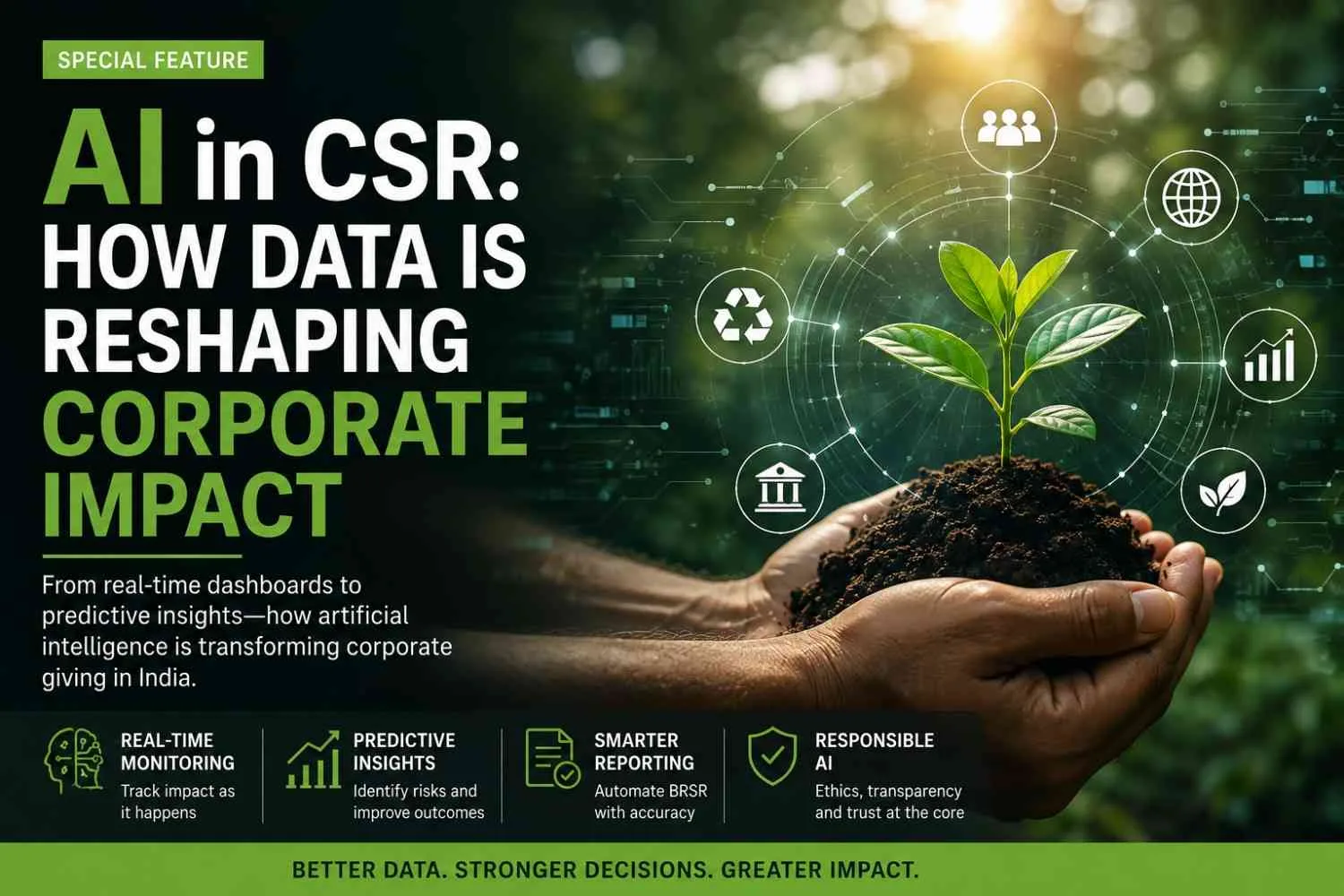
Kolkata | August 5, 2026
| Artificial intelligence is rapidly transforming how companies measure, monitor and report the impact of their CSR initiatives. From predicting school dropout risks to automating sustainability disclosures, AI promises faster insights and greater accountability. Yet as algorithms begin shaping corporate giving, questions over data quality, ethical safeguards and reporting credibility are becoming impossible to ignore. |
| Quick Summary Corporate Social Responsibility (CSR) is entering a new phase where artificial intelligence is reshaping how social impact is measured. Companies are increasingly moving beyond annual spreadsheets and manual surveys towards real-time dashboards, predictive analytics and automated reporting systems capable of tracking beneficiaries, identifying programme risks and simplifying Business Responsibility and Sustainability Reporting (BRSR) disclosures. While these technologies promise greater efficiency and evidence-based decision-making, they also raise concerns around algorithmic bias, privacy, data manipulation and the growing gap between digital dashboards and realities on the ground. As regulators encourage greater transparency and companies invest in AI-powered impact platforms, the debate is shifting from whether AI should be used in CSR to how it can be deployed responsibly without compromising trust or accountability. |
Keywords
|
Can artificial intelligence transform corporate giving into measurable social impact- or is technology moving faster than accountability?
Not long ago, assessing the success of a Corporate Social Responsibility (CSR) project was a slow and largely manual process. Field teams travelled to project locations with paper surveys, NGOs maintained handwritten records, and corporate CSR departments often spent weeks compiling data before presenting annual impact reports. By the time the data reached the decision-makers, it was too late to make timely course corrections.
That approach is changing rapidly.
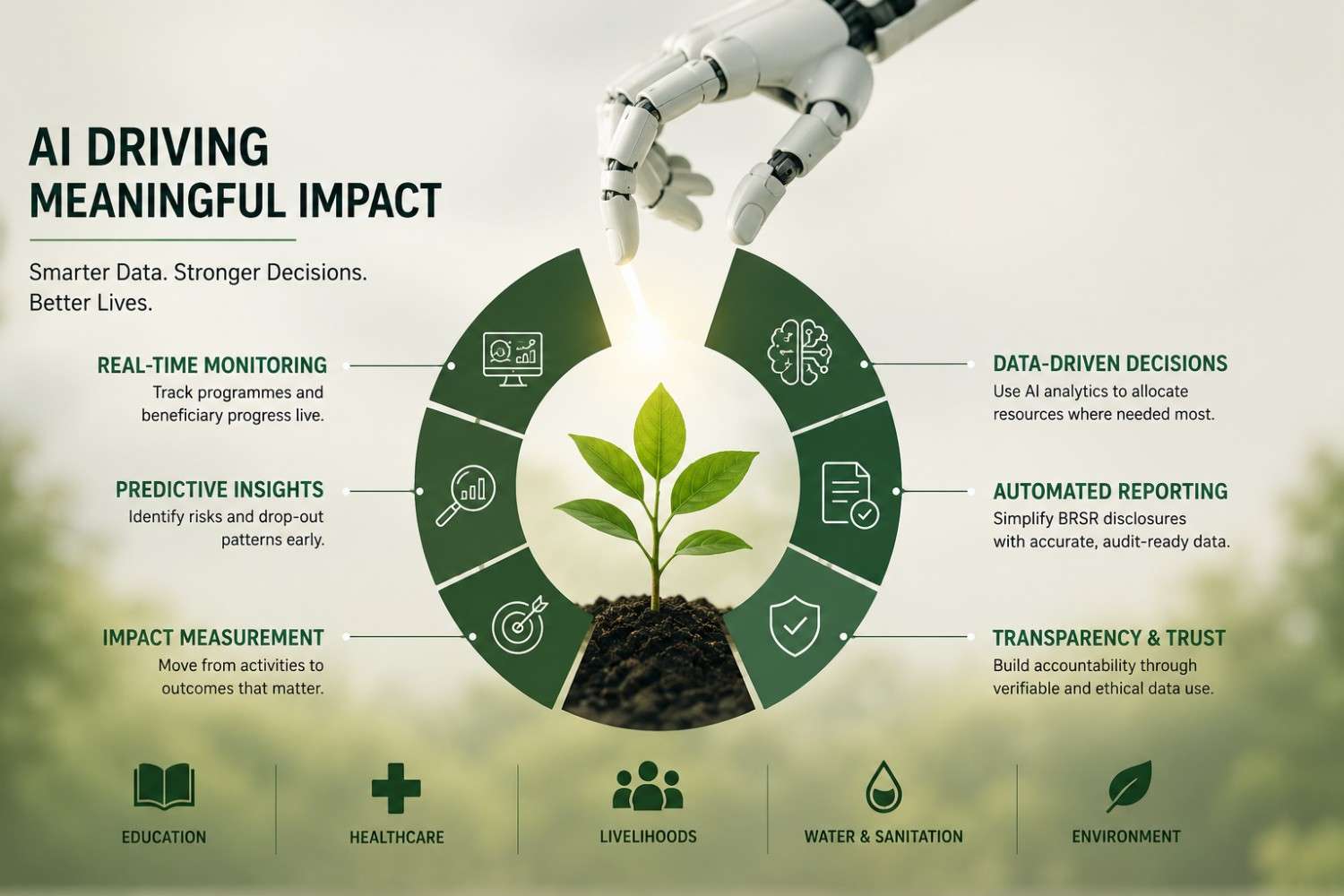
Today, a CSR manager overseeing a digital education initiative can monitor student attendance through live dashboards, receive alerts when learning outcomes begin to decline and identify schools at risk of higher dropout rates in real time.
Healthcare programmes can track patient follow-ups digitally, livelihood projects can monitor income trends through mobile applications, and sustainability teams can use automated systems to support Business Responsibility and Sustainability Report (BRSR) disclosures.
This transformation reflects a broader shift in corporate India.
As companies face growing expectations to demonstrate measurable social and environmental impact rather than simply report CSR spending, artificial intelligence is emerging as an important decision-support tool. Instead of relying solely on end-of-project evaluations, organisations are beginning to use AI, predictive analytics and cloud-based platforms to monitor programmes as they unfold, enabling faster and more informed interventions.
The potential benefits are significant.
AI can analyse large volumes of beneficiary data within seconds, identify trends that might be overlooked through manual analysis and help organisations allocate resources more efficiently.
Supporters argue that this allows CSR programmes to move beyond reactive problem-solving towards proactive decision-making, addressing challenges before they affect project outcomes.
Yet the growing reliance on AI also raises an important question: Can technology fully measure social impact?
Community development is influenced by trust, behaviour, local realities and human relationships-factors that cannot always be captured through algorithms or dashboards.
A decline in school attendance may be visible in digital data, but technology alone cannot explain whether the cause is seasonal migration, financial hardship or inadequate school infrastructure.
Similarly, a healthcare platform may accurately record beneficiary numbers while failing to reflect barriers such as accessibility, awareness or social stigma.
As AI becomes more deeply integrated into corporate philanthropy, the challenge is no longer collecting larger volumes of data. But to ensure that technology strengthens accountability without creating a false sense of precision. In the end, better dashboards do not automatically lead to better decisions, and measuring social impact will continue to depend as much on human judgement as on artificial intelligence.

From Reporting Projects to Predicting Outcomes
The evolution of CSR reporting reflects a broader shift in corporate sustainability - from documenting activities to demonstrating measurable impact.
For years, the success of CSR initiatives was largely measured through inputs such as funds spent, beneficiaries reached and projects completed during a financial year.
While these indicators met statutory reporting requirements, they revealed little about whether programmes had created lasting social or environmental value.
Artificial intelligence is beginning to change that approach.
Rather than being used only at the end of a project for reporting, AI is becoming part of programme implementation itself. Companies are adopting cloud-based dashboards, geospatial mapping, computer vision and machine learning to monitor projects in real time, enabling CSR teams to identify risks early, compare interventions and make timely course corrections before resources are exhausted.
The impact is particularly visible in education.
Instead of relying solely on annual assessments, AI-enabled systems can analyse attendance, classroom engagement, learning patterns and assessment results almost in real time.
Predictive models can identify students showing early signs of disengagement, allowing implementing agencies to intervene before irregular attendance leads to permanent dropout.
Similar applications are being explored in skill development programmes, where algorithms help identify trainees who may need additional mentoring or financial assistance based on participation and completion trends.
Healthcare initiatives are undergoing a similar transformation.
Community health workers use mobile applications to upload patient data directly from the field, while AI-assisted platforms monitor vaccination coverage, treatment adherence and disease patterns across regions.
Rather than measuring success only through the number of health camps organised, organisations can now track follow-up visits, treatment outcomes and areas requiring additional intervention.
Livelihood programmes are also benefiting from predictive analytics.
Digital platforms monitoring self-help groups, farmer producer organisations and micro-enterprises can detect changes in income, productivity and market access, enabling implementing partners to respond before financial challenges undermine programme objectives.
Instead of evaluating outcomes only after a project ends, AI is helping organisations identify emerging risks while corrective action is still possible.
AI is also reshaping corporate sustainability reporting.
The introduction of the Business Responsibility and Sustainability Report (BRSR) by the Securities and Exchange Board of India (SEBI) has significantly increased the volume of environmental, social and governance (ESG) data that listed companies are required to disclose. Collecting, verifying and consolidating this information across multiple business units has made manual reporting more time-consuming and complex.
To address this, many organisations are adopting AI-powered reporting platforms that integrate data from operational systems, identify inconsistencies, flag missing disclosures and generate draft sustainability reports.
Beyond reducing administrative effort, these systems improve reporting consistency and allow management teams to focus more on analysing performance than compiling documentation.
Despite these advances, however, AI remains only as reliable as the data it receives.
Artificial intelligence can identify patterns, generate insights and predict future trends, but it cannot compensate for incomplete records, inaccurate field reporting or weak verification processes.
Poor-quality data inevitably leads to unreliable analysis, regardless of how advanced the technology may be.
For this reason, many experts view AI not as a replacement for human oversight but as a tool that strengthens decision-making when supported by credible data, robust governance and effective monitoring systems.
How AI Is Changing CSR
| Traditional CSR Monitoring | AI-Driven CSR Monitoring |
|---|---|
| Annual surveys | Real-time dashboards |
| Manual beneficiary records | Automated data collection |
| End-of-project evaluation | Continuous performance tracking |
| Reactive interventions | Predictive analytics |
| Spreadsheet reporting | Automated BRSR disclosures |
Key takeaway: AI is shifting CSR from measuring what happened to anticipating what could happen next.
When Algorithms Meet Accountability
Artificial intelligence is transforming the way CSR programmes are monitored and evaluated, but it is also introducing a new set of ethical and operational challenges.
As organisations rely on algorithms to guide decisions, an important question is emerging: Can technology strengthen accountability without compromising trust?
At the heart of this debate, lies the quality of data.
AI systems can only produce reliable insights when the underlying data is accurate, complete and consistent. Incomplete beneficiary records, duplicate entries or reporting errors can generate misleading conclusions that appear highly credible because they are supported by sophisticated dashboards and predictive models.
Unlike manual reporting, where inconsistencies are often easier to identify, algorithm-driven analysis can sometimes conceal data quality issues behind polished visualisations.
This concern is particularly relevant in CSR impact assessment.
Many companies and CSR consultants now use AI-enabled platforms to consolidate data from education, healthcare, livelihood and environmental programmes.
While automation has significantly improved reporting efficiency, experts caution that it should complement and not replace independent field verification. Without regular validation, inaccurate beneficiary records, duplicate entries or inconsistencies across projects can find their way into impact reports and sustainability disclosures.
In many cases, these errors are not intentional.
Different implementing partners often use varying reporting formats, beneficiary definitions and data collection methods.
A beneficiary participating in multiple programmes may be counted more than once, while attendance, outreach and engagement may be measured using different indicators across projects.
AI can process these datasets rapidly, but unless the information is standardised and verified, technology may reinforce inconsistencies rather than eliminate them.
Privacy and data security have also become major considerations.
AI-powered CSR platforms collect personal information such as age, location, income, educational performance and health records to improve programme design and delivery.
Although this enables more targeted interventions, it also raises important questions about informed consent, data ownership and cybersecurity.
Many beneficiaries, particularly in rural and digitally underserved communities, may have limited awareness of how their information is collected, stored or used.
To address these concerns, experts are calling for stronger ethical safeguards around the use of AI.
Greater transparency in algorithms, human oversight, robust data governance, protection of sensitive information and regular third-party audits are increasingly seen as essential for ensuring that AI strengthens accountability without creating new risks.
There is also a growing recognition that not every aspect of social impact can be measured through technology.
AI can efficiently analyse beneficiary numbers, attendance, training hours and financial disbursements while identifying patterns that may indicate emerging programme risks.
| Affected Voices Development organisations working at the grassroots say artificial intelligence is making programme monitoring faster, but not necessarily simpler. NGOs involved in education, healthcare and livelihood projects argue that digital dashboards can highlight patterns, yet they cannot replace conversations with communities. A field worker may know why a child has stopped attending school, why a family refuses a healthcare intervention or why a self-help group is struggling despite positive financial indicators- insights that rarely appear in automated reports. Consumer and civil society organisations also caution that communities should not become passive data points. They argue that beneficiaries must understand how their information is collected, stored and used, particularly as AI systems become more integrated into social programmes. For them, responsible technology is not only about better analytics but also about protecting privacy, maintaining informed consent and ensuring that people remain at the centre of every CSR intervention. |
However, it remains far less effective at measuring outcomes such as community trust, behavioural change, social inclusion and local ownership- factors that often determine the long-term success of CSR initiatives.
For this reason, development practitioners continue to emphasise the importance of human engagement alongside technological analysis.
AI can identify that attendance in a vocational training programme is declining, but conversations with beneficiaries are often needed to understand whether transport costs, household responsibilities or seasonal employment are driving that trend.
Technology can reveal patterns, but people provide the context that explains them.
As AI becomes more deeply embedded in corporate philanthropy, the future of CSR impact measurement is likely to depend on balancing automation with accountability.
Organisations that combine advanced analytics with transparent governance, independent verification and continuous engagement with communities will not only generate more reliable evidence but also strengthen public trust in the impact they seek to create.
AI Can Measure, But Can It Understand?
AI Measures Well
Beneficiary numbers
Attendance and participation
Learning outcomes
Health follow-ups
Resource utilisation
Reporting efficiency
Humans Still Matter For
- Community trust
- Behavioural change
- Inclusion and dignity
- Local context
- Cultural realities
- Independent verification
Key takeaway: Artificial intelligence can improve measurement- but meaningful impact still requires human judgment.
When Evidence Meets Scrutiny
As artificial intelligence becomes an integral part of CSR monitoring, experts argue that the technology itself must be evaluated as rigorously as the programmes it measures.
A sophisticated dashboard may present real-time insights and impressive visualisations, but its credibility ultimately depends on the quality of data, the methodology behind the analysis and the transparency of the reporting process.
The first challenge lies in how impact is measured.
CSR programmes often use different indicators to define success.
An education initiative may focus on attendance or learning outcomes, while a healthcare project may measure beneficiary reach, treatment adherence or long-term health improvements.
When AI systems analyse datasets built on different definitions and reporting standards, comparing outcomes across projects becomes difficult, even if the technology functions accurately.
For this reason, development economists and impact evaluation specialists continue to emphasise the importance of establishing reliable baselines before introducing AI-driven monitoring.
Without a clear starting point, it is difficult to determine whether a programme has genuinely improved people's lives or simply produced more data.
An algorithm may report a significant increase in school attendance, but the finding has limited value unless it is measured against credible baseline data and tracked consistently over time.
Another challenge is distinguishing the impact of a single intervention from broader social change.
AI platforms can efficiently capture data generated within CSR programmes, but they cannot always account for external factors that influence outcomes.
Improvements in school attendance, for example, may reflect not only a company's education initiative but also better government infrastructure, scholarship schemes or wider community participation.
As a result, experts caution against treating AI-generated correlations as conclusive evidence of impact.
Benchmarking presents similar limitations.
Many AI platforms allow organisations to compare CSR performance across projects, districts or business units.
However, such comparisons are meaningful only when programmes operate under similar conditions and pursue comparable objectives.
Comparing projects with different beneficiary groups, geographies or impact indicators may produce conclusions that are statistically sound but practically misleading.
This is why independent assurance remains essential.
AI can quickly identify anomalies, missing records and unusual reporting patterns, but it cannot replace field verification, beneficiary feedback, external audits or independent programme evaluations.
Experts argue that technology is most valuable when it strengthens existing evaluation processes rather than serving as a substitute for them.
The growing investment in AI also raises important questions about transparency.
Companies are allocating substantial resources towards digital CSR platforms, cloud infrastructure, analytics and cybersecurity.
Yet annual reports rarely distinguish expenditure on AI-enabled monitoring from broader CSR administration or programme implementation.
This makes it difficult for stakeholders to assess whether these investments are improving programme delivery or primarily enhancing reporting efficiency.
Ultimately, the success of AI in CSR will not be measured by the volume of data it generates, but by the quality of the decision it supports.
Technology can strengthen accountability and improve impact measurement, but only when it is backed by transparent methodologies, credible data, independent verification and meaningful human oversight.
Evidence Check: Questions Every AI-Powered CSR Dashboard Should Answer
| Evidence Test | Why It Matters |
|---|---|
| Is the methodology publicly explained? | Ensures transparency and comparability. |
| What is the baseline? | Measures real change, not isolated data points. |
| Has the data been independently verified? | Reduces reporting bias and inflation. |
| Are reporting boundaries clearly defined? | Prevents misleading impact claims. |
| Does AI support or replace field verification? | Human validation remains essential. |
| Is investment in AI transparently disclosed? | Demonstrates accountability beyond technology adoption. |
Key takeaway: Artificial intelligence can process information at extraordinary speed, but trustworthy CSR still depends on evidence that is transparent, independently verified and grounded in reality.
Beyond the Dashboard
Artificial intelligence is transforming the way companies design, monitor and evaluate their CSR initiatives.
What was once driven by periodic surveys and retrospective reporting is evolving into a system supported by real-time data, predictive analytics and continuous monitoring.
For businesses, this means faster decision-making and more informed resource allocation.
For regulators and stakeholders, it offers the potential for greater transparency, consistency and accountability in sustainability reporting.
However, technology alone cannot guarantee meaningful impact.
The value of AI will ultimately depend on the quality of the data it processes, the transparency of the methodologies behind it and the governance system that ensures every insight is credible and independently verifiable.
While dashboards can identify patterns and emerging risks, they cannot replace human judgement, community engagement or an understanding of the local realities that shape social outcomes.
As AI becomes gradually embedded in corporate philanthropy, the conversation is shifting from whether it should be adopted to how responsibly it should be used.
Its long-term success will not be measured by the sophistication of its algorithms, but by its ability to strengthen decision-making, build public trust and deliver measurable improvements where they matter the most.
Ultimately, no algorithm, dashboard or report can define the success of CSR. Its true measure will always be the positive and lasting change it brings to people's lives.
Evidence Check
| Parameter | Status |
|---|---|
| Methodology disclosed | Partial – Varies by platform |
| Independent verification | Essential but inconsistent |
| Baseline comparison | Required for credible impact measurement |
| AI ethics & privacy | Increasing regulatory focus |
| Human field validation | Still indispensable |
| AI investment disclosure | Limited in public CSR reports |
Key Takeaways
|
Primary Sources:
- Ministry of Corporate Affairs (MCA) – Corporate Social Responsibility (CSR) Framework & Companies Act, 2013
https://www.mca.gov.in/ - Securities and Exchange Board of India (SEBI) – Business Responsibility and Sustainability Reporting (BRSR) Framework
https://www.sebi.gov.in/ - NITI Aayog – Responsible AI for All: Strategy and Discussion Papers
https://www.niti.gov.in/ - Ministry of Electronics and Information Technology (MeitY) – IndiaAI Mission & AI Governance Initiatives
https://www.meity.gov.in/ - CSRBOX – CSR Intelligence, Case Studies & Impact Measurement Resources
https://csrbox.org/ - Microsoft AI for Good – AI Applications for Social Impact and Sustainable Development
https://www.microsoft.com/en-us/ai/ai-for-good - World Economic Forum (WEF) – Artificial Intelligence Governance & Responsible AI Reports
https://www.weforum.org/ - J-PAL South Asia – Evidence-Based Programme Evaluation and Impact Measurement
https://www.povertyactionlab.org/south-asia







Add a Comment