Decarbonisation

Focuses on Asia’s efforts to reduce carbon emissions through clean energy adoption, policy reforms, and sustainable industrial practices.

Showing 11

27 Aug 2026

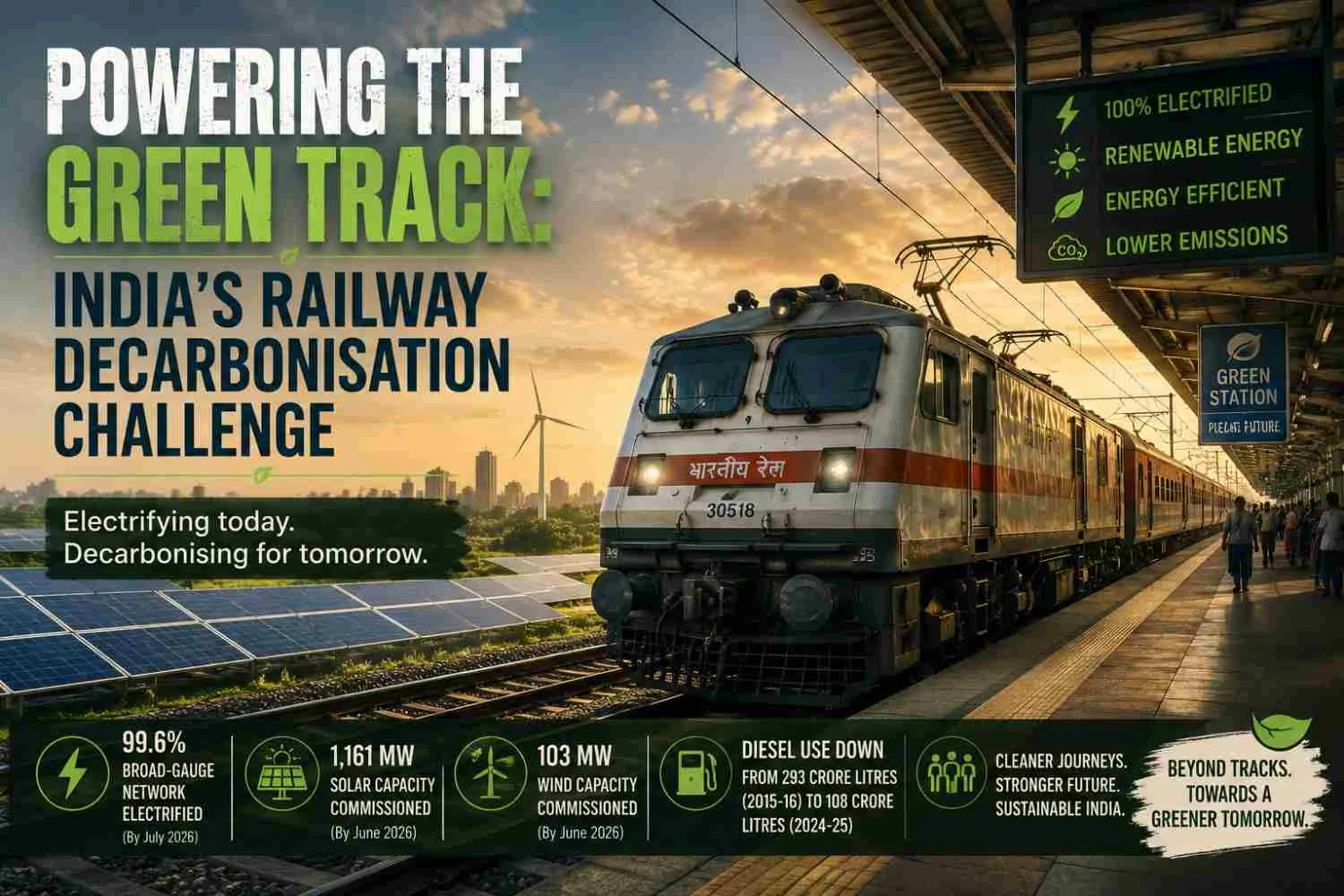
Kolkata | 27 August, 2026  India is electrifying its railway network while metro systems are adding solar power, renewable procurement and energy-efficiency measures. But as passenger numbers rise, the next challenge is deeper: making the electricity, stations and first- and last-mile connections cleaner without confusing infrastructure announcements with actual emissions cuts. SummaryIndia's railway and metro systems are undergoing a major energy transition. Indian Railways had electrified 99.6% of its broad-gauge network by July 2026, while about 1,161 MW of solar and 103 MW of wind capacity had been commissioned by June 2026. Railway electrification has also sharply reduced diesel use for traction. Delhi Metro is increasing its renewable-energy use while passenger demand continues to grow. Kolkata Metro offers another lesson through energy-efficiency improvements alongside expanding ridership. The transition therefore cannot be judged only by kilometres electrified, solar capacity installed or green-station certifications. The stronger test is whether renewable electricity is actually being used, energy consumption per passenger falls, emissions decline within a clearly defined boundary and investments deliver measurable results. Keywordsrailway decarbonisation India, green railways India, railway electrification, Indian Railways electrification, railway renewable energy, railway solar power, railway wind energy, sustainable transport India, green transportation, railway energy efficiency, metro sustainability, railway emissions reduction, low-carbon transport, railway sustainability, railway renewable electricity, green railway stations, first and last mile connectivity, sustainable mobility, railway energy transition, clean transportation India Can India’s railway system go green as fast as it electrifies?  For decades, diesel locomotives were a visible part of India’s railway emissions story. Electrification has changed that equation dramatically. Indian Railways has pushed electrification at an exceptional pace. By July 2026, Indian Railways had electrified 99.6% of its broad-gauge network, with only a small portion yet to be electrified. Between 2014 and 2026, around 48,072 route kilometres were electrified, compared with roughly 21,801 kilometres during the six decades before 2014. The transition has also reduced diesel use for railway traction. Indian Railways reported that traction-related diesel consumption fell from 293 crore litres in 2015-16 to 108 crore litres in 2024 - 25.That represents a major operational shift. But electrification raises the next question: What powers the electricity? Switching from diesel to electric locomotives reduces direct emissions, but the overall climate benefit also depends on the source of the electricity used to power them. Electrification therefore removes one major source of direct emissions, but it does not automatically make the railway system renewable or zero-carbon.That makes renewable energy the next stage of the transition. Indian Railways reported that, as of June 2026, around 1,161 MW of solar capacity and 103 MW of wind capacity had been commissioned. The solar capacity includes both rooftop and land-based projects.The numbers show that the railway’s transition is moving beyond simply replacing diesel with electricity. The next challenge is to make more of that electricity cleaner - and to measure how much renewable power actually contributes to the railway’s overall energy demand and emissions reduction. THE ELECTRIC RAILWAY TEST  DIESEL TRACTION↓RAILWAY ELECTRIFICATION↓HIGHER ELECTRICITY DEMAND↓RENEWABLE POWER↓ACTUAL CLEAN ELECTRICITY USED↓LOWER EMISSIONS PER JOURNEY Electrification is the transition. Cleaning the electricity is the deeper decarbonisation test. Can railway stations become power producers instead of just power consumers?Railway stations offer a natural opportunity for solarisation. Their rooftops, parking areas and other available spaces can support solar installations, allowing electricity to be used at the station or integrated into wider railway operations. The scale of this effort has grown rapidly. In November 2025, Indian Railways reported 898 MW of commissioned solar capacity across 2,626 railway stations. Around 629 MW was intended for traction, while the remaining capacity supported non-traction requirements such as stations, workshops, service buildings and railway quarters.That figure, however, should now be treated as a milestone rather than the latest national total. By June 2026, Indian Railways reported around 1,161 MW of commissioned solar capacity.Installed capacity alone does not tell the full story. What matters is how much renewable electricity is actually generated and used. A stronger assessment would therefore ask:•    How much electricity is the solar capacity actually generating?•    How much is being used for railway operations?•    How much is supporting traction?•    When was each plant commissioned?•    What was the capital cost?•    What is its expected operating life?•    How is its performance being monitored?•    What happens to the equipment at the end of its useful life? A station covered in solar panels may look green. Renewable capacity is only part of the picture. A station that can demonstrate actual clean-energy generation, consumption and emissions avoided offers stronger evidence of meaningful decarbonisation. What happens when more passengers choose greener transport? This is where the story becomes more complicated. A public transport system can become more efficient even as its overall electricity consumption rises. Higher energy use does not necessarily mean that the system is becoming less efficient.If more people choose a metro instead of private vehicles, the system may consume more electricity overall while producing lower emissions per passenger journey. Delhi Metro provides a useful example. DMRC’s 2025 energy case study reported that solar power contributed 32% of its total energy consumption during the period assessed. The system has also used renewable electricity procurement to reduce its dependence on conventional power.Passenger demand has also grown, with Delhi Metro recording 235.8 crore passenger journeys in 2025 compared with 223.5 crore a year earlier. The figures highlight why electricity use needs to be assessed alongside passenger demand. If ridership grows faster than energy demand, the system may become more efficient. Even if total electricity consumption increases, a decline in energy use per passenger journey can indicate improved efficiency. But if both absolute electricity consumption and emissions continue to rise, a higher renewable-energy share alone does not tell the complete story. The real measure of a greener public transport system is therefore not simply how much renewable energy it uses, but whether it can move more people with a lower environmental cost per journey. ENERGY SAVINGS VS RIDERSHIP RENEWABLE SHARE ↑RIDERSHIP ↑ENERGY EFFICIENCY ↑↓CHECKTotal energy useEnergy per passengerCarbon per passengerAbsolute emissions A greener network should be measured against the people it moves, not only the infrastructure it installs. Can Kolkata Metro cut emissions by using less electricity in the first place?Kolkata Metro offers a different lesson in decarbonisation: sometimes the cleanest unit of electricity is the one the system does not need to consume.The transition does not always require a new renewable-energy plant. Improving the efficiency of existing infrastructure can also reduce energy use and emissions.Metro Railway Kolkata has been replacing its older steel third rail with a more conductive aluminium third-rail system. The railway has stated that the upgrade can reduce energy losses by 84% on the affected system, while also reducing voltage drops and improving operational efficiency. The project highlights a simple but important principle:Electricity generated from clean sources is still wasted if it is unnecessarily lost before reaching the system that needs it. That makes energy efficiency an important part of railway and metro decarbonisation. More efficient traction systems, regenerative braking, better station cooling, energy-efficient lighting and improved energy management can all complement renewable-energy procurement. Kolkata also demonstrates why ridership needs to be part of the climate discussion.After the Green Line became fully operational in August 2025, daily ridership rose from around 78,000 to 2.04 lakh.More passengers can naturally increase a metro system’s electricity demand. But that does not automatically mean its environmental performance is worsening. If those additional passengers are shifting from private cars, motorcycles or other more carbon-intensive modes, the wider transport system could still be reducing emissions. Can a Metro Be Truly Green If Passengers Still Depend on Cars to Reach It? A metro journey does not begin when a passenger enters the station.It begins at home.That makes first- and last-mile connectivity an important part of the decarbonisation story. A passenger who walks, cycles or uses an electric feeder to reach a metro station has a very different emissions profile from someone who drives a petrol or diesel vehicle to the station. A metro’s climate benefit does not depend only on the train journey. How passengers get to and from the station matters just as much. A low-carbon metro cannot be judged only by what happens on the tracks. The entire passenger journey has to be considered. That means the transition needs to connect: Homes → Feeder transport → Metro/Railway → Feeder transport → Destination Electric buses, e-rickshaws, shared mobility, cycling infrastructure and safe pedestrian routes can extend the climate benefits of mass transit beyond the station gates. This means metro corporations need to look beyond the electricity used to run their trains. The wider question is whether the transport network makes it easy for passengers to complete their entire journey through low-emission modes. The key question is:Are metro systems making it easier for people to reach and leave stations without having to fall back on high-emission private transport?A metro may run on clean electricity, but its full environmental benefit is limited if passengers still need petrol or diesel vehicles to complete the first and last mile. THE LOW-CARBON JOURNEY HOME↓🚶 WALK / CYCLEor⚡ ELECTRIC FEEDER↓🚇 METRO / RAILWAY↓🚶 WALK / CYCLEor⚡ ELECTRIC FEEDER↓DESTINATION The train can be green. The entire journey needs to move in the same direction. Does a green railway-station certificate prove that a station is sustainable? Not by itself.Green-building and green-station certifications can provide a useful framework for improving a station’s performance across areas such as energy efficiency, renewable energy, water conservation and waste management. The IGBC Green Railway Stations rating system, for example, covers several of these areas and can help guide stations towards more sustainable design and operations.But certification and actual environmental performance are not the same thing. A stronger evidence test should ask:What was the baseline? What did the reporting boundary include? Which measures were actually commissioned? How much energy is being saved? How much water is being conserved or reused? What was budgeted, and how much was actually spent? Are the claimed savings still being measured after implementation? These questions matter because a green rating can demonstrate that specific sustainability measures have been incorporated into a project. It does not automatically prove that the station is delivering the same level of long-term carbon reduction in its day-to-day operations. Ultimately, a certificate can show what a station was designed or assessed to achieve. Actual performance data shows what it is achieving in practice. Beyond Electrification: How Green Is the Railway? THE GREEN TRANSIT SCORECARD EvidenceWhat should be measuredElectrificationRoute kilometres + commissioning dateSolarInstalled MW + actual generationWindInstalled MW + actual generationTractionRenewable electricity actually usedStationsSolar coverage + electricity consumptionEfficiencyEnergy saved + energy intensityRidershipPassenger journeys + passenger-kmEmissionsAbsolute + intensity emissionsFirst/last mileEV and public-transport connectivityCertificationBaseline + reporting boundary + performanceInvestmentBudget/capex + money actually spentOffsetsQuantity, type and relianceLifecycleConstruction, equipment and end-of-life impacts This is where corporate and government reporting needs to become much more transparent. A company supplying renewable-energy infrastructure should clearly distinguish between capacity that has been announced, installed and actually commissioned. A railway authority should separate electricity generated from electricity actually consumed. A metro corporation should demonstrate whether renewable-energy procurement is translating into measurable changes in its emissions profile. Similarly, green-station certification should be treated as one part of the sustainability assessment, not a substitute for measuring the station’s wider emissions and resource use. The distinction may sound technical, but it determines whether sustainability claims reflect what is actually happening on the ground. Can the world’s largest passenger railway network decarbonise without compromising access? There is no single technology that can answer that question. Electrification is essential, but it is only the first layer of the transition. Solar and wind power can reduce the carbon intensity of railway electricity. More efficient traction systems can reduce energy losses. Greener stations can lower energy and water demand. Metro expansion can shift passengers away from private vehicles. Electric buses and feeders can connect neighbourhoods to mass transit while keeping the wider journey cleaner. Together, these measures can move the railway and public-transport system towards lower emissions without making access to mobility more difficult. But every layer creates a new measurement challenge.The sector needs to distinguish between announced and commissioned projects, installed capacity and actual generation, renewable-energy procurement and actual renewable-energy consumption, and energy savings and measurable emissions reductions. It also needs to account for the lifecycle footprint of new tracks, stations, trains, solar equipment and other infrastructure, rather than measuring only the emissions produced during day-to-day operations. The goal is not simply to build a railway that uses more clean technology. It is to build a transport system that can demonstrate, with evidence, that it is moving more people while reducing the environmental cost of that mobility. THE REAL DECARBONISATION TEST  ELECTRIFY↓POWER WITH RENEWABLES↓REDUCE ENERGY LOSSES↓GROW RIDERSHIP↓CONNECT FIRST & LAST MILE↓MEASURE EMISSIONS PER PASSENGER↓VERIFY SPENDING & PERFORMANCE  India’s Railways Are Going Electric. But Are They Truly Low-Carbon? The evidence points to a major transition - but not a finished one.Indian Railways has reached 99.6% broad-gauge electrification, while its latest reported renewable-energy capacity stood at 1,161 MW of solar and 103 MW of wind commissioned by June 2026. Traction-related diesel consumption has also fallen substantially over the past decade. These are significant milestones. But electrification is not the finish line. It is the foundation for the next stage of decarbonisation. The harder task now is to clean the electricity powering the network, reduce energy losses, expand public-transport use and make the entire passenger journey lower-carbon - from the first mile to the last. For Indian Railways and the country’s expanding metro systems, the strongest sustainability claim will therefore not simply be:“We electrified the railway.”It will be:“We can show how much cleaner each journey has become - where the electricity came from, how much energy and carbon were actually saved, what was spent and what changed on the ground.” That means moving beyond headline numbers and proving the difference between infrastructure installed and performance achieved. Because a railway does not become truly green simply because its locomotives run on electricity. Electrifying the railway is a major step. But it is not the finish line. The transition becomes truly green when the electricity gets cleaner, energy losses fall, more people choose mass transit, and emissions per journey show a measurable decline.That is what India’s green rail transition must ultimately prove: not simply that more tracks are electrified, but that every step is making the country’s mobility cleaner and lower-carbon.  Sources: Indian Railways / Ministry of Railways — Railway Electrification & Renewable Energy, July 2026Supports the latest 99.6% broad-gauge electrification, the 1,161 MW solar + 103 MW wind commissioned by June 2026, and the fall in traction diesel consumption from 293 crore litres in 2015-16 to 108 crore litres in 2024-25. Ministry of Railways — Railway Electrification & Renewable Energy Indian Green Building Council — Green Railway Stations Rating SystemSupports the sections on green-station certification, energy and water savings, renewable energy, waste management and first-/last-mile connectivity. It also explains the performance-improvement study and third-party assessment process. IGBC Green Railway Stations Rating System Indian Green Building Council — Green High Speed Rail Rating SystemUseful for the broader low-carbon rail infrastructure, lifecycle/site boundary and first-/last-mile connectivity discussion. IGBC Green High Speed Rail Rating System Indian Railways — Renewable Energy / Solarisation milestonesUse this for the earlier 898 MW solar capacity across 2,626 stations milestone that appears in the article as historical context. For the latest figure, use the July 2026 Ministry of Railways release above. Delhi Metro Rail Corporation — Sustainability / Energy documentationThis is the source to retain for the Delhi Metro solar contribution, renewable procurement, energy efficiency and ridership portions. The official DMRC site is also the appropriate primary source for its operational and sustainability documentation. Delhi Metro Rail Corporation ...Read more
27 Aug 2026

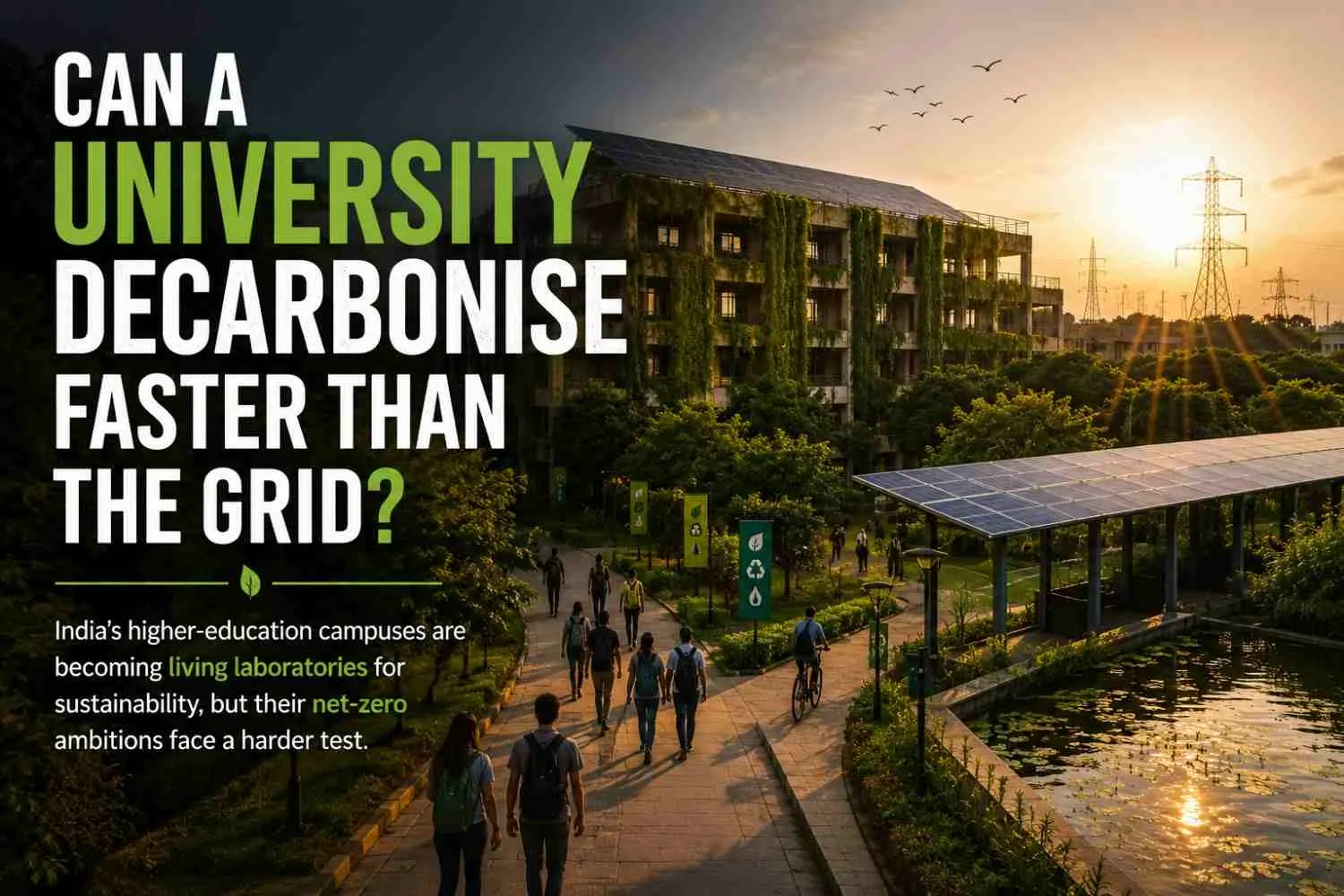
Kolkata | 27 August, 2026   India’s higher-education campuses are becoming living laboratories for solar power, green buildings, waste reduction and water conservation, while their net-zero ambitions face a harder test from carbon-intensive grids, ageing infrastructure and rising student demand. SummaryIndian IITs, IIMs and universities are increasingly incorporating renewable energy, green buildings, energy-efficient infrastructure, waste management and water conservation into campus planning. Rooftop solar can reduce dependence on grid electricity, while retrofits can make hostels, classrooms and laboratories more efficient. Campuses can also reduce emissions through wastewater reuse, rainwater harvesting, waste segregation and better cooling systems. But a green campus is not automatically a low-carbon campus. A university must account for electricity purchased from, the grid, construction and renovation emissions, transport, water and waste systems, and the growing energy demand of laboratories, data infrastructure and air-conditioning. Students can add another layer of accountability by independently tracking whether sustainability promises translate into measurable outcomes. The real test is therefore not how many solar panels or recycling bins a campus installs, but whether its absolute emissions fall, its energy intensity improves, its investments deliver measurable outcomes and its sustainability systems continue after the initial funding cycle ends. Keywordsnet-zero universities India, green campuses India, university decarbonisation, sustainable campuses, campus sustainability, net-zero campus, green building in universities, rooftop solar universities, IIT net-zero campus, IIM sustainability, university carbon neutrality, campus carbon footprint, renewable energy in universities, sustainable higher education, green buildings India, campus waste management, campus water management, student sustainability audits, energy-efficient campuses, higher education sustainability Can a university really become greener while depending on a carbon-intensive grid?A university campus can look remarkably green from the outside. Solar panels may cover rooftops, new academic buildings may carry green-building certifications, waste may be segregated, rainwater may be harvested and students may cycle across campus instead of using cars. But these visible changes only tell part of the story.Where does the campus actually get its electricity from?Rooftop solar can reduce the amount of electricity a university buys from the grid, but most large campuses cannot rely entirely on solar power throughout the day or across every season. Laboratories, hostels, libraries, computer centres and air-conditioned classrooms can require a steady supply of electricity for long hours. This creates the central challenge of the green-campus transition. A university can reduce its dependence on grid electricity without becoming independent of it. The challenge becomes even greater as campuses expand. More cooling, digital infrastructure, research equipment and other energy-intensive facilities can push electricity demand higher, meaning that energy efficiency gains do not necessarily translate into lower overall emissions. The real test is therefore not how green a campus looks, but whether it is reducing its carbon footprint as its energy needs continue to grow. THE CAMPUS CARBON EQUATION Grid Electricity•    Campus Fuel•    Buildings & Construction•    Transport•    Water & Waste         ↓TOTAL CAMPUS FOOTPRINTSolar + Efficiency + Circular Systems          ↓EMISSIONS REDUCTION  The real test: Does the total footprint actually fall?   Are rooftop solar panels cutting emissions - or simply cutting electricity bills?Solar panels have become one of the most visible signs of a green campus. For universities, rooftop solar can deliver two benefits at the same time: lower electricity costs and lower emissions from grid power. But the number of panels installed does not, by itself, show environmental progress. A university can announce a large solar project and still rely heavily on grid electricity if the installed capacity is not fully operational or generation remains limited. The more meaningful questions are: How much solar capacity is actually operational? How much electricity does it generate each year? What share of the campus’s total electricity demand does it meet? How much grid power has it replaced? How much was invested? What is the expected payback period? And what will happen to the panels when they reach the end of their useful life? These questions become particularly important for IITs, IIMs and other institutions making carbon-neutrality or net-zero commitments. A megawatt of installed solar capacity is an activity. The electricity actually generated and the emissions demonstrably avoided are the outcomes that matter.Can old hostels become greener without rebuilding them? India’s university campuses also have a major opportunity in the buildings they already have. Many hostels, lecture halls, laboratories and administrative blocks were constructed decades ago, before energy efficiency became a central part of building design. Retrofitting these buildings can therefore deliver significant improvements without requiring complete reconstruction. Measures can include LED lighting, energy-efficient air-conditioning, building-management systems, insulation, improved windows, smart electricity controls, solar water heating, efficient pumps and better ventilation. Organisations such as IGBC and GRIHA Council have helped establish frameworks for improving the environmental performance of buildings. But achieving a green-building certification should not become the end goal. A building may receive a green rating because it meets specified design and construction requirements. How it actually performs once students, faculty and staff occupy it - is a separate question. For universities, the stronger test is simple: how much energy did the building consume before the retrofit, and how much does it consume afterwards? That comparison shows whether a green upgrade is delivering measurable energy savings rather than simply a greener label. THE GREEN-BUILDING TESTBEFORE RETROFIT Energy useWater useCooling demandMaintenance cost ↓ RETROFIT SolarEfficient coolingInsulationLightingSmart controls ↓ AFTER RETROFITEnergy saved?Water saved?Emissions reduced?Operating cost reduced? Certification shows design intent. Performance data shows what actually happened.   What happens to the waste and water a campus produces?Decarbonisation does not begin and end with electricity. A university campus functions much like a small city, with thousands of students, faculty members and staff using classrooms, hostels, laboratories, kitchens, cafeterias and other facilities every day. All of these activities create environmental pressures beyond energy use. Campuses generate solid waste, food waste, wastewater and other forms of resource demand that need to be managed alongside their carbon footprint. A campus cannot claim to be truly sustainable simply because its rooftops carry solar panels if its waste is poorly managed or its wastewater systems are inadequate. The green-campus question therefore extends beyond where electricity comes from to what happens to the resources and waste flowing through the campus every day. A serious green-campus strategy therefore needs to consider: Waste → segregation → recovery → recycling → residual disposal and Freshwater → consumption → wastewater → treatment → reuseRainwater harvesting can help reduce dependence on freshwater sources, while treated wastewater can be reused for landscaping, toilet flushing and other non-potable needs. Food waste can also be composted or sent through other recovery systems instead of being discarded. But the presence of rainwater tanks, composting units or wastewater-treatment plants does not, by itself, demonstrate environmental progress. Universities should report how much waste they generate, how much is recovered, how much is recycled or composted, and where the remaining waste ultimately goes. Water reporting should be equally transparent. Campuses should disclose freshwater withdrawals, total water consumption, the volume of wastewater treated and how much treated water is actually reused. These figures can give students, administrators and other stakeholders, a much clearer picture of how efficiently a campus uses resources - and where its environmental footprint still remains. Can students become the campus’s sustainability auditors?This could be one of the most valuable opportunities for higher education. Students do not have to remain passive beneficiaries of a greener campus; they can also become part of the system that monitors and questions its environmental performance. Engineering students can track electricity use and solar generation. Management students can examine sustainability budgets and spending. Architecture students can study how buildings perform after green upgrades. Public-health students can monitor indoor temperatures and heat exposure. Environmental studies students can track waste and water use, while journalism students can investigate whether a university’s sustainability claims match what is actually happening on campus. This approach can turn the university into a living laboratory, where sustainability is not just taught in classrooms but observed and tested in the institution itself. However, student participation should complement - not replace - professional auditing. Students can identify gaps, collect observations, analyse data and question institutional claims, while independent technical verification should remain in place wherever specialised assessment or certification is required. The goal is not to turn students into unpaid auditors. It is to give them a meaningful role in making the campus more transparent, measurable and accountable.  STUDENT SUSTAINABILITY AUDIT  ENERGY → Solar generation / grid dependence BUILDINGS → Energy intensity / cooling WATER → Freshwater / reuse WASTE → Generation / recovery / disposal TRANSPORT → Public transport / walking / cycling / EVs PROCUREMENT → Sustainable materials / suppliers ↓ STUDENT AUDIT REPORT Promise → Evidence → Gap → Recommendation   What happens when a green campus keeps expanding?There is another contradiction that net-zero plans need to confront: universities are growing, and growth itself has an environmental cost. New hostels, laboratories, classrooms and research facilities require concrete, steel, glass, cooling systems and other materials. A new green building may use less energy once it is occupied, but its construction still creates emissions and consumes resources. That means campus sustainability cannot be measured only through operational electricity use. Universities need to define a clear reporting boundary that captures the wider environmental impact of their activities. Does the footprint include new construction? Outsourced transport? Staff and student commuting? Purchased electricity? Refrigerants used in cooling systems? Or waste generated by contractors? If these sources are left outside the calculation, a university could report a smaller carbon footprint without addressing the emissions linked to its wider operations. A credible net-zero plan must therefore account for the emissions a university creates—not simply the emissions it chooses to count.Can corporate green-building partnerships create lasting change?  Corporate partnerships can play a useful role in campus decarbonisation. Companies such as Saint-Gobain, building-management firms, developers and other green-building partners can provide energy-efficient materials, cooling systems, building-management technology, solar solutions and retrofit expertise. But corporate involvement also needs to pass the same evidence test as the university’s sustainability claims. Was the intervention funded through CSR or delivered as a commercial project? Who paid for the capital investment? How much did the company contribute? What savings were expected? And who will maintain the system once the project is complete? These distinctions matter because installing a green technology is not the same as delivering a measurable and lasting reduction in emissions. Universities should therefore report the budget, actual expenditure, expected energy or emissions savings and the system’s actual performance after implementation. That makes it possible to distinguish between a partnership that simply delivers new infrastructure and one that produces a measurable environmental improvement.Can a campus measure sustainability without hiding behind percentages?This is where the evidence test becomes crucial. A reported “30% reduction in emissions” may sound impressive, but it does not tell the full story without context. Thirty per cent compared with what baseline? Over which period? Across which buildings? Was campus occupancy higher or lower? Did electricity demand change? Were construction emissions included? And was the reduction measured in absolute emissions or per student? Universities need to disclose their baseline, reporting boundary, methodology and measurement period alongside headline percentages. Absolute figures can show the scale of emissions, while intensity measures - such as emissions per student, per square metre or per unit of electricity consumed - can help compare campuses of different sizes. The same principle should apply to every major sustainability claim: solar generation, water savings, waste recovery, energy efficiency and carbon reductions should be backed by transparent data rather than isolated percentages. A green campus is not defined by the size of its sustainability claims. It is defined by whether those claims can be measured, compared and independently verified. THE GREEN CAMPUS SCORECARD  MeasureWhat should be reported?BeneficiariesStudents, faculty and staff actually coveredEnergyTotal consumption + energy intensitySolarInstalled capacity + actual generationBuildingsPre- and post-retrofit performanceWaterWithdrawal + consumption + reuseWasteTotal generated + recovered + final destinationCarbonAbsolute emissions + emissions intensityInvestmentBudgeted vs actually spentOutcomeActual reduction achievedContinuityWhat remains operational after funding ends A 20% reduction in energy intensity may sound like significant progress. But the more important question is: what happened to the university’s total electricity consumption? If a campus doubles its size while it’s energy use falls slightly per square metre, it’s overall electricity demand could still increase. That is why universities need to report both absolute and intensity-based results. Absolute figures show the total amount of energy or emissions being generated, while intensity measures show how efficiently that energy is being used relative to factors such as floor area or student population. The same principle applies to carbon emissions. Before claiming progress towards net zero, a university should clearly disclose its baseline, measurement methodology and reporting boundary. A lower percentage does not always mean a lower footprint. The numbers need context to show what has actually changed. So, what would a genuinely green campus actually look like?It would not necessarily be the campus with the most solar panels, the most green-building certificates or the longest list of sustainability initiatives. It would be a campus that can clearly account for its environmental footprint. It would know where its energy comes from, how much electricity it consumes, how its buildings perform, how much water it uses, where its waste goes and how its emissions are changing over time. It would consider lifecycle emissions when constructing new buildings instead of treating a green certification as the final measure of sustainability. It would also prioritise retrofitting older infrastructure where improvements can reduce energy and resource use, rather than focusing only on new construction. Water reuse and waste recovery would be measured through actual volumes and outcomes, not simply through the number of treatment plants, collection bins or recycling facilities installed. Students would have the opportunity to examine campus data, question sustainability claims and contribute to monitoring - while independent technical audits would provide verification where needed. And most importantly, sustainability would not depend on one CSR partnership, one university administration or one publicity campaign. A genuinely green campus is one where sustainable practice become part of how the institution operates - and continue to deliver measurable results even when the people, funding and projects behind them change. FROM GREEN CAMPUS TO NET-ZERO CAMPUS  MEASURE↓BASELINE↓REDUCE DEMAND↓RETROFIT BUILDINGS↓ADD RENEWABLE ENERGY↓CIRCULARISE WATER & WASTE↓VERIFY RESULTS↓ CONTINUE AFTER FUNDING   Can a university decarbonise faster than the grid?Yes. A university can reduce its own emissions faster than the wider electricity system changes—but it cannot simply disconnect itself from the grid. That is precisely where the opportunity lies. Universities can become living laboratories for decarbonisation: campuses where students, researchers, administrators and private partners can test technologies, measure results and learn what actually works in the real world. For CSR programmes and institutional sustainability plans, the defining question should therefore not be: “How many solar panels did the campus install?” It should be: “How much energy, water, waste and carbon did the campus actually reduce? How much did it cost? And is that improvement still delivering results?” A credible green campus should be able to show its baseline, account for its spending, disclose both absolute and intensity-based results, and explain what happens when a project or funding cycle ends. Because sustainability cannot be measured by appearances. A campus may have solar panels, green buildings, recycling bins and water-treatment systems and still struggle to reduce its overall footprint if its energy demand keeps rising or its wider emissions remain outside the reporting boundary. The real test is whether the entire campus moves towards lower resource use and lower emissions - and whether the evidence proves that progress. A university does not become sustainable simply when it looks green. It becomes sustainable when its buildings, electricity, water, waste and people move in the same direction - and the numbers can prove it. That is how a campus can become more than a demonstration of sustainability. It can become a model for how decarbonisation actually works.   Primary sources: IIT Delhi — Climate Action Plan & GHG Emission InventoryUseful for its Net Zero 2040 target, Scope 1/2/3 framework, renewable power, rooftop solar and campus sustainability measures. (IIT Delhi)IIT Delhi Climate Action PlanIIT Madras — Climate Action PlanUseful for the campus-wide climate strategy, carbon neutrality, academic buildings, hostels, laboratories, biodiversity and sustainability roadmap. (IIT Madras)IIT Madras Climate Action PlanIIT Madras — Carbon Footprint ReportParticularly important for your evidence-test section because it defines the campus boundary and explains Scope 1 and Scope 2 emissions, including purchased grid electricity. (sustainability.iitm.ac.in)IIT Madras Carbon Footprint ReportIIM Calcutta — Sustainability FrameworkThis is one of the most important sources for your article. It documents IIM Calcutta's Net Zero Campus 2036 target, carbon assessment, renewable expansion, emission reduction, energy/water/waste management and carbon audits. (IIM Calcutta)IIM Calcutta Sustainability FrameworkIIM Calcutta — Campus Transformation / Net-Zero Campus PlanUseful for the academic-block and hostel retrofit/construction angle, including its earlier plan for a Net Zero Energy, Net Zero Discharge and Net Zero Waste campus. (IIM Calcutta)IIM Calcutta Campus Transformation PlanIIT Bombay — Campus Sustainability AssessmentUseful for the campus-as-a-living-lab, sustainability assessment, resource management, student involvement and growing infrastructure-demand angle. (gesh.iitb.ac.in)IIT Bombay Campus Sustainability AssessmentIGBC — Green Campus Rating System, Version 1.0 (January 2026)Very important for your section questioning whether green certification equals actual performance. It explains documentation, third-party assessment, preliminary vs final submissions and implementation evidence required before certification. (IGBC)IGBC Green Campus Rating System 2026GRIHA Council — GRIHA for Existing BuildingsUseful for the green-building retrofit argument. It specifically discusses reducing energy and water demand in existing buildings and the importance of continuous performance monitoring. (GRIHA)GRIHA for Existing BuildingsGRIHA Council — Rated Projects 2025This gives you a concrete campus example: IIT Hyderabad's AD3 project reports a 51.25% reduction in energy performance index from the GRIHA base case, 3.5 MW solar PV, 73% reduction in building water demand and campus-level sewage-treatment infrastructure. (GRIHA)GRIHA Rated Projects 2025Bureau of Energy Efficiency — Energy Conservation Building Code (ECBC)Useful for the energy-efficient building and retrofit section. BEE's material specifically includes educational buildings such as colleges and universities within the building-energy-efficiency framework. (Bee India)BEE — Energy Conservation Building Code materialAssociation of Indian Universities — University NewsUseful for the broader higher-education sustainability framework, including sustainable buildings, reducing energy and water consumption, waste reduction, student/faculty engagement and industry/civil-society collaboration. (Association of Indian Universities)AIU University News — Sustainability in Higher Education ...Read more

17 Aug 2026

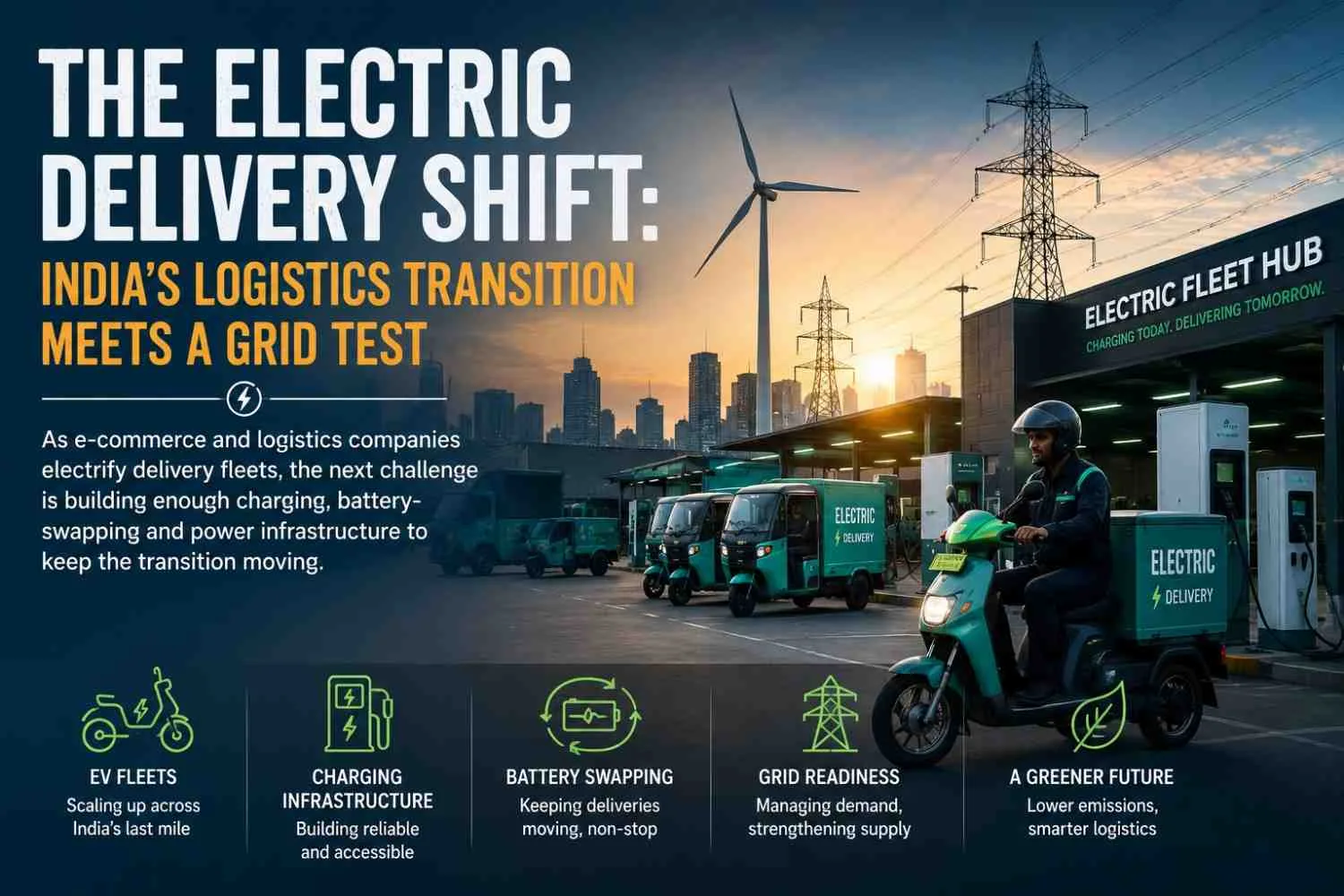
Kolkata | 17 August 2026  As e-commerce and logistics companies electrify delivery fleets, the next challenge is building enough charging, battery-swapping and power infrastructure to keep the transition moving. SummaryIndia’s e-commerce and logistics sector is steadily shifting towards electric delivery vehicles as companies seek to reduce fuel costs and transport emissions. Amazon has already crossed its target of 10,000 electric delivery vehicles in India, while Flipkart has reported more than 13,000 EVs in its delivery ecosystem and is working towards a fully electric fleet by 2030. However, the transition involves more than replacing conventional vehicles with EVs. Commercial fleets also require dependable charging and battery-swapping infrastructure, adequate grid connections and careful management of electricity demand. As electric fleets expand across delivery hubs and logistics networks, the availability and capacity of supporting power infrastructure will become central to the success of India’s commercial e-mobility transition. Is India’s E-commerce Sector Ready to Electrify the Last Mile?  Every day, thousands of delivery vehicles carry parcels across Indian cities. These vehicles often follow fixed routes, return to warehouses or delivery hubs and operate for long hours, making last-mile logistics one of the areas where electric vehicles can be adopted at scale. The transition is already underway. Amazon India set a target of deploying 10,000 electric delivery vehicles by 2025 and reached that goal ahead of schedule. Flipkart has set a longer-term target of making its last-mile delivery fleet fully electric by 2030. The shift is also spreading beyond the country’s largest e-commerce companies. Electric mobility firms are supplying vehicles to quick-commerce platforms, food-delivery companies and logistics operators, expanding the market for electric two-wheelers, three-wheelers, vans and other commercial vehicles. But the size of an electric fleet alone does not show whether the transition is working or not. For an EV to be useful in commercial delivery, it must be able to complete its route, recharge within the required time and return to service without disrupting operations. That makes charging infrastructure one of the biggest challenges in India’s move towards electric last-mile delivery. What Happens When the Vehicle Is Ready but the Charger Isn’t? For a private EV owner, charging can usually be planned around personal schedules. For a commercial delivery fleet, however, charging directly affects business operations. Every hour a delivery vehicle spends waiting for a recharge is an hour it is not on the road making deliveries. The challenge becomes even greater when several vehicles return to the same warehouse or delivery hub around the same time, creating a sudden increase in electricity demand. This is why companies are gradually exploring dedicated fleet-charging hubs instead of relying entirely on public charging stations. Tata Power has been expanding its charging network across public, semi-public and fleet locations, while oil and energy companies are also becoming part of the growing EV-charging ecosystem. The wider transition involves companies such as NTPC, NTPC Green, Tata Power, Reliance New Energy, ReNew, Adani Green, Indian Oil and GAIL. Their roles vary from renewable power generation and electricity supply to charging infrastructure, energy storage and existing fuel-station networks - but they are connected to the same shift towards electric mobility. The last-mile EV transition, therefore, is no longer just about replacing petrol and diesel vehicles with electric ones. But also, about building the energy and charging infrastructure needed to keep those vehicles moving.Could Battery Swapping Help Delivery Fleets Stay on the Move?  Charging time matters even more for electric two- and three-wheelers that spend most of the day making deliveries. For these high-use vehicles, battery swapping can offer an alternative to conventional charging. Instead of waiting for a depleted battery to recharge, a delivery vehicle can exchange it for a fully charged one and get back on the road. Reliance’s Jio-bp has explored battery-swapping and Battery-as-a-Service models for electric mobility, while India’s policy framework has also started recognising battery swapping as part of the broader EV-charging ecosystem. For delivery companies, the benefit is clear: less time spent charging can mean more time making deliveries. However, battery swapping also creates new challenges. Companies will also need to address key questions around battery ownership and maintenance, compatibility across different vehicle models, the location of swapping stations and who will bear the cost of setting up and operating the network.  Without common standards and enough vehicles using the network, swapping stations may struggle to reach the scale needed to remain commercially viable. Battery swapping can help reduce charging downtime, but it does not remove the need for a strong and reliable infrastructure network. Instead, it shifts the focus from charging stations to a wider network of batteries, swapping points and supporting systems.  Could Faster Charging Put More Pressure on India’s Power Grid?  One of the less visible challenges of the EV transition is its growing impact on India’s electricity network. Electric vehicles reduce dependence on petrol and diesel, but they also shift transport energy demand from fuel stations to the power grid. For commercial delivery fleets, this shift can be particularly significant because vehicles often operate for long hours and need to recharge within tight schedules. A large delivery depot could have dozens or even hundreds of vehicles requiring power within a limited period. If several vehicles charge at the same time, the local distribution network could face a significant increase in demand. This does not necessarily mean that India’s power grid cannot support the growth of electric vehicles. The bigger issue is where, when and how that electricity is consumed. Smart-charging systems can shift charging to periods of lower electricity demand. Battery storage can help manage peak loads, while renewable energy can reduce the emissions associated with charging. Careful planning can also help companies avoid placing large charging facilities in locations where the local power network is already under pressure. The move towards electric delivery, therefore, cannot be managed by fleet operators alone. Companies and electricity providers will need to plan charging capacity together so that the growth of electric fleets does not create unnecessary pressure on the power system. Can India’s Commercial Freight Sector Make the Bigger Shift to Zero Emissions? Electrifying two- and three-wheelers may be relatively easier, but heavy commercial vehicles present a much bigger challenge. Electric trucks require larger batteries, higher-capacity charging systems and careful route planning to ensure they can cover long distances without disrupting delivery schedules. India is beginning to identify priority freight corridors for zero-emission trucking, with charging infrastructure being planned along major routes. Over time, this could help connect warehouses, logistics hubs and cities through dedicated electric freight networks. However, the financial and operational challenges of this transition cannot be overlooked. Companies will need to account for vehicle purchase costs, battery replacement, charging infrastructure, land requirements, grid connections, electricity tariffs and ongoing maintenance. For investors and corporate sustainability teams, therefore, the important question is not simply whether a company has announced a target for electric trucks. The real test is whether the company has the business model, infrastructure and financial capacity to achieve that target at scale. Could Renewable Energy Make Commercial EVs Even Cleaner?  The environmental benefits of commercial electric vehicles become stronger when the electricity used to charge them comes from renewable sources. In other words, the transition is not only about replacing petrol and diesel vehicles with EVs, but also about ensuring that the electricity powering those vehicles comes from cleaner sources.This is where India’s renewable-energy and power-sector companies have an important role to play. Companies such as NTPC Green, ReNew and Adani Green can contribute to the broader clean-energy ecosystem supporting electric transport, while Tata Power can help connect electricity supply with the charging infrastructure needed by commercial fleets.   The future may therefore involve a much more integrated system:   THE LAST-MILE ELECTRIFICATION CHAIN  Renewable electricity↓Grid & energy storage↓Charging / battery swapping↓Electric delivery fleet↓Zero-emission last-mile deliveries  The success of the transition depends on how well these different parts work together. A growing EV fleet needs sufficient charging capacity to operate smoothly, while charging infrastructure must be supported by proper grid planning to avoid new pressure on the electricity network. At the same time, powering electric vehicles with cleaner electricity can further increase their overall emissions benefits.  The EV Is Only the Beginning   The real test of India’s commercial EV transition will not be the number of targets companies announce. It will be the evidence they provide on what has actually changed.  A company promising a 100% electric fleet by 2030 has set a target. It has not yet achieved an outcome.   To show real progress, companies should disclose how many electric vehicles are currently in operation, what share of deliveries they handle, how many kilometres they travel and how much petrol or diesel use they have replaced. Charging infrastructure also needs to be measured by what it can actually deliver, rather than simply the number of stations announced or installed. Similarly, battery-swapping investments should be assessed through their actual use and operational performance. The financial picture matters too. Companies should clearly report the amount they committed to the transition, the amount actually spent, the number of EVs deployed, the charging capacity brought into operation, the baseline from which progress was measured and the changes achieved as a result.This evidence can help investors assess whether electrification is becoming an integral part of a company’s operations or remains largely a sustainability commitment on paper. The bigger question, then, is whether India can electrify its last-mile delivery network without creating new pressure on the systems that support it. The answer will depend not simply on how quickly companies purchase EVs, but on how effectively the wider ecosystem develops. India needs more electric vehicles, but it also needs well-planned charging hubs, reliable electricity connections, battery-swapping networks where they make economic sense and smart-charging systems that can manage peak demand. Most importantly, companies need to report what happened after the announcement. The case for electrifying commercial delivery is strong. These vehicles operate frequently, travel extensively through cities and account for significant fuel costs. Switching to EVs can help businesses reduce operating costs while also cutting local air pollution and transport-related emissions. But replacing a petrol or diesel vehicle with an electric one is only the beginning. The vehicle may be the most visible part of the transition, but it is supported by a much larger system of batteries, chargers, electricity networks, distribution infrastructure, renewable energy and investment. India’s e-commerce boom has already created the demand for this transition. Now the energy system has to build the capacity to support it. And that is the real story of India’s electric last mile: the shift may begin with an EV, but achieving genuinely lower emissions will depend on the entire system behind it - from batteries and charging infrastructure to the power grid and clean energy.   Primary sources  Amazon India — 10,000 EV milestoneSupports Amazon’s 10,000-EV target, its achievement ahead of schedule, deployment across 500 cities and its continuing work on electric heavy goods vehicles. Amazon India — 10,000 electric vehicles milestone Flipkart — Sustainability JourneySupports Flipkart’s 13,300 EVs and its commitment to 100% electric mobility by 2030. Flipkart — Building for tomorrow: sustainability journey Flipkart — EV Assist, June 2026Supports the current figure on delivery-partner adoption, including the 6,000+ delivery-partner study and 46% willingness to transition to EVs, as well as the 2030 ambition. Flipkart — EV Assist Tata Power — Integrated Annual Report 2025–26Supports the article’s discussion of commercial/fleet charging infrastructure, with 5,800+ public, semi-public and fleet charging points and 1,200+ e-bus charging points reported as operationalised. Tata Power — Integrated Annual Report 2025–26 Reliance Industries / Jio-bp — EV and battery-swapping initiativesSupports the claims about Jio-bp exploring battery swapping, Battery-as-a-Service and charging/swapping points, including applications for three-wheelers and commercial/last-mile mobility. Reliance — Jio-bp and Mahindra EV partnership Central Electricity Authority — EV Charging Station / Power Consumption ReportsThis is the key government source for the article’s grid and electricity-demand section. CEA maintains dedicated EV Charging Station/Power Consumption Reports as part of its energy-transition work. CEA — EV Charging Station / Power Consumption Reports Ministry of Power — EV Charging Infrastructure GuidelinesSupports the article’s discussion of charging infrastructure, grid-support requirements and fast charging for long-range/heavy-duty EVs. The guidelines specify fast-charging stations for heavy-duty vehicles at 100-km intervals on designated highways and call for supporting infrastructure such as transformers and feeders. Ministry of Power — EV Charging Infrastructure Guidelines WRI India — Electrifying India’s HighwaysSupports the section on electric freight and explains why e-truck charging requires high-capacity grid connections, larger sites and carefully planned electrical systems. WRI India — Electrifying India’s Highways WRI India — Accelerating India’s Freight DecarbonizationSupports the article’s discussion of electric freight, charging constraints, corporate adoption and the structural challenges facing zero-emission trucking. It currently reports 869 electric medium- and heavy-duty freight vehicles and identifies charging infrastructure and upfront costs as major barriers. WRI India — Accelerating India’s Freight Decarbonization WRI India — Fi-ZET: Financial Impact Assessment for Zero-Emission TrucksSupports the article’s discussion of the financial and operational feasibility of electric trucks, including vehicle costs, financing and route-specific economics. WRI India — Fi-ZET           ...Read more

10 Aug 2026

Kolkata | August 6, 2026 Climate-tech companies are beginning to deliver the kind of investor returns once reserved for mainstream technology start-ups. High-value private equity exits, founder wealth creation and employee stock payouts suggest India's green economy is entering a more mature phase. Yet behind the headline deals lies a more complex reality, although sustainability attracts unprecedented investment globally, many early-stage climate innovators still struggle to secure the capital they need. Quick SummaryIndia's climate-tech ecosystem is reaching an important milestone as sustainability-focused start-ups begin generating meaningful financial returns for investors, founders and employees. Successful private equity exits, strategic acquisitions and expanding ESOP wealth creation indicate that green businesses are gradually moving from experimental ventures to commercially viable enterprises capable of attracting institutional capital. These developments could strengthen investor confidence and encourage greater participation from banks, infrastructure funds, venture capital firms and green-bond issuers. However, beneath these success stories, early-stage climate-tech companies continue to face tightening funding conditions, higher investor expectations and longer fundraising cycles. As India's clean economy expands, the real challenge is ensuring that capital supports not only established winners but also the next generation of innovators developing technologies needed for the country's long-term climate transition. KeywordsClimate Tech, Green Investment, PE/VC, Sustainable Finance, Green Startups, Climate Innovation, ESG Investment, Clean Technology, Startup Funding, India Sustainability Are Climate-Tech Exits Creating a Stronger Green Investment Cycle? For years, climate-tech entrepreneurs faced a familiar question: Can sustainability generate attractive financial returns? Although investors recognised the long-term potential of sectors such as clean energy, battery recycling, carbon capture, green materials and circular manufacturing, many remained cautious about investing. Climate-tech businesses often require years of research, large upfront investments and supportive government policies before they become profitable, making them a riskier bet than many conventional technology start-ups.That perception is gradually changing.Across India, a growing number of climate-tech companies are moving beyond the experimental stage and proving that environmental innovation can also be commercially successful. High-value acquisitions, private equity exits and strategic investments are giving investors the returns they have been waiting for while rewarding founders who have spent years building businesses around the low-carbon economy. For venture capital and private equity firms, these deals represent far more than isolated success stories. Every successful exit strengthens confidence that climate-tech can become a profitable business. It shows that companies in the sector can grow, attract institutional buyers and generate competitive returns, encouraging more investors to back climate-focused innovation.The benefits are also reaching employees.Many professionals who joined climate-tech start-ups in their early years are now benefiting through Employee Stock Ownership Plans (ESOPs), turning years of equity ownership into real financial gains. In a sector long driven by purpose as much as profit, wealth creation is becoming an important sign of maturity. These success stories are also helping attract experienced professionals who may once have viewed climate-tech as a risky career choice. However, the headlines tell only part of the story. While a handful of established climate-tech companies are securing impressive valuations and rewarding investors, many younger start-ups continue to struggle to raise funding. Investors have become far more selective, preferring businesses that already have clear revenue streams, strong financial performance and a realistic path to profitability. As a result, many promising early-stage innovators are finding it difficult to secure the capital needed to grow. This reflects one of the biggest challenges facing India's green economy. If the wealth created through successful exits is reinvested across the broader climate-tech ecosystem, it could encourage new ideas, support emerging businesses and accelerate India's transition to a low-carbon economy. But if investment remains concentrated in a small number of mature companies, many promising innovators may never receive the support needed to develop the technologies that will drive India's future in clean energy, resource efficiency and net-zero development. The debate is therefore no longer about whether climate-tech can create economic value. The real question is whether today's success stories will generate enough fresh investment to support tomorrow's innovators and strengthen the ecosystem that made those achievements possible. From Climate Ambition to Commercial Returns India's climate-tech sector has changed dramatically over the past decade. What was once a niche investment space focused mainly on renewable energy has grown into a broad ecosystem of businesses working on electric mobility, battery technologies, sustainable materials, carbon management, resource efficiency and circular economy solutions. This growth has been fuelled by a combination of government support, rising investor confidence and increasing demand from businesses for low-carbon technologies. Policies promoting clean energy, electric vehicles and green manufacturing, together with India's net-zero commitment and growing ESG expectations, have encouraged companies to develop solutions that not only reduce environmental impact but also create long-term commercial value. As the sector has matured, the pattern of investment also evolved.In the early years, most climate-tech start-ups depended on angel investors, incubators and venture capital firms willing to back high-risk ideas. Today, many successful companies are attracting larger investors, including private equity firms, infrastructure funds, strategic corporate buyers and institutional investors. This shift reflects growing confidence that climate-tech can deliver strong and sustainable financial returns.For investors, a successful exit represents far more than the success of a single company. When a company is acquired or investors sell their stake, they recover their investment, demonstrate returns to their backers and free up capital to invest in the next generation of start-ups.  This recycling of capital is essential for keeping the innovation ecosystem healthy. Without successful exits, investors become more cautious, fundraising slows and fewer new businesses receive the support they need to grow.India is beginning to see the benefits of this cycle.Large infrastructure investors, climate-focused funds and financial institutions are treating green businesses as long-term investment opportunities rather than experimental ventures. Organisations such as IREDA continue to expand financing for renewable energy and clean technology projects, while SIDBI Venture Capital is strengthening support for innovation-driven enterprises. Alongside them, specialised climate funds and impact investors are broadening the range of financing available for businesses working on decarbonisation, sustainable manufacturing and resource efficiency.The country's expanding green finance market is also playing an important role. Green bonds, sustainability-linked loans and ESG-focused investment products are opening new funding channels and attracting larger pools of institutional capital. Banks, non-banking financial companies (NBFCs) and infrastructure funds are gradually evaluating climate-tech businesses not only for their environmental benefits but also for their commercial potential and long-term resilience. While the sector has made significant progress, important hurdles remain.  While established climate-tech companies are attracting larger investments and delivering successful exits, many younger start-ups continue to struggle to raise funding. Investors have become more selective, favouring businesses with proven revenues, efficient operations and a clear path to profitability. As a result, many promising start-ups are finding it difficult to secure the funding needed to develop and expand their technologies. This growing gap raises an important question. If successful exits are creating wealth and attracting new investors, how can India ensure that enough of this capital reaches the next generation of climate innovators who will drive the country's future green economy?   The Climate-Tech Capital Cycle Innovation → Seed Funding → Series A/B Growth Capital → Scale-Up → Private Equity / Strategic Investment → Exit → Capital Reinvested into New Climate Start-ups Key takeaway: Successful exits do more than reward investors- they recycle capital back into the innovation ecosystem. The Exit Economy: When Green Innovation Starts Delivering Returns For venture capital and private equity investors, a successful exit is more than a profitable deal- it is a sign that an industry has reached a new level of maturity. Climate-tech companies have traditionally taken longer to grow than conventional technology start-ups. Many require significant investment, years of research and supportive regulations before becoming commercially successful. Because of this, investors often had to wait much longer to see returns. Today, however, successful acquisitions, private equity exits and secondary sales are changing that picture, showing that businesses built around sustainability can generate strong financial returns alongside environmental impact. These success stories are boosting investor confidence. Institutional investors are viewing climate-tech as a promising long-term investment rather than a niche sustainability sector. Large transactions in renewable energy, electric mobility, battery technology, climate software and sustainable materials are encouraging infrastructure funds, pension-backed investors and growth capital firms to increase their exposure to India's green economy. The gains are not limited to investors and founders. Employees who joined climate-tech companies in their early years are also beginning to benefit through Employee Stock Ownership Plans (ESOPs), turning years of equity ownership into significant financial rewards. These outcomes are helping attract experienced engineers, scientists, sustainability professionals and business leaders who may once have considered climate-tech too risky as a long-term career choice. For entrepreneurs, successful exits carry equal importance. They validate years of innovation, business development and investor confidence, proving that sustainability-focused businesses can scale successfully while delivering meaningful environmental solutions.  Many founders who achieve successful exits also go on to become angel investors or mentors, using their experience and capital to support the next generation of climate-tech start-ups. However, these encouraging developments reveal only one side of the story. While established climate-tech companies are attracting larger investments and delivering strong investor returns, many younger start-ups continue to face a difficult fundraising environment. Investors are becoming selective, favouring businesses with stronger revenues, clear business models and a faster path to profitability. As a result, many early-stage companies developing new technologies are finding it harder to secure the funding needed to grow. This has created an uneven investment landscape. A small number of mature companies are generating impressive returns, while many promising start-ups continue to struggle for early-stage funding. Industry experts warn that if investment remains concentrated only in established businesses, India could slow the development of the next generation of technologies needed to support its long-term decarbonisation and sustainability goals. Successful exits, therefore, are only part of the story. They prove that climate-tech can create both environmental impact and financial value. But the long-term strength of the sector will depend on whether today's returns are reinvested in the innovators building tomorrow's clean technologies. Where the Returns Go Successful Climate-Tech Exit ⬇ ✔ Investors recover capital ✔ Employees benefit through ESOPs ✔ Founders gain liquidity ✔ Confidence in climate-tech grows ✔ Fresh capital flows into future ventures Key takeaway: Every successful exit has the potential to finance the next generation of climate innovation- but only if capital continues moving downstream.  Beyond the Headlines: Are Green Returns Reaching the Next Generation of Innovators? The recent wave of climate-tech exits has strengthened confidence in India's green economy. However, experts caution that headline valuations and high-profile deals alone do not reflect the true health of the sector.Every successful acquisition or investor exit marks the end of one investment journey. The bigger question is whether the money generated from these deals is being reinvested in the next generation of climate-tech start-ups or remaining concentrated in a small number of established companies. Research organisations such as the Council on Energy, Environment and Water (CEEW), Climate Policy Initiative India (CPI India) and WRI India have consistently pointed out that achieving India's climate and net-zero goals will require steady investment at every stage of innovation. This includes everything from early research and product development to large-scale commercial deployment. In other words, a strong climate-tech ecosystem depends not only on successful exits but also on a continuous flow of funding for new ideas and emerging businesses. This is where the funding gap becomes more visible. While investors continue to announce ambitious climate commitments, much of the available capital is flowing towards companies with proven business models and stable revenues. Early-stage start-ups working on technologies such as green materials, carbon removal, industrial decarbonisation and advanced battery solutions often face longer fundraising periods and greater difficulty attracting investment, despite their long-term importance. For policymakers, the challenge is not simply attracting more investment but ensuring that it reaches the right parts of the ecosystem. Institutions such as the Reserve Bank of India (RBI), SEBI, IREDA, SIDBI and the Ministry of Finance are gradually strengthening India's sustainable finance ecosystem through green bonds, climate-focused lending and improved disclosure frameworks. However, experts argue that financing must support innovation as much as infrastructure if India hopes to remain a leader in climate technology. Looking beyond headline numbers is therefore essential. A large investor exit may signal growing confidence in the sector, but it does not tell the complete story. Analysts believe that market performance should also be assessed through transparent reporting, realistic valuations and clear distinctions between announced investments and capital that has actually been deployed. Such disclosures provide a more accurate picture of the sector's long-term growth. Transparency is equally important. Large funding announcements often make headlines, but less attention is given to how that capital is used, how projects perform over time or whether they deliver meaningful environmental outcomes. Experts believe that stronger disclosure around investment deployment, technology adoption and measurable impact would help investors identify businesses creating lasting value rather than short-term optimism. Ultimately, the future of India's climate-tech sector will not be defined by the size of a few high-profile exits alone. Its long-term success will depend on whether today's financial gains help fund tomorrow's innovators, ensuring that investment continues to support not only companies already delivering returns but also those developing the technologies that will power India's low-carbon future.   Evidence Check Evidence TestWhat Investors Should AskMethodologyHow was the valuation calculated?Peer BenchmarkHow does the company compare with similar climate-tech firms?Implementation GapWas announced investment fully deployed?BaselineWhat was the company's starting scale before investment?Reporting BoundaryAre only financial returns measured, or environmental impact too?Capital DeploymentHow much funding actually reached projects?Long-Term ValueDoes the exit strengthen future climate innovation? Key takeaway: A successful exit proves commercial viability-but a healthy climate-tech ecosystem is measured by how effectively capital is reinvested into future innovation. The Road AheadClimate-tech has reached an important turning point.Not long ago, many green start-ups depended on bold ideas, supportive policies and investors willing to wait years for returns. Today, that picture is changing. A growing number of successful exits show that businesses built around sustainability can create real financial value while helping address environmental challenges. They also reflect a more mature ecosystem where climate-focused companies are attracting institutional investors, rewarding founders and creating wealth for employees through ESOPs. But a few high-profile success stories alone cannot define the future of the sector. For India's climate-tech ecosystem to remain strong, investment must continue across the entire innovation journey- from research labs and early-stage start-ups to companies ready for large-scale commercial growth. If funding keeps flowing only to businesses that have already proven themselves, many promising ideas may never reach the market. The real success of climate-tech will not be measured only by billion-dollar exits or investor returns. It will depend on whether today's gains help build tomorrow's innovators. If the capital generated through successful exits is reinvested into the next wave of entrepreneurs, India will not only strengthen its green economy but also accelerate the development of technologies needed for a cleaner and, a more sustainable future. Evidence Check Evidence TestStatusMethodology disclosedVaries across transactionsExit completed or announcedMust be independently verifiedPeer benchmark availableEssential for valuation comparisonCapital actually deployedMore important than commitments announcedESOP wealth disclosedLimited public reportingLong-term reinvestmentKey indicator of ecosystem maturity Key Takeaways:Climate-tech exits are validating India's green innovation ecosystem.  Private equity returns can attract the next wave of sustainable investment.  ESOP payouts are creating wealth and attracting talent to climate ventures.  Early-stage funding remains significantly tighter than growth-stage capital.  Long-term ecosystem strength depends on reinvesting today's returns into tomorrow's climate innovators.  Expert SnapshotCEEW: Climate innovation requires sustained investment across the entire technology lifecycle.  Climate Policy Initiative India: Long-term climate finance must support both infrastructure and innovation.  IEEFA South Asia: Strong capital flows are essential, but funding must remain diversified across emerging technologies.   Sources: Securities and Exchange Board of India (SEBI) – ESG disclosures, sustainable finance and capital marketshttps://www.sebi.gov.in/ Reserve Bank of India (RBI) – Climate risk, sustainable finance and financial stability reportshttps://www.rbi.org.in/ Ministry of Finance, Government of India – Green finance and economic policy updateshttps://finmin.gov.in/ Indian Renewable Energy Development Agency (IREDA) – Annual Reports, project financing and renewable energy lendinghttps://www.ireda.in/ Small Industries Development Bank of India (SIDBI) – Venture Capital and MSME innovation financinghttps://www.sidbi.in/ Council on Energy, Environment and Water (CEEW) – Climate-tech investment, energy transition and clean economy researchhttps://www.ceew.in/ Climate Policy Initiative (CPI) India – Climate finance reports and investment analysishttps://www.climatepolicyinitiative.org/ WRI India – Climate innovation, sustainable finance and energy transition researchhttps://wri-india.org/ IEEFA South Asia (Institute for Energy Economics and Financial Analysis) – Clean energy investment and financial market analysishttps://ieefa.org/ Rainmatter Foundation – Climate innovation grants and ecosystem supporthttps://rainmatter.org/ Climate Collective Foundation – Indian climate-tech ecosystem and start-up support initiativeshttps://climatecollective.net/ Baring Private Equity Partners India (now part of EQT) – Private equity investment insights and portfolio informationhttps://eqtgroup.com/     ...Read more

01 Aug 2026

As India pushes sustainable aviation fuel to cut aviation emissions, questions over feedstocks, costs and competition for land and food are beginning to shape the debateKolkata| August 1, 2026: The future of aviation may depend not only on how aircraft are designed, but also on what powers them.Today, aviation contributes around 2–3% of global carbon dioxide emissions, and unlike road transport, long-distance flights still have limited alternatives to conventional liquid fuels. As governments and airlines look for ways to reduce emissions without disrupting air travel, Sustainable Aviation Fuel (SAF) has emerged as one of the sector's most promising solutions. For India, adopting Sustainable Aviation Fuel is not simply a question of replacing one fuel with another. It requires balancing climate ambitions with economic viability, feedstock availability and long-term sustainability. SAF is produced from renewable or waste-based feedstocks instead of conventional crude oil. Depending on the production pathway, it can substantially reduce lifecycle greenhouse gas emissions while remaining compatible with existing aircraft engines and airport infrastructure. Its compatibility with existing aircraft engines and airport infrastructure makes SAF one of the most practical and scalable solutions for reducing aviation emissions. India is gradually bringing Sustainable Aviation Fuel into the centre of its clean energy and climate strategy.Government agencies, airlines, oil marketing companies and research institutions are working to expand domestic production, support pilot projects and prepare for future blending mandates.Beyond reducing aviation emissions, these efforts are intended to strengthen energy security and help India secure a place in the emerging global SAF market. The real challenge, however, extends beyond policy ambition. It lies in ensuring a sustainable and reliable supply of feedstock that can support production on a commercial scale. Experts point to agricultural residues, used cooking oil, municipal solid waste, forestry waste and certain non-food energy crops as the most promising sources for Sustainable Aviation Fuel. Unlike food-based feedstocks, these resources can help reduce emissions without affecting food security. The challenge, however, lies in building efficient supply chains, as collecting, transporting and processing these materials remains expensive and operationally complex. The conversation becomes far more complex when cleaner fuel begins to compete with food and land resources. Using edible oils, sugar crops or fertile agricultural land as feedstocks could place additional strain on food prices, water availability and rural livelihoods. Environmental experts also warn that clearing forests or natural ecosystems to cultivate energy crops may erode many of the climate gains that Sustainable Aviation Fuel seeks to achieve. As a result, the real challenge is not simply producing cleaner aviation fuel- it is ensuring that the path to cleaner aviation does not create new environmental or social pressures along the way.  Cost remains one of the biggest hurdles for Sustainable Aviation Fuel. Production volumes are still limited, supply chains are yet to mature and, as a result, SAF continues to cost significantly more than conventional jet fuel. For airlines already operating in a highly competitive market with narrow profit margins, absorbing these additional costs will not be easy without targeted policy support and market incentives. That is why the design of future blending mandates could determine how quickly SAF moves from ambition to widespread adoption. Rather than imposing immediate large-scale adoption, many countries are introducing phased blending mandates that gradually expand the use of Sustainable Aviation Fuel while supporting domestic production and maintaining industry competitiveness. Experts argue that India will need a similar approach—one that balances climate commitments with commercial realities and gives producers, refiners and airlines the certainty and time needed to expand investments, production capacity and supporting infrastructure.Despite these challenges, experts emphasise that Sustainable Aviation Fuel is only one part of the solution. Reducing aviation emissions will also depend on more fuel-efficient aircraft, improved air traffic management, operational efficiencies and the development of future technologies such as hydrogen-powered aircraft. The future of aviation decarbonisation won’t rest on SAF alone. It will sit alongside efficiency, new aircraft, and operational changes. For India, Sustainable Aviation Fuel represents more than an alternative fuel- it offers an opportunity to reshape the future of cleaner aviation. A successful SAF ecosystem could create economic value from agricultural waste, strengthen energy security, encourage innovation and help the country move closer to its climate commitments. But lasting success will depend on ensuring that the transition protects food security, safeguards ecosystems and supports the communities that depend on them. The future of aviation will not be judged only by how much it reduces emissions, but by how responsibly it achieves that transition. Because sustainable flight truly begins long before it’s take-off - with fuel that is as sustainable in its production as it is in its purpose. Sources: International Civil Aviation Organization (ICAO) – SAF Feedstocks (CORSIA Framework)https://www.icao.int/CORSIA/feedstocksInternational Civil Aviation Organization (ICAO) – Guidance on Policy Measures for SAF Development and Deploymenthttps://www.icao.int/SAF/saf-guidance-policy-measuresInternational Civil Aviation Organization (ICAO) – SAF Rules of Thumb (Feedstocks, Costs & Production Pathways)https://www.icao.int/SAF/saf-rules-of-thumbICAO ACT-SAF Programme – India Sustainable Aviation Fuel Feasibility Studyhttps://www.icao.int/sites/default/files/environmental-protection/Documents/ACT-SAF/Feasibility_Study_India.pdfInternational Air Transport Association (IATA) – Global Feedstock Assessment for SAF Production Outlook to 2050https://www.iata.org/globalassets/iata/publications/sustainability/global-feedstock-assessment-for-saf-production-outlook-to-2050.pdfMinistry of Petroleum and Natural Gas (Government of India) – Biofuels and Sustainable Aviation Fuel policy updateshttps://mopng.gov.in/Ministry of Civil Aviation (Government of India) – Aviation sustainability initiatives and SAF developmentshttps://www.civilaviation.gov.in/NITI Aayog – Reports on biofuels, energy transition and low-carbon transporthttps://www.niti.gov.in/International Energy Agency (IEA) – Aviation and Sustainable Fuelshttps://www.iea.org/Down To Earth – Coverage on SAF, biofuels, feedstock availability and food-versus-fuel concerns in Indiahttps://www.downtoearth.org.in/ ...Read more

01 Aug 2026

As pumped storage gains momentum across India, debates over land, ecology, financing and cleaner alternatives are growing alongside it KOLKATA | August 1, 2026: India's renewable energy capacity is expanding rapidly, but the next phase of the transition will depend on solving a critical challenge: storing clean electricity when renewable sources are not generating power. Pumped storage hydropower (PSH) has emerged as one of the country's most promising solutions and is now playing a central role in India's energy planning. However, as projects begin moving from policy announcements to on-ground development, they are also raising important questions about land, ecology, financial viability and whether alternative storage technologies can deliver the same benefits with fewer trade-offs. Pumped storage hydropower functions like a giant rechargeable battery. Surplus electricity is used to pump water from a lower reservoir to an upper one, where it is stored until demand rises. When additional power is required, the water is released back through turbines to generate electricity. Its ability to provide long-duration energy storage and stabilise the electricity grid has made pumped storage an important part of India's strategy for integrating larger amounts of solar and wind power. Pumped storage hydropower is emerging as a cornerstone of the Union government's long-term clean energy strategy. Across states such as Maharashtra, Andhra Pradesh, Madhya Pradesh, Odisha and Karnataka, a growing pipeline of projects is expected to play a vital role in integrating larger volumes of solar and wind power into the grid. Yet as development gathers pace, the conversation is expanding beyond energy storage to include questions of land, ecology, financial viability and sustainability. While pumped storage offers important benefits for the power sector, many proposed projects are located in ecologically sensitive hilly and forested areas. Developing two reservoirs often requires significant land acquisition and extensive civil works. Experts caution that large-scale construction, forest diversion and changes to natural drainage systems could have lasting impacts on biodiversity, wildlife movement and local ecosystems. In many regions, residents have also expressed concerns about displacement, water availability and the long-term effects on their livelihoods. Financial sustainability is another issue shaping the debate. The financial challenge begins long before a pumped storage project starts generating electricity. While these facilities can operate for decades with relatively low operating costs, they demand substantial upfront investment and long construction timelines. Delays in environmental clearances, land acquisition or financing can sharply increase costs and affect overall project viability. Developers also need reliable revenue mechanisms that recognise the value of energy storage and grid-balancing services, rather than compensating only for electricity generation. These constraints have led to a broader discussion on whether alternative storage technologies could offer faster or more flexible solutions.Battery Energy Storage Systems (BESS) are emerging as a promising alternative, with declining costs and faster deployment making them well suited for a wide range of energy storage applications.Yet experts believe each technology serves a different purpose. While batteries perform well for short-duration storage, pumped storage hydropower remains better suited for storing large amounts of electricity over longer periods. Other solutions, including green hydrogen and advanced battery technologies, are also making steady progress, but they are still some ways from delivering the scale and reliability needed to support India's national electricity grid. Experts argue that pumped storage and batteries should be viewed as complementary rather than competing technologies. As renewable energy expands, India's electricity system is expected to require a combination of storage solutions capable of meeting different grid requirements. At the same time, policymakers face a broader challenge. Future projects will need rigorous environmental assessments, transparent engagement with local communities, fair compensation frameworks and stronger ecological safeguards to support both sustainable development and investor confidence. As India's renewable energy capacity continues to grow, pumped storage hydropower is expected to play a defining role in keeping the power system reliable. But its legacy will not be determined by storage capacity alone. It will be defined by whether development can balance environmental responsibility, financial sustainability and public trust alongside the country's growing energy needs.In the years ahead, the clean energy transition will be judged not only by how much renewable electricity India generates, but by how responsibly it chooses to store it. Sources: Ministry of Power, Government of India – Pumped Storage Projects Guidelines & Policy Initiativeshttps://powermin.gov.in/ Central Electricity Authority (CEA) – National Electricity Plan (Volume II: Transmission & Energy Storage)https://cea.nic.in/ NITI Aayog – Energy Storage Roadmap for Indiahttps://www.niti.gov.in/ International Energy Agency (IEA) – Electricity Storage & Hydropower Analysishttps://www.iea.org/ International Hydropower Association (IHA) – Pumped Storage Hydropowerhttps://www.hydropower.org/ Central Electricity Authority (CEA) – Status of Pumped Storage Projects in Indiahttps://cea.nic.in/hydro/ Down To Earth – Reports on pumped storage projects, environmental clearances and ecological concerns in India.https://www.downtoearth.org.in/ Mongabay India – Coverage of pumped storage projects, biodiversity impacts and community concerns.https://india.mongabay.com/ The Hindu BusinessLine – Coverage on pumped storage investments, project financing and renewable integration.https://www.thehindubusinessline.com/ Ministry of Environment, Forest and Climate Change (MoEFCC) – Environmental clearance notifications and project approvals.https://moefcc.gov.in/ ...Read more

31 Jul 2026

India is generating more clean energy than ever before. The next challenge is ensuring it can be stored, transmitted and delivered when it matters most     KOLKATA | JULY 31,2026India is making notable strides in its renewable energy transition. The expansion of solar parks, the growth of wind energy projects, and the steady increase in non-fossil fuel capacity highlight the country's progress toward its climate commitments. At the same time, another fundamental question is coming into sharper focus. Can India's electricity grid and energy storage systems keep pace with the rapid expansion of renewable power? The answer will play a decisive role in determining whether India's clean energy ambitions are matched by a resilient electricity system or limited by inadequate grid and storage capacity. India has made substantial progress in scaling up its non-fossil electricity capacity through sustained investments in solar, wind, hydropower, and nuclear energy. As a result, the country is steadily advancing toward its target of 500 GW of non-fossil capacity by 2030 while emerging as one of the fastest-growing renewable energy markets globally. The greater challenge, however, lies beyond generation- it is ensuring that the grid and energy storage systems can efficiently integrate and deliver this growing supply of clean power. While renewable energy capacity continues to expand, its effective utilisation remains a major challenge. Solar generation declines after sunset, and wind power fluctuates with changing weather conditions. For clean electricity to be available whenever and wherever it is needed, sufficient energy storage and a resilient transmission network are essential. Consequently, the focus of India's energy transition is shifting from merely generating renewable power to integrating it efficiently into the electricity system. As the share of renewable energy grows, the role of Battery Energy Storage Systems (BESS), pumped hydro storage projects, and modern transmission networks becomes critical. These technologies provide the flexibility required to store excess electricity, balance demand and supply, and maintain grid stability despite the intermittent nature of solar and wind power. Recent policy initiatives indicate a growing shift towards strengthening these enabling infrastructures alongside renewable energy expansion. Recognising the need for stronger supporting infrastructure, the government has announced large-scale battery storage programmes, accelerated interstate transmission projects, and encouraged investments in flexible power systems. Several states are also co-locating energy storage facilities with new renewable energy parks, reflecting an understanding that future electricity systems must expand generation, storage, and transmission in tandem. Even with these initiatives, critical gaps continue to hinder the pace of the transition. However, the transition is far from complete. Many energy storage projects remain in the pipeline, and utility-scale battery systems continue to be costlier than conventional power alternatives. Transmission infrastructure, too, has struggled to keep pace with the rapid growth of renewable energy, especially where large solar and wind projects are situated far from major demand centres. The expansion of storage and transmission infrastructure is further constrained by delays in land acquisition, regulatory approvals, and access to finance. At the same time, integrating increasing volumes of renewable energy into the national grid requires accurate forecasting, real-time digital monitoring, and smarter grid management technologies. The consequences of these challenges extend beyond the electricity sector, influencing energy security, industrial competitiveness, and the pace of India's broader low-carbon transition. Reliable renewable electricity is becoming the foundation of India's next-generation industries. Clean manufacturing depends on a dependable supply of low-carbon power, electric mobility requires a stable electricity network, and green hydrogen production demands uninterrupted renewable energy. Without sufficient storage capacity and modern transmission infrastructure, these sectors could struggle to realise their full potential despite the country's growing renewable energy capacity. For this reason, experts increasingly argue that India's clean energy transition must now be judged not only by the number of megawatts it adds, but by its ability to build an integrated, resilient, and flexible energy ecosystem capable of delivering clean power whenever and wherever it is needed. Meeting the next phase of the energy transition will require more than expanding renewable generation. It demands greater investment in domestic battery manufacturing, faster development of pumped hydro storage, modernised grid infrastructure, wider deployment of smart grid technologies, and increased private-sector participation in energy storage. Equally vital is effective coordination among central agencies, state utilities, and renewable energy developers to accelerate project execution and strengthen grid reliability. For consumers, the impact of these measures may not be immediately visible. Over time, however, they will translate into fewer power disruptions, a more dependable electricity supply, stronger support for low-carbon industries, and the ability to deliver clean energy generated during the day whenever demand is highest. As India approaches its 2030 renewable energy targets, the real challenge is no longer generating more clean electricity-it is ensuring that every unit of that electricity can be stored, transmitted, and delivered reliably. The next chapter of the energy transition will be written not in solar parks or wind farms alone, but in batteries, transmission corridors, and smarter electricity grids. In the end, India's clean energy future will not be defined by the scale of its renewable capacity, but by the strength of the infrastructure that supports it. Because renewable energy fulfils its promise only when clean power is available - not just when it is generated, but whenever and wherever it is needed. Sources:  Ministry of New and Renewable Energy (MNRE) – Energy Storage Systems (ESS) Overview (https://mnre.gov.in/en/energy-storage-systemsess-overview/)Ministry of New and Renewable Energy (MNRE) – Energy Storage Systems Technical Reports (https://mnre.gov.in/en/document-category/energy-storage-systemsess-technical-reports/)Central Electricity Authority (CEA) – Integrated Resource Planning (https://cea.nic.in/integrated-resource-planning-division/?lang=en)Central Electricity Authority (CEA) – National Electricity Plan (Generation) (https://cea.nic.in/integrated-resource-planning-division/?lang=en)Ministry of New and Renewable Energy (MNRE) – State Resource Adequacy Planning (https://mnre.gov.in/en/state-resource-adequacy-planning/)Ministry of Power, Government of India (https://powermin.gov.in/)Press Information Bureau (PIB), Government of India (https://pib.gov.in/)NITI Aayog – India's Energy Storage Mission: A Make-in-India Opportunity for Globally Competitive Battery Manufacturing (https://mnre.gov.in/en/document-category/other-reports/)International Energy Agency (IEA) – India Energy Outlook (https://www.iea.org/countries/india)International Renewable Energy Agency (IRENA) (https://www.irena.org/) ...Read more

31 Jul 2026

India and the UAE are deepening cooperation in renewable energy, green hydrogen, logistics and sustainable finance, signalling a shift from traditional commerce to long-term clean growth KOLKATA | July 30, 2026: For years, the India-UAE partnership has been driven by trade, investment and energy cooperation. Today, it is being redefined by a new priority- building a low-carbon future together. Renewable energy, green hydrogen, sustainable finance and resilient infrastructure are increasingly moving to the centre of bilateral cooperation as both countries respond to the growing demand for cleaner energy and more sustainable economic growth. For India, the UAE is no longer just an important trading partner. It is emerging as a strategic ally in accelerating the country's clean energy transition. The partnership is no longer just about strengthening economic ties. It is about shaping the future of clean energy.This raises an important question: can India and the UAE together accelerate the transition to a low-carbon economy while creating new opportunities for trade and investment? Recent developments suggest they are moving in that direction. Renewable energy has become a cornerstone of the partnership, with UAE-based companies investing in India's solar and wind sectors and both countries exploring ambitious clean energy projects. The investments are reinforcing India's clean energy ambitions by supporting renewable energy expansion and reducing long-term dependence on fossil fuels.Green hydrogen is quickly emerging as the next frontier of cooperation. With its potential to decarbonise energy-intensive industries such as steel, fertilisers, chemicals and heavy transport, green hydrogen has become a key focus area for both India and the UAE.While India is implementing the National Green Hydrogen Mission, the UAE is positioning itself as a major global producer and exporter of clean hydrogen. As these ambitions converge, collaboration through technology partnerships, joint projects and long-term supply agreements is expected to accelerate.The partnership is also moving beyond energy generation to the infrastructure that supports global trade. Investments in ports, transport corridors, warehousing and digital logistics systems can improve the movement of industrial goods and clean energy equipment while reducing trade costs. In today’s carbon-conscious economy, efficient logistics are shifting from a speed issue to a strategic advantage. Another area witnessing growing collaboration is green finance. Sustainable investment funds, climate finance and ESG-linked capital are playing an increasingly important role in supporting renewable energy projects, resilient infrastructure and low-carbon industrial growth.For Indian businesses, access to these financial resources could accelerate technology upgrades and help meet rising global sustainability expectations. Sectors such as renewable energy manufacturing, battery storage, hydrogen technologies, sustainable construction materials and clean transport stand to gain from stronger investment flows and expanding market opportunities. Even so, translating ambition into action will not be easy. Large-scale green projects require supportive policies, timely regulatory approvals, skilled manpower and modern infrastructure. Affordable financing, technology partnerships and long-term commercial viability will also determine whether these initiatives move beyond announcements and turn into implementation. Experts say continued coordination between India and the UAE will be essential to ensure that investments deliver measurable economic growth alongside meaningful environmental progress. For most citizens, the effects of this cooperation may not be visible today, but its long-term impact could be significant. Cleaner energy investments can enhance energy security, generate employment, support technological innovation and contribute to a healthier environment. At the same time, modern logistics can strengthen supply chains and improve the competitiveness of Indian products in international markets. As climate action reshapes the global economy, the India-UAE partnership is becoming more than an economic relationship - it is emerging as a strategic collaboration for a more sustainable future. The future of the India-UAE partnership may no longer be measured by trade volumes alone, but by how effectively the two countries work together to build cleaner industries, drive innovation and lead the transition towards a more sustainable global economy. Sources: Ministry of External Affairs (Government of India) – India-UAE Bilateral Relationshttps://www.mea.gov.in/Portal/ForeignRelation/India-UAE_Bilateral_Brief.pdfMinistry of Commerce & Industry (Government of India) – India-UAE CEPAhttps://commerce.gov.in/trade/international-trade/trade-agreements/india-uae-cepa/Ministry of New and Renewable Energy (MNRE)https://mnre.gov.in/International Renewable Energy Agency (IRENA) – Green Hydrogen & Energy Transition Reportshttps://www.irena.org/Abu Dhabi Future Energy Company (Masdar)https://masdar.ae/AD Ports Group – India Investments & Logistics Projectshttps://www.adportsgroup.com/DP World – India Operations & Trade Logisticshttps://www.dpworld.com/Invest India – UAE Investment & Clean Energy Partnershipshttps://www.investindia.gov.in/Press Information Bureau (PIB), Government of Indiahttps://pib.gov.in/The Economic Times – Energy & Infrastructurehttps://energy.economictimes.indiatimes.com/ ...Read more

31 Jul 2026

As Europe tightens its carbon border rules, Indian steel, cement and aluminium exporters face a new test of competitiveness   Kolkata | July 31, 2026: What if the next barrier to global trade is not tariffs or product standards, but carbon emissions? As the European Union moves closer to fully implementing its Carbon Border Adjustment Mechanism (CBAM), that question is becoming relevant. The policy is expected to redefine trade in carbon-intensive products, with Indian exports of steel, cement and aluminium among those likely to feel its impact. The Carbon Border Adjustment Mechanism is designed to tackle "carbon leakage"- the practice of shifting production to countries with weaker climate regulations while continuing to supply European markets. Under the new system, importers into the EU will have to pay a carbon price on products manufactured in countries that do not have comparable carbon pricing measures.For Indian exporters, the policy marks a significant shift in the rules of global trade.For India, the stakes are particularly high. The country is among the world's largest producers of steel and aluminium, with the European Union representing an important export market for both. As CBAM moves into its next phase, exporters will need to provide verified emissions data and may face additional carbon-related costs if their products are produced through carbon-intensive processes.Experts say the debate is no longer confined to climate policy. It is rapidly becoming a question of who remains competitive in global markets and who risks being left behind. Steel, cement and aluminium form the backbone of India's industrial economy, but they are also among its most carbon-intensive sectors. Coal-based steelmaking, clinker production in cement manufacturing and electricity-dependent aluminium production all contribute significantly to greenhouse gas emissions. If these industries are unable to reduce their carbon footprint, Indian exports could face higher costs in the European market, making them less competitive than products manufactured using lower-emission technologies. The transition to CBAM is no longer a future concern- it has already begun. Exporters are now required to submit emissions data, while carbon-related costs are expected to rise as the mechanism becomes fully operational over the coming years. Recognising the changing trade landscape, many Indian manufacturers have already started adapting their operations.Industry response is already beginning to take shape. Steel manufacturers are investing in renewable energy, energy-efficient technologies and cleaner production methods such as hydrogen-based steelmaking and electric arc furnaces. Cement companies are reducing emissions through alternative fuels, blended cement and waste-heat recovery systems, while aluminium producers are increasing renewable energy use and improving efficiency throughout their operations. The government is supporting this transition through initiatives aimed at expanding green hydrogen, renewable energy and industrial decarbonisation. At the same time, discussions on carbon markets and green manufacturing standards are gaining momentum as India prepares its industries for evolving global trade requirements.However, significant challenges remain. Experts believe CBAM could also redefine global trade patterns. With European buyers placing greater emphasis on products with lower embedded emissions, sustainability is rapidly emerging as a key factor- alongside price, quality and delivery, in determining who remains competitive in international markets. For businesses, the rules of global trade are beginning to change. Reducing emissions is no longer only about supporting climate action- it is becoming a decisive factor in securing future markets.As carbon costs gradually become important part of global trade, India's steel, cement and aluminium industries are entering a defining phase.  The companies that move early towards cleaner technologies, lower emissions and transparent reporting could strengthen their global competitiveness. Those that wait may discover that in tomorrow's marketplace, the cost of inaction is far greater than the cost of transition. The next chapter of India's export story may be written not only by its factories, but by the carbon footprint they leave behind! Sources: European Commission – Carbon Border Adjustment Mechanism (CBAM)Official overview of CBAM, covered sectors (including steel, cement and aluminium), reporting requirements, and the definitive regime from 2026.European Commission – CBAM Definitive RegimeInternational Energy Agency (IEA) – Carbon Border Adjustment Mechanism (CBAM)Explains the purpose of CBAM, its link with the EU Emissions Trading System (EU ETS), and its role in industrial decarbonisation.IEA – Carbon Border Adjustment Mechanism (CBAM)Economic Survey 2024–25, Government of IndiaDiscusses India's exposure to CBAM, sector-wise export dependence, and the likely impact on iron & steel, aluminium and cement exports. (Invest India)Economic Survey 2024–25 (Government of India)Ministry of Statistics & Programme Implementation (MoSPI) – CBAM: An Opportunity for Generating Higher Revenue from Indian Steel Export through Market DiversificationReviews how CBAM may affect Indian steel exports and explores strategies to maintain export competitiveness. (Ministry of Statistics)MoSPI – CBAM and Indian Steel Exports ReportThe Economic Times – India-EU FTA Includes Dedicated Framework to Address CBAM ConcernsCovers recent developments on how India and the EU are addressing CBAM through ongoing trade negotiations. (m.economictimes.com)India-EU FTA and CBAM Framework ...Read more

17 Jun 2026

A Four-Day Global Call to Turn the SDGs into Lived Reality Jakarta, one of Asia’s most energetic crossroads of culture, commerce, policy and innovation, is preparing to become the global capital of sustainable transformation. From 22 to 25 June 2026, the Indonesia Convention Exhibition in Jakarta will host the fifth annual Global Sustainable Development Congress, a major international gathering designed around one urgent conviction: the world no longer needs sustainability as a slogan; it needs sustainability as a system of action. Convened by Times Higher Education, the Global Sustainable Development Congress 2026 arrives at a critical hour. The 2030 deadline for the United Nations Sustainable Development Goals is no longer distant. It is near enough to demand accountability, yet far enough to permit courage, course correction and collaboration. Against this backdrop, the congress has framed its message around “collective action for a sustainable future,” bringing together the people and institutions capable of translating aspiration into measurable change: university leaders, researchers, government representatives, business executives, investors, NGOs, foundations, civil society actors, HR and people-development leaders, sustainability professionals, students and emerging young leaders. This is not designed as a routine conference of speeches and ceremonial networking. It is being positioned as a working platform where knowledge, capital, policy, entrepreneurship, education and social purpose meet. Over four days, the congress will seek to do what many sustainability forums promise but few achieve: connect the evidence of universities, the authority of governments, the resources of business, the creativity of innovators and the conscience of civil society. Why Jakarta, Why Now? The choice of Indonesia is not incidental. Southeast Asia sits at the centre of several of the twenty-first century’s defining sustainability challenges: rapid urbanisation, coastal vulnerability, biodiversity protection, clean energy transition, food security, sustainable finance, equitable education, responsible industrialisation and the future of work. Indonesia, as one of the region’s largest economies and most strategically important democracies, gives the congress a powerful geopolitical and developmental setting. The Government of Indonesia, through the Ministry of National Development Planning, Bappenas, has joined as co-host, giving the event a sharper policy significance. This is important because sustainability conversations often fail when they remain either academic or corporate GSDC 2026 is attempting to bridge that divide by placing national planning, higher education, business transformation and civil society engagement in the same arena. The participation of Indonesian ministers and regional education leadership also signals that Southeast Asia is not merely hosting the global conversation; it is helping shape it. For the Global South, and particularly for Asia, the congress has the potential to reposition sustainability from a compliance burden to a development opportunity. It asks a decisive question: can emerging economies design a growth model that is cleaner, fairer, more resilient and still ambitious? From Universities to the Real World At the heart of the congress is a strong belief in the transformative role of higher education. Universities are no longer being asked simply to teach sustainability or publish research on the SDGs. They are being asked to become living laboratories of climate action, social inclusion, public health, gender equity, innovation, entrepreneurship and community resilience. Times Higher Education’s involvement gives the congress a distinctive academic spine. THE has built a global reputation through its university rankings and its Impact Ratings framework, which measures how universities contribute to the UN SDGs. At GSDC 2026, the live global reveal of the THE Sustainability Impact Ratings 2026 is expected to be a major moment, bringing visibility to institutions that are not only producing graduates but shaping measurable public good. This is particularly significant for universities in Asia, Africa, the Middle East and Latin America, where institutions often operate close to the lived realities of inequality, climate vulnerability, public health gaps and employment transition. The congress can become a stage where universities from developing and emerging economies showcase not just academic excellence but social relevance. In this sense, GSDC 2026 may help redefine the prestige of a university. The future-facing institution will not be judged only by citations, patents and graduate salaries, but also by how deeply it contributes to clean energy systems, inclusive cities, gender justice, local livelihoods, responsible innovation and ecological restoration. Six Pillars for a Planet Under Pressure The programme brings together research, policy and industry leaders across six broad agenda pillars: cities and communities; education, gender and inequality; environment; circular economy and materials; decarbonisation and energy; and supply chains and resources. Each of these tracks addresses a crisis that is no longer theoretical. Cities and communities will look at the future of urban life, resilience and inclusion. This is crucial in a world where cities are both engines of opportunity and epicentres of climate risk. From heat stress and flooding to affordable housing, transport and waste systems, the urban question is now inseparable from the sustainability question. Education, gender and inequality will examine how social justice must sit at the centre of any credible sustainability agenda. The SDGs cannot be achieved if millions remain excluded from quality education, digital access, health systems, secure livelihoods and leadership pathways. Gender equality, in particular, is not an isolated goal; it is a multiplier across every other goal. The environment pillar speaks to biodiversity, ecosystems, climate adaptation and the delicate balance between development and ecological survival. In a region like Southeast Asia, where forests, seas, agriculture and livelihoods are tightly interconnected, environmental policy is also economic policy and social policy. Circular economy and materials will focus on one of the most important shifts of our time: moving from extract-use-discard models to systems that design out waste, reuse materials, extend product life and create new industrial value chains. For manufacturers, cities and consumers alike, circularity is fast becoming a practical necessity. Decarbonisation and energy will take on the complex challenge of powering economic development while reducing emissions. This is not merely a technology question. It involves finance, policy, grid systems, industrial transitions, skills, political will and just transition frameworks for workers and communities. Supply chains and resources will examine transparency, resilience and responsibility in global production networks. Recent years have shown that fragile supply chains can disrupt economies and deepen inequality. Sustainable supply chains are now central to corporate credibility, investor confidence and national economic security. The Business of Doing Better A defining feature of the 2026 edition is the Asia-Pacific Sustainable Business Summit, co-located with the main congress and running across the four days. Its theme is direct and practical: connecting the value chain for sustainable growth. This summit acknowledges a basic truth: sustainability will not scale unless business models change. Corporate leaders, financiers, innovators, procurement specialists, manufacturers, digital infrastructure players and policymakers will gather to examine how sustainability can drive competitiveness, long-term value and market creation. The business summit’s tracks include AI, digital and finance; decarbonisation, energy and the built environment; natural resources, commodities and agriculture; nature, climate and the environment; social impact, equity and health; and supply chain, manufacturing and circular economy. This is a strong indication that the congress recognises sustainability as an operating system for the economy, not a CSR appendix. Speakers and participants from companies and institutions such as Olam Agri, Bosch Power Tools, Coca-Cola Europacific Partners, Nickel Industries, UltraTech Cement, DBS Bank, Singtel Digital Infraco, the European Investment Bank and others suggest a programme designed to move from good intentions to implementable strategies. The business presence matters because governments can regulate and universities can innovate, but corporations control large parts of production, consumption, logistics, capital flow and employment. The test of the summit will be whether it can push business leaders beyond brand positioning and into measurable commitments: cleaner operations, transparent sourcing, decarbonised supply chains, nature-positive investments, workforce reskilling and credible ESG governance. Finance: The Missing Bridge Between Vision and Delivery One of the most important additions to the GSDC ecosystem is the “Unlocking Capital for Sustainability” initiative, hosted with Eco-Business on 24 June. It focuses on a persistent barrier in sustainability: the gap between ambition and finance. Across Asia, the ideas are present. The technologies are emerging. The policy frameworks are evolving. But the capital needed for renewable energy, resilient infrastructure, low-carbon industry, sustainable agriculture, inclusive health and climate adaptation often remains inadequate, expensive or misaligned. The summit’s theme, “Strengthening governance, securing resilience,” recognises that money follows trust. Investors need credible governance, transparent regulation, bankable projects and long-term policy stability. This finance conversation is especially important for Indonesia and the wider Asia-Pacific region. The just transition cannot be achieved by moral appeal alone. It needs blended finance, carbon market integrity, public-private partnerships, development finance, green bonds, transition finance, climate-risk disclosure and new models of local investment. By bringing financiers, regulators, carbon-market experts and sustainability leaders into the congress, GSDC 2026 gives the SDG agenda a crucial economic engine. Skills for the Green Economy Another major component is the Sustainability Skills Summit, scheduled for 23–24 June. Its central concern is the workforce transformation required for a sustainable economy. This is one of the most practical questions of the decade. The green transition will create new jobs, but it will also disrupt old ones. It will require engineers who understand renewable systems, managers who understand ESG metrics, designers who understand circularity, teachers who can embed sustainability into curricula, financiers who can evaluate climate risk, communicators who can fight misinformation, and public officials who can design integrated policy. The summit’s focus on future-proof workforces, closing skills gaps, strengthening business resilience and driving inclusive growth is therefore essential. Sustainability cannot remain the language of experts. It must become a competence across sectors. For universities, this means redesigning curricula. For companies, it means investing in reskilling rather than treating sustainability as a specialised compliance department. For governments, it means aligning education, industry and employment policy. For young people, it means preparing for a labour market in which green literacy, digital fluency and ethical leadership will be central to employability. Policy, Prosperity and the New Social Contract The Policy Summit, taking place on 22–23 June, adds another decisive layer. It convenes senior decision-makers from government, multilateral institutions, industry and finance to examine sustainable economic growth, trade frameworks, industrial strategy and cross-border cooperation. This matters because the SDGs cannot be achieved through isolated projects. They require national plans, fiscal frameworks, international cooperation, regulatory coherence and institutional capacity. The policy summit appears designed to address the difficult terrain where sustainability meets competitiveness. How can economies remain globally competitive while becoming cleaner and fairer? How can trade systems support climate goals? How can regulation protect people and planet without strangling innovation? How can industrial strategy support both growth and inclusion? These are not abstract questions. They are the core governance questions of the next decade. A Stage of Global Voices The confirmed speaker list reflects the congress’s multi-sector character. It includes Rachmat Pambudy, Indonesia’s Minister of National Development Planning; Brian Yuliarto, Indonesia’s Minister for Higher Education, Science and Technology; Sir Dr Jeffrey Cheah, Founder and Chairman of Sunway Group and Founder and Chancellor of Sunway University; Gita Sabharwal, United Nations Resident Coordinator in Indonesia; Habibah binti Abdul Rahim of the Southeast Asian Ministers of Education Organization; Dominic Jermey, the UK Ambassador to Indonesia and Timor-Leste; and sustainability leaders from major global and regional organisations. The corporate and finance voice is also visible through leaders such as Nikita Asthana of Olam Agri, Elena Kapreeva of Bosch Power Tools, Lucia Karina of Coca-Cola Europacific Partners, Sunita Lukkhoo of the European Investment Bank, Muchtazar Muchtazar of Nickel Industries and others. The wider speaker list brings in experts from universities, technology, urban policy, public health, sustainable finance, ESG, procurement, agriculture, biodiversity and climate innovation. This diversity is one of the strengths of the congress. Sustainability is not one profession. It is an interdisciplinary public mission. What Outcomes Should Matter? The success of GSDC 2026 should not be measured only by attendance, applause or media visibility. Its real test will lie in outcomes. First, it should generate partnerships: university-to-university research collaborations, university-industry innovation projects, government-academia policy frameworks, NGO-business community programmes and cross-border sustainability networks. Second, it should accelerate curriculum reform. Every university represented in Jakarta should return with a clearer commitment to embedding sustainability across disciplines, not confining it to environmental studies. Third, it should push sustainability finance forward. If the congress can help connect bankable projects with credible capital, especially in Asia, it will have moved from conversation to transformation. Fourth, it should strengthen measurement. The THE Sustainability Impact Ratings reveal will matter only if institutions use rankings not as a trophy but as a mirror: a way to examine gaps, improve practices and align strategy with public good. Fifth, it should elevate youth and emerging leaders. The SDGs will ultimately be inherited by today’s students. Their presence must not be symbolic. They must be treated as co-creators of the sustainability agenda. South Asia, the Middle East and the Wider Global South For South Asia and the Middle East, GSDC 2026 has special relevance. These regions face extreme climate exposure, fast urban growth, water stress, youth employment challenges, energy transition pressures and the need for inclusive education. They also possess vast entrepreneurial talent, expanding higher education systems, growing digital economies and increasing capital flows into sustainability. Universities from India, Bangladesh, Nepal, Sri Lanka, Pakistan, the Gulf and the wider Middle East can use the congress as a bridge to global partnerships. Incubators, sustainability portals, green business networks, social enterprises and policy schools can find collaborators in Jakarta. The congress can help shift the Global South from being seen merely as a site of vulnerability to being recognised as a source of solutions. From Declaration to Delivery The Global Sustainable Development Congress 2026 is arriving at a moment when the world is fatigued by promises. Climate pledges, ESG statements and SDG banners are everywhere, but implementation remains uneven. The power of the Jakarta congress will lie in its ability to insist that sustainability must now become institutional behaviour. Its promise is not simply that leaders will gather. Its promise is that leaders from different worlds will be forced to listen to one another: ministers to scientists, CEOs to community actors, investors to educators, universities to young people, and policymakers to those living the consequences of unsustainable development. If GSDC 2026 succeeds, it will not be remembered only as a large congress in Jakarta. It will be remembered as a moment when the sustainability movement matured—from advocacy to architecture, from concern to collaboration, from fragmented good work to connected global action. The world has spoken about sustainable development for decades. In Jakarta, the challenge will be sharper: to build it.   ...Read more

02 Apr 2026

In the haze of pollution and pressure, cities are not just sites of crisis—but places where new ecological futures are quietly being imagined. Every morning, the modern city performs a miracle and a warning at the same time. Milk vans arrive before sunrise. Tea stalls steam into life. Trains unload workers. Schools stir awake. Elevators climb. Screens glow. Tower cranes begin their slow sweep across the skyline. Somewhere a new apartment block is being cast in concrete. Somewhere an old pond is being filled for parking. Somewhere traffic has already formed, long before office hours have officially begun. And above all this movement hangs something nearly invisible, yet deeply intimate: the exhausted breath of development. That is the great urban contradiction of our age. Cities are where humanity concentrates its dreams, but they are also where humanity concentrates its emissions. Urban areas now account for the great bulk of the world’s energy use and a very large share of global emissions, while the United Nations projects that 68 percent of the world’s population will live in urban areas by 2050. In other words, the future is not only urban. The future is urban at climate scale.  The note you shared already carried the bones of this story: cities as engines of aspiration, cities as engines of carbon, cities as possible sites of repair. What follows is a fuller, more literary, more publication-ready telling of that same truth—rooted in the realities of India and South Asia, and grounded in the laws, policies, and examples that now shape the debate. The Promise That Built the City No city begins as an environmental crime. It begins as a promise. A young man leaves a village because the city has colleges. A family migrates because the city has hospitals. A woman seeks work because the city offers both a salary and a chance at independence. A trader moves because the city has customers. A builder invests because the city has roads, demand, and speculation. A government expands because the city appears to embody national progress. Urbanization, then, is not a failure of civilization. It is one of its oldest ambitions. That is why the climate story of cities is so emotionally complicated. We do not hate cities. We need them. They generate jobs, wealth, mobility, innovation, and access. In India, this matters enormously. The World Bank has noted that Indian cities are expected to generate around 70 percent of new jobs by 2030, while the country’s urban population could nearly double from 480 million in 2020 to 951 million by 2050. That means that more than half of the infrastructure, buildings, and urban services India will need for that future are still to be built.  That is the opportunity. It is also the danger. Because cities do not merely expand in numbers. They expand in material appetite. Every new neighbourhood requires roads, buildings, drainage, electricity, water, transport, and waste systems. Every rising income bracket often brings more appliances, more air-conditioning, more packaged consumption, and more daily travel. Every glass façade in a tropical climate may look like progress, yet quietly lock in years of higher cooling demand. Development, in other words, is never just growth. It is a pattern of energy and land use. Where Carbon Hides in Plain Sight Many people imagine carbon emissions as something far away—coal plants, refinery stacks, distant industries. But in cities, carbon becomes ordinary. It is folded into routine. It is in the car that moves one person through a corridor that could have carried fifty by bus. It is in the traffic jam that turns a twenty-minute commute into ninety minutes of idling fuel burn. It is in the office block that depends on sealed glass and relentless cooling. It is in the apartment tower built with carbon-heavy cement and steel. It is in the backup diesel generator that starts the moment the grid falters. It is in the mountain of organic waste that decomposes into methane on the city’s edge. It is in the hot asphalt that traps heat all day and releases it all night. This is why climate experts no longer speak about urban emissions as a side issue. Cities are where the transport problem, the building problem, the materials problem, the waste problem, and the public health problem all meet each other at once. UN-Habitat states that urban areas account for roughly 71 to 76 percent of CO2 emissions from global final energy use, while UNEP’s latest global buildings report says the buildings and construction sector alone consumes 32 percent of global energy and contributes 34 percent of global CO2 emissions.  This should change how we think about the city. The city is not just a place where emissions happen. It is a machine that can either multiply emissions or shrink them. The Commute That Pollutes Transport is the most visible part of the urban carbon story because everyone feels it in their lungs, their wallets, and their lost time. When cities sprawl without thought, they force distance into daily life. Homes move farther from jobs. Schools move farther from affordable neighborhoods. Warehouses move farther from retail areas. Public transport lags behind. Walking becomes unpleasant, unsafe, or impossible. The result is not merely congestion. It is structural dependence on fuel. That is why urban planning and transport planning cannot be separated. A badly planned city manufactures emissions before a single vehicle has entered the road. But the reverse is also true. A well-designed transit system can bend an emissions curve. Hyderabad Metro’s own carbon footprint assessment has argued that a 30-kilometre metro trip produces dramatically less CO2 than equivalent travel by car or bus, while the Government of India continues to position metro systems as energy-efficient urban infrastructure supported by regenerative braking, solar installations, and cleaner modal shift.  The real lesson is larger than Hyderabad. Every time a city invests in reliable public transport, shaded walkways, last-mile connectivity, and mixed-use planning, it is not simply improving convenience. It is redesigning the carbon behavior of millions. The Building That Looks Modern but Burns the Future In much of urban India and South Asia, the word “modern” still too often means concrete-heavy, glass-heavy, mechanically cooled, and ecologically indifferent. Yet buildings are among the longest-lasting climate decisions any city makes. A road can be redesigned. A bus fleet can be upgraded. But a badly designed building may stand for fifty years, consuming unnecessary energy every single summer. In hot climates, poor envelopes, dark surfaces, weak ventilation, and over-reliance on artificial cooling can quietly turn entire districts into long-term energy liabilities. India has begun to respond. The Energy Conservation framework and the Bureau of Energy Efficiency’s codes now provide an increasingly serious regulatory pathway. Eco Niwas Samhita was designed to set minimum standards for residential building envelopes to reduce heat gain and improve natural ventilation and daylighting, while the Energy Conservation and Sustainable Building Code 2024 pushes the commercial and institutional building conversation toward deeper efficiency and sustainability. India’s long-term low-emission development strategy explicitly links low-carbon development to improved efficiency, cleaner transport, and better urban systems.  This is where architecture stops being a style question and becomes a climate question. A cool roof in Ahmedabad, a shaded courtyard in Jaipur, a naturally ventilated school in Kolkata, a less energy-intensive façade in Hyderabad—these are not tiny gestures. In a warming South Asia, they are acts of intelligent survival. The Waste We Push Out of Sight Every city believes, a little dishonestly, that waste disappears when it is collected .It does not disappear. It migrates.It moves to the edge of the city, where dump yards rise like unofficial hills and the people living nearby inhale what the rest of the city refuses to remember. There, organic waste decomposes into methane, construction debris spreads dust, fires break out, and environmental burden settles with cruel predictability on those with the least political power. Delhi’s landfill crisis has long made this reality impossible to ignore. Proceedings and reports before the National Green Tribunal on the Ghazipur landfill have documented repeated concern over fires, waste handling, and associated public harm. India’s Solid Waste Management Rules, 2016 already impose extensive duties on local authorities, generators, and processors, and the newer Construction and Demolition Waste Management Rules, 2025 add responsibilities around collection, handling, processing, compliance monitoring, and environmental compensation for non-compliance.  This is not merely a sanitation issue. It is a climate issue. Methane from landfills is a powerful greenhouse gas. Construction debris means more dust, illegal dumping, and lost recycling opportunities. A city that does not manage its waste does not merely become dirty. It becomes more carbon-intensive and more unjust. When Cities Become Hotter Than the Land Around Them Ask anyone who has walked through a South Asian city in May or June: city heat feels different. It is sharper. It radiates upward from the road, sideways from walls, downward from metal roofs. There are fewer trees, fewer breezes, fewer cool surfaces. The heat lingers even after sunset. This is the urban heat island effect in lived form, and it is becoming one of the defining experiences of contemporary urban life. The tragedy is that urban design often intensifies exactly what it then struggles to protect people from. More concrete means more heat absorption. Less vegetation means less evapotranspiration and shade. More air-conditioners dump more waste heat outdoors. More heat drives more electricity use. If that power still comes substantially from fossil fuels, then cooling itself becomes part of the warming cycle. UNEP and UN statistics together make the broad warning unmistakable: cities are where emissions and vulnerability now increasingly cohabit.  In India and South Asia, this is no abstract scientific puzzle. It is about elderly people in poorly ventilated homes, street vendors in unshaded markets, traffic police at blazing intersections, schoolchildren in tin-roofed structures, and urban workers who cannot escape exposure because their labour happens outdoors. When Development Eats Its Own Defences The most reckless city is not the one that builds. It is the one that builds by erasing what protected it .Wetlands are treated as empty land. Lakes are treated as developable parcels. Mangroves are treated as inconvenient vegetation. River edges are treated as land banks. Trees are treated as traffic obstacles. Open soil is treated as an inefficiency waiting to be paved. Then the flood comes. Chennai has become one of India’s clearest warnings. The Comptroller and Auditor General’s performance audit on flood management and response in Chennai and its suburban areas documented repeated weaknesses in planning, drainage, management of water bodies, encroachments, and disaster preparedness, while the executive summary noted the catastrophic human and property losses of the 2015 floods. The city’s tragedy was not only rainfall. It was the urban vulnerability that had been built into the landscape over time.  Across South Asia, similar lessons recur in different forms. Dhaka’s air pollution has repeatedly ranked among the worst in the world, underscoring what happens when density, fuel use, construction pressure, industrial activity, and weak control mechanisms converge in one urban basin.  The ecological systems cities destroy are often the very systems they later spend billions trying to replace with engineering. A wetland stores water for free until it is filled. A tree cools for free until it is cut. A lake buffers runoff for free until it becomes a housing colony. Nature does not vanish without leaving a bill. The Law Has Entered the City There was a time when urban expansion behaved as if the atmosphere had no legal standing. That time is ending. At the global level, the Paris Agreement is the central climate framework, and UN bodies increasingly place cities at the center of climate mitigation and adaptation. SDG 11 has made sustainable cities a formal development objective rather than a rhetorical afterthought.  In India, the legal structure is distributed but substantial. The Air (Prevention and Control of Pollution) Act, 1981 remains a foundational statute for air pollution control. The Environment (Protection) Act, 1986 gives the central government broad powers to regulate environmental pollution and issue rules. The National Clean Air Programme now covers 131 cities and aims for up to a 40 percent reduction in PM10 levels, or attainment of national standards, by 2025-26. Alongside that sit the Solid Waste Management Rules, the C&D Waste Rules, building energy codes, and city-level by-laws that increasingly define how urban development is supposed to happen.  The problem, then, is often not absence of law. It is fractured implementation. One arm of government promises clean air. Another tolerates dust and dumping. One agency announces resilience. Another permits ecological destruction. One authority speaks of sustainability. Another approves layouts that guarantee future congestion and heat. The crisis of the city is often a crisis of coordination. Why the Poor Carry the Heaviest Climate Burden The city distributes comfort upward and risk downward .Those who consume the least energy often suffer the highest exposure. They live near dumps, drains, industrial zones, congested roads, or low-lying flood-prone land. They work outdoors. They travel farther. They own fewer cooling devices. They are least likely to have insurance, legal recourse, or political influence. A rich neighborhood may experience heat as inconvenience. A poor neighborhood may experience it as illness, lost wages, or death. That is why low-carbon urbanism must also be just urbanism. A city cannot call itself green because it has a handful of premium eco-buildings while waste workers remain unsafe, informal settlements remain overheated, and peri-urban communities remain sacrifice zones for landfills, sewage, and speculative expansion. The climate question inside the city is never only about tonnes of carbon. It is about whose body carries the cost of that carbon. What Must Be Done Now Activists must continue to do what they often do best: keep evidence alive. They must document disappearing wetlands, broken compliance, toxic waste chains, unsafe labour, illegal dumping, heat inequality, and the gap between law and lived reality. Without public memory, urban environmental damage is quickly normalized. Citizens must become more than consumers of the city. Waste segregation at source, reduced energy waste, support for public transport, neighborhood defence of open spaces and water bodies, and pressure on local authorities for transparent planning all matter. A sustainable city is not built only by ministries. It is also built by what its residents tolerate and what they refuse. Governments must finally govern the city as a climate system. That means compact, transit-linked growth instead of endless sprawl; enforceable building efficiency standards instead of symbolic guidelines; serious waste processing instead of landfill dependence; heat action plans, urban forestry, stormwater restoration, and better local data. It also means empowering city governments with money, technical capacity, and accountability. The private sector must stop treating sustainability as brochure language. Developers, logistics players, infrastructure firms, industrial operators, and technology companies help determine how much carbon a city emits and how much damage it can absorb. They must shift toward material efficiency, cleaner energy, circular waste practices, ecological compliance, and lower-carbon design—not because it sounds progressive, but because the old urban model is becoming financially, legally, and morally indefensible.  The Ending Has Not Been Written Yet This is the most important thing to remember: the story is not over. Cities can still become denser without becoming harsher. They can become richer without becoming dirtier. They can grow without erasing lakes, wetlands, and trees. They can move people faster without chaining everyone to private cars. They can build more housing without locking in decades of cooling demand. They can handle waste without poisoning their margins. They can be modern without becoming unlivable. India and South Asia stand at a decisive urban threshold. So much of the infrastructure of the future is still unbuilt. That is frightening, but it is also liberating. It means the mistakes of the past are not destiny. It means planning still matters. Law still matters. Design still matters. Public pressure still matters. The city is a living story. It breathes through roads, rail, roofs, drains, trees, towers, markets, and memory. It can inhale ambition and exhale poison. Or it can learn, at last, to inhale intelligence and exhale hope. The future of climate action will not be settled only in summits, treaties, or scientific reports. It will be settled in the shape of streets, the design of buildings, the fate of wetlands, the discipline of waste systems, and the courage of citizens who decide that development should no longer mean slow self-destruction .That is the fork in the road before us now. One path leads to hotter, dirtier, more unequal cities of smoke .The other leads to cooler, cleaner, fairer cities of hope .Top of Form Bottom of Form ...Read more