
SPECIAL FEATURE | GREEN RAILWAYS, METRO SOLARISATION & LOW-CARBON PUBLIC TRANSIT
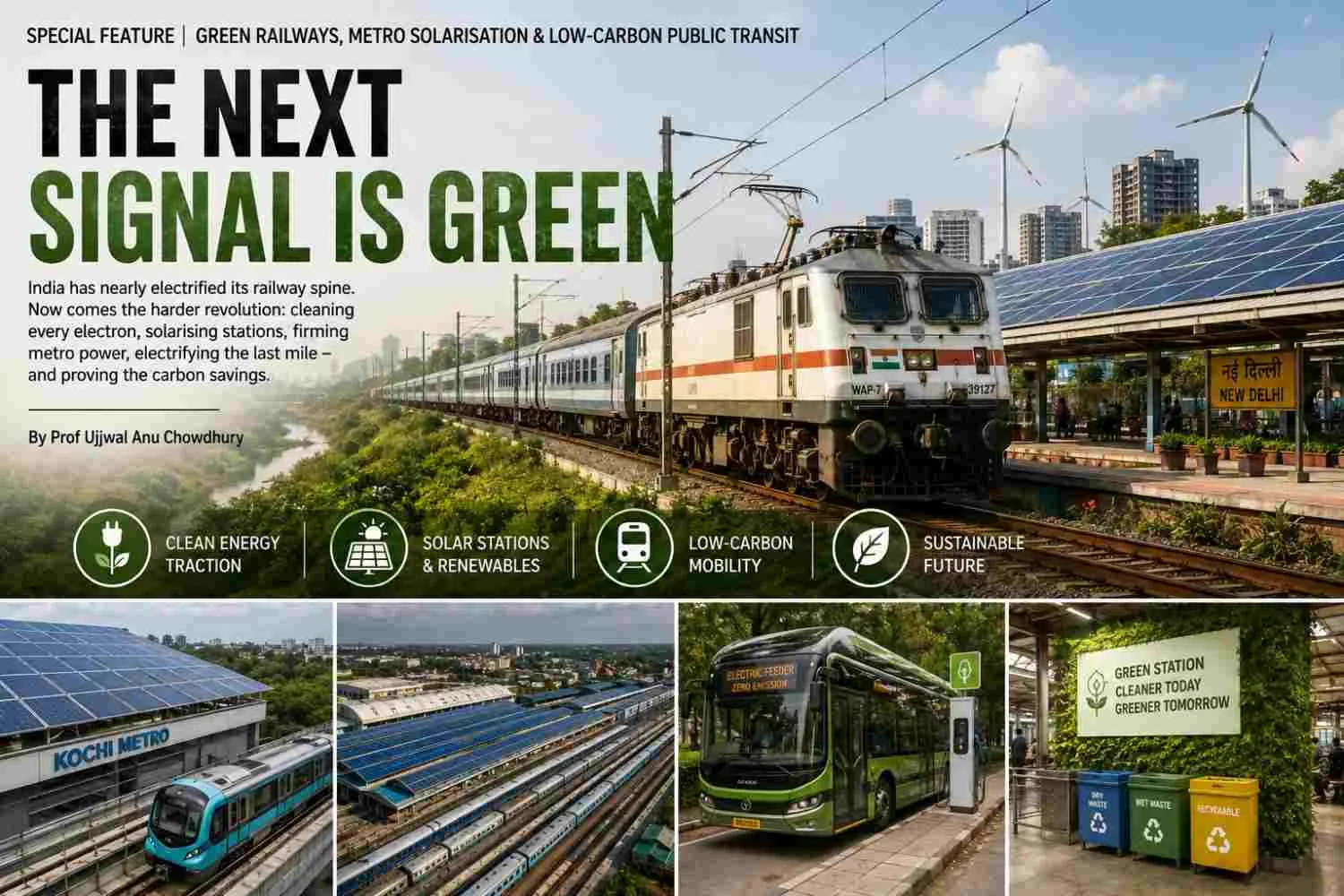
India has nearly electrified its railway spine. Now comes the harder revolution: cleaning every electron, solarising stations, firming metro power, electrifying the last mile - and proving the carbon savings.
BLURB India has almost finished the great engineering task of electrifying its broad-gauge railway. The harder transition starts now: making the electricity genuinely low-carbon, turning station roofs and railway land into productive energy assets, using storage and regenerative braking intelligently, and ensuring that the first and last kilometre do not push passengers back into fossil-fuelled vehicles. The test of a green railway is no longer how many megawatts it announces, but how much verified low-carbon mobility it delivers - per passenger, per tonne and across the full life cycle. |
IN BRIEF Indian Railways reached 99.6% broad-gauge electrification by March 2026 while carrying about 741 crore passengers in FY2025-26. India also crossed 1,155 km of operational metro rail across 26 cities, with daily metro ridership above 1.15 crore. This scale makes rail one of India's most important climate assets, but electrification alone does not eliminate emissions: grid electricity, construction materials, storage, maintenance, last-mile access and accounting methods all matter. The next phase must combine distributed solar, firm renewable procurement, batteries, regenerative braking, low-carbon station design, electric feeder networks and transparent carbon ledgers. Delhi, Kolkata, Kochi, Howrah, Germany, the Netherlands and Santiago offer practical lessons. The central policy message is simple: measure mobility outcomes, not installed capacity alone. |
| KEYWORDS Indian Railways; railway electrification; metro solarisation; renewable procurement; battery storage; regenerative braking; last-mile connectivity; green stations; lifecycle carbon; public transit |
| HASHTAGS #GreenRailways #SolarMetros #LowCarbonTransit #IndianRailways #CleanMobility #PublicTransport #EnergyTransition #NetZeroMobility #EVFeeders #SustainableCities |
DATA NOTE Facts and project status rechecked to 18 August 2026. Operator estimates and corporate disclosures are identified as such; tendered/awarded capacity is not treated as commissioned capacity.
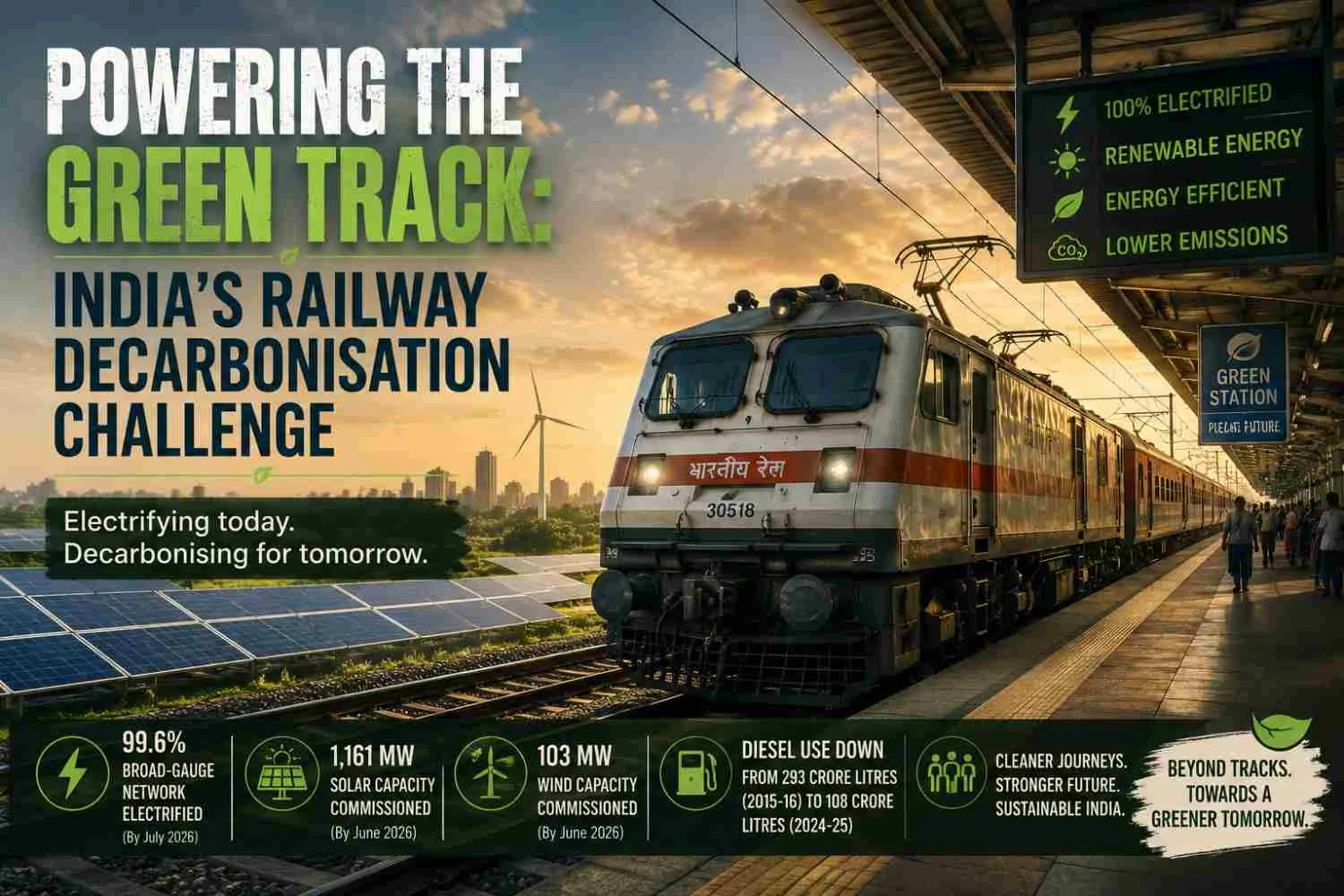
99.6% Broad-gauge network electrified by Mar 2026 | 741 crore Passenger journeys in FY2025-26 | >1,260 MW Solar + wind commissioned by mid-2026 | 1,155+ km Metro operational across 26 cities by Mar 2026 |
Electrification Was the Great First Act
At dawn, before the first commuter boards, the railway is already drawing electricity for signals, lifts, escalators, workshops, depots, station lighting, ventilation and traction substations. By March 2026, 99.6% of Indian Railways' broad-gauge network was electrified. The system carried about 741 crore passenger journeys in FY2025-26 and operates roughly 25,000 trains a day. Few infrastructure systems on earth operate at this scale.
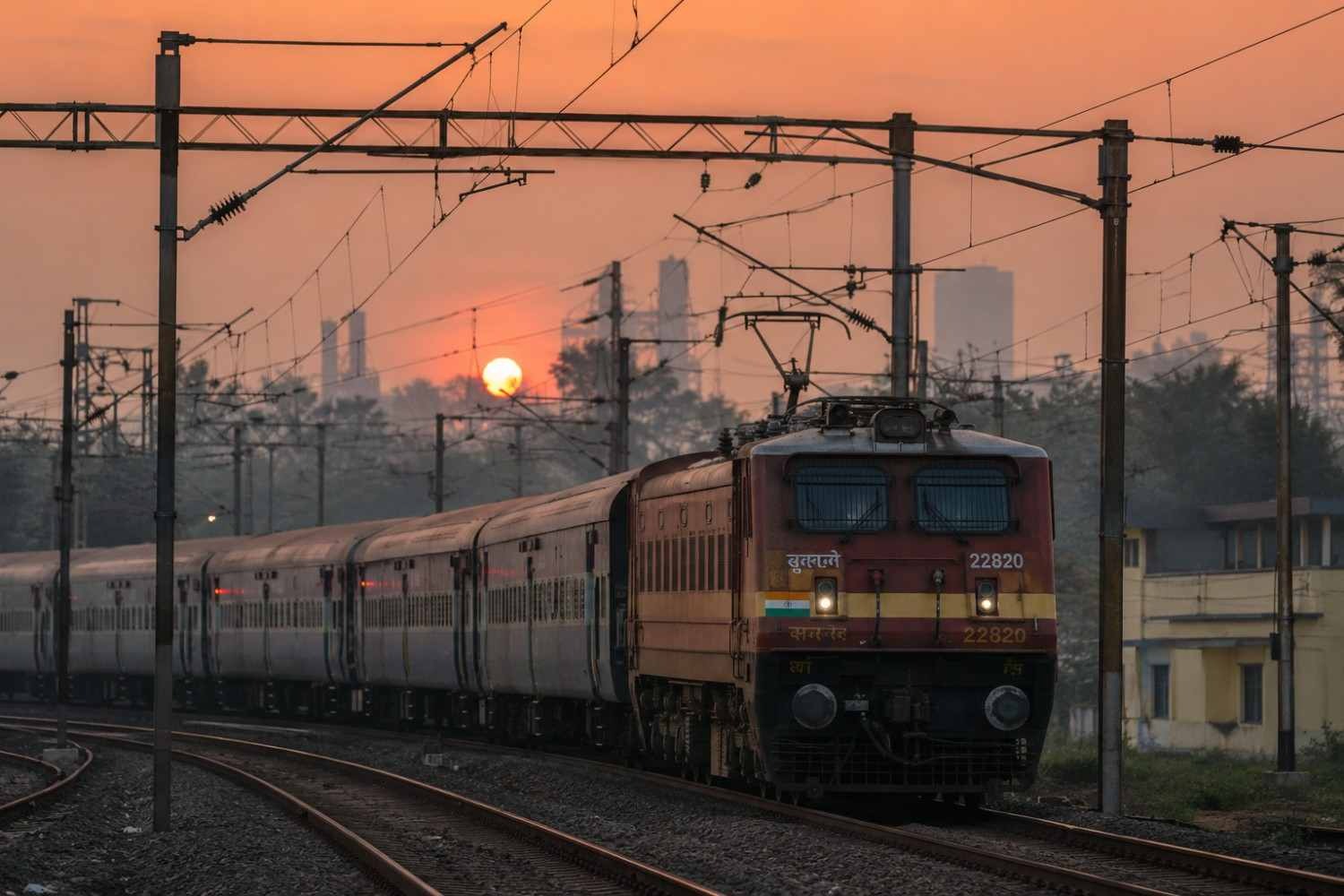
The speed of the conversion is striking. The Ministry of Railways says about 48,072 route kilometres were electrified between 2014 and 2026, compared with 21,801 route kilometres before 2014. Diesel used for traction fell from 293 crore litres in 2015-16 to 108 crore litres in 2024-25. Between FY2020-21 and FY2024-25, actual expenditure reported on railway electrification projects was Rs 29,826 crore; the traction-energy bill itself was Rs 32,378 crore in FY2024-25.
That achievement delivers three structural benefits. Electric traction removes locomotive exhaust from dense station areas and corridors; it improves the efficiency and performance potential of the fleet; and, most importantly, it makes the energy source substitutable. A diesel locomotive remains tied to a liquid fuel. An electric locomotive can become progressively cleaner as its power supply shifts from fossil-heavy grid electricity to solar, wind, hydro, storage-backed renewable contracts and other low-carbon sources.
But this is where the celebratory language must become more exact. Electrification eliminates a large part of Scope 1 traction emissions; it does not automatically eliminate Scope 2 emissions from purchased electricity, and it says nothing about the embodied carbon in steel, concrete, rolling stock, batteries, substations or construction. The government's own rail-versus-road comparison points to rail's major efficiency advantage - around 89% lower CO2 in the cited comparison - but the climate prize is fully captured only when the electricity itself gets cleaner and more journeys shift from higher-carbon modes to rail.
Megawatts Are Not Megawatt-Hours
Indian Railways reported roughly 1,161 MW of commissioned solar capacity and 103 MW of wind by June 2026. The distributed footprint was already broad: by November 2025, 2,626 railway stations were using solar power, and 898 MW of solar had been commissioned, with 629 MW then being used for traction and 269 MW for non-traction loads. That is real progress. Yet the key word is commissioned. Over the years, railway renewable announcements have mixed targets, tenders, awarded capacity, signed power-purchase agreements and operating plants. They are not the same thing. A 500 MW award does not reduce one tonne of CO2 until the project is built, connected, dispatched and contractually attributed to railway consumption.
The same discipline is needed for the railway's 2030 ambition. Government planning has linked the net-zero goal to projected electrical demand of roughly 8,200 MW by 2029-30 and a renewable-installation requirement of about 30 GW. That 30 GW is a target for a future portfolio, not today's operating renewable fleet. Reporting should therefore lead with renewable megawatt-hours delivered to railway loads, not only megawatts of nameplate capacity.
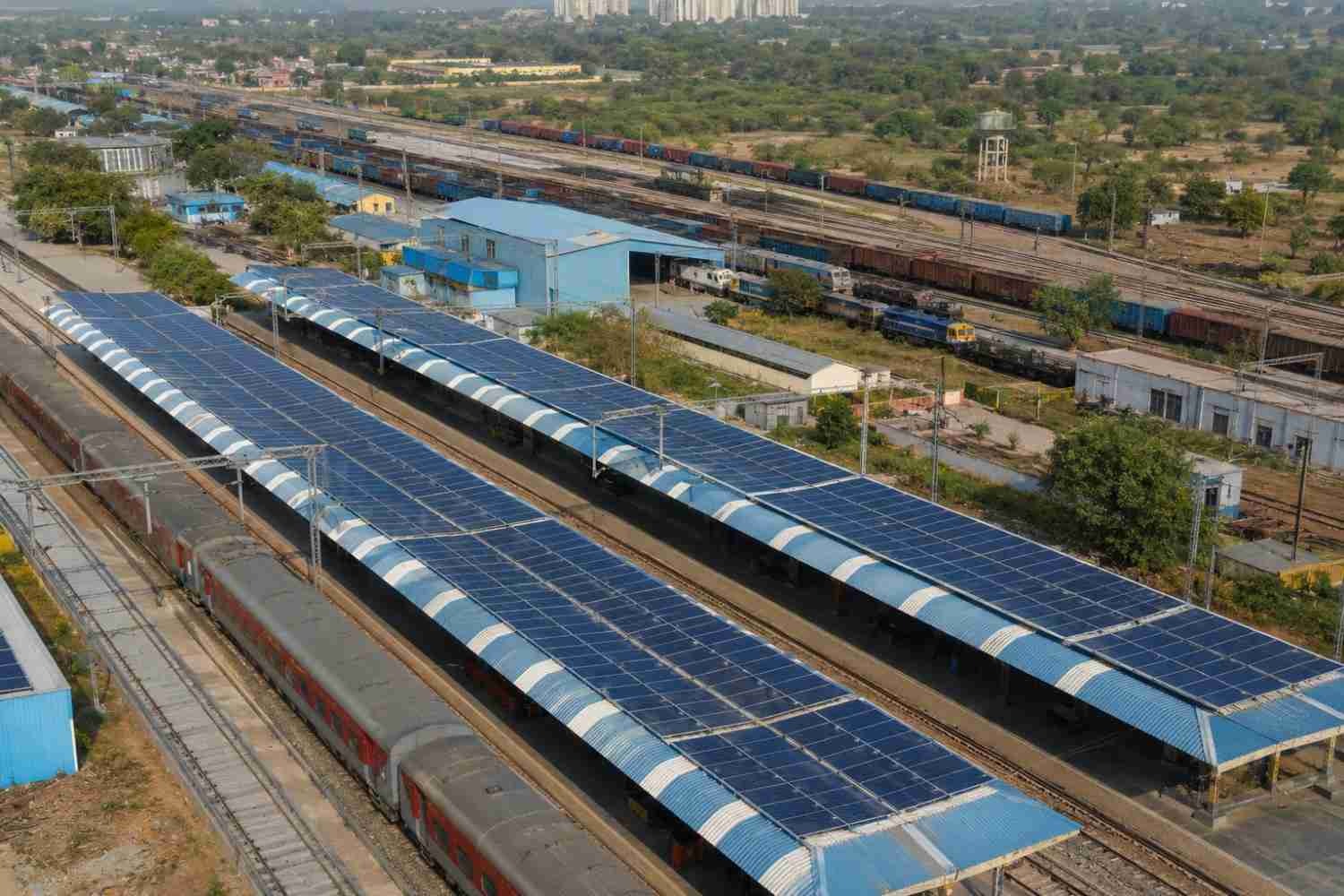
The engineering possibilities are expanding. In 2020, the 1.7 MW Bina pilot in Madhya Pradesh demonstrated direct connectivity of solar generation to the 25 kV traction system. The deeper opportunity is to combine distributed station and depot solar with utility-scale renewable power, storage and smart dispatch. Solar roofs are excellent for daytime auxiliary loads, but trains run through the night and peak traction demand does not politely follow the sun.
Station roofs and railway land are also not frictionless assets. Old roofs may be structurally constrained; heritage stations may limit visual interventions; dust, heat and bird fouling can cut output; monsoons raise waterproofing risks; and cyclone-prone eastern India requires more demanding wind-load design. Every rooftop programme should therefore start with a station-level energy and structural audit and end with a performance contract covering generation guarantees, degradation, inverter replacement, fire access, operations and maintenance, surplus power, insurance, and end-of-life module recycling.
THE REPORTING RULE Capacity is not generation. Annual renewable generation is not round-the-clock clean supply. A PPA is not a commissioned plant. A certificate is not a physical electron. Every claim should identify status, actual MWh delivered and the accounting boundary. |
Delhi: From Solar Panels to a Power Portfolio
Delhi Metro shows why the next stage is a portfolio problem rather than a rooftop problem. DMRC's 2023-24 annual report listed about 50 MWp of rooftop solar capacity and procurement of 349 million units of solar electricity from the Rewa project during the year. Renewable sources accounted for about one-third of its energy requirement. The important innovation is not only the panel count; it is the ability of a large, creditworthy transport utility to aggregate demand and contract renewable supply at scale.
DMRC has since moved toward storage-backed procurement. In October 2025 it issued a central e-procurement tender for inter-state captive renewable supply built around solar photovoltaic generation with co-located battery energy storage. Industry reporting on the tender described a requirement of about 500 million units a year, with roughly 170 MW of solar and 680 MWh of battery storage. The tender's 455-day supply period is a reminder that project status matters: tendered capacity must not be reported as commissioned capacity.
Storage changes the operating logic. Solar generation peaks during the day, while metro demand extends into the evening. Batteries can firm renewable supply, shave demand peaks, improve resilience and create a place to capture electricity that might otherwise be curtailed. Regenerative braking adds another layer: when a train brakes, part of its kinetic energy can be returned to the traction system and used by other accelerating trains or, where the architecture allows, stored.
The metric that should dominate future metro reporting is energy and carbon per passenger-kilometre. Delhi Metro recorded 2,358.03 million passenger journeys in calendar 2025, averaging 64.6 lakh daily. If ridership rises, total electricity use can rise even while efficiency improves. That is not a climate failure if the network carries far more mobility and replaces car, taxi or motorcycle trips. A metro that cuts electricity by losing passengers is not a sustainability success.
Kolkata: Solarise - and Audit the Claim
Kolkata Metro illustrates both the opportunity and the accounting challenge. On 1 July 2026, Metro Railway commissioned a 500 kWp rooftop solar plant at Jessore Road station. The operator expects average generation of about 1,800 units a day and annual electricity savings of roughly Rs 50 lakh, with cloud-based monitoring of plant performance. It also says awarded and planned projects could eventually take its solar portfolio toward 34.3 MWp - a forward pipeline that should be tracked separately from operating capacity. The Jessore Road case is valuable because it is a modest, measurable asset serving station loads rather than a distant headline target.
Kolkata is also moving into storage. On 25 February 2026, Metro Railway inaugurated a 4 MW/6.4 MWh lithium-iron-phosphate battery energy storage system at Central station on the Blue Line. Its immediate function is resilience: during a major grid failure, it can supply emergency traction to move a stranded train toward a station and support tunnel ventilation. Over time, storage at traction substations can also become part of a wider peak-management and renewable-balancing architecture.
But Kolkata offers a warning about climate arithmetic. An official October 2025 release reported 4.556 MWp of solar capacity producing about 57 lakh units annually, while also claiming a reduction of 49 lakh tonnes of carbon footprint each year. Taken literally, those numbers imply roughly 860 kilograms of CO2 avoided for every kilowatt-hour generated - an order-of-magnitude impossibility for electricity accounting. The correct response is not to dismiss the solar effort. It is to correct the emissions claim and institutionalise better reporting.
Every railway zone and metro corporation should use a common CEA-aligned methodology, disclose the baseline year, the grid-emission factor used, the reporting boundary, and the treatment of physical PPAs, renewable energy certificates and offsets. The difference between installed and delivered, and between a promotional estimate and an audited carbon result, is where the credibility of green infrastructure will now be won.
FACT-CHECK: WHY THE MATH MATTERS Metro Railway's October 2025 release paired 57 lakh solar units a year with a claimed 49 lakh tonnes of annual carbon reduction. Taken literally, that equals roughly 860 kg CO2 avoided per kWh - plainly irreconcilable with power-sector carbon accounting. The solar capacity is real; the emissions figure needs correction or clarification. |
The First and Last Kilometre Can Cancel the Carbon Win
A railway station is an interchange, not the beginning or end of a journey. If a passenger must take a petrol motorcycle, a diesel auto or a private car to reach a metro, the low-carbon advantage of the main line is diluted. The climate boundary of public transport must therefore extend from doorstep to destination: safe walking, cycling, e-rickshaws, electric autos, feeder buses, shared mobility, universal access and coordinated interchange design all belong inside the decarbonisation plan.
WRI India's Station Access and Mobility Program has treated this as an implementation problem rather than an aspiration. WRI reports more than 50,000 last-mile trips facilitated and over 240,000 passenger minutes saved through connectivity interventions that have included electric autorickshaws and other station-access solutions. CEEW's work on India's bus transition similarly argues for using electric buses in metro-feeder services and building the charging, contracting and financing ecosystem that makes service reliable. CEEW researcher Anannya Jha puts the priority plainly: 'Electric buses will be central to delivering clean, affordable, and inclusive mobility.'
Kochi offers a useful systems example. Its rail metro is complemented by the Water Metro, a network of electric-hybrid boats that connects island communities and is designed to integrate with metro rail, buses and cycling. The lesson is not that every city needs ferries; it is that the main trunk system, its feeders and the ticketing or information layer should be planned as one mobility service.
Santiago provides the Global South scale lesson. By early 2026, its Red Movilidad bus system was on course to reach about 4,400 electric buses, around 68% of the fleet, supported by large charging depots and a procurement model that separated fleet and service functions. Indian cities should treat e-buses as the capillaries of metro systems, not as a parallel EV scheme. Every new metro corridor should open with an electric-feeder plan, charging-capacity assessment, frequency obligation and a map of underserved neighbourhoods, schools, markets, hospitals and employment clusters.
A Platinum Plaque Is Not a Carbon Ledger
The Indian Green Building Council and Indian Railways have already created the Green Railway Stations Rating System, covering energy, water, waste, site planning, passenger experience and environmental performance. Howrah station is a strong eastern India example. Eastern Railway reported that Howrah moved from Gold to Platinum in January 2024 with a score of 83, after initiatives including energy and water audits, rainwater harvesting, waste segregation, air-quality measures, SCADA and extensive rooftop solar coverage.
Certification is useful because a station is simultaneously a building, a workplace, a commercial precinct, a mobility hub and a neighbourhood gateway. A genuinely green station should combine efficient equipment and solar generation with water conservation, waste recovery, shade and heat mitigation, universal accessibility, safe walking and cycling access, low-emission feeders, clean indoor air and resilience to heatwaves, floods and extreme rainfall.
The next generation of certification should, however, move from design intent to post-occupancy performance. A station should not remain 'green' because panels, meters or rainwater tanks were installed five years ago. Annual recertification data should include electricity per passenger, renewable generation and consumption, water per passenger, waste diverted from landfill, accessibility performance, Scope 1 and Scope 2 emissions, climate-risk readiness, capital and operating expenditure, equipment uptime and savings against a published baseline.
Concrete, Steel, Batteries: Count the Hidden Carbon
The most misleading phrase in urban rail is 'zero-emission metro'. Electric trains may have no tailpipe, but tunnels require large volumes of concrete; viaducts require cement and steel; stations use glass, aluminium, HVAC and electrical systems; rolling stock carries embodied emissions; construction machines burn fuel; and solar modules and batteries eventually require recovery and recycling.
TERI researchers comparing a Delhi Metro case with an Ahmedabad bus rapid transit case showed why lifecycle boundaries matter. Their context-specific study found that while metro rail was highly energy-efficient, the addition of infrastructure and other lifecycle emissions could change the CO2-per-passenger-kilometre comparison. The lesson is not 'do not build metros'. It is: build them in corridors with sufficient long-term ridership, optimise structures, and count the carbon embedded in what is built.
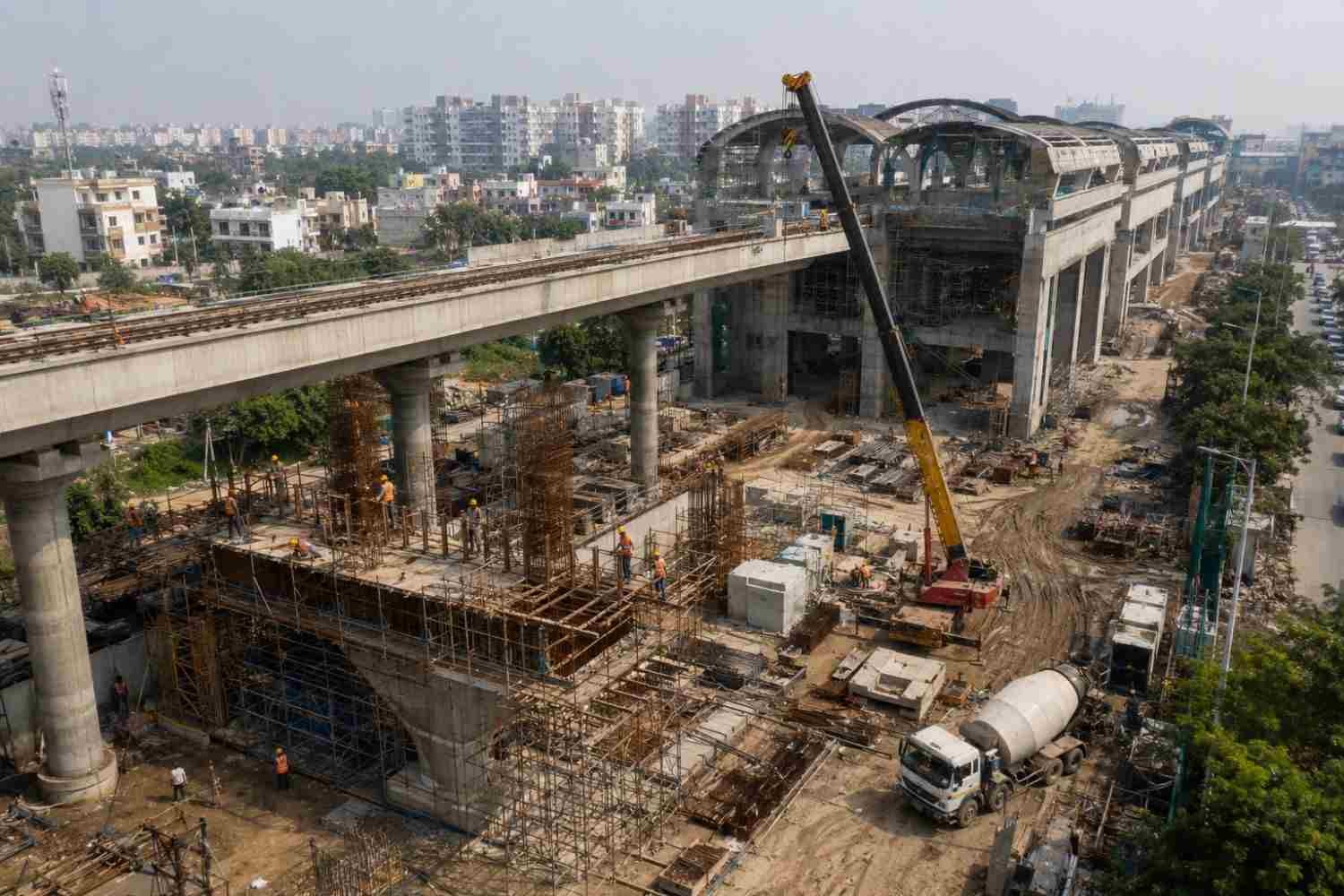
Metro detailed project reports should therefore include an embodied-carbon budget alongside the financial budget. Procurement can reward lower-carbon cement and steel, recycled aggregates, leaner structural design, electric construction equipment where feasible, Environmental Product Declarations and end-of-life responsibility. Battery and solar contracts should specify chemistry, expected life, performance degradation, fire safety, refurbishment and recycling pathways.
Hydrogen belongs in this technology hierarchy too - but as a niche solution, not a universal replacement for wires. On 17 July 2026, India flagged off its first hydrogen-powered train on the Jind-Sonipat section. The current configuration uses two 1.2 MW power cars, giving 2.4 MW total propulsion power, supported by batteries; a dedicated storage facility at Jind holds about 3,000 kg of hydrogen. The train has no tailpipe CO2, but its lifecycle climate value still depends on how the hydrogen is produced. Where overhead electrification is technically or aesthetically difficult - heritage or isolated routes, for example - green hydrogen or battery-electric traction may be useful. On dense main lines, direct electrification remains the efficiency benchmark.
What the World Teaches: Match Energy, Measure Mobility
Germany's Deutsche Bahn offers a mature procurement lesson. DB reported that 69.8% of its traction current mix was renewable in 2024 and is pursuing 80% by 2030 and 100% by 2038. Its strategy is broader than rooftop solar: it uses long-term procurement across renewable technologies and works within a railway-specific electricity architecture. For India, the lesson is diversification - solar for daytime, wind and other sources with different production profiles, storage and firming for night operations, and contracts that clearly identify what is delivered and when.
The Netherlands adds a more subtle accounting lesson. NS reported 16.5 billion passenger-kilometres in 2025, up from 16.1 billion, while energy intensity improved from 69.6 to 68.4 Wh per passenger-kilometre. Crucially, its climate reporting distinguishes market-based electricity emissions from location-based emissions and includes material Scope 3 categories, including passenger journeys before and after the train. Renewable Guarantees of Origin are disclosed as accounting instruments rather than confused with the physical hourly grid mix.
This is exactly the transparency India needs. A metro buying certificates should not imply that every train is physically powered by zero-carbon electrons at every hour. Onsite generation, physical PPAs, open-access renewable supply, grid electricity, storage, certificates and offsets should be disclosed separately. Avoided emissions should also be distinguished from an organisation's own emissions inventory.
The broader Global South lesson is to leapfrog selectively. Santiago demonstrates that large electric feeder fleets and charging depots can be built in a middle-income urban system. Kochi demonstrates multimodal integration across rail and water. Modelling work in South Asian cities, including studies of rooftop solar opportunities for Dhaka MRT, can help size investments - but modelled avoidance must always be labelled as a scenario until meters and operating data exist.
Corporate India: From Capability to Contracted Carbon
The corporate ecosystem matters, but the evidence test must be project-specific. Renewable developers, EPC companies, battery manufacturers and fuel suppliers can all support rail decarbonisation. Their corporate portfolio numbers, however, do not become railway carbon savings by association. A transit claim should be tied to a named asset, commissioning status, contracted delivery, measured MWh or charging uptime, lifecycle boundary and capital actually deployed.
Entity | Evidence status | What the evidence supports |
NTPC / NTPC Green | Direct rail link | NTPC Renewable Energy won a 500 MW RE-RTC award from REMCL in 2023; report commissioning date and delivered MWh before claiming reduction. |
ReNew | Direct rail link | Signed a 200 MW RTC PPA with REMCL in Jan 2025; underlying portfolio was estimated at ~600 MW. PPA status is not operating status. |
L&T | Metro operator + EPC | L&T Metro Rail Hyderabad lists 9.35 MWp solar across depots and 32 station roofs, meeting about 12% of its electricity requirement; L&T also brings rail EPC capability. |
Tata Power | Adjacent capability | Large renewables and charging platform; 1,200+ e-bus charging points reported in 2026. Transit benefit needs named contract, uptime and MWh. |
Adani Green | Adjacent capability | Utility-scale renewables and large BESS capability, including multi-GWh storage at Khavda. Do not infer railway savings without a rail contract. |
Reliance New Energy | Manufacturing capability | Building integrated solar and battery manufacturing. Rail relevance is future supply-chain potential unless a specific transit asset is contracted. |
IndianOil | Last-mile / fuels capability | 14,000+ EV charging stations reported by Aug 2026. Useful feeder ecosystem potential; project emissions and charging delivery must be separated from group-wide claims. |
GAIL | Solar + storage capability | Approved 700 MW of solar projects with battery storage in 2026. These are not rail projects unless contracted and delivered to transit loads. |
Two direct railway procurement examples show the importance of status language. NTPC Renewable Energy received a Letter of Acceptance in 2023 for 500 MW of round-the-clock renewable capacity for REMCL, combining solar and wind under a proposed 25-year arrangement. ReNew disclosed in January 2025 that it had signed a 200 MW round-the-clock PPA with REMCL, backed by an estimated 600 MW of underlying renewable capacity. These are important contracting milestones, but the emissions ledger should move only as projects commission and electricity is delivered.
The same rule applies to supplier capability. Tata Power's more than 1,200 e-bus charging points, Adani Green's large BESS deployment at Khavda, Reliance's battery-manufacturing build-out, IndianOil's more than 14,000 EV charging stations and GAIL's new solar-plus-storage approvals demonstrate potentially relevant industrial capacity. None should be counted as a rail or metro emissions reduction unless a specific transit contract can show commissioning, delivery and a defensible baseline.
For fossil-fuel incumbents such as IndianOil and GAIL, project-level transparency is even more important. Green hydrogen, charging, biofuels or storage can be useful transition businesses, but their benefits should not be allowed to obscure the emissions profile of the wider corporation. Public transport procurement should buy outcomes, not corporate narratives.
Rules Exist. The Missing Piece Is a Carbon Protocol
India does not need to invent the enabling architecture from scratch. The Ministry of Power's Green Energy Open Access Rules reduced the eligibility threshold to 100 kW, widening the pool of consumers that can contract renewable electricity. CERC provides the electricity-market and certificate framework; CEA maintains the country's CO2 baseline database; MNRE sets renewable and storage policy; SECI structures competitive procurement; BEE can strengthen efficiency benchmarks and audits; and the Ministry of Railways, RITES/REMCL and metro corporations can aggregate demand and execute contracts.
What is missing is a common Rail and Metro Carbon Protocol. It should be jointly designed by the Ministry of Railways, MoHUA, Ministry of Power, MNRE, CEA, CERC, BEE, SECI, RITES/REMCL and state metro corporations. It should define the reporting boundary and force every major system to publish an annual dashboard using the same vocabulary.
At minimum, the dashboard should show total traction and non-traction electricity; onsite renewable generation; renewable MWh physically procured; storage charge/discharge and availability; Scope 1 and both location-based and market-based Scope 2 emissions; material Scope 3 emissions; passenger journeys and passenger-kilometres; tonne-kilometres for freight; kWh and gCO2e per unit of mobility; modal-shift estimates; and capital allocated, contracted and actually spent.
This is also where independent scrutiny by CEEW, TERI, WRI India, CSE and IEEFA South Asia is valuable. CSE's urban-mobility warning remains concise: 'Cities will have to reduce health risk and climate risk together.' IEEFA's storage work makes the system point equally clearly: 'Energy storage is integral to renewable integration and grid resilience.' The transition is not only an engineering programme; it is an accountability programme.
THE 10-POINT GREEN-RAIL EVIDENCE TEST • Name the asset, location, technology and lifecycle boundary. • State status and date: announced, tendered, awarded, PPA signed, under construction, commissioned or operating. • Report nameplate MW/MWp and actual MWh delivered. • Show the power source by time period, grid imports, storage and curtailment where material. • Publish Scope 1, location-based and market-based Scope 2, plus material Scope 3. • Separate physical renewable supply, RECs/GoOs and carbon offsets. • Disclose the baseline year and denominator: passenger-km or tonne-km. • Publish both absolute emissions and intensity results. • Distinguish capex approved, committed and actually spent; include O&M and uptime. • Use independent assurance and a public correction protocol for material errors. |
2035: Build a Clean-Mobility Operating System
Imagine the railway of 2035 not as a set of trains, but as a national mobility-energy operating system. Station roofs, depots, parking canopies and suitable railway land produce solar electricity. Wind and solar farms hundreds of kilometres away supply traction through long-term contracts. Batteries at selected substations absorb cheap midday energy, smooth acceleration peaks and support emergency operation. Pumped hydro and other firming resources cover longer-duration needs. Regenerative braking feeds usable energy back into the system.
Artificial intelligence forecasts passenger loads and adjusts train frequency, cooling and station demand. Digital twins predict component failures and optimise maintenance. Feeder buses arrive according to train schedules. E-autos are geofenced into organised interchange areas. Walking routes are shaded and barrier-free. Bicycles and shared mobility sit inside the same journey-planning layer, while interoperable payment through NCMC and future mobility-as-a-service platforms makes transfers less punitive.
The rural opportunity is just as important. Railway stations in district towns can become clean-mobility hubs for electric buses, e-rickshaws and shared vehicles linking villages to regional rail. Solar canopies can provide daytime charging; storage can reinforce weak local grids; station redevelopment can combine logistics, public services and resilient cooling. Decarbonisation then becomes not an elite metropolitan project, but a public-service upgrade across the country.
The investment rule should be 'efficiency first, renewable second, storage where valuable, offsets last'. Reduce waste through LEDs, efficient pumps, variable-speed drives, optimised ventilation and cooling, timetable management and regenerative braking. Then replace remaining electricity with additional renewable supply. Use storage where it reduces peak charges, improves resilience or increases renewable utilisation. Reserve offsets for residual emissions that cannot yet be eliminated, and disclose them separately.
The final accountability shift is from infrastructure completion to mobility performance. Each new project should publish a commissioning timetable and then a post-commissioning record: actual energy generation, uptime, MWh delivered, tariff, savings, carbon factor, passenger intensity, first/last-mile access and lifecycle impacts. If a project misses its stated performance, the annual report should say why and what will be corrected.
The Destination Is Mobility, Not Megawatts
India has almost completed one of the largest railway electrification transformations in history. The achievement is historic, but it was the easier revolution. The next one is more difficult because it cuts across the power system, station architecture, rolling stock, city streets, procurement rules, data standards and passenger behaviour.
The winning formula is now visible: electrify the network; decarbonise the electricity; cut energy intensity; build storage and flexibility where they add value; design electric first- and last-mile services into the network; certify stations for measured performance; reduce embodied carbon; and report the lifecycle honestly. Rail can carry more people and freight while reducing carbon intensity - but only if India measures both absolute emissions and emissions per unit of mobility.
The greenest train is not the one with the most solar panels in the photograph. It is the one embedded in a system where clean power, efficient operations, resilient stations, transparent accounting and low-emission access make the entire journey better. If India can achieve that at its extraordinary scale, it will do more than decarbonise a railway. It will build one of the world's most consequential and affordable laboratories for low-carbon mass mobility - and give the Global South a model worth adapting.
SOURCEBOOK | VERIFIED PRIMARY AND AUTHORITATIVE REFERENCES
1. Press Information Bureau, Ministry of Railways. The Ever-Evolving Journey of Railways. 15 Apr 2026. Source link
2. Press Information Bureau, Ministry of Railways. India Emerges as Global Leader in Railway Electrification.... 22 Jul 2026. Source link
3. Press Information Bureau, Ministry of Railways. 2,626 Solar-Powered Railway Stations Supporting Cleaner Operations. 16 Dec 2025. Source link
4. Press Information Bureau. 25 States Achieve 100% Railway Electrification. 11 Feb 2026. Source link
5. Press Information Bureau, Ministry of Railways. Indian Railways set to meet all its energy consumption needs... (Bina direct traction solar). 27 Aug 2020. Source link
6. Press Information Bureau, Ministry of Railways. Indian Railways to become Net Zero Carbon Emitter by 2030. 15 Mar 2023. Source link
7. Press Information Bureau. The Story of India's Hydrogen Train. 25 Jul 2026. Source link
8. Press Information Bureau. Ease of Living: India's Journey of Inclusive Progress. 15 Jun 2026. Source link
9. Delhi Metro Rail Corporation. Annual Report 2023-24. 2024. Source link
10. Delhi Metro Rail Corporation. Delhi Metro - the lifeline of Delhi-NCR.... 15 Mar 2026. Source link
11. Government of India eProcurement System / DMRC. RfS ORE/CGP/01: ISTS captive solar PV with co-located BESS. 8 Oct 2025. Source link
12. Mercom India. Delhi Metro Invites Bids to Procure 170 MW Solar, 680 MWh BESS. 10 Oct 2025. Source link
13. Metro Railway Kolkata. 500 KWP Solar Power Plant at Jessore Road. 3 Jul 2026. Source link
14. Metro Railway Kolkata. BESS inaugurated in Blue Line. 25 Feb 2026. Source link
15. Metro Railway Kolkata. Metro generating solar power to reduce carbon footprints. 14 Oct 2025. Source link
16. Eastern Railway. Coveted IGBC Platinum Rating Awarded to Howrah Station. 4 Jan 2024. Source link
17. World Resources Institute India. Unlocking Connectivity to Mass Transit in India. accessed 18 Aug 2026. Source link
18. Council on Energy, Environment and Water. How can India's Bus Market Scale up Sustainable Public Transport?. 25 Sep 2025. Source link
19. The Energy and Resources Institute. Carbon footprint of urban public transport systems in Indian cities. research paper. Source link
20. Centre for Science and Environment. Media briefing on urban mobility and climate change. 17 Feb 2017. Source link
21. IEEFA / JMK Research. The standalone energy storage market in India. 28 Apr 2025. Source link
22. Deutsche Bahn. Integrated Report 2025 - share of renewable energies in DB traction current mix. 2026. Source link
23. Deutsche Bahn. How Deutsche Bahn uses solar energy. accessed 18 Aug 2026. Source link
24. NS (Nederlandse Spoorwegen). Annual Report 2025 - Sustainability / Climate and Energy. 2026. Source link
25. Institute for Transportation and Development Policy. 2026 Sustainable Transport Award case material: Santiago and Kochi. 13 Jan 2026. Source link
26. NTPC. NTPC wins 500 MW RE-RTC capacity for Indian Railways. 28 Apr 2023. Source link
27. ReNew. 200 MW RTC PPA with REMCL. 9 Jan 2025. Source link
28. L&T Metro Rail Hyderabad. Green Metro - Eco-Friendly Transit. accessed 18 Aug 2026. Source link
29. Tata Power. Q1 FY27 results / charging network update. 27 Jul 2026. Source link
30. Adani Green Energy. Commissioning of large single-location BESS at Khavda. 26 May 2026. Source link
31. Reliance Industries. Q1 FY27 Analyst Presentation - New Energy. 17 Jul 2026. Source link
32. IndianOil. About IndianOil - EV charging network. updated 13 Aug 2026. Source link
33. GAIL (India) Limited. Approval of 700 MW solar projects with battery storage. 14 Apr 2026. Source link
34. Ministry of Power / PIB. Green Energy Open Access Rules, 2022. 2022. Source link
35. Central Electricity Authority. CDM CO2 Baseline Database - Version 21.0. accessed 18 Aug 2026. Source link
36. Ministry of New and Renewable Energy. Schemes, guidelines and Energy Storage Systems. accessed 18 Aug 2026. Source link



Add a Comment