
Kolkata| 29 August, 2026
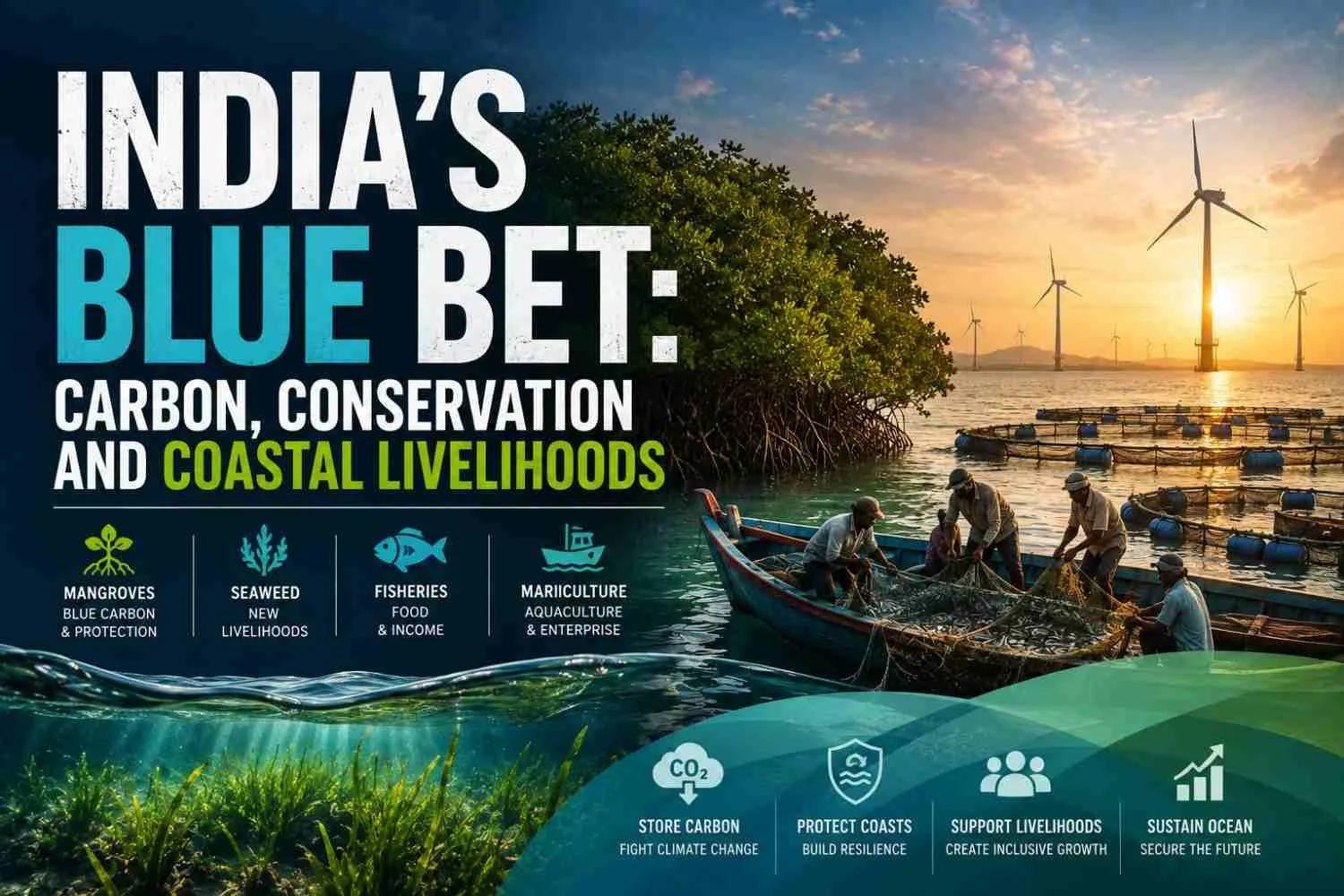
| India is looking to its coastline for a new sustainability opportunity, from mangrove restoration and blue carbon to seaweed farming and fisheries. But the real test is whether ocean-based growth can protect ecosystems and improve coastal livelihoods at the same time. |
| Summary India's blue economy is expanding across conservation, fisheries, aquaculture and emerging ocean-based industries. The government is using MISHTI to restore mangroves, while seaweed cultivation and marine fish farming are being promoted as new blue-economy activities. India is also a major global fisheries producer, with the sector supporting millions of livelihoods. But measuring the climate value of coastal ecosystems remains more complicated than simply counting trees or calculating land-based carbon. For communities living along India's coastline, the transition is equally about income, access to resources, markets and benefit sharing. The real challenge is to ensure that blue-carbon projects and ocean-based businesses create measurable environmental gains without turning coastal communities into passive beneficiaries of a transition happening around them. |
Keywords Blue Economy India, Blue Carbon, Mangrove Restoration, Coastal Livelihoods, Seaweed Farming, Sustainable Fisheries, Mariculture, Coastal Conservation, Ocean Economy, Marine Ecosystems, MISHTI, Sustainable Development |
Can India turn its coastline into its next sustainability frontier?
India’s relationship with the ocean is economic before it is environmental.
The country’s 11,099-km coastline supports fisheries, aquaculture, ports, tourism and millions of coastal livelihoods. The fisheries sector alone supports nearly 30 million livelihoods, according to NITI Aayog, while India accounts for around 8% of global fish production. Fish and fishery products generated about ₹60,523 crore in export earnings in FY2023–24.
That makes the blue economy more than an environmental concept. It is equally a question of livelihoods, incomes, jobs and the future of coastal communities.
At the same time, India’s coastline contains ecosystems with significant climate value. Mangroves, seagrasses, tidal wetlands and coastal sediments can store carbon while also helping protect coastal communities from erosion, storms and other hazards.
This is where the idea of blue carbon enters the conversation.
But India’s blue economy is much broader than carbon alone. It includes fisheries, aquaculture, seaweed, marine biotechnology, coastal tourism and ecosystem restoration, alongside emerging opportunities to create economic value from healthy marine ecosystems.
The opportunity is substantial. So is the balancing act.
A project can produce a strong sustainability headline without creating lasting benefits for the communities living along the coast.
The challenge is ensuring that higher incomes do not come at the expense of the ecosystems that make those livelihoods possible.
The real question, therefore, is not simply how much economic value India can generate from its coastline.
But it is who creates that value, who benefits from it and whether the coastal ecosystem remains healthy enough to support those livelihoods in the long run.
INDIA'S BLUE ECONOMY
MANGROVES
↓
BLUE CARBON + COASTAL PROTECTION
SEAWEED
↓
NEW LIVELIHOODS
FISHERIES
↓
FOOD + INCOME
MARICULTURE
↓
AQUACULTURE + ENTERPRISE
TOURISM
↓
LOCAL ECONOMIC VALUE
↓
BLUE ECONOMY
Economic growth + ecosystem protection + coastal livelihoods
Is MISHTI turning mangrove restoration into a climate and livelihood strategy?
Mangroves are at the heart of India’s blue-carbon conversation, but their value extends far beyond the carbon they store. They can help protect coastlines, support fisheries and provide livelihoods for communities living along the shore.
The government launched MISHTI - Mangrove Initiative for Shoreline Habitats & Tangible Incomes - in June 2023 to promote mangrove restoration across India’s coastline. The programme’s original target covered approximately 540 sq km across nine coastal states and four Union Territories.
By 2023–24 and 2024–25, the government reported that 26,396.34 hectares of degraded mangrove area had been brought under restoration through MISHTI, along with convergence with State CAMPA, MGNREGS and other schemes.
A national MISHTI workshop held in January 2026 also placed emphasis on scientific restoration, climate resilience, livelihood generation and community participation.
Planting mangroves is only the beginning; the real test is whether they survive, restore ecosystems and support the communities that depend on them.
The more meaningful test is what happens after planting.
How many hectares survive? Are the right species being restored in the right locations? What was the ecological condition before restoration? Has the project affected how local communities access fishing grounds, forests or other coastal resources? Who receives the livelihood benefits? And, critically, how much money was actually spent on restoration and community outcomes?
India’s latest official assessment puts the country’s total mangrove cover at 4,991.68 sq km. West Bengal accounts for the largest share at 42.45%, followed by Gujarat at 23.66%.
That makes both states particularly important to India’s blue-carbon story, but also places greater importance on ensuring that restoration is ecologically sound, locally relevant and capable of delivering benefits that extend beyond the project period.
MISHTI: FROM PLANTING TO PROOF
ECOLOGICAL BASELINE
↓
SITE SELECTION
↓
COMMUNITY PARTICIPATION
↓
RESTORATION
↓
SURVIVAL MONITORING
↓
CARBON MEASUREMENT
↓
LIVELIHOOD BENEFITS
↓
LONG-TERM OUTCOME
The measure of restoration is not saplings planted. It is ecosystems that survive.
Why is blue carbon harder to measure than carbon on land?
This is one of the biggest challenges for India’s emerging blue economy. Carbon stored on land can often be measured within relatively defined boundaries, but coastal ecosystems are constantly changing.
In blue-carbon systems, carbon can be stored not only in vegetation but also in coastal sediments. Tides, erosion, sediment movement, changes in land use and ecosystem degradation can all affect how much carbon remains stored and for how long.
That makes a credible blue-carbon claim much more demanding than simply counting mangroves or measuring the area restored.
A robust assessment needs to establish a clear baseline, identify the relevant carbon pools, define the geographical boundary and monitoring period, use a recognised methodology and assess how permanent the carbon storage is likely to be.
India’s blue-economy investment framework identifies mangrove, coral and seagrass restoration and blue-carbon credits as potential investment opportunities, alongside activities such as seaweed farming and aquaculture.
But this is where an important distinction needs to be maintained:
An ecosystem can have significant environmental value even when its carbon benefit cannot yet be measured precisely enough - or converted into a tradable carbon credit.
That means blue-carbon policy should not reduce the value of a mangrove, seagrass bed or coastal wetland to how many carbon credits it can generate. Their role in biodiversity, coastal protection, fisheries and local livelihoods also needs to be counted.
THE BLUE-CARBON ACCOUNTING GAP
COASTAL ECOSYSTEM
Mangrove biomass
+
Sediment carbon
+
Ecological services
↓
MEASUREMENT
Baseline
+
Carbon stock
+
Change over time
+
Permanence
↓
VERIFICATION
Methodology
+
Monitoring
+
Audit trail
↓
CREDIBLE BLUE-CARBON CLAIM
An ecosystem's carbon value is not automatically a carbon credit.
Can seaweed farming create a new income stream for coastal communities?
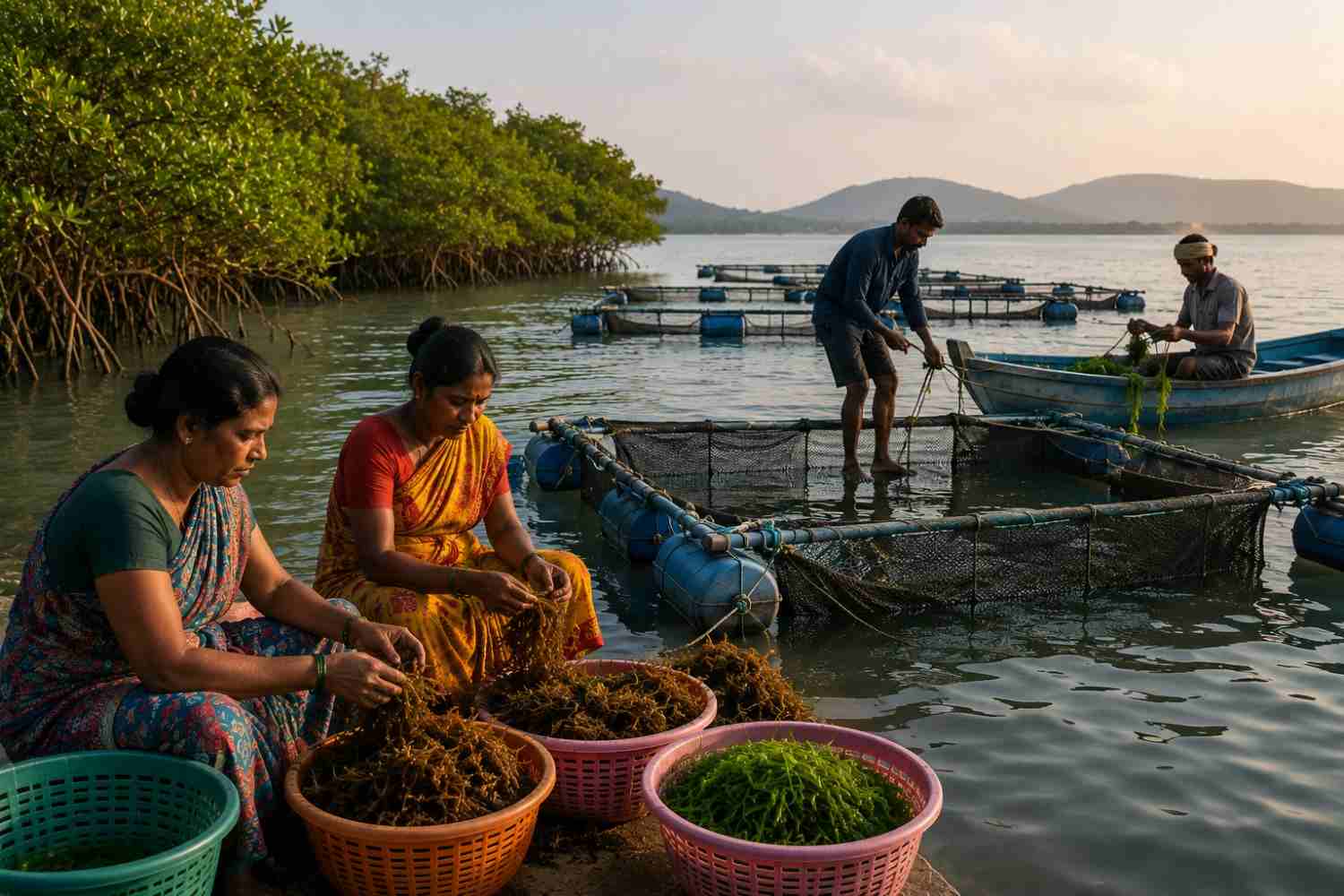
Seaweed is emerging as one of the most visible livelihood opportunities in India’s blue-economy push. The government identifies the country’s 11,099-km coastline as having significant potential for seaweed cultivation, while research institutions including ICAR-CMFRI and CSIR-CSMCRI have identified 384 potential sites covering 24,707 hectares across coastal states and Union Territories.
Government programmes are supporting activities such as rafts, monolines and tubenets, seed banks, hatcheries, training, research and market linkages.
The Ministry of Earth Sciences has also identified seaweed farming, seed banks, tissue-culture laboratories, cluster farming, credit and insurance as potential areas for blue-economy investment.
But potential is not the same as livelihood success.
The stronger evidence would show how many people actually enter seaweed farming, how many continue beyond the first year, what farmers earn, who buys the harvest and how stable those prices are.
It should also establish who owns the cultivation infrastructure and what happens when storms, disease or other environmental shocks damage a crop.
Training women is only the first step. The real test is whether they stay involved, earn an income and have a say in how that income is used.
Could mariculture reduce pressure on wild fisheries - or create new environmental risks?
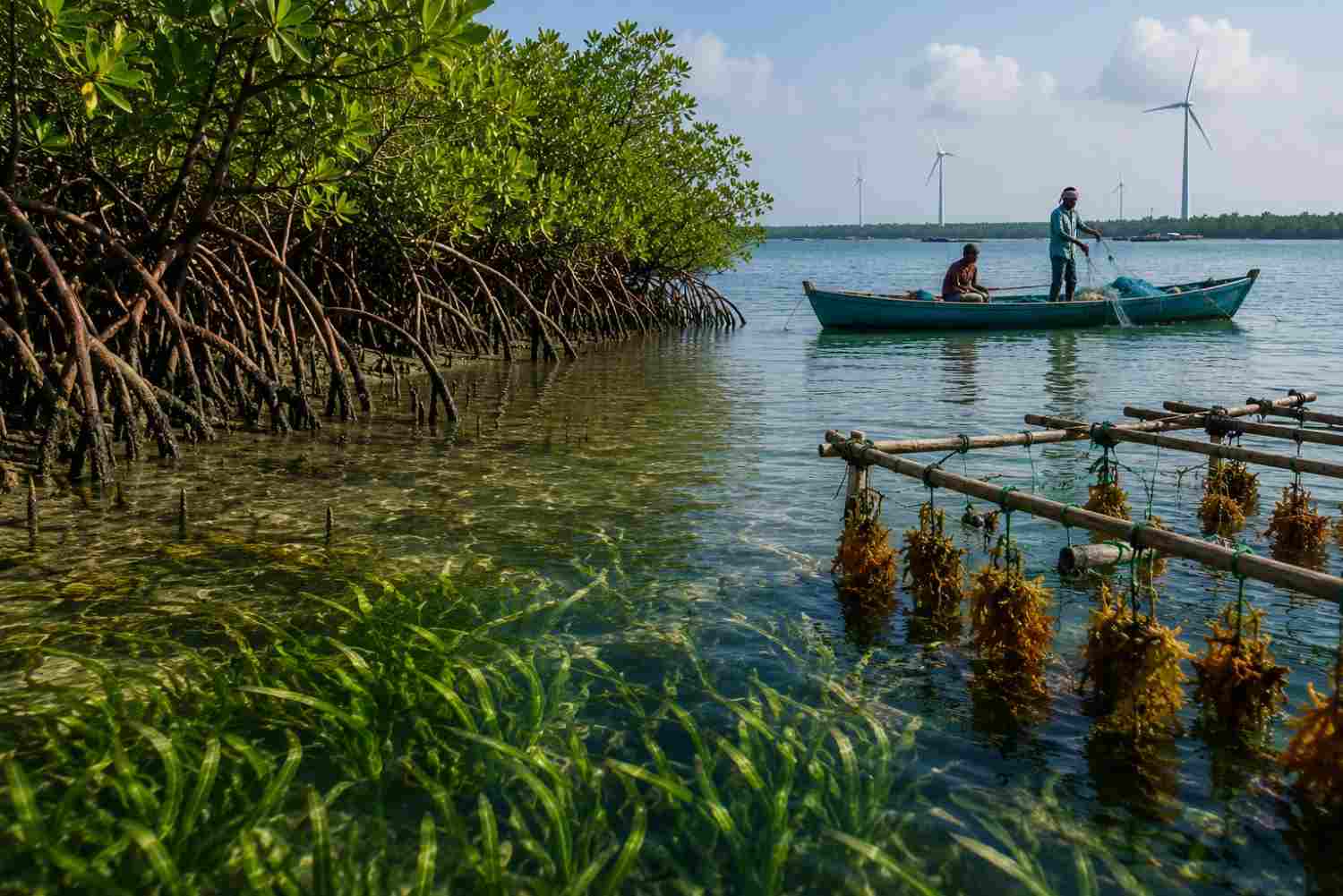
Mariculture and aquaculture can expand seafood production while creating new livelihood opportunities. The government is promoting marine fish farming alongside seaweed cultivation.
In February 2026, it said India was developing both activities as part of its blue-economy strategy, including pilot-scale seaweed-farming studies along the Andaman coast.
India has also entered into cooperation with Israel on fisheries and aquaculture, with an emphasis on technology-driven and sustainable practices and improving coastal livelihoods.
But expanding marine farming brings another set of questions.
Where does the feed come from? What happens to the waste? Which species are being farmed? Does the activity affect water quality? How much coastal space does it occupy? And does it restrict access for existing fishing communities?
A project cannot be considered sustainable simply because its output comes from the sea.
The full production chain and the ecological footprint it leaves behind must be accounted for.
What do India’s fisheries numbers tell us about the people behind the blue economy?
India is already a global fisheries powerhouse.
NITI Aayog’s 2025 blue-economy strategy describes India as the world’s second-largest fish-producing country, accounting for around 8% of global fish production and supporting nearly 30 million livelihoods.
The government is also using the Pradhan Mantri Matsya Sampada Yojana (PMMSY) to strengthen fisheries infrastructure and fisher welfare.
The scheme has an investment framework of more than ₹20,000 crore and includes measures such as insurance and livelihood support for fishing communities.
But national production figures can conceal what is happening at the household level.
More fish production does not automatically mean higher fisher incomes. Higher seafood exports do not automatically translate into higher household earnings. And a larger fisheries economy does not necessarily mean better access to credit, insurance or social protection.
That is why production data needs to be paired with household-level evidence.
The real measure of a blue-economy livelihood programme is not simply how much seafood or seaweed it produces. It is whether coastal households earn more stable incomes, gain greater economic security and remain able to depend on the ecosystems that sustain them.
DON'T STOP AT THE NATIONAL RANKING
FISH PRODUCTION ↑
does not automatically mean
FISHER INCOME ↑
So, measure:
Production
+
Prices
+
Household income
+
Employment
+
Insurance/social protection
+
Market access
BLUE-ECONOMY OUTCOME
More ocean value + stronger coastal livelihoods
Why do Gujarat, Tamil Nadu, Odisha and West Bengal matter to India’s blue-economy transition?
India’s coastline is not a single ecological or economic zone. Different states face different combinations of fisheries, industry, ports, agriculture, tourism, coastal settlements and climate risks.
Gujarat, for instance, combines major fisheries activity with extensive industrial and port infrastructure.
Tamil Nadu has a large network of fishing communities alongside fisheries, aquaculture and dense coastal settlements. Odisha brings together vulnerable coastal ecosystems, fisheries, agriculture and industrial development. West Bengal presents a particularly distinctive case through the Sundarbans, where mangroves, fishing, agriculture and climate vulnerability intersect.
That makes state-level implementation critical.
A restoration or livelihood model that works in one coastal region may not deliver the same results elsewhere. Ecological conditions, community dependence, land-use patterns and economic opportunities can vary significantly from one coastline to another.
The government’s blue-economy strategy itself identifies coastal states including Gujarat, Odisha and Tamil Nadu in discussions around fisheries development.
The evidence should therefore move beyond national targets and examine what is actually happening in each coastal region - whether ecosystems are recovering, livelihoods are improving and communities are benefiting from the transition.
Can corporate investment protect the coast while delivering measurable returns?
The blue economy is also opening a larger role for private capital.
Companies connected to steel, infrastructure, mining, ports, agriculture and exports often have direct or indirect links with coastal ecosystems and communities. Their investments could support mangrove restoration, livelihood diversification, research, coastal resilience and more sustainable supply chains.
But private investment needs the same level of scrutiny as public spending.
A large corporate commitment does not mean the money has actually reached the ground. A CSR allocation does not automatically translate into an outcome. And hectares covered by a restoration programme do not tell us how many hectares actually survived.
The evidence test should therefore follow the money from announcement to outcome:
What was announced? What was budgeted? What was actually released? How much was spent? What was completed? Who benefited? And what continued after the funding cycle ended?
The government’s PMMSY reporting offers a useful benchmark by distinguishing between funds approved and released and reporting both physical and financial progress.
Private blue-economy projects should be held to the same standard.
If the investment cannot be traced from the announced commitment to actual spending and measurable results, its sustainability value remains difficult to establish.
Can India’s blue economy grow without pushing coastal communities aside?
This is ultimately the social test of India’s blue-economy transition.
Coastal communities are not simply beneficiaries waiting to receive the benefits of conservation or development projects. They already live and work within these ecosystems. Their livelihoods are closely tied to coastal waters, natural resources and the health of the ecosystems around them.
That means community participation cannot be added at the end of a project. It has to be built into the design from the beginning.
If mangrove restoration restricts access to fishing grounds without meaningful consultation or alternative livelihood support, an environmental intervention can create a real economic cost. If a blue-carbon project generates tradable credits while local communities receive little of the resulting revenue, a new carbon market could reproduce existing inequalities rather than correct them.
A credible blue-economy model therefore needs transparent consent, tenure, access and benefit-sharing arrangements. It also needs grievance mechanisms that communities can actually access and use.
Most importantly, the people affected by these projects should have a voice in measuring whether they worked.
A sustainability claim should not rely entirely on project reports or management data.
The strongest proof is on the ground: healthier ecosystems, stronger livelihoods and benefits reaching the communities that depend on them.
What should India measure before calling a blue-economy project successful?
THE BLUE-ECONOMY SCORECARD
| Evidence test | What to measure |
|---|---|
| Ecology | Baseline + habitat condition + survival |
| Blue carbon | Carbon stock + methodology + permanence |
| Livelihoods | Beneficiary number + income change |
| Women | Participation + income control + retention |
| Fisheries | Production + household income + market access |
| Seaweed | Farmers retained + yield + actual earnings |
| Community rights | Consent + tenure + access + benefit sharing |
| Carbon credits | Verified credits + audit trail |
| Investment | Budget/capex + actual expenditure |
| Implementation | Announced vs operational |
| Monitoring | Multi-year ecological + livelihood outcomes |
| Reporting | Baseline + boundary + absolute/intensity results |
This changes the conversation. Instead of asking how much India is investing in the blue economy, it should ask what that investment is actually achieving.
So, can the ocean become India’s next sustainability frontier?
India’s coastline presents an enormous opportunity to build an economy around healthy ecosystems, resilient communities and sustainable use of marine resources.
Mangroves can protect vulnerable coastlines while storing carbon. Seaweed can open new livelihood opportunities. Responsible aquaculture can expand seafood production. Fisheries can remain a major source of employment and income. And blue-economy investment can create new markets around conservation, restoration and ocean-based resources.
But the transition comes with a crucial warning: India’s coastline cannot become the next sustainability frontier simply because it offers new carbon assets, investment opportunities and emerging markets.
The people who already live and work along the coast must remain at the centre of the transition. The numbers alone do not tell the full story. Hectares restored, carbon stored and fish produced are only part of the picture.
The real test is whether these efforts improved local incomes, protected access to resources, gave communities a meaningful say in decisions, shared benefits fairly and helped ecosystems remain healthy over time.
Blue carbon must be measurable before it is monetised. Coastal livelihoods must be protected before they are transformed. And corporate investment must ultimately be judged not by the size of the announcement, but by the money that reaches the ground, the people who benefit and the outcomes that continue after the funding ends.
Because India’s blue economy will be truly sustainable only when the value created by the ocean does not come at the cost of the people and ecosystems that depend on it.
THE REAL BLUE-ECONOMY TEST
Protect the ecosystem.
Measure the carbon.
Create viable livelihoods.
Share the benefits.
Track the outcome.
Keep it working after the funding ends.
Because India's next sustainability frontier cannot simply be blue. It has to be measurable, equitable and capable of surviving beyond the project cycle.
Sources:
- Ministry of Earth Sciences, Government of India — Deep Ocean Mission [Source]
- Ministry of Earth Sciences, Government of India — Blue Economy Initiative [Source]
- Ministry of Earth Sciences, Government of India — Blue Economy Policy [Source]
- Ministry of Environment, Forest & Climate Change — Blue Carbon Ecosystems (Seagrass and Mangroves) of India [Source]
- Department of Fisheries, Government of India — Strategy for the Seaweed Development [Source]
- Department of Fisheries, Government of India — Seaweed Culture in India [Source]
- Department of Fisheries, Government of India — Seaweed Cultivation [Source]
- Department of Fisheries, Government of India — Pradhan Mantri Matsya Sampada Yojana (PMMSY) [Source]
- PMMSY — Climate-Resilient Coastal Fishing Villages [Source]
- PMMSY — Artificial Reefs and Coastal Fisheries Conservation [Source]


Add a Comment