Sustainable Consumption

Highlights responsible consumption patterns that minimize waste, conserve resources, and support long-term sustainability.

Showing 11

25 Aug 2026

Kolkata | 25 August, 2026 India’s fashion industry is experimenting with textile recycling, cleaner production and circular retail models, but the real test is whether discarded clothes actually stay in the material loop - and whether companies can prove where they go. SummaryIndia generates about 70.73 lakh tonnes of textile waste every year, with around 58% coming from post-consumer disposal. At the same time, more than 70% of total textile waste is already being recovered through recycling, reuse, upcycling and downcycling, showing that India has an established recovery ecosystem rather than a complete absence of recycling. The bigger challenge is what happens to clothes after consumers stop wearing them. Garments can be reused, repaired, resold, downcycled or recycled, but blended and damaged textiles can be difficult to recover at their original value. Companies are responding through take-back programmes, recycled fibres, organic cotton sourcing, cleaner dyeing technologies and retail trade-ins. Yet a collection box or sustainability label does not automatically make fashion circular. The stronger test is whether companies can account for the material collected, show an audit trail for its destination, protect the workers handling discarded textiles and demonstrate measurable environmental gains against a clear baseline. Keywordstextile waste in India, circular fashion, textile recycling, sustainable fashion, textile waste management, fashion circular economy, textile circularity, post-consumer textile waste, textile waste recovery, textile recycling India, sustainable textiles, clothing waste, garment waste, textile upcycling, textile downcycling, recycled fibres, textile traceability, circular fashion supply chain, sustainable textile production, textile waste workers, informal waste workers, fashion sustainability, textile sustainability, circular textile economy, sustainable fashion India   What really happens to a T-shirt after we stop wearing it?For most of the consumers, a garment’s journey seems to end when it is placed in a donation bag, dropped into a collection box or thrown away. For the textile itself, however, that may be only the beginning.A discarded T-shirt can take several different paths. It may be worn again, repaired and resold, converted into wiping cloths or other products, or mechanically recycled into new fibres. But textiles that are heavily damaged, contaminated or made from difficult-to-separate blends can be much harder to recover and may ultimately end up as waste.This is where the idea of a circular fashion economy becomes more complex than simply collecting old clothes. India’s latest government mapping of the textile-waste value chain estimates that the country generates around 70.73 lakh tonnes of textile waste every year. About 42% is pre-consumer waste, generated during manufacturing, while the remaining 58% comes from post-consumer disposal. The study also estimates that more than 70% of total textile waste is already recovered through recycling, upcycling, downcycling or reuse. That changes the way the problem needs to be viewed. India is not starting from zero. A large share of textile waste is already finding its way back into the economy. The bigger challenge is what happens to the remaining material and whether textiles can be collected, sorted and recovered efficiently once they leave the formal manufacturing system. Collecting an old T-shirt does not, by itself, make fashion circular. True circularity begins when the garment has a clear path to its next use. FOLLOW THE FABRICConsumer discards garment↓Collection↓Sorting↓Reuse / Repair → Resale↓Recycling → New Fibre / Product↓Residual Waste → Documented Final Destination  The question: Does every kilogram collected have a documented destination? Can textile collection really make fashion circular?Post-consumer collection is becoming an increasingly visible part of sustainable-fashion efforts. Brands and retailers are encouraging consumers to return unwanted clothes through store collection points, take-back programmes and trade-in schemes. But collection numbers alone can give a misleading picture of circularity. Collecting 10 tonnes of used clothing may sound impressive, but the more important question is what happened to that material after collection.How much was reused? How much was recycled? How much was downcycled? How much was rejected? And where did the rejected material go? This is the difference between collection and actual material recovery.A credible circular-fashion programme therefore needs to maintain a clear mass balance - showing what entered the system, what was recovered, what was converted into another product and what ultimately remained as waste.India’s 2026 government assessment provides an important counterpoint. The country already has a substantial textile-recovery ecosystem, particularly for pre-consumer waste generated during manufacturing. High recovery rates in this segment show that parts of the domestic textile industry already have established systems for collecting and recovering material. The bigger challenge is what happens after a garment leaves the formal manufacturing system and enters the hands of consumers. That is where collection, sorting, logistics and end-market demand become critical to making post-consumer textiles genuinely circular. Is recycling always better than making new clothes?  Not necessarily. The environmental benefit of textile recycling depends on what material is being recycled, which technology is used and what the recovered fibre can replace. Cotton, polyester, nylon and blended fabrics behave differently during recycling. Mechanical recycling, for example, can shorten textile fibres and reduce the quality of the resulting material. More advanced recycling technologies may recover higher-quality fibres from difficult textiles, but they can also require greater investment, energy and specialised infrastructure. This creates an important competing view: Recycling is necessary, but recycling alone cannot solve the problem of overproduction and overconsumption. If brands continue producing large volumes of inexpensive clothing designed for short use, recycling systems may simply end up managing the waste created by a high-consumption model. That is why repair, reuse, resale and longer garment life need to be treated as equally important parts of the circular-fashion system. A garment that is worn for longer, repaired instead of replaced or resold to another consumer can delay the point at which recycling becomes necessary. The goal of circular fashion is therefore not simply to recycle more clothes. It is to keep garments and their materials in productive use for as long as possible. THE CIRCULARITY HIERARCHYLONGER USE↓REPAIR↓REUSE / RESALE↓RECYCLING↓DOWNCYCLING↓DISPOSALKeep the garment in use before breaking it back into material. Can fashion cut its water footprint before a garment even becomes waste?The environmental impact of clothing begins long before a garment reaches the end of its life. Processes such as dyeing and finishing during manufacturing can require significant amounts of water.This has led brands and technology companies to explore waterless and low-water dyeing technologies. Some emerging systems use alternatives such as supercritical carbon dioxide, while others use digital, foam-based or other processes designed to reduce conventional water consumption.The potential benefit is straightforward: using less water for the same production output can reduce pressure on freshwater resources while also lowering the volume of wastewater generated. But the technology still needs to pass an evidence test. A company should not simply state how many litres of water it saves per garment. It should explain what the saving is measured against and what the calculation includes.What exactly does the reported reduction cover? Is it limited to dyeing, or does it include finishing as well? Does the alternative process save water but consume more energy? Has it been proven at commercial scale? And how much has the company actually invested compared with what it originally announced? These questions matter because a technology can look highly efficient in a pilot project but deliver very different results when used across a large manufacturing operation. A water-saving technology becomes meaningful only when its environmental benefits can be demonstrated at commercial scale.Does organic cotton automatically make a garment sustainable?Organic cotton can be part of a lower-impact sourcing strategy, but the label alone cannot tell the complete sustainability story. What matters is how the cotton was produced, verified and traced through the supply chain. Companies need credible certification and traceability systems to establish whether suppliers are meeting the required environmental and production standards. There is also a crucial social question: Who is able to participate in this transition? Who are the farmers producing the cotton? What prices are they receiving? Can small producers afford certification? Who pays for compliance and verification? If sustainable sourcing requirements become too expensive or complicated, smaller farmers may find it harder to participate.Responsible sourcing therefore needs to look at both environmental performance and farmer inclusion. Certification can provide an important layer of verification, but it should be treated as a starting point for scrutiny rather than the final proof that a supply chain is sustainable.Can retail trade-ins actually make fashion more circular?Trade-in programmes are becoming another visible part of the circular-fashion model. Consumers return unwanted clothing to a retailer and receive a discount, store credit or another incentive towards a future purchase. The model can help solve one problem by giving retailers a way to bring used garments back into the system instead of allowing them to disappear into the waste stream. But there is also a potential contradiction. If a trade-in reward simply encourages consumers to buy another garment immediately, the programme could increase consumption rather than reduce it. A truly circular model would prioritise repair, resale and reuse for returned clothing, with recycling serving as the last option.The priority should be to keep the garment in use for as long as possible before breaking it down into fibre or treating it as waste.Who handles India’s discarded textiles?  India’s textile-recovery system cannot be understood without looking at the workers who already operate within it. Waste pickers, sorters, aggregators and small recycling units play an important role in collecting and recovering materials that formal systems may not reach. Yet much of this work remains invisible in corporate sustainability reporting. That raises an important CSR question: If companies want to build a circular fashion economy, what happens to the workers who are already recovering its materials? A responsible transition should consider fair wages, workplace safety, protective equipment, social-security access and stable incomes. Formalisation should not simply push informal workers out of the value chain. It should improve their working conditions, recognise their contribution and give them a more secure role in the circular economy. Organisations working with waste pickers and vulnerable communities, including Chintan and Goonj, can offer an important perspective on this issue. The worker’s voice matters because circularity cannot be considered fully sustainable if material recovery improves while the conditions of the people doing that work deteriorate.How can companies prove that their circularity claims are real?This is where the evidence test becomes the centre of the story. Saying that a company collected textiles, saved water, used organic cotton or launched a trade-in programme tells us what it did. The more important question is what difference those actions actually made.The more important question is what happened because of that activity.Companies should therefore disclose how much material was collected, how much was actually reused or recycled, what happened to rejected material, how much water was saved against a clear baseline, how much was invested and spent, who benefited and whether the programme continued after the initial funding or pilot period.The reporting boundary should also be clear. A garment collected is not necessarily a garment recycled. A garment recycled is not necessarily a garment returned to an equivalent use. And a sustainability claim is not meaningful unless the company can explain how the claimed benefit was calculated and what happened to the material afterwards. Circular fashion is ultimately not about making better claims about old clothes. It is about building a system in which materials, resources and livelihoods can be tracked from the beginning of the supply chain to what happens after the garment is no longer wanted. THE CIRCULAR FASHION EVIDENCE TEST  ClaimWhat should be proved?“We collected textiles”Total material collected and consumer/beneficiary denominator“We recycled them”Mass balance and material destination“We use recycled fibre”Fibre content and chain-of-custody evidence“We reduced water”Baseline, methodology and actual reduction“We use organic cotton”Certification and sourcing audit trail“We support waste workers”Wages, safety, income and benefit access“We invested in circularity”Budget versus actual expenditure“We reduced our footprint”Absolute and intensity results“Our programme is sustainable”Performance that continues over time This is the difference between a sustainability claim and a sustainability result. A percentage on its own does not tell the full story. Companies should clearly disclose what they measured, where they measured it, the period covered and how the improvement was calculated. A reported 30% reduction may sound significant, but the real questions are: 30% compared with what baseline? Across which facilities? Over what period? Did production increase or decrease? Was the saving measured in absolute terms or per garment? Without this context, sustainability figures can be difficult to verify or compare. Clear reporting boundaries and methodologies are therefore essential to show whether an environmental improvement represents a genuine change in performance. Can India turn textile waste into a resource without leaving its workers behind? India’s policy direction is also moving towards greater textile circularity. The Tex-Eco Initiative, announced in the Union Budget 2026–27, aims to promote globally competitive and environmentally sustainable textile and apparel manufacturing while helping the sector align with international sustainability standards and emerging green markets. Government efforts are also gradually focusing on textile-waste management, recycling technologies and value addition from discarded textiles.This creates an opportunity to move beyond isolated brand-led campaigns and build a wider circular textile system. But recycling cannot carry the entire burden. A genuinely circular apparel model would begin much earlier with durable products designed to last longer, followed by repair, reuse and resale before recycling becomes the final recovery option. That requires action across the entire value chain. Brands need to design garments that are easier to repair and recycle. Retailers need transparent take-back systems. Recyclers need reliable and traceable material flows. Governments need effective standards and enforcement. Consumers need clear information about garment durability, care and disposal. And there is one group that cannot be left out of this transition: the informal workers already collecting, sorting and recovering textile waste. They are not outside the circular economy. In many cases, they are already helping make it work. A truly sustainable textile system must therefore account not only for where the waste goes, but also who handles it, who earns from it and whether those livelihoods become safer and more secure as the system evolves.   THE REAL CIRCULAR-FASHION TESTDESIGN FOR LONGER USE↓REPAIR↓REUSE / RESALE↓COLLECT↓SORT↓RECYCLE↓TRACE THE MATERIAL↓MEASURE THE IMPACT   What should companies actually report?For CSR and corporate sustainability programmes, the most important question is not how many clothes were collected. It is what happened to those clothes afterwards, who handled them, who benefited and what environmental impact was actually avoided. A credible programme should report the total quantity of material collected, where it went and how much genuinely re-entered a productive material or product cycle. It should clearly distinguish between pre-consumer and post-consumer waste, disclose relevant certifications and audit trails, and explain how claims based on those certifications were verified. The people behind the system also need to be visible. When informal workers are involved in collecting, sorting or recycling textiles, companies should report their wages, working conditions, safety measures, access to social protection and how they are being brought into the formal circular economy. Financial reporting should be equally transparent: How much was budgeted? How much was actually spent? How much went towards collection, sorting, recycling, technology, worker protection and infrastructure? The reporting boundary must remain clear throughout. A kilogram collected is not automatically a kilogram recycled.A donated garment is not automatically a garment reused.A certified fibre is not automatically proof that the entire garment has a low environmental footprint.And a percentage reduction means little without a credible baseline and clearly defined methodology. Can fashion become circular without simply moving the waste problem somewhere else? That is the real test of India’s sustainable-fashion transition. India already has a significant textile-recovery ecosystem, with the latest government assessment indicating that more than 70% of textile waste is recovered through different pathways. But recovery alone does not equal circularity. The material still needs to be traced. Workers still need to be protected. Recycling processes still have their own environmental costs. Consumers still need to be encouraged to wear, repair, reuse and resell clothes for longer. And companies still need to demonstrate that their sustainability claims reflect what is actually happening on the ground. This is where the next phase of sustainable fashion will be decided. It will not be defined by how many collection bins a brand installs, how many take-back campaigns it runs or how many recycled garments appear in a catalogue. It will be defined by whether companies can follow a garment from the consumer’s wardrobe to its next useful life - and provide evidence for every major step along the way. Because a fashion system is not circular simply because it collects its waste. It becomes circular when materials stay in productive use, value reaches the people who make the system work, and environmental benefits can be measured and proven. That is the real standard India’s circular-fashion economy now needs to meet. Primary sources:  Ministry of Textiles — Mapping of Textile Waste Value Chain in India (2026)Covers the 70.73 lakh tonnes annual textile-waste estimate, 58% post-consumer / 42% pre-consumer split, recovery pathways, recycling technologies and post-consumer infrastructure gaps.Ministry of Textiles — Mapping of Textile Waste Value Chain in IndiaPress Information Bureau — Ministry of Textiles: Mapping of Textile Waste Value Chain in IndiaOfficial government release covering the report's headline findings, including 70.73 lakh tonnes of annual textile waste and more than 95% recovery of pre-consumer textile waste.PIB — Mapping of Textile Waste Value Chain in IndiaPress Information Bureau — Ministry of Textiles: Textile Recycling and Circular EconomyCovers the government's current textile-recycling and circular-economy initiatives, including the Tex-Eco Initiative.PIB — Textile Recycling and Circular EconomyPress Information Bureau — Ministry of Textiles: Innovative Textile Recycling TechnologiesCovers government support for textile-waste management, recycling, recycled fibres, new materials and value addition from discarded textiles under Tex-Eco.PIB — Innovative Textile Recycling TechnologiesPress Information Bureau — Environmentally Sustainable Production PracticesUseful for the article's cleaner-production, water/energy efficiency, hazardous-chemical reduction, organic textiles, natural dyeing and textile-waste management sections.PIB — Environmentally Sustainable Production PracticesCentral Pollution Control Board — Charter for Water Recycling and Pollution Prevention in Textile IndustriesPrimary regulatory material for the water-consumption, wastewater, chemical use and pollution-prevention angle.CPCB — Charter for Water Recycling and Pollution Prevention in Textile IndustriesPress Information Bureau — Textile Waste Innovation ChallengeDocuments the government's “What Is It Made Of?” Textile Waste Innovation Challenge and its focus on circularity, sustainable production and practical textile-waste solutions.PIB — Textile Waste Innovation ChallengePress Information Bureau — Union Budget 2026–27: Strengthening India's Textile Value ChainUseful for the wider policy context around Tex-Eco, sustainable manufacturing, textile modernisation and circularity.PIB — Union Budget 2026–27: Strengthening India's Textile Value ChainPress Information Bureau — Integrated Programme for the Textile SectorCovers the Budget's broader textile programme, including the Tex-Eco Initiative and sustainable textile manufacturing.PIB — Integrated Programme for the Textile SectorMinistry of Textiles — Textile Recovery Facility, Navi MumbaiParticularly useful for the newer collection, traceability and impact-measurement angle. In August 2026, the Ministry documented a proposed digital circular-textile infrastructure platform for collection, traceability and impact measurement.PIB — Textile Recovery Facility, Navi Mumbai ...Read more

19 Aug 2026

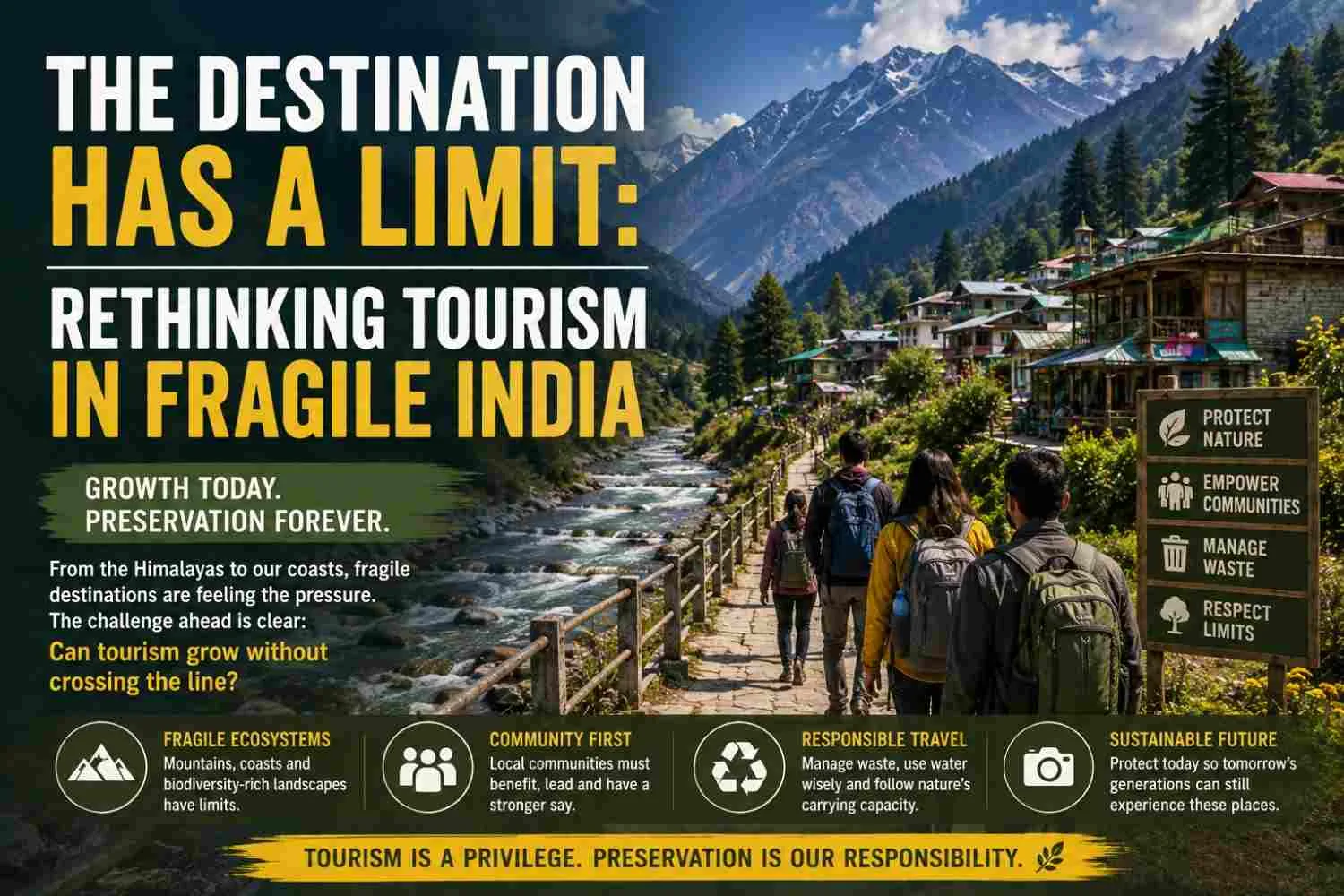
Kolkata|19 August, 2026 India’s tourism economy is expanding across its mountains, coasts and biodiversity-rich landscapes, but fragile destinations are reaching the limits of what they can absorb. The next test for responsible tourism is whether growth can protect the ecosystems and communities that make these places worth visiting. SummaryTourism is creating valuable economic opportunities for communities across India’s Himalayan and coastal regions. But the rapid rise in visitors is also putting growing pressure on water, waste management, natural habitats and local infrastructure. A recent carrying-capacity study of Uttarakhand’s Char Dham shows why setting clear limits on tourist numbers is becoming important. At the same time, government policy is gradually promoting carrying-capacity assessments, responsible tourism and community-based models such as homestays. Waste-management partnerships and village-led tourism offer possible alternatives to high-volume tourism, but their success depends on what happens after the initial intervention. For CSR and private tourism investment, the real test is whether ecosystems remain protected, communities retain a meaningful share of the benefits and projects continue to work after the funding cycle ends. KeywordsSustainable Tourism, Responsible Tourism, India Tourism, Fragile Ecosystems, Tourism Carrying Capacity, Himalayan Tourism, Rural Tourism, Community-Based Tourism, Eco-Tourism, Sustainable Travel How Much Tourism Is Too Much for a Fragile Destination?For popular destinations, more tourists mean more hotels, restaurants, transport services, jobs and income for local communities. But fragile destinations cannot absorb unlimited growth. Mountain region often has limited land, vulnerable water sources, difficult terrain, waste-management challenges and sensitive ecosystems. Coastal areas face their own pressures, including erosion, cyclones, mangroves, wetlands, nesting sites and changing water conditions. The growing pressure is already visible in the Himalayas. A recent study found that visitor numbers to Uttarakhand’s Char Dham reached a record 5 million in 2023.Using geoscientific, biological, socioeconomic and cultural indicators, the study estimated sustainable daily visitor limits of 15,778 for Badrinath, 13,111 for Kedarnath, 8,178 for Gangotri and 6,160 for Yamunotri. These figures are more than tourism statistics. They represent an effort to understand how much pressure a destination can take before tourism begins to damage the natural resources and local communities that support it. The ability to accommodate more visitors is not simply a question of physical space. Water resources, waste systems, forests and local communities may be under significant pressure. Can Tourism Limits Work on the Ground?India is gradually recognising that tourism growth needs to be planned at the destination level, rather than simply focusing on attracting more visitors. The Ministry of Tourism’s National Strategy for Sustainable Tourism calls for better visitor management, physical site planning and greater community participation in tourism decisions. The government is also encouraging states and Union Territories to assess carrying capacity when planning new tourism projects. But the real challenge begins once these assessments are completed. A carrying-capacity report has little value if visitor numbers continue to exceed the limits it identifies. At the same time, restricting tourist numbers is not a simple solution. Fewer visitors may reduce pressure on water, waste systems and fragile habitats, but it can also affect hotels, transport operators, guides, vendors and other local businesses that depend on tourism income. This creates an important policy challenge: how can destinations protect their environment without cutting local communities out of the tourism economy? The answer could lie in better demand management. Timed entry, seasonal visitor limits, promoting less-crowded destinations and strengthening local businesses can help spread tourism more evenly. Instead of concentrating visitors and income in a few high-footfall locations, destinations can create opportunities for more communities to benefit while reducing pressure on fragile hotspots. Absolutely. The ideas are strong, but the language can be made more reader-friendly, smoother and less repetitive, while still keeping the article professional. I’d also simplify the headers so they feel more natural and engaging. Managing Tourism’s Waste, Not Just Measuring ItWaste is often one of the most visible signs of tourism pressure. In mountain regions, poorly managed waste can find its way into water sources, attract animals and affect both wildlife and local residents. In coastal areas, plastic and other waste can pile up along beaches, wetlands and marine ecosystems. This makes waste management an important area for collaboration between travel companies, local authorities and community organisations. But simply collecting waste is not enough. If a tourism company reports collecting hundreds of tonnes of waste, it is important to ask: How much was segregated? How much was recycled or composted? How much ended up in landfills? Who managed the system? And what happened after the CSR funding ended? A more meaningful approach would also measure waste per visitor. This helps destinations understand whether their environmental impact is actually decreasing as tourist numbers increase. The numbers need to be viewed in context. Higher waste collection may simply reflect a rise in tourist arrivals, rather than an improvement in waste management.  Can Communities Lead Tourism?One way to make tourism more inclusive is to spread its economic benefits beyond large hotels and commercial operators. Homestays and community-based tourism allow local households to earn directly from visitors while keeping accommodation smaller and closer to existing communities. Government policy is supporting this model. A 2026 rural-homestay initiative under Swadesh Darshan includes plans for 1,000 homestays in tribal areas, along with financial support for village-level needs, construction and renovation, as well as technical training for homestay owners. Ladakh also launched a Holistic Homestay Support Framework in March 2026, aimed at developing village-led tourism enterprises with a focus on quality, preparedness and sustainability. These efforts point to a broader idea: tourism growth does not always have to depend on large-scale infrastructure. A well-managed homestay can turn an existing household asset into a source of income while giving visitors a more direct experience of local culture. But homestays are not automatically sustainable. A 2026 study of Himalayan homestays in Kalimpong found that their sustainability depends on factors such as infrastructure, accessibility, social conditions and environmental performance. It also highlighted how poorly planned tourism can lead to waste accumulation, environmental damage and greater pressure on local resources. Community-based tourism, too, must operate within the limits of what a destination can sustainably support.   Who Really Benefits When Tourism Grows?For local communities, the real question is not how many tourists a destination attracts, but whether tourism creates stable local incomes without making everyday life more difficult for residents. In Himalayan villages, residents can earn through homestays, guiding, transport and food services. But alongside these economic benefits, communities may also face more waste, greater demands on local water resources and changes to land use.That is why community participation cannot stop at creating jobs. Who owns the land? Who controls tourism development? Who receives and shares the revenue? Who has the authority to decide where infrastructure is built? And do local communities have a meaningful voice when development puts their resources at risk? These questions are particularly relevant in regions where forests, grazing lands and other natural resources are managed through customary systems and community institutions. A stronger community-based tourism model therefore gives residents a meaningful role in decision-making, ownership and sharing of benefits, rather than treating them only as service providers. Recent policy thinking on Himalayan tourism has also emphasised community participation, local workforce development and stronger connections between tourism, conservation and local businesses. What Does Real Community Consent Look Like? Community consent should mean more than simply holding a consultation meeting. When a project affects forests, coastal areas or resources used by local communities, companies should clearly record who was consulted, what concerns were raised and whether those concerns influenced the final plans. For example, if a proposed resort is moved away from a sensitive forest after residents and environmental assessments identify the area as important, that shows avoidance. If local residents receive a share of tourism revenue or own a stake in the business, that is benefit sharing. But if a project moves ahead despite community objections, without showing how environmental and livelihood concerns were addressed, it becomes difficult to call the project genuinely “community-based.” That is why independent community interviews are important. The people living in the destination should be able to speak freely about both the benefits and the costs of tourism, without their responses being shaped by project management.  How Green Is an “Eco-Resort” Really? Certification can help set common standards for sustainable tourism. But having a certificate should not be treated as proof that a project is environmentally responsible. India’s tourism sector is promoting sustainable practices through initiatives such as Travel for LiFE and sustainability criteria for tourism businesses gradually. However, a resort can install solar panels, reduce plastic use and market itself as “eco-friendly” while still consuming large amounts of groundwater, being built on sensitive land or producing more waste than the local system can manage. The real test lies in the evidence. Ask: Was the local ecosystem assessed before construction began? Were sensitive habitats identified and avoided? How much water does the property use per guest? How much waste does it generate per guest? Were local communities meaningfully consulted? How many employees and suppliers are from the local area? And perhaps most importantly: Are these indicators being tracked year after year? A certification may confirm that a resort meets sustainability standards when it is awarded, but long-term environmental performance requires continued monitoring.   What Makes Tourism Regenerative?  THE RESPONSIBLE TOURISM EVIDENCE TEST  Ecological Baseline↓Avoid Sensitive Habitat↓Community Consent & Tenure↓Benefit Sharing↓Waste & Water Performance↓Multi-Year Habitat Monitoring↓Actual CSR Spend & Long-Term Continuity  CSR-funded projects should be judged by more than the numbers announced. Companies should disclose the original budget, actual expenditure and scope of their reporting. If ₹5 crore is announced but only ₹2 crore is spent, the gap deserves explanation. Likewise, a waste-management initiative cannot be considered a lasting success if it works only while CSR funding is available and disappears once the funding ends. For habitat restoration, the number of saplings planted is only a starting point. What matters more is how many survive and continue to grow three or five years later. The same principle applies to community tourism. Counting homestays is useful, but tracking how many remain active, how much income they generate and how much of that income reaches local households gives a far better measure of impact. Can Tourism Grow Without Consuming the Destination Itself? India does not have to choose between tourism and conservation. But it does have to decide what kind of tourism it wants to build and what it is willing to protect along the way. Tourism can create jobs, support local businesses and bring valuable income to communities. But when growth comes without limits, the same industry can put pressure on water resources, waste systems, habitats, infrastructure and the people who call these destinations home. A more responsible approach begins by recognising that growth cannot be measured by visitor numbers alone. It means managing tourist flows, spreading demand beyond overcrowded hotspots, strengthening local businesses, involving communities in decisions and building infrastructure that reflects the ecological limits of each destination. Homestays can help keep tourism income within communities. Waste-management partnerships can reduce the environmental burden of visitors. Carrying-capacity assessments can help establish clear limits. Certification can set standards for more responsible operations. But none of these measures is a guarantee of sustainability on its own. The real test comes years later. Is the destination healthier? Are its natural resources better protected? Are local communities earning more without bearing a greater burden? And are the systems created through tourism still working after the initial funding, publicity or project period has ended? For companies, this means measuring not just what was built, funded or promised, but what continues to deliver results. For communities, it means having a genuine voice in decisions, a meaningful share of the benefits and a say in how their resources are used. For governments, it means turning carrying-capacity assessments into clear and enforceable limits, rather than leaving them as recommendations on paper. A fragile mountain, forest or coastline cannot be treated as an endlessly expandable tourism asset. Its natural resources are not infinite, and neither is its ability to absorb the pressure of visitors. The destination is the asset. And if tourism damages the ecosystem, exhausts the resources and weakens the livelihoods that make a place worth visiting in the first place, the industry is not simply harming the destination - it is undermining its own future. That is why regenerative tourism must ask a different question. Not how many more tourists can this destination accommodate? but: What will still be here, thriving and protected, long after the tourists have gone?   Sources:  Ministry of Tourism, Government of India — National Strategy for Sustainable Tourism (https://tourism.gov.in/index.php/whats-new/national-strategy-sustainable-tourism) (Tourism India)Ministry of Tourism, Government of India — National Strategy and Roadmap for Development of Rural Tourism (https://tourism.gov.in/sites/default/files/2026-02/National%20Strategy%20and%20Roadmap%20for%20Development%20of%20Rural%20Tourism.pdf) (Tourism India)PIB / Ministry of Tourism — Development of 1,000 Tribal Homestays under PM-JUGA (https://www.pib.gov.in/PressReleasePage.aspx?PRID=2212575) (Press Information Bureau)UT Ladakh Administration — Holistic Homestay Support Framework, March 2026 (https://ladakh.gov.in/secretary-tourism-launches-holistic-homestay-support-framework/) (Ladakh Government)Scientific study — Carrying capacity and strategic planning for sustainable tourism practices in the Char Dham, Uttarakhand (https://pmc.ncbi.nlm.nih.gov/articles/PMC12534453/) (PubMed Central (PMC))PubMed — Char Dham carrying-capacity study (https://pubmed.ncbi.nlm.nih.gov/41107367/) (PubMed)Scientific study — Sustainable homestay tourism in the Himalayas: A multicriteria evaluation approach (Kalimpong) (https://www.sciencedirect.com/science/article/abs/pii/S2211464525002568) (ScienceDirect)Ministry of Tourism — Travel for LiFE (https://nidhi.tourism.gov.in/home/page/travel-for-life) (NIDHI) ...Read more

13 Aug 2026

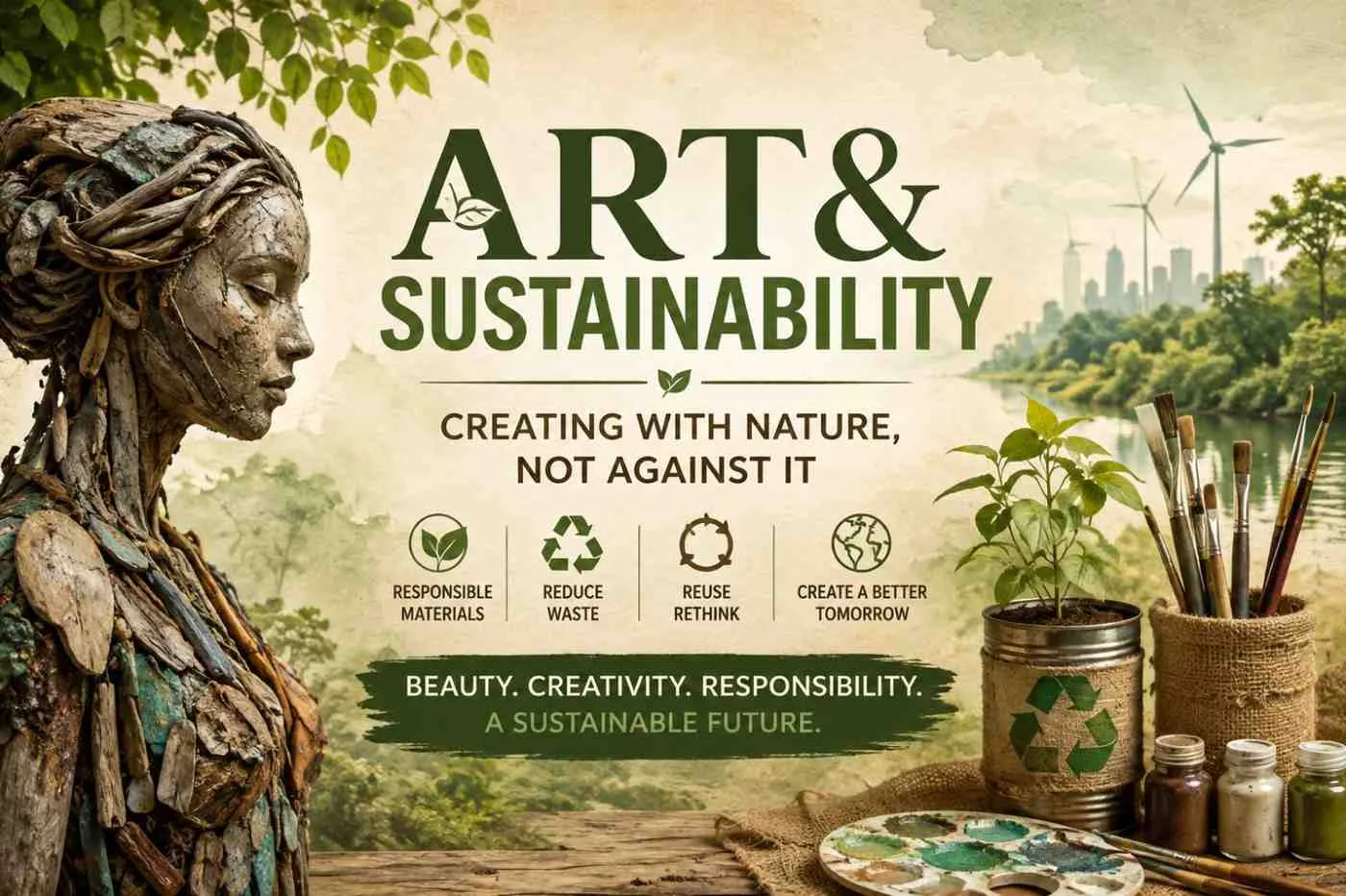
Sustainability is not only about saving the planet; it is also about changing the way we create, consume and live. Art and design can help us imagine a world where beauty and responsibility go hand in hand.    By Ankan Bandyopadhyay   At one point in human history, artists mainly created paintings around religion, mythology and stories of the divine. Art gradually changed as society changed. The Renaissance brought a greater interest in the individual and the human experience. Later, artists began to question traditional ideas about what art could be and where it could exist. This eventually led to movements such as Land Art, where nature itself became the subject, material and sometimes even the space of the artwork.    This relationship between art and nature has continued to evolve. Today, sustainability has become an important subject not only in art but also in design, architecture, fashion and everyday life.    Artists, writers, poets and designers are increasingly using their work to make people aware of environmental problems. Art has the power to make people stop, look and think. A painting about a polluted river may communicate something that a page full of statistics cannot. A sculpture made from discarded plastic can make us realise how much waste we produce every day.    This is where art and sustainability meet.   What does sustainability really mean?  In simple words, sustainability means using what we have responsibly so that future generations can also use it.    It does not mean that we have to stop making things or stop enjoying beautiful objects. It means we need to think about how things are made, what they are made from, how long they will last and what happens to them after we stop using them.    Take a simple example: a plastic bottle may be used for a few minutes, but the material can remain in the environment for hundreds of years. If millions of people use and throw away such products every day, the problem becomes enormous.    This is why sustainability has to become part of the way we think about design.   Design begins with a material  A designer makes choices every day. What material should be used? How much of it is required? Can it be repaired? Can it be reused? What happens when the product is no longer useful?    For example, many companies are replacing unnecessary plastic packaging with paper, cardboard or cloth. A cloth bag can be used repeatedly instead of receiving a new plastic bag every time we go shopping.    Even advertising materials can be reconsidered. Posters and hoardings often use materials that are difficult to reuse or recycle. Could some of these be made from cloth or other reusable materials? Such changes may seem small, but when adopted on a large scale, they can make a significant difference.    Businesses have an important role to play here. Sustainability cannot be the responsibility of individuals alone. Manufacturers, brands, designers and policymakers must also take responsibility for the materials they introduce into society.    What happens to our waste?  Look around us.    Garbage is often found along roadsides. Plastic bottles and wrappers collect in drains. Plastic waste enters rivers and eventually reaches the sea. Animals can mistake plastic for food or become trapped in it. What looks like a small piece of waste to one person can become part of a much larger environmental problem.    We often think of waste as something that disappears once it leaves our hands. But it does not disappear. It simply goes somewhere else.    This is why our everyday habits matter.   The practice of automatically giving a plastic bag with every purchase needs to change. We can carry reusable bags instead. We can use refillable bottles instead of buying disposable ones. We can repair things instead of immediately replacing them.    Even something as simple as having properly maintained waste bins at important public places can encourage better waste disposal. But infrastructure alone is not enough. People also need to be aware of why responsible waste disposal matters.    Sustainability begins with both systems and behaviour.    Can art change the way we think? Artists have a unique role in this conversation.    An artist does not always have to create a work that directly says, "Save the environment." Sometimes the material itself can communicate the message.    Imagine a large sculpture made entirely from discarded plastic bottles. The viewer does not need a long explanation to understand that the amount of plastic waste around us has become enormous.    This idea of transforming discarded objects into art is not new. Assemblage, for example, brings together everyday or discarded objects to create an artwork. Pablo Picasso's Bull's Head is a famous example. Picasso created the work by combining a bicycle seat and handlebars to suggest the head and horns of a bull. The work demonstrates how an ordinary object can be given a completely different meaning through creative thinking.    Artists such as Louise Nevelson also became known for constructing large sculptural compositions from found wooden objects. Her work shows how discarded or ordinary materials can be reorganised into something visually powerful.    The important lesson is that an object does not necessarily become useless simply because it has completed its original purpose.    From waste to creativity This idea became personal to me during the COVID-19 pandemic.    During the lockdown, it was difficult to purchase art materials, including paper, from stationery shops. Instead of stopping my practice, I began looking around me for materials that were already available.    I started painting on discarded milk cartons and sweet boxes.    Something that was originally considered waste became my canvas.    What began as a practical solution gradually became a creative process that I genuinely enjoyed. It made me look at everyday objects differently. A box was no longer simply a box. It could become a surface, a material and eventually a piece of art.    This experience made me realise that sustainability does not always require expensive technology or complicated solutions. Sometimes, it begins with looking at an ordinary object differently.    Learning sustainability through art  Education can play a major role in developing this way of thinking.    In schools, children often make crafts and objects as part of their work education. These activities may seem simple, but they teach children something important: objects can be transformed.    A torn piece of cloth can become a doormat or a bag. Old newspapers can become envelopes or decorative objects. Plastic bottles can become flower pots or vases. Waste cardboard can become models and sculptures.    Children can also learn about natural materials through traditional art practices.    In Bengal and other parts of India, traditional practices such as alpana, wall painting and various forms of folk art connect creativity with local materials, culture and surroundings. Pattachitra artists, for example, traditionally work with natural and locally available materials, including handmade surfaces and natural pigments.    These practices remind us that sustainable thinking is not necessarily a new invention. Many traditional communities have historically worked with local materials because they had limited resources and understood the value of not wasting them.    Modern design can learn from this knowledge.    Designing less: Dematerialisation  One important idea in sustainable design is dematerialisation.    The word may sound complicated, but the idea is quite simple: use less material to provide the same function.    For example, if a product can be made lighter without becoming weaker, less material may be required to manufacture it.    Think about packaging. Does a product really need three layers of packaging? Does a large box need to be used for a small object? Can the packaging itself be reused?    These are design questions.    A sustainable designer does not simply ask, "How can I make this product beautiful?"    They also ask:    How much material do I need?    Where does this material come from?    How long will the product last?    Can it be repaired?    What will happen to it after it is discarded?    This is where design becomes more responsible.    Designing for a circular economy  Another important concept is the circular economy    The traditional model is often:    Take → Make → Use → Throw Away    The circular economy tries to change this into:    Make → Use → Repair → Reuse → Remanufacture → Recycle.    For example, imagine a chair.    In a traditional system, a broken chair might simply be thrown away and replaced with a new one. In a circular system, the chair could be designed so that individual parts can be repaired or replaced. The wood or metal could potentially be reused when the chair is no longer needed.    The goal is to keep materials in use for as long as possible.    This is why durability, repair and reuse are important parts of sustainable design.    If a product lasts ten years instead of one year, fewer products need to be manufactured and discarded. If a product can be repaired instead of thrown away, its useful life increases.    Sometimes, the most sustainable product is simply the one that we do not need to replace.    Choosing better materials  Material selection is another important part of sustainability.    Designers can look for materials that are less harmful to the environment and consider their entire life cycle — from where the material comes from to how it is manufactured, transported, used and finally disposed of.   This applies to fashion as well.    The textile industry produces enormous amounts of waste. Designers and consumers can therefore explore natural fibres, recycled materials, longer-lasting garments and better ways of repairing and reusing clothes.    Traditional textile and craft practices can also provide inspiration. Many Indian craft traditions have developed around local materials, local skills and techniques passed down through generations.    Instead of always searching for something new, perhaps we should also learn to value what already exists.    Architecture and sustainability  Sustainable thinking does not stop at products and artworks. It is also changing architecture.    Today, architects are increasingly thinking about sustainability before designing a building. Instead of depending entirely on air conditioning, buildings can be designed to make better use of natural ventilation and shading. Local materials can be considered to reduce transportation requirements. Natural light can reduce the need for artificial lighting during the day.    The basic question is simple:    How can a building provide comfort while consuming fewer resources?  A sustainable house does not necessarily have to look unusual or futuristic. Sometimes it can simply use traditional knowledge more intelligently.    In hot climates, for example, architectural features such as courtyards, shaded windows, thick walls and natural ventilation have historically helped buildings remain comfortable without depending entirely on mechanical cooling.    Modern technology can work together with such traditional knowledge rather than replacing it completely.    Sustainability is everyone's responsibility  Artists and designers can create new possibilities, but they cannot solve the environmental crisis alone.    Businesses need to rethink production. Governments need to create better waste-management systems. Schools need to educate children. Communities need to support responsible practices. And ordinary people need to change their everyday habits.    A person carrying a reusable bag may seem insignificant. A designer reducing the amount of material in a product may seem insignificant. A student turning waste cardboard into an artwork may seem insignificant.    But sustainability is made up of these small decisions.    When millions of people make better choices, the impact becomes much larger.    Creating a different future  Art has always reflected the world around us. It has recorded our beliefs, our struggles, our cultures and our dreams. Today, environmental concerns are becoming an important part of that story.    Perhaps the role of the artist and designer today is not only to create something beautiful, useful or interesting. It is also to ask whether what we create is necessary, responsible and respectful of the world around us.    My own experience of painting on discarded cartons taught me something very simple: sometimes, sustainability begins when we stop seeing something as waste.   A discarded box can become a canvas.    An old piece of cloth can become a bag.    A plastic bottle can become a planter.    Scrap can become a sculpture.    A damaged product can become something repairable.    And an ordinary idea can become a movement when many people begin to believe in it.    We do not necessarily need to stop creating.    We need to learn how to create better.    The future of sustainable design may not be about choosing between creativity and the environment. It may be about understanding that the two can exist together.    Because when art learns from nature, and design learns to respect resources, creativity does not become smaller.    It becomes more meaningful.    ABOUT AUTHOR Ankan Bandyopadhyay (born 1986, in Kolkata, West Bengal) is an Indian painter. He obtained a BFA and MFA  in Painting from Rabindra Bharati University, Kolkata. His paintings intricately depict the evolving perspectives of individuals and society, reflecting changes in both psychology and societal dynamics over time.His works have been displayed at the CIMA Gallery (Kolkata), Emami Art (Kolkata),19th Asian Art Biennale (Bangladesh) , 62nd National Exhibition Lalit Kala Akademi (New Delhi) and many more.Presently he is a professor of Ecole Intuit Lab,  Techno India University he lives and works at his studio in Kolkata. ...Read more

07 Aug 2026

From Swadeshi to Sustainability, Why India Must Wear Its Handlooms Into the Future Prof Ujjwal K Chowdhury A century ago, Indian cloth became an instrument of freedom. Today, the handloom faces a different battle—against invisibility, imitation, industrial speed, uncertain incomes and disposable fashion. Yet the same loom offers India something remarkably contemporary: millions of livelihoods, women-led grassroots enterprise, cultural identity, low-energy production and the possibility of a more conscious wardrobe. On National Handloom Day, the question is no longer whether handloom deserves preservation. It is whether India can turn its extraordinary textile inheritance into an aspirational economy of the future. Summary:India celebrates its 12th National Handloom Day on 7 August 2026, linking the occasion to the Swadeshi Movement formally proclaimed on this date in 1905. The sector continues to support more than 35 lakh weavers and allied workers, with women accounting for over 72% of the workforce. But handloom faces formidable pressures: mechanised production, misleading imitations, price competition, unstable artisan earnings, raw-material challenges and changing consumer behaviour. At the same time, new research is strengthening handloom’s environmental case, while design, digital commerce, traceability, branding and technology are opening new markets. The next handloom movement must therefore go beyond nostalgia. India needs to make authentic handloom desirable, verifiable, contemporary and economically rewarding to those who create it. Keywords: Indian Handloom, National Handloom Day, Swadeshi, Indian Weavers, Sustainable Fashion, Slow Fashion, Bengal Handloom, Jamdani, Tant, Banarasi, Ikat, Kanchipuram, Artisa\n Livelihoods, Women Weavers, Handloom Mark, India Handloom Brand, Vocal for Local, Conscious Consumption Hashtags: #NationalHandloomDay #HandloomDay2026 #IndianHandloom #ChooseHandloom #WearIndia #WeaveTheFuture #SustainableFashion #SlowFashion #IndianWeavers #BengalHandloom #SupportArtisans #VocalForLocal #MadeInIndia #ConsciousFashion #SustainableIndia A Freedom Movement You Could Wear There are moments in history when an ordinary object stops being ordinary. For India, cloth became one such object. On 7 August 1905, amid the growing resistance to the partition of Bengal, the Swadeshi Movement was formally proclaimed at a massive meeting in Calcutta Town Hall. Indians were urged to reject imported goods and revive indigenous production. Textiles were central to that political imagination. What one wore could become a declaration of economic independence. More than a century later, India commemorates that moment every 7 August as National Handloom Day. The first observance was inaugurated in Chennai in 2015. This year marks the 12th National Handloom Day.  That history makes handloom different from almost every other consumer product. Handloom is cloth. But it is also memory. Work. Geography. Culture. Enterprise. And, once again, choice. The great question of 2026 is whether India will merely admire that inheritance—or build an economy around it. 35 Lakh People Behind the Fabric The handloom conversation often starts with beautiful saris. It should start with people. India's Fourth All India Handloom Census done in 2019-20 recorded 35.22 lakh handloom weavers and allied workers—about 26.74 lakh weavers and another 8.48 lakh allied workers. Of the total workforce, roughly 25.46 lakh are women, more than 72%. The country had approximately 28.20 lakh handlooms when the census was conducted.  That makes handloom one of India's most important decentralised livelihood systems. Behind a finished piece can stand an entire economic chain: cotton and silk producers, yarn suppliers, reelers, spinners, dyers, warp makers, designers, weavers, finishers, traders and sellers. Unlike a giant garment factory, much of this economy is dispersed through homes and small workshops. A loom may stand beside a kitchen. A grandmother may understand a motif without ever having studied design. A daughter may prepare yarn while another member of the family works the loom. Knowledge passes not through manuals, but through observation, rhythm and repetition. That is why when a weaving household abandons its loom, India does not merely lose a unit of production. It can lose a library that was never written down. India Is Not One Handloom Story. It Is Hundreds Try reducing Indian handloom to one aesthetic and the idea collapses immediately. Banarasi brocades carry one vocabulary. Kanchipuram another. Sambalpuri and Pochampally Ikat make mathematics out of resist-dyed yarn. Chanderi finds elegance in translucence. Paithani speaks through colour and peacocks. Kani weaving turns shawls into painstaking compositions. Assam's textiles carry extraordinary traditions of their own. And then there is Bengal. Tant. Jamdani. Baluchari. Garad. Dhaniakhali. Begampuri. Each belongs not merely to a product category but to a landscape and social history. The scale of India's diversity was visible again in the Ministry of Textiles' Weaves of India Festival, which ran up to National Handloom Day this year and brought together 116 heritage weaves.  One nation has somehow accumulated hundreds of ways of crossing warp and weft. That is cultural capital few countries can replicate. Bengal: Where the Loom Carries Memory The Bengal story deserves particular attention because the Swadeshi story itself is inseparable from Bengal. The latest national census data listed more than 6.3 lakh handloom workers in West Bengal, making the state one of India's largest handloom livelihood centres.  Travel through weaving belts such as Nadia and other traditional clusters and the paradox becomes visible. On one side is extraordinary skill. On the other is economic vulnerability. A Jamdani motif can require extraordinary patience. A Baluchari can carry narrative complexity that turns fabric almost into illustration. A fine Tant derives beauty precisely from an apparent simplicity that machinery can imitate visually without replicating the making. And therein lies the problem. The shopper sees two saris. The weaver knows that they represent two completely different economic systems. If the customer cannot tell the difference, the cheaper system usually wins. When Price Wins, Craft Can Lose Handloom should not wage war on machinery. India needs powerlooms. It needs efficient textile factories. It needs an internationally competitive garment industry employing millions. The problem begins when mass-produced cloth and authentic handloom are placed in the marketplace as though they were identical products—or when machine-made imitations are sold using the cultural prestige of handwoven traditions. A handloom artisan simply cannot compete with the speed of mechanised production on price per metre. Nor should that be the competition. The value of handloom lies precisely in human labour, small-batch production, variations, complex craft, provenance and cultural character. India has long recognised this structural vulnerability. The Handlooms (Reservation of Articles for Production) Act, 1985 protects specified products from being manufactured on powerlooms, and enforcement inspections continue. Parliamentary data released in 2026 showed lakhs of powerloom inspections under the Act in recent years.  Authenticity is therefore not merely a marketing issue. It is an economic justice issue. The China Question Needs More Precision There is understandable concern about cheap synthetic fibres, polyester, imported yarn and low-cost textiles entering Indian markets. An anti-dumping investigation is currently underway into Polyester Textured Yarn imported from China, demonstrating that synthetic-yarn competition is a live issue in India's wider textile economy.  But the handloom debate should resist simplistic slogans. Government data presented to Parliament this year says imports classified specifically as handloom products have remained nominal, averaging around ₹14.1 crore annually over the preceding three years.  So the greater threat to the Indian weaver is not simply "foreign handloom". It is a much wider ecosystem of cheap synthetic substitutes, industrial scale, imitation, weak differentiation and a consumer culture trained to compare everything primarily by price. A patriotic case for Indian handloom therefore does not require hostility towards another country. It requires something more constructive: make Indian craftsmanship economically competitive on value rather than impossibly competitive on speed.     The Poverty Hidden Behind the Beautiful Sari This is where the romance of craft must confront economics. Customers may admire a ₹10,000, ₹20,000 or ₹50,000 handwoven sari without knowing how much of that value finally reaches the people who produced it. The artisan often occupies one of the weakest negotiating positions in the value chain. Production takes time. Cash flow does not wait. Yarn must be purchased. Families must be fed. Unsold inventory ties up scarce working capital. The Government acknowledged in a 2025 parliamentary reply that it had not conducted a specific study assessing the income levels and working conditions of women in the handloom sector, although third-party evaluations of schemes indicated improvements in earnings, working days and working conditions among beneficiaries.  This itself points to the next reform requirement. India needs better real-time livelihood data. How much does the primary weaver receive? How much time does a product require? Who captures the retail margin? Are younger family members staying in the profession? Preserving a craft without ensuring a respectable income for the craftsperson is not preservation. It is museumisation. Sustainability: Move From Poetry to Proof Handloom is frequently called sustainable. That claim needs to be both celebrated and qualified. At the weaving stage, a manually operated loom requires little of the industrial energy demanded by mechanised weaving. That is an enormous inherent advantage. And the environmental argument is becoming measurable. In 2025, the Ministry of Textiles and IIT Delhi released Carbon Footprint Assessment in the Indian Handloom Sector: Methods and Case Studies, examining products including cotton bedsheets, floor mats, Ikat and Banarasi saris.  Subsequent research presented by the IIT Delhi team reported that a studied handloom cotton bedsheet had a carbon footprint of about 1.30 kg CO₂-equivalent—nearly four times lower than the comparable powerloom product assessed. The work also showed why one cannot lazily label every handloom item "green": energy and fuel used elsewhere in production, chemicals, dyeing and other processes still matter.  That distinction is crucial. A handwoven polyester product dyed through a highly polluting process and transported repeatedly across continents does not become environmentally perfect simply because the final weaving was manual. True sustainability must examine: fibre → farming → yarn → dye → water → energy → weaving → transport → durability → reuse → end-of-life. Handloom begins with an enormous advantage. Now India needs to improve the rest of the chain. Slow Fashion Before We Invented the Term The global fashion industry is searching for ideas such as slow fashion, traceability, artisanal production, durability, circularity, local supply chains and storytelling. India has practised many of these ideas for generations. The grandmother's sari becoming the granddaughter's sari is circular fashion. Repairing a border rather than discarding an entire garment is circular fashion. A locally woven textile produced in small quantities is slow fashion. A motif carrying the identity of a particular weaving community is traceability through culture. Handloom therefore should not be positioned merely as something ancient that environmentally conscious consumers must rescue out of sympathy. That is terrible branding. Handloom should be sold as premium intelligence: beautiful, tactile, breathable, distinctive, culturally rich and—when responsibly produced—environmentally compelling. Heritage Must Enter the Wardrobe of the 25-Year-Old If handloom remains associated only with ceremonial saris, government emporia and nostalgia, its market will remain unnecessarily narrow. Handloom belongs in shirts. Jackets. Dresses. Trousers. Sneakers and accessories. Curtains. Cushions. Throws. Bed linen. Tableware. Boutique hospitality. Corporate gifting. Contemporary interiors. The government's own recent outreach acknowledges the need for reinvention. In April 2026, Vishwa Sutra – Weaves of India for the World paired 30 Indian handloom traditions with design inspirations from 30 countries, explicitly placing traditional textiles within a contemporary global design narrative.  The ecosystem has also expanded beyond traditional Khadi institutions, cooperatives and state emporia. Retailers, designer labels and platforms such as Fabindia, Taneira, Jaypore, GoCoop, Raw Mango and Anavila have, in different ways, helped introduce craft-based textiles to contemporary consumers. The lesson is simple. Do not ask the young to dress like the past. Give them the past with which to design the future. The Weaver Needs Technology—Just Not a Replacement Technology need not be the enemy of handloom. Technology can make weaving less physically punishing. It can improve jacquards. Map designs. Predict demand. Verify provenance. Translate an artisan's story. Photograph products professionally. Connect rural clusters directly to urban and international customers. Digitise inventories. Improve payments. Reduce middlemen. The Government's current architecture includes the National Handloom Development Programme and Raw Material Supply Scheme, along with support for upgraded looms, design, skills, marketing, branding, e-commerce, credit and social security.  The government-backed Indiahandmade digital marketplace is another attempt to connect artisans and weavers more directly to online consumers.  The question is not whether technology will enter handloom. It already has. The question is whether technology will replace the artisan—or increase the artisan's power. Choose the second. Ask One Question: Who Wove My Cloth? Consumers finally constitute the last—and perhaps most powerful—policy instrument. You do not need to become a textile historian. Just become slightly more curious. Look for credible authentication such as the Handloom Mark and, where applicable, the India Handloom Brand, which was introduced to combine handloom identity with quality and compliance parameters.  Ask the retailer what the weave is. Ask where it came from. Ask whether it is genuinely handwoven. Ask what fibre was used. Ask how to care for it so that it lasts. And then do something even more important: Use it. Do not turn handloom into precious fabric permanently imprisoned in cupboards. Wear the sari. Wear the shirt. Use the runner. Put the handwoven cushion on the sofa. Gift the stole. Take handloom into offices, campuses, hotels, homes, festivals and international conferences. Traditions survive through use, not reverence alone. A New Swadeshi for a New Century The original Swadeshi asked Indians to understand that consumption had political consequences. The same insight is relevant today, but the vocabulary can evolve. Buying handloom can be pro-jobs without being anti-machine. Pro-India without being anti-world. Pro-artisan without romanticising poverty. Pro-sustainability without greenwashing. Pro-tradition without resisting modern design. And pro-market—provided the market learns to recognise genuine value. India's handloom exports themselves show that opportunity exists: provisional government data puts exports of handloom products at about ₹1,359 crore in 2025–26, up from ₹1,201 crore the previous year.  The ambition should be far greater. India does not merely possess handlooms. India possesses one of the world's greatest distributed design laboratories. Millions of hands. Hundreds of textile languages. Generations of tacit knowledge. An extraordinary archive of colour, geometry, fibre and technique. The real tragedy would not be that machines become faster. They will. The tragedy would be if India became wealthier while the people who carry this knowledge became too poor to continue carrying it. Wear India. Weave the Future. Perhaps somewhere tonight, as National Handloom Day celebrations conclude, a shuttle is still moving. Left. Right. Left. Right. Thread crossing thread. The sound is remarkably similar to the sound it made when Swadeshi entered India's political vocabulary 121 years ago. But the loom is no longer asking us to boycott. It is asking us to choose. Choose authenticity over imitation when we can. Choose durability over disposability. Choose craftsmanship over anonymous sameness. Choose a product whose purchase can travel backwards—from our wardrobe to a retailer, from the retailer to a producer, from the producer to a weaving household. And choose an India where modernity does not require the destruction of memory. Because every genuine handloom contains two stories. One is the story woven into the fabric. The other is the story of the person who wove it. This National Handloom Day, preserve both. Choose Handloom. Wear India. Support the Weaver. Protect the Craft. Weave the Future.   ...Read more

04 Aug 2026

Kolkata | August 4, 2026 As eco-labels, ESG ratings and sustainability badges multiply across supermarket shelves and e-commerce platforms, consumers are finding it harder than ever to distinguish genuine environmental responsibility from sophisticated green marketing. India's evolving certification ecosystem now faces its biggest challenge- not creating more labels, but restoring trust in the ones that already exist. Quick SummaryConsumers today are surrounded by products claiming to be sustainable, eco-friendly or environmentally responsible. From government-backed certifications such as Ecomark to private ESG ratings, retailer sustainability badges and company-generated claims, environmental labels have become an important influence on purchasing decisions. Yet the rapid expansion of certification systems has also increased confusion, making it difficult for shoppers to identify which claims are independently verified and which are simply marketing tools.India is now attempting to strengthen consumer confidence through updated standards, stronger regulations against misleading advertisements and renewed attention to official certification programmes. However, experts argue that transparency, independent verification and consistent enforcement remain essential if eco-labels are to become trusted indicators rather than promotional symbols. KeywordsConsumer Eco-Labelling, Ecomark India, Greenwashing, Sustainable Products, Eco Labels, ESG Ratings, EcoVadis, S&P, ESG, Green Certification, Sustainable Consumption   Can consumers still trust the growing number of green labels, or has identifying genuinely sustainable products become more difficult than ever before? Standing in the cleaning products aisle of a supermarket, a consumer compares two bottles of liquid detergent. Both feature green packaging and environmental claims. One displays a sustainability certification, another highlights the use of recycled packaging, while a third promotes lower carbon emissions during production. Online, similar products carry additional badges such as "eco-friendly," "planet positive" or "green choice," all claiming to represent the more sustainable option.At first glance, the choice appears straightforward-pick the product with the green label. But determining which claim is credible has become far more complicated. Over the past decade, sustainability has shifted from a niche concern to a major factor influencing consumer purchasing decisions. Manufacturers across sectors ranging from FMCG and electronics to automobiles and batteries are gradually marketing products through claims of lower emissions, recyclable materials, responsible sourcing and improved resource efficiency. Retailers and e-commerce platforms have introduced their own sustainability badges, while ESG rating agencies, certification bodies and independent assessors continue expanding their influence across global supply chains. The result is a marketplace crowded with environmental claims.Behind these labels, however, lies a fragmented certification ecosystem where government-backed standards coexist with private certifications, corporate declarations and voluntary rating systems. While some labels are supported by independent verification and transparent assessment methods, others rely largely on company disclosures or proprietary frameworks that remain difficult for consumers to understand or verify. This growing complexity has contributed to what many experts describe as a widening certification trust deficit. Consumers are becoming more conscious of sustainability and are willing to choose environmentally responsible products. At the same time, they expect clear evidence that these claims are genuine. Businesses investing in credible sustainability practices also face a challenge, as their products often compete alongside others making similar environmental claims with far less transparency. Without stronger verification systems and clearer standards, distinguishing authentic sustainability from effective marketing is becoming progressively more difficult. For India, this has emerged as a significant policy priority. As regulators strengthen consumer protection, revive official eco-labelling programmes and promote more sustainable production practices, the objective is no longer simply encouraging businesses to adopt greener practices. The real challenge is ensuring that every environmental claim consumer encounters is credible, transparent and capable of standing up to independent scrutiny. In a marketplace crowded with sustainability claims, trust may ultimately become the most valuable certification a product can carry. The Green Label Dilemma Long before sustainability became a mainstream marketing strategy, India introduced its own official environmental certification system. Launched in 1991 by the Ministry of Environment, Forest and Climate Change (MoEFCC), the Ecomark scheme was created to help consumers identify products with a lower environmental impact throughout their life cycle. While environmental standards were developed under the scheme, the Bureau of Indian Standards (BIS) was responsible for ensuring that certified products also met the required quality benchmarks. The objective was straightforward. A single, government-backed certification would enable consumers to recognise environmentally responsible products without having to interpret complex sustainability claims or corporate environmental reports.Despite this vision, Ecomark never achieved widespread recognition. Industry participation remained limited, public awareness was low and relatively few products carried the certification. For most consumers, the label was rarely seen on store shelves, while many businesses found greater commercial value in promoting their own environmental claims or obtaining internationally recognised certifications. The sustainability landscape has changed considerably since then. Today's products often carry multiple environmental claims at the same time, ranging from "recyclable packaging" and "responsibly sourced" to "carbon conscious," "plastic neutral" and "green product." Retailers and e-commerce platforms have also introduced their own sustainability badges, while brands use environmental messaging as a key differentiator in a highly competitive marketplace.For consumers, however, the growing number of labels has made purchasing decisions more complicated rather than being more transparent. Unlike government-backed certification systems, private eco-labels operate under diverse standards, assessment methods and verification processes. Some are supported by rigorous third-party audits, while others rely primarily on information provided by companies themselves. Even globally recognised ESG assessment platforms such as EcoVadis and S&P Global ESG Scores evaluate the overall sustainability performance of companies rather than certifying the environmental credentials of individual products. This distinction is significant but frequently misunderstood. A company with strong ESG performance does not necessarily mean that every product it sells meets the same environmental standards. Likewise, a retailer's sustainability badge may not undergo the same level of independent verification expected under an official certification programme. Recognising these concerns, the Government of India has initiated efforts to revitalise the Ecomark scheme by expanding product categories, simplifying certification procedures and updating environmental criteria to reflect evolving sustainability priorities. The broader objective is not merely to certify more products, but to establish a credible national benchmark that consumers can recognise and trust. Whether the renewed Ecomark can establish itself in a marketplace crowded with private sustainability labels remains uncertain.Its revival, however, highlights a far broader issue. In a marketplace where environmental claims are becoming a key factor in consumer decisions, the value of a certification will depend not only on the standards it represents, but also on the trust it is able to earn. Official vs Private: Understanding Green Labels Government-backed   Private / Commercial Ecomark (BIS & MoEFCC)     EcoVadisTransparent public criteria    Proprietary assessment frameworksNational certification    Corporate ESG ratingsProduct-focused    Company-focused Regulatory oversight Third-party or company-led verification When Sustainability Becomes a Marketing Strategy As sustainability becomes a growing priority for consumers, the value of being perceived as environmentally responsible has never been higher. Across industries, terms such as eco-friendly, natural, carbon neutral, planet positive and environmentally responsible have become common features of product packaging and advertising. For businesses, these claims offer a competitive advantage in a market where consumers are becoming more conscious of environmental issues. For consumers, however, they raise a fundamental question: who verifies whether these claims are genuine? The issue has gradually moved beyond environmental discussions and become a matter of consumer protection.Recognising that vague or exaggerated sustainability claims can influence purchasing decisions just as much as misleading claims about price or quality, the Central Consumer Protection Authority (CCPA) has stepped up its scrutiny of environmental advertising. Businesses are now expected to support green claims with credible evidence rather than relying on broad marketing language. The challenge is particularly evident on e-commerce platforms. Many online marketplaces now feature sustainability badges, "green choice" labels and eco-friendly filters to help consumers identify environmentally responsible products. While these initiatives encourage sustainable consumption, the criteria behind these labels are often unclear. Consumers may see that a product carries a sustainability badge, but they rarely know who awarded it, the standards used for assessment or whether the claim has been independently verified. This lack of transparency has fuelled growing concerns over greenwashing. Greenwashing occurs when businesses exaggerate or misrepresent the environmental performance of their products. In some cases, marketing highlights a single positive attribute such as recyclable packaging- while overlooking the much larger environmental impacts associated with manufacturing, transportation or disposal. In others, broad claims such as "green," "eco-safe" or "environmentally friendly" are promoted without recognised certification or measurable evidence.Environmental organisations warn that the consequences extend well beyond consumer confusion.Groups such as Toxics Link and Chintan have repeatedly argued that weak verification systems place genuinely sustainable businesses at a disadvantage. Companies investing in cleaner production, responsible sourcing and improved waste management often find themselves competing alongside products making similar environmental claims without meeting comparable standards. When verified and unverified claims appear equally credible, consumer confidence in eco-labels and certification systems begins to erode. The challenge becomes even greater in sectors such as electronics, batteries and automobiles, where environmental performance depends on the entire product life cycle rather than manufacturing alone. Factors such as durability, repairability, recycling infrastructure and end-of-life management play a critical role in determining a product's overall sustainability. A product promoted as environmentally responsible during production may still create significant environmental impacts if effective collection, recycling and producer responsibility systems are absent. As a result, the conversation is gradually shifting from environmental marketing to corporate accountability. Experts argue that sustainability claims should be supported by the same level of transparency expected in financial reporting. Clear assessment methodologies, independent verification, publicly available standards and regular audits are becoming essential for maintaining the credibility of eco-labels. Without stronger oversight, the growing number of environmental claims risks achieving the opposite of their intended purpose- not strengthening consumer confidence, but undermining it. Greenwashing Checklist: Five Questions Every Consumer Should Ask ✔ Who issued the certification?Government, independent third party or the company itself?✔ Is the assessment publicly available?Can consumers understand how the product was evaluated?✔ What exactly is being claimed?The entire product—or only one environmental attribute?✔ Has the claim been independently verified?Or is it based only on company disclosures?✔ Is the certification regularly reviewed?Environmental performance changes over time.  Takeaway: A green label is only as credible as the evidence behind it. From Claims to Credibility As sustainability claims become a stronger influence on consumer decisions, experts argue that eco-labels should meet the same standards expected of financial disclosures- clear methodologies, transparent reporting and independent verification. Without these safeguards, even credible certification systems risk losing public trust.This remains one of the biggest challenges for India's eco-labelling ecosystem.Government-backed certifications such as Ecomark follow publicly defined environmental criteria, with compliance linked to standards developed by the Bureau of Indian Standards (BIS). The framework is transparent, product-specific and subject to regulatory oversight. Many private certifications and ESG ratings, however, rely on proprietary assessment methods that are not always fully disclosed. While these systems may be rigorous, the basis on which products or companies are evaluated is often difficult for consumers to understand.The distinction is especially important when comparing product certifications with corporate sustainability ratings.Experts also point to a wider implementation gap.Companies may announce ambitious sustainability targets or highlight recyclable packaging and lower emissions, but consumers often receive little information on whether these commitments have been independently verified or consistently maintained. Sustainability reports frequently showcase progress through percentages and intensity-based indicators, while providing limited visibility into overall environmental impacts or areas where targets remain unmet.Environmental researchers argue that meaningful sustainability claims require greater transparency. Consumers need to know what has been measured, how it has been assessed and who has verified the findings. They also need clarity on whether a certification evaluates the entire product life cycle or only selected environmental attributes.As India continues strengthening its sustainability framework, experts believe the priority should not be creating more eco-labels, but making existing ones easier to understand, compare and trust. Ultimately, an eco-label can support responsible consumption only when the standards behind it are transparent, independently verified and consistently enforced. Evidence at a Glance Question     Why It Matters Who certifies the product?Government, third party or company? Is the methodology public?    Transparency builds trust. Product or company assessment? ESG ratings and product certifications are different.Independent verification?Reduces greenwashing risk. Regular review and audits?    Ensures claims remain valid over time.            Key takeaway: A credible green label should explain not just what it certifies- but also how it was certified.   The Trust Behind the Label The rise of sustainable consumption has fundamentally changed the way businesses compete. Today, products are evaluated not only on price and performance but also on their environmental credentials. This reflects a positive shift, signalling that sustainability is moving from a niche concern to a core business priority.At the same time, the growing number of eco-labels has created a new challenge.As environmental claims become more common, it is becoming difficult for consumers to distinguish genuinely sustainable products from well-crafted marketing. Government-backed certifications, private ESG ratings, retailer sustainability badges and company-led environmental claims often appear side by side, despite being based on very different standards, assessment methods and levels of verification.Ultimately, the issue is not the number of labels, but the trust behind them.India's efforts to strengthen Ecomark, tighten consumer protection guidelines and increase regulatory oversight reflect an important step towards improving transparency. However, regulation alone cannot build consumer confidence. Businesses must communicate environmental claims responsibly, certification bodies need stronger disclosure and independent verification, and digital marketplaces should clearly explain the basis of their sustainability labels.Consumers, too, have an important role to play. As environmental considerations influence purchasing decisions, informed choices become just as important as responsible production. An eco-label should help consumers make better decisions- not leave them questioning every claim on a product's packaging. As India's sustainability journey gathers pace, the real measure of success will not be the number of green labels in the marketplace, but the confidence consumers place in them. In the end, trust will remain the most valuable certification of all. Primary Sources: 1.    Bureau of Indian Standards (BIS) – Ecomark Certification Schemehttps://www.bis.gov.in/ 2.    Ministry of Environment, Forest and Climate Change (MoEFCC) – Ecomark & Environmental Policies https://moefcc.gov.in/ 3.    Central Consumer Protection Authority (CCPA) – Guidelines for Prevention and Regulation of Greenwashing and Misleading Environmental Claimshttps://consumeraffairs.nic.in/ 4.    Central Pollution Control Board (CPCB) – Waste Management, EPR & Environmental Compliancehttps://cpcb.nic.in/ 5.    EcoVadis – Sustainability Ratings Methodologyhttps://ecovadis.com/ 6.    S&P Global Sustainable1 (ESG Scores & CSA Methodology)https://www.spglobal.com/sustainable1/ 7.    Toxics Link – Research on Green Claims, Packaging, Waste and Circular Economyhttps://toxicslink.org/ 8.    Chintan Environmental Research and Action Group – Sustainable Consumption, Waste & Circular Economyhttps://chintan-india.org/  ...Read more

31 Jul 2026

RESEARCH + POLICY + MARKETPLACE Green products, India’s Ecomark, global ecolabels and the shift from attractive claims to verifiable product evidence A critical evaluation of the Ecomark Rules, 2024, with a six-part product-claim test, label glossary, international comparisons, market-readiness scorecard and a roadmap for a credible green marketplace in India. MATERIALSTraceable inputsUSE PHASEDurable + repairableEND OF LIFECollected + recovered Status date: 29 July 2026 Magazine-style research report | 5,000+ words | India and international evidence BOTTOM LINEIndia has moved from a largely dormant 1991 label to a more credible legal framework in 2024. But the Ecomark is still better described as institutionally re-designed than marketplace-ready: certification counts, a consumer-facing registry, procurement preference, retailer integration, repairability scores and measurable public outcomes remain the decisive missing links. Contents 1. The green-shopping problem: abundance of claims, shortage of proof 2. What a credible green-product label must establish 3. How the world built ecolabels: timeline and institutional models 4. India’s Ecomark: why the 1991 scheme failed 5. The Ecomark Rules, 2024: what changed and what did not 6. Critical evaluation: a strong rulebook with a weak market engine 7. Progress through July 2026: rules, draft criteria, claims control and repair information 8. Global lessons and cases: Blue Angel, EU Ecolabel, Nordic Swan, ENERGY STAR and France 9. Product claim test, label glossary and marketplace-readiness scorecard 10. The future: from a logo to a green trust stack 11. Ten actions that can make Ecomark work 12. Sources and further reading Research method and a necessary caution In this report, the current statistics and legal status were then rechecked against official Indian, European, German, Nordic, French and United States sources. This matters because the green-label field changes quickly: for example, current official counts for Blue Angel and the EU Ecolabel are substantially higher than older figures, and the June 2026 Indian criteria are a draft under consultation rather than final law. The phrase “green product” is itself comparative. No credible label proves that a product is environmentally harmless. At best, it establishes that a particular product or service meets stated criteria, within a stated boundary, at a stated time, using a stated method. This report therefore asks not whether a label is perfect, but whether it is specific, independently verifiable, transparent, updated, enforceable and useful at the point of purchase. 1. The Green-Shopping Problem: Plenty of Claims, Too Little Proof Walk through a supermarket, electronics store or online marketplace and the vocabulary of virtue is everywhere: natural, clean, conscious, planet-positive, carbon-neutral, recyclable, biodegradable, sustainable, responsible. The visual grammar is equally familiar—green leaves, blue globes, forests, water droplets and earthy colours. Yet the shopper is rarely told the most important facts: what exactly has improved, compared with what, across which part of the lifecycle, tested by whom, for which product model, and for how long. This is why ecolabelling has become both necessary and controversial. The abundance of labels does not automatically produce clarity. ISO distinguishes between Type I multi-criteria labels independently awarded by a third party; Type II self-declared claims made by manufacturers; and Type III environmental product declarations that disclose quantified lifecycle information. These are not interchangeable. A company’s “100% recyclable” statement is not the equivalent of a government-backed, audited, category-specific ecolabel, and neither is the same as a verified environmental product declaration. THE CENTRAL CONSUMER TESTA claim is not credible merely because it is technically possible. “Recyclable” packaging may be impossible to collect locally. “Compostable” material may require an industrial facility that does not exist nearby. “Carbon neutral” may describe purchased offsets rather than a low-carbon product. The consumer needs evidence of real-world systems, not only laboratory possibilities.   A useful label also has to survive the “quality paradox”. A lightweight product made with fewer materials may be worse for the environment if it breaks in half the time. A refill pack may reduce packaging but increase leakage or contamination. A bio-based material may come from land-intensive or poorly traced feedstock. The green-shopping question is therefore multi-dimensional: materials, performance, durability, repairability, packaging, hazardous substances, use-phase energy and water, and end-of-life responsibility must be examined together. “The future is not trust the leaf. It is verify the product.” 2. What a Credible Green-Product Label Must Establish A serious consumer system should force every important claim through six gates. Each gate answers a different question, and failure at any one can make the overall “green” story misleading. DimensionCredible evidenceRed flagsIndia market readinessMaterialsExact recycled, renewable or bio-based percentage; chain-of-custody or mass-balance method; restricted substances; supplier evidence; product/SKU scope.Vague “made with recycled material”; no percentage; company-wide data applied to one product; bio-based treated as automatically low-impact.Moderate. Mature in paper, metals and simple plastics; weaker in composites, electronics, fashion blends and informal supply chains.DurabilityRecognised stress, wear, cycle or reliability tests; stated expected life under defined use; warranty and failure-rate evidence.“Long-lasting” without test standard; a long warranty with exclusions; environmental savings calculated against unrealistic life.Emerging. Strongest where regulators require a score; otherwise usually hidden from shoppers.RepairabilityDisassembly with common tools; spare-part availability and price; manuals; diagnostic access; software/security support; non-destructive battery replacement.Parts technically available but prohibitively priced; parts paired by software; no manuals; repair voids warranty; support period unstated.Low-to-moderate in India; higher in parts of Europe. Information portals are not yet the same as comparable repair scores.PackagingPackaging-to-product ratio; recycled content; certified compostability and conditions; local recyclability; refill/reuse system; EPR registration.“Plastic-free” outer box around multilayer inner pack; recyclable in theory but not collected; biodegradable without timeframe or conditions.Moderate-to-high for basic formats, but multilayer films, small formats, inks, adhesives and collection gaps remain major barriers.CertificationIndependent, competent and accredited verifier; public criteria; certificate number, scope and expiry; audit evidence; conflict-of-interest controls.Brand-created badge; certificate for factory rather than product; expired licence; audit firm paid without safeguards; no public registry.Transitioning. Strong official schemes exist, but label proliferation and inaccessible registers weaken trust.End of lifeTake-back route; producer/EPR registration; recycler identity; actual collection and recovery rates; safe handling of hazardous residue; geographic availability.“100% recyclable” with no collection channel; take-back only in a few metros; recovery claimed from certificates rather than physical evidence.Moderate in regulated categories; weak where reverse logistics and municipal segregation are poor, especially outside large cities. The unit of truth is the exact product Environmental marketing frequently shifts between levels: a company may have a renewable-energy target, a factory may hold ISO 14001 certification, a package may contain recycled plastic, and a particular product may have none of those advantages. Credible labelling must identify the exact stock-keeping unit or model, production boundary, facility where relevant, validity period and evidence base. A sustainable company claim cannot silently substitute for product evidence; nor can a single greener attribute stand in for overall environmental preferability. 3. How the World Built Ecolabels: Who, When and Where The international history shows three broad waves. The first established visible trust marks. The second standardised claim types and laboratory methods. The third, now under way, connects labels to durability, repair, digital records and anti-greenwashing law. 1978 | GermanyBlue Angel became the first major national ecolabel. It uses product-group criteria, an independent Environmental Label Jury and public product listings.   1989 | Nordic region and JapanThe Nordic Council of Ministers created the Nordic Swan; Japan’s Eco Mark also began. Both apply category criteria and lifecycle thinking.   1991 | IndiaIndia launched Ecomark with the earthen-pot symbol, requiring environmental criteria plus relevant Indian quality standards.   1992 | European Union and United StatesThe EU Ecolabel began as a multi-country Type I scheme. ENERGY STAR began as a focused energy-efficiency label and later became one of the world’s best-known endorsement marks.   1990s–2020s | ISO systemISO 14020-series standards clarified general principles, self-declared claims, Type I labels and Type III environmental declarations.   2021 | FranceA mandatory repairability score out of 10 appeared at the point of sale for selected electronics and appliances.   2024–2026 | EuropeThe EU adopted rules against generic environmental claims, a Right to Repair directive and the Ecodesign for Sustainable Products Regulation with digital product passports.   2024–2026 | IndiaIndia replaced the 1991 scheme with the Ecomark Rules, 2024, issued anti-greenwashing guidelines, expanded repair information, and proposed tougher category criteria in June 2026.   What separated successful schemes from symbolic ones? Successful labels did not rely on the logo alone. They built a surrounding market system: clear criteria, visible product catalogues, recurring review, independent verification, public procurement, retailer display, enforcement against misuse and a consumer benefit that could be understood quickly. ENERGY STAR made operating-cost savings visible. Blue Angel connected criteria to procurement and a large searchable catalogue. France placed a comparative repair or durability score beside the price. In each case, the environmental signal became part of the buying transaction rather than a distant policy aspiration. 4. India’s Ecomark: An Early Idea That Failed to Create a Market India’s 1991 Ecomark was conceptually ahead of its time. The matka symbol represented renewable materials, low-energy production and the fragility of ecosystems. The scheme eventually covered a broad set of categories, including paper, paints, batteries, detergents, textiles, leather, coir, plastics, cosmetics, food items and packaging. Its cradle-to-grave framing was sound: the mark was intended for products that satisfied both environmental criteria and relevant quality standards. But the market barely noticed. A 2006 CUTS International assessment found that only 12 manufacturers had applied over roughly fifteen years and that even licence holders often did not use the mark prominently because it created little market benefit. A 2009 government statement recorded twenty licences awarded to fifteen companies in only three product categories. The exact historic count varies by date and measure, but the conclusion is consistent: the scheme never approached meaningful scale. Why the first Ecomark stalled No demand pull: consumers did not recognise the symbol, retailers did not differentiate it and manufacturers saw no price or volume advantage.An additional compliance layer: firms had to satisfy environmental requirements on top of BIS quality requirements, without offsetting incentives.Weak institutional ownership: fragmented committees, frequent transfers and no dedicated mission-style organisation diluted accountability.No procurement engine: government purchasing did not create a guaranteed initial market for compliant paper, paints, furniture, cleaning products or office supplies.Static or slowly updated criteria: the scheme did not keep pace with new materials, circular design, toxic-substance controls, electronics, repairability or digital traceability.Poor transparency: there was no easy public registry of applications, licences, product models, test reports, expiry dates or enforcement actions.MSME economics: testing, documentation and process upgrades were costly for smaller manufacturers, while the commercial return was uncertain.Product-heavy design: environmental performance of services—hotels, cleaning, logistics, retail, events—received little practical attention. THE ENDURING LESSON FROM 1991–2023Good criteria are necessary, but a label becomes real only when someone wants to buy it, someone can verify it, and someone is punished for misusing it. Ecomark’s first generation had a certification concept without a market-transformation strategy.   5. The Ecomark Rules, 2024: What Changed On 26 September 2024, the Ministry of Environment, Forest and Climate Change notified the Ecomark Rules, 2024 under the Environment (Protection) Act framework and rescinded the 1991 notification. The purpose is broader than branding: the rules link Ecomark to Mission LiFE, resource efficiency, conservation, circular economy, lower adverse environmental impact, consumer information and the prevention of misleading environmental claims. A stronger institutional design Administration shifts to the Central Pollution Control Board in partnership with the Bureau of Indian Standards. A product ordinarily needs the applicable BIS licence, certificate of conformity or Quality Control Order compliance, and must then meet category-specific Ecomark criteria. This two-layer test protects against a common failure of green marketing: a product should not be called environmentally preferable if it cannot also perform safely and effectively. The Steering Committee is wider than the old architecture. It includes representatives from consumer affairs, industry, information and broadcasting, chemicals, agriculture, health, MSME, power, drinking water, expenditure, external affairs, commerce, textiles, scientific institutions, BIS and CPCB, along with experts and industry. On paper, this creates the possibility of linking criteria to consumer protection, trade, public expenditure, industrial policy and communication. Lifecycle criteria—but with flexibility The rules permit category criteria to address raw-material sources, manufacturing processes, natural-resource use, environmental impacts, emissions and waste, recycled content, hazardous substances, recyclability, disposal of product and packaging, and EPR compliance. That breadth is a major improvement over one-attribute green claims. It allows Ecomark to distinguish an environmentally preferable product rather than merely certify one recycled component or one efficient factory. Verification, limited validity and post-market checks Applications are made to CPCB. Verification may be undertaken by CPCB or a registered verifier, with a report to be prepared within sixty days of verification. A granted Ecomark is valid for three years or until the criteria change, whichever is earlier; holders must file annual reports. CPCB may suspend or cancel the mark for false information or wilful concealment, and market verification may be conducted through CPCB or registered agencies. These are meaningful safeguards against the “certify once, drift forever” problem. A portal is not a side feature—it is the credibility infrastructure The rules require CPCB to develop a portal for applications, grants, annual reports and verifier registration. The portal is also expected to publish holders, certified products, the reports on which grants are based, environmental research, benefits and relevant international practices. The rules permit consideration of domestic and foreign ecolabel programmes for recognition or mutual recognition. If fully implemented, this would allow a shopper, buyer, journalist or regulator to move from a logo to auditable evidence. 6. Critical Evaluation: A Stronger Rulebook, an Incomplete Market System The 2024 rules deserve credit for rebuilding the legal and institutional foundation. They do not, however, resolve the commercial and consumer failures that defeated the first scheme. The following scorecard is an analytical assessment, not an official rating. DimensionScoreWhat worksWhat remains weakLegal foundation4/5A formal rule-based scheme under environmental law, with defined authorities, application, validity, cancellation and appeal.The rules do not themselves create a detailed Ecomark-specific penalty schedule for every misuse; effective deterrence depends on wider environmental and consumer law enforcement.Scientific breadth3/5Criteria may cover lifecycle impacts, resources, pollution, hazardous substances, recycled content, recyclability and EPR.The final 2024 framework does not require a uniform, public LCA method, functional unit or comparative “best-in-class” threshold across all product groups.Verification3/5CPCB/registered verifier review, annual reporting and post-market verification are built in.Verifier accreditation, conflict-of-interest controls, audit sampling, fees and public disclosure need operational detail and visible implementation.Transparency2/5A public portal and publication of holders, products and underlying reports are explicitly envisaged.As of this review, an easily discoverable, consumer-facing registry with current product counts and model-level reports could not be located on the main public interfaces.Consumer usability1.5/5A single government-backed mark could reduce label clutter.The rules do not provide a simple comparative score for durability, repairability, carbon, water or lifecycle cost; a static logo cannot answer every consumer question.Market pull1/5The Steering Committee includes public expenditure and multiple market-facing ministries.No automatic purchase preference, retailer display rule, e-commerce filter or fiscal incentive is created by the rules.MSME accessibility1.5/5MSME representation exists in governance.No clear fee subsidy, shared testing infrastructure, transition finance, simplified evidence pathway or small-business technical assistance is guaranteed.Circularity integration3/5EPR, recycled content, recyclability and disposal can be embedded in criteria.No cross-category repairability, spare-parts, take-back performance or digital product passport requirement appears in the final 2024 rules.Services1.5/5The legal concept could potentially evolve.The operative market emphasis remains consumer products; India has not yet matched mature ecolabel coverage of accommodation, cleaning, logistics or other services.OVERALL ASSESSMENTApproximately 2.4/5: a promising certification architecture, but not yet a complete consumer-market institution. The biggest gap is no longer the absence of legal criteria; it is the absence of visible demand, comparable information, measurable uptake and an easily verified product universe.    The BIS gate: protection and bottleneck Requiring basic quality conformity is defensible: environmentally preferable goods must not compromise safety or function. Yet the BIS/QCO gate can also become an entry barrier when no suitable Indian Standard exists, when an innovative product does not fit an established category, or when an MSME faces duplicate documentation and testing. The solution is not to abandon quality control, but to create coordinated, single-window evidence, clear category manuals, recognised test laboratories and subsidised pathways for smaller firms. The “best-in-class” question Mature Type I schemes are usually designed to identify a leading segment of a category and then tighten criteria periodically. The Ecomark Rules state desirable environmental outcomes but do not consistently define the label as the top-performing share of the Indian market. Without a comparative ambition, Ecomark risks becoming “compliant plus” rather than a mark of environmental leadership. Category rules should therefore state the market baseline, expected qualifying share and revision trigger. ISO 14001 is useful—but it is not a green-product certificate The June 2026 draft criteria often require ISO 14001 environmental-management certification. That may improve process discipline, but it certifies a management system, not the lifecycle superiority of a specific product. A factory can operate an ISO 14001 system and still produce a relatively high-impact product. Ecomark must therefore treat management-system certification as supporting evidence, never as a substitute for product-level thresholds and verified outcomes. 7. Actual Progress Through July 2026 The strongest conclusion is mixed: policy construction has accelerated, but public evidence of market penetration remains thin. Four developments matter. 1. Anti-greenwashing rules now flank Ecomark On 15 October 2024, the Central Consumer Protection Authority issued Guidelines for Prevention and Regulation of Greenwashing or Misleading Environmental Claims. They require clear, specific and substantiated claims; generic terms such as sustainable, natural, organic and regenerative need adequate qualification; comparative claims need verifiable evidence; and credible certification or scientific evidence is expected. ASCI’s environmental-claims rules similarly state that broad claims such as eco-friendly or planet-friendly require robust support and cannot be rescued by a distant disclaimer. This is a crucial complement to Ecomark. A voluntary label can reward better products, while consumer-protection rules can police misleading claims across the rest of the market. The unresolved task is enforcement integration: complaints, investigations, Ecomark misuse, advertising decisions and certificate cancellation should flow through interoperable systems and become visible in a public enforcement register. 2. June 2026 draft amendments move from principles to measurable category rules On 8 June 2026, MoEFCC published draft amendments for sixty days of public consultation, ending 6 August 2026. The proposals cover six areas—paints and coatings, batteries, paper and paper products, wood substitutes, fire extinguishers and coir products—and introduce substantially more specific requirements. Examples include QR-linked criteria and end-of-life information; chemical restrictions; renewable-energy thresholds; EPR registration; traceability; recycled-content requirements; accredited testing; ISO 14001; and lifecycle narratives in selected categories. The battery proposals are especially concrete: limits on mercury and cadmium, EPR registration, restrictions on chlorine-containing plastic/PVC, packaging conditions, rising domestic recycled-lead thresholds, collection and recycling obligations, and energy-reduction requirements. Paper criteria include high recovered-paper content for recycled products, bleaching restrictions and a cradle-to-gate LCA narrative. Coir criteria add traceability, heavy-metal testing, renewable-energy and water-management requirements, compostable packaging and QR-linked disposal information. IMPORTANT LEGAL STATUSThese June 2026 provisions are draft amendments under consultation as of 29 July 2026. They are evidence of policy direction, not completed certification outcomes. A rigorous market assessment must not count proposed QR codes, thresholds or category tests as already operating nationwide.   Where the 2026 draft still needs refinement Method consistency: some categories receive numerical limits, others rely on management systems or narrative evidence. A common hierarchy of product outcomes, facility controls and documentation is needed.Lifecycle boundary: a cradle-to-gate narrative is useful but does not capture use, durability, repair or disposal. High-impact categories need cradle-to-grave methods and declared functional units.Packaging language: “biodegradable” or “compostable” requirements must specify test standards, time, conditions, toxicity and the collection system in which the material will actually be treated.MSME transition: renewable-energy shares, laboratory testing, traceability and LCA can be costly. Shared facilities, phased deadlines and financial support are essential.Data architecture: QR codes should point to standardised, machine-readable, persistent product records—not brand marketing pages that can change or disappear.Outcome verification: EPR registration proves legal enrolment, not actual collection. Ecomark should disclose physical collection, reuse and recycling performance. 3. Right to Repair has begun as an information portal, not yet a comparative right India’s Right to Repair portal covers farming equipment, mobiles and electronic devices, consumer durables and automobile equipment, and lists participating brands. It can provide warranty, service-network and spare-part information. This is a useful foundation for extending product life. But product records vary in completeness, and the portal does not yet provide a mandatory, standardised repairability score beside the price. Information availability is therefore emerging; comparable repair performance and enforceable access remain incomplete. 4. BEE shows that Indian labelling can transform a market The Bureau of Energy Efficiency’s Standards and Labelling programme is the clearest domestic counter-example to Ecomark’s historical stagnation. It launched in 2006 with a simple 1-to-5 star comparison tied directly to electricity-bill savings. By 2025, BEE reported 38 covered appliance categories, 3,662 registered brands, 58 crore star-labelled appliances produced and 89.8 billion units of savings. In March 2026, BEE launched a mobile application that lets consumers scan a QR code for authentic model and compliance information. BEE succeeded because it combined mandatory coverage in important categories, a comparative visual language, regular ratcheting of standards, market surveillance, databases, public communication and a wallet benefit. Ecomark cannot copy the same methodology across every environmental dimension, but it can copy the institutional lesson: the consumer must understand the signal in seconds and verify it in one scan. So, how market-ready is Ecomark? As of 29 July 2026, the framework is legally and institutionally more ready than the market. MoEFCC’s 2024–25 annual report records the notification and its intended implementation. The 2026 draft shows active technical development. Yet this research did not find, through the main public CPCB, MoEFCC and BIS interfaces, a readily discoverable product registry displaying current applications, granted marks, exact models, reports, expiry dates and post-market actions. Nor was an official, current aggregate certification count located. That absence does not prove that no applications or grants exist; it does mean that a consumer or buyer cannot yet easily verify scale and availability. Marketplace readiness should therefore be described as nascent. Paints, batteries, paper, cleaning products, packaging, textiles and electronics are technically suitable categories. Retail and e-commerce systems can display the mark. Testing and EPR infrastructures exist in parts. But demand, visibility, searchable evidence, MSME participation and procurement preference have not yet combined into a self-reinforcing market. 8. Global Lessons: What Has Worked—and What Has Not Germany’s Blue Angel: credibility through longevity, criteria and catalogue Launched in 1978, Blue Angel is the foundational example of a government-backed Type I ecolabel. Its official catalogue now reports more than 70,000 products and services from over 1,800 companies. The German Environment Agency develops criteria, the independent Environmental Label Jury decides on new and revised criteria, and RAL handles certification. Product groups publish detailed Basic Award Criteria and certified items are searchable. Its strength is not perfection but institutional repetition: category selection, stakeholder hearings, evidence, award, publication, expiry and revision. Blue Angel also reaches public and institutional purchasing. A recycled-paper label becomes commercially meaningful when offices, schools and government departments buy to the standard. The broader lesson for India is that procurement can create the first reliable market before mass consumers learn the label. EU Ecolabel: scale, services and integration with consumer law The EU Ecolabel began in 1992 and operates through product-group criteria and national competent bodies under a common regulation. As of March 2026, the European Commission reported 3,541 licences covering 116,692 goods and services; 61% of licence holders were SMEs. The scheme includes detergents, paper, paints, textiles and tourist accommodation, demonstrating that ecolabelling can assess operational services as well as manufactured goods. Its influence is being strengthened by adjacent law. Directive (EU) 2024/825 applies from 27 September 2026 and restricts generic environmental claims and sustainability labels that are not based on recognised certification schemes or public authority systems. This does not make the EU Ecolabel mandatory, but it improves the competitive position of credible labels by making unsupported alternatives legally riskier. Nordic Swan: lifecycle thinking that includes service quality The Nordic Swan was created in 1989 by the Nordic Council of Ministers and remains the official ecolabel of Denmark, Finland, Iceland, Norway and Sweden. Nordic Ecolabelling describes it as an ISO 14024 Type I, independent third-party scheme with a holistic lifecycle perspective. Its reported recognition across the Nordic region is exceptionally high. Criteria extend to services and operational systems, while quality and function are treated as environmental variables because a product that lasts longer or works at a lower dose may have lower overall impact. ENERGY STAR: the power of one simple, verifiable benefit ENERGY STAR is narrower than a multi-criteria ecolabel, but its market success is instructive. It is government-backed, uses product performance specifications and third-party certification, and tells a simple story: this model uses less energy and should cost less to operate. The programme reports recognition by about nine in ten United States households and has a substantial cumulative emissions impact. The label works because the benefit is measurable, comparable and financially relevant. France: put repairability and durability beside the price France made repairability visible from 1 January 2021 through a mandatory score out of 10 for selected electrical and electronic products. The score considers documentation, disassembly, spare parts, price and product-specific factors. In 2025, a durability index replaced it for televisions from 8 January and washing machines from 8 April, adding reliability, robustness, maintenance and resistance to wear. Sellers must display the score near the price in stores and online. The French model is not foolproof: much of the calculation is manufacturer-generated and regulators must inspect supporting evidence. But it solves a problem that static ecolabels do not—the shopper can compare competing models on a specific circular-economy attribute at the exact moment of purchase. India should combine Ecomark’s holistic endorsement with mandatory comparative indices in high-impact categories. EU digital product passports: the label becomes a data layer The EU’s Ecodesign for Sustainable Products Regulation, in force since 2024, establishes a framework for durability, repairability, recycled content, environmental footprint and other product requirements. It also creates the Digital Product Passport: a structured record connected to a product through a data carrier such as a QR code. Depending on product rules, the passport can include model or batch identity, compliance documents, materials, substances of concern, repair information, environmental performance and end-of-life instructions. Online marketplaces must be able to expose relevant passport access before purchase. The decisive shift is from “trust this symbol” to “inspect this evidence”. A passport does not eliminate false data; it improves traceability, interoperability and enforcement. India’s 2026 draft QR proposals are a first step, but Ecomark should eventually define common data fields, persistent identifiers, APIs, access rights, retention rules and links to BIS, EPR, customs, ONDC, GeM and consumer-complaint systems. No scheme is foolproof: five recurring failure modes Boundary manipulation: a label covers packaging, a factory or one ingredient while advertising implies the whole product or company is green.Audit dependence: third-party verification can fail through weak sampling, conflicts of interest, competence gaps, fraud or industry capture.Criteria lag: a once-leading threshold becomes average as technology improves, but the label remains unchanged.Burden shifting: reducing carbon can increase toxicity, water stress, land pressure or waste; lifecycle and multi-attribute methods are needed.Real-world system failure: a technically recyclable or compostable product enters a market without collection, sorting, repair or treatment infrastructure. 9. Consumer Label Glossary: What the Words Should Mean TermCredible interpretationEco-friendly / greenNot a technical category by itself. Must be qualified with the specific benefit, lifecycle boundary and evidence. Broad unqualified use is a greenwashing red flag.NaturalDescribes origin, not safety or low impact. Natural substances may be toxic, scarce, land-intensive or non-renewable on the relevant timescale.OrganicShould refer to compliance with a recognised organic standard for the stated agricultural ingredient or product. It does not automatically cover packaging, labour or total carbon impact.Recycled contentThe proportion of input material recovered from pre-consumer or post-consumer waste. The percentage, method and chain of custody should be stated.RecyclableTechnically capable of being recycled under specified conditions. A credible claim should also address collection, sorting and reprocessing availability in the market of sale.Reusable / refillableDesigned for multiple use cycles for the same purpose. The system, cleaning requirement, return route and expected cycles should be disclosed.BiodegradableCapable of biological breakdown under defined conditions and time. The environment—soil, marine, home compost or industrial compost—must be specified.CompostableMeets a recognised compostability standard under stated conditions. Industrial compostability does not mean home compostability or harmless littering.Bio-basedMade wholly or partly from biomass. The percentage and feedstock should be disclosed; bio-based does not automatically mean biodegradable or low-carbon.Carbon footprintQuantified greenhouse-gas emissions for a defined product lifecycle and functional unit, usually expressed as CO2-equivalent. Method and data year matter.Carbon neutralA balance claim often involving reductions and offsets. Product-level claims should disclose gross emissions, reductions, residual emissions, offset type and claim period.Net zeroA long-term state requiring deep emissions reductions and limited neutralisation of residual emissions. It should not be used casually for a single product without a robust standard and boundary.Zero wasteShould identify the waste stream, boundary, period and destination. “Zero waste to landfill” may still include incineration or export.CircularShould demonstrate design for durability, reuse, repair, remanufacture and material recovery—not merely the presence of one recycled component.LCALife Cycle Assessment: a method for evaluating impacts across defined lifecycle stages. Results depend on system boundary, functional unit, allocation and data quality.EPDEnvironmental Product Declaration: a verified, standardised disclosure of quantified environmental data. It reports impacts; it does not necessarily certify that the product is best in class.Type I ecolabelA voluntary, multi-criteria, third-party label under ISO 14024 principles that identifies environmental preferability within a product category.Type II claimA self-declared environmental statement under ISO 14021 principles. It can be valid, but requires precise substantiation and is not independent certification.EPRExtended Producer Responsibility: legal responsibility for managing products or packaging after use. Registration is not the same as demonstrated collection performance.Digital Product PassportA structured digital identity for a product, model or batch carrying sustainability, compliance, repair and end-of-life information through a data carrier such as a QR code.   10. Marketplace Readiness: Where India Can Move First CategoryReadinessWhat must happenPaper and tissueHigh technical readinessEstablished recycled-fibre testing, public procurement potential, simple consumer use. Needs fibre traceability, chemical limits and procurement mandates.Paints and coatingsModerate-highVOC and hazardous-substance tests exist; large institutional market. Needs consumer-readable emissions classes and strong lab surveillance.BatteriesModerate-highEPR and recycler systems exist; draft recycled-lead thresholds are concrete. Needs model-level data, collection proof and safety integration.Detergents and cleanersModerateStrong global criteria examples on toxicity, biodegradability, dosage and packaging. India needs updated category rules and service-cleaning criteria.PackagingModerateEPR creates legal push. Real-world recyclability varies by format and geography; small and multilayer packaging remain difficult.Electronics and appliancesModerateBEE, BIS, e-waste EPR and Right to Repair form building blocks. Missing mandatory durability/repairability scores and unified product passports.Textiles and footwearLow-moderateExport supply chains already use certifications, but fibre blends, chemicals, microfibres, labour issues and traceability make claims complex.Hotels, cleaning and eventsLow but high opportunityGlobal schemes show services can be certified across operations. India needs service-specific audit protocols, periodic performance data and customer-facing display.E-commerce marketplacesTechnically high; institutionally lowPlatforms can filter and verify certificates quickly. They need standard APIs, liability rules, claim fields and a trusted Ecomark registry.Government procurementHigh leverage, underusedGeM and departmental tenders can create immediate demand. Ecomark preference and equivalent-performance clauses are not yet systematic. A practical marketplace product card A consumer should not have to become a lifecycle analyst. The evidence can be translated into a standard product card displayed online and, through QR, in stores. At minimum it should show: exact product/model; Ecomark licence and expiry; two or three reasons it qualified; recycled or renewable content; energy/water performance where relevant; durability or warranty; repair score and support period; packaging route; EPR/take-back link; and disposal instructions for the buyer’s location. The underlying technical report can remain available for experts and enforcement authorities. 11. The Future: A Green Trust Stack, Not One Magic Logo The next decade will not be governed by one universal green symbol. Credible consumption will depend on a layered “trust stack” in which each instrument performs a different function. LAYER 1 | MINIMUM PRODUCT LAWSafety, energy, toxic-substance, waste and ecodesign rules prevent the worst products from entering the market.   LAYER 2 | ANTI-GREENWASHING ENFORCEMENTGeneric, exaggerated or offset-only claims are restricted; scope and evidence must be disclosed.   LAYER 3 | COMPARATIVE SCORESEnergy, water, repairability, durability or carbon ratings permit fast comparison within a category.   LAYER 4 | TYPE I ECOLABELEcomark identifies multi-attribute environmental leaders that exceed minimum compliance.   LAYER 5 | DIGITAL PRODUCT PASSPORTStructured product data allows verification, repair, customs checks, marketplace display and end-of-life handling.   LAYER 6 | EPR AND REVERSE LOGISTICSProducer responsibility is connected to actual take-back, refurbishment and recycling outcomes.   LAYER 7 | PROCUREMENT AND MARKETPLACE DEMANDGovernment, companies, retailers and platforms preference verified products and expose credentials at search and checkout.   LAYER 8 | POST-MARKET ACCOUNTABILITYSampling, complaints, certificate withdrawal, penalties and public enforcement protect the label after award.   Digital does not automatically mean trustworthy QR codes and blockchain can improve traceability, but they cannot repair weak governance. A QR code that opens a marketing page adds little. A digital passport is credible only when the data fields are standardised, claims are linked to evidence, revisions are logged, certificates are signed by recognised bodies, access survives company failure, and regulators can audit the underlying physical flows. AI may identify anomalies in supplier, energy or recycling data, but human accountability and legal responsibility remain essential. Green products will compete on lifetime value The most useful future comparison may not be “green versus ordinary” but cost and impact per year of service. A more expensive appliance that lasts twice as long, consumes less electricity and can be repaired locally may be cheaper and greener over its life. Retailers and public buyers should therefore display lifetime energy cost, expected life, repair support and recovery value alongside upfront price. This also reduces the tension between affordability and sustainability. 12. Ten Actions That Can Make Ecomark Work 1. Make the registry real and searchable. Publish every holder, exact model/SKU, criteria version, verifier, report summary, issue date, expiry, annual status, complaint and enforcement action through a fast public portal and open API. 2. Create market pull through procurement. Require Ecomark or equivalent verified performance in high-impact central and state procurement where adequate supply exists, beginning with paper, paints, furniture, cleaning products, batteries and office equipment. 3. Integrate retail and e-commerce. Develop an official Ecomark data feed for GeM, ONDC and major marketplaces; require certificate validation before environmental badges appear and allow filters for repair, recycled content and end-of-life. 4. Adopt comparative indices. Build mandatory repairability and durability scores for selected electronics and appliances, drawing on France and EU ecodesign methods, while retaining Ecomark as the holistic endorsement. 5. Subsidise MSME compliance. Provide vouchers for accredited testing and LCA, cluster laboratories, shared traceability platforms, technical helpdesks and transition finance tied to verified improvements. 6. Define best-in-class ambition. For every product group, publish the market baseline, intended qualifying share, measurable thresholds, test methods, data quality rules and a three-to-four-year review cycle. 7. Connect claims law to certification. Link CCPA, ASCI, CPCB, BIS and consumer-complaint systems so that false claims, forged labels and certificate violations trigger coordinated, public action. 8. Expand to services. Develop criteria for hotels, institutional cleaning, events, logistics, retail and data centres with periodic operational audits, not one-time policy-document reviews. 9. Move from EPR registration to outcomes. Publish geographic collection coverage, verified quantities, reuse and recycling rates, leakage and recycler destinations at product or producer level where feasible. 10. Measure success publicly. Report applications, grants, processing time, certification cost, MSME share, category sales share, consumer recognition, procurement spend and quantified environmental savings each year. Conclusion: The Matka Must Become a Window, Not a Decoration India’s 2024 Ecomark reform is important. It replaces a weak, fragmented and commercially invisible scheme with clearer authority, lifecycle criteria, registered verification, limited validity, annual reporting, post-market checks and a planned public portal. The June 2026 draft indicates a welcome turn toward QR-linked disclosure, chemical restrictions, renewable energy, recycled content, traceability, EPR and lifecycle evidence. Yet a certification rule is not the same as a functioning green marketplace. The first Ecomark failed not because India lacked an environmental logo, but because consumers could not recognise value, manufacturers could not see demand, buyers did not preference certified goods, and the public could not easily verify products. Those market failures remain the test of the reboot. The most credible future will combine a strict floor for all products, comparative scores for specific attributes, a selective multi-criteria Ecomark, digital product passports, repair and take-back rights, and visible enforcement. The matka can remain the trusted front door—but behind it must sit a transparent product record, measurable environmental performance and a real system for keeping materials in use. Only then will “green” move from marketing language to consumer infrastructure. Sources and Further Reading 1. Ministry of Environment, Forest and Climate Change, Government of India. “Ecomark Rules, 2024,” G.S.R. 596(E), 26 September 2024. 2. MoEFCC. Draft Notification G.S.R. 452(E), 8 June 2026, proposing amendments to the Ecomark Rules, 2024; consultation closes 6 August 2026. 3. MoEFCC. Annual Report 2024–25, section on eco-labelling. 4. Central Consumer Protection Authority / Department of Consumer Affairs. Guidelines for Prevention and Regulation of Greenwashing or Misleading Environmental Claims, 2024, 15 October 2024. 5. Advertising Standards Council of India. Guidelines for Advertisements Making Environmental/Green Claims. 6. Right to Repair India, Department of Consumer Affairs. About, FAQs and registered brands. 7. Bureau of Energy Efficiency. Standards and Labelling Programme: design, current scope and achievements. 8. Bureau of Energy Efficiency. 2025 programme dashboard and achievements. 9. Press Information Bureau. BEE launches Star Label Mobile App, 1 March 2026. 10. CUTS International. “Establish an Independent Board on Ecolabelling in India,” 21 September 2006. 11. Press Information Bureau. “Eco Mark Scheme,” historical status and licences, 2009. 12. International Organization for Standardization. ISO 14024:2018, Type I environmental labelling; ISO 14020 and ISO 14021 family information. 13. European Commission. EU Ecolabel facts and figures, March 2026. 14. European Union. Directive (EU) 2024/825 on empowering consumers for the green transition. 15. European Union. Directive (EU) 2024/1799 on common rules promoting repair of goods. 16. European Union. Regulation (EU) 2024/1781, Ecodesign for Sustainable Products Regulation and Digital Product Passport. 17. Blue Angel. Products and services; Basic Award Criteria and governance information. 18. Nordic Ecolabelling. Official Nordic Swan Ecolabel, history, lifecycle principles and governance. 19. French Ministry for Ecological Transition. Repairability Index, updated July 2025. 20. French Ministry for Ecological Transition. Durability Index, updated June 2025. 21. United States EPA. ENERGY STAR brand, certification and impacts. 22. Global Ecolabelling Network. Type I ecolabelling principles and member programmes. Note: Web sources were checked against their publicly available status on 29 July 2026. Counts and draft legal provisions may change after that date. ...Read more

24 Jul 2026

When coastal communities get the right support, the journey from the sea to the market can become a story of resilience, livelihoods and sustainable growth.   Kolkata |24 July, 2026:   For thousands of families along India's coastline, fishing is more than a livelihood- it is a way of life.But rising sea levels, shifting weather patterns, and declining fish stocks are making it harder for coastal communities to sustain their livelihoods. As climate threats increase, communities are exploring new approaches to protect their incomes and natural resources. On July 9, 2026, three women's self-help groups (SHGs) from Maharashtra brought value-added seafood products to a national exhibition under the Enhancing Climate Resilience of India's Coastal Communities (ECRICC) project, highlighting new livelihood opportunities for coastal communities.The initiative proves climate adaptation isn’t just about resilience - it’s about new jobs and income. By backing women entrepreneurs, sustainable fisheries and better market access, it shifts climate action from cost to opportunity. Instead of selling fresh fish at modest prices, the women are creating value-added seafood products through processing, packaging, and branding, helping them earn more from every catch.According to experts, this approach boosts household incomes, raises profit margins, cuts post-harvest losses, and generates new jobs in coastal communities.It also promotes improved food safety standards and gives producers access to wider markets and new customers beyond their local communities. The process begins with seafood sourced responsibly from local fishermen, followed by cleaning, processing, packaging and labelling prior to distribution through exhibitions, retailers and local markets. This coast-to-consumer value chain generates employment at every step - from procurement and processing to packaging, branding and marketing. Experts say models like this help communities earn more from existing resources rather than adding pressure on fish stocks.  Local Fishermen         ↓ Sustainable Fish Harvest         ↓ Cleaning & Processing         ↓ Packaging & Branding         ↓ Food Safety & Licensing         ↓ Exhibitions / Retail Markets         ↓ Consumers   The initiative is supported by the Mangrove Cell, the United Nations Development Programme (UNDP), and the Green Climate Fund under the ECRICC project.The programme equipped women with skills across the entire business chain; including food processing, quality control, branding, packaging, licensing, and enterprise management, while providing financial and business support too. These skills are helping them build businesses that can withstand climate and economic shocks. Experts say the real challenge begins after the exhibition. Long-term success will depend on building reliable supply chains, maintaining food safety standards, strengthening branding, improving logistics, and expanding access to stable markets. Quality products alone are not enough. Without strong support system, community enterprises may find it difficult to compete in larger markets.   Growing coastal businesses is only a part of the solution. Experts say long-term success will depend on balancing economic opportunities with healthy marine ecosystems through sustainable fishing, responsible sourcing, and stronger mangrove conservation. Sustainable management of local fisheries will be crucial to ensuring marine resources remain available for future generations.Experts believe wider access to finance, digital sales platforms, and organised retail networks can help women's self-help groups scale their businesses. Continued institutional support will be equally important to ensure growth is environmentally sustainable and community-driven. ProductValue AdditionCommunity BenefitDried FishHygienic processing & packagingLonger shelf life and higher incomeFish PickleReady-to-eat productBetter profit marginsFish PowderNutrient-rich food ingredientReduced fish wastePrawn PicklePremium branded productAccess to urban marketsDry Fish SnacksRetail-ready packagingEmployment for women The Maharashtra initiative suggests that climate resilience is built not only by protecting the environment but also by strengthening livelihoods. Experts say supporting women-led enterprises, improving seafood value chains, and conserving coastal ecosystemscan create a future where economic development and environmental sustainability reinforce one another.   Document Support:Press Information Bureau (9 July 2026), Mangrove Cell, Government of Maharashtra, Enhancing Climate Resilience of India's Coastal Communities (ECRICC), United Nations Development Programme (UNDP), Green Climate Fund (GCF), Food Safety and Standards Authority of India (FSSAI) – Food processing and licensing guidelines (background reference) Sources: Press Information Bureau (PIB) – 9 July 2026, Mangrove Cell, Government of Maharashtra, Enhancing Climate Resilience of India's Coastal Communities (ECRICC), United Nations Development Programme (UNDP), Green Climate Fund (GCF) ...Read more

16 Jul 2026

India’s ethanol–electric vehicle choice, the old-car compatibility question, and the difference between a useful transition fuel and an unsustainable lock-in Prof Ujjwal K Chowdhury THE VERDICT IN ONE SENTENCEEthanol can reduce oil imports and clean up the existing petrol fleet, but India should not treat ever-higher blends as a substitute for electrification: protect legacy vehicles, cap first-generation crop pressure, accelerate waste-based ethanol, and electrify every road-transport segment where electrons work better than liquid fuel. Research note: Vehicle compatibility is model-, market- and certification-specific. The owner’s manual, fuel-lid label and written OEM guidance override general timelines in this report. The Debate at a Glance India has moved from a modest ethanol-blending programme to a petrol market centred on E20 with exceptional speed. The achievement is material: the Petroleum Planning and Analysis Cell reported 20.00% blending for November 2025–March 2026, while the country simultaneously expanded charging facilities at oil-company retail outlets. [3] Yet success has created a second-order policy problem. Millions of vehicles were designed in the E5/E10 era; E10 has largely disappeared as a consumer choice; motorists report lower mileage; and an ethanol industry built for rapid expansion is pressing for demand beyond E20. The argument is no longer simply ‘renewable versus fossil’. It is about who bears transition costs, which feedstocks deserve public support, and whether India is building a bridge to electric mobility or a new combustion lock-in. 20.00%India’s official blending level for Nov 2025–Mar 2026.April 2023New Indian petrol vehicles were scheduled to become E20 material-compliant and E10-tuned.April 2025New petrol vehicles were scheduled to become E20 engine-tuned/compliant.2–3%ARAI-observed fuel-economy decline for tested four-wheelers using E20 instead of E10.5–6%ARAI-observed decline for tested two-wheelers.E30Mandatory regular Brazilian petrol blend from 1 August 2025—not E100. First, Decode the Pump: E10 Is Not E100 The ‘E-number’ normally indicates ethanol’s volumetric share in a petrol–ethanol blend. It says nothing by itself about sustainability, engine compatibility or lifecycle carbon. Those depend on feedstock, production energy, vehicle design, calibration, storage and regulation.   LabelWhat it meansWhat a driver should understandE0Nominally ethanol-free petrolLegacy/special applications; increasingly difficult to obtain in India.E5Up to 5% ethanolLow blend; historically common in many markets.E1010% ethanol + 90% petrolThe broad compatibility baseline for much of India’s E10-era fleet.E2020% ethanol + 80% petrolIndia’s current mainstream grade; best used in E20-certified/tuned vehicles.E27/E3027%/30% anhydrous ethanol in petrolBrazilian regular petrol was E27 and became E30 in August 2025.E85Typically 51–85% ethanol depending on season/specificationRequires a flex-fuel vehicle; not for an ordinary petrol car.“E100”Commercial hydrous ethanol in BrazilUsed in flex-fuel or dedicated ethanol vehicles. It contains regulated water and is not laboratory-pure ethanol.   The most dangerous misconception is linear extrapolation: “If E10 works, E20 must be twice as good, and E100 must be perfect.” Engines do not work that way. A high-ethanol fuel needs compatible elastomers, metals, pumps and injectors, different cold-start strategy, greater fuel flow, oxygen-sensor control and calibration that exploit ethanol’s octane while compensating for its lower energy per litre. Old Car, New Fuel: The Compatibility Answer India Needs There is no scientifically defensible single cut-off, such as “all cars before year X are unsafe” or “all cars after year Y are safe”. A model launched in one year may continue with older fuel-system parts; a manufacturer may revise calibration mid-cycle; imported vehicles may follow a different standard; and aftermarket hoses or pumps may be the weakest link. Nevertheless, India’s policy and industry timeline provides a practical risk map. [2][5] Vehicle cohortPractical fuel positionPrincipal risk or nuanceWhat the owner should doPre-E10-era / vintage / carburetted vehiclesE5 or the blend explicitly approved by the OEM. E10 may work in some vehicles, but should not be presumed.Ethanol may loosen old deposits; aged cork, nitrile rubber, plastics, zinc/aluminium components and vented systems may be vulnerable. E20 or higher should not be used without specialist conversion and written approval.Inspect hoses, seals, tank and carburettor; avoid long storage with ethanol fuel; seek marque-specialist advice.Indian vehicles built from 2008 through the E10 eraThe NITI roadmap stated vehicles made since 2008 were material-compatible with E10, while fuel-economy optimisation lagged. [2]Many are not E20-certified or tuned. Short-term operation is not equivalent to lifetime compatibility. Expect possible mileage loss and monitor elastomers, pump, injector and warning lights.Check manual/fuel lid/VIN bulletin. Obtain written OEM guidance. Preserve service records and fuel bills.Vehicles sold before 1 April 2023 but carrying explicit E20 approvalE20 within the manufacturer’s stated conditions.Approval is model-specific; do not infer from registration year alone.Follow normal maintenance and software updates.Vehicles manufactured from 1 April 2023Designed under the transition plan to be E20 material-compliant and E10 engine-tuned.“Material-compliant” means the fuel system can tolerate E20; it does not necessarily mean the engine achieves best mileage or performance on it.Confirm the fuel-lid label and manual; E20 is generally the intended market fuel.Vehicles manufactured from 1 April 2025New gasoline vehicles were scheduled to be fully E20-tuned/compliant.They should manage E20 as the normal grade, subject to proper fuel quality.Use E20 as specified; any E20-related fault should be handled under normal warranty rules.Flex-fuel vehicleThe certified range, potentially E20–E85/E100 depending on design.Sensors and software detect blend; fuel system and cold-start design differ materially from ordinary cars.Never assume “flex” without OEM certification. A useful distinction is therefore between three claims: “the car starts and runs”, “the fuel system is materially compatible”, and “the engine is optimised and warranted for the blend”. Public debate often collapses these into one. It should not. What the Indian Tests Actually Found—and What They Did Not ARAI, working with Indian Oil and SIAM, tested new and in-use E10-compatible two- and four-wheelers on E20. It reported similar changes in selected plastics under E20 and E10; all tested vehicles met their original mass-emission compliance; and measured fuel-economy losses were 5–6% for two-wheelers and 2–3% for four-wheelers. [4] This is meaningful reassurance against claims that every older vehicle will immediately fail. But it is not a lifetime warranty for every model, every replacement part, every climate and every storage condition. Fleet testing samples cannot eliminate low-frequency failures, ageing interactions or vehicle-specific calibration issues. The fair consumer position is neither panic nor dismissal. An E10-era vehicle may operate acceptably on E20, yet the owner should not be forced to treat an aggregate test as a substitute for an OEM compatibility statement. Where a manual limits ethanol to E10, the manufacturer and regulator should issue a VIN-specific clarification, retrofit schedule or fuel alternative—not ask the owner to infer safety from a press release. “Compatibility is a certification question, not a slogan—and absence of immediate failure is not proof of lifetime optimisation.” The Chemistry Gives Ethanol Both Its Halo and Its Headaches High octane, lower energy Ethanol is oxygenated and highly knock-resistant. Its high octane can support higher compression, turbocharging and more efficient combustion when an engine is designed for it. In an E20-tuned engine, this can improve response and partly recover efficiency. Yet ethanol carries substantially less energy per litre than petrol. Without compensating efficiency gains, more liquid must be injected to travel the same distance. That is why a lower kilometres-per-litre figure is not evidence of adulteration; it is an expected physical consequence whose size depends on calibration, driving conditions and the base petrol. Water-loving fuel in a monsoon country Ethanol is hygroscopic: it attracts and mixes with water. In a sealed, well-managed modern fuel system this is controllable. In poorly maintained underground tanks, boats, farm equipment, seasonal vehicles or old vented tanks, water ingress can trigger phase separation, corrosion and hard starting. The correct diagnosis is usually “water management and fuel-quality failure”, not “all ethanol is inherently bad”. India’s humid coast, heavy monsoon and vast retail network make tank integrity, drainage, sampling and traceability unusually important. A solvent that exposes old weakness Ethanol can clean varnish and deposits accumulated over years. The cleaned material may then clog filters or injectors. It can also swell, harden or embrittle incompatible elastomers and interact with certain metals. New E20 systems use appropriate polymers and coatings; old vehicles and low-quality aftermarket components may not. A sensible transition programme therefore includes compatible service parts, not merely a change at the refinery gate. Cleaner does not mean emission-free Ethanol can reduce carbon monoxide, aromatics and particulate formation, especially in older combustion systems. However, aldehydes such as acetaldehyde and some evaporative organic compounds can increase; nitrogen-oxide outcomes vary with engine and after-treatment calibration. Tailpipe carbon dioxide from ethanol is biogenic, but the climate account must include farming, fertiliser nitrous oxide, irrigation, distillation heat, transport and possible land-use change. The phrase “zero-carbon ethanol” is therefore misleading unless lifecycle boundaries and feedstock are stated. India’s Leap: From Sugar Surplus Fix to Energy-Security Strategy India’s Ethanol Blended Petrol programme began as a modest blending and sugar-sector instrument. The National Policy on Biofuels, 2018 originally placed the 20% ambition farther out; its 2022 amendment advanced E20 availability and set the ESY 2025–26 target. It also broadened eligible feedstocks to molasses, sugarcane juice and syrup, maize, cassava, damaged grain, agricultural residues and industrial wastes. [1] The policy logic combined five objectives: reduce crude-oil imports, absorb agricultural surplus, support farmer and distillery income, lower selected emissions, and create a domestic biofuel industry. The scale-up was extraordinary. The NITI roadmap estimated ethanol demand for blending would rise from about 173 crore litres in 2019–20 to around 1,016 crore litres in 2025–26 and called for capacity of roughly 1,500 crore litres. [2] PPAC now reports the 20% blend. [3] By mid-2026, industry estimates cited in the press suggested installed capacity had grown beyond immediate blending and industrial demand, producing a notional surplus. [18] That changes political economy: once factories and loans depend on expanding ethanol sales, “go beyond E20” can become an industrial demand as much as a climate conclusion. The Genuine Gains: Why Ethanol Is Not a Fraud Every litre of domestic ethanol displaces part of a volatile imported petroleum barrel. This improves energy diversification even when ethanol is not always cheaper litre-for-litre.It creates a second revenue stream for sugar mills and grain processors and can move money into rural districts. Co-products such as distillers’ dried grains with solubles can return protein feed to livestock markets, partly offsetting grain diversion.Ethanol’s octane value can reduce dependence on some petroleum-derived octane components and enables efficient engine designs when the vehicle is tuned for it.Blending gives a near-term emissions benefit across the enormous existing combustion fleet; an EV policy affects only vehicles as they are replaced.Waste- and residue-based 2G ethanol can address crop-residue burning and deliver much better sustainability—provided residue extraction does not rob soils or livestock of needed biomass.   The Hidden Bill: When “Green” Fuel Becomes Resource-Hungry Food versus fuel is not a conspiracy theory When maize, rice or sugar are diverted to fuel, the impact depends on genuine surplus, stocks, yields, trade, co-products and market response. Using damaged or unfit grain is easier to justify than creating a permanent fuel pull on edible grain during a poor harvest. A procurement price attractive enough to build distilleries can alter sowing decisions, feed costs and food inflation. “Farm income” and “food security” are both legitimate public interests; neither should erase the other. The water problem can dwarf the carbon claim The NITI roadmap cited an estimate of roughly 2,860 litres of water for one litre of sugarcane-based ethanol when cultivation water is counted, while recommending less water-intensive feedstocks and 2G routes. [2] The figure varies sharply by rainfall, irrigation efficiency, yield and accounting method, but the policy message is robust: water-stressed districts should not be rewarded for producing a water-intensive transport fuel. Sugarcane ethanol from rain-fed, high-yield regions with bagasse-powered distillation is a different environmental product from cane grown with groundwater and coal-fired process heat. A national average can hide a bad litre Ethanol’s lifecycle greenhouse-gas performance ranges widely. A residue-based refinery using renewable process heat may be deeply beneficial. Grain ethanol powered by coal, fertilised intensively and linked to land expansion may deliver a much smaller reduction. Policy should therefore purchase verified carbon intensity, water performance and soil safeguards—not pay the same environmental premium for every litre merely because it is called bioethanol. The consumer-choice deficit India’s rapid nationwide move effectively removed E10 from many pumps before every legacy owner received an unambiguous compatibility route. This is the strongest procedural criticism of the programme. A transition can be technically defensible yet unfairly administered. Owners whose manuals specify E10 should have access to a clearly labelled compatible grade during a sunset period, an OEM-backed retrofit, or explicit warranty protection. Higher-priced premium petrol is not an adequate solution if it is unavailable, unaffordable or still contains ethanol. Use and Abuse: Seven Claims That Need a Reality Check ClaimEvidence-based reading“E20 will destroy every old car.”Unsupported as a universal claim. ARAI testing did not find general catastrophic failure, but model-specific material and calibration risks remain.“If it runs, it is compatible.”False. Immediate drivability does not prove long-term seal, pump, injector or warranty compatibility.“Ethanol always makes petrol cheaper.”False. Delivered cost depends on feedstock, administered procurement prices, crude prices, taxes, logistics and the extra litres consumed per kilometre.“Bioethanol is carbon-neutral.”Incomplete. Biogenic carbon recycling is only one part of lifecycle emissions.“Brazil uses E100, so India can do it tomorrow.”Misleading. Brazil built decades of flex-fuel vehicles, hydrous-ethanol logistics, consumer choice and sugarcane productivity.“EVs have zero emissions.”False on a lifecycle basis. Battery and electricity emissions matter, although Indian BEVs still show a substantial lifetime advantage over petrol cars in major assessments.“Ethanol and EVs are rivals; one must win.”Poor policy framing. Ethanol addresses the existing liquid-fuel fleet; EVs can eliminate combustion and dramatically improve energy efficiency in new vehicles. Brazil: A Powerful Lesson—and a Dangerous Shortcut Brazil is the world’s most important real-world demonstration of high-ethanol road transport, but the slogan “Brazil runs on E100” strips away the engineering and institutional system that makes it possible. Brazilian petrol is E30 Brazil’s regular petrol, gasolina C, contained 27% anhydrous ethanol for years. From 1 August 2025, the mandatory share rose to 30%, and the regulator ANP simultaneously tightened the petrol specification and increased the minimum research octane number from 93 to 94. [10] That is a regulated E30 petrol system—not a decision to put neat ethanol into every old petrol vehicle. Brazilian “E100” is hydrous fuel ethanol At Brazilian stations, drivers can also buy etanol hidratado combustível. It is colloquially labelled E100 because it is sold as the ethanol option rather than as a petrol blend. Yet ANP guidance specifies ordinary automotive hydrous ethanol at about 92.5–95.4% alcohol by mass, with premium hydrous ethanol higher. [11] The remaining water is intentional and regulated. Calling it “100% ethanol” is a market shorthand, not a chemical specification. The vehicle, not the pump, is the secret Brazil introduced modern flex-fuel cars in 2003 after decades of Proálcool experience. Flex vehicles use ethanol-compatible materials, wide-range fuel control, sensors or adaptive software, larger effective fuel flow and cold-start strategies. They can take petrol blend, hydrous ethanol or mixtures of the two. An EPE study estimated flex vehicles were already 74% of the light fleet in 2017 and projected about 90% by 2030. [12] Brazil also gives motorists a visible pump choice, allowing the relative price of ethanol and petrol to influence demand. What India can copy—and what it cannot India can copy Brazil’s long-term standards, pump labelling, flex-fuel engineering, quality enforcement and consumer choice. It cannot copy-paste Brazil’s feedstock geography. Brazilian centre-south sugarcane is often rain-fed, highly productive, mechanised and integrated with bagasse energy. Indian cane frequently grows under different water stress, smallholder and power-subsidy conditions. Nor should India create a large new flex-fuel passenger-car market without asking whether those vehicles will still be economically rational as batteries and charging improve. Ethanol Route Versus EV Route: Molecules or Electrons? The cleanest strategic principle is: electrify what can be electrified efficiently; reserve sustainable molecules for the existing fleet and for transport that is genuinely hard to electrify. The two routes solve different time horizons. Ethanol reduces fossil content in vehicles already on the road. EVs replace the combustion chain itself. TestEthanol / combustion routeBattery-electric routeEnergy efficiencyCombustion rejects most fuel energy as heat; high blends do not change that basic architecture.Electric drivetrains deliver a far larger share of input energy to the wheels.Legacy-fleet effectImmediate: E20 changes every litre burned by compatible petrol vehicles.Slow at first: benefit arrives as vehicles are replaced, but compounds over the fleet life.Urban airCan reduce some pollutants but retains exhaust, cold-start emissions and brake/tyre pollution.No tailpipe pollution; brake dust can fall through regenerative braking, though tyre and road dust remain.ClimateHighly feedstock-specific; first-generation crop ethanol gives limited-to-moderate reductions at blend level.Battery manufacturing matters, but major lifecycle studies still find Indian BEVs lower-emitting than petrol cars, even on a coal-heavy grid. [13]InfrastructureUses much of the liquid-fuel network but requires blend-compatible tanks, quality control and ethanol logistics.Needs home/depot/public charging and distribution upgrades; PPAC reported charging at 29,047 OMC outlets by April 2026. [3]Resource pressureLand, water, fertiliser, biomass and distillation energy.Minerals, batteries, electricity generation, grid capacity and recycling.Rural developmentCan create farm, aggregation and biorefinery income when safeguards are real.Creates manufacturing, charging, service and renewable-power jobs; rural benefit is less directly tied to crops.Best Indian fitExisting petrol fleet, carefully limited flex-fuel niches, 2G ethanol, and eventually aviation/chemical pathways.Two- and three-wheelers, city buses, delivery fleets and a growing share of passenger cars; depot charging is especially attractive. Why EVs Usually Win the New-Vehicle Carbon Contest A combustion car must grow or extract a fuel, process it, transport it, burn it and discard most of its energy as heat. An EV converts electricity to motion far more efficiently and becomes cleaner automatically as the grid adds renewables. The ICCT’s lifecycle assessment estimated that BEVs registered in India in 2021 produced about 19–49% lower lifetime greenhouse-gas emissions than gasoline cars, with the range reflecting future grid pathways; for 2030 vehicles the estimated advantage widened to 30–63%. [13] The study also concluded that expected changes in biofuel blends have a low-to-negligible influence on total lifecycle emissions of average gasoline cars because only a fraction of the fuel changes and upstream emissions remain. Why Ethanol Still Matters During the Transition India cannot scrap its petrol fleet overnight. A litre blended today can reduce petroleum use today, whereas an EV purchased today replaces only one future vehicle. Ethanol also offers resilience in liquid-fuel supply and a route for residues that are otherwise burned. The mistake is to convert this bridge function into an argument for indefinite expansion of crop-based combustion. A bridge is valuable because it leads somewhere. India’s Better Route: Ten Guardrails for Sustainable Mobility 1. Protect the installed fleet. Maintain E10 or another clearly compatible grade during a defined sunset period in regions with substantial legacy demand; publish a transparent end date only after OEM mapping. 2. Create a national VIN-level compatibility database. Every manufacturer should state maximum blend, material compatibility, tuning status, retrofit parts and warranty position for each model and model year. 3. Make the weakest claim illegal. Do not permit “E20 safe” advertising where the vehicle is only material-compatible but not calibrated, certified or warranted for normal E20 use. 4. Pay for carbon and water performance, not litres alone. Procurement should reward verified lifecycle greenhouse-gas reduction, renewable process heat, low irrigation stress and low land-use risk. 5. Cap food-grain exposure. Use dynamic safeguards tied to stocks, food inflation, fodder markets and harvest conditions. Damaged grain is not a blank cheque for permanent edible-grain diversion. 6. Move public support decisively toward 2G ethanol. Agricultural residue, municipal biogenic waste and industrial off-gases deserve technology support, while recognising residue’s soil and fodder value. 7. Fix the monsoon quality chain. Require water detection, tank-integrity audits, digital batch traceability, sealed sampling and rapid compensation for contaminated fuel. 8. Do not subsidise combustion lock-in. Beyond-E20 or flex-fuel deployment should pass a full cost test against EVs, including vehicle lifetime, fuel volume, land, water and charging alternatives. 9. Electrify high-utilisation fleets first. Two-wheelers, three-wheelers, buses, taxis and delivery fleets produce rapid oil and pollution savings because they travel many kilometres and can use predictable charging. 10. Reserve scarce sustainable molecules for hard cases. Over time, low-carbon ethanol may be more valuable as a chemical feedstock or aviation-fuel intermediate than as a routine fuel for urban cars that can run on electricity. A Practical Checklist for the Motorist Read the owner’s manual and fuel-lid label. Search for the exact words “up to E10”, “E20 material-compatible”, “E20 compliant”, “flex fuel” or a maximum ethanol percentage.Ask the manufacturer or authorised dealer for written, VIN-specific guidance—not an oral assurance that “all cars are fine”.For a rarely used, vintage, marine or seasonal vehicle, avoid months of storage with ethanol fuel; keep the tank and fuel system dry and inspect before recommissioning.Watch for fuel smell, seepage, swollen hoses, hard starting, unstable idle, warning lights, unusual pump noise or a sudden mileage change. Stop and diagnose rather than repeatedly replacing parts.Use reputable stations, retain receipts and report suspected water contamination immediately. One bad tank can imitate an “ethanol compatibility” failure.Never put E85, hydrous ethanol or “E100” into an ordinary petrol vehicle merely because Brazil uses it. Only a certified flex-fuel or dedicated ethanol vehicle can safely manage such fuel. The Bottom Line: A Bridge, Not a Destination E10 is the conservative compatibility ceiling for many older Indian petrol vehicles; E20 is the appropriate normal fuel for vehicles explicitly certified and preferably tuned for it; blends above E20 require purpose-designed flex-fuel engineering; and E100 is categorically not a universal petrol substitute. The precise answer for any car remains the manufacturer’s documented approval for that vehicle, not a broad political reassurance or social-media warning. India’s ethanol programme has delivered real energy-security, rural-income and fuel diversification benefits. Its next phase will be judged less by how quickly the blend number rises than by whether it protects consumers, avoids food and water damage, verifies lifecycle carbon, and prevents industrial overcapacity from writing national transport policy. Brazil proves that high ethanol can work—but only with the right vehicles, institutions, agronomy, quality control and consumer choice. The durable sustainable-fuel strategy is therefore plural but not directionless: E20 as a managed transition for the compatible legacy fleet; rapidly improving 2G ethanol for genuinely valuable liquid-fuel uses; and an accelerating EV pathway for new road vehicles. India should not choose between farmers and batteries, or between energy security and consumer protection. It should choose the right energy carrier for the right transport task—and measure sustainability across the whole system, not at the pump alone.   Sources and References Numbered references correspond to bracketed citations in the text. Government statements are identified as official positions; lifecycle and sustainability conclusions should be read with their stated system boundaries. 1. Ministry of Petroleum and Natural Gas, Government of India. (2022). National Policy on Biofuels–2018 Amendment, 2022. Gazette notification, 15 June 2022. Source 2. NITI Aayog & Ministry of Petroleum and Natural Gas. (2021). Roadmap for Ethanol Blending in India 2020–25. Source 3. Petroleum Planning & Analysis Cell, Ministry of Petroleum and Natural Gas. (2026). National dashboard: ethanol blending and alternative-fuel retail infrastructure; accessed 16 July 2026. Source 4. Automotive Research Association of India. (2023). Annual Report 2022–23, “Impact of E20 Fuel on E10 Compatible Vehicles”, p. 28. Source 5. Society of Indian Automobile Manufacturers. (2023–2025). Industry transition communications and annual-report material on E20 material-compliant vehicles from April 2023 and E20-tuned vehicles from April 2025. Source 6. Press Information Bureau, Government of India. (20 March 2025). Parliamentary response on ethanol blending levels, vehicle effects and policy beyond E20. Source 7. Press Information Bureau / Ministry of Petroleum and Natural Gas. (2025–2026). Official responses to concerns over E20 petrol, vehicle safety, octane, pricing and energy security. Source 8. Bureau of Indian Standards. (2022). IS 17943:2022—E20 reference fuel specification; read with IS 15464 for anhydrous ethanol. Source 9. Reuters. (8 July 2026; 29 August 2025). Reports on Indian E20 backlash, legacy-vehicle compatibility, consumer choice and automaker responses. Source 10. Agência Nacional do Petróleo, Gás Natural e Biocombustíveis—ANP, Brazil. (12 August 2025). Regulatory hearing and specification changes for E30 gasoline, effective 1 August 2025. Source 11. ANP, Brazil. (2024). Combustíveis líquidos: 10 orientações—consumer guidance on hydrous ethanol alcohol content and fuel quality. Source 12. Empresa de Pesquisa Energética—EPE, Brazil. (2018; updated projections 2025–2034). Demand for light-vehicle energy and the role of flex-fuel vehicles, gasoline C and hydrous ethanol. Source 13. Bieker, G. (2021). A Global Comparison of the Life-Cycle Greenhouse Gas Emissions of Combustion Engine and Electric Passenger Cars. International Council on Clean Transportation. Source 14. International Council on Clean Transportation. (2021). The potential for cellulosic ethanol production in India and sustainability considerations for crop- and residue-based fuels. Source 15. Ministry of Heavy Industries, Government of India. (2024). Operational Guidelines for the PM Electric Drive Revolution in Innovative Vehicle Enhancement (PM E-DRIVE) Scheme. Source 16. Center for Study of Science, Technology and Policy. (2025). Towards Long-Term Sustainability of Ethanol Use in India. Source 17. U.S. Department of Energy, Alternative Fuels Data Center; U.S. Energy Information Administration. Ethanol fuel basics, energy content and flex-fuel definitions. Source 18. India Today. (16 July 2026). “India has ended up with 700 crore litres of extra ethanol capacity. What now?”—reporting industry estimates of installed and notional surplus capacity. Source   ...Read more

08 Jul 2026

It's more than just a number on the weighing scale! A new study explains why Being overweight is often linked to diabetes and heart problems. But is that the whole story? NO! A new international study has raised fresh concerns. Researchers say excess body weight may result in much bigger health issues than people can actually realize. After reviewing 226 studies involving 1.5 million cancer cases, scientists found a worrying pattern. People with a higher Body Mass Index (BMI) are more likely to develop 19 types of cancer. It was published in the journal _Nature Metabolism_ on June 15, 2026. The study also linked obesity to bladder cancer, blood cancer, immune system cancer (non-Hodgkin lymphoma), and brain tumors. Why does this happen? Experts say excess body fat affects hormone levels. It can also cause long-term swelling and affect the normal body functions. These changes may help cancer cells grow with time. Researchers also found that the impact of obesity can differ from person to person. Some cancers are more common in women, while others are more common in men. It also varies across different regions of the world, suggesting that lifestyle, genetics and environment might play a role. For Example, the risk of bowel (colorectal) cancer was higher in men, while gallbladder cancer showed a stronger presence in women. This suggests that factors like gender, lifestyle, and body composition may influence the risk. Another key cause is different geographical regions. A study found that women in East Asia with a higher BMI faced nearly twice the risk of breast cancer after menopause compared to women in Europe. More studies are needed in regions of South Asia and Africa to better understand how obesity affects different populations. But the catch is - Obesity is Preventable! Eating Healthy. Staying active. Sleeping well. Also, doing health check-ups monthly lowers the risk. As obesity continues to rise, experts suggest small lifestyle changes today could make a huge difference tomorrow!   This report is based on research, published in the peer-reviewed journal _Nature Metabolism_ and reported by Down to Earth, an Indian Magazine known for its storytelling technique of environment, health and science. ...Read more

12 May 2026

Innovations Driving Sustainable Consumption - As the global population approaches 10 billion, the traditional methods of consumption are proving to be mathematically impossible to sustain. However, the intersection of digital technology and biological innovation is providing new pathways to satisfy human needs while minimizing the "ecological bootprint." Sustainable consumption in the modern era is increasingly defined by Dematerialization—the ability to provide the same or better utility using significantly fewer physical resources. This article explores how technological advancements and bio-based solutions are reshaping the landscape of responsible consumption and waste management. Digitalization is a primary driver of dematerialization. The shift from physical media (CDs, books, DVDs) to streaming and digital formats is a classic example of how technology reduces the need for plastic, paper, and physical logistics. However, the "Digital Revolution" goes much deeper. The Sharing Economy, powered by sophisticated algorithms, allows for the optimal utilization of existing assets. Ride-sharing, co-working spaces, and peer-to-peer tool libraries ensure that expensive, resource-intensive items do not sit idle. When we share resources, the total number of items that need to be manufactured drops significantly, leading to a massive reduction in the energy and water required for production. In the realm of food and agriculture—one of the most resource-intensive sectors—sustainable consumption is being revolutionized by Precision Agriculture and alternative proteins. Traditional livestock farming is a major contributor to greenhouse gas emissions and land degradation. Responsible consumption today involves a shift toward plant-based diets or lab-grown "cultivated" meats, which require a fraction of the land and water. Moreover, "smart" kitchens and AI-driven supply chains are tackling the global crisis of food waste. By using sensors and data to track freshness and optimize portions, we can address the fact that nearly one-third of all food produced is currently wasted, representing a colossal waste of the energy and water used to grow it. The materials science sector is also undergoing a "Green Chemistry" transformation. We are seeing the rise of Biomaterials, which are designed to mimic nature’s own cycles. Instead of petroleum-based plastics that persist in the environment for centuries, new packaging solutions are being derived from mushrooms (mycelium), seaweed, and agricultural byproducts. These materials are not only renewable but are often home-compostable, meaning they return nutrients to the soil rather than clogging oceans and landfills. For the consumer, choosing bio-based and biodegradable products is a direct way to support a "Bio-Economy" that operates in harmony with the Earth’s natural regenerative capacity. Finally, the role of data in empowering sustainable choices cannot be overstated. "Digital Product Passports" are emerging as a tool to provide consumers with real-time information about a product's carbon footprint, reparability score, and material composition via a simple QR code scan. This level of radical transparency removes the guesswork from responsible consumption, allowing individuals to make data-driven decisions that align with their values. When combined with smart grids and energy-efficient appliances, the "Internet of Things" (IoT) allows households to automate energy conservation, ensuring that consumption only happens when it is most efficient and least impactful. By leveraging these innovations, society can move toward a future where "sustainability" is not an inconvenient sacrifice, but a seamless, high-tech standard of living. ...Read more

11 May 2026

Sustainable consumption is a transformative approach to living that prioritizes resource efficiency and ethical responsibility over the traditional "take-make-waste" mindset. At its core, it challenges the linear economic model by advocating for a circular economy, where products are designed for longevity, repairability, and eventual recycling. By choosing goods that minimize environmental impact throughout their entire lifecycle—from the extraction of raw materials to their final disposal—we can significantly reduce the strain on our planet’s finite resources. This shift isn't just about individual sacrifice; it’s about demanding better standards from industries, fostering innovation in green technology, and supporting fair labor practices that ensure long-term global stability. Adopting these responsible patterns requires a conscious move toward mindful purchasing, where the focus shifts from "quantity" to "quality." This involves practicing the "5 R’s"—refusing what we don’t need, reducing what we do, and reusing, repurposing, or recycling everything else. On a broader scale, sustainable consumption lowers carbon emissions, protects biodiversity, and conserves vital energy and water supplies. Every deliberate choice, whether it's opting for seasonal local produce or supporting a brand with a transparent supply chain, acts as a vote for a more resilient and equitable future. Ultimately, by aligning our daily habits with the health of the ecosystem, we ensure that the Earth remains capable of sustaining generations to come. To deepen the impact of sustainable consumption, we must transition from a traditional linear economy—characterized by the "take-make-dispose" model—toward a circular economy that treats waste as a design flaw. In a linear system, raw materials are extracted, processed into short-lived goods, and ultimately relegated to landfills, leading to rapid resource depletion and environmental degradation. Conversely, a circular approach emphasizes resource recovery, where products are maintained, shared, repaired, refurbished, and recycled to create a closed-loop system. This transition is mathematically essential; as global populations rise, the demand for resources would eventually exceed the Earth's biocapacity if we do not decouple economic growth from environmental pressures. Beyond simple waste management, sustainable consumption involves a critical evaluation of the hidden costs and lifecycle impacts of the products we use, often referred to as "cradle-to-grave" analysis. This includes assessing the carbon footprint generated during international shipping, the water intensity required for textile production, and the ecological destruction caused by unregulated mining. By prioritizing biocompatible materials and energy-efficient manufacturing, consumers can drive market shifts that force corporations to adopt "Extended Producer Responsibility" (EPR). This policy framework holds manufacturers accountable for the entire lifecycle of their products, incentivizing them to design for durability rather than planned obsolescence. Furthermore, the social dimension of sustainability ensures that consumption patterns do not exploit vulnerable communities. This involves supporting fair trade ecosystems that guarantee living wages and safe working conditions, recognizing that environmental health is inextricably linked to social equity. On an individual level, adopting a "sufficiency" mindset—choosing "enough" over "excess"—reduces the overall metabolic rate of our society. By shifting toward collaborative consumption, such as tool-sharing cooperatives or digital subscription models for physical goods, we can maintain a high quality of life while drastically lowering the aggregate demand for new raw materials. This holistic strategy not only mitigates climate change but also fosters a more resilient and stable global economy. ...Read more