

Kolkata| August 12, 2026
| An unusually thick ozone layer was detected 21–23 km above the North Bay of Bengal, giving scientists new clues about how ozone-rich air moves through the atmosphere. |
Summary Researchers say the event was not mainly caused by sunlight-driven chemical reactions. Instead, evidence points to ozone-rich air being transported horizontally, moving downward and becoming compressed in the lower stratosphere. The finding offers new insight into atmospheric circulation over the Indian region. |
Keywords
|
What Made Ozone Build Up Unusually Over the Bay of Bengal?
The discovery came during Phase-I of the NetRAD-ASMA campaign, a nationwide atmospheric research initiative involving scientists and institutions from across India.
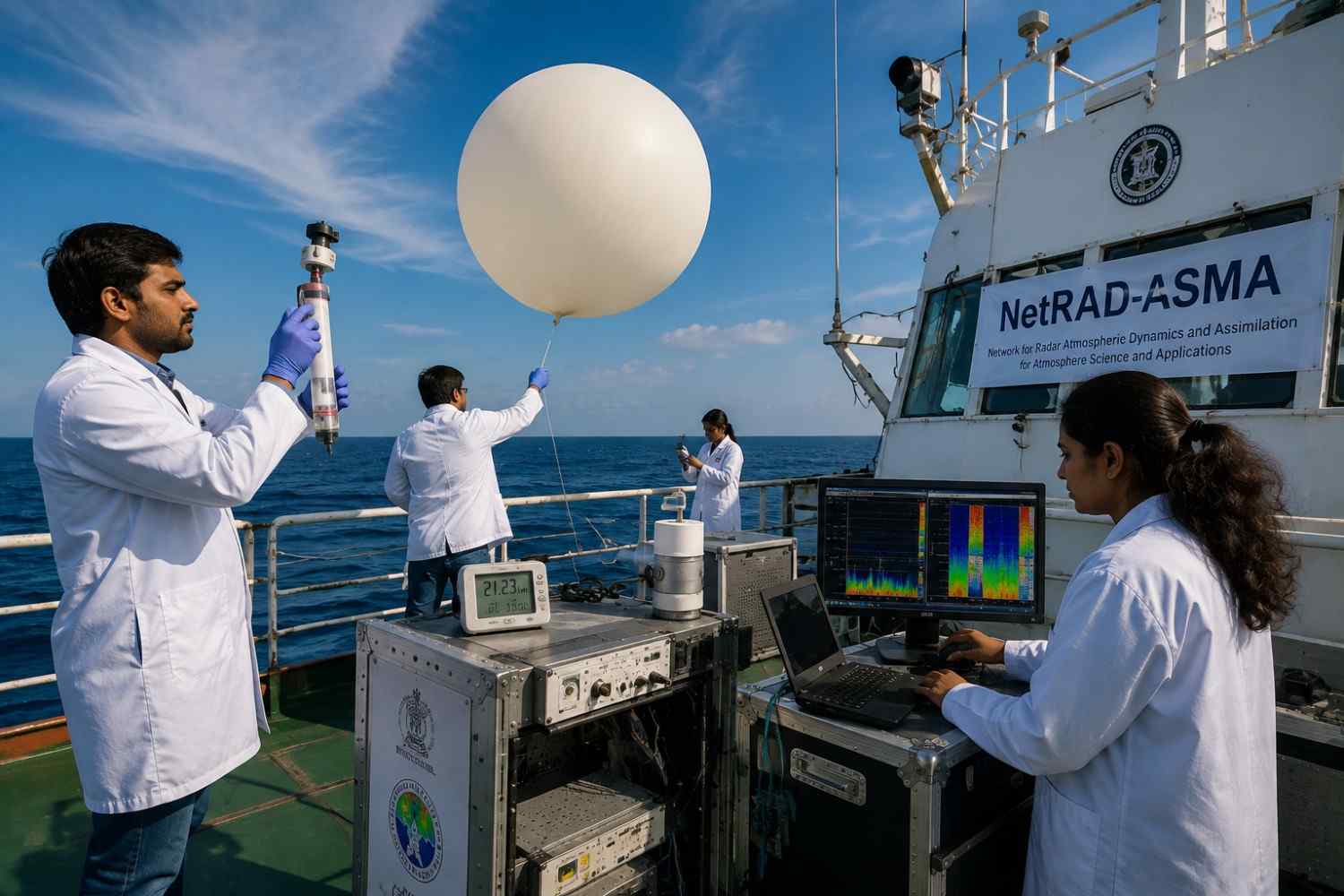
Researchers combined weather balloons, ozone-measuring instruments, atmospheric radars, satellite observations and atmospheric models to track the movement of gases through different layers of the atmosphere.
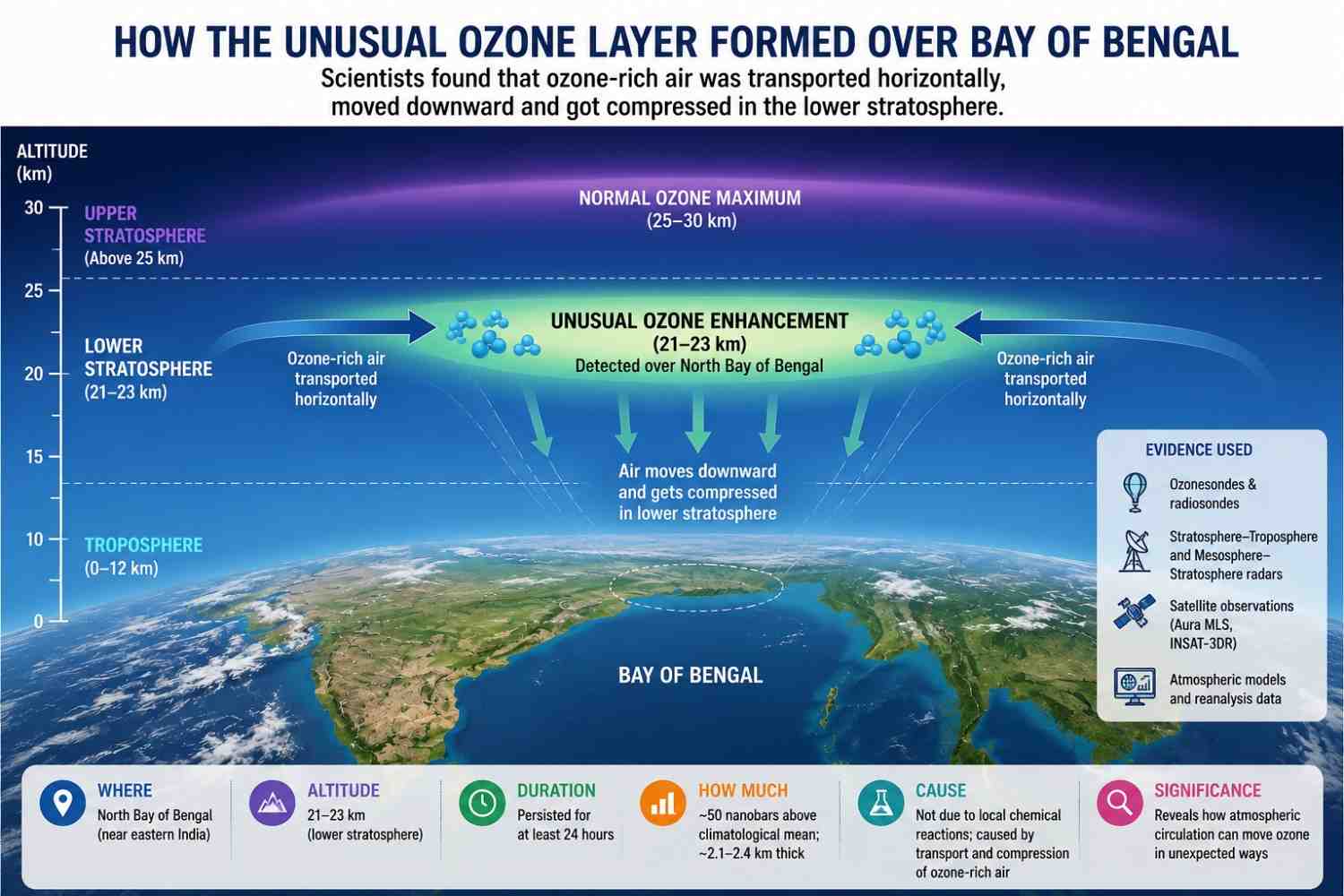
Scientists detected the unusual ozone layer at around 21–23 km above the North Bay of Bengal, significantly lower than the altitude where ozone is typically most concentrated.
Under normal atmospheric conditions, peak ozone levels are generally found higher in the stratosphere, at around 25–30 km.
Researchers found that ozone levels in the unusual layer were much higher than the normal levels recorded over eastern India.
The study reported an increase of around 50 nanobars above the long-term average, with the enhanced layer extending roughly 2.1–2.4 km vertically.
The increase was also not a brief event. Measurements showed that the unusually high ozone levels continued for at least 24 hours and were detected during both day and night. This suggested that sunlight-driven chemical reactions were unlikely to be the main cause of the sudden ozone build-up.
So, Where Did the Ozone Come From?
Scientists combined data from several sources to understand how the unusual ozone layer formed.
During the campaign, researchers used ozonesondes and radiosondes, along with a network of Stratosphere-Troposphere and Mesosphere-Stratosphere-Troposphere radars.
They also analysed satellite observations from Aura MLS and INSAT-3DR, supported by atmospheric models and reanalysis data to track air movement.
Together, the evidence suggested that the ozone was transported into the region from elsewhere in the atmosphere rather than being produced locally.
Researchers detected a persistent downward movement of air in the lower stratosphere.
Their analysis suggested that ozone-rich air had been transported into the region and then gradually moved downward.
As the air mass descended and became compressed, the ozone concentration increased, creating the unusual layer observed over the Bay of Bengal.
Scientists also considered the possible role of mid-latitude air moving into the region and other atmospheric processes. The location of the event was significant because the North Bay of Bengal lies in a region where different air masses and large-scale atmospheric movements can interact.
The North Bay of Bengal is a key region for deep atmospheric convection and is influenced by several major circulation systems.
These conditions make it an important area for understanding how ozone and other atmospheric gases move between different layers and regions of the atmosphere.
The study also shows why observations from multiple locations are important.
During the campaign, data were collected from Balasore, Gadanki, Nainital, Silkheda and Thiruvananthapuram, along with regular observations from other meteorological stations.
Comparing measurements across these sites helped provide a broader picture of atmospheric movements rather than relying on a single location.
The finding does not indicate the formation of a permanent ozone layer or an ozone hole over the Bay of Bengal.
Instead, it points to a temporary and unusual increase in ozone concentration in the lower stratosphere.
The significance of the event lies in what it reveals about atmospheric circulation.
It offers direct evidence of how large-scale air movements can transport and redistribute ozone between different parts of the atmosphere.
The study, published in Earth and Space Science, offers a deeper understanding of the Indian subtropical atmosphere and the complex ways in which large-scale air movements can redistribute ozone far from the levels where it is normally concentrated.
The significance of the finding, therefore, goes beyond an unusual rise in ozone over the Bay of Bengal.
It is a reminder that the atmosphere is constantly moving and reshaping the distribution of gases within it.
By combining detailed observations with atmospheric modelling, scientists can better understand these unexpected changes - and what they reveal about the behaviour of our atmosphere.
Primary Sources
- Das, S. S., et al. (2026). “Unusual Enhancement of Stratospheric Ozone Observed Over the North Bay of Bengal: Results Inferred from NetRAD-ASMA Campaigns-2024.” Earth and Space Science.
DOI: 10.1029/2025EA004791
Original research paper — Wiley Online Library - Press Information Bureau, Government of India — Ministry of Earth Sciences. “Scientists Discover Unusual Ozone Layer Above North Bay of Bengal.”
Source: Official Government of India release on the NetRAD-ASMA findings.
Press Information Bureau — Ministry of Earth Sciences - NASA/JPL — Microwave Limb Sounder (Aura MLS).
Source: Satellite-observation data referenced in the ozone study.
NASA Microwave Limb Sounder







Add a Comment