
Kolkata | 21 August, 2026
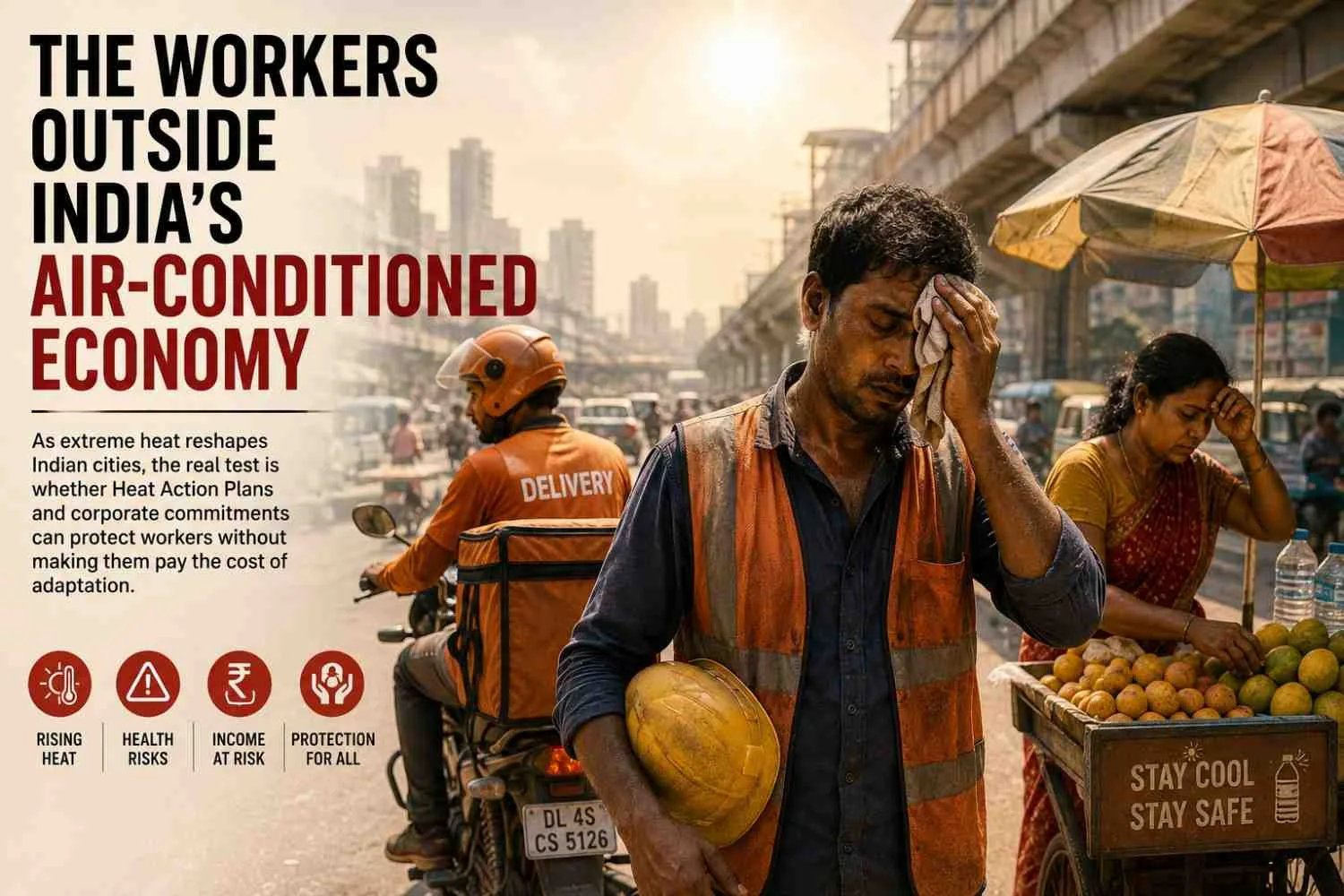
| As extreme heat reshapes Indian cities, delivery riders, construction workers and street vendors are being asked to keep working through conditions that can threaten both health and income. The real test is whether Heat Action Plans and corporate commitments can protect workers without making them pay the cost of adaptation. |
Summary Extreme heat is becoming a workplace issue as much as a weather emergency. India now has Heat Action Plans across 23 states, 195 districts and 64 cities, while the National Disaster Management Authority has specifically advised cities to include street vendors and other informal workers through shaded vending areas, hydration facilities, cooling centres and flexible working hours. Yet the people most exposed to heat are often those who cannot simply stop working. Delivery riders lose income when they take breaks, construction workers spend hours outdoors, and street vendors depend on remaining at their locations through the hottest parts of the day. A 2026 nationwide advisory from the Ministry of Labour and Employment has urged employers and construction companies to provide drinking water, rest areas and cooling measures. Meanwhile, a proposed parametric-insurance pilot for delivery workers in Delhi-NCR is testing whether heat-triggered payouts can protect income when workers reduce labour during extreme temperatures. The larger question is whether India's heat-response system can move from warnings and advisories to enforceable protection for the workforce that keeps cities moving. |
| Keywords extreme heat in India, outdoor workers India, heat stress workers, heatwave workers India, workers and extreme heat, Heat Action Plans India, heat safety at workplace, worker protection from heat, heatwave labour protection, delivery riders heat, construction workers heat, street vendors heat, informal workers India, heat and labour rights, heat stress at workplace, worker income protection, climate adaptation workers, heat insurance India, parametric insurance workers, heatwave income protection, cooling centres India, workplace cooling, CSR and climate adaptation, CSR worker protection, corporate heat safety, climate resilience India, urban heat India, extreme heat and livelihoods, heat action plans and workers, labour protection climate change |
Who Bears the Cost of Extreme Heat?
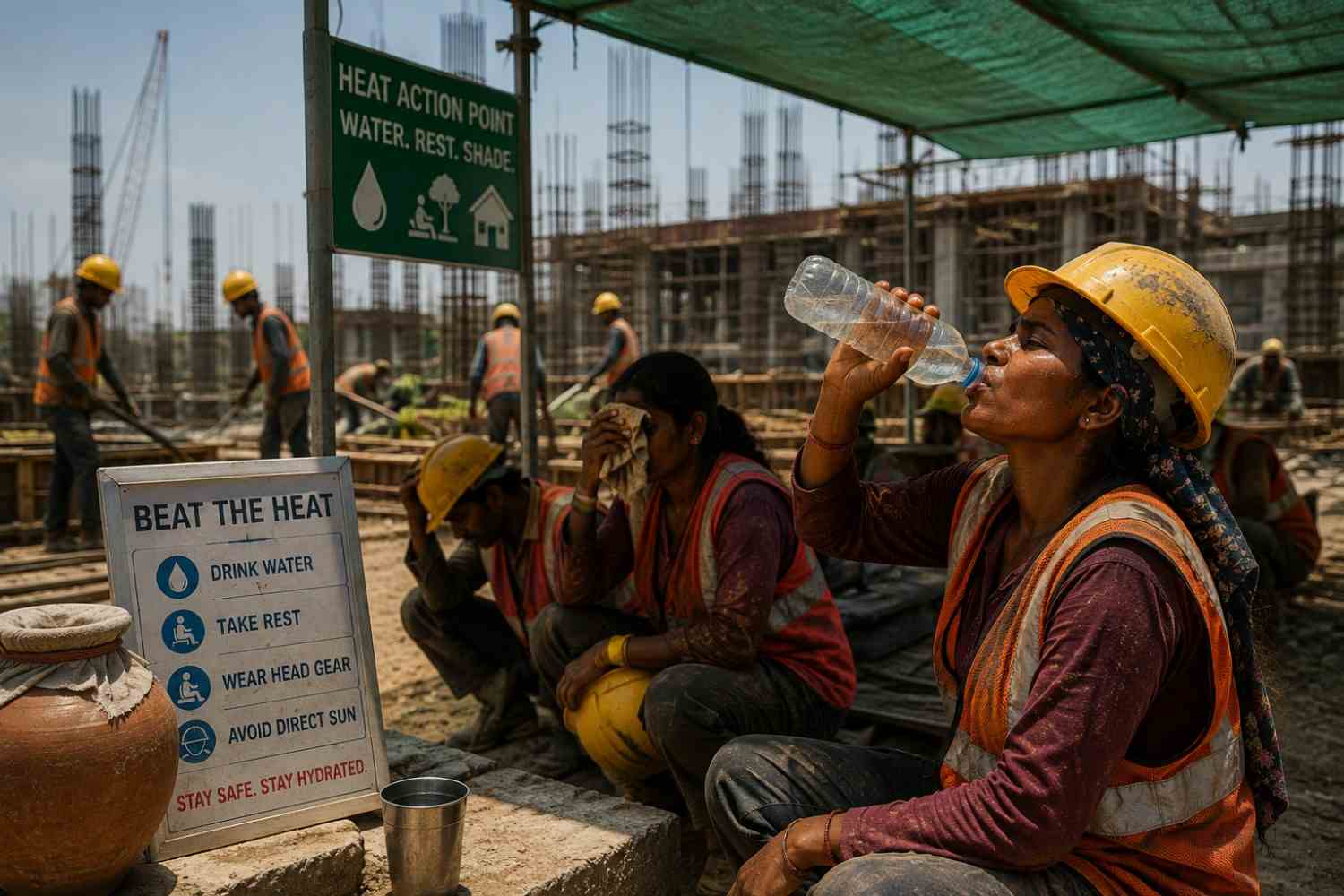
For many city residents, extreme heat may mean discomfort or changes in their daily routine. For outdoor workers, however, cutting back on work because of the heat can directly affect their earnings.
A delivery rider who delays an order may lose part of the day’s income. A street vendor who closes their stall may lose an entire day’s earnings. A construction worker may take longer breaks to cope with the heat, yet still be expected to meet daily targets.
The choice is rarely simple. For many outdoor workers, protecting themselves from extreme heat can also mean risking their livelihood.
India’s Heat Action Plans gradually recognise this vulnerability. The National Disaster Management Authority (NDMA) framework calls for early warnings, health preparedness and targeted protection for vulnerable groups. Recent government guidance has also identified informal workers and recommended measures such as shaded vending areas, drinking-water facilities, cooling centres and flexible working hours.
The framework is in place. But the real question is whether these protections reach workers on the ground, where they face the greatest heat exposure.
Is a Heat Action Plan Enough to Protect Workers?
India’s heat-response system has expanded significantly. As of 2026, Heat Action Plans have been prepared across 23 states, 195 districts and 64 cities. These plans are intended to establish when authorities should act, identify vulnerable populations and assign responsibilities across government departments.
But a plan on paper does not necessarily translate into action on the ground.
CEEW’s 2026 analysis has highlighted that many urban local bodies still lack Heat Action Plans tailored to local conditions.
It recommends city-specific heat thresholds, ward-level risk assessments, clearly assigned responsibilities and stronger monitoring.
Heat warnings may cover an entire city, but the risks are not the same everywhere. A construction site, delivery depot and street market can expose workers to different levels of heat.
The real test, therefore, is not simply whether a city has a Heat Action Plan. But it is whether that plan changes working conditions when temperatures cross dangerous levels.
What Does Extreme Heat Mean for the People Who Keep Cities Running?
Heat exposure is not distributed equally across a city.
An office worker may be able to respond to a heat warning by staying indoors. A delivery rider still has to travel through traffic. A construction worker cannot move a building site into the shade. A street vendor cannot simply walk away from the heat when leaving the market or roadside stall could mean losing the day’s income.
The danger is not determined by temperature alone. Long hours of exposure, combined with humidity, direct sunlight, physical exertion and inadequate rest, can increase the risk of heat-related illness.
Warmer nights add another layer of problem. When temperatures remain high after sunset, workers get less time to recover before another physically demanding day begins.
CEEW’s recent analysis has also highlighted the growing role of humidity and warmer nights in India’s heat risk.
Protecting workers from extreme heat requires more than monitoring the temperature at midday. It also means considering how long they work, how physically demanding the work is, whether they get enough breaks and water, and whether they have enough time to recover between shifts.
Can Employers Be Held Accountable for Heat Safety?
Government measures are placing greater responsibility on employers to protect workers from extreme heat.
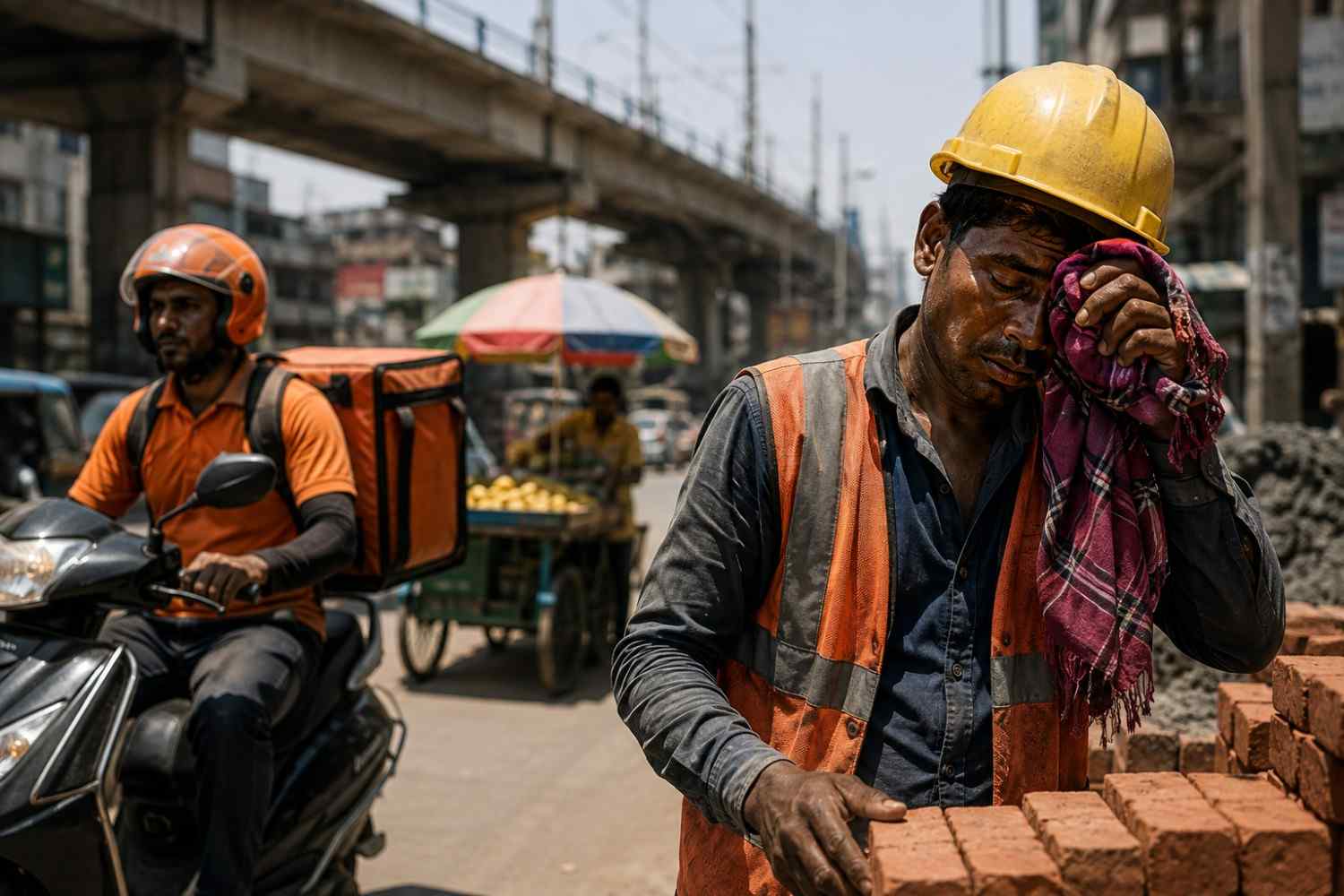
In April 2026, the Ministry of Labour and Employment issued a nationwide advisory asking states to direct employers, industries and construction companies to take measures to protect workers during heatwaves.
These included drinking water, rest areas and workplace cooling, with particular attention to construction workers, brick-kiln workers, daily-wage earners and casual labourers.
The advisory also called on ESIC facilities and labour-welfare authorities to establish support mechanisms for heatstroke cases and maintain supplies such as ORS and ice packs.
But an advisory alone does not answer a crucial workplace question:
What happens when heat protection comes into conflict with productivity targets?
A delivery platform may expect riders to complete a certain number of orders. A construction contractor may have a fixed daily target. In such situations, simply recommending more breaks may not protect workers if taking those breaks means losing wages, incentives or facing penalties.
That makes employer responsibility closely linked to income protection. A heat-safety measure works only when workers can actually use it without being financially punished for doing so.
Could Changing Work Hours Make Outdoor Work Safer?
One of the simplest ways to reduce heat exposure is also one of the hardest to implement: changing when people work.
NDMA guidance has recommended flexible working hours and other measures for outdoor workers during heatwaves. Earlier heatwave guidelines have also supported rescheduling working hours and providing drinking-water points and shaded areas.
For construction workers, this could mean moving physically demanding tasks away from the hottest part of the day. For delivery workers, it could mean reducing pressure during peak-heat hours. For street vendors, it could involve shaded vending spaces and easy access to water and cooling facilities rather than simply advising workers to stay indoors.
But changing working hours can also reduce earnings.
If a worker is paid according to hours worked or deliveries completed, reducing heat exposure without compensating for lost income can simply shift the financial cost of climate adaptation from the employer to the worker.
That is why heat adaptation is not only a public-health issue. It is also a labour and income-protection issue.
Can Cooling Centres Reach the Workers Who Need Them?
Cooling centres are becoming part of heat-response planning, but their usefulness depends on whether workers can actually access them during the working day.
A delivery rider may not be able to leave a delivery route for 30 minutes. A street vendor may not be able to leave a stall unattended. A construction worker may be working far from any public cooling facility.
This means cooling infrastructure should be planned around where workers live, work and move, rather than simply measured by the number of centres established.
In some locations, shaded bus stops, drinking-water points, rest areas, shaded markets, construction-site cooling zones and accessible public facilities may provide more practical protection than a small number of centralised cooling centres.
The more useful measure, therefore, is not simply how many cooling facilities exist, but how many vulnerable workers can actually access them when they need them.
Can Heat Insurance Protect Workers’ Income?
Another emerging approach is parametric insurance, which can provide a predetermined payout when specific temperature thresholds are reached.
J-PAL South Asia is studying a proposed pilot for outdoor delivery workers in Delhi-NCR.
Under the model, payouts would be triggered when temperatures cross defined thresholds, helping workers reduce their exposure to extreme heat without losing as much income. The research also proposes examining the effects on worker health, labour supply and platform businesses.
The idea is important because it addresses a basic problem: workers should not have to choose between protecting their health and earning their income during extreme heat.
But any such model needs to be tested carefully.
How many workers are covered? How often are payouts triggered? How much does each worker receive? Does the payment actually compensate for lost income? And does it help reduce heat exposure?
The timing of the support matters too.
A payout that arrives only after a worker has already suffered serious health consequences cannot be considered an adequate heat-protection system.
What should companies actually measure?
THE HEAT-PROTECTION EVIDENCE TEST
Workers Exposed
↓
Heat Threshold Crossed
↓
Protection Activated
↓
Break / Shift Adjustment
↓
Income Protected
↓
Health & Grievance Outcome
↓
Protection Continues Beyond the Heatwave
Companies need to look beyond the number of worksites covered and report how many workers are actually protected.
They should track whether heat-related measures affect workers’ wages, job retention, access to benefits and ability to raise complaints.
Worker feedback should also be collected independently, without management present, so employees can speak honestly about whether they were allowed to take breaks, whether supervisors followed heat-safety measures and whether taking precautions affected their earnings.
Transparency also matters in reporting. If a company protects its permanent employees but leaves contract workers outside its heat-safety measures, that gap should be clearly reported.
The same scrutiny should apply to CSR spending.
How much was promised? How much was actually spent? Where did the money go? And did it fund cooling infrastructure, worker support, insurance, training or other forms of protection?
Most importantly, did these interventions actually reduce workers’ exposure to extreme heat, or did they simply add more activities and numbers to a CSR report?
The responsibility for protecting workers cannot rest with one department alone.
Municipal corporations manage much of the response in public spaces. Disaster-management authorities coordinate heat preparedness. Health departments respond to heat-related illness. Labour authorities oversee workplace protections. Employers determine working conditions, while delivery platforms can influence schedules, workloads and incentives.
Workers experience the combined impact of all these decisions.
That is why Heat Action Plans need clear responsibilities that extend beyond issuing warnings.
A city can issue a heat alert, but that warning must lead to action at construction sites, markets, delivery depots and on the streets.
An employer can provide drinking water, but workers must also be able to take necessary breaks without putting their income at risk. A city can build cooling centres, but the workers most exposed to heat must be able to reach and use them. And a company can fund a heat-adaptation programme, but the money should result in measurable protection - not just a list of activities completed.
Who Protects the People Who Keep Our Cities Running?
India’s urban economy relies heavily on people who work outside offices, malls and air-conditioned buildings. They deliver food and medicines, build homes and roads, sell goods, transport materials and keep neighbourhoods running.
As extreme heat becomes a more persistent threat, protecting this workforce cannot remain limited to seasonal warnings and awareness campaigns.
The response needs to connect heat alerts with workplace protections, income security, accessible cooling spaces and clear employer accountability.
For CSR programmes, success should not be measured by how many water bottles were distributed or how many awareness sessions were conducted.
The more important question is whether workers were safer, able to protect their income, able to access essential benefits and able to raise concerns when protections failed.
The workers most exposed to India’s rising heat are also among those keeping its cities running.
The real test is whether India can turn heat warnings into meaningful protection for the workers who keep its cities moving.
WHAT TO CHECK BEFORE CALLING A HEAT CSR PROGRAMME A SUCCESS
| Measure | What to ask |
|---|---|
| Denominator | How many workers were actually covered? |
| Exposure | How many workers face outdoor/heat-intensive work? |
| Income | Did workers lose wages when taking heat breaks? |
| Protection | Were water, shade, cooling and adjusted shifts actually available? |
| Benefits | Could workers access medical/social-security support? |
| Grievances | How many complaints were raised and resolved? |
| Baseline | What was the situation before the intervention? |
| Outcome | Did heat exposure or illness actually decline? |
| Spending | What was budgeted versus actually spent? |
| Continuity | Does protection continue after CSR funding ends? |
Primary sources:
- NDMA — Guidelines for Preparation of Action Plan: Prevention and Management of Heat Wave (2019)
Official national framework for Heat Action Plans, heat preparedness and response. NDMA Heat Wave Guidelines - NDMA — Heat Wave portal
Official government guidance and heat-wave information. NDMA Heat Wave - Ministry of Labour & Employment / PIB — Nationwide Heatwave Advisory (28 April 2026)
This is the key primary source for your claims about employers, rescheduling working hours, drinking water, rest areas, workplace cooling, construction workers, daily-wage workers, ORS/ice packs and compliance monitoring. Ministry of Labour & Employment Heatwave Advisory, 2026 - CEEW — How We Build Scientific Heat Action Plans with Indian Cities (23 June 2026)
Supports your points about locally calibrated HAPs, ward-level risk assessments, heat thresholds, outdoor workers, revised work schedules, rest-water-shade measures and monitoring/evaluation. CEEW: Scientific Heat Action Plans - CEEW — How Extreme Heat is Impacting India: Assessing District-level Heat Risk (2025)
Useful for the claims about humidity, warmer nights, heat risk and the limitations of existing HAPs. CEEW: Extreme Heat Risk in India - NDMA — National Guidelines for Cooling Centers (November 2025)
This is the strongest primary source for the cooling-centre/infrastructure section. NDMA lists the guideline officially. NDMA: National Guidelines for Cooling Centers - J-PAL South Asia — Take-up and Impacts of Parametric Insurance for Labor Supply under Climate Change
This is the primary research source for your section on parametric heat insurance for outdoor delivery workers in Delhi-NCR, including predetermined temperature triggers and income protection. J-PAL: Parametric Insurance for Outdoor Delivery Workers






Add a Comment