
Kolkata | 20 August, 2026
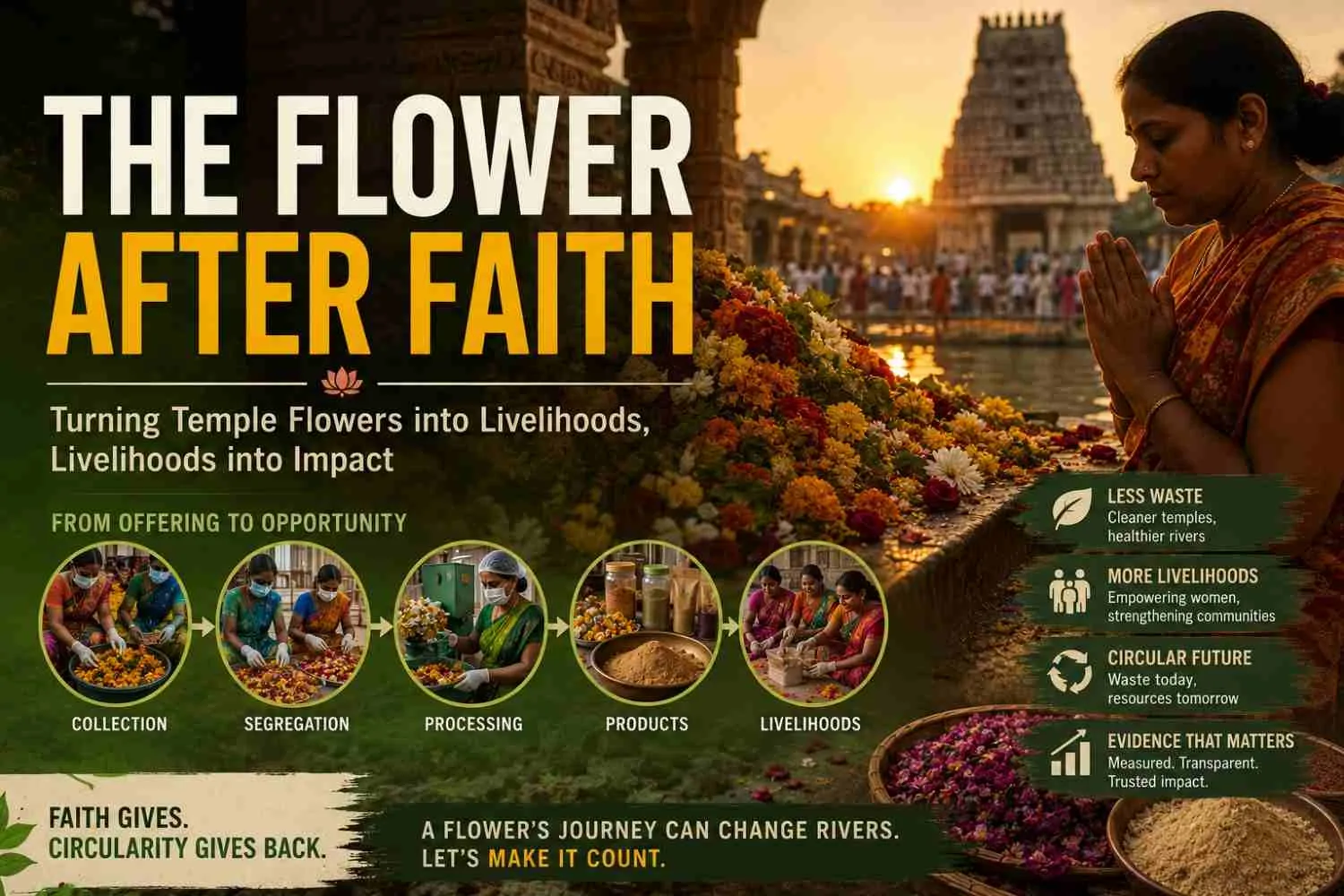
| Every day, millions of flowers are offered at India’s temples. Once the prayer is over, however, those flowers become part of a growing waste-management challenge. Across pilgrimage towns, municipalities, temple trusts, women’s self-help groups and private enterprises are trying to give them a second life - as incense, natural colours, compost, flower powder and other products. The bigger opportunity is not simply to prevent flowers from reaching rivers. It is to build a system where ritual waste creates reliable rural livelihoods, supports women and waste workers, and can prove every environmental claim it makes. |
| Summary Temple flowers can become more than biodegradable waste. They can become products, income and a reason to strengthen local circular economies. But a credible model must answer difficult questions. How much waste was actually collected? Where would it have ended up without the intervention? How much was successfully converted into usable products? Where did the remaining material go? How much did the workers earn? What did the project cost? And, most importantly, can the claimed reduction in river pollution be supported with clear evidence? The future of India’s temple economy may depend less on how many flowers are collected and more on whether the entire chain can be measured and trusted. |
| Keywords Temple Flower Waste, Floral Waste Management, Circular Economy India, Temple Waste Recycling, Women Self-Help Groups, Sustainable Livelihoods, Circular Economy, Waste to Wealth, River Pollution, Environmental Impact, CSR, Sustainable Communities |
When Devotion Becomes a Waste-Management Challenge
For a devotee, flowers are an offering made with faith and devotion. But for temples that receive thousands of visitors every day, those offerings eventually become a large and regular source of organic waste.
The problem arises when floral waste is mixed with other garbage or dumped in drains, open spaces and water bodies.
Although flowers are biodegradable, that does not make them harmless when large quantities are disposed of, without proper treatment.
When floral waste enters water bodies in large amounts, it can increase organic pollution, reduce dissolved oxygen and put additional stress on aquatic ecosystems.
The scale of the waste can be significant.
At Ujjain’s Mahakaleshwar Temple, which receives an estimated 75,000–100,000 visitors a day, around 5-6 tonnes of floral and other waste are generated daily.
A processing plant with a reported capacity of three tonnes per day is part of the temple’s waste-management system, while women’s self-help groups also help turn collected floral waste into useful products.
Tirupati offers another example. More than six tonnes of floral waste are reportedly handled every day, with around 150 women from self-help groups involved in recycling the material.
These examples highlight an important reality: a major temple is not only a place of worship. It is also a large local ecosystem involving visitors, livelihoods, waste management and the environment.
Temple floral-waste scale
Ujjain: 75,000–100,000 visitors/day | 5–6 tonnes floral + other waste/day | 3-tonne/day processing capacity
Tirupati: 6+ tonnes floral waste/day | 150 women involved in recycling
Gulf of Mannar: 849 kg garland waste collected → 155 kg usable flower powder | 60 women involved
Can Temple Flowers Become a Source of Livelihood?
Floral waste is often discussed as an environmental problem, but it can also become an economic opportunity when it is collected, processed and reused properly.
A model in the Gulf of Mannar Biosphere Reserve shows how this can work. Temples were used as collection points, with 15 collection drums installed across five temples, according to UNESCO.
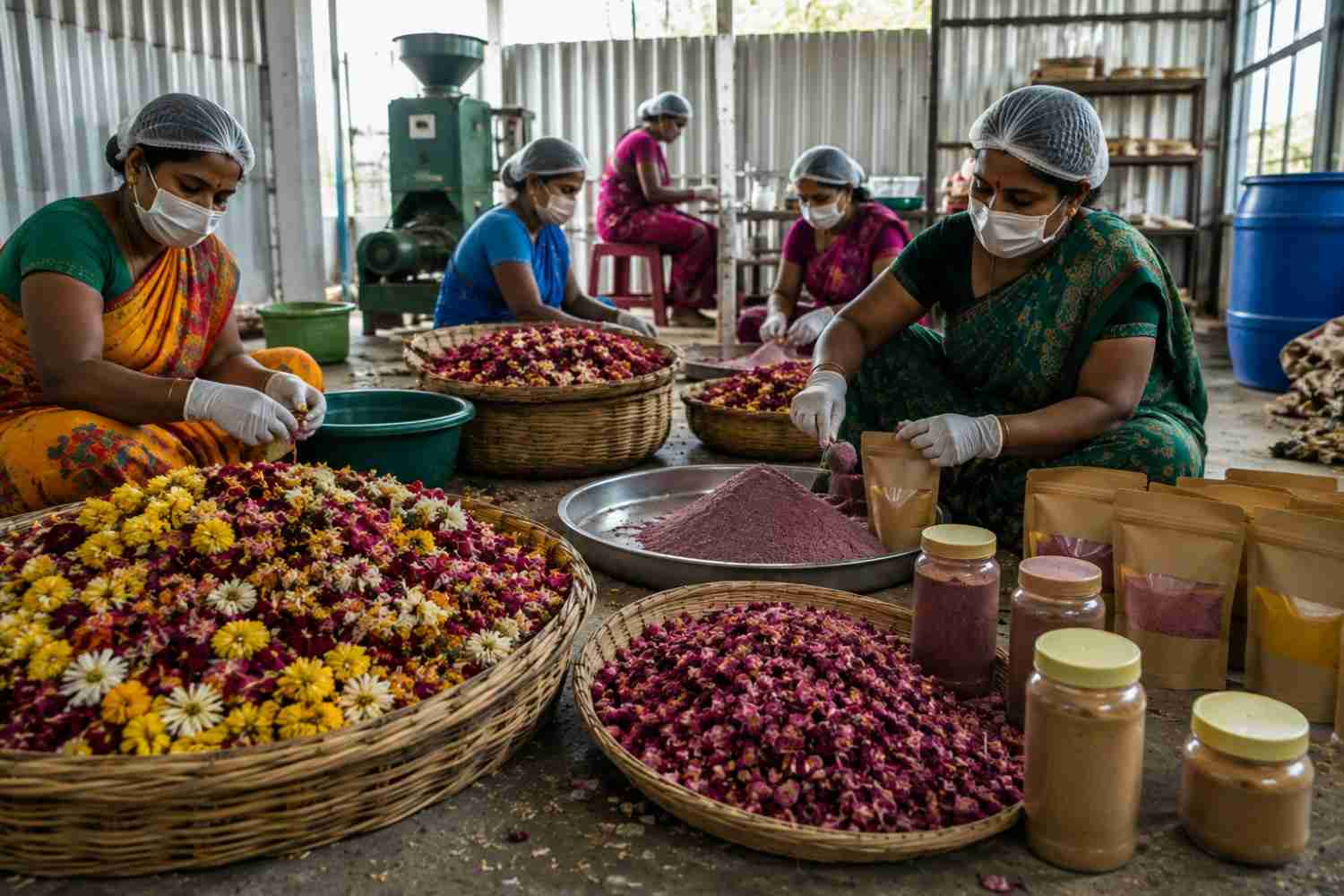
Between May and August 2025, around 849 kg of garland waste was collected and processed. After segregation and drying, 155 kg was converted into usable flower powder, while 60 women received training in processing, quality control, packaging, pricing and managing micro-enterprises.
The numbers also show why waste processing cannot be measured simply by comparing what is collected with what is sold. 849 kg went into the process, while 155 kg became usable flower powder.
That difference is expected. Flowers contain significant moisture, while temple offerings can also contain threads, plastic, synthetic decorations and other unwanted material. Some of the material is removed during sorting, while further losses can occur during drying and processing.
Not all collected waste will necessarily be suitable for the final product.
This is why credible circular-economy projects need a clear mass balance - tracking how much material enters the system, how much is recovered, how much is converted into products and how much ultimately remains as waste.
Collected → segregated → processed → converted into product → sold/used → residual material → final destination.
Without that chain, “X tonnes recycled” can hide what happened between collection and the final product.
Who Benefits When Temple Flowers Get a Second Life?
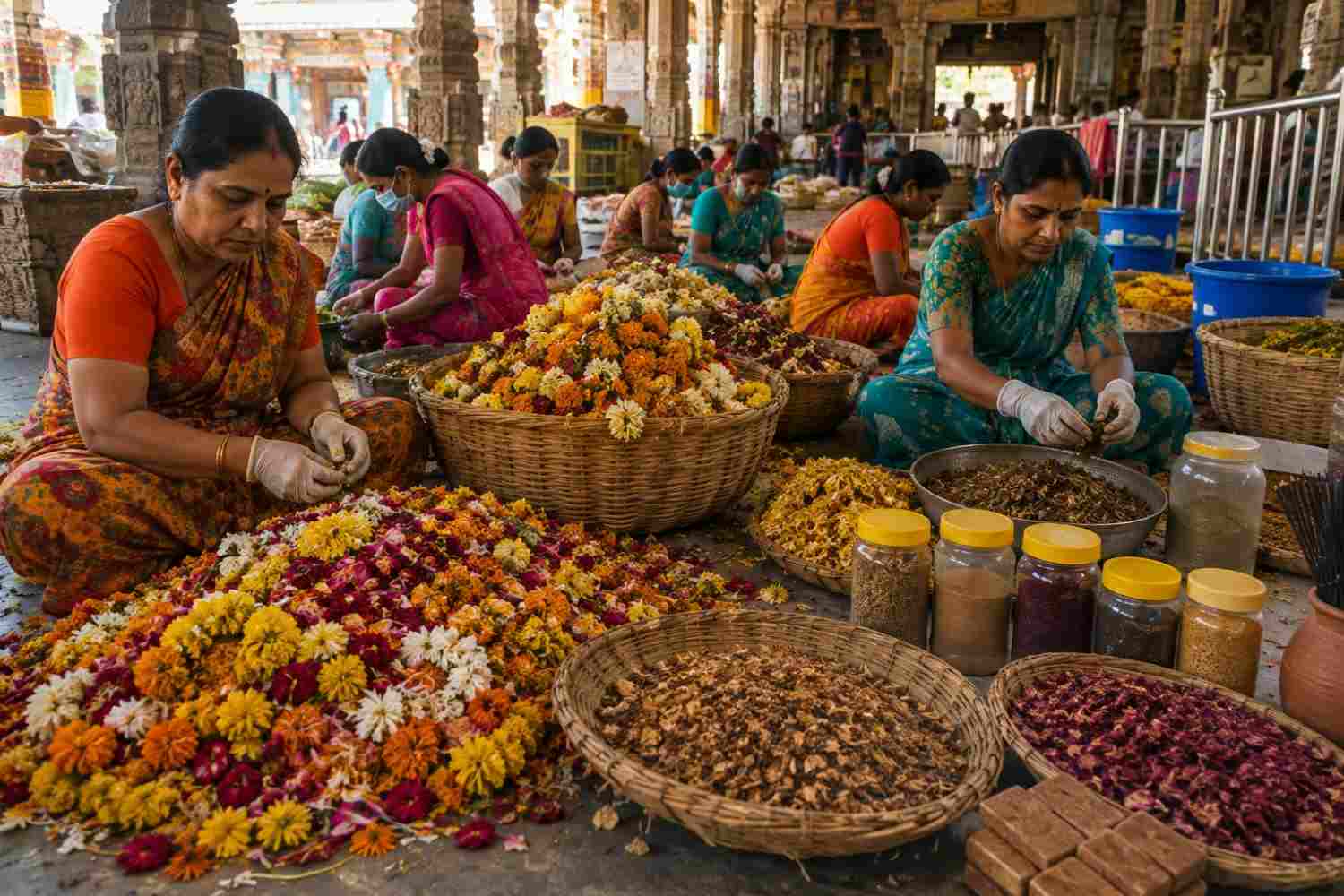
The strongest potential of floral-waste circularity may lie in its ability to address waste while creating local livelihoods. Women’s self-help groups can take part in collection, segregation, drying, processing, packaging and sales.
This can keep more of the economic value within pilgrimage centres and nearby communities, instead of sending the waste to a distant processing facility.
But formalising the waste stream can also affect people who already depend on it for their livelihoods.
Before a new floral-waste system is introduced, it is important to ask: Who was collecting, sorting or recovering value from this waste before the project began?
Informal waste workers may already be earning an income from these activities. If a formal system replaces their work without including them, it could solve a waste-management problem while creating a new livelihood problem.
A responsible circular-economy model should therefore examine whether informal workers are:
included in the new system or offered alternative livelihoods;
provided formal contracts or predictable payments;
- given appropriate protective equipment and training;
- included in decisions that affect their work;
- given opportunities to participate in higher-value stages of processing and sales; and
- actually, earning more or receiving a more stable income as a result.
The same principle applies to women-led self-help groups.
Saying that a project has “created 100 jobs” does not narrate the full story. It is important to know whether these are full-time or occasional jobs, how much workers are paid, who pays them and whether the income will continue after the pilot or CSR funding ends.
A circular-economy project should create value not only from discarded flowers, but also for the people whose work keeps that system running.
VALUE-CHAIN FLOW
FLOWER OFFERED → TEMPLE COLLECTION → SEGREGATION → WOMEN/WASTE-WORKER NETWORK → PROCESSING → PRODUCT → MARKET → INCOME
Waste residue → documented destination
Can Temple Trusts Turn Faith-Based Giving into Environmental Action?
India’s religious institutions already play a major role in supporting education, healthcare, food distribution, welfare and other community programmes. This gives temple trusts and endowment bodies an opportunity to extend that work into environmental management and circular-economy initiatives.
Instead of leaving floral waste entirely to municipal systems, temple administrations could invest in the infrastructure needed to manage it properly, including:
- separate collection points;
- storage and transportation systems;
- processing equipment and facilities;
- training and protective equipment for workers;
- support for women-led enterprises;
- market development for products made from floral waste; and
- regular monitoring and independent audits.
Tirumala Tirupati Devasthanams, for instance, already operates several social-service and charitable programmes through dedicated trusts and institutional structures.
This established model of organised giving could be expanded to support environmental stewardship, responsible waste management and sustainable livelihood opportunities for local communities.
But funding a circular-economy project is only the beginning. Temple trusts should also be able to demonstrate how that money is being used and what it is achieving.
Capital expenditure, operating costs, worker payments, equipment purchases and actual programme spending should be clearly documented.
A large budget announcement does not necessarily mean the money has been spent. A large processing facility does not automatically mean the system is functioning. And a finished product on a shelf does not prove that the wider floral-waste stream is being managed responsibly.
The real measure of a temple’s circular-economy investment is not how much it announces or builds, but how effectively it turns waste into environmental and social value.
Can Private Companies Help Take Temple-Waste Circularity to Scale?
Taking temple floral-waste circularity to a larger scale will likely require more than temple trusts and municipal bodies. Private companies can bring the technology, logistics, packaging, market access, training and investment needed to build a more efficient system.
Different industries can contribute in different ways. FMCG companies could support product development and distribution, while packaging companies could help create lower-impact packaging for products made from floral waste.
Recyclers and producer-responsibility organisations could bring expertise in collection, traceability and material management.
Companies in sectors such as automobiles, electronics and batteries could also support floral-waste initiatives through CSR funding, livelihood programmes and wider circular-economy partnerships.
Businesses involved in repair and reuse can bring another useful lesson: materials retain greater value when they are kept in productive use instead of being discarded.
But corporate participation should not turn floral-waste management into another branding exercise.
If a company supports such a project through CSR, there should be clear answers to basic questions: How much money was committed? How much was actually spent? What was built? Who benefited? What results were achieved? And what continued after the funding ended?
That transparency is what separates a CSR announcement from a functioning programme that delivers lasting environmental and social impact.
Who Is Responsible for Making Temple-Waste Management Work?
Temple floral waste does not exist separately from the wider urban waste-management system.
In pilgrimage towns, municipal corporations are responsible for local waste collection, sanitation and supporting infrastructure. That makes coordination with temple administrations essential.
Running two separate waste systems in the same town can create gaps, duplication and confusion over responsibility.
The regulatory framework is equally important.
The Central Pollution Control Board (CPCB) and State Pollution Control Boards play a role in pollution monitoring and environmental compliance, while the Ministry of Environment, Forest and Climate Change (MoEFCC) provides the broader policy framework.
BIS may be relevant where standards apply to particular products or processes, while the Central Consumer Protection Authority (CCPA) has a role in addressing misleading environmental claims.
This becomes especially important as circular-economy projects use environmental benefits as part of their public messaging.
India’s 2024 Guidelines for Prevention and Regulation of Greenwashing and Misleading Environmental Claims require environmental claims to be truthful, clear and supported by evidence. Floral-waste projects should meet the same standard.
If a project claims to have “saved a river,” the crucial question is whether that claim can be supported by clear, verifiable evidence.
Can a Floral-Waste Project Prove Its Environmental Impact?
Collecting waste does not automatically tell us how much pollution has been prevented.
Suppose a project collects 1,000 kg of flowers. It cannot simply claim that 1,000 kg of waste was diverted from a river. To make that claim, the project needs to establish where that waste would have gone without the intervention.
Was it entering a river or other water body? Was it being sent to a landfill? Was it already being composted? Was it being collected separately?
The environmental benefit depends on the answer.
A credible project should therefore report at least four things:
- Waste collected: How much floral waste entered the programme?
- Waste diverted: How much was demonstrably prevented from its documented previous disposal route?
- Product output: How much was converted into a usable product?
- Residual waste: Where did the remaining material go?
The scale of the project should also be taken into account. Reporting both absolute and intensity-based results can provide a clearer picture.
For example:
Absolute: 10 tonnes of floral waste diverted in one year.
Intensity: 10 kg of floral waste diverted per 10,000 visitors.
The second measure can make comparisons between temples of very different sizes more meaningful.
Is the Final Product Really the Measure of Circularity?
Not necessarily.
It is easy to focus on the visible end products - incense sticks, soaps, colours, compost, paper or decorative items made from flowers. But these products represent only one part of the circular-economy process.The system begins with segregation and collection and ends only when the material, money and people involved can be accounted for.
That means asking:
- Material: Where did the collected flowers go?
- Money: How much was spent and how much revenue was generated?
- People: Who did the work, who benefited and was anyone’s existing livelihood affected?
- Environment: What pollution or waste was actually avoided?
- Market: Were the products actually sold and used, or simply produced?
- Longevity: Did the model continue after the initial grant, CSR funding or pilot ended?
Organisations working on waste management, informal labour and environmental justice - including groups such as Chintan, Toxics Link, Waste Ventures India and Goonj - can bring an important perspective here: a circular system should not only change where waste goes; it should also improve the conditions and opportunities of the people handling it.
What Would a Truly Circular Temple-Waste System Look Like?
A genuinely circular temple economy would begin before the flower becomes waste.
Temples would have dedicated collection systems and ensure that plastic, thread and other contaminants do not enter the floral-waste stream. Municipalities would integrate these systems into local waste-management plans.
Temple trusts could support infrastructure, worker training and livelihood development. Women’s self-help groups and existing waste workers could participate across the value chain, rather than being restricted to the lowest-paid collection work.
Private companies could contribute technology, logistics, packaging and market access. NGOs and waste-sector organisations could help monitor worker safety, inclusion and environmental outcomes.
Regulators could ensure that environmental claims are backed by evidence.
The final test is straightforward:
Can the project trace the flower from the moment it is offered to its final destination?
If it can, that flower becomes more than waste. It can become a product, a source of income, an opportunity for local enterprise and a measurable part of pollution prevention.
But if a project cannot show where the waste went, how much became a usable product, how much workers earned, what the system actually cost or how its environmental claims were calculated, then “circularity” risks becoming little more than a label.
India does not have to choose between faith and sustainability. It can build systems where faith supports environmental stewardship, environmental action creates local livelihoods and every claimed impact is supported by credible evidence.
A flower offered at a shrine should not have to end its journey in a polluted river.
But making that journey truly circular requires more than collecting the flowers - it requires tracking their journey and proving what happens to them at every stage.
THE CIRCULARITY TEST” SCORECARD
| What a project claim | What readers should ask |
|---|---|
| “X tonnes recycled” | How much was actually collected, processed and converted? |
| “River pollution avoided” | Where would the waste have gone without the project? |
| “Women employed” | How many women, doing what work, for how much income? |
| “Waste diverted” | What was the baseline disposal route? |
| “Circular product” | Where did processing residues go? |
| “₹X crore invested” | How much was actually spent and on what? |
| “Sustainable” | What evidence supports the environmental claim? |
Before You Call It Circular, Follow the Flower.
“849 KG → 155 KG”
Use the Gulf of Mannar case as a simple mass-balance graphic:
849 KG GARLAND WASTE
↓
SEGREGATION + DRYING + PROCESSING
↓
155 KG USABLE FLOWER POWDER
Side panel:
60 women involved
15 collection drums
5 temples
May - August 2025
“Collected material ≠ final product.”
EDITORIAL EVIDENCE BOX:
For every floral-waste project studied, the reporting checklist should be:
Collection records
Weighing/mass-balance records
Processing capacity vs actual throughput
Final-product quantity
Residual-material destination
Baseline disposal route
Pollution or environmental baseline
Worker numbers and actual income
Worker safety provisions
CSR/temple/municipal budget and actual expenditure
Sales/market evidence
Audit or certification trail
Clear reporting boundary
Absolute and intensity results
Primary sources:
- PIB / Ministry of Housing & Urban Affairs — Floral Waste is boosting circularity in economy — Ujjain, Tirupati, temple trusts, SHGs, processing capacity and employment. PIB source
- UNESCO — Advancing Circular Economy and Inclusive Waste Management in the temples of Gulf of Mannar Biosphere Reserve — 5 temples, 15 collection drums, 849 kg collected/processed, 155 kg flower powder, 60 women and processing workflow. UNESCO source
- PIB — Flower Power: India’s Temple Waste Transformation — Ujjain, Siddhivinayak, Phool, HolyWaste and Aaruhi case studies. PIB feature
- Swachh Bharat Mission Urban — Petals to Profit — official government resource on temple floral-waste recycling and circular-economy models. Swachh Bharat Mission source
- CCPA — Guidelines/Guidance on Prevention and Regulation of Greenwashing, 2024 — substantiation, verifiable evidence and accuracy of environmental claims. CCPA source
- Tirumala Tirupati Devasthanams / Andhra Pradesh Endowments material — TTD funds, donations, offerings and permitted social/institutional uses of funds. TTD Endowment Act source
- UNESCO — Phool: A Story of Change — floral waste, river-pollution context, recycling into incense and employment of marginalised women. UNESCO / Phool source
- Kolkata Municipal Corporation project — 2026 — temple flowers being collected for incense and herbal aabir, with an initial employment target for 15 women. The available report quotes a senior state municipal-affairs official, so I would treat this as reported municipal information, rather than an independently audited source. Kolkata floral-waste project report





Add a Comment