
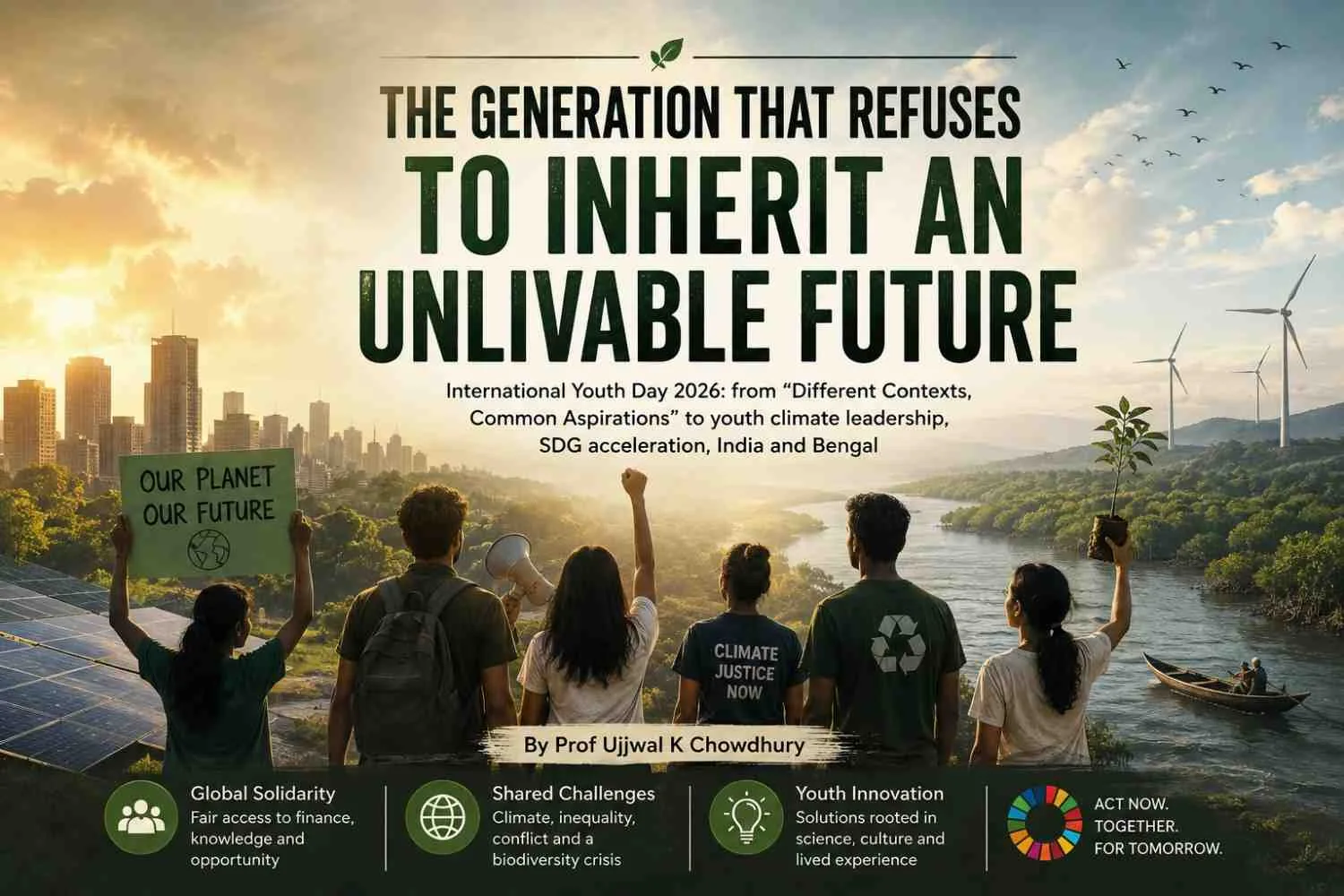
International Youth Day 2026: from “Different Contexts, Common Aspirations” to youth climate leadership, SDG acceleration, India and Bengal
By Prof Ujjwal K Chowdhury
International Youth Day 2026 is not officially a “climate day.” Its theme is broader: “Different Contexts, Common Aspirations.” Yet few issues reveal that idea more sharply than climate change. From Samoa to Sudan, Kampala to Stockholm, Tamil Nadu to the Sundarbans, young people are moving from beneficiaries of development to organizers, innovators, litigants, negotiators, translators, journalists and implementers of the SDGs. The challenge now is not to praise their courage from a distance, but to give them the skills, finance, protection and institutional power to shape the future they will live in. |
SUCCINCT SUMMARY The UN observes 12 August as International Youth Day following a 1998 ministerial recommendation endorsed by General Assembly Resolution 54/120 in 1999. The 2026 theme, “Different Contexts, Common Aspirations,” is built around Global Solidarity, Shared Challenges and Youth Innovation. This feature uses climate leadership as an SDG lens: climate action intersects with food, health, education, water, clean energy, jobs, inequality, cities, ecosystems, governance and partnerships. It profiles twelve global youth voices, examines practical models of youth-led action, and places India—especially West Bengal—at the centre. Bengal’s opportunity is to graduate from episodic green activities to youth climate governance through a Sundarbans Youth Climate Corps, Kolkata climate labs, Bangla knowledge systems, green-skills pathways, micro-grants and youth seats in decision-making. |
| KEYWORDS International Youth Day 2026; youth climate leadership; SDGs; climate justice; youth innovation; Indigenous knowledge; climate literacy; green skills; India; West Bengal; Kolkata; Sundarbans; youth governance |
| HASHTAGS #InternationalYouthDay #YouthDay2026 #DifferentContextsCommonAspirations #YouthClimateLeadership #SDGs #ClimateAction #ClimateJustice #GreenSkills #YouthInnovation #India #Bengal #Sundarbans #Kolkata #ActNow |
12 AUGUST: NOT A GREETING CARD, A GOVERNANCE QUESTION
On 12 August, the United Nations does more than “celebrate youth.” International Youth Day is a reminder that the generation expected to live longest with today’s decisions must have power in making them. The date itself carries a policy lineage. Young people at the first World Youth Forum of the United Nations System in Vienna proposed an international youth day in 1991. The World Conference of Ministers Responsible for Youth, meeting in Lisbon from 8–12 August 1998, recommended 12 August as the observance. The UN General Assembly endorsed that recommendation on 17 December 1999 through Resolution 54/120, and the first International Youth Day was observed in 2000.
The purpose was deliberately larger than ceremony: to draw public attention to youth issues and strengthen awareness of the World Programme of Action for Youth. In other words, 12 August is a day of visibility, participation and accountability. It asks governments, universities, businesses, civil society and the UN system to stop treating young people as a future constituency and start treating them as present-tense partners.
That is especially urgent in a decade defined by climate disruption and a race to rescue the Sustainable Development Goals. Young people are not simply inheriting climate change. They are already living through heat stress, floods, wildfire smoke, polluted air, water insecurity, displacement, disrupted education, precarious work and climate anxiety. UNICEF’s 2026 Children’s Climate Risk Report says more than a billion children face at least three overlapping climate hazards. Youth climate leadership therefore is not a fashionable add-on to sustainable development. It is increasingly one of the places where the SDGs become real.
2026: DIFFERENT CONTEXTS, COMMON ASPIRATIONS
GLOBAL SOLIDARITY | SHARED CHALLENGES | YOUTH INNOVATION |
|---|---|---|
Fair access to finance, technology, education and opportunity. | Jobs, education, climate, digital inclusion and mental well-being cross borders. | Youth-led social enterprise, climate tools, community action and civic innovation. |
The official UN theme for International Youth Day 2026 is “Different Contexts, Common Aspirations.” That distinction matters. “Youth Climate Leadership and the SDGs” is a powerful lens through which to interpret the day, but it is not the formal UN theme.
The 2026 framing begins with a simple truth: a young entrepreneur in a Small Island Developing State, a student in a landlocked country, a climate organizer in a Least Developed Country and a graduate in Kolkata may inhabit radically different economies and ecologies, yet share remarkably similar aspirations—quality education, decent work, health and mental well-being, a voice in decisions, dignity and the chance to build a viable future.
UN DESA organizes the 2026 observance around three connected ideas. First, Global Solidarity: opportunities for youth depend on cooperation, fair access to finance, technology, education and resources. Second, Shared Challenges: employment, education gaps, climate change, digital exclusion and mental stress cross borders even when their intensity differs. Third, Youth Innovation: young people are not simply describing problems; they are building social enterprises, climate tools, community networks and new forms of civic action.
Climate change runs through all three. It exposes inequality between countries and communities; it multiplies shared risks in food, water, health, cities and jobs; and it is generating some of the most inventive youth-led responses. For young people in SIDS, climate risk can mean the physical survival of homelands. For youth in the Sundarbans, it can mean salinity, embankment failure and migration. For city youth, it can mean lethal heat, air pollution or flooded streets. Different contexts; unmistakably common aspirations.
CLIMATE IS NOT JUST SDG 13
The mistake is to place youth climate action in a box marked SDG 13. Climate leadership is an SDG multiplier.
A young farmer using climate-resilient methods touches SDG 2 on hunger, SDG 8 on livelihoods and SDG 13. A student campaign for clean air intersects with SDG 3 on health and SDG 11 on sustainable cities. Mangrove restoration links climate action with SDGs 14 and 15 on oceans and terrestrial ecosystems while protecting incomes and settlements. Climate education connects SDG 4 with future green skills. Clean-energy innovation links SDG 7 with decent work. Youth participation in municipal planning and litigation activates SDG 16 on accountable institutions. Partnerships for finance, technology and scale invoke SDG 17.
Young people add a distinctive political force to this web. They translate complex science into peer language. They organize through networks faster than many institutions. They expose the gap between promises and implementation. They experiment with technology and behaviour. Above all, they introduce intergenerational justice into public reasoning: what does a development decision look like when the people who will bear its longest consequences are in the room?
KEY IDEA | Climate leadership is an SDG multiplier: one youth-led intervention can move health, education, water, energy, jobs, cities, ecosystems, justice and partnerships at the same time. |
WHY YOUTH LEADERSHIP WORKS DIFFERENTLY
Youth leadership also changes the method of development. Traditional programmes often begin with institutions, budgets and sectoral silos; young organizers frequently begin with lived friction—a flooded lane, an unsafe water source, plastic in a lake, a missing tree canopy, a school without cooling, a community that cannot access climate information. They then connect the problem to networks, media, science and public authority. This “problem-first” approach can make the SDGs legible at neighbourhood scale.
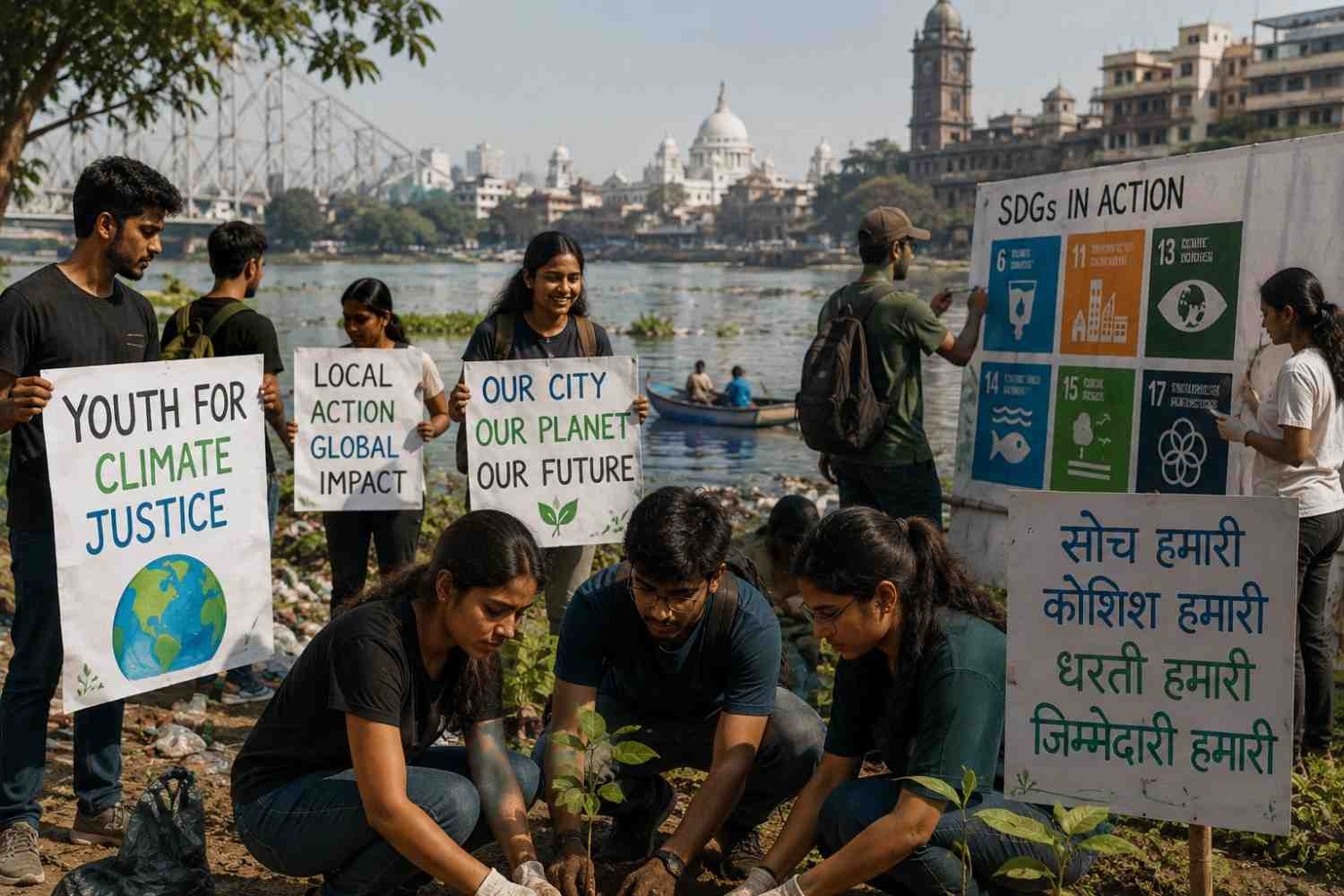
A UN example from Mathare in Kenya illustrates the pattern. Youth-led community work around clean-ups, tree planting and water initiatives can simultaneously advance sustainable cities, climate action and clean water while mobilizing residents and local authorities. The point is not that volunteering substitutes for public infrastructure. It is that young people can act as connectors between community evidence and systems that otherwise operate at a distance.
Young leaders also insist on intersectionality because their lives do not arrive in ministerial departments. A cyclone is simultaneously an education event if schools close, a health event if water is contaminated, a gender event if care burdens rise, an employment event if livelihoods disappear, and a migration event if families move. Climate anxiety similarly cannot be dismissed as a soft issue when insecurity about heat, jobs, disasters and the future affects mental well-being. The 2026 UN theme recognizes exactly this interconnectedness.
Finally, youth networks are unusually capable of combining local identity with global solidarity. A student in Kolkata can learn from Pacific advocacy on sea-level rise; a Sundarbans youth group can exchange tools with mangrove communities elsewhere; an Indigenous Indian activist can connect land rights to global biodiversity debates. Digital platforms make those bridges possible, although unequal access means digital inclusion itself remains part of the agenda.
TWELVE VOICES THAT CHANGED THE CLIMATE CONVERSATION
Twelve youth voices show how wide this repertoire has become.
Greta Thunberg of Sweden turned a solitary school strike in 2018 into the global Fridays for Future movement. At the 2019 UN Climate Action Summit, her accusation that leaders were “failing us” made the credibility gap between climate science and political action impossible to discuss as a technical matter alone. Her enduring contribution is intergenerational accountability: targets mean little without delivery.
Vanessa Nakate of Uganda brought African climate justice into a conversation too often dominated by wealthier countries. Through the Rise Up Climate Movement and work around renewable energy, schools and the Congo Basin, she has insisted that climate change is about people, livelihoods and survival. She helped normalize demands that adaptation, loss and damage and climate finance must reflect those already on the frontlines.
Xiye Bastida, an Indigenous Otomi-Toltec activist from Mexico based in the United States, co-founded the Re-Earth Initiative and has pushed climate movements to center Indigenous knowledge and frontline communities. Her public argument is that Indigenous peoples are not decorative “stakeholders” in climate policy; their rights, land stewardship and knowledge must shape decisions.
Elizabeth Wathuti of Kenya founded the Green Generation Initiative. Its model joins environmental education with greening schools, fruit-tree planting, food forests and an adopt-a-tree culture. Her example shows why restoration works best when biodiversity, nutrition, education and community ownership reinforce one another.
Autumn Peltier, an Anishinaabe water protector from Canada, brought clean water and Indigenous rights to global forums while still very young. Her leadership reframed water security as a moral, treaty and human-rights issue—not merely an infrastructure problem. In a warming world, that is also climate adaptation.
Brianna Fruean of Samoa has carried Pacific youth perspectives into global climate spaces, including COP26. Her presence makes an essential point: Small Island Developing States are not marginal to the climate debate. Their experience turns abstract arguments about sea-level rise, adaptation and finance into questions of culture, sovereignty and survival.
Nisreen Elsaim of Sudan moved from activism into climate negotiation and served in the UN Secretary-General’s first Youth Advisory Group on Climate Change. Her work connects climate vulnerability with renewable energy, development, governance and security. She embodies the transition from youth being invited to side events to youth participating in policy architecture.
Sophia Kianni of the United States founded Climate Cardinals, which has worked to translate climate information into more than 100 languages. That is climate justice through knowledge. If science, warnings and policy options remain linguistically inaccessible, millions are excluded from meaningful participation before a meeting even begins.
Archana Soreng of India, from the Kharia Indigenous community, served on the Secretary-General’s Youth Advisory Group and advocates documenting and protecting traditional knowledge. Her core message is radical in its clarity: Indigenous people and young people should be leaders of climate action, not victims of climate policy. She places land rights, identity and ecological knowledge inside contemporary governance.
Ridhima Pandey of India showed that the courtroom can also be a youth climate arena. She petitioned the Indian government on climate inaction when she was nine and later joined an international child-rights climate complaint. Her contribution is to frame climate failure as a question of children’s rights and duties owed across generations.
Licypriya Kangujam of India began campaigning as a child and has pushed climate education, stronger environmental laws and public attention to pollution and disasters. Her persistence shows the importance of making climate literacy part of basic civic education rather than leaving it to specialist environmental courses.
Vinisha Umashankar of Tamil Nadu represents another route: invention. Her solar-powered ironing cart was designed as an alternative to charcoal-fired street irons, linking cleaner air and renewable energy with the livelihoods of ironing vendors. As an Earthshot Prize finalist and a COP26 speaker, she turned a locally observed problem into a globally legible clean-tech idea.
Together these leaders break the stereotype of the youth climate activist as only a protester. The contemporary repertoire includes protest, litigation, negotiation, translation, engineering, ecological restoration, Indigenous knowledge, entrepreneurship, journalism and policy design.
FROM PROTEST TO PRACTICE: THREE MODELS THAT SCALE
Three case studies reveal why this breadth matters.
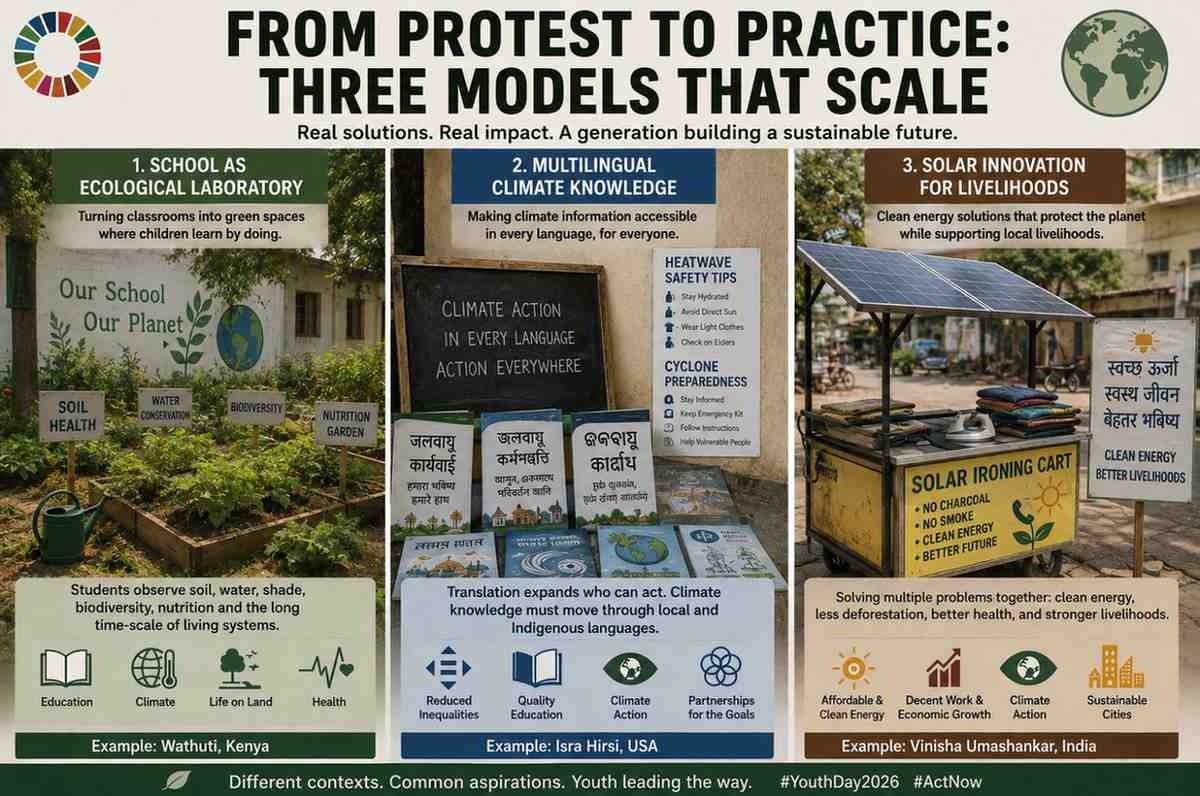
First, Wathuti’s “school as ecological laboratory” model. When students plant and tend fruit trees or food forests, climate learning leaves the textbook. Children observe soil, water, shade, biodiversity, nutrition and the long time-scale of living systems. The lesson for education systems is profound: sustainability becomes a practice, not a chapter.
Second, Kianni’s multilingual climate knowledge. Climate information is still heavily concentrated in English and technical language. Translation expands who can act. In India, this principle should move climate information through Bangla, Hindi, Odia, Tamil and Indigenous languages so that a cyclone warning, heat-risk protocol, farming adaptation guide or waste handbook is genuinely public knowledge.
Third, Vinisha’s solar ironing cart. Climate innovation is strongest when it solves several problems together. The cart tackles charcoal smoke and deforestation pressures while preserving a familiar livelihood and adding the possibility of phone charging and mobility. That is the SDG mindset at its best: clean energy without forgetting jobs.
INDIA: FROM BENEFICIARIES TO CLIMATE PARTNERS
India is one of the world’s most consequential arenas for youth climate leadership because its scale is immense and its vulnerabilities are diverse. UNICEF describes young Indians organizing in courtrooms, classrooms, neighbourhoods and online spaces; national youth statements have demanded that children and young people be placed at the centre of resilience and climate policy. The UN in India’s #WeTheChange campaign has likewise showcased young people working across renewable energy, forestry, climate finance, sustainable agriculture, disaster-risk reduction, ecosystem restoration, water and waste.

There is also an institutional turn. The UNDP-TERI Mission LiFE Youth Ambassadors Programme, launched in 2026, aims to put young leaders and higher-education institutions at the forefront of sustainability through behaviour change and zero-waste campus systems. This is significant because the next phase of youth action cannot depend only on heroic individuals. It needs repeatable pathways: climate education, green skills, grants, procurement opportunities, internships, representation in public bodies and access to data.
India’s youth climate agenda should therefore move from “awareness” to co-governance. A climate club is useful; a youth seat on a city climate committee is more consequential. A hackathon is exciting; seed finance and public procurement for its best solution are better. A plantation drive is valuable; youth participation in biodiversity budgeting and survival audits is deeper.
BENGAL: A LIVING CLIMATE CLASSROOM
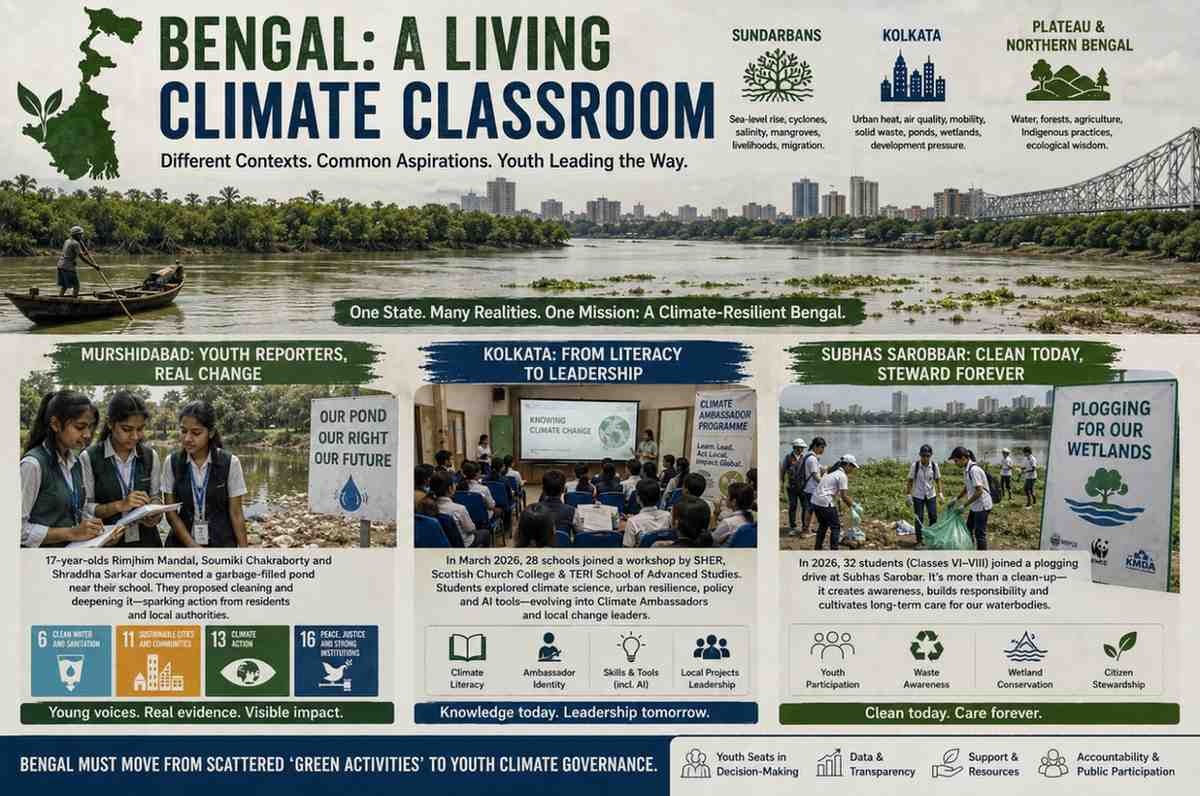
West Bengal may be one of India’s most complete classrooms for climate leadership because the state compresses multiple climate realities into one geography.
In the Sundarbans, sea-level rise, cyclones, salinity, embankment stress, erosion, livelihoods, migration and mangrove ecology meet each other every day. In Kolkata, the agenda shifts to urban heat, air quality, mobility, solid waste, ponds, wetlands and development pressure. In the western plateau and northern districts, water, forests, agriculture and Indigenous ecological practices form another set of realities. “Different Contexts, Common Aspirations” could almost have been written for Bengal.
The most telling youth stories are often local.
In Murshidabad, UNICEF’s Community Youth Reporter Programme, designed with IMAGIN Community Media and the Press Club Kolkata, enabled 17-year-olds Rimjhim Mandal, Soumiki Chakraborty and Shraddha Sarkar to document a pond near their school that had deteriorated into a garbage dump. They did not stop at reporting. They proposed cleaning and deepening the pond, helping trigger conversations among residents and local authorities. In one modest story, SDG 6 on water, SDG 11 on communities, SDG 13 on resilience and SDG 16 on civic accountability meet.
In Kolkata in March 2026, NGO SHER, Scottish Church College and TERI School of Advanced Studies brought representatives from 28 schools into a “Knowing Climate Change” workshop and launched a Climate Ambassador Programme. Students encountered climate science, urban resilience, policy, analytical tools and applications of AI in environmental monitoring. The significance lies in the progression: from climate literacy to a role identity—ambassador—and then to local projects.
At Subhas Sarobar, a 2026 plogging and wetland-conservation activity organized by the West Bengal Pollution Control Board, WWF West Bengal and KMDA involved 32 students from Classes VI to VIII. A clean-up alone will not solve urban waste systems, but it makes pollution visible, turns a waterbody into a learning site and can recruit long-term citizen stewardship.
These examples echo the attached source document’s larger insight: Bengal must move from scattered “green activities” to youth climate governance.
SEVEN MOVES BENGAL SHOULD MAKE NOW
A serious Bengal strategy could be built around seven moves.
One: create a Sundarbans Youth Climate Corps. Train local young people in mangrove ecology, salinity and water monitoring, cyclone preparedness, citizen science, sustainable aquaculture, solar systems, climate communication and resilient livelihoods. Pay them where the work provides public value.
Two: establish Kolkata Youth Climate Labs. School, college and university teams could audit ward-level heat, trees, ponds, wetlands, waste, mobility and energy, with standardized data feeding municipal planning rather than ending as exhibition posters.
Three: launch a Bangla Climate Knowledge Mission. Translate rigorous climate science, disaster guidance and green-skills material into accessible Bangla and local dialects. Make climate knowledge usable by schools, panchayats, fishers, farmers, self-help groups and local media.
Four: reserve meaningful youth participation in climate-relevant governance—municipal consultations, biodiversity committees, wetland dialogues, disaster planning and panchayat-level resilience work. Representation must include girls, rural youth, Indigenous and marginalized communities, not only metropolitan student leaders.
Five: create green innovation micro-grants. Small sums, quickly disbursed, could finance prototypes in water, cooling, waste, clean energy, mangroves, sustainable agriculture and climate-tech. Pair grants with mentors and routes to procurement.
Six: build a Bengal Green Skills Pathway across schools, ITIs, polytechnics and universities for solar, EV systems, batteries, green buildings, sustainable tourism, biodiversity, environmental data, ESG and climate-resilient agriculture. Climate leadership must also lead to dignified work.
Seven: create district youth climate-journalism networks. The Murshidabad model shows why. Environmental damage often remains politically invisible until it is documented. Train young reporters in evidence, mobile storytelling, data, verification and solutions journalism.
The principle behind all seven is the same: do not romanticize youth action while withholding power and resources.
DON’T OUTSOURCE THE CRISIS TO THE YOUNG
There is a danger in celebrating young climate heroes. Governments, companies and older generations can applaud a teenager planting mangroves while continuing the policies that destroy coasts; praise students carrying steel bottles while failing to regulate industrial pollution; celebrate clean-ups while underfunding waste systems.
That reverses responsibility.
Youth leadership must supplement, not absolve, state responsibility, corporate accountability and adult political leadership. The right response to youth courage is not to outsource the crisis to them. It is to give them knowledge, finance, safety, institutional authority and access to decisions, while those with larger legal and economic power meet their own obligations.
LEADERS OF TODAY—BECAUSE TOMORROW IS TOO LATE
Perhaps the most outdated compliment we still offer young people is: “You are the leaders of tomorrow.”
For the climate generation, tomorrow is not an adequate timetable.

Greta Thunberg changed political language before she could vote. Autumn Peltier addressed global leaders as a child. Ridhima Pandey used legal institutions before adulthood. Archana Soreng carried Indigenous knowledge into a UN advisory structure. Vinisha Umashankar turned a street-side observation into a clean-energy prototype. Three schoolgirls in Murshidabad used reporting to make a polluted pond a civic question.
These are not rehearsals for citizenship. They are citizenship in practice.
That is the deeper meaning of International Youth Day 2026. Different contexts: a Samoan island, an African school, an Indigenous forest, a Tamil Nadu street vendor, a Kolkata wetland, a Murshidabad pond, a cyclone-threatened Sundarbans village. Common aspirations: clean water, breathable air, meaningful work, education, dignity, participation, justice and a planet on which adulthood remains worth looking forward to.
Young people have already answered the question of whether they care.
The harder question is directed at institutions: will we give them the seat, the skills, the finance and the authority to convert concern into measurable change?
On 12 August, celebration should become a contract. Listen to youth. Fund youth. Protect youth civic space. Teach climate literacy. Build green skills. Put youth into decision-making. And then judge success not by the number of speeches made on International Youth Day, but by whether a generation with everything at stake is finally allowed to help shape the future it will inherit.
SOURCES & VERIFICATION NOTES
This feature integrates the uploaded YouthDay.docx as its editorial base, then independently checks the 2026 theme, UN history and key current/local claims. Current-event facts were verified on 12 August 2026 (IST). The article does not rely on unverified assertions from the source document.
1. United Nations — International Youth Day: Background
2. UN DESA Voice (July 2026) — What unites young people across borders?
3. United Nations — Closing Remarks at the 2026 ECOSOC Youth Forum
4. UNICEF — The Children’s Climate Risk Report 2026
5. UNICEF India — India’s Youth and Climate Change
6. United Nations in India — #WeTheChange youth climate leaders
7. United Nations — Youth Advisory Group on Climate Change
8. United Nations — Archana Soreng: Our voice matters
9. United Nations — Vanessa Nakate: Climate change is about the people
10. UNEP — Elizabeth Wathuti, Young Champions of the Earth
11. The Earthshot Prize — Vinisha Umashankar
12. UNICEF India — West Bengal’s Community Youth Reporters Drive Social Change
13. TERI — Mission LiFE Youth Ambassador Programme (2026)
14. Scottish Church College — “Knowing Climate Change” workshop listing, 30 March 2026
15. Times of India — 2026 Kolkata climate-literacy / Climate Ambassador workshop
16. Times of India — Students help make Subhas Sarobar plastic-free
Verification caveat: As this document was prepared at the start of 12 August 2026 in India, it relies on UN DESA’s official July 2026 IYD framing and the April 2026 ECOSOC Youth Forum remarks for the 2026 theme and pillars. No unverified 2026 Secretary-General IYD message is quoted.





Add a Comment