
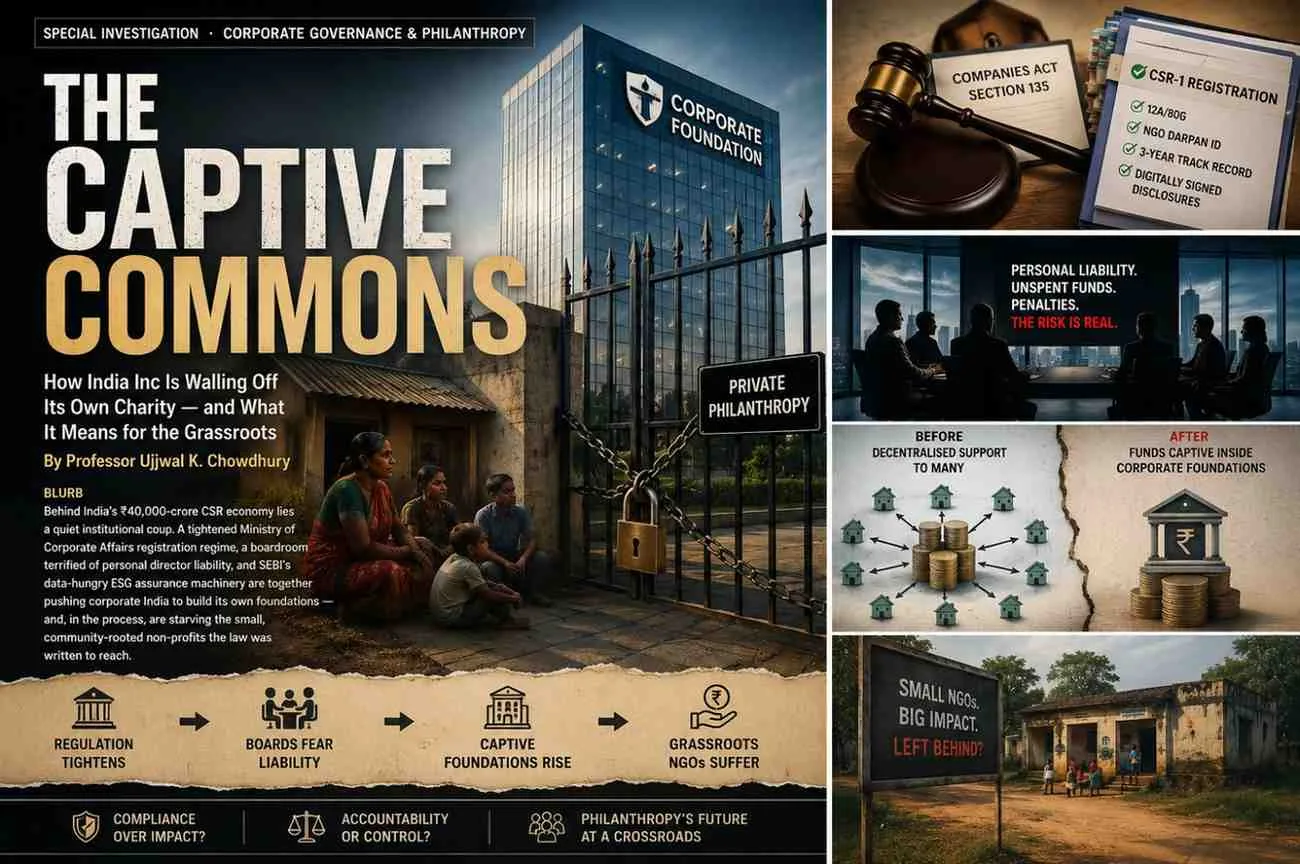
SPECIAL INVESTIGATION · CORPORATE GOVERNANCE & PHILANTHROPY
How India Inc Is Walling Off Its Own Charity — and What It Means for the Grassroots
By Professor Ujjwal K. Chowdhury
| Behind India's ₹40,000-crore CSR economy lies a quiet institutional coup. A tightened Ministry of Corporate Affairs registration regime, a boardroom terrified of personal director liability, and SEBI's data-hungry ESG assurance machinery are together pushing corporate India to build its own foundations — and, in the process, are starving the small, community-rooted non-profits the law was written to reach. |
SUMMARY Since Form CSR-1 became mandatory on 1 April 2021, and more sharply since the Companies (CSR Policy) Amendment Rules, 2025 came into force on 14 July 2025, the Ministry of Corporate Affairs has converted CSR implementation into a licensed activity. The new web-based, CA/CS/CMA-certified CSR-1 form — demanding 12A/80G proof, NGO Darpan IDs, a three-year track record and digitally signed disclosures — now gates roughly ₹35,000-40,000 crore of annual statutory CSR spend. Boards newly exposed to personal liability for unspent funds under Section 135(5), (6) and (7) are responding by internalising social spending inside wholly owned Section 8 foundations: Tata Steel Foundation, JSW Foundation, Infosys Foundation, Wipro Foundation, SBI Foundation and dozens more. This feature traces the regulatory chain from 2014 to 2026, the cost-benefit and tax arithmetic of building versus outsourcing, hard data on where the money actually lands, and mounting evidence that grassroots NGOs — 84% of India's non-profits, most running on budgets under ₹3 crore — are being pushed out of a philanthropic economy their own advocacy helped build. |
| KEYWORDS: CSR-1 registration, Section 8 foundations, Companies Act Section 135, corporate CSR India, Ministry of Corporate Affairs, BRSR Core, grassroots NGOs, CSR compliance, 12A and 80G registration, Tata Steel Foundation, Infosys Foundation, Social Stock Exchange, CSR governance, corporate philanthropy India |
| HASHTAGS: #CSRIndia #Section8Foundations #CSR1Registration #CorporateGovernance #MCA #BRSRCore #GrassrootsNGOs #CSRCompliance #IndiaInc #SocialStockExchange #NonProfitIndia #ESGIndia |
THE BOARDROOM THAT BROKE WITH CIVIL SOCIETY
In a wood-panelled boardroom overlooking Mumbai's Bandra-Kurla Complex late last winter, the CSR committee of a top-tier industrial conglomerate faced an existential briefing. For nearly a decade the company had dispersed its mandatory 2% statutory spend — roughly ₹140 crore a year — across a decentralised constellation of 45 grassroots NGOs working the rural hinterlands from Kalahandi to Bastar.

Then came the regulatory audit. A routine notice from the Registrar of Companies, coupled with statutory-auditor queries over third-party utilisation certificates, Form CSR-1 validations and unspent-escrow allocations under Section 135(6), pushed boardroom anxiety to a fever pitch. By the time legal counsel finished briefing directors on personal liability under the amended penalty provisions, the decision was unanimous: terminate 38 external partner contracts and incorporate a wholly owned, captive Section 8 not-for-profit.
“Within eighteen months, our entire social budget was internalised. It wasn't philanthropic philosophy — it was regulatory survival.” — Chief Sustainability Officer, industrial conglomerate
This boardroom pivot is neither isolated nor accidental. Across corporate India a seismic restructuring of statutory philanthropy is under way. What began in 2014 as a broad legislative mandate under Section 135 of the Companies Act has hardened into a tightly policed, data-audited compliance machinery — and in its place has arisen a sprawling new institutional class: the captive corporate foundation.
FROM ‘COMPLY OR EXPLAIN’ TO A COMPLIANCE MACHINE
Section 135 was notified in 2014 as a soft ‘comply or explain’ regime — a company could simply justify a shortfall in its board report. That leniency did not survive long. A High-Level Committee on CSR (2019-20) recommended tightening; the escrow mechanisms of Section 135(5) and (6) followed; then, in 2021, came Form CSR-1 and the decriminalisation-cum-mandatory-impact-assessment amendments. By 2023-26, SEBI's BRSR Core reasonable-assurance regime and the Social Stock Exchange had pulled CSR into the wider architecture of ESG disclosure.
2014 | 2019‑20 | 2021 | 2023‑26 |
Section 135 notified — the ‘comply or explain’ era begins. | High-Level Committee on CSR; Section 135(5)/(6) escrow mechanisms introduced. | MCA Form CSR-1 mandatory; decriminalisation amendments; mandatory third-party impact assessments. | SEBI BRSR Core reasonable assurance rolls out; Social Stock Exchange goes live; CSR-1 re-engineered (July 2025). |
FORM CSR-1: THE FORM THAT REWROTE THE RULES
The decisive shift began on 1 April 2021, when it became illegal for any company to route CSR capital to an implementing agency lacking an MCA-issued, eleven-digit unique CSR Registration Number. To secure that number, a Section 8 company, registered public trust or registered society had to demonstrate valid Section 12A/12AB and 80G registrations, a verified three-year operational track record in comparable development work (waived only for Section 8 entities established by the funding company itself), and Digital Signature Certificate verification certified by a practising Chartered Accountant, Company Secretary or Cost and Management Accountant.
The ground shifted again on 14 July 2025, when the Companies (CSR Policy) Amendment Rules, 2025 replaced the old PDF-based process with a fully web-based e-form on the MCA21 V3 portal — now demanding an NGO Darpan ID as a compulsory field, governing-body member details with DIN/PAN, audited financials, and OTP-verified, digitally signed submission. MCA subsequently clarified that entities already holding valid CSR registration numbers need not register afresh merely because the form changed. Running in parallel, the Ministry of Home Affairs tightened the Foreign Contribution (Regulation) Act, cancelling the licences of over 6,000 civil society organisations and banning sub-granting between NGOs. CSR funds are technically domestic capital, but the institutional fallout — lost accounting staff, deep regulatory scrutiny, sudden instability — hit thousands of multi-funded grassroots entities regardless.
THE ESCROW TRAP: WHEN NON-COMPLIANCE BECOMES PERSONAL
For corporate legal teams, the cost of an implementing partner's compliance lapse has become intolerable. Under Section 135(5) and (6), unspent capital tied to an ‘ongoing project’ must move within 30 days of fiscal close into a designated Unspent CSR Account at a scheduled bank, to be utilised within three fiscal years — or, for one-off projects, surrendered within six months to a Schedule VII fund such as PM CARES or Clean Ganga. Section 135(7) penalises failure with fines running up to twice the unspent amount for the company, plus personal financial liability for every defaulting officer. Recent RoC adjudication orders — some now under appeal — show that enforcement is real, not theoretical.
A further procedural tightening in 2025 requires companies to file Form AOC-4 (audited financial statements) before filing Form CSR-2, the annual CSR report; the CSR-2 web form must now carry the AOC-4 Service Request Number to link it algorithmically to audited accounts. Regulators can now cross-reference CSR spend against financials in real time, closing off the discretion companies once used to smooth over reporting gaps.
THE GREAT SPIN-OFF: MAPPING INDIA INC’S CAPTIVE FOUNDATIONS
The stampede toward captive vehicles has reshaped the institutional map of Indian philanthropy. Data compiled from the MCA portal, the Registrar of Companies and analytics platform CSRBOX show that over 65% of the NIFTY 100 now execute the majority of their social spend through promoter-backed Section 8 companies, captive trusts or dedicated operating foundations — and, since the 2025 CSR-1 overhaul, more than 60% of large corporate CSR budgets are routed through company-owned implementation arms.
Yet corporate India is not converging on one model. In heavy industry, Tata Steel Foundation — a Section 8 company and wholly owned subsidiary of Tata Steel — has saturated 81 blocks and 4,500 villages across Jharkhand and Odisha, spending roughly ₹473 crore in FY2024-25, reaching between 5.77 million and 6.9 million lives across different reporting cycles and unlocking over ₹5,300 crore of public entitlements through grassroots mobilisers. Under its MANSI maternal-health programme, 93% of high-risk pregnancies now culminate in institutional deliveries; through Masti Ki Pathshala, 73% of 5,406 highly vulnerable children in Jamshedpur's urban slums have entered mainstream schooling. JSW Foundation scaled from ₹63 crore in FY2018-19 to ₹235 crore in FY2023-24 and ₹363 crore in FY2024-25, touching 30 lakh lives across Maharashtra, Karnataka and Odisha.
In technology, Infosys Foundation — three decades old in FY2026 — has deployed cumulative spending above ₹4,800 crore, with FY2024-25 alone seeing ₹545 crore across healthcare, education and environment, and FY2025-26 global CSR of about ₹666 crore reaching more than seven million people across 200-plus projects; its annual report won a Gold Stevie in 2025, even as a 2026 fraud case — a former contractor who posed as a regional head to defraud the foundation of ₹6 crore — exposed governance vulnerabilities that scale alone cannot fix. TCS reported FY2024-25 CSR of ₹960 crore, rising to a global figure of about ₹1,153 crore in FY2025-26 with more than 18 million beneficiaries and over nine million volunteering hours, through flagship programmes such as goIT, Ignite My Future and BridgeIT reaching 7.1 million people worldwide. Wipro runs a deliberate dual-engine architecture: the endowment-backed Azim Premji Foundation, which holds an economic interest in Wipro and preserves pure civil-society funding, alongside Wipro Foundation and Wipro Cares, which executed statutory CSR of ₹259.4 crore in FY2024-25 and ₹227.4 crore in FY2025-26 against an adjusted obligation of ₹130.4 crore — a zero-shortfall result.
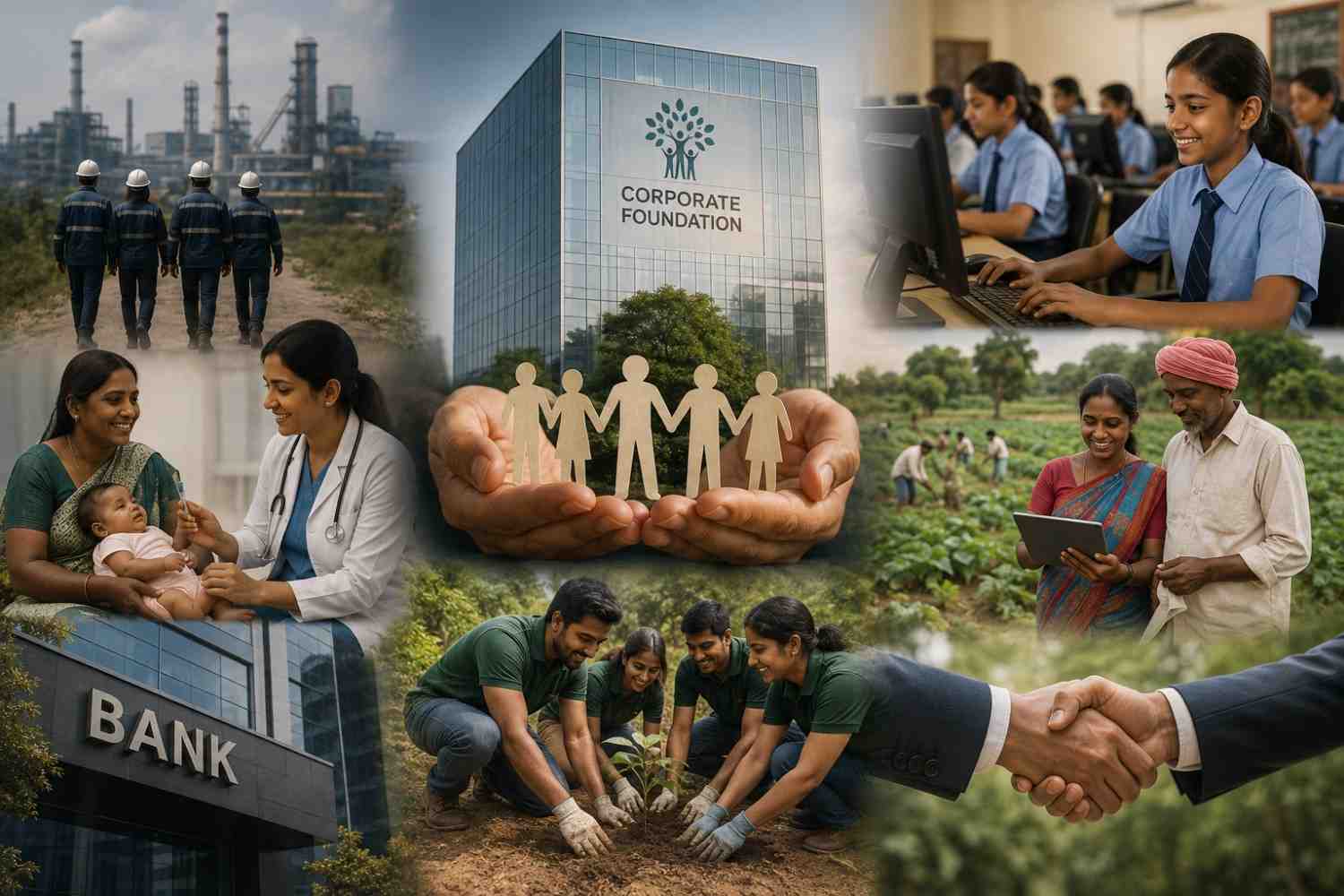
Among banks, HDFC Bank's Parivartan posted a record ₹1,068 crore in FY2024-25 across seven focus areas — including a newly added natural-resource-management vertical — reaching over 100 million beneficiaries through 214 implementation partners. SBI institutionalised its CSR inside SBI Foundation, a Section 8 company, spending ₹610.77 crore. ICICI Bank earmarked ₹801 crore but spent only ₹527 crore, citing delays in statutory approvals — a reminder that even large, well-resourced banks face implementation lag. Axis Bank Foundation, notably, is a registered trust rather than a Section 8 company and openly runs a partnership model with multiple development-sector organisations, showing that the captive-foundation trend is not universal even among peer institutions. In agribusiness, ITC's Mission Sunehra Kal spent ₹325 crore in FY2023-24, embedding climate-smart agriculture and e-Choupal watershed development directly into its sourcing catchments, creating a circular loop in which agroforestry CSR supplies pulpwood for its paperboard business. Reliance Industries, largely through Reliance Foundation, led all spenders at ₹2,156 crore in FY2024-25.
THE HIDDEN P&L: WHY BUILD BEATS BUY
Running an in-house foundation is not cheap. Registering a Section 8 company — the preferred structure — costs roughly ₹18,000-35,000 in government and professional fees, with annual compliance of ₹15,000-40,000 covering statutory audits, RoC filings (MGT-7, AOC-4), income-tax returns and 12A/80G maintenance. That is markedly steeper than a trust (₹500-3,000 to register; ₹5,000-15,000 a year) — yet for companies with large, recurring CSR budgets the arithmetic still tilts toward internalisation.
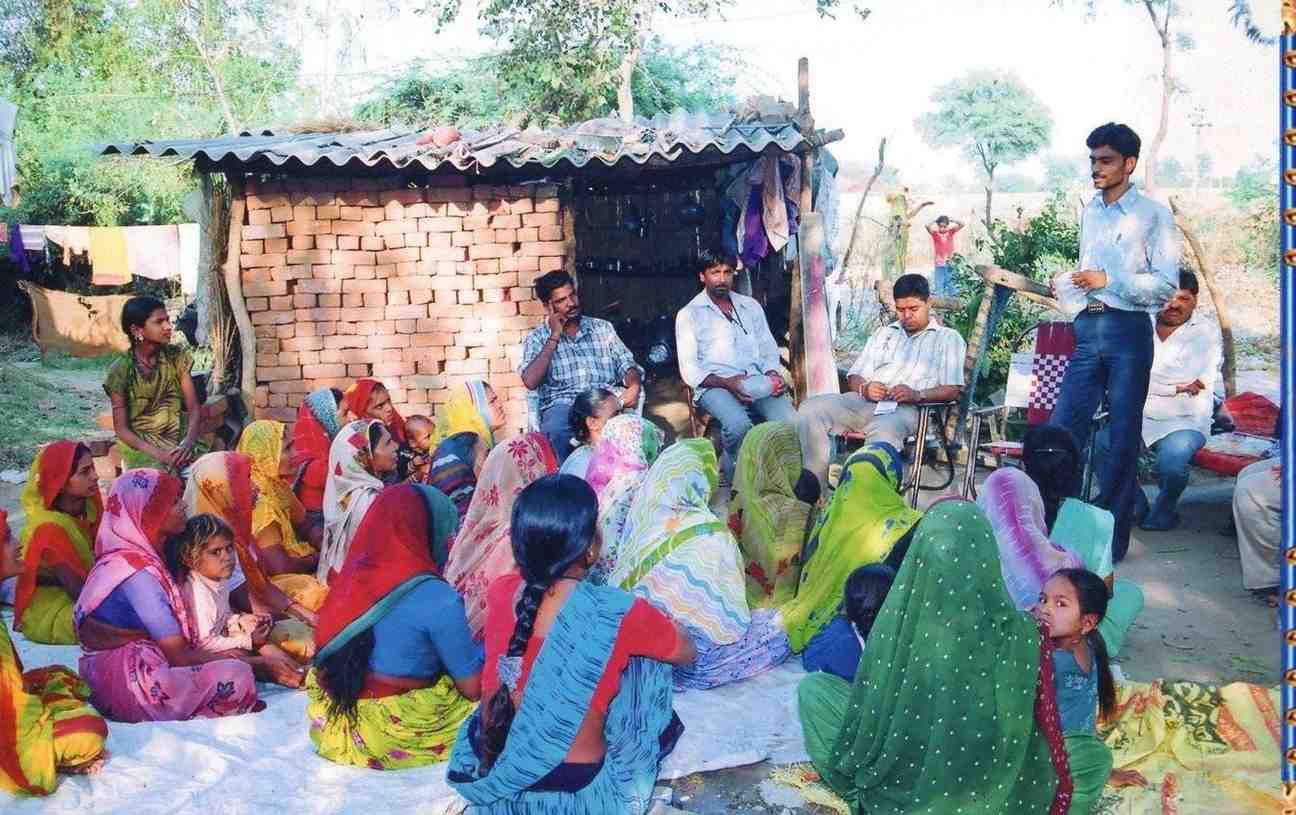
The decisive lever is Rule 7(1) of the CSR Rules, which caps administrative overheads at 5% of total CSR spend for the company itself — but explicitly excludes the administrative expenses of implementing agencies, including a company's own Section 8 foundation, from that cap. Grassroots NGOs typically need 15-20% institutional overhead to cover compliance, monitoring, senior management and rent; bound by the 5% ceiling, corporates routinely disallow these core costs when funding external partners, forcing NGOs into project-restricted budgets that erode their long-term health. A captive foundation, by contrast, allows structural reclassification: salaries of social workers, agronomists, project directors and field-monitoring teams are booked not as ‘administrative overhead’ but as direct programmatic implementation expense — full operational capacity, while the general-administration line on paper stays comfortably under 5%.
Outsourced NGO Model (₹100 Cr Spend) | Captive Section 8 Model (₹100 Cr Spend) | |
External grant / direct programme | ₹95 Cr grant, capped at 5% overhead (Rule 7(1)) | ₹96 Cr — field salaries booked as direct delivery cost, not overhead |
Overhead / admin | ₹5 Cr — partner NGO's core costs largely disallowed | ₹4 Cr head-office admin, technically within the 5% cap |
Net effect | Operational friction for the NGO partner | Full in-house operational capacity retained inside the group |
Tax structuring compounds the advantage. A Section 8 foundation without 12A registration is taxed at the ordinary corporate rate — an effective 29-33% including surcharge and cess — which is why 12A is treated as non-negotiable; newly registered entities get a provisional 12A (Form 10A, valid three years) before moving to regular 12AB (Form 10AB, valid five years, extendable to ten years for foundations with annual income under ₹5 crore). Once secured, foundation income is 100% tax-exempt if applied to charitable objects. Section 80G then lets the donor — typically the parent company — claim a deduction of 50% on the donated sum, subject to a ceiling of 10% of Adjusted Gross Total Income (cash donations above ₹2,000 do not qualify; the foundation must file Form 10BD and issue Form 10BE to preserve the donor's claim). On a ₹10 crore contribution, that works out to a ₹5 crore deduction and, at a 30% marginal rate, roughly ₹1.5 crore of tax saved by the parent — while the foundation itself receives the full ₹10 crore tax-free.
There is a catch worth flagging for the balance sheet: when a 12A-registered foundation passes money onward to other NGOs, 15% of that onward transfer is disallowed from tax exemption, creating an effective 30% tax cost on unstructured pass-through grants — one more reason captive foundations prefer to spend directly rather than sub-grant. And Mumbai ITAT rulings through 2025-26 have clarified that CSR donations to 80G-approved entities can claim the 80G deduction even though CSR itself is disallowed as business expenditure under Section 37(1) — clearly so for voluntary spending above the mandatory 2%, more contestably so for the mandatory 2% itself.
FOLLOW THE ₹40,000 CRORE: WHERE THE MONEY ACTUALLY GOES
Reported national CSR expenditure rose from ₹24,965.82 crore in FY2019-20 to ₹34,908.75 crore in FY2023-24 — more than ₹1.44 lakh crore across those five years, and over ₹2.17 lakh crore cumulatively since 2014. A July 2026 private analysis by Fulcrum, based on corporate filings, estimates FY2024-25 spending at about ₹40,794 crore across 29,546 companies and 72,233 projects — a research estimate, not yet the government's own consolidated figure, but directionally consistent with NSE data showing listed companies alone spent ₹22,212 crore in FY2025, up 23% year-on-year, with the top 10 companies contributing 34% of that total.
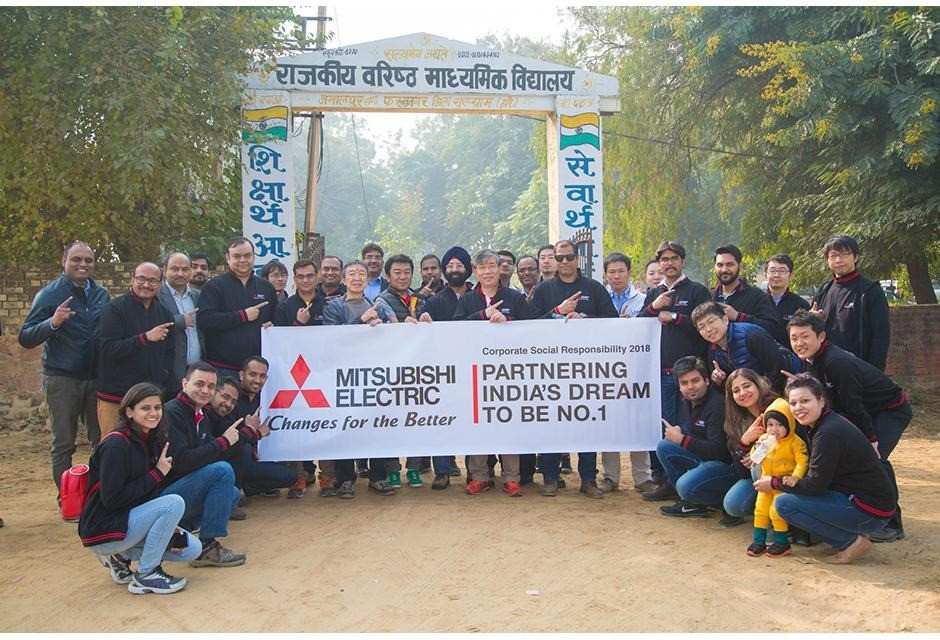
Thematically, the captive model has produced herd behaviour. According to CSRBOX analytics, Education and Skill Development absorbs roughly 38% of national CSR capital and Healthcare and Sanitation another 27% — together nearly two-thirds of all corporate spending — while Rural Infrastructure takes 12%, Environmental Sustainability just 6%, and Gender and Vulnerable Groups only 4%.
Theme | Share of National CSR Spend |
Education & Skill Development | 38% |
Healthcare & Sanitation | 27% |
Rural Infrastructure | 12% |
Other Schedule VII heads | 13% |
Environmental Sustainability | 6% |
Gender & Vulnerable Groups | 4% |
Environmental CSR, while the fastest-growing category — up 54% year-on-year in FY2023-24 to roughly ₹3,500 crore, per CEEW — remains a rounding error against India's climate-finance need: the Climate Policy Initiative India estimates ₹162.5 trillion (about $2.5 trillion) is required by 2030 to meet the country's Nationally Determined Contributions, of which current tracked green finance for mitigation covers only about 30%. CEEW argues CSR could become a major financing source for clean air — clean mobility, waste management, crop-residue solutions, construction-dust reduction — but notes that such programmes cluster around existing corporate locations and frequently lack measurable outcomes. WRI India separately flags biodiversity's marginal CSR share.
Geography compounds the theme problem. Despite statutory language urging companies to prioritise their local operating areas, Maharashtra, Gujarat, Karnataka, Tamil Nadu and Andhra Pradesh — the states with the highest concentration of corporate headquarters — together absorb over 45% of all national CSR outlays. NITI Aayog's 112 Aspirational Districts and 500 Aspirational Blocks, precisely the geographies where marginal investment could generate the most disproportionate impact, receive only 2-4.5% of total CSR funds between them. And headline compliance conceals an implementation gap: NIFTY 500 annual reports show that even as reported compliance sits above 95%, 8-12% of committed capital is parked in Unspent CSR Accounts under Section 135(6); over ₹1,000 crore went unspent in FY2021-22 alone and had to be transferred to government Schedule VII funds.
THE GRASSROOTS SQUEEZE
The most consequential casualty of this restructuring is India's smallest, most rooted non-profits. Roughly 84% of Indian NGOs run on annual budgets under ₹3 crore — yet only 71% of CSR-1-registered NGOs actually accessed corporate funding in FY2023-24, leaving nearly three in ten locked out despite having cleared the registration bar. A 2025 Fulcrum survey of 325 NGOs across more than 20 states found that 89% held valid CSR-1 registration, but only 71% received any CSR money; about 80% reported inadequate opportunities to network with corporates; nearly half faced project-documentation difficulties; 40% experienced delayed fund disbursement; and 61% lacked the technical MIS expertise corporate due-diligence teams now expect. Small NGOs saw proposal-acceptance rates of roughly 50%, against about 73% for larger organisations.
“A small organisation working on forest rights in Bastar cannot afford the compliance overhead that a corporate foundation's legal department takes for granted.” — Senior researcher, Centre for Science and Environment
The barriers compound. Hiring a CA, CS or CMA solely to certify a CSR-1 filing adds ₹15,000-25,000 in professional fees — a material sum against a ₹20-30 lakh annual budget. The three-year track-record rule excludes newer or informally structured community organisations by design. The ban on sub-granting has eliminated the traditional intermediary model, through which large aggregator grantmakers once dispersed micro-grants to unheralded community groups; capital must now flow directly from company or foundation to final implementer, cutting hyper-local groups out of the pipeline entirely. Surviving small NGOs are increasingly demoted from co-equal strategic partners to third-tier field contractors — conducting surveys or distributing materials on razor-thin management fees, without budget for staff healthcare or institutional capacity-building. An ₹800 crore CSR-diversion racket uncovered across six states in 2025-26 has only sharpened corporate caution, disproportionately penalising honest but less-polished grassroots groups. And a May 2026 MCA notification recognising Zero Coupon Zero Principal (ZCZP) instruments on the Social Stock Exchange as a valid CSR channel — while officially framed as widening CSR's ambit — has been described by critics as tilting the playing field further toward large, listing-ready organisations, at the expense of community-based groups too small to meet SSE disclosure norms.
THE GOVERNANCE MIRAGE: IS BIGGER ACTUALLY BETTER?
Is the captive corporate foundation a genuinely superior vehicle for social transformation, or a tax-exempt marketing division wearing a Section 8 registration? Proxy-advisory and governance researchers urge scrutiny of the premise itself.
“When a company routes its entire CSR allocation through an in-house Section 8 entity, board oversight must be twice as vigilant. Is the foundation's board genuinely independent? Are procurement contracts subject to arm's-length competitive bidding — or is the foundation a soft-money vehicle for the parent's brand and executive pet projects?” — Amit Tandon, Institutional Investor Advisory Services (IiAS)
IiAS's 2024 Corporate Governance Scorecard found that 94 of the BSE 100 now meet the 2% spend threshold, up from 74 the previous year — but only 54 of the BSE 100 conducted impact assessments in FY2024, unchanged from FY2023, suggesting that measurement remains driven by legal mandate rather than mission. InGovern's Shriram Subramanian points to the underlying logic: once personal penalties for board directors and statutory escrow timelines entered the picture, boards concluded that reliance on third-party non-profits carried unacceptable legal risk, and that a captive vehicle offered what no external NGO could guarantee — absolute operational line-of-sight, brand control and an unassailable audit trail.
The pros are real: continuity across CSR-head turnover, comparable multi-year data, the ability to hire genuine sector specialists, replicable multi-state programme design, and clearer board-level accountability than a scattershot grants portfolio ever offered. The cons are equally real: concentration risk, potential self-dealing between parent and foundation, thematic herd behaviour toward ‘safe’ brand-accretive causes, and — as Infosys Foundation's own 2026 fraud episode showed, in which a former contractor posed as a regional head to defraud the foundation of ₹6 crore — the loss of the deep, hyperlocal community trust that independent NGOs spend decades building and that no ERP dashboard can substitute for.
SEBI, BRSR CORE AND THE SOCIAL STOCK EXCHANGE
The foundation boom is accelerating under market-driven sustainability regulation running in parallel to CSR law. SEBI's BRSR Core framework requires the top 1,000 listed companies to disclose roughly 30 designated environmental and social KPIs, with independent reasonable assurance phased in from the top 150 companies to all top 1,000 by FY2026-27; non-compliance can draw penalties of ₹2,000 a day under the LODR framework, with SEBI enforcement penalties running up to ₹1 crore. The Reserve Bank of India has entered from the banking side, through its 2023 Green Deposits Framework and a 2024 draft climate-risk disclosure framework aligned with TCFD standards — pulling bank CSR into climate-risk management rather than treating it as siloed philanthropy.
“If ESG data comes from dozens of dispersed, un-audited NGOs, the assurance provider will qualify their opinion. If it flows from a captive Section 8 company with ERP tracking, the process is smooth. Corporates are building foundations because foundations are data pipelines.” — ESG Director, Big Four audit firm
The Social Stock Exchange, launched by SEBI with the BSE and NSE, was designed to let non-profits raise capital through Zero Coupon Zero Principal instruments and democratise social finance; companies can now allocate up to 10% of CSR expenditure this way. In practice, the SSE demands the same sophisticated disclosure norms and social-audit verification that have already strained grassroots non-profits — so early issuances have been dominated by well-funded, professionally managed and corporate-backed entities, reproducing at market scale the same exclusion visible in CSR-1 registration.
THE SEVEN-QUESTION EVIDENCE TEST
Every large CSR claim — corporate or foundation-issued — should now survive seven tests before it is taken at face value:
- Methodology: was there an explicit theory of change and an independent evaluator, or simply a beneficiary head-count?
- Baseline: what were incomes, water use, school enrolment or health indicators before the intervention began?
- Comparison group: measured against the previous year, a non-programme geography, industry peers, or a genuine control group?
- Implementation gap: did a board-approved allocation actually become a signed contract, deployed capital and completed field expenditure — or only the first of those?
- Reporting boundary: when a foundation funds three NGOs, who counts the beneficiaries, and are repeat beneficiaries double-counted?
- Absolute versus intensity: does ‘one billion litres conserved’ also tell us conservation per hectare, per beneficiary, or against baseline?
- Money trail: what is the gap between the statutory 2% obligation, the approved programme budget, cash actually spent, unspent balances, and asset ownership?
Platforms such as India CSR and CSRBOX track corporate foundations and spending at scale, and MCA's own CSR-2 annual filing offers a layer of transparency — but without mandatory third-party impact audits, the quality of self-reported outcomes still varies enormously across the ecosystem.
THE POLICY CROSSROADS: FIVE PILLARS FOR REFORM
India's CSR experiment has already answered its first-generation question — social spending can be mandated at national scale. The harder, second-generation question is whether ₹35,000-40,000 crore of annual corporate capital can be made more accountable without becoming more distant from the people it is meant to serve. Policy thinkers converge on five interventions:
- MCA reform: carve out a mandatory 20-25% grassroots allocation quota, directed to independent, community-rooted non-profits operating in NITI Aayog's Aspirational Districts and Blocks.
- SEBI mandate: incentivise listed companies on the Social Stock Exchange to back independent, non-captive NPOs rather than only large, listing-ready organisations.
- RBI incentives: link Priority Sector Lending benefits to demonstrated corporate backing of rural micro-NGOs.
- Overhead relief: modernise the Rule 7(1) admin cap into a tiered structure — 5% for captive foundations, but 12-15% for grants to independent grassroots partners, so they can invest in compliance, technology and fair staff wages.
- Regional equalisation: create a pooled national fund, or tax and ESG credits, to channel CSR capital toward historically underfunded regions, alongside a single-window CSR-1/12AB/80G/Darpan compliance pathway for NGOs with budgets under ₹1 crore.
CONCLUSION: CONTROL VERSUS COMMUNITY
The corporatisation of CSR has professionalised social spending: it has curtailed fraudulent balance sheets, built modern community infrastructure, brought enterprise-grade technology to the development sector, and mobilised tens of thousands of crores with genuine audit precision. Section 8 foundations bring governance discipline, institutional continuity and scale that the early, freewheeling years of mandatory CSR often lacked.
But that efficiency has arrived alongside a quieter cost — the marginalisation of a pluralistic, independent civil society. Section 135 was conceived as a bridge between corporate success and societal well-being. If that bridge hardens into a closed loop of captive corporate vehicles feeding data pipelines rather than communities, the letter of the law will have triumphed over its spirit. The evidence test remains open: until independent, standardised impact assessments compare foundation-led projects with NGO-implemented ones on the same terms, the true cost — and the true benefit — of India's captive-foundation era will stay only partially visible. What is no longer in doubt is that India's CSR story has stopped being a story about compliance. It is now a story about power, control, and who gets to decide what ‘impact’ means for the country's poorest and most remote communities.
SOURCES:
The writer compiled this feature from Ministry of Corporate Affairs and Registrar of Companies filings, SEBI and RBI circulars, corporate annual reports and BRSR disclosures, the MCA CSR-1/CSR-2 portals, CSRBOX and India CSR analytics, Fulcrum's 2025 NGO survey, and assessments by IiAS, InGovern, CSE, WRI India and Climate Policy Initiative India.





Add a Comment