
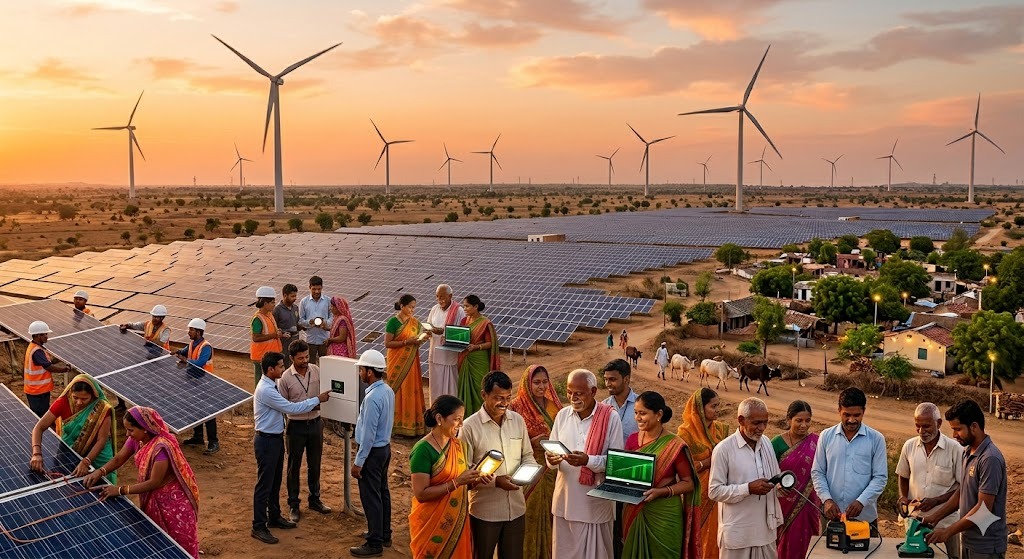
The global conversation around the renewable transition is frequently dominated by abstract numbers: gigawatts of installed capacity, billions of dollars in climate finance, and percentage points of carbon reduction. While these metrics are essential for policy benchmarks, they often obscure the most critical element of the entire movement: the people. In a country as vast and as complex as India, the shift from a fossil fuel-dependent economy to a renewable one is not merely a technical swap of solar panels for coal furnaces. it is a profound social evolution that touches every layer of the human experience.
For India, the Renewable Transition is a deeply personal story. It is the story of a coal miner in Dhanbad wondering if his son will have a job in twenty years, a farmer in Rajasthan leasing his arid land for a solar park to pay for his daughter’s education, and a young engineer in Bengaluru designing smart grids for a future she hopes to live in. To write about this transition for a professional audience, we must look beyond the hardware and examine the Just Transition—the commitment to ensuring that as we move toward a cleaner planet, we do not leave our people behind.
The Architecture of a Just Transition in the Indian Context
India stands in a unique position. Unlike many developed nations that built their wealth on centuries of unrestricted carbon emissions, India is attempting to industrialize and lift millions out of poverty while simultaneously decarbonizing its energy grid. This is an unprecedented historical challenge. A Just Transition in India must be defined by three pillars: economic security for legacy workers, energy equity for the underserved, and the massive undertaking of national upskilling.
1. Economic Security and the Coal Heartland
The Indian economy has long been anchored by the coal sector. States like Jharkhand, Chhattisgarh, and Odisha are not just regions of mining. they are entire ecosystems built around the "black gold." From the formal employees of Coal India Limited to the informal workers who transport coal on bicycles, millions of livelihoods are at stake.
A professional analysis of the transition must address the reality that a solar farm requires significantly fewer permanent employees than a coal mine. Therefore, the transition cannot be a "shut down and walk away" approach. It requires a repurposing strategy. We are seeing the early stages of this in discussions around Green Energy Corridors. The goal is to transform aging thermal power plants into hubs for battery storage or green hydrogen production. By doing so, we utilize existing land and grid infrastructure while providing a localized transition path for the existing workforce.
2.Energy Equity: Beyond the Grid
For a professional website focusing on sustainability, it is vital to highlight that renewable does not always mean centralized. In India, the humanized version of the transition is often seen in decentralized renewable energy (DRE).
In remote villages where grid stability remains a dream, solar microgrids are changing the fundamental quality of human life. When a health clinic in a rural district gets a reliable solar-powered refrigerator, it isn't just a technical achievement. it means vaccines remain viable, and lives are saved. When a woman in a village can use a solar-powered sewing machine, she moves from subsistence to entrepreneurship. The professional narrative here is one of Productive Use of Energy. We are not just giving people light. we are giving them the tools for economic agency.
The Great Upskilling: Preparing the Workforce of 2030
The transition is often described as a threat to jobs, but for the professional sector, it is more accurately described as a massive shift in required competencies. The skills needed to maintain a wind turbine in Tamil Nadu are vastly different from those needed to operate a boiler in a thermal plant.
Bridging the Skill Gap
India’s Skill Council for Green Jobs (SCGJ) has been instrumental in identifying these gaps. However, the professional community must go further. We need to bridge the gap between academic theory and vocational reality.
From Mechanical to Digital: The future renewable worker is as much a software specialist as a mechanical one. As we integrate more solar and wind, which are intermittent by nature, the human in the loop must be adept at using AI-driven forecasting tools and automated grid management systems.
Localized Manufacturing:The Make in India initiative for solar modules and lithium-ion batteries is not just about reducing imports. it is a massive job creator. The human story here is the birth of a new middle class of technicians and factory floor managers who are building the components of a green future.
The Role of the Private Sector: Companies like Tata Power and Adani Renewables are not just building plants. they are becoming educators. Professional articles should highlight corporate social responsibility (CSR) programs that focus on training local youth in the vicinity of renewable projects, ensuring that the local community benefits from the clean air and the green paycheck.
The Social Fabric: Gender and Youth in Renewables
One of the most humanizing aspects of India’s energy shift is its potential to dismantle old social hierarchies. Historically, the energy sector—particularly coal and heavy oil—has been heavily male-dominated due to the physical nature of the work. The renewable sector offers a cleaner, more digitized, and more inclusive entry point.
Women as Energy Leaders
In rural India, the Solar Mamas program has gained international acclaim, but the professional sector needs to look at the broader integration of women in the green workforce. From assembling solar modules in factories to managing micro-finance for solar irrigation pumps, women are at the forefront. A professional website should explore how the transition provides a unique "reset button" for gender parity in the corporate energy world. It is about creating workplaces that are safe, accessible, and designed for a diverse workforce from day one.
The Aspiration of the Youth
India is one of the youngest countries in the world. For an Indian professional under the age of 30, climate change isn't a theoretical threat. it is a defining reality of their career. This generation does not want to work for companies that are part of the problem. they want to be part of the solution. This shift in sentiment is forcing traditional Indian conglomerates to accelerate their green pivots to attract top-tier talent. The human story here is the alignment of professional ambition with planetary survival.
Overcoming the Human Hurdles: Culture and Mindsets
One of the least discussed barriers to the renewable transition is the human tendency to stick with what is known. In the professional world, this manifests as incumbent bias. Engineers who have spent thirty years perfecting the efficiency of a coal turbine may naturally be skeptical of solar energy's reliability. Policy makers who rely on the steady tax revenue from fossil fuel movements may be hesitant to pivot toward decentralized models. Humanizing the transition means acknowledging these fears and addressing them with data and empathy.
The Reliability Myth
The professional conversation must pivot from "Is renewable energy reliable?" to "How do we make the grid resilient?" This involves a shift in mindset from centralized control to distributed intelligence. By framing the transition as an upgrade rather than a replacement, we reduce the friction of change. It is not about taking away the reliable power that coal provided. it is about providing a smarter, more reliable, and ultimately cheaper alternative through a hybrid of solar, wind, and sophisticated storage.
The Environmental Justice Aspect: Health as a Human Right
We cannot talk about renewables in India without talking about the air we breathe. For many professionals living in NCR, Mumbai, or Bengaluru, the transition is a matter of public health. The humanized argument for renewables is found in the pediatric wards of our hospitals. Reducing our reliance on thermal power plants directly correlates with a reduction in particulate matter and respiratory illnesses. When writing for a professional audience, it is crucial to link energy policy to healthcare costs and productivity. A healthier workforce is a more productive workforce. The renewable transition is, at its heart, a massive public health intervention.
India’s Leadership on the Global Stage
When we talk about the renewable transition in India, we are talking about a global bellwether. The success of the International Solar Alliance (ISA), headquartered in Gurugram, is a testament to India’s intent to lead the Global South in this journey.
The humanized professional narrative here is about Global Collaboration. It is about Indian engineers sharing best practices for high-temperature solar installations with colleagues in Africa or South America. It is about the One Sun, One World, One Grid (OSOWOG) initiative, which envisions a world where power is shared across borders, ensuring that the sun never sets on the global energy supply. This is not just a geopolitical strategy. it is a vision of human interconnectedness.
The Role of Finance: Investing in People, Not Just Projects
For the professional reader in the financial sector, the transition is often seen through the lens of ESG (Environmental, Social, and Governance) scores. However, the humanized approach requires a "S" (Social) focus that is as rigorous as the "E" (Environmental).
Capital must flow toward projects that demonstrate a clear community benefit. We are seeing the rise of Green Bonds in India, but the next step is the "Social Impact Bond" for energy transitions. These financial instruments should fund the reskilling of coal workers or the electrification of primary health centers. The human story in finance is the shift from "extraction" to "stewardship." Investors are beginning to realize that a project that ignores its local community is a risky project.
Case Studies: Human Success Stories in India
To truly humanize this, we must look at where it is already working.
Modhera, Gujarat: India’s first round-the-clock solar-powered village. Here, the transition isn't an article. it's the fact that villagers have zero electricity bills and are actually earning money by selling excess power back to the grid. This transforms the consumer from a passive recipient of energy into an active participant in the economy.
The Rewa Ultra Mega Solar Park: By providing cheap, clean power to the Delhi Metro, this project connects the rural sun of Madhya Pradesh to the daily commute of millions in the capital. It is a tangible link between rural land and urban mobility.
The Road Ahead: A Call to Action for Professionals
As we look toward 2030 and 2070—India’s target for net-zero—the transition will accelerate. For those writing or working in this space, the goal should be to keep the human element at the forefront of every strategy.
The professional community in India has a responsibility that goes beyond the balance sheet. We are the architects of a new social contract. One where energy is a right, not a privilege, and where the air we breathe is as clean as the ambitions we hold.
Key Takeaways for Professional Strategy:
1. Prioritize Social Impact: Every renewable project should have a clear human ROI. How many local jobs are created? How is the local community’s energy access improved?
2. Invest in Human Capital: The hardware of the transition (panels and turbines) is a commodity. the software (the people who design, install, and maintain them) is the true asset.
3.Transparent Communication: Avoid the jargon of carbon credits and sequestration when talking to the public. Talk about cleaner air for our children, cheaper electricity for our small businesses, and a future where India is energy-independent.
4. Embrace Resilience over Perfection: The transition will be messy. There will be grid failures and policy hiccups. The human element requires us to build resilient systems that can learn and adapt, rather than seeking a perfect, static solution.
Conclusion: The Legacy of the Green Shift
In the decades to come, when history books look back at India in the early 21st century, they will not just record the number of megawatts added to the grid. They will record how a nation of over a billion people managed to redefine its relationship with the planet while lifting its people out of poverty.
The Renewable Transition is the most significant industrial shift since the dawn of the steam engine. In India, it is a chance to rectify historical inequities and build a nation that is both prosperous and sustainable. By focusing on the Just Transition, we ensure that the green future we are building is a home for everyone. It is a journey from the darkness of the coal mine to the brightness of the solar-powered home, and every step of that journey is taken by a person seeking a better life. That is the story we must tell. That is the future we must build.
This transition is not a destination. it is a continuous process of human improvement. As professionals, our role is to ensure that the light of this new energy era reaches every corner of our country, leaving no one in the shadows of the past. Let us build a grid that is not just made of copper and silicon, but of empathy, foresight, and unyielding hope.


Add a Comment