Total Articles 238+

All Posts

Explore the latest sustainability news, innovations, insights, and industry stories from around the world.

Showing 12/238

29 Oct 2026

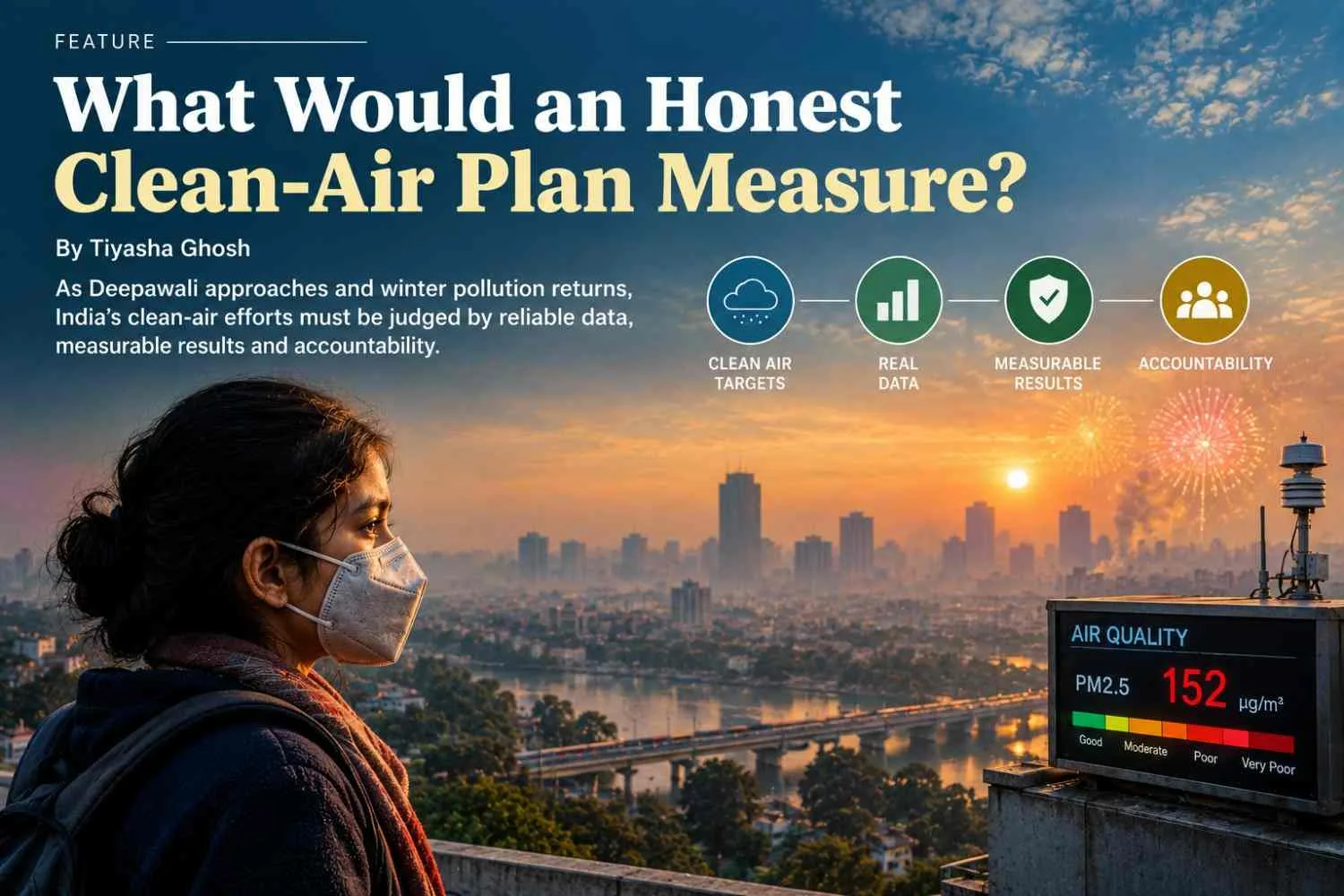
29 October, 2026 | Kolkata As Deepawali approaches and winter pollution returns, India’s clean-air efforts must be judged by reliable data, measurable results and accountability. SummaryIndia has reported progress under its National Clean Air Programme, but lower pollution levels do not automatically mean that cities have achieved safe air. Reliable monitoring, evidence of effective action and clear responsibility are essential to judge whether clean-air plans are working. Are Clean-Air Plans Reducing Pollution - or Mainly Reporting Progress? Every winter, polluted air becomes a familiar concern for millions of people across India. Families worry about breathing difficulties, children playing outdoors, elderly relatives and the health risks of travelling through polluted streets. As Deepawali approaches and seasonal conditions begin to change, these concerns become even more urgent. Governments announce new measures, cities report improvements and funds are allocated to tackle pollution. But one important question remains: how can we tell whether these efforts are actually making the air safer to breathe? An effective clean-air plan must do more than announce targets or report reductions. It must demonstrate what has improved, which measures have made a difference and who is responsible when progress falls short. 1. Is the Data Reliable Enough to Show Real Progress? The first test is whether air quality is being measured consistently and accurately. In September 2026, the Union government reported that 108 of the 130 cities covered by the National Clean Air Programme (NCAP) recorded lower PM10 levels in the financial year 2025–26 than in the 2017–18 baseline year. PM10 refers to airborne particles small enough to enter the respiratory system. The government also reported that 14 cities had met the prescribed national PM10 standard. These figures indicate progress in several cities. However, lower pollution levels do not necessarily mean that the air has become safe to breathe. A January 2026 assessment by the Centre for Research on Energy and Clean Air (CREA), covering 100 NCAP cities with sufficient data, found that 77 recorded lower PM10 levels than their respective baseline levels. Of these 77 cities, 68 still exceeded the national standard. The two assessments cover different reporting periods and city samples, so their figures should not be treated as a direct comparison. Together, however, they highlight an important distinction: improvement and clean air are not the same thing. An honest assessment must report both. It should also identify gaps in monitoring, explain how the figures were calculated and make the underlying data accessible to the public. 2. Are the Measures Producing Measurable Results? The second test is whether pollution-control measures address the sources responsible for poor air quality. Road dust, vehicle emissions, industrial activity, waste burning and household fuels can all contribute to air pollution. Their relative importance varies between locations. A city cannot control pollution effectively without understanding where its emissions originate and which sources contribute most to the problem. CREA’s January 2026 assessment reported that a substantial share of NCAP funding had been directed towards road-dust management, while comparatively smaller shares went towards transport, industrial pollution, household fuel use and public awareness. Road cleaning and dust control can be necessary, but spending alone does not demonstrate success. Authorities must show whether these interventions reduced pollution, how much they cost and whether the improvements lasted. For example, if a city reports lower particulate pollution, it should explain which measures were introduced, when they were implemented and how their impact was evaluated. Independent studies and source-apportionment research can help determine whether the reported improvement is linked to a particular intervention or whether other factors may have contributed. Public money should therefore be assessed through measurable outcomes, not simply by how much has been spent. 3. Who Is Accountable When Pollution Crosses City and State Boundaries? Air pollution does not stop at administrative borders. Emissions from one region can affect the air people breathe elsewhere, making coordination between states and neighbouring regions essential. A study published by the Centre for Study of Science, Technology and Policy (CSTEP) in August 2026 examined the movement of pollution across regions of the Indo-Gangetic Plain. Its findings estimated that around 39% of annual PM2.5 pollution in the National Capital Region came from other regions of India. PM2.5 consists of extremely fine particles that can penetrate deep into the lungs. The findings underline why a city cannot address the problem through local action alone. Effective regional cooperation requires clear responsibilities for governments and relevant sectors, shared monitoring systems and coordinated measures to reduce emissions. Authorities must also be able to identify delays, track commitments and hold responsible agencies accountable for their performance. The issue is also one of public fairness. Outdoor workers, daily commuters and people living near busy roads or industrial areas may face repeated exposure to polluted air. They need practical protection and timely public-health guidance, alongside sustained action on transport, industry, waste management and other pollution sources. What Should an Honest Clean-Air Plan Look Like? A credible clean-air plan should answer three basic questions: Is the data reliable? Are the measures reducing pollution? And can the responsible authorities demonstrate what they have achieved? The answers should be supported by transparent monitoring, independent evaluation, clear spending records and regular public reporting. Where evidence is incomplete, that limitation should be acknowledged rather than obscured by a headline reduction. Clean air cannot be achieved through a single announcement or a seasonal campaign. It requires sustained action, coordination across regions and a willingness to revise measures that are not producing the intended results. As winter approaches, the real measure of progress is not how many promises are made or how much money is spent. It is whether pollution levels are moving towards safe standards, whether people are better protected and whether governments can demonstrate, with evidence, what their actions have achieved. An honest clean-air plan must make progress measurable, responsibility visible and results open to public scrutiny. Sources: Press Information Bureau (PIB) — India’s Path to Blue Skies, 7 September 2026.https://www.pib.gov.in/PressNoteDetails.aspx?ModuleId=3&NoteId=159871&id=159871&lang=2&reg=48Centre for Research on Energy and Clean Air (CREA) — Tracing the Hazy Air 2026: Progress Report on NCAP, 9 January 2026.https://energyandcleanair.org/publication/2026-progress-report-on-national-clean-air-programme/Centre for Study of Science, Technology and Policy (CSTEP) — Beyond State Boundaries: Quantifying Interstate Air Pollution Transport and Sectoral Solutions in the Indo-Gangetic Plain, 19 August 2026.https://cstep.in/publication/beyond-state-boundaries-quantifying-interstate-air-pollution-transport-and-sectoral-solutions-in-the-indo-gangetic-plain/ ...Read more

29 Oct 2026

Delegation from Cushing Academy, Hyde School and Fay School visits Delhi and Mumbai to engage with Indian students, schools and families. New Delhi/Mumbai, October 2026: Strengthening educational ties between India and the United States, representatives from three leading American boarding schools — Cushing Academy, Hyde School and Fay School — participated in an educational outreach initiative organised by TALIEM – International Liaison Centre for Global Universities and Boarding Schools. The initiative facilitated interactions with students, educators and prospective families, highlighting opportunities offered by American boarding school education and encouraging international academic partnerships. Discussions also covered sustainability issues and the importance of environmental learning, emphasising the role of education in building environmental awareness and encouraging responsible practices among students. Visiting delegation & Taliem officials with Principal & Vice Principal of GD Goenka School, Vasant Kunj, New Delhi (From Left to right) Mr Pinku Biswas, Mr Paul J Abein, Dr Kevin Patrick Brady, Mr Kevin Smith, Ms Seema Sinha, Mr Ayan Biswas The delegation visited prominent schools across Delhi and Mumbai, including Apeejay School, Panchsheel Park; G.D. Goenka Public School, Vasant Kunj; Amity International School, Saket; and St. Xavier’s High School, Goregaon, Mumbai. Representatives also interacted with prospective families at local boarding school fairs.  With students of St Xaviers High School, Goregaon, Mumbai Kevin Smith of Cushing Academy appreciated the initiative, stating, “Supported by educational consultants Pinku and Ayan Biswas, my recent Cushing Academy outreach trip to India provided a wonderful platform to engage with leading school communities across Delhi and Mumbai.” The visits provided opportunities to discuss academic programmes, extracurricular activities, residential learning and the overall development offered by American boarding schools. The discussions also highlighted sustainability and environmental learning as important areas of student education, encouraging a broader understanding of environmental challenges and responsible decision-making. Mr. Ayan Biswas, Director of TALIEM, is warmly welcomed by Ms. Madhavi Gaonkar, Principal of St. Xavier’s High School, Mumbai, along with the students. Ayan Biswas, Director of TALIEM, praised the enthusiasm and engagement of Indian students. “Our interaction with the students was one of the highlights of the visit. We were genuinely amazed by the curiosity, confidence, and thought-provoking questions they raised. Their enthusiasm for learning, coupled with their discipline, respect, and cultured manner, was truly impressive and reflects the excellent values being nurtured by your school,” Biswas said. For Hyde School, the October visit marked an important step towards developing relationships with Indian students and families. Justin Fahey, Director of Enrollment & Financial Aid at Hyde School, expressed his appreciation, saying, “I am deeply grateful to TALIEM for welcoming Hyde to Mumbai. Their expertise and the depth of their connections across Indian and South Asian education are remarkable. The students and families I met here are curious, thoughtful, and ambitious, exactly the kind of young people who thrive at Hyde, and I look forward to a long and meaningful partnership.” Paul J. Abeln, Director of International Relations at Fay School, highlighted the value of direct engagement with Indian educational institutions. “Our hosts provided a welcoming atmosphere for families to meet with attending schools, and they also spent a significant amount of time in conversation with each school, educating us on the Indian market and learning from us about U.S. boarding schools. The school visits were particularly valuable. Each school community was extremely welcoming, providing direct conversations with management as well as visits with students and detailed tours of facilities. I am hopeful that my school can continue to work with TALIEM and enrich our relationship in the coming years,” Abeln said. TALIEM works with educational institutions across the United States, United Kingdom, Europe, Canada and Asia, facilitating student recruitment, international marketing, academic collaborations and institutional partnerships. The successful outreach initiative reflects the growing interest among American boarding schools in engaging with Indian students and families. By bringing together educational opportunities, sustainability discussions and environmental learning, TALIEM continues to strengthen Indo-American educational ties and create opportunities for long-term international academic cooperation. ...Read more

27 Oct 2026

27 October 2026 | Kolkata, India New funding pledges offer hope, but the real test is whether money reaches conservation work and delivers healthier ecosystems. Summary: The UN Biodiversity Conference in Yerevan is reviewing global progress towards the 2030 nature targets. India reports that all 23 of its national biodiversity targets are on track, but the UN’s global assessment warns that progress remains insufficient. New funding pledges at COP17 raise a critical question: how much money will reach conservation projects and communities, and how will countries prove that nature is recovering? If Countries Promise to Protect Nature, Who Will Pay - and How Will We Know It Works? A forest can be marked for protection on a map, a wetland can be assigned a restoration target, and a government can announce new funding. But none of these steps automatically guarantees that wildlife habitats are recovering or that local communities are benefiting. This is the central question at the 17th Conference of the Parties to the Convention on Biological Diversity (CBD COP17). Held in Yerevan, Armenia, from 19 to 30 October 2026, the conference is undertaking the first global review of progress under the Kunming–Montreal Global Biodiversity Framework. Adopted in 2022, the framework sets out 23 targets intended to halt and reverse biodiversity loss by 2030. The issue is particularly important for India, where biodiversity supports food production, water systems, livelihoods, climate resilience and cultural practices. Protecting nature requires more than declaring protected areas. It also demands long-term financing, effective management, scientific monitoring and decisions that recognise the rights and knowledge of communities connected to these landscapes. What Has India Promised - and What Does Its Progress Report Show? India released its updated National Biodiversity Strategy and Action Plan (NBSAP) for 2024–2030 at CBD COP16 in October 2024. The plan outlines national priorities for conservation, sustainable use, ecosystem restoration and the fair sharing of benefits arising from genetic resources. On 26 February 2026, India submitted its Seventh National Report to the Convention on Biological Diversity. The report assesses 23 national biodiversity targets through 142 indicators, drawing on information from 33 central ministries and departments, state governments, statutory authorities, research institutions and other stakeholders. India’s official assessment describes all 23 national targets as “on track to achieve”. The report also records progress in conservation infrastructure and community biodiversity institutions. It lists 98 notified Ramsar wetlands as of 2026 and states that the National Biodiversity Authority had issued more than 5,600 access-and-benefit-sharing agreements, with ₹140 crore disbursed. These figures indicate the scale of reported activity, but they do not establish that every wetland is healthy or that benefits are being distributed fairly among communities. Counts of institutions, agreements and protected sites are useful indicators of progress, but they need to be supported by evidence showing what has actually changed on the ground. The wider global picture is more concerning. The United Nations’ State of Biodiversity Action report, launched on 18 October 2026, found that fewer than half of the assessed national targets were on track. It also identified gaps in financing, national ambition, implementation, data and international cooperation. Although many countries have prepared biodiversity plans, their targets do not always cover the full scope of the global framework. India’s national assessment and the UN’s global findings are not directly comparable because they use different levels of analysis and sets of indicators. However, both highlight the same accountability question: what evidence shows that plans and reported progress are translating into healthier ecosystems? Who Will Pay to Close the Biodiversity Finance Gap? Financing has become one of COP17’s most important tests. On 26 October, the Global Environment Facility (GEF) announced more than $500 million in additional biodiversity-related pledges across the GEF and the Global Biodiversity Framework Fund (GBFF). The GEF’s ninth replenishment moved close to $4.4 billion, while new contributions of more than $60 million were announced for the GBFF. Contributors included Germany, Iceland, Monaco, the province of Québec and the city of Berlin, while Armenia confirmed its intention to contribute. These announcements are significant, but their status matters. A pledge is a promise to contribute, not necessarily money that has already been transferred. A contribution received by a fund is not the same as a project being approved, and an approved project does not automatically demonstrate that the intended ecological results have been achieved. The GBFF provides a useful example. The GEF reported that, since the fund’s launch in August 2023, it had received $446 million in commitments from 14 national and two subnational governments. It had programmed $362.1 million across 82 projects in 87 countries. In this context, “programmed” means allocated to projects; it should not be interpreted as proof that every dollar has reached its final recipient or delivered the intended results. The debate is not simply about whether biodiversity needs more money. It is also about who should provide that money, how much should come from public budgets and international support, and whether developing countries can access the funds they need. Developing countries have called for stronger and more predictable financial support to implement global biodiversity targets. Funding institutions, meanwhile, also emphasise the role of private investment and blended finance. Both approaches raise important questions. Public funding can provide a stable foundation, but it must be sustained over time. Private investment may expand the resources available, but projects must demonstrate genuine ecological benefits and include safeguards against treating biodiversity merely as a marketable asset. For India, the practical test is whether funding is predictable, accessible and sufficient to support conservation work. Ecosystem restoration often requires years of maintenance and monitoring. Short funding cycles can leave restored sites without the staff, resources or community participation needed to protect earlier gains. Who Receives the Money - and Who Gets to Decide? Biodiversity is not protected by governments and large conservation organisations alone. Indigenous Peoples and local communities often maintain traditional knowledge, manage natural resources and depend directly on forests, wetlands, coastlines and other ecosystems. Their participation matters because conservation decisions can affect access to land, forest produce, fishing grounds, grazing areas and culturally significant sites. A project may increase the area designated for protection on paper but still create difficulties if the people affected are excluded from decision-making or cannot access the funding intended to support them. At COP17, the Wildlife Conservation Society called for more direct access to finance for Indigenous Peoples and local communities, meaningful participation in decision-making, recognition of customary territories and protection for environmental defenders. This is an advocacy position, not a final COP17 decision, but it highlights a practical test for conservation finance: whether the people most closely connected to ecosystems have a meaningful role in protecting them and benefit fairly from the resources allocated. India has established Biodiversity Management Committees (BMCs) and People’s Biodiversity Registers (PBRs) to document local biological resources and associated knowledge. Its Seventh National Report recorded 2,76,653 BMCs and 2,72,648 PBRs. These institutions can support local participation, but their numbers alone cannot establish whether committees have adequate resources, whether biodiversity records are regularly updated, or whether communities genuinely influence decisions and receive fair benefits. Those outcomes require evidence beyond the number of institutions established. COP17 is also addressing the fair sharing of benefits arising from the use of digital sequence information on genetic resources. This refers to digital information derived from genetic material that can be used in scientific research and commercial development. The Cali Fund is intended to help address benefit-sharing from such uses. Its effectiveness will depend on how contributions are encouraged, how funds are distributed and whether benefits reach the countries and communities connected to those resources. Are We Measuring Healthy Ecosystems - or Just the Area Covered? A protected-area boundary, a count of planted saplings or a restoration target measured in hectares can show that an activity has taken place. None of these indicators, by itself, establishes that native species are returning, water flows are improving, soil is recovering or habitats are becoming sufficiently connected to support wildlife. Consider a restored wetland. A planting drive alone cannot establish whether it is recovering. Water levels, pollution, native vegetation, wildlife and long-term management all influence whether the ecosystem is functioning properly. Forest restoration similarly requires attention to native species, sapling survival, habitat quality and the pressures that caused degradation in the first place. This distinction is central to COP17’s review of implementation. A credible assessment should identify the ecosystem’s starting condition, the intervention undertaken, the period over which change is measured, the method used and the evidence supporting the reported result. Where data are missing, the gap should be acknowledged rather than replaced with an assumption of success. India’s updated national plan and reporting system provide a framework for tracking progress. The next step is to connect spending and conservation activities to measurable changes in ecosystem condition, while recognising that ecological recovery can take years. What Should Readers Watch as COP17 Closes? COP17 is scheduled to continue until 30 October. Its final decisions will indicate what countries have agreed to do next, but the real test will come afterward: whether commitments are translated into budgets, project delivery, meaningful community participation and measurable results. For India, follow-up should examine the final COP17 decisions, the treatment of biodiversity finance, progress against national targets and implementation evidence published by the Ministry of Environment, Forest and Climate Change (MoEFCC), biodiversity boards and relevant institutions. It should also assess whether funding reaches local conservation initiatives and whether restoration projects are evaluated against ecological outcomes rather than area totals alone. The central question is not simply whether governments are willing to promise more for nature. It is whether the money arrives, whether communities have a meaningful role in decisions and whether ecosystems actually improve. Keeping India’s biodiversity alive will depend on turning national plans and international pledges into sustained action on the ground-and making that action measurable, transparent and fair.COP17 biodiversity decision ledger What to trackEvidence neededWhat must not be confusedGlobal finance pledgesAnnounced amount, contributor, intended fund and dateA pledge is not a transferFunds reaching projectsAmount received, approved, released and spentAllocation is not proof of deliveryIndia’s national targetsNBSAP 2024–2030, Seventh National Report and target indicators“On track” is a reported assessment, not proof every ecosystem is healthyCommunity rights and benefitsDirect access to funds, participation, benefit-sharing and grievance processesCommittee or register counts do not prove effective community powerRestoration resultsBaseline, survival rates, native species, habitat quality, water or soil indicators and follow-up datesArea planted or designated is not the same as ecological recovery Sources: Convention on Biological Diversity — COP17, Yerevan, 19–30 October 2026: https://www.cbd.int/conferences/2026MoEFCC / Press Information Bureau — India submits its Seventh National Report to the CBD, 16 March 2026: https://www.pib.gov.in/PressReleasePage.aspx?PRID=2240576&lang=2&reg=48FAOLEX — India’s Updated National Biodiversity Strategy and Action Plan 2024–2030: https://faolex.apps.fao.org/documents/LEX-FAOC244471/india-s-updated-national-biodiversity-strategy-and-action-pl-ind-2024CBD — State of Biodiversity Action: Global Report on Collective Progress, 24 September 2026: https://www.cbd.int/globalreview/report2026Global Environment Facility — Additional biodiversity finance pledges at COP17, 26 October 2026: https://www.thegef.org/newsroom/press-releases/un-biodiversity-conference-gets-finance-boost-action-nature-500-millionWildlife Conservation Society — Issues affecting Indigenous Peoples and local communities at COP17, 19 October 2026: https://programs.wcs.org/press/News-Releases/articleType/ArticleView/articleId/26743/Several-Issues-of-High-Importance-to-Indigenous-Peoples-and-Local-Communities-Pending-at-UN-Biodiversity-Conference-2026.aspxTERI and National Biodiversity Authority — Financing Nature with Integrity, COP17 side event, 22 October 2026: https://www.teriin.org/event/financing-nature-integrity-building-high-integrity-biodiversity-credit-markets-global-southCOP17 Presidency — Yerevan Declaration on Taking Action for Nature, 16 October 2026: https://cop17yerevan.am/en/articles/%D5%B6%D5%B8%D6%80%D5%B8%D6%82%D5%A9%D5%B5%D5%B8%D6%82%D5%B6/yerevan-declaration-on-taking-action-for-nature-adopted-in-yerevan ...Read more

27 Oct 2026

Renewable capacity is expanding fast, yet coal still supplies most electricity. The data centre boom makes efficiency, distributed energy and climate resilience urgent public priorities. India is preparing to host an expanding artificial intelligence economy on an electricity system already being tested by hotter nights, rising cooling demand and uneven local infrastructure. The danger is that digital ambition becomes an excuse to prolong dependence on coal, appropriate scarce water and transfer infrastructure costs to ordinary consumers. A different outcome is possible. AI investment could finance cleaner electricity and more resilient networks, provided public policy makes those contributions a condition of expansion. Shankar Sharma’s Counterview article rightly connects India’s power difficulties with the growth of data centres and the climate crisis. Its emphasis on distributed renewables, storage and managing demand offers a useful starting point. But the argument becomes stronger when we distinguish installed machinery from electricity delivered, long-range forecasts from present consumption, and decentralisation from an assumption that national networks have become dispensable.[1] The paradox begins with installed capacity. As of September 30, 2026, India had approximately 558.8 gigawatts of installed electricity capacity. Ministry of New and Renewable Energy figures put renewable capacity, including large hydropower, at 299.25 GW, or about 53.6% of that total. Adding nuclear takes non-fossil capacity to 308.03 GW, approximately 55%. Renewables are already a majority of installed capacity; their contribution to actual generation remains much smaller.[2,3] Electricity sourceInstalled capacityCoal lignite gas and diesel combinedAbout 250.8 GWSolar171.05 GWWind59.20 GWLarge hydropower52.06 GWSmall hydropower5.18 GWBioenergy and waste to energy11.75 GWNuclear8.78 GWTotalAbout 558.8 GW Capacity snapshot at September 30, 2026. Rounded figures; large hydropower includes pumped storage. The fossil total is calculated from the reported overall and non-fossil totals.[2,3] The generation picture explains the paradox. The ministry’s April 2026 summary reported approximately 1,846 terawatt-hours of electricity generated in 2025–26. Fossil fuels supplied about 71%, renewables including large hydro about 26%, and nuclear roughly 3%. Renewables excluding large hydro contributed around 17%; solar and wind together approximately 15%. A terawatt-hour equals a billion electricity units. These annual shares, rather than capacity announcements alone, reveal how far India still has to travel.[4] Electricity also has to pass through an institutional and physical chain. Central utilities, state companies and private developers generate it; interstate and state networks transport it; distribution companies deliver it through substations, transformers and local feeders. Grid operators balance supply and demand continuously. Regulators determine tariffs and network access, while governments influence subsidies and investment. Captive industrial plants and local systems add further layers. Installing a solar panel solves one part of this chain. This is also a federal system. State regulators and utilities shape local delivery, while central institutions oversee interstate networks and national coordination. Power purchase contracts, open-access rules and electricity markets influence which plant supplies which consumer. Industrial captive generation and cross-border electricity trade add options. The resulting mix must provide voltage control, reserves and other services as well as sufficient annual energy. Electricity policy therefore cannot be reduced to a contest between two generation technologies. National adequacy can therefore coexist with poor service at a particular household or workshop. The government reported an aggregate energy shortfall of only 0.1% in 2024–25, a substantial improvement on earlier shortages. That measure cannot establish that every feeder has reliable voltage or every consumer receives uninterrupted supply. Local breakdowns, distribution constraints and difficulties purchasing power remain consequential even when national annual supply appears sufficient.[5] Several forces explain coal’s continuing dominance. Solar produces during daylight, with output affected by cloud, dust and temperature. Wind varies across seasons and locations. Hydropower depends on rainfall, river conditions and competing water uses. An installed gigawatt of solar consequently delivers fewer annual units than a gigawatt of coal operated for much of the year. Solar’s rapid recent expansion also means the year-end capacity figure includes plants that did not generate for the entire preceding year. Coal has an accumulated institutional advantage: established plants, fuel logistics, contracted payments and operating practices. Replacing its annual energy output also requires replacing the reliability services it provides at particular hours. Existing assets and long contracts can discourage change. Yet the transition still has to deliver dependable power through long summer nights and weak renewable periods. India needs cleaner firm supply and flexibility that can actually be dispatched when required. Geography compounds the difficulty. Renewable resources are concentrated in particular states, while electricity must serve widely dispersed industries and cities. A generating station may be commissioned before the transmission line or substation needed to carry its output. Congestion, inadequate flexibility and operational restrictions can force renewable generators to reduce production even while another area needs electricity. Such curtailment represents a failure to coordinate generation, networks and demand; installing further capacity alone cannot resolve it.[6] Investment must follow that diagnosis. The government’s July 2026 parliamentary reply identified an estimated ₹9.16 lakh crore of transmission investment under the 2022–32 National Electricity Plan. The critical issue is coordinated execution: renewable plants, lines, substations and storage must become usable together. Modern grid-support equipment and capable inverters also matter as the generation mix changes. Public reporting should show electricity successfully delivered and reliability achieved, alongside expenditure and kilometres of line constructed.[9] Distribution reform is equally important. National aggregate technical and commercial losses fell from 21.91% in 2020–21 to 15.04% in 2024–25. This indicator includes billing and collection problems alongside physical losses; treating the entire percentage as electricity disappearing from wires would be misleading. Better conductors, transformers and maintenance can save energy, while accurate billing and timely subsidy payments improve the finances needed to purchase clean power and maintain service.[5] Rooftop solar can complicate those finances when higher-paying consumers buy less grid electricity while the distribution company retains network costs and subsidised customers. Regulators should reward utilities for integrating local generation, maintaining reliability and reducing physical losses. Transparent compensation for network services and timely public funding of social subsidies would help prevent a transition in which affluent consumers capture the benefits and poorer households inherit rising costs. Energy efficiency deserves comparable investment. Efficient motors and pumps, reduced industrial waste and better building design can relieve demand without reducing useful services. For scale, an illustrative saving equal to 5% of the reported 2025–26 generation would amount to roughly 92 TWh. This is an arithmetic comparison, not a forecast of achievable savings. It nevertheless shows why public policy should compare the cost of avoiding waste with the cost of adding generation and networks. Distributed energy offers a substantial opportunity because production can be placed close to useful demand. School roofs, hospitals, railway premises, warehouses and factories can generate electricity where daytime consumption already exists. India’s grid-connected rooftop solar capacity reached 33.41 GW by September 2026. The scale is becoming significant, but installation quality, maintenance and usable electricity matter as much as the number of beneficiaries announced.[2] For a school or primary health centre, solar paired with properly sized storage can support fans, lighting, communications and essential refrigeration during interruptions. In cyclone-exposed places such as the Sundarbans, such systems should be designed around emergency services, elevated equipment and local repair capacity. Ordinary grid-connected solar usually disconnects during an outage for safety. Continuing service requires appropriate controls, storage and equipment that can operate safely apart from the grid. Gujarat’s Dhundi solar irrigation cooperative demonstrates how institutional design can improve the value of a technology. Farmers use solar electricity for irrigation and sell surplus power to the utility. Payment for electricity creates an incentive to conserve energy and water, instead of pumping merely because sunlight appears free. The broader lesson is that solar irrigation needs groundwater safeguards and remunerative export arrangements; otherwise cheap pumping can aggravate depletion.[7] Access must extend beyond households that own suitable roofs and can obtain loans. Community solar, shared installations for apartments, public buildings and affordable service contracts can include tenants and poorer families. Local technicians need training, spare parts and viable maintenance businesses. Decentralisation becomes meaningful when communities gain dependable service and bargaining power, rather than responsibility for equipment they cannot afford to repair. Sustainable expansion also requires discipline about land and materials. Agrivoltaics can combine farming with electricity production where crop choice and design permit, while carefully sourced agricultural residues can support local bioenergy. Neither label guarantees environmental benefit. Food production, biodiversity, soil needs and air quality require protection. Batteries and solar equipment need repair, collection and recycling systems. A clean electricity transition should reduce environmental burdens over its lifecycle rather than relocate them. Storage then connects generation with the hours when electricity is needed. A battery rated at one gigawatt with four gigawatt-hours of usable energy can deliver full output for roughly four hours; the power rating alone says little about endurance. Batteries can absorb solar production, reduce evening peaks and respond quickly to disturbances. Longer shortages require a portfolio of resources. Pumped storage may help where environmental assessment supports it, but neither batteries nor reservoirs create energy. Virtual power plants can coordinate rooftop batteries, controllable pumps and electric-vehicle charging as a collective grid resource. Time-sensitive tariffs can encourage willing consumers to shift flexible activity towards plentiful supply. These arrangements require dependable communications, cybersecurity and consumer consent. Essential cooling and medical needs need protection. Demand management should reward flexibility; it should not become a sophisticated means of rationing electricity to people with little political influence. A distributed revolution nevertheless needs a strong wider grid. Regional connections allow electricity to move between different weather conditions and demand patterns. Large renewable parks can complement local generation. Nuclear can provide low-carbon electricity, although it is not renewable and its costs, construction times, water requirements and waste obligations require scrutiny. Each investment should be assessed against realistic alternatives. Blanket rejection of transmission, nuclear or pumped storage would narrow India’s options prematurely. AI introduces a new concentration of demand into this complicated transition. The International Energy Agency’s 2026 update estimates that global data-centre electricity consumption reached 485 TWh in 2025 and could rise to approximately 950 TWh by 2030. AI-focused facilities grew faster than the sector overall. These totals cover data centres, including other digital services; they should not be presented as the footprint of generative AI alone.[8] For India, the government told Parliament in July 2026 that AI data centres could add 26.3 GW of load by 2031–32, expected to be integrated into the grid and primarily served by renewable capacity. Separately, Wood Mackenzie projected Indian data-centre electricity use reaching 191 TWh by 2040. That is the year attached to the striking figure cited in the Counterview discussion. Both are forecasts with different boundaries and units, rather than measurements of today’s consumption.[9,10] The investment commitments are substantial. Google announced a $15 billion programme for an AI hub in Visakhapatnam and reported breaking ground in April 2026. Its plans include gigawatt-scale computing, transmission, clean generation and storage. Such commitments show how computing and electricity infrastructure are becoming linked. They also create a clear public test: whether promised energy and community benefits are delivered alongside the computing capacity, with independently verifiable results.[11] The arithmetic makes the stakes tangible. An illustrative facility with 100 megawatts of continuously operating IT equipment and a power usage effectiveness of 1.2 would draw 120 MW overall, consuming approximately 1.05 TWh annually. That calculation assumes full utilisation throughout the year; real demand varies. Power usage effectiveness measures total facility electricity against IT electricity. It can identify cooling and electrical overheads, but cannot tell us whether the computing itself performs useful work efficiently. The immediate pressure can be highly local. A large facility may need new transformers, redundant connections and substantial dependable supply in one urban corridor. AI equipment also produces rapid power fluctuations that require careful management. Some training and batch processing can move to different hours or locations; interactive services have tighter response requirements. Operators should disclose and contract the flexibility they can genuinely offer, rather than promising that every workload can follow sunshine.[8] Water makes siting especially consequential. Cooling can consume water directly, and electricity generation adds an indirect water footprint. Liquid cooling at the chip does not by itself establish that the entire facility uses little water: heat still has to be rejected somewhere. Treated wastewater, dry cooling and hybrid designs deserve site-specific evaluation, including energy trade-offs. A low-carbon electricity contract cannot compensate a neighbourhood for an aquifer depleted during summer. Green AI addresses the computing side of this problem by treating environmental performance as a lifecycle discipline. Accounting must include experimentation, training, routine inference, cooling, hardware manufacture and eventual disposal. It must also preserve useful performance. A smaller model that repeatedly fails, triggers retries or demands extensive correction may consume more resources per completed task than a better-designed alternative.[12] Practical choices begin with selecting the smallest system that reliably accomplishes the task. An Indian-language information service may need a specialised model grounded in approved documents, rather than a frontier model for every request. Quantisation reduces numerical precision and memory requirements; distillation transfers capabilities to smaller models. Caching avoids repeated calculations, while efficient batching can improve hardware utilisation. Savings depend on workload and implementation, so procurement should require measurement rather than assume that any technique guarantees lower impact. Model cascades send simpler requests to smaller models and reserve more demanding systems for difficult work. The FrugalGPT research reported reductions of up to 98% in inference cost on selected benchmarks while matching a stronger individual model’s performance. That finding supports selective routing. It does not establish a universal 98% reduction in electricity or carbon emissions, because commercial prices and physical resource use are different measures.[13] Autonomous agents need additional restraint. A single instruction can generate repeated searches, model calls and unsuccessful attempts. Limits on steps, output length and retries, together with detection of unproductive loops, can reduce waste. The relevant question is how much energy a successfully completed task required, including failed attempts. Evaluations should test quality on Indian languages and real operating conditions, where poor performance could erase apparent savings. Measurement should make comparisons fair. Google’s study reported 0.24 watt-hours for a median Gemini Apps text prompt in May 2025. This was a company-specific, dated observation, not a universal footprint for AI. Longer reasoning, video generation and agent workflows can require substantially more energy. Organisations should publish task definitions and quality thresholds alongside facility-adjusted electricity, emissions, water and hardware impacts, with annual absolute totals to expose growth hidden by improving averages.[14] Energy procurement needs similar honesty. Matching annual consumption with renewable purchases does not prove that clean electricity was available in the relevant grid every hour. A data centre can claim annual matching while relying on fossil generation after sunset. Contracts that support additional clean capacity, storage and verifiable hourly matching offer a stronger pathway. India should progressively tie fiscal incentives and public AI contracts to that standard, while requiring disclosure of residual fossil dependence.[15] Efficiency alone cannot guarantee falling demand. If electricity per task halves while the number of tasks quadruples, total use doubles. This rebound effect makes absolute resource budgets and scrutiny of applications necessary. Public agencies should favour demonstrable services such as accessible information, grid forecasting or carefully validated agricultural advice. Deploying computationally intensive systems for routine functions without comparing simpler alternatives wastes both money and scarce infrastructure. AI can also help the transition by improving renewable forecasts, detecting equipment faults, managing charging and coordinating storage. These uses should be evaluated against a credible baseline: how much additional renewable electricity was delivered, how much physical loss was avoided, and what reliability improved? Emissions savings claimed elsewhere in the economy should be reported separately from a company’s own footprint. Promised benefits cannot substitute for controlling the resources consumed by the AI system. Climate change makes delay increasingly expensive. The IEA’s analysis of May 2026 showed India reaching 270 GW of peak demand on May 21, with rising nighttime cooling needs becoming a particular challenge as solar output disappears. It projects cooling demand more than doubling by 2035 under current policy settings. Efficient air conditioners, building standards, shade and passive cooling therefore belong inside electricity strategy, alongside new generating capacity.[16] Climate hazards also weaken supply. Drought can constrain thermal-plant cooling and hydropower; floods and cyclones can damage substations and lines. IEA and CEEW analysis has documented the vulnerability of India’s coal fleet to water stress. Adding data-centre demand without planning for these conditions risks a damaging feedback: more fossil generation increases emissions, warming raises cooling requirements, and heat and water constraints make reliable electricity harder to provide. Local resilience and emissions reduction must advance together.[17] India should require large data-centre proposals to demonstrate grid readiness, additional clean supply, credible water budgets and climate-resilient design before receiving major concessions. Developers should pay a fair share of attributable network costs and provide financial safeguards against abandoned expansion plans. Regulators should publish connection queues and resource commitments. Communities need accessible information and enforceable service protections. These requirements would turn investment announcements into obligations that citizens can assess. The wider transition must protect coal-dependent workers and districts through retraining, economic diversification and rehabilitation of damaged land. It should also build Indian capabilities in storage, power electronics, efficient models, maintenance and environmental auditing. Renewable deployment offers greater public value when its supply chains, employment and ownership opportunities are deliberately developed, and when affordable electricity remains a central measure of success. AI becomes a long-term curse for Indian sustainability if unlimited computing is treated as an entitlement while clean electricity, water and climate stability become somebody else’s problem. India cannot stop global warming by itself, but it can decide how its digital expansion affects emissions and resilience. The test is whether AI helps deliver worthwhile services within a declining environmental burden. A future that requires sacrificing reliable household electricity and water to sustain ever-growing computation would fail that test. Sources and data notes Capacity data are dated September 30, 2026. Generation shares refer to the ministry’s April 2026 summary for FY 2025–26 and are rounded. Forecasts are identified separately from measured consumption. The main feature is approximately 2,930 words, including the capacity table and its note. [1] Shankar Sharma, India’s power paradox, Counterview, 18 October 2026 [2] MNRE, Physical Achievements, capacity data at 30 September 2026 [3] Akashvani, India at the East Asia Summit Energy Ministers’ Meeting, 8 October 2026 [4] MNRE, India Ranks Third Globally in Renewable Energy Installed Capacity, 8 April 2026 [5] Ministry of Power, Availability and Quality of Power Supply, 12 March 2026 [6] IEA, Renewables Integration in India, 2021 [7] IWMI, Solar Irrigation for Agricultural Resilience, Dhundi cooperative account [8] IEA, Key Questions on Energy and AI, executive summary, 2026 [9] Ministry of Power, Rajya Sabha Unstarred Question 956, 27 July 2026 [10] Wood Mackenzie, India Data Centre Capacity to Reach 12 GW by 2030, 27 July 2026 [11] Google, Google AI Hub Scaling India’s AI Infrastructure and Community Impact, 28 April 2026 [12] Prof Ujjwal K Chowdhury, Building the Frugal Machine Inside the Real Push for Green AI, supplied document GreenAIDetails(2).docx [13] Lingjiao Chen, Matei Zaharia and James Zou, FrugalGPT, 2023 [14] Google, Measuring the Environmental Impact of Delivering AI at Google Scale, August 2025 [15] Google, Clean Energy 24x7 Carbon Free Internet, annual versus hourly matching [16] IEA, India’s Electricity Demand Grows at Night, 3 June 2026 [17] IEA and CEEW, Managing the Water Energy Nexus Is Vital to India’s Future, 22 March 2021 ...Read more

26 Oct 2026

Prof Ujjwal K Chowdhury explores consumerism, family life and the search for meaning in South Asia’s festival seasons The Festival Arrives in the Cart For many connected households, the festival now arrives as a notification. Before relatives have agreed when to gather, screens announce discounts, delivery deadlines and the possessions supposedly essential to celebration. There are clothes to refresh, homes to transform, gifts to upgrade and experiences to reserve. A season promising release from everyday pressures begins by issuing fresh instructions. The promise is seductive because it borrows from our deepest desires: to belong, to be appreciated, to make our children happy, to feel that life has moved forward. Consumerism attaches a transaction to each longing. Gradually, purchasing power begins to stand in for the ability to love and live meaningfully. Bhabani Shankar Nayak’s Counterview essay, “The desolation of our times,” examines how brands become measures of identity and human worth. India’s festival seasons offer an intimate setting for considering that concern: who decides what makes a life valuable, and why have commercial answers acquired such authority?  When Belonging Gets a Price Tag Festivals have always involved material things. A sari, a sweet, a clay lamp or a child’s new shoes can carry affection, memory and dignity. Seasonal purchases sustain weavers, potters, tailors, flower sellers, cooks and shopkeepers. For someone emerging from deprivation, buying a good garment may represent a hard-won freedom. The damaging change occurs when spending becomes an admission requirement for social respect. A present chosen with care enters a different moral world when its price becomes evidence of commitment. An affordable celebration becomes humiliating when everyone is expected to demonstrate prosperity. Consumption becomes consumerism when acquisition expands from one activity within life into its organising principle. The question shifts from whether something serves us to whether possessing it makes us appear successful. That distinction matters especially in an unequal society: preaching simplicity to someone struggling for necessities can be insulting, while questioning compulsory display can defend that person’s dignity. Garba, Glamour and the Missing Neighbour Navratri’s diverse traditions encompass worship, fasting, music and community participation. Consider an urban garba celebration where admission, fashionable clothing, accessories and photographs accumulate into a substantial expense. Dancing may remain joyful. Yet someone repeating an outfit or unable to afford a pass may experience participation as an examination. Commercial events can provide employment and professional entertainment. Trouble begins when their expensive versions become the standard against which ordinary celebrations are judged. A neighbourhood gathering risks appearing inadequate because it offers fewer purchasable distinctions. Durga Puja presents a related tension. Its pandals can bring remarkable art into public space, sustain craftspeople and create encounters across social boundaries. Such public splendour can enrich collective life. But competition over scale, publicity and prestige can also overshadow whether ordinary visitors feel welcome and comfortable. A spectacular structure and an inclusive festival are separate achievements. The care shown to an elderly visitor, a disabled person or a family unable to spend deserves as much attention as the photograph of the installation. Diwali and the Compulsory Upgrade Diwali intensifies these pressures through its associations with renewal, prosperity and homecoming. Cleaning a room can expand into an expectation to redecorate it. Giving sweets becomes a contest between elaborate hampers. A functioning appliance suddenly appears embarrassing beside its discounted replacement. Even corporate gifting can become an exercise in ranking: the packaging announces the importance assigned to a recipient. The festival’s vocabulary of affection is recruited into professional calculation. Within households, the promise becomes more intimate. An advertisement can imply that improving the home means improving the family’s life. But an upgraded television cannot settle an unresolved grievance. Matching clothes cannot ensure that people listen to one another. When objects are asked to perform emotional work beyond their capacity, disappointment follows. Another purchase then appears with the same excessive promise. Meanwhile, the difficult conversation remains postponed, and the family’s limited time together disappears into arranging its possessions. Eid Between Giving and Display Ramadan and Eid al-Fitr occur elsewhere in the calendar; they belong here as another recurring season of South Asian consumption. In Lucknow, Hyderabad, Dhaka and Lahore, new clothes, food, gifts and Chand Raat’s bustle can express delight and reunion. Traditions of restraint, generosity and concern for others also offer resources for questioning excess. A premium iftar buffet, an expensive outfit or a carefully staged Eid photograph can nevertheless become a measure of successful celebration. Competitive hospitality leaves households with fewer resources choosing between overspending and embarrassment. Generosity itself can become performative. Photographing a charitable act may encourage others to contribute, but the recipient’s dignity deserves priority over the giver’s public image. Help becomes troubling when someone else’s vulnerability supplies material for our reputation. The same commercial logic travels across religious boundaries, borrowing each community’s symbols. It offers an appearance of fulfilment that may have little connection with the ethical demands of the occasion. The Algorithm at the Family Table The commercial use of emotion is explicit in marketing literature. Google’s 2025 Ramadan guidance advises advertisers to draw on family, community and giving, and emphasise deals as Eid approaches. Meta’s Indian festive playbook promotes creators, personalised advertising and short videos as routes to purchases. These corporate strategies reveal how intimate festival associations become tools for directing expenditure.  Digital platforms also widen the circle against which people compare themselves. Earlier generations knew status rivalry. Today, an ordinary household encounters professionally arranged celebrations, influencer wardrobes and exceptional holidays in a continuous stream. Someone else’s exceptional moment becomes a daily reference point. Young people can recognise that an image is curated and still feel diminished beside it. Understanding the mechanism does not cancel the need for recognition. A student may begin judging friendships through restaurant visits, branded clothes and the events a group can afford. The pressure becomes particularly cruel when visible success is demanded from people whose education, employment or income remains uncertain. A structural problem of opportunity is experienced as personal inadequacy. Buy Now, Worry Later Nor is every purchase the result of unhurried consideration. India’s consumer authorities identified practices including false urgency, disguised advertising and confirm shaming in the 2023 dark-pattern guidelines. A fabricated deadline can turn uncertainty into an immediate transaction.  Credit then separates the pleasure of acquiring something from the discomfort of paying. Instalments can make necessary purchases manageable. Trouble begins when avoiding social embarrassment justifies obligations a household cannot comfortably carry. The festival ends; repayments enter conversations about groceries, school expenses and emergencies. Nayak’s companion article on the American Dream questions whether corporate performance adequately represents shared prosperity. That question applies to festival economics too. Sales figures reveal commercial activity; they cannot establish household security or human fulfilment. A seller’s successful season may coexist with a buyer’s financial strain.  Celebration becomes a particularly effective market because spending can feel morally compulsory. Refusing an unnecessary object appears to risk disappointing someone we love. The pressure reaches us wearing the face of affection. Love Starts Keeping Accounts Inside families, these expectations can alter the language of care. A child’s disappointment over a device may be heard as ingratitude. A parent’s financial limit may be heard as indifference. Partners compare gifts, restaurants or holidays with those displayed by other couples. There is nothing inherently shallow about wanting a present. Being remembered matters. Harm arises when expensive gestures become compulsory proof of remembrance, crowding out practical help, patience, forgiveness and dependable companionship. Children learn from the standards adults establish. If every festival requires a larger reward, anticipation can become an exercise in escalation. Making rangoli together, learning a song or helping prepare food offers another kind of satisfaction: contributing to an occasion rather than waiting to be supplied with it. Older relatives may face a different exclusion. A gathering organised around photographs and rapid posting can leave someone physically present but barely heard. The family portrait is complete; the conversation with the person inside it remains unfinished. Joy Has No Audience Requirement Joy and show need not be the same. Joy concerns how an experience is lived. Show concerns how it appears to others. They can meet in a magnificent dance performance, a beautiful pandal or an exuberant family celebration. Yet neither expense nor visibility guarantees the feeling. Consider a family meal repeatedly interrupted to rearrange plates, correct someone’s expression and record another version of a supposedly spontaneous moment. Everyone may eventually look delighted. The labour of appearing happy may have displaced the happiness available in simply eating together. Conversely, an ordinary meal after a tiring journey can bring immense joy because someone has waited for us. Its emotional richness comes from recognition, relief and affection. These qualities resist measurement through price. Research by Alixandra Barasch, Gal Zauberman and Kristin Diehl found, across field and laboratory studies, that taking photographs for sharing could reduce enjoyment compared with taking them for oneself. Concern about others’ impressions helped explain the effect. The findings concern particular conditions, rather than establishing that photographing or sharing is inherently harmful.  The distinction is useful. A photograph can preserve delight or connect distant relatives. But when the imagined audience directs the evening, people can become performers in their own lives. Joy also allows imperfection: a burnt sweet, an old joke, an unplanned visitor, a sari worn before. Display becomes exhausting when such ordinary details threaten the image. One practical question exposes the difference: would we still want this experience if nobody outside it ever knew? The Quiet Values Lose Their Place Comparison can make satisfaction feel premature. Someone else possesses more, travels further or celebrates more spectacularly. Gratitude becomes difficult when attention is continually redirected towards a deficiency. A 2014 meta-analysis by Helga Dittmar and colleagues, covering 259 independent samples, found that materialistic orientations were associated with lower well-being. This does not establish that any particular purchase causes distress. It does challenge the assumption that making acquisition central to life reliably improves it.  The deeper change concerns what earns admiration. Patient care, intellectual curiosity and loyalty through difficulty seldom produce a dramatic reveal. They take time and may remain unseen. When novelty and visibility dominate recognition, people can invest in what is displayable while postponing what requires sustained attention. A meaningful life includes grief needing company, conflict needing honesty and ageing needing patience. Treating these ordinary conditions as failures requiring another upgrade makes people less able to inhabit their lives compassionately. Even sadness deserves room during a festival. Even Escape Comes in a Package The market also sells an apparent escape from shopping through curated experiences: the festive resort break, the exclusive concert, the premium wellness weekend. These can bring pleasure and renewal. Their value still depends on what people experience, rather than the desirability of the package. Consider a holiday chosen mainly because everyone seems to be posting from that destination. The family may spend its limited leave pursuing crowded attractions and photographic landmarks while the conversation it needed never happens. Another household may spend an afternoon playing cards with cousins and feel deeply restored. An expensive retreat cannot, by itself, repair a working life that allows no ordinary rest. When every remedy must be purchased, the conditions producing exhaustion escape scrutiny. Festival freedom should include wandering, reading, sleeping, talking and doing very little. Unscheduled time can be valuable even when it supplies no impressive story afterwards. Whose Festival, Whose Work? Festival spectacle can conceal unequal labour. The immaculate home may depend on an exhausted family member, frequently a woman, managing cooking, cleaning, shopping and the emotional responsibility of keeping everyone pleased. Convenience may depend on delivery workers, cleaners and retail staff whose own celebrations are constrained by work. A migrant worker helping prepare another family’s reunion may be unable to travel home. An account of happiness confined to the customer’s experience leaves such relationships outside its view. Buying prepared food or paying for assistance can ease burdens. Fair payment, reasonable expectations, time off and shared domestic work matter more than nostalgia for an allegedly simpler past. Consider the contradiction of bargaining relentlessly with a potter over a few lamps while accepting a substantial charge for branded packaging. The distinction reveals whose labour we have learned to value. A celebration gains ethical depth when the people making it possible share in its benefits. The Morning After the Lights There is also a material afterlife to the performance: disposable decorations, elaborate packaging, surplus food and garments unlikely to be worn again. A household’s brief impression can become a prolonged burden for waste workers and public spaces. The government’s 2023 Swachh Diwali campaign encouraged avoiding single-use plastics, waste segregation, and reducing, reusing and recycling. The underlying principle deserves attention beyond a seasonal appeal: what remains after celebration belongs within its moral account.  Environmental concern can itself become another premium shopping category. A costly “green” gift may feel reassuring while the possibility of buying less, repairing something or reusing decorations receives little attention. Repeated use can carry emotional value. Lamps brought out each year, inherited utensils and familiar decorations link occasions across time. Their continuity offers something the demand for perpetual novelty struggles to recognise: pleasure can deepen through familiarity. Let Celebration Be Shared Again Recovering that possibility requires more than individual self-control. Affordable public celebrations, libraries, parks and accessible cultural spaces offer ways to gather without continually paying. Organisers can judge success through welcome, participation and care alongside attendance and publicity. Schools can help young people examine advertising, sponsorship and the difference between an attractive image and an adequate life. Communities can support skilled local producers through fair prices and prompt payment. Households can agree on spending limits, welcome repeated clothes and simple gifts, share the work and leave part of the gathering unrecorded. These choices become easier when openly shared, so nobody feels privately obliged to sustain an unaffordable appearance. Such changes should expand freedom. Earlier communities could enforce hierarchy, restrict women and exclude outsiders. Privacy, independence and chosen relationships can be deeply valuable. A humane festival welcomes different ways of belonging, including people who do not observe its religious rituals. Generosity can mean allowing someone time off, including a lonely neighbour, visiting an older relative or listening without checking a screen. Its worth need not depend on a public announcement. Enough Can Be a Beautiful Word A festival’s deepest promise is a temporary enlargement of ordinary life: room for memory, hope, affection and one another. That promise weakens when every gesture must prove prosperity and every pleasure must establish rank. Imagine leaving a celebration certain that your presence mattered, comfortable with what you could afford and grateful for those who shared the evening. There would still be food, clothes, music, lamps and gifts. Their meaning would grow from the relationships around them. We deserve celebrations from which people return less ashamed of their circumstances and more assured of their place among others. Joy becomes possible when belonging feels secure. And the fullest evening may be one in which nobody has anything left to prove. ...Read more

26 Oct 2026

Nineteen deaths at a Puja pandal and widely reported attacks on bookstalls in Bengal expose a government facing two tests of public responsibility — protecting citizens in a crowd and protecting their freedom to think, explains Prof Ujjwal K Chowdhury. Durga Puja promises a temporary enlargement of ordinary life: streets become galleries, neighbourhood welcome strangers, and families reclaim the city after dark. At Chorbagan in north Kolkata on October 17, that promise ended in a crowd disaster. Reports available on October 19 put the toll at 19 dead and around 25 injured. Each death demands an explanation of how a visit to a community festival became fatal. [1] During the same festival, Left organisations reported attacks on their bookstalls, while municipal and police action against stalls generated separate disputes over permissions and selective enforcement. The CPI(M) blamed BJP supporters for the attacks; BJP state president Samik Bhattacharya denied that his party had directed them. Responsibility for individual incidents requires investigation. The government's obligation to protect lawful activity requires no such clarification. [2] The BJP government's first Durga Puja has exposed a destructive imbalance in the exercise of power. Its administration must answer for grave failures of public protection, while its leadership's interventions over bookstall language raise disturbing questions about ideological conformity. A government claiming stewardship of Bengal's greatest festival must accept scrutiny of both. The criticism must remain precise. An elected government is answerable for the institutions it commands; allegations against particular organisers still require evidence. Neither principle cancels the other. Warnings before the deaths The early reporting describes a hazardous combination: constricted lanes, a single exit, inexperienced crowd handlers, heavy rain and confusing announcements. The Indian Express reported, citing police sources, that barricades had been breached at least ten times on the preceding Friday. That detail transforms the accountability question. Dangerous pressure apparently announced itself before the fatal evening. Who recorded those breaches, and who decided the arrangements could continue? [3] The human cost appears in survivor Ram Sarkar's account to the newspaper. He described struggling to extract his wife, Arti, from the crush and attempting resuscitation; she died. Local rescuers described carrying victims through narrow lanes towards the main road. Their efforts deserve recognition. Families should never have had to depend on improvised rescue to survive an officially permitted celebration. [3] Rain belongs in an explanation of the sequence. It cannot serve as an administrative alibi. A major outdoor festival must anticipate visitors seeking shelter and changing direction. A plan that functions only while everybody continues moving exactly as expected offers inadequate protection. The Times of India subsequently reported preliminary investigative findings of no structured evacuation plan, poorly regulated movement and inadequate coordination between police, private security and volunteers. These remain findings under investigation, but they indicate failures across several layers of responsibility. [4] India's National Disaster Management Authority had already identified restricted exits, inadequate holding space, conflicting crowd flows and deficient communication among the dangers at mass gatherings. Its 2014 guide calls for coordinated preparation and monitoring. Bengal's administration did not need to invent the fundamentals after Chorbagan. It needed to implement them before admitting visitors. [5] The operational questions are concrete. What was the safe capacity? When should incoming visitors have been stopped? Who could order that stop? Could people leave a queue midway? Were emergency routes usable when most needed? A permission certificate means little unless somebody checks whether the arrangements described on paper exist on the ground. Political patronage and public duty Reporting has brought the organisers' political connections into scrutiny. The New Indian Express described publicity material shared by the Opposition listing the chief minister's nephew Debdeep Adhikari as chief patron, Jorasanko BJP MLA Vijay Ojha as chairman and north Kolkata BJP leader Tamoghna Ghosh as chief adviser. Bhattacharya questioned the allegation concerning the nephew, saying he understood him to be a minor living in Kanthi. These competing accounts must be tested against original committee records. [6] Political proximity establishes neither criminal guilt nor innocence. It does establish why an investigation must examine the whole decision chain. Did patrons exercise influence over appointments, permissions or operational decisions? Were officials free to insist on restrictions? Were experienced personnel displaced without preserving their knowledge of the locality? The later Times of India report says organisers acknowledged a change of team and inadequate experience of managing large crowds in the narrow lane. It also reports investigators examining whether police deployment favoured VIP entrances over general access points. Neither finding should be inflated into a completed verdict. Both demand answers from those above the volunteers. [4] The accountability structure must match the authority structure. If leaders claim ownership of a festival's success, they cannot become ornamental figures when its arrangements collapse. Conversely, prosecution must follow demonstrable responsibility. Arrests cannot be substitutes for identifying who approved an unsafe system and who ignored its warnings. Seven people, including committee office-bearers, have been arrested, according to reporting. That begins a process; it does not establish guilt or complete the government's account of its own conduct. [6] When spectacle distorts administration The danger of publicity-led governance is an incentive problem. Dense crowds produce impressive images; restrictions produce complaints. Inaugurations bring visibility; rehearsing evacuation attracts little attention. Unless institutions resist these incentives, organisers may receive political rewards for attracting people without equivalent pressure to keep numbers manageable. An authoritarian performance of masculinity can deepen that problem when caution is treated as weakness and domination as competence. Officials then have reasons to conceal limits, while political workers gain approval through aggressive displays. This is an argument about organisational culture, not a diagnosis of individual leaders. Competent administration needs people who can tell a powerful patron that a venue is full, an entry must close or a favoured arrangement is unsafe. A culture that makes such candour costly undermines its own capacity to protect life. Allegations that crowds were deliberately concentrated for drone footage remain unproven. Photographs of packed venues and quieter streets cannot establish such a design. Investigators would need instructions, deployment records, communications and verified timelines. A serious critique loses force when speculation is allowed to outrun evidence. There is, however, no need to prove a publicity conspiracy to establish a planning failure. An event can become dangerously crowded through neglect, misplaced confidence or unwillingness to interrupt a successful-looking spectacle. Failure to intervene remains consequential even without an intention to cause harm. The same discipline applies to claims that visiting time was cut by five days or VIP queues moved five times faster. Those figures need documentation. The principle survives without them: opening schedules should distribute demand, and privileged entry must never obstruct safe movement. NDMA's guide explicitly contemplates refusing VIP entry when safety requires it. [5] The attempt to prescribe public culture The bookstall controversy has its own evidence. The Indian Express reported allegations that masked men vandalised CPI(M) stalls in Bardhaman despite an advance request for protection. Its report also recorded a Left leader acknowledging attacks during the previous TMC administration. Bengal's history therefore offers no licence for partisan innocence. Earlier intimidation creates an obligation to break the practice. [2] There is also documented political context. In September, Chief Minister Suvendu Adhikari urged Puja committees to allow Marxist stalls with banners saying “Durga Puja” rather than “Sharodotsav”. The remarks were reported during an Assembly debate on university administration. [7] That intervention matters because it makes language a condition of cultural legitimacy. “Sharodotsav” allows people to describe their relationship to the season through a broader cultural vocabulary. Devotees remain entirely free to call their worship Durga Puja. A chief minister should protect both expressions. State authority becomes coercive when one preferred description determines whose participation is acceptable. This is how regimentation can operate without a formal ban on a book. First establish an approved vocabulary; then portray departures as disrespect; finally make the dissenter defend the right to occupy public space. Readers begin to encounter political permission where they should encounter competing arguments. Calling this a danger to education concerns the method of learning itself. Education requires the ability to examine an argument, identify its evidence and reject it intelligently. Threatening a seller teaches that a label is sufficient grounds for punishment. It rewards obedience and makes independent judgement socially costly. Permission cannot become a political weapon Protecting bookstalls does not exempt them from safety rules. At Jadavpur, The Times of India reported that a municipal earthmover arrived after police alleged missing permission. Stall representatives disputed that account and said they possessed documents. The permits, notices and written instructions should settle the dispute, rather than rival assertions backed by unequal force. [8] The Bongaon litigation also needs accurate treatment. Court reporting says a division bench stayed an earlier protection order and called for removal of stalls lacking permission, including scrutiny of a Hindu Jagran Manch stall. That cannot fairly be represented as an unconditional judicial endorsement of every Left stall. Equally, it cannot justify selecting stalls for removal according to ideology. [9] A neutral administration should publish clear requirements, explain refusals and apply equivalent standards to comparable structures. Violence against a seller remains a separate matter requiring investigation even where permission is disputed. An administrative defect gives no political group authority to assault people or destroy property. Defending this freedom requires no endorsement of Marxism, Stalinism or any other doctrine on sale. Readers must remain free to criticise their histories and conclusions. The democratic failure begins when an organisation replaces that argument with intimidation. Young people recruited against their futures The young person who attacks a bookstall is responsible for the act. Understanding how such recruits become useful to political organisations helps explain the damage beyond the immediate victim. A system that offers status through intimidation can give a directionless young person recognition quickly, while asking little intellectual effort and rewarding aggression. No photograph or brief video establishes someone's education, employment or private motives. Poverty does not make a person violent, and political commitment does not make a young activist a thug. The relevant question concerns recruitment: what conduct earns approval, protection and opportunities within an organisation? Where coercion earns those rewards, a destructive dependence can develop. An activist becomes known for threats rather than useful skills. Criminal allegations may narrow employment prospects. A patron's promise of protection may make leaving the network harder. These are possible mechanisms of entrapment, not a prediction about any identified individual. The unequal distribution of risk deserves scrutiny. An influential organiser may have lawyers, income and connections. A recruit may face prosecution, injury and lasting notoriety. Political loyalty provides no reliable compensation for a damaged working life. Any claim of youth empowerment should be judged partly by whether it expands young people's choices or makes them dependent on patrons. Bookstall intimidation is therefore an educational failure with a political purpose. It trains participants to classify an author as an enemy before considering an argument. It also trains spectators to calculate whether expressing an opinion is worth the risk. A handful of violent acts can narrow the intellectual freedom of many more people. The alternative is practical. Young volunteers could gain recognised training in crowd safety, first aid, accessible event design and communication. Such work creates transferable abilities and public trust. Those recruited to police other people's reading deserve opportunities to build lives beyond enforcing somebody else's authority. A government strong where restraint was needed The juxtaposition of bookstall enforcement and Chorbagan's failures raises a serious question about priorities. It does not, by itself, prove that particular officers were diverted from the pandal to a demolition operation. That requires deployment records. It does require the government to explain how it allocated attention, personnel and command responsibility across the festival. Administrative force is highly visible when an earthmover confronts a stall. Effective public protection depends on less theatrical work: maintaining routes, monitoring pressure, coordinating responders and acting before danger becomes a disaster. A government can display the first capacity while neglecting the second. Chorbagan may also reveal a wider inspection problem. The later Times of India report describes post-disaster fire-service notices to Ballygunge Cultural Association and Chetla Agrani over deficiencies including lighting and obstructions. Each venue requires its own assessment. Their discovery nevertheless raises the question of what earlier inspections established. [4] There is a particularly painful gap between commitment and practice. UNESCO reported before the festival that the Bengal government had joined an accessibility initiative and that organisers had received training. That initiative deserves support. Its promise will be credible only when people with disabilities, older visitors and families can participate safely in the actual streets and pandals. [10] Accountability while the evidence is fresh Adhikari has proposed a probe headed by a sitting judge, subject to the High Court's agreement, or a retired judge otherwise. He has said the roles of police and fire officials will be examined. These commitments should be acknowledged and converted into published terms, independent expertise and a deadline. An announced inquiry is still a promise of accountability. [3] The inquiry should secure CCTV footage, crowd assessments, permissions, deployment rosters and communications before evidence disappears. It must reconstruct the earlier barricade breaches alongside the fatal evening and distinguish organisational decisions from individual conduct. Victims' families need access to findings and a credible way to submit evidence. Immediate protection cannot await the final report. High-risk venues require independent checks, workable entry limits and authority to pause admission. Emergency arrangements must be rehearsed. Assistance for disabled visitors must preserve their safety and dignity. Survivors need continuing treatment and rehabilitation, while bereaved families need support that extends beyond an announcement. The BJP government's first year offers no exemption from these duties. It can acknowledge inherited weaknesses and still answer for present decisions. Its treatment of dissent will also shape whether warnings reach officials: a system that punishes uncomfortable voices makes honest reporting harder precisely when public safety depends on it. Chorbagan's dead and Bengal's threatened booksellers impose a common test on public power. Citizens must be able to enter a festival without surrendering their safety and encounter a book without seeking ideological permission. A government seeking authority over Bengal's public culture must first demonstrate that it can protect the people who create and share it. Sources: Reporting available on 19 October 2026 [1] Associated Press, Stampede at a popular Hindu festival in eastern India kills 19, 18 October 2026. [2] Atri Mitra, The Indian Express, Attacks on Left book stalls mark a turbulent Durga Puja for CPI(M), 18 October 2026. [3] Ravik Bhattacharya and Sweety Kumari, The Indian Express, Kolkata stampede Ropes dropped one exit warnings that led to panic, updated 19 October 2026. [4] Subhro Niyogi and Tamaghna Banerjee, The Times of India, No emergency evacuation plan panic announcement led to stampede, 19 October 2026, 21.19 IST. [5] National Disaster Management Authority, Managing Crowd at Events and Venues of Mass Gathering, 2014, especially printed pages 14, 22, 29 to 31 and 50 to 51. [6] The New Indian Express, Kolkata stampede Mamata AITC targets CM Suvendu questions nephews role in puja committee, 18 October 2026. [7] Atri Mitra, The Indian Express, Write Durga Puja not Sharodotsav Suvendu takes a dig at CPI(M) bookstalls, 10 September 2026, updated 11 September. [8] Dipawali Mitra, The Times of India, Tension grips Jadavpur as earthmover rolls in to raze CPM book stalls, 18 October 2026. [9] The Times of India, Calcutta High Court stay on police cover for CPM book stall removal order for illegal stalls, 17 October 2026. [10] UNESCO, Government of West Bengal joins UN in India and UNESCO to make Durga Puja accessible, 5 October 2026, reporting the initiative of 30 September. ...Read more

26 Oct 2026

  Summary: Every year every nook and corner of West Bengal gets decorated to celebrate Durga puja. Somewhere it is celebrated in traditional manner while somewhere it is celebrated keeping various themes in mind. Every year all the puja organizations and clubs get ready to compete with each other regarding the various themes put up. This often results in crowd and sometimes mishaps occur just as this year Chorbagan Durga Puja has witnessed. A vigilant team with an adept crowd management system is the need of the hour in order to rule out any chance of casualties.  At least 19 people died and 50 others were injured in a stampede at Chorabagan Durga Puja pandal in North Kolkata on 17 October evening. The dead included 13 women and a child. The last major stampede during Durga Puja took place at Deshapriya Park in 2015 when a huge crowd converged to view the world's largest Durga Idol. Several people fell ill but suffered no death.   Causes:  Local residents blamed poor crowd management for the disaster. The policemen and the volunteers were not seen in the place at the time of disaster. A huge crowd waiting in the narrow Radha Madhab Saha Lane to enter the Puja pandal suddenly surged ahead when sudden downpours began around 7.15 pm. There was also a huge gathering at that time inside the pandal. Suddenly exit and entry were almost blocked. There was an announcement of collapse of the ramp which spread panic among the people. This misleading announcement by the Puja Committee added to the chaos. A sudden and unexpected sharp spell of shower for an hour on Saturday evening spelt disaster for revellers at the Chorabagan Puja Pandal. The rain turned the ground soggy making foothold difficult, contributing to the stampede, according to the weather officials. According to witness, thousands of people were waiting to enter the Puja pandal when the skies opened up. The pandel design, which required visitors to take a flight of stairs from an upper deck to the lower level near the exit, contributed to the disaster.  Doctors at Medical College Kolkata said the deaths were mostly due to suffocation. Many of the victims also had injuries due to stampede.  The conclusions:    Failure to seperate entry and exit ----------------- people couldn't move freely at the time of crowd Surge.    Inadequate police deployment ------------------------ insufficient personnel at critical points to control the crowd.    Possible deficiency in emergency planning --------------------- delays in identifying the danger, evacuating visitors and assisting injured people.    Inadequate crowd management -----------------the number of visitors exceeded the capacity inside and outside the Puja pandal .    Narrow entry and exit routes ----------------------people could not move when the crowd surged.    Confusing announcement -------------------------- unclear and misleading instructions had triggered panic and sudden move of the crowd .    Following the administrative instructions major pujas across Kolkata started shutting down from 8pm on Saturday, bringing pandal -hopping to an abrupt halt.  After the Chorabagan Puja incident Chetla Agrani stopped the entry point before a crowd surge. Durga Pujas , including Tala Prattay, College Square and Md Ali Park were shut down as a precautionary measure.    Sabyasachi Chowdhury of Chetla Agrani said a sharp spell of shower on Saturday, 17October, led to a huge crowd build up inside the pandal. The volunteers were concerned and , "we closed entry gates, opened the exits and removed all barricades so that the people could disperse quickly."  In 2015, when stampede broke out at Deshapriya Park, the main gate was locked at once. An announcement was made to disperse the crowd into the nearby alley, the avenue beside Deshapriya Park. People crossed the railings of road dividers and also metro station gates, railway stations were blocked in order to safely disperse the crowd gathered. Without any casualty then, the Kolkata police had successfully managed the stampede within half an hour. However, this time, the police were busy dismantling bookstalls rather than providing immediate help in case of stampede.  Stampede at Chorbagan Durga Puja Pandal, Kolkata Public grievance: The emergency department of Calcutta Medical College and Hospital was gripped by chaos and grief as stampede victims started being rushed around Saturday 8 pm. Victims of the stampede continued to be brought to the hospital till 10 pm.  The people were angry at the lack of arrangements and claimed the victims were brought to the hospital in private cars and cabs.  Priya somaddar, 20, from Madhyamgram was out pandel -hopping with a friend. Her father Shyamal Samaddar, was inconsolable at the hospital after being told of her death. " She came with her friend. They visited many pandels before going to Chorabagan. Her friend called me up at 8.30 pm and gave me the news. I rushed to the hospital, but they are not allowing me to see my daughter, I will never forgive those who are responsible for her death " he said. Outside the hospital, police personnel and vehicles lined the area as senior ministers, BJP functionaries and police officials arrived in convoys. Several angry relatives tried to approach the visiting officials, but were stopped by the police.  Immediate steps to be taken:   Best possible treatment for all injured people. Financial assistance to the families of the victims without delay. Psychological support for the survivors and bereaved families. Verified list of the deceased and injured persons to be published. Proper investigation of the disaster to be initiated immediately. Police personnel, puja organizers. Private security agency and the contractors responsible for pandal construction should be under investigation process. Responsible individuals should face appropriate legal action. Conduct emergency safety inspection, temporary close down of the pandals which are not following safety measures and safe crowd management. Deployment of sufficient police and trained crowd management personnel. Install good public address system c. Prepare efficient evacuation plan.  Keep ready ambulance and medical practitioners.   The Chief Minister has announced a 25 lakh rupees compensation and a Group D government job for the family of each person killed in the stampede at Kolkata’s Chorbagan puja pandal.  Sources:  Tamaghna Bannerjee, CM Blames Organisers, says , 'Action will be taken ' The Times of India, 18 October , Kolkata .  Zeeshan Jawed, As festival turns into tragedy........, The Times of India, October 18, Kolkata .  Prithvijit Mitra, Sharp spell turns ........ Death trap, The Times of india, October 18 , Kolkata . Shantanu Ghosh, Milan Haldar, mondope podopristho,mrito 19 , Anandabazar potrika , 18 October Kolkata.  ...Read more

16 Oct 2026

16 October 2026 | Kolkata, India A secure food supply depends on more than a good harvest. Farmers need fair returns, food must reach markets safely, and farming must protect the resources future crops depend on. Summary: Weather risks, rising cultivation costs, uncertain selling prices and food loss can weaken both farmers’ incomes and household food security. The developing US–India trade agreement adds another factor to watch: changes in agricultural imports could affect input costs and competition, but the final terms and their effects are not yet established. Can Today’s Harvest Feed Us Without Exhausting Tomorrow’s Soil and Water? If the harvest feeds today’s market, will the soil and water still support tomorrow’s crop? A full field does not always guarantee a secure livelihood. A farmer may harvest a good crop but earn less than expected because cultivation costs are high or market prices are low. Another may lose part of the crop to floods, extreme heat or irregular rainfall before it reaches the market. Both situations affect household food supplies and the resources needed to grow crops in the future. These risks are not evenly distributed. A review published by India’s Agriculture Ministry in July 2026 reported that eastern and northeastern India received 36% less rainfall than normal between 1 June and 15 July. This was an early-season figure, not a final assessment of the monsoon. However, it highlights why local weather records and crop conditions are essential when assessing agricultural risks. Odisha offers an example of how farmers and agricultural institutions are responding to these challenges. In July, the Indian Council of Agricultural Research (ICAR) reported demonstrations of the paddy varieties Pooja, Kalachampa and Swarna Sub-1 across 16 acres in flood-prone areas of Khordha district. Green manuring was also reported on four acres to support soil health. While these interventions demonstrate possible approaches to agricultural adaptation, the public report did not establish their final yields, costs or net returns. These outcomes must be measured before the methods can be recommended more widely. The financial side of farming is equally important. For the 2026–27 marketing season, the government’s minimum support price (MSP) is ₹2,441 per quintal for common paddy and ₹2,461 per quintal for Grade A paddy. On 15 October, a market listing for Khatra in Bankura recorded a modal price of ₹2,441 per quintal. However, this represents a snapshot from one market, not a statewide price trend. Nor does the MSP guarantee that every farmer can sell every quintal at that rate. Cultivation expenses, transportation costs, crop quality and access to procurement all influence a farmer’s actual earnings. What Could the US–India Trade Deal Mean for Farmers? Trade negotiations can influence the cost of agricultural inputs and the competition faced by domestic producers. However, their effects depend on the final terms, which products are covered and how the agreement is implemented. On 6 February 2026, India and the United States announced a framework for an interim trade agreement. The proposed terms included reducing or removing Indian tariffs on a range of American agricultural products, including tree nuts, fresh and processed fruit, soybean oil, red sorghum used for animal feed and dried distillers’ grains, which are also used in animal feed. India also agreed to address certain non-tariff barriers affecting US food and agricultural exports. These were commitments outlined in the framework. The final legal terms and implementation arrangements must be checked against the signed agreement before its effects can be assessed conclusively. The negotiations have since progressed, but the agreement has not yet been signed. On 15 October, India’s trade secretary said the first phase had been finalised and was undergoing legal drafting. On 20 October, US officials described the countries as being close to completing a deal, while India’s foreign minister cautioned that it would not be final until signed. Although both sides have indicated progress, the remaining details are important. For Indian farmers, the potential effects could vary across sectors. If imported animal-feed ingredients become cheaper, some poultry and livestock businesses could benefit from lower input costs. Consumers might also benefit if those savings are passed on. However, greater access for imported products could increase competition for certain Indian growers and processors, depending on the products covered, import volumes, prices and safeguards. The framework does not mean that every Indian farmer will face direct competition from American crops. India has stated that sensitive sectors, including dairy, meat, poultry and cereals, remain protected under the proposed arrangement. Paddy farmers should therefore not assume that the framework automatically opens India’s rice market to US imports. The wider question is how the final agreement will balance access to imported products with the needs of domestic producers. Farmers need clear information about which products are covered, when tariff changes will take effect and what support will be available to help local producers compete. Until the agreement is signed and implemented, claims about its effects on farm prices and incomes should be treated as possibilities rather than established outcomes. From Field to Food Plate: Where Can Food Lose Value? Food security depends on more than the quantity harvested. Produce must also be handled, stored, transported and sold efficiently before it reaches consumers. Losses at any stage can reduce the value of a farmer’s work and increase costs for buyers. A government-reported study covering 2020–22 estimated post-harvest losses of 6.02–15.05% for fruits and 4.87–11.61% for vegetables across the assessed commodities and regions. These national ranges are not estimates for any particular district. However, they highlight why harvesting practices, storage and transportation deserve attention alongside production. Cold storage can give farmers more time to sell perishable produce instead of accepting distress prices when supply is high. Solar-powered facilities may also reduce dependence on unreliable electricity. However, installation costs, maintenance, appropriate storage conditions and access to buyers determine whether these facilities are practical for small farmers. The availability of government support does not, by itself, establish that affordable storage facilities are accessible in every local area. Food security also cannot be measured by grain production alone. Families need food that is affordable, diverse and nutritious. Even a good paddy harvest may not prevent households from cutting back on other foods if prices rise or vegetables spoil before reaching local markets. Food wasted in households must also be measured separately from losses occurring between the farm gate and the market. What Would Make the Next Harvest More Secure? The World Food Day 2026 theme, “Innovate today. Nourish tomorrow,” points towards a broader approach to food security. Innovation can include climate-resilient crop varieties and solar-powered storage, but it also involves better water management, soil conservation, reliable market information and stronger farmer organisations. Trade policy must be part of this discussion. Farmers need clear information about which imported products may become more accessible, how domestic producers will be protected and whether lower input costs will reach them. Any proposed change should be assessed using evidence on crop yields, cultivation expenses, market prices, food losses and household affordability—not promises alone. India’s food security will depend on connecting decisions across the entire food system. The next harvest must be judged not only by how much grows, but also by how much farmers earn, how much food reaches consumers, what households can afford to eat, and whether the soil and water remain productive for the seasons ahead. Sources: FAO — World Food Day 2026: https://www.fao.org/world-food-day/en/Press Information Bureau — Agriculture Ministry’s Kharif 2026 and monsoon review, July 2026: https://www.pib.gov.in/PressReleasePage.aspx?PRID=2287282&lang=2&reg=48ICAR — Climate-resilient paddy demonstrations in Khordha, Odisha: https://www.icar.gov.in/en/kvk-khordha-promotes-climate-resilient-agriculture-safeguard-farmers-against-el-nino-challengesDepartment of Food and Public Distribution — Minimum Support Price: https://dfpd.gov.in/msp-for-wheat-and-rice/enWest Bengal paddy market listing — Khatra, Bankura: https://mandibhavindia.in/en/commodity/dhan/west-bengalPress Information Bureau — Post-harvest losses and government schemes: https://www.pib.gov.in/PressReleasePage.aspx?PRID=2148529&lang=2&reg=3NITI Aayog Frontier Tech — Solar-powered cold storage: https://frontiertech.niti.gov.in/story/solar-powered-cold-storage-a-sustainable-solution-for-indias-agricultural-sector/The White House — US–India Joint Statement on the Interim Trade Agreement Framework, 6 February 2026: https://www.whitehouse.gov/briefings-statements/2026/02/united-states-india-joint-statement/Reuters — India says first phase of US trade deal finalised, 15 October 2026: https://d2233.cms.socastsrm.com/2026/10/15/india-says-first-phase-of-us-trade-deal-finalised/Reuters — US–India trade deal not imminent, 1 October 2026: https://www.reuters.com/world/china/us-india-trade-deal-not-imminent-greer-says-2026-10-01/ ...Read more

15 Oct 2026

15 October 2026 | Kolkata India’s BRSR Core has moved ESG reporting closer to evidence. But a reported number is only as credible as its boundary, source data, methodology and verification trail. Summary: India’s BRSR Core framework is moving corporate sustainability reporting from broad disclosure towards measurable, verifiable evidence. But as FY2025 - 26 becomes a critical reporting year, the real test is whether reported figures for water, energy and worker safety can actually be reproduced from the underlying data, stated boundaries and methodologies. A comparison of Reliance, Infosys and Tata Steel shows why apparently similar ESG numbers can represent very different operational boundaries, denominators and assurance coverage. The investigation therefore asks not simply whether a number has been “assured”, but whether another reviewer can trace it back to its source, understand how it was calculated and determine exactly what the assurance or assessment covered. The same test becomes even more important as companies gradually use automated and AI-enabled software for carbon accounting and ESG data management. Can BRSR Core Numbers Be Independently Reproduced-or Are Companies Still Reporting Figures That Cannot Be Compared at Face Value? India’s sustainability reporting framework is becoming more structured. But differences in reporting boundaries, calculation methods and assurance coverage raise a crucial question: how much can an outside reader actually verify? When a company says it has reduced its environmental impact, what should readers look for beyond the headline figure? Can they trace the number to its source, understand how it was calculated and establish exactly which operations it covers? These questions matter as Indian companies publish increasingly detailed Business Responsibility and Sustainability Reports (BRSRs). The Securities and Exchange Board of India (SEBI) introduced BRSR Core to standardise selected environmental, social and governance indicators. Later regulatory changes also provided for third-party assessment or assurance, while making value-chain ESG disclosures voluntary from FY2025–26 under the revised framework. But a standard reporting format does not automatically make every figure comparable—or independently reproducible. A review of the FY2025–26 reports of Reliance Industries, Infosys and Tata Steel shows why the distinction matters. Their published disclosures contain figures that can be checked against other information in the same reports. They also demonstrate how reporting boundaries and assurance scopes affect what those figures can establish. What This Review Checked The review examined the companies’ published BRSRs, annual reports and available assurance statements. It checked whether selected totals could be reconciled with their published components and compared the stated reporting boundaries with the indicators covered by third-party assurance. It did not access internal meter readings, utility bills, fuel invoices, employee time records, incident registers or complete calculation workbooks. It therefore does not claim to have independently verified the underlying source data or completed an external audit of the companies. That limitation is important. Reproducing a calculation from published figures is not the same as independently verifying the records from which those figures originated. 1. The Same Company Can Report Different Boundaries for Different IndicatorsTABLE 1. What the FY2025–26 reports disclose CompanyIndicatorReported figureReporting detail that mattersReliance IndustriesEnergy consumption517 million GJ; 5.4 million GJ from renewable sourcesReported for O2C and E&P operations; assurance scope is defined by indicator and entity.Reliance IndustriesWater228.52 million kL withdrawn; 112.07 million kL recycledThe report identifies the relevant hydrocarbon reporting boundary.InfosysEnergy consumption887,193 GJGlobal consumption; renewable and non-renewable subtotals are published.InfosysWater2,125,432 kL withdrawn; 2,029,557 kL consumedGlobal water figures; reporting is consolidated unless otherwise specified.InfosysEmployee LTIFR0.134 per million person-hoursApplies to India operations; a separate worker category is not reported.Tata SteelWater consumption126.350 million kL, consolidatedThe report also provides source-wise water withdrawal and water intensity per tonne of crude steel.Tata SteelLTIFREmployees: 0.64; workers: 0.38, consolidatedThe assurance statement specifies standalone assurance for BRSR Core indicators, while selected consolidated indicators are disclosed voluntarily.  Figures are taken from the companies’ FY2025–26 reports. Differences in reporting boundaries, definitions and assurance scope mean these figures should not be used to rank company performance directly. Source: Company annual reports and BRSR disclosures; links are provided in the article’s source list. Reliance Industries reports total energy consumption of 517 million gigajoules (GJ) for its Oil-to-Chemicals (O2C) and Exploration and Production (E&P) operations, including 5.4 million GJ from renewable sources. Its natural-capital disclosures also report 228.52 million kilolitres (kL) of water withdrawal, 38.85 million kL discharged and 112.07 million kL recycled during FY2025–26. However, the assurance statement does not treat every indicator as having one identical boundary. Its listed scope covers energy consumption for O2C entities and specified digital subsidiaries; water withdrawal, discharge, consumption and recycling for O2C entities; and workplace injury indicators for O2C entities and specified digital subsidiaries. The report also defines the entities covered by these terms. This does not establish that the reported figures are incorrect. It shows why readers need to examine the boundary attached to each indicator rather than assume that every figure represents the entire Reliance group on the same basis. Infosys, meanwhile, states that its BRSR disclosures are consolidated unless otherwise specified. Its reported energy and water figures include global consumption, while its employee lost-time injury frequency rate (LTIFR) is specifically reported for India operations. Its reasonable-assurance statement also makes clear that the opinion covers the listed BRSR Core indicators within the defined reporting boundary-not every item in the annual report. Tata Steel presents another important distinction. It publishes selected consolidated indicators, but its FY2025–26 statement says reasonable assurance of the BRSR Core indicators was undertaken on a standalone basis. Consolidated indicators were voluntarily disclosed for selected entities, with a pathway towards consolidated assurance following restructuring. The central finding is that a reported figure must be read alongside its boundary and assurance scope. A consolidated number and a standalone number cannot automatically be treated as equivalent. 2. Published Totals Can Be Checked—but That Is Only the First TestTABLE 2. What can be reproduced from published subtotals? CheckPublished calculationResultStatusInfosys — energy640,111 GJ renewable + 247,082 GJ non-renewable887,193 GJReconciles with reported totalInfosys — water withdrawal281,568 kL surface water + 65,518 kL groundwater + 1,778,346 kL third-party water2,125,432 kLReconciles with reported totalTata Steel — consolidated water withdrawal126,370 + 21,521 + 22,607 + 161,080 + 15,538 million litres347,116 million litresReconciles with reported totalReliance Industries — water and energyHeadline figures and selected components are disclosedFull source-level reconstruction not performed in this reviewUnderlying records not independently reproduced How to read this table: “Reconciles” means the published components add up to the reported total. It does not mean that this review independently checked the original meter readings, invoices, source records or company consolidation process. Some figures can be reconciled using the components disclosed in the same report. Infosys reports total energy consumption of 887,193 GJ. Its renewable energy consumption totals 640,111 GJ, while non-renewable energy consumption totals 247,082 GJ. Adding these two figures reproduces the reported total. Its water-withdrawal table also provides a check. Surface water of 281,568 kL, groundwater of 65,518 kL and third-party water of 1,778,346 kL add up to the reported total withdrawal of 2,125,432 kL. Tata Steel’s consolidated water-withdrawal components also add up to its reported total of 347,116 million litres. These are meaningful arithmetic checks because the inputs and the stated totals are publicly available. However, the checks establish only that the published components add up. They do not independently establish whether every source measurement was accurate, whether all relevant facilities were included or whether the original records were correctly classified. CompanyPublished figure checkedResult of the public-data checkWhat remains unverified by this reviewInfosysTotal energy consumption: 887,193 GJRenewable and non-renewable subtotals add up to the reported total.Underlying meter, fuel and source records were not independently examined.InfosysTotal water withdrawal: 2,125,432 kLPublished source-wise figures add up to the reported total.Original source records and site-level measurements were not independently examined.Tata SteelConsolidated water withdrawal: 347,116 million litresPublished source-wise figures add up to the reported total.Source records, site-level measurements and consolidation files were not independently examined.Reliance IndustriesEnergy and water indicatorsThe report provides headline figures and identifies indicator-specific boundaries.This review did not reconstruct the totals from original operational records. These results support a limited but useful conclusion: some published calculations can be checked from the report itself, while the underlying source data cannot be independently reproduced from the information examined here. 3. Water Figures Need More Than a Single NumberFIGURE 1. From an ESG number to verifiable evidence Reported figure↓Definition and reporting boundary — What is counted, and which sites, businesses or workers are included?↓Source records — Meter readings, utility bills, fuel records, production data, hours worked or incident registers↓Calculation method — Formula, conversion factor, assumptions, exclusions and denominator↓Consolidation — How individual sites, units and subsidiaries are combined↓Assurance or assessment — Which indicator and reporting boundary were examined, and at what level?↓Reproducibility result — Can the figure be reconstructed from the available evidence? A figure is easier to verify when the reporting boundary, source data, calculation method and assurance scope can all be traced. A published total alone does not provide the complete evidence trail. Water reporting illustrates why comparisons can be misleading when definitions differ. Water withdrawal refers to the water taken from sources such as rivers, groundwater, municipal supplies or the sea. Water consumption refers to the portion not returned to the environment during the reporting period, as defined by the applicable reporting method. Water discharged and water recycled or reused are separate measures. Reliance reports water withdrawal and recycled water, while Infosys separately reports withdrawal and consumption. Tata Steel reports both measures, along with source-wise withdrawal and water intensity per tonne of crude steel. These indicators answer different questions. A company may withdraw a large volume of water but return much of it after use. Another may withdraw less water but consume a larger proportion. Comparing the figures without checking the definitions would create a false ranking. A stronger reproducibility test would trace water withdrawal from the source-wise totals to the relevant utility bills, meter readings or estimates, then examine how recycled water, discharge and consumption were calculated. It would also check whether the same facilities and reporting period were used throughout the calculation. The public reports allow some arithmetic checks. They do not, by themselves, provide this review with the complete underlying records needed to reconstruct each company’s water balance independently. 4. Energy and Workplace Safety Also Depend on Definitions Energy consumption is meaningful, but the total alone does not establish efficiency. A large industrial producer and a technology-services company have very different operating models. Their energy use must be interpreted alongside suitable denominators, such as production output, floor area, revenue or another relevant activity measure. Even intensity figures require care. The denominator, reporting boundary and treatment of renewable energy must be consistent before a comparison can be considered meaningful. Workplace safety presents a similar problem. Reliance reports LTIFR figures for different business units, while Infosys reports an employee LTIFR for India operations and states that it has not reported a separate worker category. Tata Steel reports separate employee and worker rates for both standalone and consolidated operations. For FY2025–26, Tata Steel reports a consolidated LTIFR of 0.64 for employees and 0.38 for workers, compared with standalone figures of 0.49 and 0.36 respectively. The company defines workers in this table to include third-party contractors. These figures cannot be ranked fairly without checking who is included, the hours worked, the reporting period and the definition of a recordable injury. A lower rate is not, on its own, proof that one company provides a safer workplace than another. 5. Assurance Is Important—but Its Scope Matters Third-party assurance provides an important layer of scrutiny. Infosys’s assurance statement describes procedures including document inspection, evaluation of quantification methods, reconciliation with underlying records on a sample basis, and testing of selected assumptions and methodologies. Reliance’s statement similarly describes different assurance levels and lists the indicators and boundaries covered. Tata Steel states that its BRSR Core indicators received reasonable assurance on a standalone basis, while selected consolidated indicators were disclosed voluntarily. The lesson is not that assurance is ineffective. It is that readers must understand what was assured, which operations were covered and which disclosures were outside the engagement. Reasonable assurance is a conclusion on specified information within a defined scope. It is not a blanket guarantee that every statement in a sustainability report has been verified, nor does it mean an outside reader can reproduce the underlying calculation using only public information. The Next Challenge: Reconstructing AI-Assisted Carbon Figures The same question becomes more complicated when companies use models, software or AI-assisted systems to estimate value-chain emissions. The GHG Protocol’s Scope 3 guidance recognises multiple calculation methods and different forms of data, including supplier-specific information, industry averages and proxy data. These approaches can be appropriate in different circumstances, but the method and data quality affect the result. A credible reproducibility trail should identify the activity data, emission factors and their sources, the reporting boundary, assumptions, exclusions and the calculation method. For AI-assisted estimates, it should also preserve relevant model or software versions and material human adjustments. This is a logical next stage of the investigation, rather than a conclusion that the three companies examined here used unreliable AI-generated figures. The reports reviewed do not establish that claim. From Disclosure to Demonstrable Evidence TABLE 3. Public-evidence reproducibility ledger CompanyIndicatorPublic-document checkEvidence statusInfosysEnergy consumptionPublished renewable and non-renewable components add up to the reported total.Arithmetic reconciled; source records not independently reproducedInfosysWater withdrawalPublished source-wise figures add up to the reported total.Arithmetic reconciled; source records not independently reproducedTata SteelWater withdrawalPublished source-wise figures add up to the consolidated total.Arithmetic reconciled; source records not independently reproducedReliance IndustriesEnergy consumptionPublished total and renewable component identified; original operational records were not examined.Reported figure identified; source-level reconstruction not performedReliance IndustriesWaterPublished withdrawal, discharge and recycling figures identified; a complete water balance was not reconstructed.Reported figures identified; source-level reconstruction not performedAll three companiesWorkplace safetyReporting boundaries, worker categories and assurance scope differ.Not directly comparable without further boundary and method checks Status definitions Arithmetic reconciled: Published subtotals add up to the published total.Reported figure identified: The figure appears in an official report, but this review did not reconstruct it from underlying records.Not independently reproduced: The source records needed for independent reconstruction were not examined in this review.Not directly comparable: Definitions, reporting boundaries or calculation methods differ in ways that prevent a like-for-like comparison. The FY2025–26 documents of Reliance Industries, Infosys and Tata Steel show that structured ESG reporting can provide useful figures, definitions and assurance statements. They also show why totals should not be compared without examining the boundaries and methods behind them. This public-document review reproduced selected arithmetic relationships from the published tables. It did not independently verify the underlying operational records, and it found that reporting and assurance boundaries differ across indicators and companies. The next step towards a fuller reproducibility audit would be to request source-wise calculations and supporting records, examine the relevant assurance criteria, and document whether the reported figures can be reconstructed from evidence beyond the headline disclosures. The test for transparent sustainability reporting is therefore not simply whether a number appears in a report. It is whether a reader can understand what the number represents, trace how it was calculated, and see exactly what the available evidence does—and does not—establish. Sources: SEBI — BRSR Core framework, 12 July 2023SEBI — FAQs on assessment, assurance and value-chain disclosuresReliance Industries — FY2025–26 Natural Capital disclosuresReliance Industries — Independent Assurance Report, FY2025–26Infosys — Integrated Annual Report, FY2025–26Tata Steel — BRSR, FY2025–26Tata Steel — Integrated Report and Annual Accounts, FY2025–26GHG Protocol — Scope 3 Calculation Guidance Scope note: This article is based on publicly available documents. It does not claim that company source records were independently audited or that company representatives were interviewed. ...Read more

14 Oct 2026

14 October 2026 | Kolkata, West Bengal Kolkata’s wastewater-reuse efforts show what is possible, but the real test is how much treated water reaches users reliably, safely and at a workable cost. Summary: Treated wastewater can reduce pressure on freshwater supplies, but a treatment plant’s capacity does not prove that its water is being reused. Public records point to reuse in Kolkata’s Sector V and the East Kolkata Wetlands, while gaps in published data make it difficult to assess actual volumes, costs and reliability. As West Bengal moves towards its 2030 reuse target, the question is whether the water is reaching users and delivering measurable benefits. If a City Can Treat Wastewater, What Stops It from Reusing More of It? A wastewater treatment plant may appear to offer a practical solution to water scarcity. It collects sewage, treats it and produces water that can be used for certain non-drinking purposes. But treatment is only one part of the process. What happens afterwards matters just as much. Does the treated water reach an actual user? Does it meet the required quality standards? Can the supply remain reliable without making the water too expensive? These questions are central to Kolkata’s water-security challenge. Reusing treated wastewater can reduce dependence on freshwater, but only when treatment, distribution and actual use work together. What Do Kolkata’s Records Reveal? One documented example comes from Sector V in Salt Lake, where the Nabadiganta Industrial Township Authority (NDITA) manages water and civic services. A report published by The Times of India on 13 November 2025 stated that treated wastewater from Sector V’s sewage treatment plants was being reused for gardening and road washing. The report also noted that NDITA received close to three million gallons of filtered water daily from Tala to supply the township. These are two separate water streams. The filtered water supplied from Tala should not be confused with the treated wastewater reused locally. The example establishes that treated-water reuse has been reported in a real urban setting. However, the publicly available report does not specify the daily volume of wastewater reused, its operating cost, the energy required for treatment and distribution, or the latest laboratory results. It therefore cannot, on its own, establish how efficiently the system operates or how much freshwater it saves. The wider picture in Kolkata is more complex. A Kolkata Municipal Corporation progress report for August 2025, submitted in a matter related to the National Green Tribunal, estimated that the city generated around 1,400 million litres of sewage per day (MLD). It reported that approximately 910 MLD received natural treatment through the East Kolkata Wetlands and was used for activities including pisciculture, mixed farming and animal husbandry. The report also listed five operational sewage treatment plants with a combined capacity of 179 MLD, while provisions for reusing their treated water were still under consideration. Kolkata’s District Environment Plan for 2025–26 also recorded 910 MLD associated with the East Kolkata Wetlands, 179 MLD of capacity across five existing treatment plants, and 311 MLD of untreated or partially treated sewage. These figures describe different parts of the city’s sewage system. They should not be interpreted as a current measurement of how much treated water is actually being reused by end users. The East Kolkata Wetlands are an important part of this story. They support fisheries and other livelihoods while naturally treating wastewater. However, this process is not identical to a conventional treatment plant supplying reclaimed water through a controlled distribution system. Both approaches have a role to play, but each must be assessed according to its own water-quality, environmental and operational requirements. West Bengal’s 2030 Target Raises the Stakes On 14 July 2026, West Bengal notified its State Policy on Safe Reuse of Treated Wastewater. The policy sets a target for at least 20% of the state’s overall industrial water requirement to be met through municipal wastewater by 2030. It also promotes reuse for non-drinking purposes in eligible residential developments, public buildings and commercial establishments. This is a future policy target, not a measure of current achievement. Meeting it will require more than increasing treatment capacity. Industries need a dependable supply that meets their quality requirements and fits their budgets. Treatment operators need sufficient funds for electricity, chemicals, testing, equipment and maintenance. Municipal authorities must also establish distribution systems that connect treatment plants with users who can consistently consume the reclaimed water. These priorities can come into conflict. Operators need to recover treatment and pumping costs, while buyers may be unwilling to pay more than they currently spend on water. Some industrial processes may require additional treatment before reclaimed water can be used. If the supply becomes unreliable or its quality fluctuates, users may hesitate to depend on it. Health and environmental safeguards are equally important. Water suitable for road washing or certain landscaping activities may not be appropriate for every industrial process or agricultural use. Treatment and testing must match the intended purpose. Reuse cannot be considered successful if it simply transfers pollution risks to workers, land or water bodies. The Numbers That Should Accompany Every Reuse Claim A credible assessment must distinguish between the volume a treatment plant is designed to handle, the volume it actually treats and the amount ultimately reused. A supply agreement is useful evidence, but it does not prove that the contracted volume is consistently delivered. Similarly, treatment records cannot establish how much freshwater has been displaced unless the end user’s consumption is also examined. What Is Known - and What Remains Unclear Investigation pointWhat the public record establishesSector V reusePublic reporting describes treated wastewater being reused for gardening and road washing.Daily reuse volumeNo verified daily reuse volume was established from the sources reviewed.Water qualityThe latest project-specific laboratory results were not available in the reviewed material.Electricity and operating costsNo verified project-level figures were located.Reliability and downtimeCurrent operating and interruption records were not established.Citywide contextKolkata’s 2025 records document sewage generation, treatment capacity and the role of the East Kolkata Wetlands, but do not provide a current, complete account of reuse across all facilities. This is the evidence gap that matters. A project can be operational while still lacking publicly accessible information about its performance. Without records of output, delivery, testing, costs and downtime, readers cannot independently assess whether a system is reliable or whether it achieves the expected freshwater savings. From Infrastructure to Water Security SustainVerse’s Kolkata summit, scheduled for 19–21 November 2026, includes water security, wastewater reuse and circular sanitation among its planned themes. The event offers an opportunity to move the discussion beyond announcements and towards measurable outcomes. A practical next step would be to publish regular performance records for each reuse project. These should include daily treated output, the volume supplied and reused, water-quality test results, downtime, electricity consumption, maintenance costs and the terms of supply agreements. Wherever possible, these figures should be cross-checked against delivery receipts and the user’s own consumption records. Kolkata already has examples of wastewater being put to use. The challenge is to establish how consistently these systems operate, what they cost and how much freshwater they actually replace. A treatment plant is an important starting point, but its existence alone does not guarantee water security. The real measure of success is whether treated water reaches users safely and reliably—and whether the evidence proves that it is being used. Sources: 1. Nabadiganta Industrial Township Authority (NDITA) — Official website and civic information. https://ndita.org/ 2. The Times of India, 13 November 2025 — “Sec V ranks 3rd in country in water conservation.” Reports NDITA’s water-management recognition and claimed reuse of treated wastewater for gardening and road washing. https://timesofindia.indiatimes.com/city/kolkata/sec-v-ranks-3rd-in-country-in-water-conservation/articleshow/125284135.cms 3. National Mission for Clean Ganga / Kolkata Municipal Corporation, August 2025 — Monthly progress report in the National Green Tribunal-related matter OA No. 673 of 2018. Provides city sewage generation, East Kolkata Wetlands and STP capacity figures. https://udma.wb.gov.in/public/uploads/file_doc/mpr16oct25oa673.pdf 4. Kolkata Municipal Corporation — District Environment Plan 2025–26. Records sewage generation, treatment capacity and untreated or partially treated sewage estimates. https://www.kmcgov.in/KMCPortal/downloads/DISTRICT%20ENVIRONMNET%20PLAN%202025-26.pdf 5. Government of West Bengal, Department of Urban Development and Municipal Affairs — Official listing of the West Bengal State Policy on Safe Reuse of Treated Wastewater, notified 14 July 2026. https://udma.wb.gov.in/page/cms/ngt_policy_ae3077 6. The Times of India, 30 July 2026 — “State mandates wastewater recycle in condos, sets 20% industrial reuse target by 2030.” https://timesofindia.indiatimes.com/city/kolkata/state-mandates-wastewater-recycle-in-condos-sets-20-industrial-reuse-target-by-2030/articleshow/132747241.cms 7. SustainVerse — SustainVerse Summit Series 2026 India. https://sustainverse.org/events-community/sv-summit-india ...Read more

13 Oct 2026

13 October, 2026 | Kolkata Mining generates public revenue, but the real test is whether that money delivers reliable water, better healthcare, stronger schools and lasting livelihoods for the communities living with its impacts. SummaryDistrict Mineral Foundation (DMF) funds are meant to improve the lives of people affected by mining. Yet money sanctioned for a project does not automatically mean that the project is complete, functional or benefiting the intended community. Starting with Keonjhar, Odisha, this investigation traces public records from fund collection and approvals to expenditure, completed work and services on the ground. If a district receives mining revenue, how can residents know whether it is improving their lives? The money is collected. What happens next? Mining brings revenue to the government, but it can also place pressure on local water resources, land, health and livelihoods. For communities living close to mining operations, the benefits of mineral wealth should therefore extend beyond the value extracted from the ground. The District Mineral Foundation was created under the Mines and Minerals (Development and Regulation) Act, 1957, through its 2015 amendment. DMFs are non-profit trusts established in mining-affected districts to work for the benefit of affected people and areas. Their funds come from statutory contributions by mining leaseholders. The Pradhan Mantri Khanij Kshetra Kalyan Yojana (PMKKKY) provides the framework for using this money for development and welfare. The intended priorities include drinking water, healthcare, education, environmental protection, sanitation, support for women and children, skills and livelihoods. Under the revised 2024 guidelines, at least 70% of DMF funds must be directed towards directly affected areas and high-priority sectors. But a policy commitment is only the starting point. To understand whether DMF spending is delivering its intended benefits, the financial trail must be followed beyond the approval stage. A large fund, but what does the spending show? The scale of DMF funding makes public scrutiny important. According to the Ministry of Mines, by November 2024, DMFs across India had collected ₹1,02,083.03 crore. Of this, ₹87,357.28 crore had been sanctioned for 3.60 lakh projects, while ₹54,892 crore had been spent. The ministry also reported that 2.01 lakh projects had been completed. These figures are a dated national snapshot, not a current total for every district. Each number answers a different question. Collections show how much money has entered the system. Sanctions indicate the amount approved for projects. Releases show how much has been transferred to implementing agencies, while expenditure records indicate reported spending. Completion records show whether a project has been declared finished. None of these figures, on its own, proves that a service is working or that the intended beneficiaries are receiving it. For example, a sanctioned water-supply scheme may still be awaiting construction. A completed facility may lack electricity, staff, maintenance or a dependable water source. A livelihood programme may report participants trained without showing whether they secured sustained income. The investigation must therefore distinguish money approved, money released, money spent, work completed and outcomes achieved. Why Keonjhar is the starting point Keonjhar has a public-facing DMF website with project-level information, including project names, locations, sanctioned amounts, released amounts and status. Its records provide a starting point for matching financial documents with individual projects. The portal is a useful discovery tool, but its existence does not settle the accountability question. The reporting task is to test whether the information is sufficiently complete, current and consistent with supporting documents—and whether the projects listed can be verified on the ground. The first step is to select one project in a high-priority area, such as drinking water, healthcare, education or livelihoods. Its approval should be matched with the annual action plan, administrative sanction, tender, work order, release records, expenditure statements and completion certificate. Dates and amounts must be reconciled rather than assumed to match. The next step is physical verification. If the project is a water-supply scheme, for example, the investigation should check whether the infrastructure exists, whether water is available reliably, whether the equipment works and who can access the service. If it is a health or education project, the relevant checks may include operating hours, staffing, facilities and maintenance. This is where the difference between a project being built and a public service being delivered becomes visible. The accountability question is bigger than construction DMF spending can produce visible infrastructure, including roads, buildings and water pipelines. These may be necessary, but the presence of concrete structures does not establish that the spending has addressed the most urgent needs of mining-affected communities. In a 2025 assessment, iFOREST reported that DMFs had collected more than ₹1.03 lakh crore over their first decade and argued that weak planning, implementation and community participation were limiting their potential. Its analysis raised concerns about underutilised funds and investments that may not adequately address the needs of affected people. These are findings and arguments from an independent research organisation; they should be examined alongside district records and the government’s account. There are also questions about who decides which projects receive funding. The revised PMKKKY guidelines provide for Gram Sabhas and local bodies to contribute to planning, while requiring stronger monitoring and accountability measures. The investigation should establish whether affected communities had a meaningful role in identifying priorities, rather than simply being counted as beneficiaries after a project was selected. An official response may point to the number of projects approved, completed or funded. That information matters, but it must be tested against expenditure documents, the condition of the assets and evidence of who benefits. An independent expert may identify gaps in planning or participation, but such claims should also be checked against the relevant records. The purpose is not to assume that every project has failed—or that every official figure is misleading. It is to establish what the evidence supports. From public spending to public benefit The final assessment should follow one project from its financial approval to its actual use. Where records agree and the service functions, that should be reported clearly. Where money has been released but work remains incomplete, the ledger should show the gap. Where a project is marked complete but its functionality cannot be established, that distinction should remain visible. Missing records also matter. If a release order, expenditure statement or completion certificate cannot be found, the investigation should document the gap, ask the responsible authority for clarification and avoid treating an unanswered question as proof of wrongdoing. A district-level spending ledger can make this process repeatable. Each entry should include the project name, location, sector, sanctioned amount, amount released, reported expenditure, completion status, on-site functionality, beneficiary evidence, source documents and date of last verification. The wider lesson is straightforward: mining-affected communities should be able to see not only how much money their district receives, but also what that money delivers. A project list is useful; a verified account of spending, functioning services and community benefit is far more meaningful. The real measure of DMF money is not how much concrete a district can show. It is whether the people meant to benefit can rely on the services the money was supposed to provide. Sources: Ministry of Mines, Government of India — District Mineral Foundation and PMKKKY overview, including the revised 2024 guidelinesPress Information Bureau, Ministry of Mines — National DMF collection, sanction, expenditure and project figures up to November 2024DMF Keonjhar, Odisha — District Mineral Foundation portalDMF Keonjhar, Odisha — Phase-wise project details, including sanctions, releases and statusiFOREST — Assessment and discussion on the first decade of District Mineral FoundationsiFOREST — “A missed opportunity for social justice in mining regions” ...Read more

13 Oct 2026

Oct 13, 2026 | Kolkata As India transitions towards a green economy, green skills will be presented as a pathway to sustainable occupations. But after graduation, will the certificate be merely the finishing school or will it lead to good jobs, wages, and career progression? Looking beyond enrolment, this paper explores ways in which training providers, employers, and policymakers can connect green skills to livelihoods by addressing learnings beyond course completion. Summary :Green skills will play a critical role in India’s sustainable development, but a certificate will not guarantee employment. The focus will need to turn to the jobs obtained and the wages earned, as well as safety and career progression. Employers, institutions, and government will need to collaborate to ensure that green skills lead to sustainable, fair, and economically workable occupations. Can Green Skills Training Guarantee a Sustainable Career? Green skills training will prepare learners for emerging opportunities in renewable energy, sustainable farming and waste management. However, completing a course will not automatically guarantee employment or financial stability. Graduates will need practical experience, relevant job opportunities and fair working conditions to build sustainable careers. The focus must therefore extend beyond certificates to the livelihoods they help create. Introduction: From Learning Green Skills to Earning a Living Solar panel installation, sustainable farming, waste recycling, and energy auditing will soon be among India’s hot careers. The opportunity will be reassuring to many, as a certificate will be presented as a gateway to a sustainable livelihood. But after graduation, where will the solar panel installers, sustainable farmers, waste recyclers, and solar panel installers obtain jobs? What will they earn? How safe will the working conditions be? And will they be able to progress? While a degree or certificate will be a fulfilling milestone and a useful credential, it will not be a guarantee of a job offer. Employment will still require prospecting, proving competence and competency, negotiating wages, and learning the ropes on the job. We will therefore need to focus beyond the number of people trained and look at their livelihood outcomes after graduation. India’s push towards renewable energy, efficiency, and effective waste disposal will create demand for various occupations. But the green skills agenda will need to prioritize linking learners to jobs while considering local labor-market realities. We will need to think through such questions as: Will the training lead to relevant employment? Will the wages be adequate? Will the working conditions be safe? And will there be opportunities for career progression? The certificate will be merely the beginning. What Are Green Skills? Green skills will encompass the knowledge, expertise, and skills that will be needed to support an environmentally sustainable and resource-efficient economy. The skills will include technical competencies, such as solar panel installation and electric vehicle maintenance, and core skills, such as digital literacy, communication and collaboration, and project planning. The skills will be relevant across professions, from electricians and farmers to truck drivers and plumbers, as the occupational requirements for many will change over time. Various jobs will need to be made greener, including electricians, gardeners, construction workers, and transport drivers. Green skills will therefore need to be developed for both emerging jobs, such as solar panel installers, and established occupations, such as plumbers and car mechanics. We will need to think through the job requirements when designing the curriculum, such that construction workers learn about energy-efficient materials, car mechanics get the skills to service electric or hybrid vehicles, and plumbers learn about water harvesting systems. Why the Certificate Will Only Be the Beginning? A certificate will show that the graduate has completed a course, but employers will need to figure out whether the trainee can perform specific tasks and duties safely and competently. The skills bought may not always be directly applicable, and theoretical knowledge may not be sufficient if the job requires working with equipment and materials. Some training centres may also not have the infrastructure and ability needed to ease the skills needed for a specific occupation. Graduates may also find that the local labor market does not value the skills they have got or that there are no jobs that match their qualifications. This is not to dismiss the value of certificates but to acknowledge that the employability of the graduate will depend on the quality of training and the demand for the skills in the local labor market. Apprenticeships, practice, and field schools will therefore be useful in linking skills to specific occupations. Employers will need to find the entry-level competencies needed for the target jobs and advise on the learning strategies best suited to building those skills. The training program will also need to recognize its limitations and avoid misleading the trainees into thinking that the certificate will guarantee employment. The placement of learners will therefore need to be considered when producing the curriculum, such that it builds skills for specific occupations. Unless there is a confirmed placement, a training curriculum should not position itself as a guaranteed gateway to employment. Where Will the Green Jobs Be? Solar panel manufacturing and installation, sustainable farming, and waste collection and recycling will create employment opportunities. Other careers likely to appear include energy auditors, water harvesters, and environmental analysts. The occupations will be found in diverse economic sectors, including construction, transport, and agriculture. There will be variations in the type and number of jobs depending on the location, with urban areas likely to lead the way in some areas, such as rooftop solar panel installation, while rural towns and cities will lead in others, such as agriculture. A local assessment will therefore be needed to show the green jobs that are likely to appear and the skills needed for each. Industry players will also need to engage local employers and show the vacant positions, the recruitment criteria, and the entry-level skills and competencies needed. Policymakers and employers can support the process by providing insights into the most promising green jobs in various localities. The assessment will also need to consider the opportunities that might arise at various levels, such as entry-level jobs for people with only basic skills or supervisory roles for those with more experience and advanced skills. India’s Green Skills Challenges India’s shift towards a green economy will create employment opportunities but will also require that the skills being gotten match the local labor-market needs. While some will be able to secure jobs and advance their careers using the skills, others will be unemployed or may need to look for alternative careers. Green skills will therefore need to be developed with a focus on linking the learners to jobs while addressing their diverse needs. Access to the training programs will also be important, and factors such as distance to training centres, gender, and disability (physical and intellectual) will need to be considered. Lack of transport, poor road safety, and the absence of hostel facilities may discourage learners from enrolling and completing the courses. Similarly, inadequate consideration of the needs of people with disabilities may limit their participation. The gender dimension will also need to be considered, including the opportunity to take up certain occupations and address any cultural challenges that could influence the working conditions. Language skills will also be needed, depending on the occupation, and learners will need to understand instructions and the working conditions, especially if they are likely to be unsafe. It will also be important to share information about the working hours and conditions, as well as the wages and career progression, so that they make an informed decision about joining the program. We will not be able to help address the employment challenge if we mislead the learners into thinking that a certificate will guarantee them a well-paying job when there are no opportunities. Following the Graduate: What Will We Measure? It will be important to follow up on the graduates to figure out whether the training program was successful in linking them to a sustainable livelihood. First, we will need to collect information on the graduate’s employment status and the length of time it took for them to secure a relevant job. Someone who takes only a few months to get employed will have a dissimilar experience from someone who is unemployed. This information will enable us to show the link between the training program and the labor market. The information on the wages will also be important in showing the value proposition of the training program. We will need to ask the graduates to provide details on their salaries and their satisfaction with the working conditions and opportunities for progression. If a graduate can secure a well-paying job with good working conditions, we can use the information to promote the training program as a pathway to sustainable livelihood. We will also need to consider the differences in the wage levels, length of service, and other factors, such as whether the employment is permanent or daily. Other indicators to consider include the relevance of the job to the training course, the provision of safety equipment, and the working conditions and terms of employment. Employers will need to provide details on whether the workers are provided with contracts and the benefits they are entitled to as employees. Where possible, efforts will also need to be made to ensure that the information collected is disaggregated based on gender, location, and disability so that we can show the specific employment needs of various groups. The findings will also need to consider the graduates who are unable to secure employment and their perspectives on the shortcomings of the training program in helping them get a job. The follow-up will need to be done at specified intervals, such as every three, six, and twelve months, and can be done through surveys, interviews, and employer feedback, where possible. The graduate will also need to understand the type of information being collected and its purpose and have the option to decline if they are not comfortable sharing the information. The goal of the follow-up should not be to blame the graduate for being unemployed but to understand the extent to which the training program and the overall system did not support them in securing a relevant job. What Role Does the Employee Play? Employment relations will be key to ensuring that green skills lead to sustainable livelihoods. Training institutions will need to engage prospective employers when producing the curriculum, such that the course aligns with the skill needs of the local labor market. Employers can also advise on the most right learning strategies to use in developing the skills, such as apprenticeships and field schools. The input will be critical in ensuring that the training program meets the skill expectations of the local employers and that the graduates are not wasting their time and money on irrelevant skills. The engagement will need to go beyond signing partnership agreements, hosting the opening, and closing ceremonies of the training programs. Employers will need to support the process by providing the necessary equipment and making apprenticeships available, where possible. They will also need to acknowledge the value of their input into the training program and treat the graduates fairly and respectfully. Unless the training institution has sufficient knowledge of the local labor market, the skills being taught could be irrelevant, and the employer will withstand the worst of the disappointment when the graduate turns out to be unprepared for the job. The employer will also need to take a realistic view of the recruitment needs and not promise jobs that they do not intend to offer when the time comes. The collaboration should be based on realistic expectations on both sides, with the employer recognizing that the training program will help both the worker and the business. Employers in small businesses will also need to consider engaging in shared apprenticeships, where possible, rather than host in-house training programs that could be too expensive to sustain. Local associations and government agencies will need to ease the process of bringing together the employers and the trainees. The strategy will be useful in ensuring that the training aligns with the skill needs of the local economy while also addressing the limited resources of the individual employer. Women, Informal Work, and Fair Wages The green transition will only be truly sustainable if it supports fair development and enables everyone to derive maximum benefit from the opportunities it creates. For instance, women will need to be recruited into mainstream employment, and working conditions will need to consider their specific needs, such as safe working conditions and flexible working hours, where possible. Training institutions and employers will need to recognize the challenges facing women as they join the workforce, including personal safety and general working conditions, such as the provision of amenities. The informal sector will also need to be considered, as many potential workers will be using in the informal economy, where they lack the social security and financial benefits of formal employment. They will need to be supported to transition into the formal sector, where they will be able to enjoy safer working conditions and access a wider range of opportunities, such as skills upgrading, formal contracts, and better wages. Training will play a role in empowering the informal workers by helping them understand their rights and equip them with new skills that will increase their capacity and bargaining power. Fair wages and safe working conditions will also need to be prioritized if the informal workers are to transition into the formal sector. The opportunity to join the formal economy should not be limited to those with specific skills, as most of those working in the informal sector are doing so out of necessity. Policies will need to be put in place to support informal workers through incentives, such as reduced taxes and access to credit, and encourage employers to offer formal employment to their workers. What Can Training Institutions and Government Do? Training institutions will need to provide clear information on the training course, including the length, costs, assessment criteria, and types of jobs the graduate will be able to secure after completing the program. They will need to recognize that a certificate does not guarantee employment and should discourage prospective learners from enrolling if there are no job opportunities for the graduates. The curriculum will need to be reviewed on a regular basis based on the feedback from past graduates, current learners, and employers, as well as general considerations of the quality of training. Government agencies and local authorities will need to help the process of connecting the training institutions with employers, provide relevant data and insights on the local economy, and encourage and support quality apprenticeships and effective career guidance. They will also need to support small businesses in engaging in quality apprenticeships that will help both the employer and the employee. Reporters will need to ensure that the information on vocational training is presented in a responsible manner that highlights the dissimilar stages of the training journey and makes it clear what the graduate will be able to achieve at the end of the program. Independent evaluation will also be needed to ensure that training institutions are not misleading the public by overestimating the benefits of the training program. The independent assessment should be used to review the courses that do not lead to sustained employment and consider ways of improving those that are useful but have limited impact, such as by incorporating more practical aspects into the curriculum. The evaluation will also be useful in comparing different training programs to decide which are more beneficial to the graduate. The Graduate’s Voice We will need many indicators to understand the employment outcomes of the green skills training programs. But we will also need the voice of the graduate, who will provide a personal perspective on the situation and explain the context in which the indicators were achieved. Someone will be excited and grateful to have been recruited, while another will be disappointed and frustrated with the overall outcome. The graduate will also provide an explanation of why the outcome was achieved, such as mentioning that the apprenticeship helped them get the job, that the local economy did not support their recruitment needs, or that the employer did not value their skills. The insights will be critical in helping us name opportunities for improvement, such as encouraging those who did not secure a relevant job to consider alternative careers. Some of the graduates will need to be supported to upgrade their skills so that they can move from an entry-level position to a more advanced role, while others will need to be informed about the working conditions and other considerations, such as the distance to the workplace or the ability to afford to work in the informal sector. The feedback will therefore need to be considered when reviewing the overall approach to vocational training. Graduates will need to be encouraged to become partners in ensuring that vocational training contributes to sustainable livelihoods. Their views and experiences will need to be considered when interacting with potential employers and designing training programs, with those who have had a positive experience emphasising their success while those who are disappointed will challenge us to improve the overall system. Honest feedback will be important in empowering future graduates to make informed decisions about vocational training. Conclusion: Green Jobs Must Deliver Green Futures Green skills will open the door to a wide range of occupations, including solar panel installation, sustainable farming, and waste recycling, among many others. But the certificate will only be the beginning of the journey, and the focus will need to shift to helping the graduate secure a relevant job, obtain competitive wages, and move up the career ladder. We will need to measure the success of green skills training in terms of the livelihood outcomes of the graduates and not just the number of people trained and certified. Are the graduates being recruited into relevant occupations? Are the wages and working conditions satisfactory? Will the job allow the worker to grow professionally? Will women and other disadvantaged groups be given equal opportunities? Are the employers satisfied with the skill levels of the new hires, and will the workers be able to sustain the jobs? These are some of the questions we will need to consider in assessing the impact of green skills training. References and Sources 1. International Labour Organisation (ILO) https://www.ilo.org/ 2. International Energy Agency (IEA), 2024 https://www.iea.org/ 3.Ministry of Environment, Forest and Climate Change, Government of India https://moef.gov.in/ 4. Skill Council for Green Jobs (SCGJ) https://sscgj.in/ ...Read more