Total Articles 238+

All Posts

Explore the latest sustainability news, innovations, insights, and industry stories from around the world.

Showing 12/238

13 Oct 2026

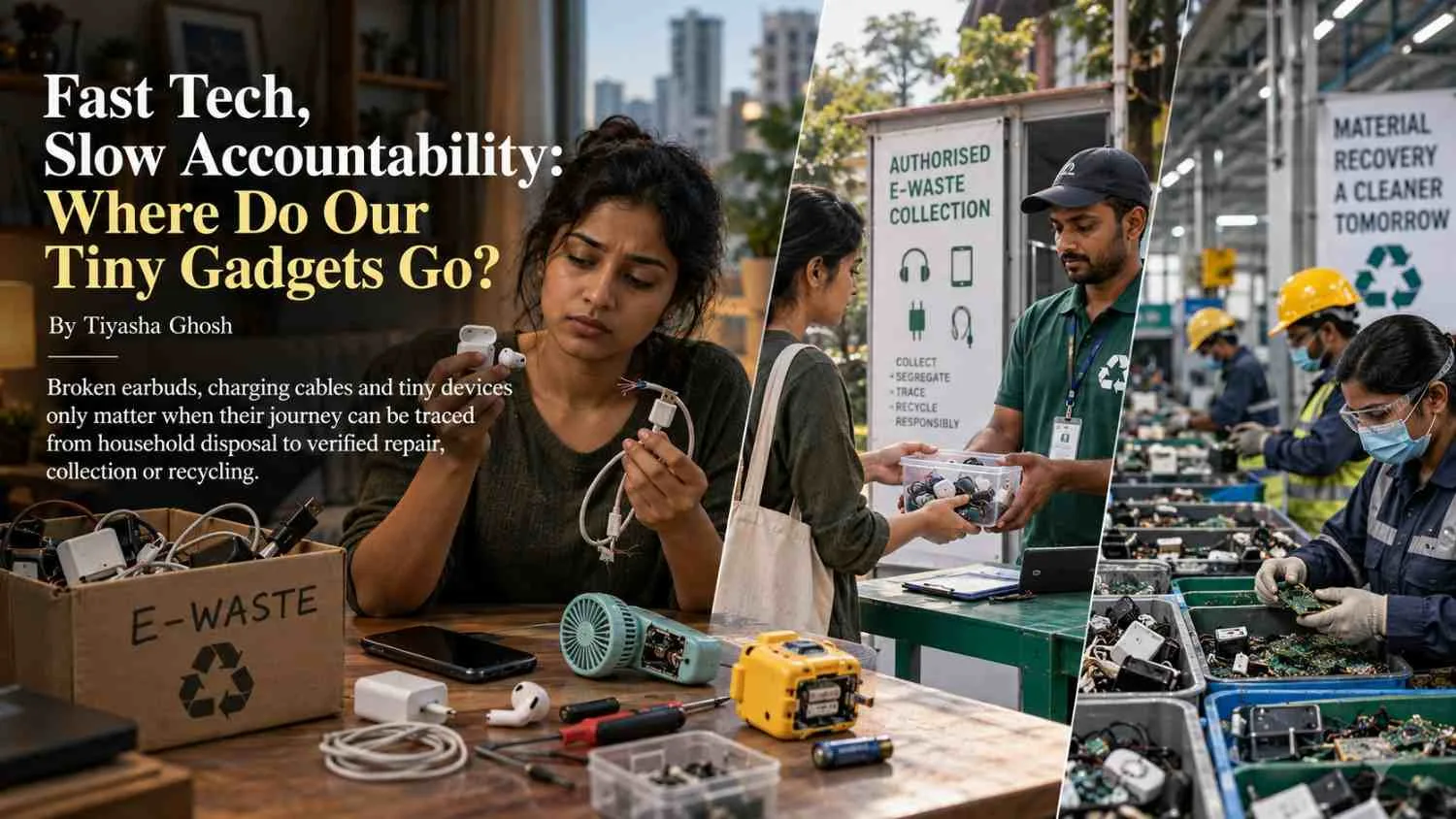
13 October 2026 | Kolkata Earbuds, charging cables and electronic toys are easy to replace. But when they stop working, their journey towards repair, collection or recycling is far less visible. Summary: Small electronic devices are an overlooked part of the e-waste problem. India has a formal e-waste management framework, but responsible disposal depends on accessible collection, accountable recycling and products that can be repaired. The real test is whether a discarded gadget can be traced from a household to its verified destination. If a Broken Earbud or Charging Cable Leaves Your Home, Can You Trace Where It Goes Next? A pair of earbuds stops working. A charging cable becomes unreliable. A small electronic toy breaks, or a mini fan is replaced by a newer model. These items are often too small to attract much attention, and their relatively low prices can make replacement seem easier than repair. Yet their size does not make them insignificant. Devices containing plugs, cables, circuit boards or batteries can become electronic waste when discarded. Some contain valuable materials that can be recovered, while others contain components that require careful handling. The problem is not simply how much electronic waste is generated. It is whether discarded devices enter a traceable system that can demonstrate what happens to them after they leave a household. The Global Numbers Reveal a Blind Spot The Global E-waste Monitor 2024, produced through the International Telecommunication Union and the United Nations Institute for Training and Research, estimated that the world generated 62 million tonnes of e-waste in 2022. Only 22.3% was documented as formally collected and recycled in an environmentally sound manner. Small equipment, including electronic toys and other household devices, accounted for 20.4 million tonnes, of which only 12% was documented as formally collected and recycled. India generated an estimated 4.137 million tonnes of e-waste in 2022, according to the Global E-waste Statistics Partnership. This is a historical estimate, not a measure of India’s current annual output or of the amount generated by small gadgets alone. These figures establish the scale of the problem, but they do not tell us how many earbuds or cables are collected in Kolkata, how much is processed locally or how much reaches its final destination. National estimates cannot substitute for evidence from a local collection chain. What Do India’s E-Waste Rules Require? India’s E-Waste (Management) Rules, 2022, which came into force on 1 April 2023, establish responsibilities for manufacturers, producers, refurbishers, dismantlers and recyclers handling electrical and electronic equipment covered by the rules. The framework includes extended producer responsibility (EPR), under which producers have specified obligations linked to e-waste management. The rules cover equipment listed in Schedule I and related components, parts and spares. Waste batteries are governed separately under the Battery Waste Management Rules, 2022. The Central Pollution Control Board operates an e-waste portal as part of the regulatory framework. Registration and compliance records provide an important starting point for checking whether an operator is authorised and what responsibilities apply to it. However, a regulatory framework does not prove that every household can conveniently return a small device. Nor does an authorised recycler’s stated annual capacity establish how much e-waste it actually receives or processes. Capacity, collection, processing and verified recovery are different measures. The key question is whether records connect these stages - and whether the information is accessible enough for consumers to make informed choices. Repair, Recycling and the Informal Sector Repair can extend a device’s useful life and delay the need for replacement. However, access to spare parts, repair information, compatible components and affordable services can influence whether a product is repaired or discarded. India’s Right to Repair portal, maintained by the Department of Consumer Affairs, provides information on warranty terms, spare parts, service details and repair options across several product categories. It is a useful consumer resource, but its existence does not guarantee that every component will be available or that every independent repair will be possible. There are competing concerns. Manufacturers and authorised service providers may emphasise product safety, quality control and the need for trained handling. Independent repairers and consumer advocates focus on affordability, access to parts and the ability to repair products without unnecessary restrictions. These concerns should be examined through actual repair costs, product policies and spare-part availability rather than assumptions about every company or repair shop. The collection stage raises another question. Informal collectors and dismantlers can help recover discarded materials and provide convenient collection services. However, where handling practices are unsafe or downstream destinations are unclear, both workers and the environment may face risks. The solution is not to overlook informal workers, but to improve safe working practices, traceability and access to accountable systems. From a Broken Gadget to Its Final Destination Tracing a discarded device means looking beyond the first collection point. A gadget may be repaired, reused, stored, handed to a collector or transferred to a recycling facility. Each route requires different evidence, and collection alone does not establish that materials have been recovered. The Afterlife of a Small Gadget What happens after your electronics stop working? StageWhat to checkRepairCan the gadget be repaired and used again?CollectionWas it handed over to an appropriate e-waste collection channel?ProcessingWhich recycler or other facility received it?Final destinationIs there evidence that it was properly processed, recycled or reused? The Accountability Gap A collection claim is not the same as proof of recycling. To trace a gadget’s journey, look for the receiver’s identity, a handover receipt, transfer records and evidence of its final destination. This is a reporting checklist, not a verified account of Kolkata’s current e-waste routes. A credible local audit should record the type and weight of items collected, the date and location of handover, the receiving operator’s identity, available receipts or transfer records, and any evidence of subsequent processing. This information would help distinguish between a collection drive that gathers devices, a facility capable of processing them and a system that can demonstrate actual recovery. A directory of collection points is useful only when locations, accepted items and operator details have been verified. What Can Consumers Do Now? The immediate steps are practical. Consider repair where feasible, keep discarded electronics out of ordinary household waste, and check with an appropriate authorised collection or recycling channel before handing them over. Devices containing lithium-ion batteries, including some wireless earbuds and small gadgets, should not be thrown into general waste. Damaged batteries can create fire risks during collection, transport and processing. Consumers can also check warranty conditions, ask whether spare parts are available and compare repair costs with replacement costs. These choices will not solve the e-waste problem alone, but they can help extend product life and reduce unnecessary disposal. The larger responsibility remains shared among producers, regulators, collection systems, repair businesses and recyclers. Each has a role in making repairs accessible, collection convenient and the final destination of discarded devices more transparent. The challenge is to make responsible disposal as convenient as buying a replacement. Small gadgets may be easy to overlook, but accountability should not disappear with them. A device’s journey should not end at the collection box; it should end with evidence of where it went and how it was handled. Sources: 1. WEEE Forum — International E-Waste Day 2026: “Fast Tech” Read the campaign brief 2. International Telecommunication Union — Global E-waste Monitor 2024 Read the report and key findings 3. Global E-waste Statistics Partnership — India, 2022 data View country statistics 4. Ministry of Environment, Forest and Climate Change — E-Waste (Management) Rules, 2022 Read the official rules (PDF) 5. Central Pollution Control Board — E-Waste Management System Visit the official portal 6. Department of Consumer Affairs — Right to Repair India Portal FAQs · About the initiative 7. Repair Café — International Repair Day, 17 October 2026 Read the announcement ...Read more

12 Oct 2026

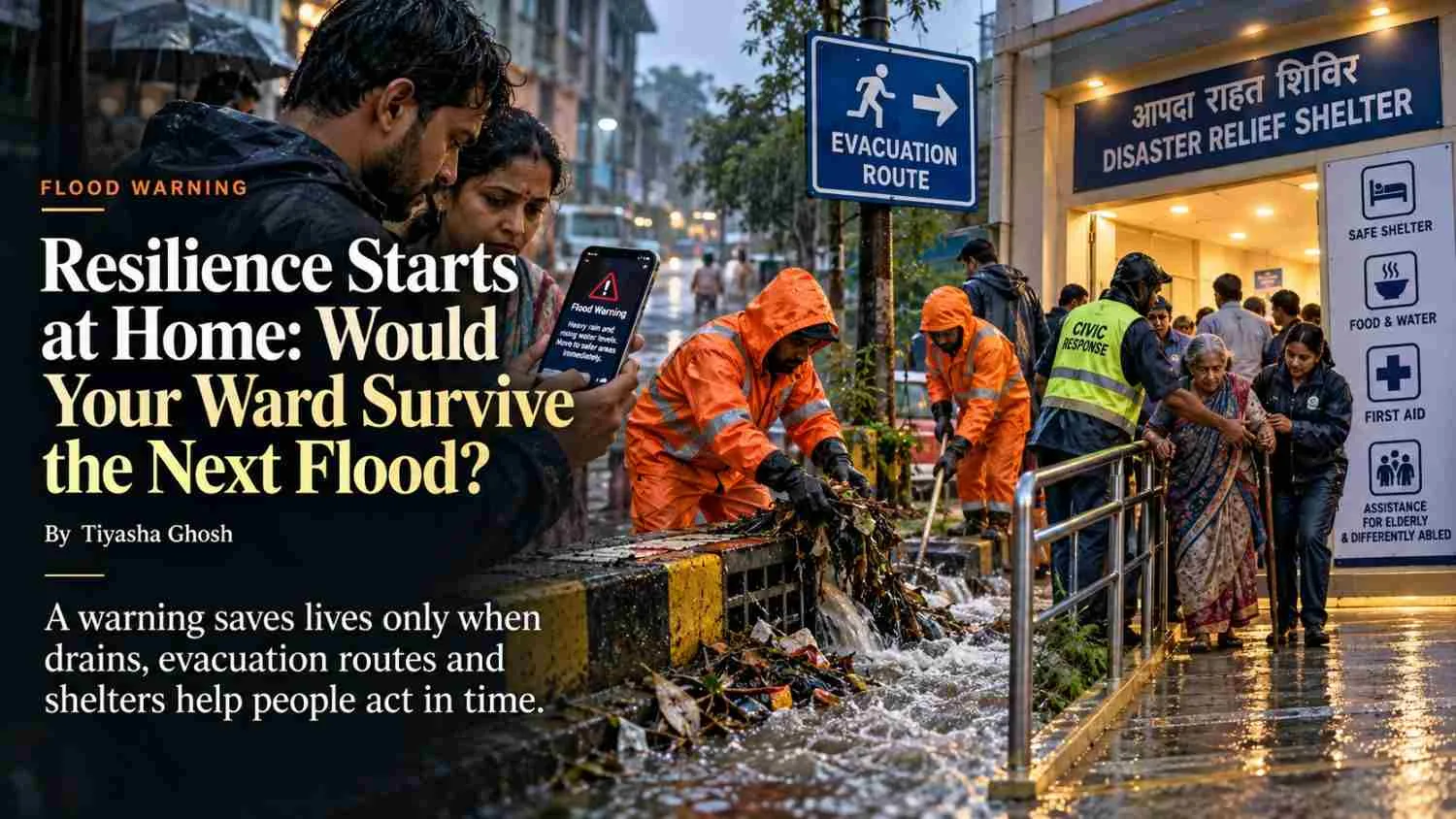
12 October, 2026 | Kolkata A flood warning may reach people in time, yet fail to protect a family if drains are clogged, evacuation routes are unsafe or the nearest shelter is inaccessible. By examining household preparedness, public infrastructure and early-warning systems, this analysis explores what genuine flood resilience means and whether communities are truly equipped to act when disaster strikes. Summary: From waterlogged streets in Kolkata to flood-prone delta settlements and cloudburst-exposed Himalayan communities, disaster preparedness depends on more than forecasts. This investigation examines whether warnings, drainage, evacuation routes and shelters can protect people when they need them most. If a Flood Warning Arrives Today, Would Every Household Know What to Do - and Be Able to Do It? A warning on a phone is only the beginning of disaster preparedness. Imagine a family receiving an alert about heavy rainfall. The nearest drain is clogged, the lane outside is already filling with water, and the designated evacuation route passes through a low-lying stretch. An older family member cannot walk quickly, while the household is unsure which shelter is open. The warning may be accurate, but the family’s ability to respond depends on what happens next. Can they reach safety in time? Is the evacuation route accessible? Will the nearest shelter be open and equipped to receive them? These questions lie at the heart of the 2026 International Day for Disaster Risk Reduction, observed on 13 October under the theme “Resilience Starts at Home.” The United Nations Office for Disaster Risk Reduction (UNDRR) is using this year’s theme to highlight safe housing, risk-informed planning, accessible warnings and household preparedness. It also recognises that people do not have equal access to safe homes, reliable information, financial resources or the support needed to evacuate. Source: UNDRR For India, this question matters across very different landscapes. Urban neighbourhoods can struggle with waterlogging and drainage failures; delta settlements face flood- and cyclone-related risks; and Himalayan communities may experience intense, highly localised rainfall, landslides and sudden changes in river conditions. Although these hazards differ, they expose a common problem: preparedness is only as strong as the weakest link between receiving a warning and being able to act on it. What Happens Between a Warning and a Safe Evacuation? India has developed systems to monitor weather hazards and distribute warnings. The India Meteorological Department (IMD) provides impact-based and risk-based weather warnings, while the National Disaster Management Authority (NDMA) operates the SACHET National Disaster Alert Portal. SACHET brings together warnings from agencies, including IMD and the Central Water Commission (CWC), and supports their dissemination through mobile phones, television, radio, apps and other communication channels. Sources: IMD information via PIB and NDMA SACHET These systems are important advances. However, the availability of a warning channel does not automatically establish that every household received the message, understood its urgency or had enough time to leave. Official figures also show why forecasts must be interpreted carefully. In a December 2025 parliamentary response, the Ministry of Earth Sciences reported that IMD’s accuracy for heavy-rainfall forecasts was 85% at a one-day lead time and 58% at a five-day lead time. These figures describe national heavy-rainfall forecast performance at different lead times. They do not indicate the probability that a particular street will flood or that a specific household will receive an alert. Nevertheless, they underline why forecasts, local observations and preparedness plans must work together. Source: PIB, 17 December 2025 The investigation should therefore follow an alert through its entire journey: when the forecast was issued, when the relevant authority received it, when a local message was sent, when residents received or heard it, and what action followed. Where records are unavailable, that gap must be reported rather than filled with assumptions. Can a Kolkata Ward Drain the Water - and Move People Out Safely? In an urban neighbourhood, flooding is not simply a question of how much rain falls. Drainage capacity, waste accumulation, maintenance, road levels, land use and the condition of nearby water channels can all influence how quickly water collects and recedes. The National Institute of Disaster Management (NIDM) has identified urban flooding as an issue requiring coordination among local bodies, planners and disaster-management authorities. Its training material on urban flood management also highlights the role of geospatial tools and community-based approaches. Source: NIDM A ward-level audit should begin with a drainage map and a physical inspection. Which streets and lanes are most vulnerable? Where are the drains, culverts and outfalls located? Are maintenance records available, and do they show when the system was last cleared? Are there recurring complaints about waterlogging, and what action followed? These questions matter because a map of infrastructure cannot, by itself, establish its actual condition. A drain may appear on a municipal map but remain blocked in practice. A road may be designated as an evacuation route but become impassable when water rises. The same test applies to housing. Reporting should examine whether homes have safe exits, whether residents know where to go, and whether people living in ground-floor or low-lying dwellings have a practical way to move essential belongings and reach safer ground. It should also distinguish household responsibilities from the public responsibility to maintain drainage, enforce appropriate building and land-use standards, communicate risks and provide safe evacuation options. Does a Delta Settlement Face a Different Preparedness Test? A delta settlement requires a different risk assessment. Its exposure may involve river flooding, intense rainfall, tidal conditions, cyclone-related inundation or damage to roads and other connections. The specific hazards must be established for the settlement selected rather than assumed to be identical across the Sundarbans or the wider delta. The audit should examine whether residents have reliable access to warnings, whether evacuation routes remain usable during flooding and whether the designated shelter can be reached on foot, by boat or through another locally appropriate means. It should also establish what happens when transport services stop, mobile connectivity weakens or a route becomes inaccessible. Shelter availability is not the same as shelter accessibility. A building may be designated for evacuation but remain difficult to reach for a wheelchair user, an older person, a pregnant resident or someone who needs assistance. The investigation should check ramps, entrances, toilets, lighting, accessible communication and arrangements for people who cannot evacuate independently. The comparison with Kolkata should not rank one community as safer simply because it has more visible infrastructure. Instead, it should identify how each location manages its specific risks and which gaps prevent residents from acting on warnings. What Can Himalayan Cloudbursts Teach Us About the Last Mile? The additional reporting module on Himalayan cloudbursts and early-warning systems extends the investigation beyond the two flood-prone locations. It examines how warning systems perform in remote hill districts, where steep terrain, highly localised rainfall and limited observation coverage can complicate risk communication. IMD has explained that cloudbursts are highly localised events and that monitoring them requires dense networks of automatic rain gauges and weather stations. It has also noted that remote Himalayan and Western Ghats areas remain data-sparse, making long-term trend analysis difficult. This distinction matters: warning systems may improve, while highly localised events can remain challenging to observe and anticipate. Source: IMD press release, 15 October 2025 The comparison should focus on the practical chain from detection to action: available observations, forecast or warning issuance, transmission to district and local authorities, communication to residents, and the availability of safe routes and shelters. It should not suggest that a Himalayan cloudburst can be predicted in exactly the same way as a widespread heavy-rainfall event. The Tunis exercise also requires careful treatment. Its findings may offer useful lessons about preparedness, coordination or warning communication, but a simulation cannot establish how effectively a system performs in real conditions. Any exercise results should be presented as findings from that exercise, supported by its date, participants, scenario and documented outcomes. Claims about actual performance in Indian communities must be supported by separate Indian records or field observations. Who Is Responsible When a Warning Does Not Lead to Safety? Preparedness is a shared responsibility, but responsibility is not distributed equally. Households can keep emergency contacts, understand local alerts and prepare essential supplies. They cannot independently clear municipal drains, repair damaged public roads, build accessible shelters or establish a reliable public warning network. Local authorities and ward officials must be able to explain their drainage and maintenance arrangements, evacuation plans and shelter provisions. Engineers can help establish whether infrastructure is designed and maintained for the relevant risks. Disaster-management authorities can explain how warnings are received and passed on. Disability advocates can identify barriers that standard evacuation plans may overlook. The investigation should include different perspectives. Authorities may point to warning platforms, preparedness plans, shelters or completed infrastructure works. Residents may report that routes remain unusable or that messages arrive too late to act on. Engineers may explain the limits of drainage capacity, funding or the challenges of managing intense rainfall. Each perspective should be tested against records and direct observations rather than treated as a complete explanation. The evidence should include warning timestamps, drainage maps, maintenance records, shelter-access checks and documentation of disaster drills. A published plan establishes that a plan exists; it does not prove that the plan has been practised or will work under pressure. Similarly, a completed drill does not prove that every resident can evacuate safely. What Should a Household and Ward Preparedness Audit Include? The final reader tool should make the investigation practical. A household and ward checklist can ask: Housing: Are exits safe, and does the household understand the hazards affecting its location?Warnings: Which official channels provide alerts, and is there a backup if a phone or internet connection fails?Drainage: Are nearby drains and outfalls maintained, and are recurring waterlogging points documented?Evacuation: Is there a clearly identified route, and has it been assessed for flood conditions?Shelters: Is the shelter open, reachable and suitable for people with different mobility and support needs?Emergency arrangements: Are contact numbers, essential medicines, documents and necessary supplies accessible?Practice and accountability: Has a drill been documented, and is there a designated authority or office to contact about unresolved risks? A ward risk map should accompany the feature only after locations and routes have been verified. It should distinguish confirmed hazards, official evacuation and shelter information, observed infrastructure problems, and locations that still require verification. Sensitive household information should not be published. Resilience Is Measured Before the Water Rises The proposed comparison between a Kolkata ward, a delta settlement and Himalayan warning systems should produce more than a list of risks. It should reveal where the chain of preparedness works, where it breaks and who has the authority to address each gap. The aim is not to claim that every flood can be prevented or every warning can eliminate danger. It is to examine whether people receive usable information, whether public infrastructure supports safe action and whether the most vulnerable residents are included in disaster planning. On the International Day for Disaster Risk Reduction, “Resilience Starts at Home” offers a useful principle. But homes cannot become resilient through household effort alone. Safe housing, maintained drainage, accessible evacuation routes, dependable warnings and accountable local planning must work together. The real test is not whether a ward has a disaster plan. It is whether residents can use that plan when the next warning arrives. Sources: UNDRR — 2026 International Day for Disaster Risk Reduction: “Resilience Starts at Home”UNDRR — 2026 campaign and key messagesMinistry of Earth Sciences / PIB — Early Warning System, 1 April 2026Ministry of Earth Sciences / PIB — Monsoon Warning System, 17 December 2025NDMA — SACHET National Disaster Alert PortalIMD — Press release on cloudbursts and observation requirements, 15 October 2025National Institute of Disaster Management — Urban flood management training report, March 2025NDMA guidelines — Floods, urban flooding and disability-inclusive disaster risk reduction ...Read more

12 Oct 2026

Oct 12,2026 Across rural India, women are protecting farms from droughts, unpredictable rainfall and rising agricultural costs. But the people keeping agriculture alive do not always control the land, credit or income that could make it more resilient. From women-led farming collectives to watershed development, their experiences suggest a critical gap between participation and financial power. If women are expected to secure the future of Indian agriculture, we must ask ourselves whether they have the resources to shape it. Summary:Rural women are central to India’s climate adaptation efforts, but land ownership, credit, technology, and market access barriers continue to diminish their financial independence. Drawing on Indian examples, this article explores women’s collectives, watershed programmes, and financial protection, and examines why participation cannot guarantee economic empowerment. Introduction: The missing link in climate-ready farming When we talk of climate-resilient agriculture, we tend to think of better seeds, water conservation, and changing farming practices. But we should also be asking a fundamental question do the women implementing these changes have control over the resources and income that would make them work? Across rural India, women sustain agricultural production while facing barriers to land, credit, and decision-making. Without financial agency, climate resilience will only be partial.  Who is keeping India’s farms climate-ready? Women are involved in every stage of agricultural production – sowing, transplanting, and harvesting, livestock management and post-harvest processing. In many rural households, they also preserve seeds, keep kitchen gardens, manage household food supplies, and collect water. For these women, the extra work associated with agriculture is amplified when droughts, floods and heat disrupt agricultural livelihoods. As climate patterns become less predictable, women often must adapt their work to changes in agriculture. A delayed monsoon may alter sowing schedules, while prolonged dryness may lengthen the time for obtaining water for household use and livestock. A crop failure can need reconsidering food expenditure, seek added employment and borrow to finance the next season. But we cannot automatically assume that a person doing agricultural work is a ‘farmer’ or has an equal say in agricultural decisions. Women may contribute their labour to family-owned land without their names appearing on land records or work as tenant cultivators or agricultural labourers. India’s Agriculture Census 2015–16 recorded approximately 20.4 million female operational holders, representing around 13.96% of all operational holders. These numbers are important, but they do not capture every woman contributing to agricultural production. We must distinguish between people officially recorded as operational holders and the many women whose labour sustains farming households. Recognition matters because official documentation can influence access to certain benefits, institutional credit, and support programmes. Eligibility varies across schemes, but women whose farming contributions are not formally recognised may face extra administrative hurdles. If we want to know who is keeping India’s farms climate-ready, we must look not only at the number of women taking part in agricultural activities, but at who makes decisions, controls productive assets, and receives the financial returns. Recognising women as farmers is therefore not only a question of representation, but of ensuring that their agricultural knowledge translates into greater security, influence, and economic independence. What stops women from controlling land, credit, and agricultural income? The barriers women face is interconnected. Limited land rights can affect access to finance, while restricted access to finance can prevent women from investing in climate-resilient practices. Even when women receive training, their ability to implement what they learn depends on decisions made by other household members. Land is one of the most key factors. Secure land rights can strengthen a woman’s ability to decide which crops to cultivate, invest in soil improvement and plan for future agricultural seasons. They may also help set up eligibility for government benefits or loans, depending on the applicable rules. But we should not assume that a land title automatically guarantees independence. A woman may legally own land but have limited control over the crops grown, the sale of produce, or the income generated. Similarly, tenant farmers may make day-to-day agricultural decisions while lacking the documents required to access some formal support mechanisms. Access to agricultural equipment is equally crucial. Tools for irrigation, processing, and storage can reduce labour and improve productivity, but their benefits depend on affordability, availability, and practical training. A woman may understand how a technology could help her farm, but she may not have the money or the authority to obtain it. Market access decides whether agricultural production translates into income. Farmers need reliable information about prices, buyers, transport costs, and demand. When women cannot negotiate directly with traders or access suitable storage and processing facilities, they may have fewer opportunities to secure favourable prices. Finally, we must examine who controls the money earned. A woman may contribute to cultivation, but another household member may manage the sale proceeds or decide how the income is spent. Increased agricultural productivity does not necessarily translate into greater financial independence for women. This is why we cannot measure empowerment by counting training sessions, loans distributed, and women enrolled in a programme. We must ask whether women can access resources independently, make meaningful decisions, and keep a fair share of the benefits generated by their work. Where are we seeing women-led climate resilience in India? India has examples of programmes and community institutions linking women’s participation to agricultural development, natural resource management, and livelihood security. These initiatives suggest pathways to increased resilience, but their outcomes depend on implementation, local conditions, and the extent to which women exercise real decision-making power. Watershed development and women’s participation. In rain-dependent agricultural regions, the development of watersheds can help communities manage rainfall through water harvesting, groundwater recharge, soil conservation, and improvements in local water management. Such measures can support farmers facing irregular rainfall, declining water availability, and soil degradation. The National Bank for Agriculture and Rural Development (NABARD) supports watershed development and climate-adaptation initiatives across India. These programmes can connect environmental improvements with livelihood development, where communities take part in planning and managing shared natural resources. This creates an opportunity for women to influence decisions about water use, soil conservation, and agricultural priorities. Women often have detailed knowledge of household water requirements, livestock care and the added work caused by water scarcity. Including this knowledge in local planning can make interventions more responsive to community needs. A NABARD-supported climate-proofing project implemented with the Centre for Integrated Rural Health and Education Project (CIRHEP) in Tamil Nadu documents women’s participation in self-help groups and livelihood activities in watershed villages. The project report discusses access to institutional finance, participation in local decision-making and activities such as floriculture, nursery development, and other income-generating enterprises. These examples suggest how natural resource management can be linked with women’s economic opportunities. But we must not assume that every watershed programme leads to the same results. We must examine whether women influence decisions about water, whether landless households benefit, and whether new income opportunities are practical after project support ends. Women farmers and collective livelihood programmes - The Mahila Kisan Sashaktikaran Pariyojana (MKSP), implemented as a part of the Deendayal Antyodaya Yojana–National Rural Livelihoods Mission, was designed to strengthen women’s participation in agriculture and support sustainable livelihood opportunities. The programme’s significance lies in recognising women as agricultural producers, rather than treating their contribution as an extension of household labour. By supporting agricultural knowledge and collective organisation, such initiatives can help women improve farming practices and explore more sustainable livelihoods. But the presence of a collective does not automatically guarantee financial independence. A group may provide training but lack working capital, dependable buyers, or suitable storage facilities. We must assess whether members experience measurable improvements in income, asset ownership, and control over agricultural decisions. Self-help groups and financial inclusion - Self-help groups offer another route towards greater financial inclusion. Through regular savings, internal lending and links with formal banking institutions, women can develop financial relationships and explore income-generating activities. When connected with agricultural programmes, these groups can help women finance seeds, livestock, small enterprises, or processing activities. They can also provide a platform for sharing information about government schemes and local livelihood opportunities. The benefits, however, depend on how financial resources are used and controlled. A woman may receive a loan without deciding how it is spent. If an agricultural season fails, she may still handle repayment, when she has little control over the factors affecting the household’s income. We should look beyond the number of groups formed or loans distributed. Effective programmes should help women understand loan terms, name practical enterprises, access markets, and make independent decisions about the money they borrow and earn. Crop insurance and financial protection in Chhattisgarh The experience of Lakshmi Rathiya, a farmer in Mauhar village in Chhattisgarh’s Korba district, presents another perspective. In a March 2026 account, the United Nations Development Programme highlighted the role crop insurance can play in protecting women’s farming livelihoods against agricultural risks. Crop insurance cannot prevent droughts, floods, or crop damage. Nor can it resolve every problem related to land ownership or unequal decision-making. But when coverage and claims processes work well, insurance can help farmers recover from losses, without relying entirely on new debt or selling productive assets. For women farmers, access to insurance must be practical. They need clear information about eligibility, enrolment, documentation, premiums, and claims. We should also examine whether compensation reaches the person responsible for restoring the farm and whether the support arrives in time to help finance the next agricultural season. Together, these Indian examples highlight why climate adaptation should connect environmental protection with financial inclusion and livelihood security. Their effectiveness must be measured by what changes for women, not simply by the existence of a programme. When climate shocks hit, who bears the financial losses? Climate shocks can transform an already uncertain agricultural season into a budgetary crisis. Delayed rainfall may disrupt sowing, extreme heat can affect agricultural labour and livestock, and intense rainfall can damage standing crops or stored produce. The consequences extend beyond the immediate loss of agricultural output. For a woman with limited savings, a poor harvest may mean borrowing money to buy food, finding more employment, or reducing expenditure on essential needs. If the household has already borrowed, lower agricultural earnings make repayment harder and leave little money for the next sowing season. The goal should be to ensure that climate shocks do not repeatedly push women into financial insecurity. Protecting agricultural production is essential but protecting the livelihoods and decision-making power of the people who sustain that production is equally important. Why must financial independence become part of climate adaptation? Climate adaptation requires investment, which depends on access to money and the authority to decide how it is used. This makes women’s financial independence an integral part of climate-resilient agriculture. Consider a woman farmer who learns that mulching, improved soil management, and efficient irrigation could help her farm keep moisture. She may understand the benefits of these practices, but adopting them can require materials, equipment, labour, and upfront expenditure. Without access to savings or affordable credit, she may be unable to implement the changes. The same challenge arises when women want to diversify into crops suited to the local conditions. Diversification may require new seeds, cultivating techniques, processing facilities and buyers willing to buy the harvest. Without reliable market information, changing crops can present more financial risks, rather than alleviate them. We must connect agricultural training with financial services, land rights, and market development. Agricultural extension programmes should provide practical knowledge about climate risks, while financial institutions should develop suitable products that account for seasonal income and the uncertainties of farming. Public programmes must also consider women whose contributions are not reflected in formal land records. Depending on the scheme, documentation requirements may prevent cultivators of family or leased land from accessing particular benefits. Clear eligibility rules and accessible documentation support can reduce these barriers. At the same time, we should not assume that credit automatically creates empowerment. Loans can support productive investments, but they can also increase vulnerability when crops fail, buyers are unavailable and repayment terms do not reflect agricultural realities. Credit must go with risk protection, practical support, and realistic repayment arrangements. We need to measure climate adaptation through both environmental and economic outcomes. Improved soil health, reduced water consumption, and lower crop losses matter. So do women’s earnings, ownership of productive assets, access to affordable credit and control over agricultural decisions. If we want to know whether a farming system has become genuinely climate-resilient, we must examine whether the people managing it have the resources and authority to sustain those improvements. How can India turn women’s participation into real financial power? Moving from participation to financial agency requires action at several levels: Government agencies, banks, agricultural institutions, local organisations, and farming communities all have a role. First, we need stronger recognition of women as agricultural decision-makers. Where proper, land documentation and joint ownership can strengthen women’s position, while policies must also account for tenant cultivators and landless workers. Secure access to land should not be the only route through which women can obtain agricultural support. Second, financial services must reflect the realities of rural livelihoods. Women need access to affordable credit, savings facilities, suitable insurance, and clear information about government benefits. Financial products should account for seasonal earnings and climate-related risks, rather than if every farmer has a stable monthly income. Third, agricultural training must lead to practical opportunities. If women learn about drought-resilient crops, water conservation, or sustainable soil management, they should also be able to access suitable inputs, tools, technical support, and buyers. Otherwise, training may raise awareness without changing what women can do. Fourth, market access must be given greater attention. Collective marketing, local processing, storage facilities, and reliable price information can help women explore better opportunities for their produce. Partnerships with farmer producer organisations and cooperatives may be particularly useful when they are inclusive and transparent. Fifth, women must have a meaningful role in community-level institutions. Water committees, watershed organisations, and agricultural collectives should not merely include women, but enable them to influence planning, allocation of resources and the evaluation of local projects. Finally, programmes must measure outcomes that reflect real empowerment. We should ask whether women have gained control over income, improved their access to productive assets, reduced their financial vulnerability, or increased their influence over agricultural decisions. These outcomes tell us much more than attendance figures. Conclusion: Climate resilience cannot rely solely on women’s labour India’s agricultural future depends not only on how successfully we can adapt to climate change, but also on whether the people who sustain farms have the means or power to do so. Although rural women already contribute to agriculture through their work, natural resource management, household food security and community institutions, their contribution cannot be divorced from their access to resources, technology, markets, and the income generated from their labour. Examples from watershed development, women’s livelihood programmes, self-help groups, and crop-insurance initiatives prove how adaptation to environmental change can be married with an increase in economic opportunities. They also serve as a reminder that programme participation does not necessarily translate into financial independence for women. We need to consider whether women can access and control resources, make decisions over agriculture and keep a significant share of the benefits. We also need to ensure that landless women and tenant cultivators are not overlooked merely because they do not officially own land. The future requires collaboration between government bodies, banks, agricultural organisations, and communities to provide women with accessible finance, markets, training, and representation in decision-making. Most importantly, it requires us to measure success in terms of increased financial security and agency for women. The resilience of women should not be viewed as an infinite resource that can offset inadequate support. Their ability to withstand the effects of climate change should not rely on how much stress they can endure. For women to be able to keep India’s farms in the face of climate change, they must also have the power to decide how those farms are managed and how the money they generate is spent. Climate resilience will be incomplete so long as the people who sustain it are denied a voice in important financial decisions. India’s agricultural future not only depends on whether our farms will survive a changing climate, but also on whether the women who sustain them will have the freedom and resources to do so. References and Sources Press Information Bureau, Government of India. Women Farmers in the Country (2021). Agricultural statistics and information about female operational holders. https://www.pib.gov.in/PressReleasePage.aspx?PRID=1780263&lang=2&reg=48 Press Information Bureau, Government of India. Feminization of Agriculture (2019). Background on women farmers and the Mahila Kisan Sashaktikaran Pariyojana https://www.pib.gov.in/PressReleasePage.aspx?PRID=1577924&reg=48&lang=2  Department of Agriculture and Farmers Welfare, Government of India. Agriculture Census Scheme. Background on agricultural holdings and data collection. https://agcensus.gov.in/AgriCensus/   NABARD. Resources on watershed development, climate adaptation, soil conservation, and sustainable agriculture. https://www.adaptation-fund.org/wp-content/uploads/2024/05/India.pdf   ...Read more

12 Oct 2026

12 October 2026 | Kolkata, West Bengal Bamboo, fabric, plywood and decorations help create Kolkata’s spectacular pandals. But what happens to these materials when the celebrations end? Summary: Durga Puja pandals are temporary structures built with a wide range of materials. While some can be reused, repaired or recycled, their second life depends on how they are purchased, dismantled, stored and collected. Better planning and clear recovery arrangements can help reduce waste without compromising the festival’s creativity. When the Lights Go Out, What Happens to a Pandal’s Materials? Every year, Durga Puja transforms Kolkata into a city of elaborate pandals, artistic installations and illuminated streets. Bamboo frames, fabric, plywood, steel, ropes, paint and decorative elements come together to create these temporary spaces. But when the last visitor leaves and the lights go out, an important question arises: what happens to all these materials? A pandal may stand for only a few days, but the materials used to build it can retain their value long after the festival ends. Some can be reused in future installations, while others may be repaired, repurposed or recycled. The challenge is to ensure that they do not simply become waste once the celebrations are over. The aim is not to make Durga Puja less creative or elaborate. It is to examine whether the materials behind its artistic identity can be planned, managed and recovered more responsibly. A Temporary Structure with a Longer Story Although a pandal is dismantled after the festival, its materials do not necessarily have to share the same fate. Bamboo and metal frames may be suitable for future structures, while fabric and decorative elements can be stored for reuse. Plywood may also serve another purpose if it remains in good condition. However, recovering these materials is not always straightforward. Paint, adhesives, mixed-material decorations and damaged components can make reuse or recycling more difficult. Materials joined together may require additional labour to separate, while poor storage can reduce their chances of being used again. This makes planning essential. Waste management should not begin only after dismantling. Decisions about material selection, assembly methods, storage and recovery must be considered before construction begins. Designing for disassembly can help preserve the value of materials and reduce the amount that ultimately needs to be discarded. Reuse Must Be Proven, Not Promised Calling a pandal sustainable does not establish how much of its material is actually reused. A credible assessment must distinguish between materials that are rented, returned, stored, repaired, resold, recycled or discarded. Each category represents a different outcome. For instance, renting a frame may reduce the need to purchase new materials, but its condition and subsequent use still matter. Similarly, sending a material to a recycler is not the same as directly reusing it in another pandal. A practical assessment would begin with an inventory of the materials purchased or rented for construction. After dismantling, organisers could record how much was recovered, where it went and whether it was reused, repaired, recycled or discarded. Any recovery or reuse percentage should also specify how it was calculated, whether by weight, quantity, value or another clearly defined measure. Such records would help distinguish verified outcomes from general claims. Without them, it remains difficult to determine how much waste was actually prevented and how effectively materials were recovered. What Do Existing Rules and Examples Tell Us? The West Bengal Pollution Control Board issued a directive to Durga Puja organisers in 2024 concerning compliance with the Plastic Waste Management Rules, 2021. It addressed specified single-use plastic items and PVC banners, including requirements for handling certain used PVC banners through registered plastic-waste processors. This provides a regulatory starting point for managing particular waste streams. However, compliance with these requirements does not, by itself, establish that bamboo, plywood, fabric, metal frames and other pandal materials are being recovered or reused. There have also been examples of organisers considering reuse. A 2022 report by The Times of India described plans announced by some Salt Lake Puja committees to store plywood, reuse cloth and return decorations to artisans. These examples indicate that material recovery can be incorporated into festival planning. However, announced plans should not be treated as proof that the materials were ultimately recovered, nor do a few examples establish a city-wide practice. The wider question is whether such initiatives can be supported by reliable records, clear responsibilities and arrangements that continue beyond the festival itself. Designing a Second Life into the Next Pandal A more circular approach begins before the first frame is assembled. Organisers can assess which materials can be rented or borrowed, which decorations can be repaired, and which components can be separated without unnecessary damage. Choosing durable materials and designing structures for dismantling can make recovery easier at the end of the festival. Clear agreements are equally important. Rental and return contracts should identify who will collect the materials, where they will be taken, what condition they must be in and who will bear the associated costs. Plans must also account for the workers responsible for dismantling, sorting, transporting and storing these materials. Organisers and local authorities can strengthen the process through clearer disposal guidance and consistent record-keeping. A simple material ledger could document the quantities purchased or rented, the amount returned or stored, the materials repaired or recycled, and the waste that had to be discarded. Where possible, the final destination of each recovered material should be recorded and verified. This would allow organisers to compare their initial plans with actual outcomes, identify materials that can be used repeatedly and improve recovery arrangements for future festivals. Durga Puja’s artistic identity and responsible material management do not have to work against each other. The goal is not to diminish the scale, creativity or cultural significance of the celebration, but to make better use of the resources that bring it to life. For Bengalis, Durga Puja is far more than a festival. It is a feeling woven into memories, creativity, community and the familiar joy of returning to a pandal year after year. Every structure carries the effort of artisans, the imagination of designers and the emotions of the people who gather around it. Preserving that spirit should also mean caring about what remains when the celebrations end. Making pandals more sustainable does not mean taking away their grandeur or changing the traditions people hold close. It means extending the value of the materials, skills and resources that make these spaces possible. With thoughtful planning, responsible dismantling and verifiable reuse, the end of a pandal’s life need not mark the end of its usefulness. The lights may go out, and the pandal may come down, but the story of its materials can continue. Sources: SAHAJ Puja Permission Portal — Government of West Bengal: sahaj.wb.gov.inWest Bengal Pollution Control Board — Directive to Durga Puja organisers on compliance with Plastic Waste Management Rules, 2021: Read the directive (PDF)The Times of India — Report on Salt Lake Puja committees’ reuse plans, 2022: Read the reportCentral Pollution Control Board — Construction and Demolition Waste Rules and resources: CPCB rules · C&D waste system ...Read more

11 Oct 2026

October 11, 2026 | Kolkata India has made significant investments in school infrastructure, but the presence of facilities alone cannot guarantee girls’ safety, dignity or uninterrupted education. Safe drinking water, functional toilets, menstrual hygiene support and climate preparedness must work together to ensure that schools remain safe and accessible, even during extreme weather. SummaryA school may appear well-equipped, yet leave students vulnerable when heatwaves, floods or water scarcity disrupt essential services. This feature examines whether school facilities are not only available but also safe, functional, accessible and properly maintained. By looking at drinking water, sanitation, menstrual hygiene and learning continuity during weather extremes, it explores how infrastructure gaps can affect girls’ dignity, attendance and ability to learn—and what schools must do to close them. What does a climate-safe school look like when a girl needs it most? Imagine a school day during a prolonged heatwave: classrooms become unbearably hot, drinking water runs low, yet lessons are expected to continue as usual. Now imagine a girl arriving at school during her period, only to find a toilet without running water, privacy or safe facilities for menstrual waste disposal. During heavy rainfall, route to home gets disrupted and the risks extend beyond the school gates. Together, these challenges raise a crucial question: Can a school truly protect its students if its infrastructure fails when they need it most? These are not hypothetical scenarios: they demonstrate the connection between school infrastructure and the health, dignity, safety and learning of girls. The International Day of the Girl Child, observed annually on 11 October, aims to promote girls’ rights and highlight the challenges they face. The United Nations’ 2026 theme, “End Child Marriage,” calls for greater action to protect girls’ rights and futures. It also reinforces a wider message: girls’ education must be a priority, and learning cannot thrive when girls lack access to safe toilets, clean water and other essential facilities. Climate education is gradually becoming part of the discussion about what children should learn, from weather patterns and water conservation to waste management, food production and environmental protection. But is this knowledge being reflected in school infrastructure? Does a lesson on water conservation carry greater meaning when students can see how their school uses or wastes - water? And would a lesson on heatwaves feel more relevant if the classroom itself struggles to cope with rising temperatures? The next logical step is to assess not only what is being taught about climate change, but also whether the school environment and infrastructure are prepared to deal with the consequences or not! The Numbers Show Progress, but Do They Tell the Whole Story? India has made considerable investments in school infrastructure, with encouraging results. According to NITI Aayog’s School Education System in India: A Temporal Analysis and Policy Roadmap for Quality Improvement (2026), based on UDISE+ 2024–25 data, 93.8% of schools nationally had functional girls’ toilets. West Bengal reported 99.6%, while several other states also recorded near-universal coverage. The UDISE+ 2024–25 data also show that 99% of schools reported having functional drinking-water facilities. These figures indicate significant progress in improving access to essential school infrastructure. However, they do not necessarily establish whether water is available whenever students need it, whether it is safe to drink or whether the facilities are accessible to every child. This distinction is important. The figures do not need to be dismissed to recognise their limitations. A toilet may be present but have a faulty tap, inadequate privacy, poor maintenance or no running water. Similarly, a school may have a drinking-water facility that has not been tested recently or lacks clear procedures for dealing with contamination. Accessibility presents another concern. Standard facilities may be inadequate or impossible for children with disabilities to use. According to NITI Aayog’s analysis, only 33.4% of schools had functional toilets for children with special needs in 2024–25. This highlights a significant gap between the presence of infrastructure and its usability by all students. The statistics point to progress, but they cannot tell the entire story. A facility recorded as functional on paper must also work in practice. A field audit can help establish whether the conditions students encounter on the ground match the published figures. Why Water, Toilets and Menstrual Hygiene Must Be Examined Together? Water and sanitation are often discussed under separate administrative headings. For girls, however, these facilities are closely connected. A toilet without water cannot serve its purpose effectively. Without privacy and appropriate disposal facilities, it may fail to meet menstrual hygiene needs. Water shortages can also affect handwashing and cleanliness. If flooding or water damage forces a school to close, these challenges become even more pressing. UNICEF India’s guidance on school WASH—water, sanitation and hygiene—identifies clean, age-appropriate toilets, safe drinking water, handwashing facilities, menstrual hygiene management and regular maintenance as essential components of a healthy school environment. These facilities must be clean, functional and properly maintained to serve students effectively. India also has a National Menstrual Hygiene Policy for School-going Girls, approved by the Ministry of Health and Family Welfare in November 2024. The policy sets out objectives relating to menstrual product availability, gender-responsive facilities, safe disposal mechanisms and age-appropriate education. It also emphasises coordination between ministries rather than treating menstrual hygiene as an isolated issue. The policy provides a framework, but its effectiveness depends on implementation. Are menstrual products consistently available? Is there a private space where girls can change? Is water accessible? Can waste be disposed of safely? Is support available when a facility is out of order? Schools must also ensure that teachers are equipped to respond sensitively. A girl should not be embarrassed or penalised because she cannot manage her period due to a lack of water, an inaccessible toilet or inadequate facilities. These conditions cannot be assessed through policy documents alone. Even the presence of a sanitary-product vending machine does not guarantee that it is stocked or that students know how to use it. A proper audit must examine the entire system—from product availability and privacy to disposal, maintenance and staff training. If even one essential element is missing, girls may continue to face the same barriers. When Extreme Weather Turns Infrastructure Gaps into Climate Risks Hot weather can increase students’ need for drinking water, shaded spaces and adjustments to outdoor activities. Heavy rainfall and flooding can disrupt journeys to school, damage classrooms and lead to prolonged closures. UNICEF India’s Education on the Edge article, published in January 2025, discusses the effects of climate change on school attendance and learning, particularly among girls and marginalised communities. It highlights how floods, heatwaves and cyclones can interrupt education and undermine learning continuity. The impact can accumulate over time. Repeated weather-related closures may disrupt learning far more than an isolated missed school day, particularly when students struggle to catch up after classes resume. The scale of potential exposure is significant. According to UNICEF India’s Climate Change and Environmental Sustainability material, 55% of India’s nearly 472 million children are estimated to be at risk from multiple overlapping climate hazards, including heatwaves, drought and air pollution. This is not a direct estimate of how many children are affected by weather-related school closures. Rather, it indicates the scale of climate-related risks facing children and the systems responsible for their education. A climate-safe school therefore needs plans both to reduce the likelihood of disruption and to manage it when extreme weather makes closures unavoidable. Before an event, staff should know how to communicate weather alerts, which activities may need to be cancelled and who is responsible for decisions concerning student safety. During a flood or storm, evacuation procedures and communication with families become priorities. Once the immediate danger has passed, schools must determine how to resume classes, replace damaged materials and support students who have fallen behind. The National School Safety Policy Guidelines provide a starting point for school safety. However, procedures are effective only when staff understand them, students know how to respond and the necessary arrangements are in place. A field audit should therefore examine the school’s extreme-weather procedures, the resources available to implement them and the alternative learning arrangements that can be activated when classes must be suspended. Should Schools Close During Dangerous Weather or Keep Learning Going? This question requires a careful balance between educational continuity and student safety. Closing a school during dangerous weather may be the right decision. Keeping students in classrooms or requiring them to travel through flooded streets or dangerously high temperatures simply to avoid a closure can expose them to unnecessary risks. Learning continuity remains important, but schools cannot be expected to absorb the full impact of climate-related disasters. They cannot cancel classes indefinitely or ignore practical considerations such as examinations, staff availability and the condition of damaged buildings. School leaders must also manage the financial and logistical consequences of prolonged closures. They may need to balance repair work, water and sanitation supplies, staff availability, examination schedules and limited budgets. Some problems, such as inadequate drainage, flooded roads, disrupted water supplies and wider disaster management, fall partly or entirely within the responsibilities of local authorities. Recognising these constraints does not excuse poor maintenance. It acknowledges that climate-safe education requires coordination beyond the school gates. A field audit should examine whether clear closure and reopening procedures exist, whether students and staff can remain safe and whether the school has the resources needed to resume learning as soon as conditions allow. It should also consider the financial and administrative barriers that may prevent a school from implementing its plans. Learning continuity cannot simply mean shifting classes online. Some students may lack devices, reliable electricity or internet access, while online lessons may not meet every learner’s needs. Depending on the circumstances, printed materials, telephone support from teachers, community learning centres and flexible arrangements for submitting work may offer more practical alternatives. UNICEF India’s Education on the Edge article discusses the effects of climate-related school closures and points to low-tech and non-digital approaches, including community learning centres. The emphasis is on finding solutions that remain workable when resources and connectivity are limited. What Should a Proper School Audit Examine? The proposed investigation calls for a comparison of five schools across urban and rural settings, including government and private institutions. Each school should be assessed using the same core questions so that differences and similarities can be examined consistently. The first stage should involve a physical inspection of essential facilities. This includes drinking-water points, toilets, handwashing stations, menstrual hygiene arrangements, shaded areas and classroom ventilation. The inspection should establish whether facilities are working at the time of the visit, whether all students can access them and whether maintenance records support the school’s claims. Drinking-water safety deserves particular attention. Claims that water is safe should be checked against available water-testing records rather than inferred from the mere presence of a tap or storage tank. The second stage should involve reviewing relevant documents. These may include school safety procedures, heat and flood management plans, attendance records, maintenance logs, repair requests, infrastructure budgets and emergency-drill records, where available. These documents should be compared with on-site observations to determine whether the written procedures reflect actual conditions and account for the needs of all students, including children with disabilities. Attendance records must be interpreted carefully. Changes in attendance may be linked to weather, illness, transport difficulties or other factors. They should not automatically be attributed to inadequate toilets or water facilities. The investigation should examine the relevant time period and compare attendance patterns with weather records or school-closure data, where available. Further reporting should explore alternative explanations before drawing conclusions. The third stage should examine whether students can use school facilities without fear, discomfort or embarrassment. An anonymous feedback mechanism may reveal problems that a physical inspection cannot identify, including concerns about menstrual hygiene, accessibility and safety. Children’s privacy must remain central throughout this process. No student should be pressured to discuss personal experiences publicly, and names, photographs or other identifying details should not be published without appropriate safeguards. The investigation should present its findings in context. A single inspection cannot establish that an entire school is unsafe, but it can identify gaps, document specific problems and highlight areas for improvement. The focus should remain on how schools can protect girls’ dignity and support their education, where school-level responsibility lies and which barriers require action from local authorities or other institutions. A School Risk-and-Dignity Checklist for Principals Drinking water: Is safe drinking water available throughout the school day? Are water storage, cleaning and quality-checking procedures documented? Toilets: Are girls’ toilets clean, private and accessible to all students? Are water and basic hygiene facilities available? Menstrual hygiene: Are menstrual products, private changing spaces and safe disposal arrangements available and accessible? Can students seek assistance without stigma? Heat preparedness: Are drinking water, shaded areas, adequate ventilation and weather alerts available? Can outdoor activities be adjusted during extreme heat? Flood and emergency planning: Are evacuation procedures, safe dismissal arrangements, family communication systems and reopening plans in place? Accessibility: Can students with disabilities safely reach and use classrooms, toilets, drinking-water points and emergency exits? Learning continuity: If the school closes, are realistic online or offline learning options available? Do teachers have the resources and arrangements needed to support students? Maintenance and accountability: Are there procedures for inspecting, repairing and replacing facilities? Do staff understand emergency protocols? Are attendance patterns reviewed alongside relevant weather and closure records? The checklist should be reviewed and updated regularly, particularly after extreme weather events, infrastructure failures or changes in student needs. The goal is not simply to confirm that facilities exist, but to establish whether they are safe, accessible, functional and ready when students need them. Sources: United Nations — International Day of the Girl Child: https://www.un.org/en/observances/girl-child-dayOfficial date and 2026 theme.NITI Aayog — School Education System in India: A Temporal Analysis and Policy Roadmap for Quality Enhancement (2026): https://www.niti.gov.in/node/2288UDISE+ 2024–25 figures on functional girls’ toilets and accessible facilities.Ministry of Education — UDISE+ 2024–25 infrastructure tables: https://dsel.education.gov.in/sites/default/files/infocus/ext2425.pdfOfficial figures for drinking water, handwashing and accessibility infrastructure.National Health Mission — National Menstrual Hygiene Policy for School-Going Girls:https://www.nhm.gov.in/images/pdf/guidelines/index1.php?lang=1&level=3&lid=859&sublinkid=1531Policy framework for menstrual products, gender-responsive facilities, education and safe disposal.UNICEF India — Clean India, Clean Schools: https://www.unicef.org/india/what-we-do/clean-india-clean-schoolsSchool water, sanitation, handwashing, menstrual hygiene and maintenance guidance.UNICEF India — Education on the Edge: Battling Climate Change in India’s Classrooms (23 January 2025): https://www.unicef.org/india/blog/education-edge-battling-climate-change-indias-classroomsEvidence and analysis on climate-related school disruption and learning continuity.UNICEF India — Climate Change and Environmental Sustainability: https://www.unicef.org/india/what-we-do/climate-changeNational context on children’s exposure to overlapping climate risks.Government of India — National School Safety Policy Guidelines: https://dsel.education.gov.in/sites/default/files/rte/Guidelines_feb.pdfFramework for school safety, disaster preparedness and education continuity. ...Read more

09 Oct 2026

9 October 2026 | Kolkata Can ordinary bird observations become reliable evidence of ecological change in Kolkata's wetlands? SummaryEast Kolkata Wetlands is not simply a birding destination. Its wetlands, sewage-fed fisheries, agricultural plots and surrounding communities form a working ecological system that supports livelihoods, treats wastewater and provides important habitat for waterbirds.World Migratory Bird Day 2026 places citizen science at the centre of bird conservation with the theme “Every Bird Counts – Your Observations Matter!” The question for Kolkata is more practical: can repeated observations by birders, fishers, residents and researchers become a reliable local evidence system for tracking changes in wetland health?The answer depends not on how many photographs are uploaded, but on whether observations are made consistently, verified properly and connected to habitat conditions. Can citizens turn birdwatching into evidence of a wetland under pressure? A single sighting is interesting. A year of comparable sightings can become evidence. That distinction matters. The East Kolkata Wetlands Management Authority's management plan already recommends coordinated monitoring of waterbirds at major congregation sites, including mid-winter counts using Asian Waterbird Census protocols. It also calls for information on habitat structure, seasonal abundance and changes in prey so that population estimates and trends can inform management. The challenge, therefore, is not to invent citizen science. It is to make existing public observation more systematic, repeatable and useful. EAST KOLKATA'S BIRDS ARE PART OF A MUCH LARGER SYSTEM The East Kolkata Wetlands cover about 12,500 hectares and include nearly 254 sewage-fed fisheries across 37 mouzas, alongside agricultural areas and other land uses. That makes the wetlands unusual. Their ecological value is tied directly to human activity. Wastewater supports fish production. Wetland processes support agriculture. Open water and vegetation provide habitat. The landscape also contributes to flood buffering. Birds sit inside this system. They respond to water availability, vegetation, food, disturbance and changes in habitat. That makes them potentially useful ecological indicators. But a bird count alone cannot explain why numbers change. A lower count could mean fewer birds. It could also mean a different survey time, poorer visibility, disturbance, altered water levels or a change in where birds are feeding. That is why the method matters as much as the number. THE DATA ALREADY CARRIES A WARNING The EKW management plan records 267 bird species documented since 1964, including 93 waterbird species, of which 36 were identified as migratory. But historical records also show a changing picture. The management plan notes that while 248 species were recorded during an early Zoological Survey of India survey between 1964 and 1969, only 162 species had been variably recorded during the following decades. It also identifies species that had not been recorded after earlier surveys. These historical comparisons should not automatically be treated as proof of local extinction. Survey effort, habitat and recording practices changed over time. But they do establish something important: there is enough historical variation to justify better monitoring. The question is whether today's observations can be structured well enough to create a dependable baseline for tomorrow. WHAT SHOULD A CITIZEN COUNT? Not just birds. A useful monthly observation should record: date and time;location or designated survey zone;species observed;number of individuals;duration of observation;approximate distance or route covered;habitat type;visible disturbance;photographs or audio where possible. This is the difference between a sighting and a dataset. A photograph uploaded with no location, time or effort information may be useful for identification. A standardised observation repeated at the same site every month can reveal something much more valuable: change. FROM SIGHTING TO DATASET Observation → Date + Time → Location → Effort → Species → Count → Habitat → Disturbance → Verification → Monthly trend A simple visual explaining why standardised observations are more valuable than isolated bird photographs. ONE BIRD COUNT IS A SIGHTING. TWELVE ARE A DATASET. This is where citizen science becomes analytically useful. Suppose a group records birds at the same wetland zone every month for a year. The project can begin asking better questions: Are winter migrants arriving at roughly the same time? Are particular species becoming less frequent? Are bird numbers changing with water levels? Does disturbance correspond with changes in observations? Are certain habitat zones consistently richer than others? The point is not to force a conclusion from the first few months. It is to build a time series. World Migratory Bird Day's 2026 campaign explicitly highlights community science because repeated observations from large numbers of people can contribute to understanding migration, population trends and important habitats. The International Waterbird Census, which marks its 60th anniversary in 2026, demonstrates the value of long-running volunteer-based monitoring.  AND THE FISHERS MUST BE PART OF THE COUNT There is another reason not to make this a project only for birders. East Kolkata Wetlands are working wetlands. Fishers, farmers and other local users experience changes in water, vegetation, fish availability, access and disturbance directly. A birder may record fewer birds at a pond. A fisher may know that the water level changed, vegetation was cleared or fish availability shifted. Neither observation should automatically replace the other. They should be read together. This is particularly important because the wetlands' ecological value is inseparable from the livelihoods built around them. A citizen-monitoring project that treats local communities merely as subjects of observation would reproduce the very gap it is trying to close. THE COMPETING VIEW: CAN CITIZEN COUNTS REALLY BE TRUSTED? Yes — but only within limits. Citizen observations can be powerful because they generate information across large areas and over long periods. But they can also contain identification errors, duplicate observations and inconsistent effort. One experienced birder may identify a species confidently. A first-time observer may not. One survey may last 90 minutes. Another may last ten. One observer may systematically cover open water. Another may remain near the road. These differences can distort comparisons. The solution is not to exclude citizens. It is to standardise participation. Training, fixed survey zones, clear protocols, moderation and uncertainty labels can turn public participation into usable evidence. That is also why the proposed project should not claim that every observation is automatically verified. A SECOND WETLAND PROVIDES THE COMPARISON East Kolkata Wetlands should not be studied in isolation. A second eastern-India wetland can provide a comparative lens. Chilika Lagoon in Odisha is particularly useful because its authorities maintain formal biodiversity and bird-monitoring systems and completed a 2026 bird estimation exercise. Official Chilika information reports a 2026 bird count of about 1.13 million birds, reinforcing the lagoon's importance as a major wintering habitat. The purpose of comparison is not to rank Kolkata against Chilika. It is to ask a more useful question: What does good wetland monitoring look like when it is repeated at scale? Different wetlands have different ecological systems, so raw bird numbers should never be compared without accounting for habitat, area, survey effort and species composition. WHY THE MONTHLY COUNT SHOULD MEASURE HABITAT TOO A bird-counting project can fail if it records birds but ignores the landscape around them. Every monthly count should therefore include a short habitat checklist: Water: high / normal / lowVegetation: intact / changed / clearedHuman disturbance: low / moderate / highFishing activity: low / moderate / highConstruction or land-use change: observed / not observedPollution indicators: observed / not observedBirding pressure: low / moderate / high This does not turn citizens into hydrologists or ecologists. It simply creates context. If bird numbers change, the dataset may then offer clues about what else changed at the same location. THE MONTHLY WETLAND SCORECARD A simple dashboard showing: Bird count | Migratory species | Water level | Habitat condition | Disturbance | Pollution observations The visual should clearly state: “Citizen observations — not independently verified scientific measurements.” THE PROJECT NEEDS MODERATION, NOT JUST PARTICIPATION The easiest mistake would be to create another online form that accumulates thousands of photographs but produces little usable information. A serious citizen-monitoring programme needs an editorial protocol. Every observation should be classified as: Verified / Probable / Uncertain / Rejected Sensitive information must also be protected. Exact nesting locations or locations of threatened species should not be publicly disclosed if publication could increase disturbance or exploitation. The project should also distinguish between: what was observed, what was reported, what was verified and what is inferred. That distinction is essential if the resulting dataset is ever used in policy discussions. WHAT WOULD MAKE THE DATA GENUINELY USEFUL? Five conditions would make the project considerably stronger. 1. Consistency The same sites should be monitored using comparable effort. 2. Continuity The project should run monthly rather than only around World Migratory Bird Day. 3. Verification Uncertain records should be reviewed rather than silently accepted. 4. Context Bird observations should be accompanied by basic habitat and disturbance information. 5. Transparency The public should be able to understand how the data was collected and what its limitations are. The East Kolkata Wetlands management plan already provides a useful institutional foundation by recommending coordinated waterbird monitoring, participant training and collection of habitat and seasonal abundance information. The citizen project can build on that framework rather than operate separately from it. THE DOCUMENTARY EVIDENCE MUST SIT BEHIND THE BIRDS The strongest story will not come from photographs alone. The reporting file should seek: dated citizen observations;survey effort and route information;historical bird records;Asian Waterbird Census data where available;EKWMA monitoring records;current satellite imagery where land-use change is being examined;habitat observations;water-quality information where relevant;notices or official records relating to wetland management;interviews with birders and wetland users;responses from EKWMA and relevant government authorities. The evidence should then be compared. If citizens report fewer birds at a location, the next question should be: What else changed there? That is where the story moves from birdwatching to environmental journalism. THE EVIDENCE CHAIN Citizen observation → Verification → Habitat context → Historical comparison → Authority records → Independent analysis → Conservation action The visual should make clear that a citizen observation is the starting point, not automatically the final conclusion. WHAT SHOULD AUTHORITIES BE ASKED? A citizen-monitoring programme should ultimately lead to institutional questions. For example: Does EKWMA have a current baseline for waterbird populations across major wetland zones? How frequently are bird populations formally monitored? Are citizen observations incorporated into management decisions? Which wetland habitats are showing measurable change? How are disturbance and land-use changes being recorded? What information is publicly available? These questions turn a public activity into an accountability mechanism. THE REAL QUESTION IS NOT WHETHER CITIZENS CAN COUNT BIRDS They clearly can. The harder question is whether institutions, researchers and communities can build a system in which those observations become credible evidence over time. That requires more than enthusiasm. It requires methodology. It requires moderation. It requires data continuity. And it requires authorities to actually use the information once it exists. The 2026 World Migratory Bird Day campaign is built around precisely this principle: observations become valuable when they contribute to the knowledge required for conservation. (CMS) For East Kolkata Wetlands, that principle could be tested locally. A birder with binoculars. A fisher watching a familiar pond. A student recording birds from the edge of a wetland. A researcher checking the trend. An authority responding to the evidence. That is how a collection of observations becomes an environmental record. THE FIRST COUNT SHOULD NOT BE THE LAST World Migratory Bird Day can generate attention for a day. The real opportunity is to use that attention to establish a monthly monitoring habit. The first count can provide a baseline. The second can provide comparison. The sixth can begin showing a pattern. The twelfth can start answering questions. And after several years, the dataset may tell us something that photographs alone cannot: how the wetland is changing. That is ultimately the test. Not how many people participated. Not how many photographs were uploaded. Not how many species were listed once. But whether repeated observations can reveal ecological change early enough for communities and institutions to act. Every bird counts. But every observation must count for something. READER ACTION: MONTHLY WETLAND BIRD COUNT Record: Date and timeWetland / survey zoneSpeciesNumber of birdsObservation durationHabitat conditionDisturbancePhoto/audio evidence Do not publish exact nesting locations or sensitive threatened-species coordinates. Uncertain observations should be labelled as uncertain rather than presented as verified records. The proposed series can begin around World Migratory Bird Day and continue as a monthly, moderated citizen-science initiative. SOURCES World Migratory Bird Day 2026 — Official campaignhttps://www.worldmigratorybirdday.org/ (worldmigratorybirdday.org)Convention on Migratory Species — World Migratory Bird Day 2026https://www.cms.int/news/2026017-world-migratory-bird-day-2026-10-october-2026 (CMS)WMBD 2026 Campaign Toolkithttps://www.worldmigratorybirdday.org/assets/files/WMBD_2026_Campaign_Toolkit_en.pdf (worldmigratorybirdday.org)East Kolkata Wetlands Management Authorityhttps://ekwma.wb.gov.in/East Kolkata Wetlands Integrated Management Plan 2021–2026https://ekwma.in/ek/wp-content/uploads/2021/08/Integrated-Management-Plan-of-East-Kolkata-Wetlands-2021-2026.pdfRamsar — East Calcutta Wetlandshttps://www.ramsar.org/Chilika Development Authority — Ecology & Biodiversityhttps://www.chilika.com/chilika-ecology-and-biodiversity.phpNature Environment & Wildlife Society — Bird Meet 2026https://naturewildlife.org/event/eBird Science — Data and Methodologyhttps://science.ebird.org/ ...Read more

09 Oct 2026

9 October, 2026 | Kolkata Cotton is natural, familiar and widely used - but that does not automatically make every cotton shirt environmentally responsible. World Cotton Day highlights the need to look beyond sustainability labels and examine the water use, chemical management, farmer earnings, fabric quality and supply-chain transparency behind cotton clothing, especially when making festive purchases. SummaryIndia’s cotton industry supports farmers, textile workers and export businesses. But a shirt’s sustainability depends on more than its fibre label. Water availability, pesticide use, textile processing, durability, organic certification and the income farmers retain all matter. Following World Cotton Day on 7 October, the question is whether brands can prove their sustainability claims from the farm to the finished garment. If cotton is natural, what makes a cotton shirt sustainable? World Cotton Day, observed every year on 7 October, recognises cotton’s role in livelihoods, trade and the global textile industry. The 2026 observance highlighted the theme “Cotton for Good: Building Prosperity Through Trade, Transformation and Partnership”, placing economic opportunity and sustainability within the same conversation.  But the conversation should not end with celebrating cotton as a natural fibre. It should also ask how it is grown, how much water and how many chemicals are involved, whether farmers earn enough, and what happens when the fibre reaches textile factories. These questions matter when consumers begin buying clothes for Durga Puja, Deepawali and other festive occasions. A label may describe a shirt as cotton, organic or sustainably sourced, but each term tells us something different. None of them automatically proves that the entire garment has a low environmental footprint. The Food and Agriculture Organization (FAO) identifies cotton as an important source of income and employment for millions of smallholders and people across the textile value chain. Cotton also competes with fibres such as polyester, while manufacturers face pressure to control costs and meet buyers’ quality requirements. Sustainability therefore involves environmental protection, economic viability and the livelihoods of people who grow and process the crop.  The Hidden Water Cost of Your Cotton ShirtCotton is often criticised for its high water requirements, but its impact varies depending on where and how it is grown. Rain-fed cotton, irrigated cotton and cotton cultivated under different soil and weather conditions cannot be treated as though they have the same water footprint. A 2025 study of cotton production in central India examined water use, runoff and soil loss under rain-fed and drip-irrigated conditions between 2019 and 2022. The researchers reported that 51% of the average annual rainfall during the study period was lost through runoff. They estimated crop water use at 541 millimetres under rain-fed conditions and 624 millimetres under drip irrigation. The study also found that drip irrigation improved lint yield and reduced the calculated water footprint compared with the rain-fed system examined. These findings highlight why local conditions and the methods used to measure water consumption matter. However, they should not be treated as representative measurements for every cotton farm in Vidarbha. For this investigation, the reporting must trace the cotton back to where it was grown and establish whether the farm relied on rainfall, groundwater, canal water or another source. Farm records, irrigation details, local rainfall data and water-stress assessments can help provide this context. If a brand claims that its cotton uses less water, it should clearly explain the method, assessment boundary and comparison behind that claim. The investigation must also follow the material beyond the farm. Ginning separates cotton fibres from seeds, spinning turns the fibres into yarn, and weaving or knitting converts the yarn into fabric. Dyeing, washing and finishing can require additional water and chemicals. Therefore, lower water use during cultivation does not automatically mean that the finished shirt has a lower overall environmental footprint. Organic cotton: does certification tell the whole story? Organic certification can provide useful evidence about how cotton was grown under a defined standard. It helps buyers distinguish certified material from cotton for which an equivalent claim has not been demonstrated. India has a voluntary Standard for Chain of Custody for Indian Organic Fibres and Products, introduced under the National Programme for Organic Production. The system sets requirements for certified fibre, processing, handling and documentation, including transaction certificates for consignments moving through different processing units. It is designed to help maintain the integrity of organic material as it moves through the supply chain.  However, certification should not be treated as proof of every environmental benefit a brand might claim. A certificate does not automatically establish the water footprint of a finished shirt, the full chemical profile of its processing, its durability or the income received by the farmer. A 2025 systematic review of 20 cotton life-cycle assessment studies highlights why the distinction matters. The review found that organic cotton farming could have lower environmental impacts per unit of cultivated area, but higher impacts per unit of cotton mass in some comparisons, partly because organic systems may produce lower yields. The result depends on the measurement unit, farming conditions and impact being assessed. The review also identifies processing and consumer care, including washing and drying, as important parts of the wider lifecycle.  This does not mean organic cotton is inherently worse or that certification is unhelpful. It means that a single label cannot answer every question. Certification specialists may argue that standards and audits provide a practical foundation for accountability. Brands may point to certification as a way to manage complex supply chains. But maintaining records and separate material flows can involve costs, particularly for smaller suppliers. The reporting should examine what certification proves, what it leaves unmeasured and whether its requirements are practical for farmers and businesses. The key question is whether the claim on the garment is supported by the relevant records - and whether the brand explains the limits of that claim. Pesticides and farmer income: who bears the cost of cotton? Cotton farmers must manage pests, weeds, unpredictable weather and production costs. Their decisions are shaped by available advice, labour, seeds, inputs and reliable buyers. Reporting on pesticide use must recognise these pressures rather than treating farmers as the sole cause of environmental harm. Pesticide use can create risks for farm workers, nearby communities, soil and water when products are applied or handled improperly. Yet pesticide runoff at a particular location must be established through appropriate sampling and testing, not inferred from the mere presence of cotton cultivation. Research offers evidence that alternative approaches can be worth examining. A field study conducted during the 2022–2024 rainy seasons in Khandwa district, Madhya Pradesh, evaluated integrated pest management in Bt cotton. It reported a 46.55% reduction in pesticide sprays, a 25.38% increase in seed-cotton yield and net returns more than 56% higher than under the farmers’ usual practices. The findings support further investigation of integrated pest management, but they do not establish that the same outcomes have already been achieved across Vidarbha.  For farmers, however, the question is not simply whether a method is environmentally preferable. It must also be practical and financially viable. An alternative may require new equipment, training, additional labour or different timing. Farmers need to know whether the expected benefits outweigh those costs and whether buyers will reward the effort. This is why farmer net returns deserve particular attention. A higher selling price does not necessarily mean a higher profit. Seed, fertiliser, pesticide, irrigation, labour, transport, interest and other costs affect what remains after harvest. The investigation should compare production costs with sale receipts and, where possible, payments under procurement arrangements. It should ask whether certified cotton earns a premium, whether that premium reaches the farmer after intermediary costs, and whether growers face additional expenses to meet sourcing requirements. A brand may describe its sourcing as responsible, but the claim means little economically if the farmer cannot demonstrate a fair or reliable return. Equally, a sourcing programme should not be dismissed simply because it has documentation costs. The relevant question is whether the arrangement provides verifiable environmental and livelihood benefits, and who bears the cost of achieving them. From Vidarbha to the export house Cotton may pass through several businesses before it becomes a shirt. It can be sold to a ginner, processed into fibre, spun into yarn, woven or knitted into fabric, dyed and finished, cut and stitched into a garment, and then supplied to a retailer or export house. At each stage, material may be combined, processed or transferred to another operator. This makes chain-of-custody evidence central to claims that a garment contains cotton from a particular farm, region or certified source. India’s Kasturi Cotton Bharat programme is one example of an effort to strengthen traceability and certification. A Ministry of Textiles backgrounder reported that, as of 30 June 2026, 3,29,550 bales had been certified under the programme and 116 units had renewed registration. The initiative describes QR-based certification and blockchain technology as part of its traceability approach. These figures show activity within the programme; they do not prove that any particular retail shirt contains cotton from a named farm. Product-level claims require product-level evidence.  For this story, the evidence trail should connect the farm or producer group to the ginner, spinner, fabric maker, processor, garment manufacturer and exporter. Purchase orders, invoices, batch identifiers, processing records, certification documents and transaction records can help establish whether the material remained traceable through these stages. It is also important to distinguish physical traceability from systems that reconcile certified inputs and outputs through records. A company must explain which system it uses and what that system proves. A certificate may establish compliance with a particular standard, but it should not be presented as proof of every environmental or social benefit. Different stakeholders may judge the same sourcing system differently. Exporters may prioritise consistent quality, timely delivery and competitive pricing. Weavers may focus on yarn quality, fabric performance and reliable supply. Farmers may be concerned with crop risks, production costs and the price received. Certification specialists may emphasise standards, documentation and auditability. These priorities can overlap, but they can also conflict. Stronger traceability may improve accountability while increasing administrative costs. A sustainability premium may help farmers, but only if it is passed through transparently. A certified material may satisfy a buyer’s sourcing requirements without establishing that every stage of processing has a lower environmental impact. The reporting should test these competing perspectives against documents and evidence rather than assuming that either a certificate or a criticism settles the question. Blends, Durability and the Clothes We Keep The fibre content of a shirt is another important part of its sustainability profile. A garment marketed as cotton may contain a blend of different fibres, making its exact composition important. Blended fabrics can offer practical benefits, including stretch, better shape retention and reduced creasing. However, their environmental impact depends on the materials used, how the garment is constructed, how long it lasts, how it must be cared for and what options are available when it reaches the end of its useful life. Cotton is not automatically the best choice for every purpose, just as a synthetic blend is not automatically the worst. A meaningful comparison must consider what the garment is designed to do, how long it is likely to last, how frequently it will be worn and what happens when it is no longer usable. Durability deserves greater attention during festive shopping. A shirt that is worn repeatedly and repaired when needed may offer better value than one that loses its shape, tears or is discarded after only a few uses. However, durability claims should also be examined rather than accepted at face value. Fabric specifications, seam strength, shrinkage, colourfastness, care instructions and repair options can all help indicate how well a garment is likely to last. The same scrutiny should apply to claims about recycled content or easy recyclability. A fabric’s composition can determine how easily its fibres can be separated and recovered. Consumers should not assume that a blended garment can be recycled simply because one of its materials is recyclable on its own. The wider life cycle matters too. A garment’s environmental footprint extends beyond cotton cultivation. Processing, manufacturing, transport, washing, drying, repair and disposal all contribute to its overall impact. A 2025 systematic review of cotton life-cycle assessments highlights the importance of examining these stages together rather than judging sustainability by the raw material alone. What Should Shoppers Ask Before Buying Festive Clothes? Consumers cannot inspect an entire supply chain while shopping, but they can ask more informed questions: What is the exact fibre composition? Check whether the garment is made from pure cotton or a blend of different fibres.Is the organic or sustainability claim certified? Look for a valid certificate and understand what it actually covers.Can the brand explain its sourcing? Ask whether the cotton can be traced from the farm to the finished garment.What is known about water and chemical management? Look for specific evidence rather than broad environmental promises.Is the garment built to last? Consider the fabric quality, stitching, care instructions and availability of repair options.Does the company explain the returns to farmers? Responsible-sourcing claims should not overlook the economic realities faced by growers.What happens when the garment is no longer usable? Check whether repair, reuse or recycling options are realistically available. Brands should explain the scope of their sustainability claims in clear, accessible language. Where supporting evidence is unavailable, that limitation should be acknowledged rather than concealed behind terms such as “green”, “natural” or “conscious”. For businesses, stronger traceability can be more than a compliance exercise. Reliable records can help identify supply-chain risks, respond to buyer requirements and distinguish documented performance from marketing claims. However, the cost of certification and documentation also matters. A credible sourcing model should consider whether smaller farmers and suppliers can participate without facing a disproportionate financial or administrative burden. Following World Cotton Day, the central lesson is clear: cotton may be natural, but its sustainability must be demonstrated. It depends on how the crop is grown, how farmers and workers are treated, how the material is processed, how long the garment lasts and whether its environmental claims can be verified. The next time a shirt carries a sustainability label, the most useful question is not simply what the label says. It is what evidence stands behind it.Sources FAO — Cotton: Markets and Trade. Background on cotton’s role in livelihoods, employment, trade and competition with other fibres. https://www.fao.org/markets-and-trade/commodities-overview/fibres/enFAO — World Cotton Day, 7 October. Background on the annual observance and the 2026 theme, Cotton for Good: Building Prosperity Through Trade, Transformation and Partnership. https://www.fao.org/world-cotton-day/world-cotton-day-7-october/3/enAPEDA / National Programme for Organic Production — Chain of Custody for Indian Organic Fibres and Products. Requirements for certified organic fibre and supply-chain documentation. https://npop.apeda.gov.in/sites/default/files/announcements/Notifications_organic_textiles_1402202011032020.pdfVitale et al., Journal of Agriculture and Food Research (2025) — “Environmental sustainability of cotton: a systematic literature review of life cycle assessments.” Review of environmental impacts across cotton cultivation, processing and use. https://doi.org/10.1016/j.jafr.2025.102069Bhargavi, Blaise and Nalayini, Cleaner Water (2025) — “Water footprint, runoff and soil loss assessment of cotton production in central India.” Study of rain-fed and drip-irrigated cotton under the conditions examined. https://www.sciencedirect.com/science/article/pii/S2950263225000572Kumar et al., The Indian Journal of Agricultural Sciences — “Field validation of integrated pest management strategy in Bt cotton under farmers’ participatory mode in central India.” Study of integrated pest management in Khandwa, Madhya Pradesh, during the 2022–2024 rainy seasons. https://epubs.icar.org.in/index.php/IJAgS/article/view/168748Press Information Bureau, Ministry of Textiles (2026) — Kasturi Cotton Bharat programme background. Programme information and certification figures reported as of 30 June 2026. https://www.pib.gov.in/PressReleasePage.aspx?PRID=2286497 ...Read more

07 Oct 2026

Listen, girls! Don’t waste your time protesting. Don’t protest against the government. Don’t protest against society. Nothing will change. Just understand the place society has assigned you—and quietly go back there. Because that is where society has always kept you. Religion does not matter. Caste does not matter. Country, century, civilisation—none of it matters. Across borders, scriptures and cultures, you have repeatedly been placed in the second row of humanity. We men may occasionally roar on your behalf. We may deliver magnificent speeches on women’s empowerment. We may celebrate Women’s Day, quote poetry, worship goddesses and proclaim that women are our equals. But when equality demands that we surrender privilege? Something inside us tears apart. We simply don’t say it aloud. Don’t believe me? LOOK AT THE RAMAYANA Kaikeyi asked for what she believed was her due—and history remembers her almost as a villain. Sita endured unimaginable suffering, yet because society whispered, “What will people say?”, it was she who had to prove her purity through fire. She went into exile. She raised her sons away from the palace. And finally, she disappeared into the earth. And no, my Sanatani sister—don’t bury the question beneath verses, divinity and theological explanations. Strip away the ornament. Look at the human truth. The trial by fire is always yours. Because you are a woman. When society puts you on trial, very few will step forward to save you. We men won’t. NOW OPEN THE MAHABHARATA A daughter-in-law of the royal household is dragged into a packed court and nearly stripped in public. The men powerful enough to stop it? They debate dharma. Others watch. Some enjoy the spectacle. Because somewhere beneath the grandeur of civilisation lies an ugly assumption: your body is available for negotiation. Five brothers may decide how your marriage will work. Who asks you? Nobody. If you fail to bear a son, the blame is yours. If you give birth to a daughter, eyes turn cold. The responsibility is yours. The shame is yours. The sacrifice is yours. You may be the only sister among a hundred brothers, yet nobody questions the man you are married to. You may give birth and lose your children. You may watch sons sacrificed to war. A child born of your womb may be abandoned, condemned or killed. Still, history will sing the names of the men. Your grief becomes a footnote. Your body becomes a battlefield. And you? You are expected to manage yourself. Quietly. AFTER ALL, WHAT DID MEN DO WRONG? You should have stayed indoors. Why does a woman need so many opinions anyway? If your dignity is violated, somehow you must carry the shame. Nobody will come. We won’t. You can be Aisha, married in childhood to a husband decades older, and you are expected to accept it without question. You must cover yourself from head to toe because, apparently, the sight of you excites men. And where, exactly, is the man’s responsibility in that? Cover yourself—we may still be aroused. And somehow that too becomes your fault. Why did you walk past me? Why were you there? Why were you visible? Why were you attractive? Why were you alive in public? Apparently I am a savage sexual animal with no control over myself Yet, astonishingly, you are the one expected to take precautions. SCRIPTURE AFTER SCRIPTURE. CIVILISATION AFTER CIVILISATION. You may become the Levite’s concubine and be thrown before a mob. You may become Dinah, violated by Shechem. You may become Tamar, preyed upon by her own half-brother. You may be violated, humiliated, traded, blamed. Centuries later you may board a bus and be groped. Molested. Assaulted. Raped. And society will still ask: What were you doing there? You will be told to remain silent. A woman may be assaulted, and then stories will somehow be written explaining why she caused it. A war may be fought over you like Helen of Troy, and poets will immortalise the warriors. But who will ask what Helen wanted? What she feared? What she lost? Women, apparently, are not supposed to have so many desires of their own. Your mother may turn into a pillar of salt for daring to look back. A king of gods may desire you—and somehow you bear the curse. A god may violate a woman in a temple—and mythology may still punish the woman. You may worship your own gods and be called a witch. You may fight for your country and be burned at the stake in the name of religion. Nobody comes. We don’t. SO TELL ME, GIRL—WHO EXACTLY ARE YOU FIGHTING? Your enemies are not always strangers hiding in dark alleys. Sometimes they sit at your dining table. Sometimes they share your surname. Sometimes they bless you. Sometimes they call themselves your protectors. The family breathes easier once they have “married you off.” Your husband hits you? Men lose their temper sometimes. He controls you? He loves you. He humiliates you? Marriage requires adjustment. An uncle. A cousin. A family friend. A father-in-law. Sometimes even a father. The very people entrusted with protecting girls may prey upon them. And whom will you tell? Your mother? Your aunt? Someone may whisper: Keep quiet. These things happen. Fight your boss? Your promotion disappears. Your job disappears. Fight society? Society throws mud at you. You must have dressed wrongly. Why do you have so many male friends? You smoke? You drink? You showed cleavage? Then obviously men were going to be tempted. As though a man's morality ends exactly where a woman's neckline begins. AND NOW YOU WANT TO PROTEST? Against whom? What exactly are you asking from this society? For much of your life, the only person who loves you without calculating your social value may be your child—until that child learns the rules of the same society. Your parents love you, certainly. Yet how many parents spend years worrying primarily about one question: When can we hand her over to a “good boy”? Because surely you cannot simply earn, live independently, build wealth, travel, choose, fail, rise again and design your own life. Can you? After all— you are a girl. How dare your dreams be that large? And many men who claim to love you? Sometimes what they love is your body. The midnight message— Still awake? becomes: What are you wearing? Then: Send me a picture. Then: Just once. I’ll delete it. Different words. Same entitlement. Pleasure without responsibility. Because somewhere inside the transaction lurks the old assumption: you are something to be consumed. AND WHEN CONSEQUENCES ARRIVE? You take the emergency pill. I won’t use a condom. Why should I? I have “control.” I’m an alpha male. If you become pregnant? You get the abortion. My responsibility? What responsibility? I am a man. I have been with many women. If you suffer an infection, trauma, stigma or consequence— what can I do? That is just who I am. But if you have many relationships? You are characterless. If I have many partners? I am a stud. A macho man. Do you want to complain? To whom? The law? The neighbourhood big brother? The political leader? The police station? The courtroom? Society? Too often, institutions themselves mirror the prejudices you are fighting. Go complain to other women. Even there, patriarchy has trained its own soldiers. Women themselves may call you shameless, immoral, corrupted. Even after reading every word of this, some women will still say: “Women are more to blame.” Girls should not fly so high. Girls should know their limits. And when disaster comes? Nobody comes. We men won’t. OUR MALE EGO IS A STRANGE THING Durga Puja is coming. We worship Durga with drums, lights and flowers. Then we go home and police the women in our families. Then comes Kali Puja. We worship Kali— then explain her tongue by saying she stepped upon her husband and was ashamed. Even the goddess, we insist, must remember the hierarchy. The husband is above. The woman below. The master. The obedient one. We worship the feminine divine in temples— and discipline living women inside homes. We put goddesses on pedestals precisely because real women standing beside us as equals make us uncomfortable. So we keep you indoors. We control you. We discipline you. We suppress you. And inside the very home we call your safest place, we claim rights over your body. SO PERHAPS YOU SHOULD STOP BEGGING Stop asking politely for what should already have been yours. Stop pleading for dignity. Stop requesting equality as though equality were charity. Become Durga. Become Kali. Become the fierce force that refuses to bow. And understand the metaphor correctly: the weapon you need most is not hatred—it is power. Economic power. Legal power. Political power. Physical confidence. Education. Solidarity. The ability to say NO without explaining yourself. The ability to leave. The ability to earn. The ability to expose. The ability to prosecute. The ability to protect another woman when the mob comes for her. Stop using persuasion where confrontation is necessary. Stop extending an empty palm where rights must be claimed. Do not beg for mercy. Do not build your freedom on somebody else’s kindness. Destroy the Raktabija of patriarchy—the monster that reproduces itself every time one form of oppression is defeated but its mindset survives elsewhere. Kill the entitlement. Kill the silence. Kill the shame forced upon victims. Kill the hypocrisy. Kill the idea that honour lives between a woman’s legs. Kill the belief that masculinity means domination. Kill the system that teaches boys ownership and girls obedience. Because otherwise neither women nor men will truly be free. Let the old order die. Let every rotten idea fall. And perhaps those who remain standing will finally learn how to live beside women— not above them. ...Read more

06 Oct 2026

A grandmother repairing solar lights, a farmer selling sunshine-powered irrigation, a woman driving an electric auto: India’s green transition is changing who gets to handle technology. With the right support, it can also change who earns, owns and leads. Summary: Across India, women are turning cleaner energy, resilient farming, recycling and electric mobility into livelihoods. Their progress is inspiring but uneven. The next breakthrough will depend on practical training, affordable finance, safe workplaces and genuine control over assets and income. In a village reached by Rajasthan’s Barefoot College programme, the person who fixes your solar light may be a grandmother. She may have spent much of her life being told that technical work belonged to somebody else. Now neighbours depend on her knowledge. That small change carries a large message. For generations, women managed the consequences of unreliable energy. They gathered firewood, cooked through smoke, stretched household budgets and arranged children’s homework around power cuts. Yet the people recognised as technicians, engineers and energy decision-makers were usually men. Across India, that familiar picture is beginning to change. Women are running clean-energy shops, selling irrigation services, assembling electric vehicles and organising urban recycling. Their work offers a hopeful answer to an urgent question: can the country build a cleaner economy while opening better opportunities for women? The answer is emerging in workshops, farm fields and neighbourhoods, one working business at a time. The Workshop Door Begins to Open The older industrial economy concentrated power in large factories, mines, refineries and distant construction sites. Entry often depended on formal qualifications, apprenticeships, mobility and money. Women faced restrictions at almost every step, including the assumption that machines were men’s territory. Many green technologies offer a different starting point. A solar dryer can serve a small food enterprise. An electric auto can become a family’s productive asset. A community pump can support neighbouring farms. These systems still need serious technical skills, but some can be installed, serviced and managed locally. The opportunity has grown as India’s clean-energy market has expanded. The National Solar Mission, launched in 2010, helped establish solar power as a national priority. PM Surya Ghar aims to bring rooftop solar to one crore households. PM-KUSUM supports solar energy in agriculture. Every functioning installation creates a need for someone who can explain, fit, finance or repair it. By 2025, non-fossil sources accounted for half of India’s installed electricity capacity. That describes the equipment available to generate power, rather than half of all electricity produced. Even with that distinction, the expansion marks a substantial market for skills. Women’s self-help groups provide another advantage: an existing network of trust. A neighbour who has bought from a women-run enterprise knows where to return when something fails. That relationship matters. Technology becomes useful when people can afford it, understand it and keep it working. Women who know local customers can build businesses around those needs, provided they receive proper training and payment. Grandmothers With a New Kind of Power At Barefoot College in Tilonia, Rajasthan, rural women with limited formal schooling have learned to assemble, install and maintain solar lighting systems. Many are older women whose experience had rarely been recognised as a foundation for technical learning. The teaching approach uses demonstrations, colour codes, repeated practice and learning from other women. It begins with what a learner can understand and do, rather than treating an unfamiliar textbook as the only doorway to competence. The women known as Solar Mamas have taken these skills into communities in India and across the world. Their example challenges a stubborn habit: confusing limited schooling with limited intelligence. A local technician also solves a practical problem. A broken light needs somebody nearby who can diagnose the fault and obtain the right component. Equipment distributed with great ceremony can otherwise sit unused for months. The lesson reaches beyond village lighting. Training institutions can combine accessible teaching with recognised qualifications and demanding safety standards. Women deserve routes into advanced electrical work and engineering as well as entry-level repair. A grandmother who learns to fix a circuit gives younger girls something powerful to imagine: a future in which their hands belong on the tools. Bihar’s Energy Shops Sell Confidence Too In Bihar, Uttam Urja Kendras have brought clean-energy products into women-run shops. The initiative grew through the JEEViKA self-help group network, with technical and institutional support from partners including TERI. A pilot involving 25 women in five districts in 2021–22 developed into a much larger network. By 2024, 372 women-run marts were reported across 15 districts, with sales of about 50,000 improved cookstoves, alongside solar lights, fans and chargers. The shopkeeper’s work extends well beyond handing over a box. She demonstrates the product, explains its use, answers doubts and helps customers seek repairs. In places where unfamiliar equipment can inspire understandable suspicion, this is essential business work. The role also changes how a woman is seen. She becomes the person neighbours approach for advice about energy, product quality and household spending. Technical confidence develops alongside commercial confidence. This ability comes from experience and learning. Women deserve the same access to tools, technical explanations and business networks that helps any entrepreneur succeed. Their community relationships become an advantage when institutions invest in their expertise. Maharashtra’s Swayam Shikshan Prayog has similarly supported women entrepreneurs selling cleaner cookstoves, solar lighting and other livelihood technologies. These enterprises need ordinary business support: reliable stock, working capital, transport, fair margins and dependable suppliers. Inspiration cannot pay an overdue invoice. A women-run energy shop succeeds when its owner can earn enough to keep serving customers and expand her business. Sunlight Becomes a Business A solar pump changes more than the fuel used for irrigation. In Bihar’s Solar Didi model, it can turn a woman into the owner of a service that other farmers need. Programme examples describe women operating five-kilowatt solar systems with pumps and underground pipes, supplying irrigation to around 20–40 neighbouring farmers. Customers pay for the service, creating an income stream from an asset managed locally. For a farmer, reliable irrigation can mean better control over planting and fewer worries about diesel costs. For the entrepreneur, it brings responsibility for scheduling, pricing, maintenance and accounts. Ownership makes the difference. If a pump is registered to a woman while somebody else controls the payments and decisions, the photograph tells only half the story. Finance must therefore reach women who farm without holding land titles. Shared ownership through collectives can help, alongside loans based on service income and group guarantees. Water needs protection too. Solar energy does not make groundwater unlimited. A successful irrigation business must combine reliable service with sensible water use, so today’s earnings do not undermine tomorrow’s crops. Larger energy projects also need women’s voices before land is acquired or community resources change. A woman who uses common grazing land may have no title deed, yet her livelihood still matters. Consultation and compensation should recognise that dependence when projects are planned. Papad Meets the Solar Panel Some of the most useful green innovations begin with a familiar product. In Begusarai, Bihar, Mamta Devi and a group of 11 JEEViKA women have used a solar-powered machine to make papad. The technology enters an existing livelihood, helping women improve production rather than asking them to invent an entirely unfamiliar business. SELCO Foundation’s livelihood work follows a related principle: identify the difficulty first, then choose the energy solution. Women running tailoring units, flour mills or food businesses may need reliable power, efficient equipment or better cooling more urgently than they need a standard solar kit. A machine that reduces exhausting manual work can free time. A cold-storage system can reduce spoilage. Reliable electricity can help a business complete an order when customers expect it. But production is only part of the journey. Women also need packaging, food-safety knowledge, bookkeeping and buyers who pay on time. An efficient machine cannot rescue a business with no market. The same thinking can guide greener textiles and personal-care enterprises. Claims about being “natural” or “eco-friendly” need scrutiny. The useful questions concern energy use, ingredients, packaging, waste and the working conditions of the women making the product. Smoke Should Never Be the Price of Dinner For millions of women, the energy transition begins beside the cooking pot. Smoke, fuel collection and long hours over a stove affect health, comfort and the time available for paid work or rest. Cleaner cooking therefore deserves a central place in any discussion of women and technology. Pradhan Mantri Ujjwala Yojana, launched in 2016, placed LPG connections in the names of adult women in poor households. By early 2025, connections under the scheme had crossed ten crore. That expansion matters. Sustained use, however, depends on whether families can afford refills and obtain them reliably. LPG is also a fossil fuel, even though it can provide much cleaner cooking than a traditional smoky chulha. Biogas, efficient stoves and electric cooking can provide other options where local conditions support them. Each requires attention to cost, maintenance, safety and actual cooking habits. A stove must work for the meals people prepare every day. Women should help test these systems and be paid to install, explain and repair them. Their experience is valuable product knowledge. Listening to the cook can reveal why an apparently efficient device is awkward to clean, too slow or unsuitable for a household’s utensils. Adoption begins with that everyday reality. Millets and Drones Share the Same Field India’s green future includes both inherited knowledge and new equipment. In Telangana, women’s sanghams associated with the Deccan Development Society have worked with millet cultivation, community seed banks and farming suited to dry conditions. Their contribution received international recognition through the 2019 Equator Prize. Keeping a useful seed variety alive is practical climate work. So is understanding soil, conserving moisture and growing a mix of crops that reduces dependence on a single harvest. The Krishi Sakhi initiative recognises women as trained community resource persons who can spread knowledge of agro-ecological farming, soil management and related practices. Such roles become meaningful livelihoods when advice is valued and paid for. Namo Drone Didi adds another possibility. Designed to support 15,000 women’s self-help groups with agricultural drones, it opens a route into equipment rental and technical services. A drone brings responsibilities as well as excitement: safe operation, maintenance, customer scheduling and careful application of farm inputs. Its environmental benefit depends on how it is used. A flying machine alone cannot make farming sustainable. Women should be able to choose the tools their communities need. A seed bank, a soil test and a drone can all belong in the same agricultural future when each solves a real problem. A Woman at the Wheel Changes the View An electric auto driven by a woman challenges two assumptions at once: who belongs in transport and what powers the journey. In Varanasi, SMV Green Solutions’ Vahini programme has supported women becoming electric-rickshaw owner-drivers through finance, training and operational help. In Bengaluru, a mobility pilot helped Roopa move from homemaking into e-rickshaw driving and mentoring other women. These are demanding jobs. Drivers must understand routes, customers, charging, repayments and vehicle upkeep. They also need protection from harassment and access to safe rest spaces. Electric mobility creates opportunities inside factories too. Ola Electric’s Futurefactory in Tamil Nadu has drawn attention for its women manufacturing workforce, demonstrating women’s capacity for precision assembly after suitable training. The next question concerns advancement. Can an assembler become a supervisor, quality specialist or engineer? Can a driver own another vehicle, train others or build a fleet? Electric vehicles depend on batteries, electronics, software and diagnostics, creating several routes into technical careers. Women need access to those skills and the promotion opportunities that follow. The batteries will eventually need safe collection and recycling. Building women’s expertise in these services can create further careers, provided training addresses electrical hazards and material handling. Cleaner transport requires responsible systems throughout a vehicle’s working life. Policies supporting electric mobility can help by connecting financial assistance with women’s ownership, paid apprenticeships and safe charging infrastructure. A loan and a driving lesson are useful beginnings. A workable daily livelihood requires much more, including manageable repayments and customers who can find the service. The City Runs on Work It Barely Sees Long before recycling became fashionable, women waste pickers were recovering materials that cities threw away. Their work saved resources while exposing them to stigma, injury and insecure earnings. Pune’s SWaCH cooperative has shown how organisation can change that relationship. Emerging from waste workers’ collective action and formalised in partnership with the municipal corporation in 2008, it gives waste pickers an ownership stake in the service they provide. Thousands of workers, many of them women, collect segregated waste and connect recyclable materials to further use. Their knowledge of neighbourhoods and materials keeps the system functioning. Kerala’s Haritha Karma Sena offers another example of women’s collectives becoming part of public environmental services through waste collection and recovery networks. The technical work includes sorting, route planning, record keeping and coordination with households and recyclers. It deserves appropriate equipment, dependable payment and respect. As recycling becomes more mechanised and profitable, cities should ensure that experienced workers share in the gains. Contracts, insurance, protective equipment and opportunities to manage collection centres or processing units can help. A cleaner city should also improve the lives of the people whose work makes it clean. The Roof Is Part of the Climate Fight Climate technology can be as ordinary as a roof that absorbs less heat. In Ahmedabad and other cities, Mahila Housing Trust has worked with women in informal settlements on cool roofs, better homes and neighbourhood climate resilience. Women help identify heat risks, understand possible improvements and bring community concerns into public decisions. Extreme heat makes these interventions urgent. A room that becomes unbearably hot affects sleep, study, cooking and home-based work. Cooling that depends entirely on expensive electricity can be beyond a family’s budget. Reflective roofs, ventilation and efficient appliances can help where they are appropriately chosen and maintained. Women’s knowledge of when rooms become hottest and how households use them improves the design. Their participation should also shape heat warnings, drinking-water arrangements and public spaces. A woman managing daily life through a heatwave has information that a distant planning office needs. The opportunity extends to schools: girls can learn to measure temperatures, understand electricity bills and investigate waste. Practical learning can make climate science familiar while introducing careers in energy audits, building design and environmental services. A Startup Can Begin in the Dustbin Green entrepreneurship can begin with a material others have stopped valuing. Sonal Shukla, co-founder of eConscious, has helped turn plastic waste into furniture. The venture connects collection and recycling with design and manufacturing, showing how a waste problem can become a business opportunity. Other initiatives widen the field. Kanpur’s flower-waste enterprises have created products such as incense while providing work for women. Eco Femme, established in India in 2010, connects reusable menstrual products with livelihoods and menstrual-health education. These examples bring sustainability into everyday consumption. They also show why women should have opportunities to develop products and lead enterprises, alongside production jobs. The financial system needs to recognise that ambition. A founder may have orders, customers and sound accounts while lacking property to offer as collateral. Finance based on business income, purchase orders or suitable guarantees can help her expand. Larger companies can contribute by buying from women-led suppliers and paying promptly. Procurement can provide the stable demand that a small enterprise needs to invest in better equipment and employ more people. The Numbers Interrupt the Applause These stories deserve attention. They should also make us ask how widely the opportunities extend. A 2026 industry survey put women at about 11 per cent of the workforce across India’s surveyed solar and wind deployment and manufacturing businesses. Rooftop solar performed somewhat better, at about 15 per cent. Around 62 per cent of the women employed were in non-technical roles such as administration, accounting and human resources. These findings describe an opening that remains uneven. Women’s participation in visible projects has not yet translated into equal access to technical work or leadership. The obstacles are familiar. Training may require travel that a woman cannot safely undertake. A factory may offer no childcare or dependable transport. A bank may demand a land title she does not hold. Family members may claim the earnings from a business registered in her name. Women facing caste discrimination, poverty or disability can encounter additional barriers. Programmes need to respond to their circumstances rather than assuming that every applicant starts with the same resources. Technology will not solve these problems by itself. Their persistence gives employers, governments and communities specific work to do. A Certificate Needs a Paycheque South Asia offers a warning. A follow-up of an earlier women’s renewable-energy training programme linked to Grameen Shakti in Bangladesh found that only about three per cent of those trained had been employed by the organisation. Training had outpaced the routes into work. India can learn from that experience. Every publicly supported course should connect to paid apprenticeships, jobs, service contracts or a credible enterprise opportunity. Success should be measured after women leave the classroom. Practical courses need local-language teaching, tools, troubleshooting and recognised qualifications. Women should be able to progress into battery diagnostics, solar design, electrical safety, energy audits and advanced manufacturing. Support must extend beyond the syllabus. Childcare, safe transport and predictable schedules help women remain in training and employment. At home, sharing care and domestic work can make a technical career possible. Mentors can help graduates negotiate their first contract, resolve a difficult repair and seek promotion. Continued support makes early setbacks easier to overcome while women establish their careers. Public schemes already create markets. Rooftop programmes can support women-led maintenance firms. Agricultural schemes can finance collectively owned equipment. Municipalities can buy services from women’s cooperatives. CSR funding can help pay for tools and apprenticeships, with employment outcomes tracked beyond the launch event. The future also includes green hydrogen, battery research and sophisticated energy systems. Girls entering school today should see routes into those laboratories and control rooms. Women building businesses now should have the finance and contracts to grow with the market. A grandmother repairing solar lights has already shown what accessible learning can achieve. The next task is to make that opportunity ordinary: a woman with the skills to do the work, the resources to own the equipment and the authority to decide where her enterprise goes next on her terms. Prof Ujjwal K Chowdhury Educator & Author Vice President, Global Media Education Council Hashtags: #GreenTechnology #WomenInGreenTech #GenderJustice #WomenEntrepreneurs #CleanEnergy #SustainableIndia #GreenJobs ...Read more

07 Oct 2026

The urgent case for governing hills and rivers together in the Northeast of India with an integrated approach. The Northeast's floods begin far beyond its embankments. Roads, mines, damaged slopes, shrinking ice and crowded river valleys help determine what reaches the plains. The enormous Siang proposal now demands a harder question: will it reduce the region's combined risks, or redistribute them? Summary Northeast India needs to manage mountains, rivers and settlements as one connected system. The 2026 flood debate, new developments around the proposed Siang project and Nepal's recent catastrophe make that task urgent. Stronger embankments and reservoirs can protect particular places, but their benefits depend on location, maintenance, operating rules and the hazards they can actually withstand. Governments must also restore flood storage, regulate extraction and hill cutting, protect Indigenous rights, and make warnings trigger action across borders. The practical agenda begins before the 2027 monsoon and extends through 2031, with public measures of safety rather than construction expenditure alone. The next flood may begin above the clouds The next devastating flood in Assam may begin on a hillside where a road contractor leaves loose debris, in a rain-soaked catchment in Nagaland, or in a high Himalayan valley where rock and ice suddenly give way. By the time the danger appears beside a downstream home, decisions taken years earlier and hundreds of kilometres away may already have helped determine its force. For the family trying to save its cattle, documents and children, these distinctions offer little comfort. Yet they are essential to preventing the next loss. A breached embankment is the visible failure. The chain that brought water and sediment to it is the larger story. The three recent Counterview articles identify complementary failures: Assam's excessive dependence on embankments, inconsistent treatment of Himalayan fragility, and flood governance divided by state boundaries. Together, they point towards a regional approach that follows the river upstream into the mountains and downstream into livelihoods. [1–3] That approach now faces a consequential test on the Siang in Arunachal Pradesh. India is considering an immense multipurpose storage project partly as protection against upstream risks from China. The strategic concern deserves serious examination. So does the possibility that protecting against one danger could introduce another through excavation, reservoir slopes, displacement or operating decisions. The Northeast needs development that remains useful when conditions become dangerous. That requires treating the stability of a mountain and the safety of a floodplain as connected public responsibilities. Floodwater carries a piece of the mountain An ordinary-looking brown river contains evidence of what has happened uphill. Its load can include naturally eroded soil and rock, material loosened by construction, and sediment remobilised from earlier floods. Under exceptional conditions, that load becomes boulders, uprooted trees and a rapidly moving debris flow. Heavy rain can saturate a slope and increase pressure within its soil or fractured rock. Failure may dump material into a channel. If the material blocks the river, water accumulates behind a temporary natural dam. When that blockage breaks, the flood can arrive after the rain has weakened or stopped. Watching today's rainfall alone will miss part of tomorrow's danger. Downstream, deposited sediment can reduce the space available to carry water in particular reaches, redirect channels, or obstruct tributary outlets. Elsewhere, intense scouring deepens the bed and undermines bridges or banks. The Brahmaputra does not respond uniformly along its length. An explanation that says every embankment invariably raises every riverbed is too simple for this changing system. [5] Nor can every upstream landslide be blamed on human activity. Natural geology, earthquakes, rainfall and river erosion are powerful forces. The policy question is where human interventions add avoidable instability or exposure, and whether those additions have been measured. This creates a clear connection between two administrative files usually handled separately. Slope management determines part of what enters a river. River management determines where that material and water go. A hillside's construction waste can become a downstream village's excavation bill, lost harvest or shattered bridge. Eight states need more than one flood formula The Northeast is not a single Himalayan valley. A programme designed around glaciers would miss much of its danger, while an Assam embankment programme would miss the instability of its uplands. Arunachal Pradesh connects high mountain hazards and steep catchments to the Siang, Subansiri, Dibang, Lohit and other rivers. Its priorities include slope stability, sediment, hydropower operations and the survival of roads that serve isolated settlements. Assam receives these flows while facing its own rainfall, drainage congestion, erosion and shifting channels. The Brahmaputra and Barak valleys need distinct plans within a coordinated regional system. Nagaland's connections to Upper Assam through the Dikhow, Disang and Dhansiri illustrate why small tributaries deserve attention equal to the main river. The July 2026 accounts describe rainfall in the Naga Hills producing damaging downstream surges. That is a reason for joint investigation and warnings, rather than a licence to assign collective blame to another state's people. [3,5] Meghalaya's steep catchments, expanding settlements and extraction pressures require careful management of runoff, drains and disturbed slopes. Mizoram and Nagaland need road designs that protect hillsides and keep settlements accessible. Manipur requires separate attention to the Barak headwaters and the drainage of the Imphal valley. Loktak's ecological health and the functioning of connected waterways belong in that valley's planning. Tripura's Gomati, Manu, Khowai and Feni systems require basin-specific rainfall warnings, reservoir coordination where relevant, and links with Bangladesh. Sikkim's Teesta demonstrates the reach of glacier-related hazards beyond the mountains, through West Bengal and into Bangladesh. These geographical connections are practical units for planning; they cannot be replaced by a general declaration that the entire Northeast has the same risk. [19,20] Within each state, the distinction must become still finer. A slow, shallow inundation of agricultural land, an eroding riverbank and a boulder-rich mountain surge call for different decisions. A stilt house may be appropriate for the first; secure relocation may be essential for the other two. Climate is changing the design conditions The monsoon's apparent contradiction matters: a seasonal rainfall deficit can coexist with destructive local floods. A monthly average does not describe how rapidly rain fell, how saturated the ground was, or which upstream catchment received it. A relatively dry fortnight followed by an intense downpour can produce both agricultural stress and flood damage. [5] The IPCC assesses growing risks associated with heavy precipitation, glacier retreat and changing mountain stability. That is a reason to update design assumptions. It does not establish climate change as the exclusive cause of each landslide, or prove that every Northeast district will experience the same trend. [6] ISRO's 2024 satellite assessment offers a similarly important distinction. Of 2,431 glacial lakes larger than ten hectares identified in 2016–17 across the studied Himalayan catchments, 676 had expanded since 1984; 601 of those expanding lakes had more than doubled. Expansion warrants assessment, but is not an announcement that all these lakes will burst. Location, dam material, surrounding slopes and downstream exposure matter. [8] The lesson for Arunachal and Sikkim is to watch the surrounding mountain as well as the lake. For the non-glaciated hills farther south, the relevant questions concern intense rainfall, weathered slopes, drainage and land use. Both tasks need observations that are updated as conditions change. Embankments need an escape route for water Embankments can protect settlements, crops and essential infrastructure. Their continued use should depend on a clear answer to three questions: what are they protecting, against what event, and what happens when their intended level of protection is exceeded? A bank that keeps river water out may also trap local rainfall inside. A road embankment can interrupt drainage across a floodplain. Protecting one reach can change water levels or erosion elsewhere. These effects require connected modelling and maintained outlets, not an assumption that a taller wall automatically makes everyone safer. [1,5] The alternative is a carefully chosen combination. Retain and maintain essential defences. Where land and compensation arrangements permit, move selected embankments back, reconnect flood-storage areas and allow rivers more space. Protect beels and other wetlands together with the channels that feed and drain them. Assess proposed interventions for their effects on neighbouring villages before construction. Seasonal flooding also supports wetland ecology. Kaziranga illustrates the need to distinguish beneficial inundation from dangerous depths, prolonged submergence and blocked wildlife movement. Safe passage towards higher ground and traffic management belong alongside human evacuation planning. [1] Nature-based measures have limits. Wetlands can fill; forests cannot absorb an unlimited deluge. Their value lies in reducing particular risks and preserving ecological functions, combined with appropriate engineering and evacuation. Restoring a beel while blocking its outlet with a new development would defeat the investment. The quarry bill arrives downstream The misuse of natural resources often begins with a transaction that looks locally profitable. A hillside supplies aggregate. A river supplies sand. A forest becomes a construction site. The resulting public cost may emerge much later, in another district's flood losses. Road cuts can remove support from slopes, while badly placed drains concentrate runoff onto unstable ground. Spoil tipped into gullies adds material ready to be carried away. Unscientific mining can disturb slopes and waterways. Excessive riverbed extraction can alter channel shape and undermine banks or bridge foundations. These mechanisms require site-specific investigation; they should not become an accusation that any one activity explains an entire flood. [2,4,5] Nor should conservation become a convenient way to blame Indigenous farmers while ignoring large contractors and commercial extraction. Customary farming systems vary. Their effects depend on practices, fallow periods, slope conditions and changing economic pressures. Regulation must examine actual disturbance and offer viable livelihoods, rather than treat community identity as an environmental offence. For governments, the immediate requirement is traceability. Every major excavation should have an approved spoil destination, drainage design, restoration obligation and independently checked record of where material went. Mining permissions should reflect channel change and cumulative extraction, with inspections after major floods. Contract payments should depend on these obligations being met. Dredging needs the same discipline. Removing a shoal may help a specific obstruction, but a sediment-rich river can refill an excavated reach. Indiscriminate dredging can also shift erosion. Decisions must follow a sediment budget showing where material originates, accumulates and travels, rather than a promise to dig the flood away. Siang has reached a consequential decision point The Siang Upper Multipurpose Project, often called SUMP, remains a proposal whose design is being investigated. NHPC's 2023–24 annual report listed three alternatives: Uggeng at 11,600 MW, and Dite Dime and Parong at 11,200 MW. Those figures represent potential electricity-generating capacity, not an independently demonstrated flood-protection benefit. [9] The Arunachal Cabinet approved a high-level committee to oversee preliminary feasibility survey activities in September 2026. On 29 September, Chief Minister Pema Khandu said advancement would depend on technical feasibility, with further social and environmental assessments and a detailed project report if the proposal progressed. The investigations would address construction in Seismic Zone V and protection against possible upstream releases. He described the intended study period as November through January. Earlier alternative studies therefore should not be confused with a final, approved design. [10,11] The attraction is understandable. A large reservoir could provide electricity, revenue and some ability to regulate incoming water. The government also presents the scheme as a strategic response to upstream developments in China. But Arunachal's potential benefits and Assam's potential protection must be examined separately. An electricity project can earn revenue without protecting every downstream community. A structure on the Siang cannot intercept a flood generated in Nagaland's tributaries, the Barak basin or Guwahati's drains. Its geographical limits should appear prominently in every public claim. Flood protection depends on empty space and operating rules A reservoir moderates a flood when it can temporarily hold some incoming water and release it more slowly. Its effectiveness depends on available storage at the moment of arrival, the duration and size of the flood, outlet capacity and conditions downstream. Installed megawatts tell us none of those things. This creates an operating trade-off. Storing water supports electricity generation and dry-season supply; retaining empty space supports flood absorption. Forecasts can help reconcile the two, but cannot remove uncertainty. A seasonally prescribed rule curve, which sets intended reservoir levels over the year, must therefore be backed by enforceable responsibilities and decisions tested against difficult conditions. [22] For Siang, a public appraisal should answer four practical questions. How much usable flood storage would remain during different parts of the monsoon? Which upstream events could the project moderate, and which would exceed its capacity? What downstream consequences would follow from planned releases or emergency operations? How would those conclusions change as sediment accumulates and rainfall patterns shift? The tests should include an upstream landslide-dam outburst arriving when the reservoir is already high, intense rain in tributaries below the dam, blocked gates, power loss and disrupted communications. Scenarios should state their probabilities where these can be estimated and identify the uncertainty where they cannot. Protection against a flood wave is also different from compensation for reduced upstream flows. A reservoir can redistribute water already received; it cannot manufacture a continuing supply. Its contribution to dry-season security must be calculated against plausible inflows, demand and losses. Political assurances should not substitute for those calculations. Sediment will decide how long protection lasts A dam holds back a proportion of the sediment arriving with the river. Deposits occupy space intended for water, so a flood-storage assessment must show how useful capacity changes over decades. It must also examine damage to equipment and obstruction of outlets during exceptional sediment pulses. The Central Water Commission already has a handbook for assessing and managing this problem. [29] Below the reservoir, altered water and sediment flows can change erosion, deposition and river habitat. Tributaries may replenish some sediment farther downstream, so the response will differ by reach. It would be misleading to promise uniform benefit from trapping silt, or predict uniform damage throughout Assam. Siang needs its own connected measurements and modelling. [30] The timing of water matters too. Rapid release changes for power generation can affect people using the channel and the ecology of the river. An operating plan should examine seasonal flows, acceptable rates of change, and warnings for downstream users, alongside any minimum-flow requirement. Flood protection must therefore be assessed across the project's lifetime. The appraisal should specify monitoring, sediment-management options and the costs of keeping them effective. A reservoir cannot be advertised with the storage capacity of its opening year while later generations inherit the consequences of accumulated material. A strong dam can still sit inside an unsafe valley The safety of the dam wall is only one part of the assessment. Construction brings access roads, excavation, tunnels, quarries, spoil sites, worker camps and transmission corridors. Each creates a footprint that can affect slopes, drainage and exposure. [2,4] A future reservoir would also require close assessment of its surrounding slopes. Changing water levels can change groundwater pressure and the support provided to saturated material. A large slide into water may generate a displacement wave. Seismic loading, reservoir-related seismicity where relevant, and the stability of abutments and rim slopes need site-specific investigation. None of these possibilities proves that the proposed Siang project will fail; each identifies a question that its safety case must answer. [27] The cumulative test should consider nearby infrastructure and the construction period itself. A completed plant may have monitored slopes while temporary works, camps and access roads remain exposed. A disaster can arrive before commissioning. Arunachal should require baseline measurements before major disturbance, monitoring through excavation and filling, published intervention thresholds, and independent authority to stop unsafe work. Developers should fund these responsibilities over the project's life, including emergency planning and eventual closure. This is also an energy-security issue. Placing generation, access and transmission in a shared hazard corridor can create simultaneous failures. Alternatives should include lower-impact project configurations, energy efficiency, distributed supply for isolated settlements and broader grid options. Smaller hydropower deserves assessment too; a small project in a dangerous channel can still be unsafe. Sikkim and Nepal reveal how disasters grow Sikkim has already experienced a mountain-to-river catastrophe. A 2025 Science study reconstructed the October 2023 South Lhonak event: collapsing frozen moraine entered the lake, produced a large impact wave and released roughly 50 million cubic metres of water. The flood then eroded about 270 million cubic metres of sediment along its path and overwhelmed infrastructure, including hydropower installations. Those estimates describe successive processes, not a simple water-to-mud mixing ratio. [15] Its lesson for Siang is the growth of a hazard as it moves. Designs need to examine debris, erosion and connected failures, rather than assume that the initiating water volume remains the whole event downstream. Nepal's 26 August 2026 Rasuwa-Gyirong disaster adds another warning. ICIMOD's evolving assessment describes an ice-rock avalanche entering the Lhende corridor and transforming into a debris flow. The precise timing and possible temporary river blockage remain under scientific examination. It was not simply a conventional outburst from a known glacial lake. Direct attribution of this particular event to warming also remains unresolved. [16] Nepal's experience also shows how concentrated roads, power infrastructure, settlements and local institutions can turn one valley's destruction into a wider systems crisis. Lessons on safer relocation, redundant communications and inclusion of landless families are directly relevant to the Northeast. A village needs functioning government and access after a flood, as well as a surviving house. [4] On 25 September, ICIMOD published the Kathmandu 10 Action Points, calling for stronger monitoring, faster cross-border information, better response capacity and people-centred recovery. Northeast governments can turn that recent regional agenda into district operations before another monsoon. [17] China raises a real concern that needs real evidence China announced the start of construction of its lower Yarlung Zangbo hydropower project on 19 July 2025. The official account described five cascade stations and investment of around 1.2 trillion yuan. The river subsequently enters Arunachal as the Siang and contributes to the Brahmaputra system. [12] On 23 July, China's foreign ministry stated that the project would not adversely affect downstream areas and would support disaster prevention. That is Beijing's stated position, not an independently verified finding about every future operating condition. Indian strategic concerns likewise need to be separated from demonstrated project-specific consequences. [13] Upstream instability is already a scientific concern. Research on the Sedongpu catchment documents glacier-related cascades that blocked the Yarlung Tsangpo in 2018. The danger from natural mountain failure therefore exists alongside questions about dams. A comprehensive warning system has to observe both. [14] India should seek agreed procedures for reservoir filling, planned and emergency releases, abnormal river blockage and rapid downstream alerts. China, India and Bangladesh need arrangements that remain functional during political tension. Bhutan is equally important to coordination in the river systems it shares with Assam. If India demands transparent assessment upstream, it should offer comparable scrutiny to communities downstream of its own projects. Applying the same safety principles to China, Nepal and Arunachal would strengthen India's case. Competitive dam building without shared information could leave the basin with more infrastructure and continuing uncertainty. Consent belongs inside the safety assessment For Adi communities, the Siang valley is a place of land, food, kinship, cultural memory and customary authority. Tadu Rimi's March 2026 research describes these connections and the role of traditional councils in opposition to the project. The implications extend beyond compensation for a house or field. [18] Some local people see opportunity in development; others fear profound loss. A credible process must hear both without treating one group as the authentic community and the other as an inconvenience. Consultation should begin early enough to affect the choice of site, scale and alternatives. Villagers need accessible maps of likely submergence and hazards, independent advice, records of questions and answers, and clear distinctions between agreement to investigations and agreement to construction. Customary institutions, women, young people, tenants and households without conventional title documents need meaningful participation. Applicable land, forest, environmental and rehabilitation obligations remain part of the decision. This also improves the evidence. Residents can identify flood marks, past slope movement, springs, seasonal channels and routes that outsiders overlook. That knowledge should be tested alongside geological investigation and modelling. Assam's downstream residents need a voice too. Benefits and risks cross the state boundary. A project appraisal that listens near the proposed reservoir while overlooking those exposed to releases or changed sediment downstream would leave an important part of its social assessment unfinished. Existing policy needs consequences on the ground India already has institutions and tools for this work. The Brahmaputra Board's statutory remit includes basin planning for floods, erosion and drainage. In June 2026, it reviewed work on 15 sub-basins and sediment studies in the Siang and Dibang being undertaken by IIT Guwahati. The starting point is to make those studies influence approvals, budgets and operating decisions. [19,20] Four limitations need attention. First, assessments can remain fragmented between project sites, sectors and states. Cumulative analysis must test interacting hazards and infrastructure, with a clear requirement to change or refuse a proposal when risks are unacceptable. Second, mapped danger does not necessarily change land-use permission. National floodplain-zoning technical guidance was circulated in August 2025. States must translate such guidance into notified boundaries, development controls, appeal procedures and funded arrangements for affected households. A map without enforceable decisions offers little protection. [21] Third, ecological protection and flood planning can leave gaps between categories. The Wetlands Rules' definition excludes river channels; wetland notification alone therefore cannot protect every route that carries or stores floodwater. State planning must also safeguard connected drains, seasonal waterways and flood corridors through appropriate legal instruments. [26] Fourth, responsibility for long-term maintenance and emergency decisions needs to be unambiguous. The Dam Safety Act framework and subsequent directions address rule curves, information exchange and coordinated cascade operations. Governments must verify that these obligations result in working communication and drills, rather than assume formal compliance guarantees downstream safety. [22] The same accountability should apply to roads, embankments and spoil disposal. Ministries promoting projects need independent scrutiny of safety conclusions, and affected people need an accessible way to challenge failures. A warning matters when someone can act on it The Northeast has a base to build upon. NESAC's Flood Early Warning System combines rainfall prediction, hydrological modelling and geospatial information to issue actionable Assam advisories. Its historical lead times cannot guarantee warning for every sudden mountain event. [23] Radar satellite imagery can map inundation through cloud, while river gauges, rainfall instruments and weather forecasts help estimate what may arrive next. These are different functions. A flood map does not by itself predict the next collapse. ISRO's Landslide Atlas provides a valuable historical inventory, but new disturbances and evolving slopes require continuing observation. [7] Technology should be joined to local decisions. A dangerous threshold needs an identified official authorised to issue evacuation instructions, a tested message in locally understood languages, and a way to reach people without phones or mobile coverage. Sirens, radio, community volunteers and backup communications need regular exercises. For a steep headwater village, there may be only minutes to move. Farther downstream, useful warning may be much longer. Plans must show realistic travel times, accessible shelters, transport for people who cannot evacuate unaided, and safe arrangements for livestock. Hospitals, schools and worker camps need their own procedures. Every major event should then be reviewed publicly: when danger was detected, when the warning was sent, who received it, and what prevented action. Forecast skill and successful evacuation are related achievements, but they should be measured separately. New finance must buy a reduction in risk Assam's investment programmes already reach beyond conventional flood walls. The World Bank's $108 million project approved in 2023 includes forecasting, shelters, emergency capacity and green infrastructure. In February 2026, ADB approved $182 million in additional financing alongside its existing $200 million programme, with wetland restoration and livelihood measures among the planned activities. [24,25] Loan approval is an opportunity, not proof that protection has been delivered. Public reporting should distinguish approved finance, disbursement, completed works and outcomes. It should show whether warning reaches improved, repeated displacement declined and restored drainage functioned during heavy rain. Rescue and compensation remain essential. But annual maintenance, competent technical staff, local preparedness and the correction of unsafe land use need predictable funding too. A government should not have to wait for a disaster declaration to repair a known dangerous outlet. Dedicated State and National Disaster Mitigation Funds already provide a route for eligible prevention investments. Northeast finance departments should connect these opportunities to district risk priorities, while securing ordinary budget support for staff, instrument upkeep and maintenance. Gauges installed without funding for their operation can produce an expensive silence. [28] There is also a fairer way to connect upstream and downstream interests. Assam and neighbouring hill states could negotiate co-financing for verified catchment restoration, safe spoil management and community monitoring. Such agreements should pay for measurable stewardship and recognise local land rights. They should not promise that a restored forest can prevent every extreme flood. Sharing the cost of prevention would give cooperation a practical economic basis, rather than leaving one state to defend its development and another to count the losses. The short run begins before the 2027 monsoon The following measures are a proposed agenda for Northeast governments over the next twelve months, beginning in October 2026. They require cooperation with Union agencies and dam operators where powers are shared. In the first ninety days, identify the places where delay is dangerous. State disaster authorities should commission joint district inspections of critical embankments, blocked flood outlets, unstable road cuts, spoil sites, vulnerable bridges and exposed public facilities. Publish each finding with an owner, deadline and interim safety measure. Local observations should help select sites, while qualified engineers verify the risks. Put basin agreements ahead of the next emergency. Assam and Nagaland should begin with the Dikhow, Disang and Dhansiri catchments; Assam and Arunachal should establish comparable protocols for their shared tributaries. Other states should organise their own connected basins. Agree how gauges, rainfall alerts, reservoir information and temporary channel blockages reach downstream control rooms, and test the communication chain before the monsoon. Keep irreversible Siang decisions behind evidence. Arunachal and the Union government should publish the scope, alternatives and review process for the current feasibility work. Establish an independent multidisciplinary review, fund community access to advice, and require public responses to major objections. Survey participation must not be represented as construction consent. Decisions about construction should follow the necessary assessments and clearances. Protect drainage while long-term zoning is prepared. Planning, revenue and municipal authorities should prevent new obstruction of mapped high-risk waterways and investigate unsafe excavation. Interim restrictions need lawful notice, transparent review and support for affected occupants. Repair drainage, stabilise priority slopes and secure spoil; avoid hurried works that transfer risk to another location. Make evacuation and relief usable for every household. Before the 2027 rains, districts should run exercises with schools, health facilities, work camps and riverine communities. Pre-position safe water, sanitation, medicines and boats. Include disability access, menstrual hygiene, child protection, replacement documents, livestock and rapid livelihood assistance. Relocation support must recognise tenants and people whose land has disappeared through erosion. The first-year public dashboard should track repairs completed, gauges functioning, warnings received in drills, evacuation times and grievance resolution. These measures make readiness visible before a flood supplies the test. The middle run must change where and how development happens Over one to five years, broadly 2027–2031, governments should use those first measures to change the underlying pattern of exposure. Make flood and slope zoning enforceable and affordable. Each state should connect updated hazard maps to building permission, public infrastructure location and land records. Secure replacement land, transitional rent and livelihood support must accompany movement from places where safe habitation cannot reasonably be maintained. Relocate functioning communities with schools, health care and cultural continuity; do not recreate exposure on the nearest cheap terrace. Require development to pass a basin test. Arunachal and Sikkim should assess hydropower and associated construction alongside roads, transmission and settlements in each connected valley. Nagaland, Meghalaya and Mizoram should prioritise cumulative slope and extraction pressures. Assam should assess downstream flow, erosion and drainage consequences. Manipur and Tripura need plans adapted to their valley and cross-border river systems. Decision rules must allow redesign, relocation or refusal, with reasons made public. Restore the places that hold and safely convey water. Assam's beels and urban drainage networks deserve sustained programmes. Manipur should integrate valley drainage with Loktak management; Tripura should protect storage and conveyance in its catchments. Test selected embankment setbacks and flood-storage restoration with landholders, compensate agreed losses, and monitor performance. Upland states should restore native vegetation and springsheds where suitable, with paid community stewardship. Build a permanent regional technical capability. Strengthen the Brahmaputra Board and state agencies with geologists, hydrologists, ecologists and trained field staff. Support open data and independent analysis through institutions such as IIT Guwahati, universities and NESAC. The regional compact should have funded basin teams and annual public reviews. Avoid creating another committee whose responsibilities end at recommending that another committee act. Price lifetime risk and negotiate across borders. Project appraisals should include maintenance, sediment, rehabilitation, emergency arrangements and plausible disruption. Contractor obligations and developer reserves should cover environmental restoration and safety over time. States and the Union should pursue practical data and emergency agreements with China, Bhutan and Bangladesh, using Nepal's recent experience to strengthen regional cooperation. Share decision-ready alerts that explain the danger and required action. By 2031, progress should be assessed through reduced repeated displacement, safer infrastructure, effective warning coverage and restored water storage, accounting for differences in rainfall between years. Construction totals alone cannot show whether risk has declined. For a child beside an Assam river or an Arunachal slope, success is concrete: a home in a safer place, a school that remains reachable, and a warning the family can use. The Siang decision should be judged within that wider promise. The Northeast's mountains and floodplains need a development policy that protects the people connected by them. Sources and further reading Sources accessed or checked on 4 October 2026. Numbers in the text identify supporting research, official statements or supplied articles. Project proposals and government assurances are distinguished from demonstrated outcomes; recommendations are the author's policy proposals. [1] Yadappanavar, A. V. (4 October 2026). Beyond embankments: Why Assam's 2026 floods demand a paradigm shift in India's disaster management. Counterview. Open source [2] Sharma, Kvita (4 October 2026). If Nepal's mountains are fragile, so are Arunachal's. Counterview. Open source [3] Yadappanavar, A. V. (4 October 2026). When rivers ignore state boundaries: Rethinking flood management in northeast India. Counterview. Open source [4] Chowdhury, U. K. When the Mountain Fell into the River. Supplied article in NepCrisisFinal(3).docx; evidence cut-off 30 August 2026. [5] Chowdhury, U. K. Too Much Water, Yet Not Enough Rain: India's Monsoon Emergency of 2026. Supplied article in MonSoonFin.docx. [6] IPCC (2022). Cross-Chapter Paper 5: Mountains. Climate Change 2022: Impacts, Adaptation and Vulnerability. Open source [7] ISRO / NRSC (18 March 2023). Landslide Atlas of India. Open source [8] ISRO (22 April 2024). Satellite Insights: Expanding Glacial Lakes in the Indian Himalayas. Open source [9] NHPC (2024). Annual Report 2023–24, section 9.3 on Upper Siang Multipurpose Storage Project. Alternative capacities and geological investigations. Open source [10] Tayeng, M. (29 September 2026). Siang project will move ahead only if feasibility study gives green signal: Arunachal CM. India Today NE. Open source [11] The Economic Times (23 September 2026). Arunachal Cabinet forms panel to oversee Upper Siang project survey. Open source [12] Xinhua (19 July 2025). Chinese premier announces construction of Yarlung Zangbo hydropower project. Open source [13] Xinhua (23 July 2025). China's Yarlung Zangbo hydropower project has no adverse impact on downstream areas: spokesperson. Official position. Open source [14] Li, Y., Cui, Y., Hu, X., and colleagues (2024). Glacier Retreat in Eastern Himalaya Drives Catastrophic Glacier Hazard Chain. Geophysical Research Letters, 51, e2024GL108202. Open source [15] Sattar, A., Cook, K. L., Rai, S. K., and colleagues (2025). The Sikkim flood of October 2023: Drivers, causes, and impacts of a multihazard cascade. Science, 387, eads2659. Open source [16] ICIMOD (2026). Kyirong-Rasuwa Flood 2026: Nepal-China Cryosphere Risk. Evolving assessment and distinctions between avalanche, debris flow and GLOF. Open source [17] ICIMOD (25 September 2026). Kathmandu 10 Action Points: HKH countries chart a path to better preparedness after catastrophic Rasuwa-Gyirong flood. Open source [18] Rimi, T. (March 2026). Local Response to National Projects: The Siang Hydropower Project in Arunachal Pradesh. Centre of Excellence for Himalayan Studies, issue 30. Open source [19] Government of India (1980). The Brahmaputra Board Act, 1980. Statutory basin-planning mandate. Open source [20] Ministry of Jal Shakti / PIB (19 June 2026). Brahmaputra Board Reviews Flood Management, River Basin Planning and Sustainable Development Initiatives in North East. Open source [21] Ministry of Jal Shakti / PIB (4 December 2025). Filling of Posts in National Dam Safety Authority. Parliamentary reply also records circulation of floodplain-zoning guidance in August 2025. Open source [22] Ministry of Jal Shakti / PIB (1 December 2025). Floods in Punjab and Poor Reservoir Management at Dams. Parliamentary reply on rule curves, hydrological data and coordinated cascade operations. Open source [23] North Eastern Space Applications Centre (undated). Disaster Management Support: Flood Early Warning Systems. Historical operational description. Open source [24] World Bank (24 March 2023). World Bank Approves $108 Million to Improve Disaster Preparedness for Flood-prone Districts of Assam. Open source [25] Asian Development Bank (10 February 2026). ADB Approves $182 Million Loan to Scale Up Flood and Erosion Management Along Brahmaputra in Assam. Open source [26] Tamil Nadu State Wetlands Authority (undated). Tamil Nadu Wetlands Mission. Reproduces the definition under the Wetlands (Conservation and Management) Rules, 2017. Open source [27] Central Water Commission (June 2017). Guidelines for Safety Inspection of Dams. Includes reservoir-rim and slope inspection considerations. Open source [28] Ministry of Home Affairs, Disaster Management Division (current official information). Response Fund: State and National Disaster Mitigation Funds. Open source [29] Central Water Commission (February 2019). Handbook for Assessing and Managing Reservoir Sedimentation. Open source [30] Collier, M., Webb, R. H., and Schmidt, J. C. (1996, revised 2000). Dams and Rivers: A Primer on the Downstream Effects of Dams. USGS Circular 1126. Open source #NortheastIndia #Siang #Brahmaputra #FloodResilience #HimalayanSafety #ArunachalPradesh #ClimateJustice #RiverBasinManagement ...Read more

07 Oct 2026

AI is accelerating the world's appetite for computing. But behind every new server, GPU, laptop and smartphone lies a material chain of metals, energy, labour and waste that rarely appears in the AI conversation. The Big QuestionCan the AI Economy Become More Productive Without Making the Electronics Economy More Disposable? Artificial intelligence is usually discussed as a story of algorithms, models and computing power. But every AI system ultimately depends on physical infrastructure: processors, GPUs, memory, storage, networking equipment, servers and the devices through which users access these services. As AI workloads expand and hardware generations change faster, the sustainability question is moving beyond how much electricity these systems consume. It is increasingly becoming a question of what happens to the machines that are replaced. That matters because the electronics waste problem already exists at an enormous scale. India generated an estimated 1.40 million tonnes of e-waste in 2024–25, up from about 1.25 million tonnes the previous year, according to CPCB estimates cited by the Government of India. The reported share collected, dismantled and recycled or disposed of also increased from 61.94% to 70.71%. These figures, however, are based on sales data from registered producers and the estimated average life of covered equipment. They do not represent a complete account of every device entering India’s formal and informal waste streams. Globally, the scale is even larger. The UN’s Global E-waste Monitor 2024 estimated that the world generated 62 million tonnes of e-waste in 2022, while only 22.3% was documented as formally collected and recycled. If current trends continue, global e-waste could reach 82 million tonnes by 2030. AI is entering this already expanding system. Follow One Machine, Not an Abstract Tonne The easiest way to understand the problem is not to begin with millions of tonnes. It is to follow one machine through its entire lifecycle. Consider a laptop purchased by a school or a small business. It is procured, assigned to a user, maintained and eventually upgraded. Over time, its battery begins to deteriorate. Its processor may no longer be capable of handling newer software. Its memory may be expandable - or it may not be. Eventually, a newer device enters the procurement cycle and the old machine is declared obsolete. At that point, however, its environmental story has only just begun. Is it repaired? Is it transferred to another employee or student? Is it sold to a refurbisher? Is its data securely erased before resale? Does the organisation maintain a record of where the device goes? If it cannot be reused, does it reach a registered recycler? And even if it does, can the material be traced beyond that first handover? The same sequence exists inside a data centre, although the equipment and scale are radically different. A server or accelerator system can become economically unattractive long before every component has physically failed.    THE LIFE OF ONE MACHINEProcurement → Use → Upgrade → Repair → Secure data wipe → Resale/refurbishment → Dismantling → Recycling → Final material destination. This is where AI changes the conversation. The rapid evolution of computing architectures can create pressure for faster hardware turnover. Research published in Nature Computational Science estimated that generative AI-related e-waste could accumulate to 1.2–5.0 million tonnes between 2020 and 2030 under different development scenarios. The study identifies rapid server turnover and operational cost considerations as factors that could intensify the waste stream, while also finding that circular-economy interventions could significantly reduce it. That figure is a modelled scenario, not a measurement of future waste. It should therefore not be reduced to the simplistic claim that AI will produce five million tonnes of e-waste. The more useful question is what happens to the hardware chain when demand for computing accelerates. The Replacement Problem Replacing older technology is not automatically environmentally irresponsible. Newer hardware can deliver substantially greater computing capacity and, in some cases, improved energy efficiency. Keeping inefficient equipment in operation indefinitely is not necessarily the greener choice. The real question is whether the environmental benefits of new equipment justify the material and waste consequences of replacing hardware more frequently. Answering that requires looking beyond a single metric and considering the full life cycle of the equipment. A new server may consume less electricity per unit of computation. But manufacturing it still requires raw materials, components, energy and complex global supply chains. And when the old server leaves the data centre, it does not simply disappear. It may be refurbished, resold, dismantled, recycled or exported. The environmental cost of manufacturing that equipment does not vanish simply because its accounting value has fallen to zero. This is why hardware life needs to become part of the AI sustainability conversation. The Material Hidden Inside the Machine The word “cloud” makes computing sound almost weightless. The hardware that powers it is anything but. Electronic equipment contains metals, plastics, circuit boards, batteries and other components. Some contain valuable materials that can be recovered, while others may contain substances that pose environmental and health risks when handled improperly. India’s e-waste framework therefore treats collection, refurbishment, dismantling and recycling as regulated activities rather than leaving discarded equipment to an undefined waste market. This creates an important contradiction. An obsolete device can simultaneously be waste, a security risk, a source of recoverable materials and a functioning product with potential second-life value. What it ultimately becomes depends on the system around it. A laptop that is repaired and used for another three years follows a fundamentally different environmental pathway from one that is dismantled immediately for material recovery. Recycling is essential, but preserving the value of a functioning product represents a different form of circularity from breaking that product down into materials. That makes repair and reuse the first tests of a genuinely circular AI hardware economy. The School and SME Test The difference becomes particularly visible outside large technology companies. A major corporation or data-centre operator can negotiate procurement contracts, maintenance arrangements, take-back programmes and asset-disposition services at scale. A small business or school often cannot. For a school operating under tight budgets, replacing an ageing laptop may appear easier than paying for diagnostics, spare parts and repairs. For a small business, the cost of repair can approach the machine’s remaining economic value. If replacement is cheaper and faster, an old device can begin its journey towards the waste stream even when it still contains useful components or could serve another user. This is where the sustainability conversation has to move beyond blaming consumers. The more relevant question is what the system makes economically rational. If repairs are expensive, spare parts are difficult to access, software support ends early and replacement devices are readily available, disposal can become the predictable outcome of an otherwise ordinary purchasing decision. Data Security Can Complicate Circularity There is another reason perfectly usable electronics may never reach a second life: data. Corporate laptops and servers can contain confidential information, customer records, intellectual property and other sensitive material. An organisation therefore cannot simply hand a discarded machine to a reseller and assume that reuse automatically follows. Secure data erasure becomes a critical link between disposal and circularity. The challenge is whether an organisation can demonstrate that sensitive information has been securely removed while keeping the physical machine reusable. If destruction is chosen simply because it offers an easier way to guarantee that data cannot be recovered, security procedures can unintentionally work against the circular economy. An effective asset-disposition process should therefore be able to answer two questions at the same time: Was the data securely erased? And was the hardware given the longest feasible useful life? From Refurbisher to Recycler When a machine remains functional, refurbishment can preserve considerably more of its value than dismantling it. India’s regulatory framework recognises refurbishment as part of the e-waste system, with registered producers, recyclers and refurbishers operating through the CPCB’s EPR framework. CPCB also requires recyclers to maintain records of e-waste collected, dismantled, recycled and transferred to other registered recyclers, making documentation an important part of the formal chain. But once reuse is no longer viable, dismantling becomes unavoidable. That is where the material value of electronics becomes important. Metals and other recoverable components can return to productive use rather than being lost through dumping or poorly controlled processing. Yet the existence of an EPR certificate or a recycling claim does not, by itself, reveal the complete physical journey of an individual device. A responsible investigation therefore has to follow the chain further. Who received the equipment? How much did they receive? What weight entered the recycling facility? What materials were recovered? Which downstream recycler handled the fractions the first facility could not process? Were batteries treated separately? Where did the recovered material eventually go? And if material crossed a national border, what happened after export? The Worker Cannot Disappear from the Story There is also a labour system behind every tonne of e-waste. Someone dismantles the machine. Someone separates its components. Someone handles batteries and circuit boards. Someone works around dust, sharp components and potentially hazardous substances. That is why e-waste cannot be assessed only through recycling rates. A system that reports impressive material recovery while shifting health risks onto poorly protected workers cannot be considered fully circular. CPCB’s environmentally sound recycling guidelines specify occupational and environmental controls for recycling and refurbishment facilities, including dust control, ventilation and the management of hazardous fractions. The question, therefore, is not simply: “Was this device recycled?” It is: “Was it recycled safely, and can that be demonstrated?” The Global Problem Is Bigger Than AI It is important not to turn AI into the sole explanation for the e-waste crisis. The global e-waste problem predates generative AI and is driven by broader patterns of consumption, shorter technology cycles, rising device ownership and inadequate collection and recycling systems. The Global E-waste Monitor shows how far the existing system remains from a genuinely circular model. AI is better understood as a potential accelerator. More computing can mean greater demand for specialised hardware. More specialised hardware can create greater pressure for upgrades. Faster upgrades can shorten the effective lifetime of equipment. And shorter equipment lifetimes can increase the volume of devices entering repair, resale, refurbishment and recycling systems. The question is whether those downstream systems can scale quickly enough to keep pace. One AI Prompt, One Material Chain This is where the sustainability discussion needs to become more precise. It is tempting to calculate the environmental impact of a single AI prompt and assign it a neat number of grams of e-waste. But there is no universal figure that can responsibly be applied to every prompt. The hardware involved, the model being used, the workload, server utilisation, equipment lifetime, allocation of embodied impacts and several other factors can change the result. A more useful way to understand the issue is to follow the physical chain: ONE AI PROMPT → COMPUTE DEMAND → GPU/CPU → MEMORY & STORAGE → SERVER CAPACITY → DATA-CENTRE HARDWARE → UPGRADE/REPLACEMENT → REUSE OR DISMANTLING → MATERIAL RECOVERY The prompt is digital. The chain is physical. And that is the material story of AI that often remains hidden behind the cloud. ONE AI PROMPT → ONE MATERIAL CHAINAI prompt → compute → GPU/CPU → server → data centre → upgrade → repair/reuse → recycling → material recovery.Do not assign a fabricated e-waste figure to a single prompt. What Would a Genuinely Circular AI Hardware System Look Like? A genuinely circular AI hardware system would begin before the equipment is purchased. A company should know the expected lifespan of its servers and devices, whether components can be upgraded, how easily spare parts can be sourced, how the equipment will be maintained and what will happen when it reaches the end of its useful life. When equipment is replaced, the organisation should also be able to document why the replacement was necessary. The next question is what happens before a machine becomes waste. Was repair considered? Was the data securely erased? Could the equipment be transferred to another user, refurbished or otherwise given a second life? If it was no longer usable, did it enter an authorised recycling chain? The process should not end when the equipment is collected. A genuinely circular system should be able to demonstrate where the machine went, what happened to it and what was recovered from it. That means asset registers, replacement policies, secure-erasure certificates, refurbishment records, EPR documentation, weight tickets, recycler details, worker-protection evidence and downstream material trails should not be treated as routine paperwork completed after the fact. They are the evidence that allows a circularity claim to be tested. If the chain cannot be documented, the circularity cannot simply be assumed.    THE CIRCULARITY TEST LAST LONGER → REPAIR → REUSE → RECYCLE → TRACE A device passes the circularity test only when its journey can be documented across the chain. The Evidence Trail The final test is not whether a company can say that it “recycles responsibly.” It is whether the organisation can prove what happened to its equipment after it was replaced. For every corporate or institutional case, the reporting should seek the asset register, replacement policy, repair records, secure-erasure certificates, resale or refurbishment records, EPR documentation, weight tickets, recycler details, worker-protection evidence and downstream material trail. Together, these records can establish whether a device was actually repaired, whether it was given a second life, whether its data was securely erased, how much material reached a recycler and what happened to that material afterwards. If equipment or recovered material was exported, the investigation should follow the trail as far as the available documentation allows. If the chain ends at the first recycler, that limitation should be reported rather than filled with assumptions. Because in a circular economy, the evidence trail is not a supporting detail. It is the proof that the circle was actually completed. THE E-WASTE ACCOUNTABILITY LEDGER StageWhat must be provedProcurementAsset registerReplacementDisposal/replacement policyData securitySecure-erasure certificateReuseResale/refurbishment recordEPREPR documentationRecyclingWeight ticketDismantlingRegistered downstream entityLabourWorker-protection evidenceExportCustoms/downstream trail THE REAL TEST The future of AI will be measured by computing power, productivity, energy use, water consumption and economic value. But one measure must not remain outside the frame: how long its hardware lasts before it becomes waste. That answer will determine whether AI deepens the world’s e-waste crisis—or helps build a more circular, traceable and responsible electronics economy. AI does not need to stop advancing. But the physical infrastructure powering that progress can no longer remain invisible. Because the real sustainability test of AI is not simply how much intelligence we can generate from machines, but how responsibly we design, use, repair, reuse and finally dismantle the machines that make that intelligence possible. If AI is shaping the future, its hardware must not become the waste of that future. Primary Sources Central Pollution Control Board — E-Waste Management Rules / FAQ[https://cpcb.nic.in/uploads/Projects/E-Waste/FAQ_ewaste_23012024.pdf]Government of India / PIB — National E-Waste Generation and Recycling Data[https://www.pib.gov.in/PressReleasePage.aspx?PRID=2147876&lang=2&reg=48]CPCB — E-Waste Management / EPR Framework[https://cpcb.nic.in/e-waste/]CPCB — Environmentally Sound Management of E-Waste[https://cpcb.nic.in/uploads/Projects/E-Waste/Guidelines_Environmentally_Sound_Recycling_E-Waste.pdf]UN / UNITAR / ITU — Global E-waste Monitor 2024[https://ewastemonitor.info/the-global-e-waste-monitor-2024/]Nature Computational Science — E-Waste Challenges of Generative AI[https://www.nature.com/articles/s43588-024-00712-6]  ...Read more

06 Oct 2026

6 October, 2026 | Kolkata India wants to turn crop residue from a seasonal pollution problem into a rural fuel economy. But the real test begins after harvest: who collects the straw, who pays the farmer, who bears the transport cost, and what happens to the soil when the residue leaves the field? SummaryIndia already has hundreds of Compressed Biogas (CBG) projects either operational or under development, while government policy is gradually pushing biomethane into the transport and gas ecosystem. But crop residue is not an ordinary raw material. It is available only during a short harvest window, varies in moisture and quality, can be costly to collect and transport, and plays an important role in maintaining soil health.This makes the economics of CBG more complicated than simply building more plants. The success of India’s CBG economy will depend on whether farmers can reliably move crop residue from fields to processing plants at a cost that works for farmers, aggregators and plant operators alike - without creating new environmental costs in the process.The real question, therefore, is not how many CBG plants India can announce or build but whether India can make crop residue economically valuable without making its removal financially or ecologically costly. Can India’s Crop-Residue Economy Work at the Farmgate, Not Just at the Plant Gate? After the paddy harvest, the clock starts ticking. A farmer in Punjab or Haryana may have only a narrow window before the next crop has to be planted. The straw left behind is bulky, difficult to handle and expensive to move. Burning remains attractive precisely because it offers a fast solution to a time-sensitive problem. That is what makes Compressed Biogas (CBG) such an interesting proposition. Instead of treating paddy straw as something to dispose of, a CBG plant can treat it as a feedstock. Straw is collected, baled, transported and processed through anaerobic digestion. The resulting biogas is upgraded into biomethane and compressed for use as fuel, while the process can also generate organic manure. On paper, it is an elegant circular-economy story. But the field is much less tidy. The straw has to reach the plant on time and meet quality requirements. Trucks have to travel. Bales have to be stored. Farmers and aggregators need to be paid or compensated. The plant needs to remain operational. The gas needs a reliable buyer. Digestate needs to meet applicable standards and find a credible agricultural use. And all of this has to happen within a highly compressed agricultural season. That is the farmgate test. India’s CBG Sector Is Moving Beyond the Pilot Stage India’s policy architecture is no longer treating CBG as an experimental fuel. The Sustainable Alternative Towards Affordable Transportation (SATAT) initiative was launched in 2018 to build an ecosystem for producing CBG from waste and biomass. Oil and gas marketing companies including IOCL, BPCL, HPCL, GAIL and IGL have been inviting producers to supply CBG, while the government says long-term offtake agreements at assured prices are being executed. The policy push is becoming stronger as well. India’s CBG blending obligation has entered its mandatory phase, with a requirement of 3% for FY2026–27, rising to 4% in FY2027–28 and 5% from FY2028–29. As of 27 January 2026, the GOBARdhan portal reported 189 functional CBG projects across India. Uttar Pradesh had 37, Gujarat 25, Haryana 20, Karnataka 20, Maharashtra 20 and Punjab 10. That points to a rapidly emerging industry. But there is an important distinction: A functional CBG plant is not automatically a successful crop-residue supply chain. A plant can have the technology, an offtake agreement and the ability to produce gas. The harder question is whether it can secure enough suitable biomass, at a workable cost, year after year. THE SEASONAL RESIDUE FLOW Create a horizontal seasonal flow: Paddy harvest → Straw collection → Baling → Village aggregation → Storage → Transport → CBG plant → Biomethane → OMC/fuel buyer Under each stage, show the potential friction point: 15 –20 day harvest window | Moisture | Quality | Farmer payment | Storage loss | Transport cost | Downtime | Methane loss | Offtake Crop residue is a moving, seasonal supply chain - not a static national tonnage figure. Punjab Shows Both the Promise and the Problem Punjab is a natural laboratory for this question. The state has been promoting both in-situ and ex-situ crop-residue management. ICAR reported in September 2026 that Punjab has around 31.76 lakh hectares under paddy and nearly 20 million tonnes of straw generation, while stakeholders have been calling for stronger biomass aggregation, transportation, storage and assured offtake. That discussion reveals where the challenge is moving. The question is no longer simply how to convince farmers not to burn residue. It is how to build a system capable of handling the material once it is removed from the field. Punjab Energy Development Agency currently lists 57 allocated CBG projects, with a combined capacity of about 815.68 tonnes per day, based on paddy straw and other agricultural residues. Six projects, totalling around 107.48 tonnes per day, are operational, while another five projects with a combined capacity of 37.5 TPD are expected to become operational during FY2026–27. That immediately raises a larger question: Where will all the straw come from? Following the Straw to Lehragaga One of the most useful case studies is the Verbio biorefinery at Lehragaga in Sangrur district, Punjab. The plant began producing biomethane from agricultural residues in 2022. The company says the facility was designed to process around 100,000 tonnes of agricultural residue annually, with BioCNG production capacity of up to 33 tonnes per day, alongside large-scale production of humus fertiliser. Its gas is supplied into IndianOil’s retail network in Punjab. This is precisely the kind of plant the investigation should follow. Not because it should automatically be presented as a success story, but because it allows the reporting to examine the entire chain. Where does the straw come from? How far does it travel? Who aggregates it? What does the farmer actually receive? Is the farmer paid for the straw, or does the economic benefit primarily come from free collection? How much does baling cost? What happens when the straw is wet? What happens when the plant needs more feedstock than nearby farms can provide? What happens when the plant is not operating? And what happens to the material that comes out at the other end? Verbio has described its model as providing farmers with free straw collection while creating rural economic value. That is useful evidence. But “free collection” is not the same as a measured increase in farmer income. The reporting therefore needs the actual ledger. The Farmer’s Income Cannot Disappear Behind the Word “Waste” This is where the CBG story needs greater precision. Crop residue is often described as waste. For the farmer, however, it is not necessarily worthless. Depending on the farming system, residue can be incorporated into the soil, used for livestock-related purposes, sold into biomass-energy or industrial markets, or directed towards other value chains. In some cases, it may also represent a cost rather than an income opportunity. The relevant economic question is therefore not: “How much does a tonne of straw cost?” It is: “What is the farmer’s net position after the residue leaves the field?” That calculation should account for: payment received for residue, if any;baling and handling arrangements;transport responsibility;time saved;machinery costs avoided;alternative value of the straw;impact on field preparation;possible soil-nutrient replacement costs;and the reliability and timing of payment. A farmer receiving ₹X per tonne is not necessarily better off if removing the straw creates ₹Y of additional costs elsewhere. The article should therefore avoid using a headline straw price as a proxy for rural prosperity. FARMER NET-INCOME CARD FARMER NET OUTCOME Straw payment+Collection / handling savings+Avoided field-management cost−Transport or other deductions−Nutrient / soil-management cost=NET FARMER VALUE Use actual numbers from one documented farmer or FPO account. Do not present a modelled figure as observed farmer income. The Soil Cannot Become the Invisible Stakeholder There is another side to removing residue from the field. ICAR’s recent crop-residue work continues to emphasise in-situ management, including the incorporation of straw into soil. Its field programmes have highlighted potential benefits related to soil organic carbon, fertility, water conservation and nutrient retention. That creates a genuine competing viewpoint. One argument says: Take the residue away and turn it into fuel. The other says: Not all residue should be removed because some of it belongs in the soil. The article should not automatically choose one side. The more useful question is: How much residue can be sustainably removed from a particular farming system without undermining soil health? That answer will not be identical everywhere. Soil type, crop rotation, irrigation, organic-carbon levels, residue quantity, local machinery and competing uses can all influence the answer. A CBG plant therefore cannot simply define its feedstock requirement and assume surrounding fields can sustainably supply it. The field has an ecological budget too. The Logistics Problem Starts Long Before the Plant A bale of straw is not a pipeline commodity. It has to be collected from scattered farms and moved to aggregation points before reaching the plant. That creates a collection-radius problem. The farther a plant has to travel for its feedstock, the more complicated the economics become. The physical chain may look like: Field → Baler → Tractor/trailer → Aggregation point → Storage → Truck → Plant Every additional movement consumes time, fuel and money. There is also a seasonal mismatch. The plant may need feedstock throughout the year, while farms produce most of their straw within a narrow harvest window. Storage therefore becomes part of the business model. The investigation should seek: daily weighbridge records;bale counts;source-village records;average collection distance;storage duration;rejected loads;moisture readings;quality specifications;transport bills;and plant feedstock inventories. If those records cannot be provided, that absence is itself relevant evidence. Moisture Can Decide Whether the Economics Work Biomass is not uniform. Moisture affects its weight, storage behaviour and usable energy content. Poorly managed biomass can deteriorate during storage and create operational problems. That means two farmers delivering apparently similar bales may not be delivering the same usable feedstock. This makes moisture and quality rejection central to the investigation, not minor technical details. The plant’s contract should establish: What moisture level is acceptable?What happens when a load exceeds it?Is the farmer penalised?Is the aggregator penalised?Who pays for rejected material?Is the material returned?How frequently does rejection occur?How is moisture measured? A feedstock contract that looks attractive on paper can behave very differently once quality deductions enter the calculation. The Gas Is Only Half the Story CBG is not the end of the process. The plant also produces digestate or organic manure, creating the possibility of another circular-economy loop. Residue enters as agricultural feedstock. Gas leaves as fuel. Digestate can potentially return to agriculture. But that loop only works if the digestate is safe, compliant, usable and actually accepted by farmers. A previously reported case at the Lehragaga plant highlighted moisture-related concerns around manure specifications, showing why the by-product can become a commercial and regulatory issue rather than an automatic benefit. The investigation should therefore seek digestate analysis, not simply photographs of manure being loaded onto tractors. It should examine: moisture;nutrient content;contaminants;compliance with applicable standards;storage;farmer uptake;price;and actual field application. The circular-economy claim is incomplete if the digestate has nowhere credible to go. Methane Leakage Is the Other Side of the Climate Claim CBG can only deliver its intended climate benefit if the entire system performs properly. Methane is the product being captured and sold. It is also a powerful greenhouse gas if it escapes before capture, during processing, storage or upgrading. That makes methane leakage one of the most important evidence gaps in the story. A production number tells us how much methane became a commercial product. It does not automatically tell us how much methane escaped. The investigation should therefore ask for: Leak-detection methods, testing frequency, maintenance records, fugitive-emission data and corrective-action logs. If methane-leak testing is unavailable, the article should say so. Missing measurement should never be replaced with a generic claim that biogas is “clean”. The climate claim needs a boundary, a baseline and a measurement method. The Buyer Matters as Much as the Farmer The CBG business does not end when gas leaves the plant. Someone has to buy it. SATAT provides a potential route through oil and gas marketing companies, while the CBG blending obligation creates a growing policy-driven demand signal. But the reporting should still establish: Who is the actual buyer? What does the contract guarantee? What happens when production falls below contracted volumes? Who bears quality risk? How is the price determined? What happens if the plant cannot produce for several days? This is where the distinction between an announcement and an operating business becomes critical. A plant with a signed offtake agreement is not the same as a plant delivering gas reliably every day. Downtime Is the Number Nobody Wants to Headline A CBG plant can have impressive installed capacity and still produce far below its theoretical maximum. The reasons can range from feedstock shortages and equipment failures to maintenance, quality problems, transport disruptions, storage issues or market constraints. That is why the investigation should calculate: Actual uptime = Operating hours ÷ Available operating hours It should then compare: Installed CBG capacity with Actual average production That comparison is more informative than the nameplate number alone. The same principle applies nationally. India reported 189 functional CBG projects as of January 2026, but that figure does not tell readers how much each plant actually produces, how consistently it operates or what proportion uses crop residue as feedstock. Functional is not the same as fully utilised. CBG Is Not the Only Destination for Straw The market for crop residue is becoming more competitive. Straw can be directed towards CBG, biomass power, pellets and briquettes, biofuels and other industrial applications. The Commission for Air Quality Management has also directed Punjab and Haryana to increase the use of paddy-straw-based pellets or briquettes in brick kilns, with the mandated co-firing share rising to 30% from 1 November 2026, after 20% from November 2025. That means new CBG plants are entering a market in which multiple users may compete for the same seasonal material. This could benefit farmers. More buyers can mean more choices. But it can also create instability for plants that require predictable feedstock volumes. The investigation should therefore map the local residue market, rather than treating all available straw as if it automatically belongs to CBG. Perhaps the Answer Is Not One Technology This is where the story should resist a simple conclusion that CBG will “solve stubble burning”. ICAR’s work shows that in-situ residue management can reduce burning while supporting soil-related outcomes. Its work also stresses that machinery availability, maintenance and region-specific solutions matter. At the same time, ex-situ options such as CBG can create a market for residue that farmers otherwise struggle to manage. The stronger policy answer may therefore be a portfolio rather than a winner-takes-all technology race. Some residue can remain in the field. Some can feed CBG. Some can support industrial biomass demand. Some can move into other value chains. The right mix should be determined by soil science, economics, logistics and local conditions. Not by the number of CBG plants announced. What Would a Genuinely Working CBG Farmgate Model Look Like? A strong plant should be able to demonstrate at least ten things: 1. A defined collection radiusNot a vague reference to “nearby farmers”, but a documented sourcing geography. 2. Transparent farmer economicsWhat the farmer receives, what the farmer saves and what costs remain. 3. A functioning aggregation systemWho collects the bale, who owns it and who bears transport risk. 4. Quality controlsMoisture, contamination and rejection records. 5. High and documented plant uptimeNot just installed capacity. 6. Verified methane managementLeak testing and corrective action. 7. A credible digestate pathwayTesting, compliance, price and actual agricultural use. 8. A contracted buyerWith clear price, volume and quality terms. 9. Soil safeguardsEvidence that residue removal does not undermine local soil-health needs. 10. An independently checkable ledgerThe plant should be able to show what entered, what was produced, what was rejected, what was sold and what returned to agriculture. THE CBG ACCOUNTABILITY LEDGER Build a single-page dashboard connecting four stages: FARMGATE → PLANT → OUTPUT → FIELD Track: Farmgate Tonnes collectedFarmers coveredAverage collection distanceFarmer net valueTransport cost Plant Tonnes receivedRejected loadsMoisturePlant uptime Output CBG producedMethane leakageBuyer/offtake Field Digestate returnedFarmers using manureSoil indicatorNutrient balance Every number should carry a date, unit and source. The Documents Should Decide the Story The investigation should not depend on a company presentation deck. The reporting file should seek: feedstock contracts;farmer agreements;FPO and aggregator agreements;weighbridge logs;bale movement records;farmer payment records;transport invoices;moisture and quality-rejection logs;plant production records;downtime records;offtake contracts;methane-leak testing;digestate laboratory reports;fertiliser-compliance documentation;soil assessments;air-quality data;environmental permissions;pollution-control records;and maintenance records. If an operator refuses a document, record the request and the response. If a government agency holds the document, seek it there. If a number cannot be independently verified, label it accordingly. The reporting standard should remain clear: announced, commissioned, operational, maintained and measured are not interchangeable terms. A plant is not a success because it was announced. A capacity figure is not production. A contract is not delivery. And a climate claim is not an outcome until the underlying result can be measured. The Real Test Begins When the Harvest Ends The CBG story is often told from the plant backwards. Look at the digester. Look at the gas. Look at the cylinders. Look at the truck leaving with fuel. But the real story begins much earlier. It begins with a farmer standing in a field after harvest and asking what to do with the straw before the next crop goes in. If CBG gives that farmer a dependable alternative to burning—while protecting soil health, keeping transport costs manageable and creating a genuine economic return—then the technology becomes more than a clean-fuel project. It becomes rural infrastructure. But if the plant depends on expensive long-distance transport, inconsistent feedstock, weak storage, uncertain payments, low utilisation or an unproven digestate market, then the problem has simply moved from the field to the supply chain. And that distinction matters. India does not need more tonnes of theoretical biomass. It needs working contracts, working logistics and working economics. Punjab’s latest crop-residue discussions already point towards this next challenge: nearly 20 million tonnes of paddy straw, a growing network of CBG projects and an urgent need to solve aggregation, transportation, storage and assured offtake while replenishing nutrients where straw is removed. That is why the future of CBG will not be decided inside the digester alone. It will be decided at the farmgate. The Final Farmgate Test When the crop is harvested, does the residue become fuel, income and soil-safe value—or does it simply become another expensive material that someone has to move? That is the question the CBG economy must answer. And it should answer it with evidence—not projections. CAN THE MODEL PASS? FARMER — Is net value positive? FEEDSTOCK — Is supply reliable? PLANT — Is uptime proven? CLIMATE — Is methane leakage measured? SOIL — Is residue removal sustainable? A CBG model should not be called successful until there is evidence on all five.Primary Sources Ministry of Petroleum & Natural Gas (MoPNG) — Compressed Bio Gas / SATAT[https://mopng.gov.in/en/refining/compressed-bio-gas/1000]Punjab Energy Development Agency (PEDA) — Bio-CBG Projects[https://www.peda.gov.in/bio-cbg-compressed-piogas-projects.php]Ministry of New and Renewable Energy (MNRE) — Waste-to-Energy Schemes[https://mnre.gov.in/en/waste-to-energy-schemes/]MNRE — Bio-Energy Programme[https://mnre.gov.in/en/bio-energy-overview/]ICAR — Punjab Crop Residue Management Action Agenda[https://www.icar.gov.in/en/punjab-stakeholders-forge-integrates-action-agenda-crop-residue-management]Punjab Agricultural University (PAU) — VERBIO India, Lehragaga CBG Plant[https://pau.edu/index.php?DO=viewEventDetail&_act=manageEvent&dataE=datae&intID=7702]PIB / Ministry of Jal Shakti — GOBARdhan Scheme and CBG Projects[https://www.pib.gov.in/PressReleasePage.aspx?PRID=2222150&lang=1&reg=3]PIB / Ministry of Petroleum & Natural Gas — CBG Blending Obligation[https://www.pib.gov.in/PressReleasePage.aspx?PRID=1989226&lang=2&reg=48]CAQM / PIB — CBG and Crop Residue Management[https://www.pib.gov.in/PressReleaseIframePage.aspx?PRID=2187847&lang=2&reg=48]National Green Tribunal — Punjab Crop Residue Management Status Report[https://www.greentribunal.gov.in/sites/default/files/news_updates/Status%20Report%20by%20State%20of%20Punjab%20in%20OA%20No.%20632%20of%202023%20%28In%20Re%20News%20item%20published%20in%20The%20Hindu%20dated%2006.10.2023%20titled%20Pollution%20takes%20a%20front%20seat%20as%20Stubble%20Fires%20Spike%20in%20Punjab.pdf] ...Read more