Total Articles 238+

All Posts

Explore the latest sustainability news, innovations, insights, and industry stories from around the world.

Showing 12/238

06 Oct 2026

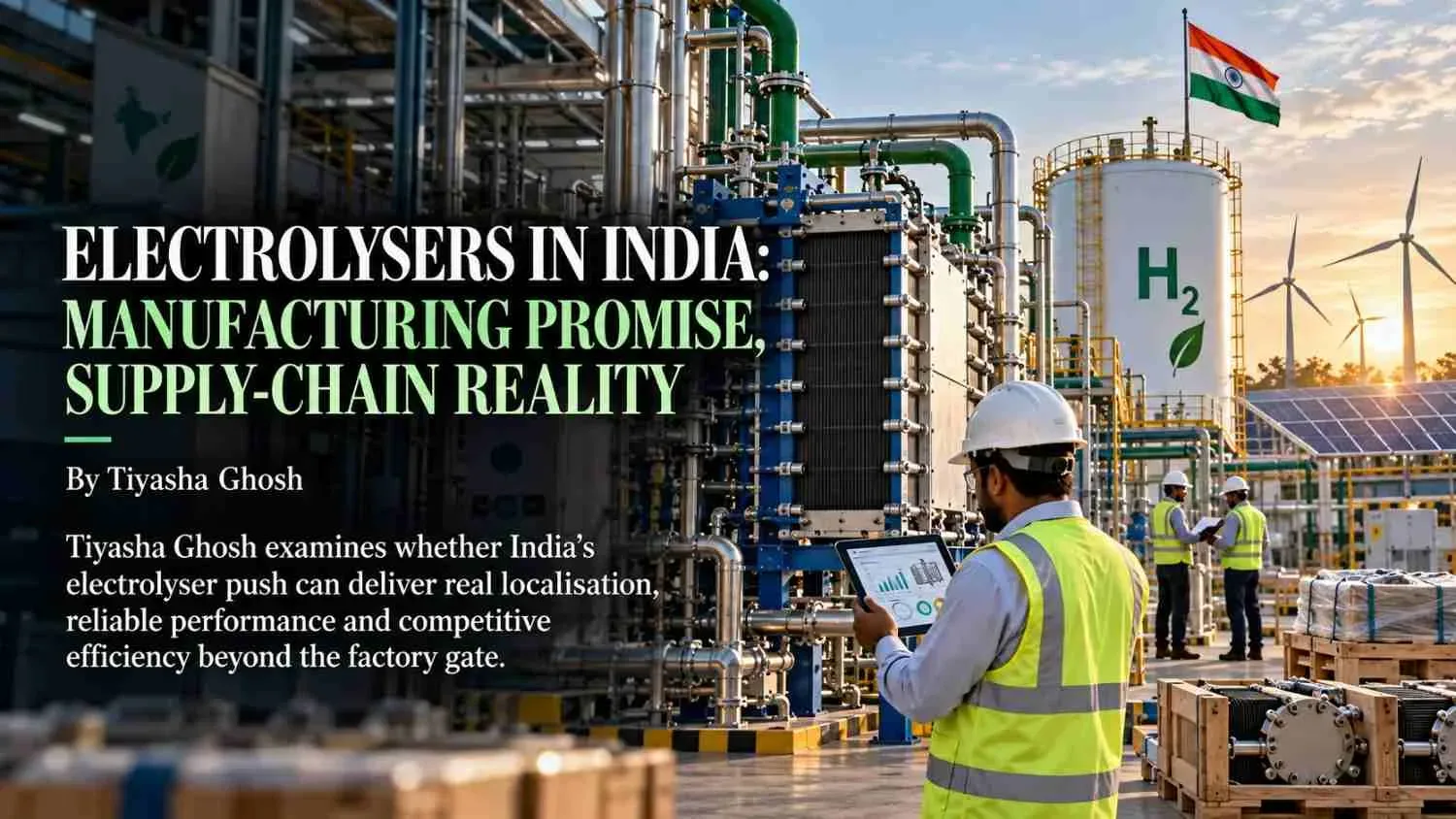
India is building the machines that could power its green-hydrogen ambitions. But the harder test is whether those machines can deliver competitive efficiency, genuine localisation and dependable performance long after the factory gates open. SummaryIndia is rapidly building a domestic electrolyser manufacturing base to support its green-hydrogen ambitions, backed by the National Green Hydrogen Mission and ₹4,440 crore in manufacturing incentives. But approved factory capacity is only the starting point. The real test lies in how much equipment is actually produced, how much of its supply chain is truly local, how efficiently it operates, and whether it can remain reliable and commercially competitive over time. This feature examines the gap between manufacturing promises and operating reality - through localisation, critical minerals, system costs, efficiency, degradation, renewable-power requirements and the evidence buyers should demand before calling an electrolyser truly “Made in India.” THE BIG QUESTION Can India turn electrolyser manufacturing capacity into a genuinely competitive industrial supply chain? India’s green-hydrogen story is gradually becoming a manufacturing story. The country is no longer viewing electrolysers simply as imported equipment required for future hydrogen projects. Through the National Green Hydrogen Mission and its Strategic Interventions for Green Hydrogen Transition (SIGHT) programme, India is seeking to establish a domestic manufacturing base for the equipment that splits water into hydrogen and oxygen. The scale is significant. The National Green Hydrogen Mission aims to position India as a global hub for green hydrogen and targets production of 5 million tonnes per annum by 2030. Under the SIGHT programme, the government has allocated ₹4,440 crore for domestic electrolyser manufacturing. The official MNRE SIGHT portal lists 3,000 MW per year of approved electrolyser manufacturing capacity across two manufacturing tranches: 1,500 MW under Tranche-I and another 1,500 MW under Tranche-II. The headline, therefore, is no longer whether India intends to manufacture electrolysers. It does. The more important question is what exactly “manufacturing” means when the system is examined component by component. INDIA’S ELECTROLYSER MANUFACTURING PUSH Infographic: National Green Hydrogen Mission → SIGHT → Tranche-I: 1,500 MW/year → Tranche-II: 1,500 MW/year → 3,000 MW/year approved capacity Callout: How much of that capacity will translate into actual production? Note: Clearly label 3,000 MW as approved/awarded manufacturing capacity, not equipment produced. FROM HYDROGEN TARGET TO FACTORY FLOOR An electrolyser is deceptively simple in principle. Electricity is passed through water, triggering an electrochemical reaction that separates hydrogen from oxygen. But the machine performing that reaction is a sophisticated industrial system involving a stack, electrodes, catalysts, membranes or diaphragms, bipolar plates, power electronics, pumps, heat-management systems, controls and other balance-of-plant equipment. And not every electrolyser is the same. Alkaline, PEM, solid-oxide and emerging AEM technologies use different materials, designs and operating characteristics. Their supply chains can therefore look very different. This matters because a factory producing an electrolyser system is not necessarily producing every critical component within it. A system can be assembled domestically while some of its most specialised inputs remain imported. That distinction lies at the centre of India’s manufacturing challenge. The policy objective, therefore, is not simply to increase the number of machines carrying a “Made in India” label. It is to build an industrial ecosystem capable of producing reliable equipment at competitive cost while reducing vulnerable import dependencies. The editorial brief for this feature identifies precisely these tests: quality, localisation, minerals, efficiency and after-sales performance—not factory ribbon-cutting. CAPACITY IS NOT THE SAME AS OUTPUT The first number any manufacturing story tends to celebrate is capacity. But capacity is only the beginning. A manufacturer may announce a plant with a particular annual nameplate capacity. A government tender may award manufacturing capacity. A facility may be constructed. Equipment may be installed. Production may begin. These are different stages. For this story, the useful ladder is: ANNOUNCED → AWARDED → BUILT → COMMISSIONED → PRODUCING → SOLD → INSTALLED → OPERATING → MAINTAINED → MEASURED The MNRE portal lists eight Tranche-I projects with scheduled commissioning dates in August 2026, while the listed Tranche-II projects have a scheduled commissioning date of 26 March 2027. As of October 2026, however, a scheduled commissioning date should not automatically be interpreted as evidence of actual commercial output. The evidence threshold must be higher. India’s electrolyser manufacturing progress should increasingly be measured through harder indicators: How much capacity has been physically commissioned?How much equipment has actually been produced?What is the plant’s utilisation rate?How many stacks or systems have been sold?Where are they operating?What is their measured efficiency?How quickly does performance degrade?What does the warranty cover?Which components are domestically sourced?Which remain imported?How quickly can replacement parts be supplied?This is where the story moves from industrial policy to industrial reality. CAPACITY ≠ OUTPUT Status ladder: Announced → Awarded → Built → Commissioned → Producing → Sold → Operating → Measured Centre callout: 3,000 MW/year = approved manufacturing capacity, not 3,000 MW produced. WHAT DOES “MADE IN INDIA” REALLY MEAN? The phrase sounds straightforward. The supply chain is not. A complete electrolyser system can contain dozens of components and materials, and the domestic share can differ substantially between technologies. A 2024 CEEW assessment examined PEM, alkaline and solid-oxide electrolysers and found substantial potential for localisation across all three. It estimated overall indigenisation potential at 82% for PEM, 88% for alkaline and 85% for solid-oxide electrolysers. The report also identified specialised materials and critical minerals as continuing supply-chain challenges. The distinction is crucial: Potential indigenisation is not the same as current indigenisation. The CEEW assessment estimated manufacturing costs of roughly USD 350–400 per kW across the technologies it studied and identified opportunities to reduce stack costs through higher current density, lower catalyst loading, thinner coatings and alternative materials. For PEM systems, the report found that around 72% of manufacturing cost could be readily indigenised in its assessment, while components such as Nafion membranes and minerals including platinum and iridium remained areas of import dependence. For alkaline systems, the picture is different but still not completely domestic. The CEEW analysis identified opportunities to manufacture or process several components in India while pointing to continuing dependence on imported materials and commodities. So the question should move from: “How much of the electrolyser is Indian?” to: “Which parts are Indian, which are imported, and which supply chains could become bottlenecks as production scales?” That is a much more useful manufacturing question. WHAT ACTUALLY SITS INSIDE AN ELECTROLYSER? Technical cutaway: Stack, electrodes, catalyst, membrane/diaphragm, bipolar plates, power electronics, water treatment, cooling, gas handling and controls. Show two labels: Domestic manufacturing potential | Import / critical-material exposure Callout: “Made in India” is a supply-chain question, not just an assembly question. THE CRITICAL-MINERAL QUESTION The localisation debate cannot stop at factories. It has to reach the materials inside those factories. Electrolyser technologies use different combinations of materials, and some specialised components rely on minerals for which India does not have sufficient domestic resources or established supply chains. This creates a strategic dilemma. Trying to manufacture everything domestically may not always be technically or economically sensible. But relying heavily on a narrow group of foreign suppliers can create another vulnerability. The better objective is therefore supply-chain resilience. That can mean: developing domestic component manufacturing;processing imported raw materials within India where economically viable;reducing the quantity of critical minerals required per unit of hydrogen;developing alternative materials;diversifying international suppliers;building domestic testing and certification capabilities;investing in research into next-generation electrolyser technologies.The CEEW study specifically identifies reduced catalyst loading, alternative materials and technology development as potential routes to lower costs and increase localisation. The strategic question is not whether India can eliminate every import. It is whether India can prevent one imported component, mineral or technology from becoming a single point of failure. THE HIDDEN COST: THE SYSTEM AROUND THE STACK Another reason headline manufacturing capacity can be misleading is that the stack is only one part of the overall economics. CEEW’s assessment found that balance of plant can account for 50–60% of the total electrolyser system cost. That changes the procurement conversation. A buyer should not compare two electrolysers simply by comparing the quoted price of their stacks. The relevant comparison is the complete system. That includes: STACK + POWER ELECTRONICS + WATER TREATMENT + COOLING + GAS PROCESSING + CONTROLS + INSTALLATION + MAINTENANCE + REPLACEMENT + FINANCING A cheaper machine that consumes more electricity, degrades faster or requires expensive imported replacement parts may not remain cheaper over its operating life. The real metric is therefore not simply: ₹ per kW of electrolyser but increasingly: ₹ per kilogram of hydrogen over the operating life of the system. That is where manufacturing competitiveness becomes commercial competitiveness. THE STACK IS ONLY PART OF THE BILL Infographic: Stack + power conversion + water treatment + cooling + gas handling + controls + installation + maintenance. Highlight: Balance of plant = 50–60% of total system cost Bottom line: Purchase price ≠ lifetime cost EFFICIENCY: THE NUMBER THAT NEEDS A COMMON RULE Efficiency sounds like a simple number. In practice, it requires a common measurement framework. Two manufacturers can describe system performance differently depending on what is included in the calculation, how electricity consumption is measured and under what operating conditions the test is performed. That makes standardisation critical. A June 2025 BIS draft standard on efficiency assessment of AEM, PEM and alkaline water electrolysers note that different electrolyser technologies have different configurations, materials, operating conditions and performance characteristics. It also states that meaningful comparison requires a standardised procedure for evaluating system performance. The document highlights another important complication: some performance characteristics can be assessed during initial testing, while aspects related to equipment life become clearer only through operation and accelerated testing. For buyers, therefore, the important question is not merely: “What efficiency does the manufacturer claim?” It is: “Under what test protocol was that efficiency measured, at what load, and which parts of the system were included?” Without comparable testing, headline efficiency numbers can be difficult to use in procurement decisions. WHEN TWO EFFICIENCY NUMBERS ARE NOT COMPARABLE Comparison graphic: Two illustrative electrolyser test cards showing: Efficiency → Operating load → Temperature → Pressure → System boundary Centre: STANDARDISED TESTING Note: Do not use invented manufacturer numbers. THE PERFORMANCE TEST DOES NOT END WHEN THE MACHINE STARTS An electrolyser can perform well when new and still become a different economic proposition several years later. That makes degradation one of the most important—and least headline-friendly—questions in the sector. A serious buyer needs to know: How quickly does stack performance decline?What operating conditions accelerate degradation?How frequently does the stack need replacement?What is covered under warranty?What happens when efficiency falls below the guaranteed level?Who supplies replacement components?How long will critical spare parts remain available?Who carries the performance risk?These questions matter because hydrogen projects are not buying a machine for a photograph. They are buying an operating asset. If an electrolyser is expected to function for years, uptime, degradation and service availability can ultimately matter as much as its initial purchase price. The editorial brief therefore calls specifically for degradation data, warranty claims and signed customer orders, rather than relying only on factory-capacity claims. THE RENEWABLE POWER QUESTION There is another part of the electrolyser equation that sits outside the factory. Electricity. Green hydrogen is only as credible and economically viable as the renewable electricity system supporting its production. An electrolyser may be technically excellent, but its economics can deteriorate if the electricity feeding it is expensive, unreliable or poorly matched to its operating profile. This creates a second test for Indian manufacturing. Can domestically manufactured electrolysers operate efficiently under the actual renewable-power conditions that Indian projects will face? Solar-heavy systems, for example, can experience changing electricity availability throughout the day. That makes dynamic operation, power-electronics performance and degradation behaviour important procurement considerations. The machine therefore cannot be assessed in isolation. The chain is: RENEWABLE ELECTRICITY → WATER → ELECTROLYSER → HYDROGEN → STORAGE / TRANSPORT → INDUSTRIAL CUSTOMER A weakness anywhere along that chain can affect the economics of the final kilogram of hydrogen. THE HYDROGEN MOLECULE’S FULL ITINERARY Systems map: Renewable electricity → Water → Electrolyser → Hydrogen conditioning → Storage → Transport → Industrial buyer Under each stage, ask one short question: Power: Affordable? Water: Available? Electrolyser: Who made it? Performance: How efficient? Storage: What infrastructure? Transport: What cost? Buyer: Who pays? Callout: A green-hydrogen project is a chain, not a machine. INDIA’S ADVANTAGE — AND ITS COMPETITIVE PROBLEM India has a major reason to pursue domestic electrolyser manufacturing. It wants the economic benefits of the green-hydrogen transition to extend beyond hydrogen production itself into manufacturing, engineering, components, services and jobs. But the global market is already competitive. The International Energy Agency’s Global Hydrogen Review 2026 reports that installed global electrolysis capacity doubled in 2025 to more than 4 GW, with China accounting for nearly three-quarters of new installations. The IEA also says electrolyser manufacturing is entering a consolidation phase as market development remains slow. That creates a difficult environment for India. The country is attempting to build manufacturing capacity while the global industry itself is still searching for stable demand and sustainable economics. The challenge is therefore not simply to make electrolysers. It is to make them: CHEAP ENOUGH. EFFICIENT ENOUGH. RELIABLE ENOUGH. SERVICEABLE ENOUGH. to win real orders. That is a much higher bar. THE GLOBAL ELECTROLYSER RACE Global map: Highlight India and China. Show the comparison around: Scale | Cost | Technology | Project experience | Domestic demand | Export potential Bottom line: The competition is for cost, scale, reliability and customers—not just technology. THE GLOBAL LESSON: CHEAP EQUIPMENT IS NOT THE WHOLE STORY China’s position provides an important comparison. The IEA reports that China has become the leading centre for electrolyser deployment and manufacturing, benefiting from lower technology costs and experience with large projects. But the same analysis points to excess capacity and market consolidation. The lesson for India is not that domestic manufacturers must simply imitate China. It is that manufacturing scale alone does not guarantee sustainable industrial competitiveness. A country can have factories and still struggle with: weak demand;underutilised capacity;thin margins;imported critical components;insufficient testing infrastructure;limited after-sales networks;technology dependence;financing constraints;inadequate customer confidence. The strongest industrial ecosystem is therefore not necessarily the one with the largest announced factory capacity. It is the one whose manufacturers can continue delivering after subsidies, incentives and policy headlines become less central to the business case. THE REAL PROCUREMENT TEST For developers and industrial buyers, the questions should become more demanding. Before purchasing an electrolyser, a buyer should be able to request a documentary record covering at least: 1. FACTORY CAPACITY What is the annual nameplate capacity, and what is the actual production? 2. BILL OF MATERIALS What are the major components, and where does each come from? 3. TECHNOLOGY Is the system alkaline, PEM, SOEC, AEM or another configuration? 4. EFFICIENCY What test protocol produced the quoted efficiency figure? 5. DEGRADATION What performance decline is expected over time? 6. WARRANTY What exactly is guaranteed, for how long and under what operating conditions? 7. WATER What water quality does the system require, and what treatment infrastructure is necessary? 8. OPERATING EVIDENCE How many systems are actually operating, and for how long? 9. CUSTOMER EVIDENCE Are there signed customer orders rather than only memoranda or announcements? 10. LIFETIME ECONOMICS What is the expected total cost of producing hydrogen over the equipment’s operating life? This is the point where “Made in India” becomes a measurable industrial proposition rather than a branding exercise. BEFORE BUYING AN ELECTROLYSER, ASK FOR THE FILE ☐ Factory capacity vs. actual output ☐ Bill of materials ☐ Supplier origin ☐ Technology / chemistry ☐ Efficiency test protocol ☐ Degradation data ☐ Warranty terms ☐ Water requirement ☐ Operating customer evidence ☐ Lifetime hydrogen cost Callout: If the number matters to the business case, ask for the document behind the number. WHAT SHOULD INDIA MEASURE NEXT? India’s next manufacturing phase should be judged through a different dashboard. Not just: MW OF ANNOUNCED CAPACITY but: MW COMMISSIONED MW ACTUALLY PRODUCING UTILISATION RATE PERCENTAGE OF COMPONENTS LOCALLY SOURCED CRITICAL-MATERIAL EXPOSURE MEASURED SYSTEM EFFICIENCY ANNUAL DEGRADATION STACK REPLACEMENT INTERVAL WARRANTY PERFORMANCE NUMBER OF OPERATING CUSTOMER SYSTEMS SYSTEM AVAILABILITY COST PER KILOGRAM OF HYDROGEN These indicators would reveal whether the domestic electrolyser industry is moving from policy-supported capacity creation towards commercially durable manufacturing. The government intervention has already created a strong market signal: according to MNRE, 15 companies have been awarded 3,000 MW/year of electrolyser manufacturing capacity with ₹4,440 crore in total incentives. The next phase is about proving what those numbers produce in practice. FROM ANNOUNCEMENTS TO OPERATING DATA OLD MEASUREBETTER MEASUREAnnounced MWCommissioned MWFactory capacityActual outputLocal assemblyLocal component shareClaimed efficiencyStandardised tested efficiencyNew equipmentOperating equipmentPurchase priceLifetime costWarranty promiseWarranty performanceCustomer announcementSigned order + operating evidence THE BUSINESS CASE BEHIND THE CLIMATE CASE There is a tendency to frame green hydrogen as a climate technology first and an industrial technology second. For electrolysers, the order increasingly needs to be reversed. The climate ambition depends on industrial performance. If electrolysers are expensive, inefficient or unreliable, green hydrogen becomes more expensive. If green hydrogen remains expensive, demand can remain weak. If demand remains weak, manufacturing plants can operate below capacity. If factories operate below capacity, domestic suppliers struggle to build economies of scale. And if component suppliers cannot scale, import dependence can persist. That creates a cycle: HIGH EQUIPMENT COST ↓ EXPENSIVE HYDROGEN ↓ WEAK DEMAND ↓ LOW FACTORY UTILISATION ↓ LIMITED SCALE ↓ WEAK SUPPLY CHAIN India needs to build the opposite cycle: RELIABLE EQUIPMENT ↓ COMPETITIVE HYDROGEN ↓ STRONGER DEMAND ↓ HIGHER UTILISATION ↓ SUPPLIER SCALE ↓ LOWER COST ↓ STRONGER DOMESTIC INDUSTRY That is the real industrial prize. THE BUSINESS-CASE CYCLE Risk cycle: High cost → Expensive hydrogen → Weak demand → Underused factories → Weak supply chain Industrial cycle: Reliable equipment → Competitive hydrogen → Demand → Scale → Lower cost → Stronger industry Centre question: Which cycle will India’s electrolyser industry enter? WHAT THE EVIDENCE SHOULD LOOK LIKE The strongest version of this story is not built around the number of factories announced. It is built around documents. For each major manufacturing claim, the evidence hierarchy should move from: Policy announcement → Letter of award → Factory commissioning evidence → Production data → Customer order → Operating data → Performance data → Independent verification, where available This distinction matters because announcements are not equivalent to operational outcomes. For this reason, the article should not claim that every SIGHT-listed factory is already producing at its awarded capacity unless documentary evidence establishes that. The absence of such evidence is itself important. It tells the reader where India’s manufacturing story currently has a measurement gap. THE EVIDENCE LADDER Announced → Awarded → Commissioned → Producing → Operating → Measured → Independently verified Callout: The higher the evidence, the stronger the claim. THE BOTTOM LINE India has moved beyond the stage where electrolyser manufacturing is merely an aspiration. Policy support exists. Manufacturing capacity has been awarded. Companies are developing production capabilities. The potential for substantial localisation is real. But: CAPACITY IS NOT YET COMPETITIVENESS. A factory can have a nameplate capacity without producing at that level. A machine can be assembled domestically while relying on imported critical components. A low purchase price can conceal higher lifetime electricity, maintenance or replacement costs. And a promising technology can still struggle if customers cannot secure affordable renewable electricity or dependable long-term service. The next chapter of India’s electrolyser story therefore needs fewer ribbon-cutting numbers and more operating numbers. The decisive evidence will come from: production records, component origins, standardised efficiency tests, degradation data, warranties, customer orders, operating experience and lifetime cost. India does not simply need electrolyser factories. It needs an electrolyser industry that can: SURVIVE AFTER INCENTIVES. COMPETE AFTER HEADLINES. PERFORM LONG AFTER THE RIBBON IS CUT. Because a factory can make a stack. The real question is whether the stack can make a business case.SOURCES & DOCUMENTATION: Ministry of New and Renewable Energy — National Green Hydrogen Mission / SIGHT approved projects MNRE National Green Hydrogen Mission — SIGHTMinistry of New and Renewable Energy — SIGHT Supply Incentives MNRE — SIGHT Supply IncentivesPress Information Bureau / MNRE — National Green Hydrogen Mission progress PIB — National Green Hydrogen Mission progressPress Information Bureau / MNRE — Green Hydrogen expansion and electrolyser manufacturing PIB — Green Hydrogen expansion and electrolyser manufacturingMNRE — India's Green Hydrogen Revolution MNRE — India's Green Hydrogen RevolutionCouncil on Energy, Environment and Water — How can Hydrogen Electrolysers be Made in India? CEEW — Hydrogen Electrolyser Manufacturing in IndiaInternational Energy Agency — Global Hydrogen Review 2026 IEA — Global Hydrogen Review 2026International Energy Agency — Global Hydrogen Review 2026: Production IEA — Global Hydrogen Review 2026: ProductionBureau of Indian Standards — Draft efficiency assessment standard for electrolysers BIS — Draft efficiency assessment standard ...Read more


06 Oct 2026

  Jhorkhali is a place where political flags change, but everyday struggles remain. In this travelogue, the author journeys through the village beside the Sundarbans, looking beyond its green fields and waterways to the lives shaped by migration, farming and limited opportunities. The journey traces how families adapt when work takes men away, while women and older people keep homes and farms going. It also explores how salinity, tides, changing livelihoods and tourism are reshaping the local economy. Encounters with people living with the risks of the forest bring a more personal dimension to the journey. Jhorkhali emerges as a place caught between political change, environmental uncertainty and the quiet resilience of its people. SummaryA travelogue through Jhorkhali explores the intersection of politics, migration, agriculture and life beside the Sundarbans. From changing political landscapes and shrinking local opportunities to salinity, tides, tourism and forest-related risks, the journey captures the everyday realities of its people. At its heart, the article asks whether the next generation can build a sustainable life in Jhorkhali without having to leave. The First Sign Was Political My Sundarbans visit began with party flags, not a tiger. For several hours our car moved through Jhorkhali, where waterways seemed to wait just beyond each bend. On the stretch I crossed, BJP flags and offices dominated the roadside; BMS flags appeared in some market places. That was one traveller’s view from a moving car, not an election survey. Still, it stayed with me: a place’s public colours can change faster than the private worries of the people who live beneath them. Ramprasad Sarkar, who told me he had lived there for more than twenty years, had watched local party offices shift from CPI(M) to Trinamool Congress and then BJP. “Parties change, colours of the flags change, people are the same,” he said. His sentence held a joke and a warning. Party offices can repaint their walls; families cannot repaint a lost season or a missing wage. In village politics, the signboard is sometimes the fastest public notice. Ordinary people still have to open the shop the next morning. The Road After School In the 2011 Census, the place people know as Jhorkhali appears in the village register as Lot No 126, under Jharkhali Gram Panchayat in Basanti Block: 15,695 residents—8,142 males and 7,553 females—in 3,820 households, spread across 4,500 plus hectares, or roughly 45 square kilometres. Its literacy rate was 81%, above West Bengal’s 2011 average of 76%; but that neat total conceals a divide, with male literacy at 88% and female literacy at 72%, a gap of 16 percentage points. By both population and area, Lot No 126 is Basanti Block’s largest village. A census is a photograph, not a live headcount; still, this one catches Jhorkhali at scale. Tables are wonderfully tidy. Opportunities seldom are. Local figures shared during my visit, fifteen years after the last census, however, put roughly 12,000 families and about 42,000 people across this area, perhaps greater Jhorkhali including nearby hamlets. The school tally in my notes was one higher secondary school, two secondary schools, 17 primary schools and four small private schools, but no college. A nearby NGO in Joygopalpur runs vocational training linked to a Krishi Vigyan Kendra. For young people the hurdle after school is not ambition; it is the next rung. A course in Canning or Kolkata requires fare, time and often a place to stay, costs that rarely appear in a prospectus. The settlement also carries the memory of families displaced during and after the 1971 war in Bangladesh. Some Hindu refugee families came here after years of hardship elsewhere, and began again on land; farmers’ cooperatives and fishermen’s bodies once helped organize production and income during the Left Front rule. People told me that many of those collective arrangements later weakened under the TMC. Land was divided into small private holdings. The shift changed more than paperwork: it left many households with little scale or bargaining power. Work Leaves Home Before Dawn Migration has become a household plan. Men often head to South India for work and may be gone for years. A 2026 farmer survey in Basanti reported higher migration rates than in Hasnabad, alongside greater female participation in farming. That fits the human picture I saw: when wage-earners leave, women and older people keep the home, school routine and sometimes the fields going. A composite local voice puts it this way: “The money comes home; the work never left.”   The River Runs Through the Ledger The Matla and Vidyadhari are close companions here. The Jhorkhali and Balikhal jetties remind a visitor that water is infrastructure as well as scenery: it carries fish, goods, commutes and the day’s plans. Fields are still planted with rice and vegetables, but the delta asks for constant adjustment. Salinity, rain, tidal inundation and market access make “two crops a year” an aspiration earned plot by plot. Jhorkhali’s economy has acquired a new shoreline. In recent years, people from Kolkata have bought land and built homestays and eco-resorts; tourists arrive for a few quiet days by the forest and river. At Jhorey Joley Jangaley, a Techno India Group venture, I found the newer grammar of this economy in a conference hall and a well-kept swimming pool. The visitor can take a dip while the delta outside negotiates with salt, water and work. Even a resort pool cannot persuade a tide to respect check-out time. UNESCO describes the Sundarbans as the world’s largest mangrove forest and a natural buffer against cyclones. A 2026 study of Basanti reports rain-season freshwater limits, saline dry-season water and weak market infrastructure [2]. That is the background to my own notes: rice and vegetables in the fields, with saline water threatening crops after heavy rain. A composite farmer might say, “We plan the crop; the tide keeps the last appointment.” The Forest Has Names The most arresting encounters were not with wildlife but with people marked by its danger. I met a woman known as a tiger widow, whose husband had entered the forest and never returned, and a man whose face bore a tiger’s attack. He did not want a photograph. I put my camera away. UNESCO notes that fishing, honey gathering and other forest livelihoods bring people into contact with tiger habitat. A loss here is never just a dramatic story for a visitor; it reshapes a household’s work, income and future. The local musical Banabibir Pala keeps the Lady of the Forest in memory. Across the Sundarbans, Bonbibi is revered by Hindus and Muslims, a shared devotion documented by religious scholars. The story belongs to people who know that the forest can feed them and frighten them in the same season. There is an irony in a place where different faiths can share a guardian while families must still face danger with too few choices. A Farmhouse at the End of the Drive The air felt so clean that I began composing a farmhouse plan in my head: a vegetable plot, a few animals, integrated farming, mornings beside the water. My plan required no maintenance, which is how I knew it was still a visitor’s fantasy. I can admire the river and drive away; the people who stay must budget for salinity, school choices, jobs and the risks of the forest. Jhorkhali remains with me as a place where changing flags, a short school list, wages sent home and the tides all appeared in the same frame. The journey began with politics, but ended with a man who declined a photograph and a woman whose loss was more than an anecdote. The question after the visit is simple: can the next generation build a life here without having to leave? ...Read more

06 Oct 2026

As temperatures rise in India, cooling is becoming essential to public health, household satisfaction, and economic productivity. But the growing popularity of air conditioning raises questions about electricity consumption, refrigerant emissions, affordability, and waste. We investigate how the Kigali Amendment and India’s Cooling Action Plan can support a cooling system that looks after people without compromising the environment.   SummaryWe explore how India’s growing cooling demand relates to climate change, public health, and energy usage. Through the Kigali Amendment and India’s Cooling Action Plan, we look at sustainable cooling technologies, refrigerant management, building design, and worker safety. The article highlights the need for affordable, accessible cooling without increasing environmental stresses.   Why is cooling becoming a necessity in India? As temperatures continue to rise, cooling is becoming an important part of everyday life in India. What once was seen as a luxury in many households is increasingly connected to health, productivity, and basic comfort. Heat affects people differently, but the risks can be particularly pronounced for older adults, children, outdoor workers, and people with existing health vulnerabilities. We often think of cooling as switching on an air conditioner or a fan, but the larger cooling system is far more complex. It begins with the design of buildings, the electricity consumed to use equipment, the refrigerants contained within cooling appliances, the workers who install and support them and the way equipment is treated when it is discarded. This wider perspective is important because cooling can protect people from heat but also contribute to environmental pressures. Air conditioners and refrigeration systems consume electricity and, if refrigerants escape, can contribute to global warming.  As more households, offices, hospitals, shops, and industries require cooling, we must consider how this demand can be met responsibly. We cannot simply focus on selling more appliances – we also must ask whether buildings can be designed to stay cooler, whether equipment will be efficient and whether cooling is affordable to the people who need it most. For us, the central question is not whether India needs cooling – it is how we can provide cooling without creating new environmental and social challenges.   What is the Kigali Amendment, and why does it matter? The Kigali Amendment to the Montreal Protocol was adopted in 2016 to reduce the production and consumption of hydrofluorocarbons, commonly known as HFCs. These substances are used in many refrigeration and air-conditioning systems. HFCs were introduced as a substitute for ozone-depleting substances, but many HFCs are powerful greenhouse gases. When they escape from air-conditioning equipment, they can contribute to global warming. The Kigali Amendment, therefore, is concerned with gradually phasing down the production and consumption of HFCs. India ratified the amendment in 2021 and follows a phased schedule for reducing HFC production and consumption. India’s schedule includes a first reduction landmark in 2032, followed by further reductions in 2037, 2042 and 2047. These are the scheduled phase-down landmarks, not evidence that the reductions have already occurred.  The amendment is important because it ties the cooling sector to global climate action – but simply substituting one refrigerant for another is not enough on its own. We also must ensure that new equipment is energy-efficient, safe to run and suitable for India’s climate and cooling needs. If a refrigerant has a lower climate impact but the appliance consumes too much electricity, the overall environmental benefit may be reduced. This is why refrigerant transition and energy efficiency need to move together. The Kigali Amendment gives us an international framework – the challenge is to translate it into practical action across India’s cooling economy.   How is India’s Cooling Action Plan addressing the challenge? India launched the India Cooling Action Plan (ICAP) in 2019 to address cooling demand with a broader, longer-term approach. The plan is aware that cooling is connected to several sectors – including buildings, transport, agriculture, healthcare, and industry. It aims to reduce demand for cooling, improve energy efficiency and encourage better technology, as well as supporting the development of skilled workers. The plan set targets for reducing cooling demand, refrigerant demand, and cooling energy requirements by 2037-38. These targets are intended outcomes and should not be described as achieved unless there is updated evidence. An important aspect of ICAP is its emphasis on reducing cooling needs before relying solely on mechanically produced cooling. If the buildings we occupy can limit the amount of heat we allow in, we may require less air conditioning to keep comfortable. The plan is also aware of the need for trained technicians – cooling equipment requires installation, servicing and maintenance, and refrigerants must be handled with care. Without skilled workers and suitable equipment, even efficient appliances can perform poorly or cause environmental harm. We should view ICAP as a framework that unites elements of the wider cooling system. Its success depends on co-ordination between government agencies, manufacturers, building designers, service providers, workers and consumers.   Why can a cooler room also mean a hotter grid? Air conditioners make indoor spaces more comfortable, but they require electricity to work. When many people start using cooling equipment, electricity demand can surge. This creates a challenge for power systems, especially during periods of extreme heat. If electricity supply relies on fossil fuels, increasing demand can also increase greenhouse gas emissions. This is why the phrase “a cooler room can mean a hotter grid” is important – cooling may protect us indoors, but the electricity we consume can have environmental consequences elsewhere. It would be wrong to interpret this as a reason to discourage people from using cooling when they need it – but it does highlight how we have to improve the overall system. Energy-efficient appliances can provide the same service but consume less electricity. Better building design can reduce the demand for energy-intensive air conditioning. Smart control systems and proper maintenance can help equipment function more effectively. We also have to consider electricity access and affordability. A household may have an air conditioner but avoid using it because of the cost of running it – in this case, appliance ownership does not mean the household has reliable access to cooling. A sustainable cooling system, therefore, has to reduce electricity consumption while ensuring that people can stay safe during extreme heat.    How can passive cooling reduce our dependence on air conditioning? Passive cooling refers to building design and other methods that seek to reduce heat indoors without relying solely on mechanically produced cooling. We can begin by looking at a few simple aspects: shading, ventilation, reflective surfaces and suitable building materials. The way a building is placed, its window size, the materials of its roof and walls – these can influence the amount of heat indoors. For example, external shading can reduce direct sunlight entering a room, and roof treatments may reflect sunlight to reduce the heat they absorb. Ventilation can also be used to create a flow of air when the outdoor conditions permit. These methods have proven to be helpful in many residential, educational, office and community buildings. They can also help reduce electricity costs by reducing the amount of time air conditioners have to work. However, passive cooling is not a universal solution, and its effectiveness varies depending on the climate, building design, humidity, air quality and use. While natural ventilation is ideal in some conditions, it may not be desirable in others. Natural ventilation, for instance, may not be desirable during periods of poor outdoor air quality or extreme humidity. Some hospitals and specialist workplaces also require controlled conditions – which cannot be achieved solely through passive measures. We should view passive cooling as one component of a broader system. Coupled with efficient appliances and thoughtful building design, it can help reduce cooling demand and contribute to indoor comfort.  What makes energy-efficient cooling important? Energy efficiency plays a crucial role in sustainable cooling, as it allows us to get the cooling we want while consuming less electricity. When comparing air conditioners or other equipment for personal use, we should pay attention to their energy-performance information rather than focusing on price, aesthetics or marketing claims. In India, the Bureau of Energy Efficiency offers energy labelling programmes for relevant appliances. These labelling guidelines can help us compare the energy performance of products, provided we look at the label for the product and its requirements. Of course, energy efficiency is not just about the appliance – it depends on several factors, such as the building’s design, the room’s size in which equipment will be used, its insulation and ventilation, as well as its maintenance. An air conditioner that is poorly installed or supported may not deliver the service we expect – in fact, dirty filters or blocked airflow can significantly affect its performance. We should also resist the assumption that the latest appliance will automatically be the right one for every space. Consumers need to understand the cooling requirements of their space, as well as the impact on operating costs, servicing requirements, and energy-performance characteristics. For hospitals, businesses and large buildings, the same principles apply – but on a larger scale, and with energy audits and maintenance playing a prominent role. The aim is not simply to reduce the amount of electricity we consume – but to provide the cooling service we want without consuming more than we must.   Which refrigerants are used, and what happens when they leak? Refrigerants are substances that are contained within cooling systems to help the transfer of heat. Different appliances use different refrigerants, and these substances vary in their environmental impact. Some have high global warming potential – others have a lower impact, but they also have safety, flammability, and operational considerations. These differences mean that refrigerant selection is a balance: it is not simply a matter of choosing whichever has the lowest climate impact. Equipment has to be compatible with a refrigerant, and technicians have to be trained to handle them. Leaks are a major concern because they can occur during equipment operation or servicing, transport or disposal. A refrigeration system may continue to function after a leak, but the system will be less effective and the refrigerant may escape. We need proper servicing records, leak detection and repair practices to reduce these risks. Technicians should have suitable tools and follow safety procedures for the specific refrigerant and equipment. We should also distinguish between refrigerant recovery and reclamation. Recovery refers to removing refrigerant from equipment, as opposed to simply releasing it into the atmosphere. Reclamation involves processing the recovered refrigerant to specific requirements for reuse. Both can be part of responsible refrigerant management, but they are distinct processes.   What happens to cooling equipment at the end of its life? The environmental impact of cooling equipment does not stop when it stops working. Discarded air conditioners, refrigerators and other appliances have materials that can be recycled or reused. They also have refrigerants and oils that may pose environmental and safety risks. Improper dismantling can expose workers to unsafe conditions and valuable materials will be lost when appliances are simply discarded without recovery. We, therefore, must consider the entire lifecycle of cooling equipment – from design and manufacturing to installation, maintenance, repair, collection, and end-of-life treatment. A responsible system would make it easier for us to return old appliances to proper collection points. Service providers and waste handlers must follow suitable procedures for recovering refrigerants and separating materials. Manufacturers can support this by considering product design, repair guidelines, spare parts availability, and take-back options were proper. We should not assume that an appliance has been responsibly recycled simply because it has been collected – we must look at the evidence about where it went, how the refrigerants were treated and which materials have been recovered.    How can district cooling support sustainable cities? District cooling refers to systems in which cooling is produced in a central location and distributed to several buildings through a network. Instead of each building having its own equipment for mechanically produced cooling, a shared system can be used for connected buildings. This can bring out opportunities for improved efficiency, maintenance and energy management depending on local conditions. District cooling can be a relevant model for large developments, commercial districts, hospitals, campuses, and other areas with intensive demand for cooling. However, it is not necessarily the best option for every city or neighbourhood – its performance will depend on factors such as building density, network design, local climate, electricity supply, investment costs, and the reliability of the system. We, therefore, must evaluate district cooling on a case-by-case basis. We need to look at how much energy it will use, what refrigerant it will rely on, how cooling is distributed, and whether the service will be affordable for the buildings and people it serves. District cooling is likely to be one component of sustainable urban infrastructure, but it has to complement other measures such as passive cooling and efficient appliances.   Why are hospitals an important part of the cooling conversation? Hospitals not only rely on cooling but also have significant cooling needs. Some spaces require controlled temperatures to support patient care, protect medicines, or operate equipment. This means reliable cooling is particularly important during extreme heat – but a cooling failure can impact patients, staff and hospital operations. At the same time, hospitals may have substantial cooling demands due to the long hours they run and the range of temperature-sensitive spaces. We should assess hospitals from both a public-health and an energy-efficiency point of view – the goal is not to reduce cooling indiscriminately, but to ensure that necessary conditions are kept while reducing unnecessary energy use. Hospitals must review their maintenance schedules, cooling arrangements, and energy performance. They must look at whether different areas require different cooling settings and whether building improvements can reduce heat gain. To understand the situation, we would have to speak to hospital administrators, maintenance staff, and healthcare professionals. Useful evidence would include indoor temperatures, equipment types, energy costs, maintenance schedules, and what resources exist for power interruptions. A specific hospital case should be based on verified reporting rather than assumptions – this would help prove how cooling decisions impact patients, workers, and costs in actual practice.   Who are the workers behind India’s cooling economy? Behind every functioning air conditioner or refrigeration system is a network of workers who install, repair, and keep equipment. Refrigeration and air-conditioning technicians are essential in the cooling transition – they handle refrigerants, inspect systems, identify leaks and perform repairs. As India moves towards new refrigerants and more efficient technologies, technicians will require updated training. We should not treat training as a one-off activity – workers have to have access to updated technical knowledge, appropriate tools and practical instruction. They also need safe working conditions and procedures related to refrigerant handling. Informal workers may face additional barriers such as the costs associated with training, limited access to equipment and uncertain employment conditions. A policy transition that ignores these may not be effective. We should include technicians in discussions on sustainable cooling, as their experience can help highlight practical problems such as recurring equipment failures, the availability of spares and difficulties in recovering refrigerants. A technician-focused field report could look at the refrigerants technicians typically handle, the tools they use, their training and the challenges they encounter during servicing. These details can help connect national climate targets with day-to-day working conditions.   How can we make cooling accessible without increasing inequality? As we develop our appreciation for new cooling technologies, we need to remember that access is not simply about availability. A cooling system may exist in a city, but it may not be affordable to nearby households. A hospital may have modern equipment, but maintenance costs may be too high. Technicians may receive training, but they may struggle to obtain recovery tools. We, therefore, must link cooling policy to affordability, infrastructure, and working conditions. For households, this can begin with better information on energy-efficient appliances, practical building improvements, and affordable servicing. For hospitals, it means protecting critical cooling while reducing unnecessary energy use. For businesses it means reviewing their equipment, refrigerant management, and the full cost of operating cooling systems. For policymakers, the challenge is to co-ordinate the various aspects of the system. We need building policies that reduce unnecessary heat gain, appliance standards that promote energy efficiency, refrigerant regulations that enable safe transitions and training programmes that reach the technicians who install and keep equipment. We also need reliable information – without data on electricity consumption, refrigerant leakage, equipment performance, indoor temperatures, and waste, it will be hard to measure whether systems are delivering the intended benefits. This is where independent research organisations, public-health experts, worker associations, and civil-society groups can contribute – their work can help us see the practical barriers that may not be clear in policy documents or industry announcements. Sustainable cooling must be measured not only through the technology being installed but also through the quality of services people are receiving, the environmental impact and the conditions in which workers are performing their roles.   What can we do at home and at work? Beyond national policy and industrial transformation, there are practical actions we can take to improve the way we use cooling. At home, we can reduce the amount of direct sunlight entering our premises by using right curtains, blinds, or shading. We can keep fans and air conditioners, keeping filters clean per manufacturers’ guidance and avoiding unnecessary use. We should use air conditioners following the needs of the room – rather than assuming lower temperatures will always be preferred. These settings can reduce electricity consumption while keeping our comfort. At work, we can review our use of fans or air conditioners, avoiding unnecessary energy use. If our workplace is air conditioned, we can check whether the temperature and airflow are proper and raise concerns if not. We can also consider the use of building materials and designs that help keep spaces cool without consuming vast amounts of electricity. As citizens, we should engage with building or appliance standards and energy labelling, encouraging our communities to embrace opportunities for passive and active cooling. We can support cleaner energy generation and promote responsible electricity use. We can ask questions about how our electricity is generated – is it cleaner? Is it cheaper? – and encourage our households and workplaces to reduce consumption where they can. We can request more information on waste management and refrigerant recovery – rather than assuming recycling happens automatically, we must demand accountability. This can help us assess whether our cooling systems are genuinely helping the environment. Finally, we can take care of our air conditioners and make sure they are supported, serviced, and repaired responsibly. This will ensure they are performing the most efficient service possible.   What should we check when evaluating a cooling system? To understand whether a cooling system is sustainable, we need evidence that covers its full lifecycle. Cool-home and cool-workplace checklist Refrigerant: What type is used, and what are its climate and safety characteristics? Energy performance: What energy label or performance information is available? Installation: Was the equipment correctly sized and installed? Service record: Is there a record of maintenance, repairs and leak checks? Recovery and reclamation: Is refrigerant collected during servicing or decommissioning, and where does it go? Disposal route: Is the appliance sent to a proper collection or treatment facility? Indoor temperature: Are indoor conditions suitable for the people using the space? Electricity cost: Is cooling affordable to use? Worker certification and training: Are technicians trained and equipped to handle the refrigerant safely? Cooling lifecycle Design and manufacture → Installation → Operation → Servicing and leak repair → Refrigerant recovery → Reclamation or proper treatment → Appliance collection and end-of-life processing This lifecycle approach helps us look beyond the appliance itself. It also gives consumers, businesses, and policymakers a clearer set of questions to ask when assessing cooling claims.   Conclusion: Cooling people without overheating the planet As we look towards India's cooling future, we need to recognise that cooling is no longer simply a question of comfort. It is connected to public health, energy security, employment, infrastructure, and climate action. The Kigali Amendment provides an international framework for reducing HFC production and consumption. India's Cooling Action Plan offers a broader approach that connects cooling demand, energy efficiency, refrigerant management, technology, and skills development. Together, they give us a starting point for rethinking how cooling is provided across the country. But the real test of this transition lies beyond policy documents and technology announcements. We need to understand whether households can afford to stay cool during extreme heat. We need to know whether hospitals can support reliable cooling when patients need it most. We need to examine whether technicians have the skills, tools, and working conditions necessary to manage refrigerants safely. And we need to set up whether cooling equipment is repaired, recovered, and disposed of responsibly. We also need to move away from the idea that one technology can solve every problem. Passive cooling can reduce heat entering buildings, efficient appliances can reduce electricity use, and district cooling may offer shared solutions in suitable locations. But each approach needs to be evaluated according to local conditions, costs, access, and environmental performance. Most importantly, we need to understand that sustainable cooling is not only about reducing harm. It is also about expanding access to an essential service. A household that cannot afford to use its air conditioner, a hospital struggling to support critical temperatures or a technician working without proper recovery equipment stands for a gap in the cooling system. We should therefore measure progress through more than the number of appliances sold or the refrigerants replaced. We need to consider whether cooling is reliable, affordable, energy-efficient, and accessible, while ensuring that workers and waste-management systems are included in the transition. The next time we enter a cool room, we should look beyond the temperature on the thermostat. We should ask how that cooling was produced, how much energy it needed, what refrigerant it uses and what happens when the equipment reaches the end of its lif Because the future of cooling is not simply about making our rooms colder. It is about building a system that protects people from heat without adding unnecessary pressure to the planet.   References and sources Ministry of Environment, Forest, and Climate Change — India Cooling Action Plan (ICAP) https://www.pib.gov.in/PressReleaseIframePage.aspx?PRID=1805795&reg=48&lang=2 Official framework for cooling demand reduction, refrigerant transition, energy efficiency, and cooling technology development. Press Information Bureau — India Cooling Action Plan      https://www.pib.gov.in/indexm.aspx?reg=48&lang=2 Government information on implementation, passive cooling in buildings and technician training. Press Information Bureau — Kigali Amendment to the Montreal Protocol       https://www.pib.gov.in/PressReleasePage.aspx?PRID=1746946&reg=48&lang=2 Details on India's ratification, HFC phase-down schedule and expected climate benefits. ...Read more

06 Oct 2026

BlurbThe present article discusses the potential application of India’s green finance taxonomy in climate-positive financing, including climate-friendly investments. The article also addresses ways through which green financing can prevent greenwashing and contribute to achieving India’s decarbonisation aims. The article provides an overview of the climate finance area in India and compares it to South Africa. SummaryWe look at howIndia can develop a credible green finance system that advances India’s environmental goals. The article addresses issues of greenwashing, taxonomies, experience in South Africa, and the need to strengthen green finance. We also examine the difficulties in designing a framework and outline how India can develop its strategy. Finally, we try to understand how green finance can go beyond lip service and truly make a difference in building a sustainable and climate resilient future.   Is India’s Green Finance Really Green?   A green label is a gate. Who set the lock, and who gets the key? Imagine two Indian companies approaching a bank for money. The first is a renewable energy company building a solar power plant. The second is a steel manufacturer trying to replace its coal-intensive production process with newer technology. Both require finance to reduce emissions but come from different starting points. The solar company may already fit comfortably into a notion of a green investment. The steel manufacturer, meanwhile, is in an industry that is challenging to decarbonise. Its transition could reduce pollution and emissions significantly, but it may rely on fossil fuels while innovative technology is being introduced. Now comes the subjective question: should both projects have access to green finance? If we only finance activities that are already environmentally friendly, we risk leaving some of the largest sources of emissions untouched. But if we allow every company to call its business sustainable because it promises to improve in the future, we risk making green finance another marketing exercise. This is where India’s proposed green finance taxonomy enters the conversation. A taxonomy is not simply a list of green industries. It is a system of criteria that allows us to figure out which economic activities are environmentally sustainable, are making a credible transition and do not meet the required standards. As India develops its infrastructure, industries, and financial markets, we should look beyond the colour of a financial label. We need to ask what the money supports, what environmental improvement it can achieve and who might miss a transition. The challenge is not simply to make finance greener. It is to make a transition credible and accessible. What is a green finance taxonomy, and why do we need one? A green finance taxonomy defines which economic activities qualify as environmentally sustainable or contribute to a recognised environmental aim. It provides financial institutions, companies, investors, and regulators with a common language to discuss sustainability. At first, this may sound like a technical exercise but think about how often we meet words such as green, eco-friendly, climate-conscious, and sustainable. A company may describe a new factory as green because it uses solar electricity. Another may call a building sustainable because it has energy-efficient lighting. A third may issue a bond to finance cleaner transport. All three may be making genuine efforts, however, without clear criteria, it is hard to compare their claims. A taxonomy tries to answer a more precise question: what environmental aim does an activity support, and what proof shows that it satisfies the required standard? For us, the importance of a taxonomy lies in the distinction between a promise and a measured outcome. A company saying it intends to reduce emissions is different from a company showing how much it expects to reduce it, when and how it will verily. This distinction is critical because green finance involves public trust as well as private money. Investors need to know what their money funds and banks need a consistent way to assess projects. Companies need to know what they must prove to make environmental claims. A taxonomy can provide a common one. But is every green-looking project green? Not necessarily. Imagine a commercial building that installs solar panels on its roof. The panels may reduce its dependence on electricity generated from fossil fuels. But what if the building consumes excessive amounts of water, has poor waste management, or is built in an ecologically sensitive area? The solar panels are a good move, but it does not necessarily make every aspect of the building environmentally sustainable. The same problem can exist in transport. An electric bus has no tailpipe emissions while running, but the environmental impact of its battery production, electricity supply and eventual disposal still matters. This is why we need to examine projects, not rely on one attractive feature. A taxonomy should help us separate genuine environmental contributions from claims that are incomplete, exaggerated, or unsupported. It should also consider that environmental performance is not often an all-or-nothing scenario. Some activities are already relatively low-carbon, some are moving away from high-emission practices, and some may have no credible transition plan at all. The challenge is to create a framework that recognises these differences without weakening the standards that make green finance meaningful.  Why does India need a taxonomy when it already has green finance? India’s development needs make this question particularly important. We are building roads, expanding cities, improving public transport, increasing electricity generation, and supporting industries that employ millions of people. These activities require substantial investment, and we face the challenge of reducing emissions, improving resource efficiency, and adapting to climate-related risks. India’s transition cannot be achieved by financing renewable energy alone. It requires changes in sectors such as steel, cement, construction, freight, and urban infrastructure. These sectors are intrinsically tied to everyday life. Steel is used in bridges, railway tracks, buildings, and manufacturing. Cement is essential to housing and infrastructure. Transport links workers to jobs and goods to markets. Buildings dictate how much energy and water we consume. If these sectors continue to grow without improving their environmental performance, the costs of development may be harder to manage. At the same time, refusing finance to every high-emission sector is not a realistic solution. Existing factories cannot all shut down overnight and be replaced completely by new facilities. Such an approach could disrupt employment, increase costs, and hinder essential infrastructure development. We need to consider how capital can support a credible transition. A taxonomy can help by clarifying which activities deserve financing because they are already sustainable and which may qualify because they are making credible progress towards an environmental goal. It can help investors find projects that are not yet green but may contribute to long-term decarbonisation. A taxonomy, however, does not create money by itself. It does not guarantee that banks will lend, that investors will accept the risks or that companies will have the technology to transition. Its role is to enhance the quality of decisions around where money goes. How is this connected to India’s development goals? It goes beyond climate policy. SDG 8 – Decent Work and Economic Growth: We need to support economic activity and jobs while ensuring that the transition does not unfairly burden workers. SDG 9 – Industry, Innovation, and Infrastructure: Cleaner industrial processes, resilient infrastructure and technological innovation require long-term investment. SDG 12 – Responsible Consumption and Production: Resource efficiency, waste reduction and responsible production must become part of how businesses run. SDG 13 – Climate Action: Financing emissions reductions and climate resilience is essential to responding to climate change. SDG 17 – Partnerships for the Goals: Governments, banks, companies, research institutions, and climate funds need to work together because no single institution can finance or deliver the transition. A taxonomy can connect these goals to financial decisions. But that connection only becomes important when applying a framework to actual projects and not simply mentioning it in sustainability reports. Who decides what qualifies as green? This is where the issue becomes more complicated. A green finance taxonomy is not a universal definition that every country follows automatically. Different economies have different industrial structures, energy systems, development priorities and climate challenges. A country that has a large share of renewable electricity may have different transition needs than one where coal is deeply entwined with electricity generation and industrial activity. India must develop criteria that reflect its own economic realities while being clear enough for international investors to understand. The Reserve Bank of India, the Securities and Exchange Board of India, the Ministry of Finance and other relevant government institutions all have roles in the wider financial and regulatory environment. Their responsibilities are not the same, and a taxonomy would need clearly defined institutional ownership, coordination and implementation arrangements. For example, financial regulators can set up disclosure and market requirements within their respective mandates. Government departments can shape national climate and economic priorities. Sector ministries can contribute technical knowledge about industrial processes, transport systems and infrastructure. Banks and investors, meanwhile, need to translate those criteria into project screening and lending decisions. But who decides whether a steel plant’s transition plan is credible? Who checks whether a building meets environmental requirements? Who decides whether the social costs of a project are acceptable? These decisions cannot rely entirely on a company’s claims. We need transparent criteria, independent verification where necessary and a clear process for challenging decisions. Otherwise, the taxonomy may become a system in which companies with better consultants and more persuasive reports qualify more easily than those delivering meaningful environmental improvements. The question is not only who writes the rules, but who can understand them, who can afford to comply with them and who is responsible when the evidence does not match a claim.    Where does India stand in comparison with South Africa? India is not the only country trying to define credible green finance. South Africa provides a useful comparison because it has also faced the challenge of aligning climate objectives with an economy that relies significantly on carbon-intensive industries. The comparison is particularly relevant because both countries need to address the environmental consequences of economic activity without ignoring employment, energy access and development needs. South Africa’s Green Finance Taxonomy was developed through a collaborative process involving public institutions, financial-sector stakeholders, and technical experts. Its framework is based on environmental objectives and technical criteria, with an emphasis on defining activities that contribute to environmental sustainability. India’s approach should be considered in the context of its own policy development and financial system. The Indian government has been working on a green taxonomy framework while the country’s green finance landscape also includes instruments such as sovereign green bonds and regulatory tools relating to sustainable finance. The important distinction is that a taxonomy is not the same thing as a green bond framework or a disclosure rule. A bond framework explains how a particular issuer intends to use and report on funds. A taxonomy defines the environmental criteria against which activities may be assessed.   What can we learn from the comparison? The South African experience shows the importance of having technical criteria that can be used by financial institutions, not just broad environmental language. India needs to develop a framework that is rigorous enough to prevent misleading claims while being flexible enough to acknowledge credible transition activities. We should also look at how the two countries approach the social dimensions of the transition. In economies where employment and local livelihoods are tied to coal, mining, heavy industry and related supply chains, environmental policy cannot be separated from the question of what happens to workers and communities. A project may reduce emissions while causing substantial disruption to a community that depends on an existing industry. That does not automatically make the project a bad choice. The transition plan must address those consequences instead of treating it as someone else’s problem. The comparison also poses a practical question for international finance. If India and South Africa use different technical thresholds, how can investors compare projects across both markets? The answer is not necessarily to copy one country’s framework into another. It is to make the differences transparent and explain the reasons behind them, ensuring that the underlying claims stay credible. A taxonomy should help us understand the transition, not hide its complexity behind a label.   When does a project deserve the label?  To understand what a taxonomy could signify in practice, it is helpful to think beyond definitions and look at the kinds of projects that could approach a bank or investor for finance. Steel, buildings, and transport serve as three sectors with different potential to contribute towards environmental aims, but also different risks that a credible taxonomy should be prepared to deal with. Case study 1: Steel – can a high-emission sector qualify for transition finance? Steel is vital to India’s development. It finds use in railway infrastructure, housing, machinery, and even renewable energy equipment. But the production process for conventional types of steel is extremely emissions-intensive, particularly when coal-based methods are used. Transitioning away from these processes entails significant investments, technological upgrades, and a long trajectory. Suppose a steel manufacturer proposes to replace its current equipment with more energy-efficient machines, increase the amount of scrap steel being used and transition to lower-emissions production technologies step by step. The company approaches a bank and asks for transition finance. Should the project qualify? The answer should rest on what the company can prove. First, we need to look at the project’s substantial contribution towards any environmental aim. Does the proposed project reduce emissions significantly compared to the manufacturing process currently being used? Is the improvement measurable? Has the company projected a credible timeline? Second, we need to consider if the project has significant adverse effects on other environmental areas. Does it worsen water stress? Does it create added pollution? Are waste materials handled properly? Are hazardous substances controlled? Third, we need to assess the implications of the project for society. What happens to the workers who may be displaced when their production technology is upgraded? Are they provided training? Are they protected from health hazards? Can the local community see shifts in employment patterns and environmental quality? These are crucial factors to ask, as a transition project may not at once reach the performance level of an emissions- or impact-free facility. A taxonomy should therefore distinguish between a project that is genuinely transitioning and one that is simply replicating its operations under a new name. For example, a company cannot simply demonstrate a credible transition by announcing a future ambition and continuing its current course of action. A bank should seek for a documented baseline, a defined pathway for emissions reductions, the investments in this process, the milestones being achieved and a method for tracking progress. The question: Is the financing enabling a measurable change in steel production or just supporting business as usual? India’s electric mobility transition encompasses electric two-wheelers, cars, buses, and other means of transport. Electric vehicles can cut down tailpipe emissions and potentially contribute to overall emissions reductions, depending on the electricity mix and the vehicle’s life cycle. But an electric vehicle is far from impact-free. Battery production requires materials and energy. Battery disposal and recycling need processes. Charging electricity generation affects the overall emissions profile. Suppose a city transport authority has decided to replace some of its diesel buses with electric buses. The project may reduce air pollution and improve the efficiency of public transport. But a taxonomy evaluation should look at more than the number of electric buses that will be acquired. How much diesel consumption will be avoided? What are the emissions reductions expected? Is the charging infrastructure reliable? How will batteries be disposed of at the end of their useful life? Will the buses improve access to public transport for those who depend on it? We should also look at the project in the broader transport context. An investment in public transport may reduce emissions by enabling more people to use it, compared to private vehicles, but a similar project that promotes private mobility use without considering congestion and other transport factors may have different implications. The difference is vital in a financing decision. Finance should support the environmental contribution of the project and not reward the mere presence of a particular technology. The question: Does the project improve the transport system’s performance, and can this improvement be demonstrated?   Few Case Studies   Case Study 1: India’s Sovereign Green Bonds from fundraising to proving impact   India’s Sovereign Green Bonds (SGBs) were issued in 2023 to partially fund climate/environmentally sensitive projects. The interesting twist here is the government’s desire to go beyond ‘raising green money’: the Department of Economic Affairs published the Sovereign Green Bonds Impact Report 2022-23 in February 2026, along with reports on the allocation of proceeds. This has the effect of testing India’s tentative taxonomy – does the project the money is being raised for qualify as green, and can the impact be measured following financing? The issue with the case study then moves the discussion from ‘was it labelled green’ to ‘what did the money do’.   Case Study 2: Green Deposits – the issue of defining ‘green’   The RBI’s Green Deposit Framework is another Indian innovation in this area. Banks raising green deposits must follow the specified allocation matrix, which includes renewable energy, clean transportation, sustainable water and waste management, and green buildings among others. Crucially, the RBI insists on mandatory reporting, third party assurance/assessment and impact measurement while acknowledging the risk of greenwashing. Before the final taxonomy is agreed, however, the RBI will use an indicative list of eligible activities. Green deposits then, present another opportunity to explore whether a given classification can truly support genuine environmental finance, or if ‘green’ is likely to be used primarily for marketing purposes.   What is substantial contribution, DNSH and social safeguards? Substantial contribution: What environmental improvement does the project deliver? A project should prove its contribution towards at least one recognised environmental aim. That could take the form of reducing greenhouse gas emissions, building climate resilience, reducing pollution, increasing resource productivity, or conserving ecosystems. But one must remember the word large. A minor improvement should not qualify a project for the same treatment as a major environmental transformation. For example, a factory has reduced its energy consumption slightly. This may be good, but the assessment should look at whether this is substantial, in line with the relevant criteria, and the project’s overall environmental performance. A strong assessment requires a baseline, measurable metrics and evidence that can connect the improvement to the project that is being financed. DNSH: Does the project create significant harm elsewhere? DNSH stands for “Do No Significant Harm.” The principle acknowledges that environmental aims are intertwined. A project that reduces emissions may cause significant harm to water resources, biodiversity, or pollution. A solar project, for example, may contribute to cleaner electricity generation, but its location, land use, water requirements, and waste management will need to be assessed. Similarly, an energy-efficient building may reduce electricity consumption, but may also involve significant harm in terms of construction practices and land use. DNSH helps in avoiding a narrow assessment in which one environmental benefit is used to bypass all other impacts. It does not necessarily require each project to have no impact. Infrastructure and industrial projects inevitably have unavoidable impacts, and the purpose of DNSH is to name, prevent, reduce, and manage significant harm according to the set criteria. Social safeguards: Who bears the cost of the transition? Environmental progress should be measured not on the cost that it imposes on people. A factory modernisation project may change the skills needed from its workers. A mine closure may negatively affect local businesses. A transport project may require land acquisition or affect livelihoods. A credible assessment should look at relevant risks and safeguards that can address them. These could take the form of worker health and safety, labour practices, community consultation, grievance mechanisms, fair treatment, and redeployment opportunities, if applicable. Social safeguards should not be considered a box-ticking exercise after the finance decision has been made. They should inform project design, risk assessment, and monitoring from the very beginning. A project that reduces emissions but leaves workers and communities without a plan for managing these consequences raises questions about whether its transition is truly sustainable. The three principles are therefore connected. Substantial contribution asks what environmental benefit is being delivered. DNSH asks what other environmental damage may occur. Social safeguards ask whether the transition is respectful of the people it affects.   Why could small businesses be left out of the green finance conversation? The key challenge is not whether large companies can understand a taxonomy. It is whether smaller businesses can afford to prove that they meet its requirements. Micro, small, and medium enterprises, or MSMEs, are key to India’s economy and find existence in a multiplicity of sectors - manufacturing, services, construction, transport, supply chains, among others. Many are likely to want to improve their energy performance, reduce waste, upgrade machinery, or adopt cleaner production methods. Yet they may not have a sustainability department, or the consultants to prepare detailed environmental reports. Imagine a small manufacturing unit that wants to replace its old machine with a more energy-efficient model. The owner knows that the new machine will consume less electricity. The business may have its electricity bills to prove this. But the lender could require a detailed baseline of emissions, documentation of the recent technology being adopted, an environmental screening, a project-level assessment and ongoing reporting.   For a large company, this process may be handled by its sustainability department. For a small business, it could incur additional costs and time, apart from unfamiliar documentation. This presents a conundrum: the businesses that need finance to make their environmental improvements may end up being the ones least able to prove that they qualify. A taxonomy that is complicated could inadvertently channel finance to companies that already have the resources to comply. The issue is not that environmental standards should be lowered for smaller businesses. It is about ensuring that compliance is practical and possible. What would help MSMEs? We could start with standardised reporting templates and simplified screening tools for smaller projects. Instead of asking every small business to prepare a lengthy sustainability report, lenders could use relevant indicators, such as energy consumption, fuel use, water consumption, and waste generated. Wherever applicable, the businesses could use verified utility bills, equipment specifications, energy audits, or other accessible documentation to make their case. Banks could also offer technical aid through partnerships with energy auditors, industry associations, and sustainability experts. A small enterprise seeking finance to get a cleaner machine should not have to go through the same administrative process as a large industrial complex, if the scale and risks of the projects are different. At the same time, simplified reporting should not become a loophole for unsubstantiated environmental claims. The aim should be to make reliability easier to achieve, not to remove the need for evidence altogether. What evidence should we demand before accepting a green label? A taxonomy becomes meaningful only once its criteria have been translated into action on the ground. If a company declares that a project qualifies for green or transition finance, we should demand to see the documentation.   How do Indian examples bring this debate closer to home?   We do not have to look far to understand why a credible taxonomy matters. Several existing Indian initiatives show how environmental aims are being connected to investment, infrastructure, and industrial development.   These examples provide context to the kind of activities a taxonomy may need to assess, and the kind of evidence needed. Sovereign green bonds: Where does public finance fit in? India introduced its Sovereign Green Bond framework to mobilise resources for public-sector projects with environmental benefits. The framework provides a way to raise funds for eligible green expenditure, including areas such as renewable energy, clean transportation, energy efficiency and other environmental objectives. This is an important example because it shows how climate-related priorities can be connected to financial markets.   However, the distinction between a green bond framework and a taxonomy remains important. A bond framework identifies eligible expenditure for a particular issuance. A taxonomy establishes broader criteria for determining whether economic activities qualify under defined environmental standards.   The experience of sovereign green bonds also raises a question about accountability: how do we know that the money raised is being used for the stated purpose, and how do we assess the environmental outcomes of the funded projects?  Allocation reports, transparent project selection and impact reporting can help answer those questions.   Green hydrogen: Can appearing technology support industrial transition?   India’s National Green Hydrogen Mission aims to support the development of green hydrogen production and its use across relevant sectors.   Green hydrogen has potential applications in areas such as fertiliser production, refining and industrial processes where reducing emissions can be challenging.   For a taxonomy, this creates an important assessment question. A project should not qualify simply because it uses the words green hydrogen.   India’s electric mobility initiatives, including support for electric buses and charging infrastructure, give another relevant example. Electric public transport can contribute to lower local air pollution and reduced transport emissions, depending on the electricity mix and the wider system. But a taxonomy assessment should go beyond counting the number of vehicles purchased. It should consider the expected emissions reduction, energy use, charging infrastructure, battery management, and the accessibility of public transport. The wider lesson is that the environmental value of a project depends on how it works in practice, not only on the technology it adopts.   Energy-efficient buildings: Can better design reduce future costs?   India’s building sector offers opportunities to improve energy efficiency through better design, equipment, and construction practices. The Bureau of Energy Efficiency’s Energy Conservation Building Code provides a policy context for improving the energy performance of relevant commercial buildings. This is useful when considering how a taxonomy could assess buildings. It points towards measurable standards rather than broad claims about sustainability.   However, compliance with an energy-efficiency standard should not automatically be presented as proof that a building meets every environmental aim. Water use, construction waste, location, and other relevant impacts still need to be considered. Across these examples, the same lesson appears repeatedly: existing Indian initiatives can provide a foundation, but the taxonomy must make the connection between an activity, its environmental contribution, and the supporting evidence clear.   What happens when a project is not fully green yet?   This is the most important question in the entire debate. If a taxonomy only recognises activities that are already environmentally sustainable, it may overlook projects that could deliver significant reductions in emissions over time. But if the framework accepts every project that promises to improve, it risks becoming too broad to be useful.   We need a way to distinguish between a credible transition and a convenient relabelling exercise. Consider a factory that currently uses a high-emission production process. The company proposes a phased investment programme to improve efficiency, reduce fossil fuel use and introduce cleaner technologies. The project may not qualify as fully green today. However, it could potentially qualify for transition finance if it meets clearly defined requirements. Those requirements should include a credible baseline, measurable milestones, a realistic timeline, and evidence that the project is moving towards a recognised environmental aim. The company should also explain how it will avoid locking itself into high-emission infrastructure for decades.   Transition finance should not become a permanent category for activities that repeatedly promise future improvements without delivering them. A credible framework could use periodic reviews to assess whether projects are meeting their milestones. If a company does not meet its commitments, the financing arrangement may need corrective measures or other consequences, depending on the terms and applicable rules.   The purpose is not to punish every delay. Industrial transitions can face technological, financial, and supply-chain challenges. But those challenges should be shown and addressed rather than hidden behind a sustainability label.   A simple decision tree for green finance   Start: What activity is being financed?   Find the project, environmental goal and available evidence.   Does it meet the relevant technical criteria and prove substantial environmental contribution?   Yes Eligible Proceed to DNSH and social-safeguard assessment. Not yet Assess transition   Illustrative screening process, not an official Indian regulatory decision tree. Eligibility depends on the applicable taxonomy and its technical criteria.   The “not enough evidence” category is especially important.   A project should not automatically be treated as environmentally harmful simply because the applicant has not yet supplied sufficient information. But it should not receive a green classification either. This distinction gives businesses an opportunity to improve their documentation while protecting investors from claims that cannot be verified.   It also makes the system more transparent. Instead of allowing decisions to depend on informal judgement, the framework can explain what evidence is missing and what needs to be done next.   How can India make its taxonomy work in practice?   India needs to make the taxonomy more specific and precise, rather than leaving “green” as an umbrella term. The proposed taxonomy for 2025 is already science-based and includes transition arrangements at a country level, and “Do No Significant Harm” principle, among others. It should be expanded to define specific criteria for different economic sectors, including steel, cement, transport, buildings, and other intensive industries, so that the finance allocated to them is genuinely impactful.   The second is a critical review and disclosure stage. India has a useful example of a Green Deposit Framework, developed by the Reserve Bank of India (RBI). It requires third-party verification and assessment of deposits, with calculations of emissions averted, renewables generated, and waste recycled. Similar requirements for reviewing green bonds and other securities were introduced by SEBI in February 2026. Thus, India can take advantage of extensive independent expert reviews of ESG-linked financial instruments and their impact to ensure credibility of “green” labeling.   The third pillar is redirecting finance, which implies actual transformation. RBI has identified a taxonomy as an essential basis for engaging financial institutions, supervisors, and stakeholders in transitioning towards a sustainable economy. It should be used to align banking activities, including credit allocation, investment, disclosure, and transition finance, with climate goals while being mindful of MSMEs’ needs. The key is to ensure that the finance redirected towards climate goals genuinely impacts sustainability: instead of being an abstract concept, “green” should be quantified in specific emissions reduced, cleaner energy, or other concrete outcomes.    First , create clear and measurable criteria The criteria should be specific enough to guide real financial decisions.   Broad terms such as “cleaner production” or “sustainable infrastructure” are not sufficient on their own. The framework should explain the relevant thresholds, evidence requirements, and environmental aims. It should also be updated as technologies develop and scientific understanding improves.   However, regular updates should not make the framework unpredictable. Companies and investors need reasonable clarity about how criteria may change and how existing projects will be treated.   Second, recognise transition without weakening standards India needs finance for sectors that cannot become low carbon overnight. A separate transition pathway could help direct investment towards credible improvements in steel, cement, transport and other difficult-to-decarbonise sectors. But the pathway should require evidence of progress, not just future promises. Clear milestones, monitoring, and transparent reporting can help distinguish genuine transition activities from relabelling.   Third, make compliance accessible to MSMEs Smaller businesses should have access to simplified tools, standard templates, and affordable technical support. Banks and financial institutions could work with industry associations, auditors and public agencies to help smaller enterprises measure energy consumption, show improvements, and prepare financing applications. This would help prevent the taxonomy from becoming a system that only large companies can navigate.   Fourth, strengthen transparency and independent verification  The public should be able to understand why a project has been classified in a particular way. Where proper, independent technical review can strengthen confidence in the assessment. Financial institutions should also show their screening approaches and explain how they watch projects after financing. This does not mean every business must publish confidential commercial information. It means the environmental basis of a financial claim should be sufficiently transparent to be examined.   Second, connect finance with technical help A company may have a credible transition plan but lack the technology or ability needed to implement it. This is where partnerships become important. Banks can provide finance, but technical institutions can help find upgrades. Climate funds can support projects that face financing barriers. Industry bodies can share knowledge and help smaller businesses understand the requirements. Public institutions can support common standards and infrastructure, while companies stay responsible for implementing and reporting on their projects. The transition will require more than a financial classification system. It will require a support system that helps projects become eligible in the first place.   Who gets the key to green finance?   A green finance taxonomy may appear to be a document filled with technical criteria, thresholds, and reporting requirements. But at its heart, it raises a much more human question: who gets access to the money needed to change?  A large corporation may have the resources to hire sustainability consultants, prepare detailed reports, and develop a long-term transition strategy. A smaller manufacturer may be trying to replace an inefficient machine while managing everyday costs. A renewable energy developer may already fit familiar definitions of green investment. A steel manufacturer may need years of investment before its production process becomes significantly cleaner.   A taxonomy must recognise these differences without allowing environmental standards to become meaningless. If it focuses only on activities that are already green, it could leave some of the most important transition opportunities behind. If it accepts vague promises, it could allow companies to use green labels without making meaningful changes. The way forward lies in combining clear technical criteria with credible transition pathways, strong environmental safeguards, and practical support for businesses. We also need to remember that taxonomy alignment is different from environmental impact.   A project may meet a set of eligibility criteria, but the real-world outcome still depends on implementation. A building may meet an efficiency threshold, but its actual energy use needs to be checked. A factory may receive transition finance, but its emissions pathway needs to be tracked. A transport project may buy electric buses, but its broader environmental and social benefits need to be assessed. The label is the beginning of the process, not the end. India’s green finance transition will require cooperation between regulators, financial institutions, industry, researchers, and civil society. It will also require a willingness to acknowledge uncertainty, show shortcomings, and improve the system as new evidence becomes available.   The purpose of a taxonomy should not be to make every financial product look green. It should be to help us understand which investments are environmentally credible, which are genuinely moving towards sustainability, and which still need to prove that they deserve the label. Because a green label is a gate. But the real test is not how many companies are allowed through it. The real test is whether the money that passes through that gate helps build a cleaner, fairer and more resilient economy.   References  Ministry of Finance, Government of India — Draft Framework of India’s Climate Finance Taxonomy (2025) https://www.pib.gov.in/PressReleaseIframePage.aspx?PRID=2127562&reg=48&lang=2   South African National Treasury — South African Green Finance Taxonomy, 1st Edition (2022) https://www.gov.za/national-treasury   ...Read more

25 Sep 2026

  The eight myths keeping CSR trapped in compliance and a practical path from two per cent spending to durable social impact, as explored by Professor Ujjwal K Chowdhury.  Twelve years later the question is no longer only how much A new school building makes a fine photograph. The harder questions arrive after the ribbon is folded away: Are the classrooms being used? Are children learning more? Can the school pay for repairs next year? Has the community helped decide what it needs? And did the company fund something that its law already required it to do?Those questions sit at the centre of India's CSR story as the Companies Act regime crosses its twelfth year. Section 135 came into force on 1 April 2014 and made India a distinctive case in corporate law: qualifying companies must spend on prescribed social-development activities, rather than leaving every contribution to voluntary philanthropy. The framework has changed since then. Board responsibility, partner registration, unspent-fund deadlines, impact assessment and new disclosure requirements have sharpened the compliance machinery. In May 2026, the Ministry of Corporate Affairs connected CSR with the Social Stock Exchange through a limited route for subscriptions to zero coupon zero principal instruments.The scale is now substantial. MCA's Corporate Data Management portal reports CSR expenditure of Rs 40,794 crore for FY 2024-25, up from Rs 34,908.75 crore in FY 2023-24. Education accounted for Rs 13,877 crore and health care Rs 8,531 crore in FY 2024-25; together they represented about 55 per cent of the reported total. Environmental sustainability accounted for Rs 3,397 crore and livelihood enhancement for Rs 2,548 crore. Separately, the Ministry told Parliament that companies reported more than Rs 1,44,159 crore in development CSR expenditure across FY 2019-20 to FY 2023-24. These are important measures of money and activity. They are not, by themselves, proof that a child learned, a river recovered or a livelihood endured. The portal's figures are based on company filings, so the next stage has to ask not only what was spent, but what changed and for whom. [6][7]A recent CSRBrief article by Pavan R. Chawla usefully names eight myths that still produce everyday mistakes: CSR confused with charity, tax, marketing, a specialist team's sole responsibility, employee welfare, local-only spending, unfiltered NGO funding and a two-per-cent box tick. This feature takes those myths as a starting point, explains how they arise, and tests them against the law and working practice. It then asks a larger question: can the next generation of CSR combine disciplined compliance with deeper social impact, sustainability policy and a more open delivery ecosystem? [1] The legal skeleton behind the shorthand A company is covered by Section 135 if, in the immediately preceding financial year, it meets any one of three tests: net worth of at least Rs 500 crore, turnover of at least Rs 1,000 crore or net profit of at least Rs 5 crore. Its annual CSR obligation is at least two per cent of the average net profits of the three immediately preceding financial years, computed under the Companies Act's prescribed method. MCA guidance treats profit before tax as the starting basis, subject to Section 198 adjustments and specified exclusions. A company that has existed for fewer than three financial years uses the years available to it. The obligation applies company by company; a holding company does not automatically make every subsidiary subject to CSR if that subsidiary fails the tests itself. Section 8 companies can also be covered when they meet the thresholds. [2][4]The law is not an unrestricted development grant. The company must choose activities that relate to Schedule VII of the Act and comply with the Companies (CSR Policy) Rules. The list is broad: it covers, among other areas, hunger and poverty, health, sanitation and safe water, education and skills, gender equality, environment and natural resources, heritage and culture, rural and slum development, sports training, research and incubators, and disaster management. Broad interpretation gives room to design useful projects, but every project still needs a credible connection to an eligible subject and must survive the exclusions in the Rules. [2][3][4]CSR is a Board-driven process. The Board approves the policy and annual action plan, selects and monitors projects, satisfies itself that disbursed funds are used as approved, and reports on the work. A CSR Committee generally recommends policy, spending and monitoring. Where the amount required to be spent does not exceed Rs 50 lakh, a separate committee is not mandatory and the Board performs those functions. The Chief Financial Officer or person responsible for financial management certifies utilisation. The annual report on CSR belongs in the Board's Report; companies also make the required MCA filings, including Form CSR-2 where applicable, and website disclosures. [2][3][4]There are also hard clocks. Unspent money committed to a duly approved ongoing project must be transferred within 30 days of the financial year-end to that year's Unspent CSR Account, then used within the next three financial years. Any balance remaining after that period goes to a Schedule VII fund within 30 days. Unspent money not linked to an ongoing project must be transferred to a Schedule VII fund within six months of year-end. Section 135(7) sets civil penalties for default in the transfer obligations: for a company, twice the amount required to be transferred or Rs 1 crore, whichever is less; for an officer in default, one-tenth of that amount or Rs 2 lakh, whichever is less. A properly disclosed shortfall handled through the statutory transfer route is different from simply ignoring the deadline. Administrative overheads are capped at five per cent of the company's total CSR expenditure for the year; direct project-design, implementation, monitoring and evaluation costs are treated separately under the Rules. Excess CSR spending may be set off against the obligation in the immediately succeeding three financial years if the conditions in Rule 7(3) are met. [2][3][4]The Rules also set a negative list. Activities in the normal course of the company's business, work outside India (apart from the narrow Indian sports-training exception), political contributions, employee-benefit activities, sponsorships designed to derive product or service marketing benefit, and activities done to meet another law's requirements do not count as CSR. An activity can be worthy and still be ineligible for the Section 135 calculation. [3][4]This legal frame matters because myths often begin with a true fragment. CSR does have a two-per-cent formula. Local areas do have a stated preference. An NGO may have done valuable work for years. A social event may raise awareness. But a fragment is not the rule. The test is what the Act, Schedule VII, the Rules and the facts of the particular project say together. The eight myths that keep returning Myth 1 CSR is charity How the idea took hold. Indian companies built a long tradition of philanthropy and institution-building well before Section 135. Business families funded schools, hospitals, arts, research and public causes; trusteeship and personal giving still shape how many leaders talk about social responsibility. That history gives CSR a human vocabulary, but it can also make a statutory obligation sound like a discretionary act of generosity. The annual report then starts to read like a donor's scrapbook.What the law actually says. For a company that crosses a threshold, CSR is a legal responsibility with a specified calculation, eligible activities, governance and reporting. The two per cent is a minimum spend obligation, not a request to the government for a suggested donation. The Board chooses a programme within Schedule VII and the Rules. It can implement activities directly, work through an eligible agency, collaborate with other companies, or contribute to specified funds. If it cannot spend the full amount, the company must explain and follow the relevant unspent-fund route. The company cannot simply say, "We were generous in spirit," and close its books. [2][3][4]The penalty point needs precision. The maximum civil penalties under Section 135(7) attach to default in the statutory unspent-fund transfer requirements. The fact that the Act permits a company to report and transfer unspent money in specified circumstances does not erase the obligation; nor does paying a penalty buy the company out of the required transfer. The intent is to turn unspent CSR from a silent year-end leftover into a disclosed and traceable obligation. [2][4]A workplace example. Imagine a company with a Rs 6 crore obligation. Its Board can choose a three-year rural learning programme, a watershed and livelihood project, or another eligible intervention based on evidence and community need. It must approve the programme, specify targets and controls, and track what happens to the money. Calling the same Rs 6 crore "our charitable gesture" cannot replace those steps. Charity may inspire a project; compliance determines whether the company has discharged its statutory duty. Myth 2 CSR is a taxHow the idea took hold. A percentage of profits, a financial-year deadline and penalties look familiar to people who manage tax, GST or statutory contributions. CSR therefore gets described as a levy paid to the state. That description is convenient for a budget meeting, but it is wrong about where the money goes and who decides how it is used.What the law actually says. CSR expenditure is deployed by the company on eligible projects or specified funds; it is not a tax remittance into general government revenue. The Board has discretion over the selection of a project within the legal framework, and the government has no routine role in approving each company's project. That discretion is bounded: the company cannot fund any activity it likes and label it CSR after the fact. It must connect its decision to Schedule VII and follow the Rules. [2][4]Tax treatment reinforces the distinction. Section 34(2)(b) of the Income-tax Act, 2025 excludes expenditure on Section 135 CSR activities from the ordinary business-expense deduction. This continues the position previously set out in Explanation 2 to Section 37(1) of the Income-tax Act, 1961. There is no general tax credit for meeting the two-per-cent CSR obligation. A separate deduction may depend on the precise fund, recipient and provision involved; it should not be assumed or folded into the CSR calculation. [5]A workplace example. If a CFO treats a Rs 2 crore CSR project as though it were ordinary deductible operating expenditure and forecasts the company's tax bill accordingly, the model is wrong. The project is a statutory social expenditure, not a government tax payment and not a blanket tax-saving device. This distinction is especially important in investment and pricing decisions, where an incorrect tax assumption can distort the real cost of a programme.Myth 3 CSR is a marketing budgetHow the idea took hold. Cause marketing is a familiar corporate tool. A brand sponsors a run, concert, school event or social-media campaign; consumers see the logo beside a worthy cause; sales teams point to the association as evidence of purpose. When the same company has a CSR obligation, it is tempting to charge the sponsorship to the CSR line as well. The good cause becomes an accounting costume.What the law actually says. The CSR Rules exclude sponsorship activities undertaken to derive marketing benefits for a company's products or services. The key question is not whether an event has a social theme, but what the activity was designed to do and what the funding buys. The MCA's CSR guidance also makes room for brand visibility as a collateral benefit of genuine work; it does not require a company to make effective projects invisible. The line is between reporting a social project honestly and paying for a promotional platform whose commercial benefit is the purpose. [3][4]A useful practical test is to imagine removing the brand placement, customer leads, product sampling and promotional rights. Would the programme still exist in substantially the same form because it answers a documented social need? If the answer is no, it is probably marketing spend. If the social intervention has a clear design, community value, budget and outcomes independent of brand exposure, communicating it does not automatically disqualify the project.A workplace example. A company that funds a year-long menstrual-health programme in public schools, trains teachers, supplies age-appropriate materials and tracks attendance may publish a factual account of the work. A product launch that gives out branded samples at a one-day "women's empowerment" event is a different proposition, even if the event raises a real issue. Similarly, a marathon fundraiser or awards night should not become CSR merely because some proceeds reach a good cause; the underlying activity must itself fit the law and be designed for social benefit. Before a communications team announces "CSR partnership", legal and CSR colleagues should check the scope, rights, budget and Schedule VII fit. Myth 4 CSR is the CSR team's jobHow the idea took hold. Organisations create CSR departments and foundations for good reason: social programmes require specialist knowledge, community relationships and continuity. The trouble begins when the rest of the company treats those specialists as the only people responsible for compliance. A project then travels through the company as an informal promise before the people who know the law have seen it.What the law actually says. The Board is responsible for approving and supervising CSR. The CSR Committee generally recommends the policy, the amount, monitoring and annual action plan; smaller obligations of up to Rs 50 lakh may be handled by the Board without a separate committee. Finance calculates the obligation and tracks deadlines. Legal and company secretarial teams confirm the statutory route, filings and partner status. Procurement tests the partner, price and conflicts. Internal audit reviews records. The programme team understands the community and implementation. Communications describes results without exaggerating them. No one department can perform all of those roles alone. [2][4]There is an additional practical trap: merely transferring money to an implementing agency does not necessarily count as CSR spending. The agency must use it for the approved project, and the Board must be satisfied that utilisation has occurred; the CFO or responsible financial officer certifies it. A year-end advance that sits unused in an agency's bank account may not close the company's spend calculation. [4]A workplace example. A regional manager visits a village school and tells the principal, "We will fund your new lab." The CSR team later discovers that the school lab has no approved project plan, the school trust is not an eligible implementing agency, and the budget deadline is three weeks away. The promise may have been well meant, but it was not an authorised commitment. Employees can identify needs and introduce partners; no one should promise company CSR money until the Board-approved process and the right eligibility checks are complete. Myth 5 Employee welfare is CSRHow the idea took hold. Health checks, scholarships, childcare, disability support and mental-health services can be valuable. They also look like familiar social programmes, and HR already knows how to organise them. The accounting temptation is to call them CSR and reduce the separate social obligation.What the law actually says. The Rules exclude activities benefiting a company's own employees, as defined through the Code on Wages, 2019. A programme for the workforce and its families remains important responsible employment practice, but it is not a substitute for the statutory CSR spend. The distinction protects the purpose of Section 135: public benefit outside a company's own employee-benefit arrangements. A company also cannot use CSR to discharge legal duties it already owes under labour, safety, environmental or other law. [3][4]The practical boundary needs care. A public health service in a plant's surrounding district may serve workers as members of the community, but the company should show that the project was genuinely designed for the wider population, not created as an employee perk with a few community beneficiaries added to the spreadsheet. Beneficiaries, eligibility and budget should be recorded transparently. If employees volunteer, the value of their volunteer time cannot be monetised and counted as CSR expenditure. [4]A workplace example. A factory pays for a creche used only by employees' children. That is a workplace benefit. A separately designed, community-run early-childhood programme open to all eligible families in a deprived block may be capable of qualifying under the relevant Schedule VII purpose, subject to careful design and review. The company should not blur the two accounts. Good employers should invest in safe jobs, fair wages and employee wellbeing from their operating budgets; CSR should add social value beyond those obligations. Myth 6 CSR must be spent near our plantsHow the idea took hold. Section 135 says companies should give preference to local areas and areas around where they operate. That direction makes intuitive sense: a mine, plant, refinery or large campus affects neighbouring communities, and local residents often experience the costs and risks of economic activity first. Over time, however, preference has been mistaken for an exclusive map boundary.What the law actually says. The local-area language is a preference, not a rule that every rupee must remain around a plant or head office. MCA's guidance says companies should balance that preference with national priorities. Some Schedule VII subjects, such as support for war widows, art and culture, or nationwide disaster response, naturally cross local boundaries. CSR must still be spent on eligible activities in India, subject to the narrow exception for training Indian sports personnel representing a state, union territory or India. [2][3][4]This is not a licence to ignore the nearest community. A company with a major industrial footprint should assess local environmental and livelihood pressures, consult residents and explain its allocation choices. A pan-India technology or financial-services company, on the other hand, may have no single plant community and may select a national education or health programme based on evidence. The Board should be able to explain its map, not merely point to its headquarters.A workplace example. A Bengaluru-based software company can support a multi-state digital-skills programme; it is not legally confined to the streets around its registered office. A mining company in a water-stressed district would need a much stronger reason to direct nearly all its CSR away from communities most affected by its operations. Local preference is a decision principle, not a prohibition on national programmes. Myth 7 Any NGO can receive CSR moneyHow the idea took hold. The word "NGO" is used as if it were a legal category. In practice it covers organisations with different legal forms, tax status, governance, track records and capabilities. A credible local group may be excellent at community work while lacking the registrations required to receive and implement CSR funds. A registration number, in turn, does not prove that an organisation is capable of delivering a project well.What the law actually says. A company may implement CSR itself or use the categories of implementing agency set out in Rule 4. These include a Section 8 company, registered public trust or society established by the company; government-established entities; statutory entities created under an Act; and qualifying independent Section 8 companies, trusts or societies with the prescribed tax registrations and at least a three-year track record in similar work. The government and statutory routes have different conditions. Implementing agencies covered by Rule 4 must register through Form CSR-1; a company carrying out its own project does not need a CSR-1 intermediary. [3][4]Section 8 companies are therefore already part of the CSR implementing ecosystem. The May 2026 Social Stock Exchange change did not newly admit them as CSR partners; it created a new funding instrument route for qualifying not-for-profit organisations listed on the exchange. This distinction matters in debates about reform. A Section 8 company is not a for-profit social business: it is incorporated for charitable or public-benefit objects and cannot distribute profits as dividends to members. [2][3][11][12]CSR-1 is a registration step, not a government quality rating, grant approval or due-diligence certificate. Companies still need to assess audited accounts, board and beneficial-control information, safeguarding policies, relevant experience, field capacity, procurement practices, related-party relationships, monitoring systems, complaints processes and ability to report actual results. They should specify the approved project, milestones, use of funds and reporting requirements in writing. The MCA portal itself describes registration as a way to establish a database and improve accountability, not as a guarantee that an agency will be funded or perform well. [4]A workplace example. A district-level trust may have deep community knowledge but no CSR-1 number; the company's CSR team cannot bypass the Rule 4 requirement because a local leader recommends it. It might build capacity, partner with an eligible agency or seek registration and funding after satisfying the rules. A Section 8 company with the required tax status, CSR-1 and track record may qualify. A women-led recycling start-up organised as a conventional for-profit company may have a strong impact idea, but it cannot simply receive a CSR grant as an implementing agency under the current Rule 4 categories. That gap is real; the next section considers how to address it without confusing eligibility with impact. Myth 8 Spending two per cent is enoughHow the idea took hold. The two-per-cent figure is measurable, auditable and easy to put on a dashboard. For an overworked finance team, closing the calculation can feel like the end of the job. For communications, the number becomes a clean headline. But it tells us how much the company reports spending, not how it earned its profits, how it treats people or whether the programme changed anything.What the law and wider policy say. The 2% is the minimum Section 135 obligation. It sits beside a larger responsible-business framework. MCA's 2019 National Guidelines on Responsible Business Conduct (NGRBC) set out nine principles covering ethical and transparent governance; safe and sustainable products and services; employee and value-chain wellbeing; stakeholder responsiveness; human rights; environmental protection; responsible public-policy engagement; inclusive growth; and responsible consumer value. SEBI requires the top 1,000 listed entities by market capitalisation to report under BRSR against the NGRBC principles; other listed entities may report voluntarily. SEBI has also introduced the more focused BRSR Core framework with phased assurance or assessment and value-chain disclosures. These disclosure rules are not the same thing as CSR spending, and BRSR does not automatically prove that a programme caused a social outcome. [8][9][10]A company can meet the CSR percentage while leaving major risks in its core operations unaddressed. A firm could fund a tree-planting programme while its own supply chain causes avoidable deforestation; run a girls' education project while tolerating harassment in the workplace; or publish a health initiative while selling an unsafe product. Those contradictions may raise legal, investment and reputational problems under other frameworks, but the important point here is simpler: a CSR spend cannot purchase moral immunity or substitute for compliance.A workplace example. A listed company funds exactly two per cent in a year and reports that it has met Section 135. That is a necessary compliance fact. Investors and workers may still ask what its BRSR says about labour conditions, emissions, human rights, products and public-policy conduct. The 2% answers one question about a company's social expenditure. It does not answer every question society has about the business. From spending lines to lasting change The first decade of CSR created reach and institutional routines. The next must strengthen the connection between money, problem definition, programme quality and public outcomes. Three distinctions help.An output is what a project delivers: 20 classrooms repaired, 500 students trained, 10,000 saplings planted. An outcome is a change in people's conditions or behaviour: attendance rises, students improve in reading, saplings survive through three dry seasons, or households gain reliable income. Impact asks whether the change is significant and durable, who benefited, what would likely have happened without the intervention, and whether the programme contributed to the change alongside other forces. Counting outputs is not useless; it is simply an incomplete account of success.Consider two familiar projects. In education, the output might be a computer lab. The outcome could be weekly student use, teacher confidence, stronger digital skills and better participation by girls. Longer-term impact might include improved completion or access to further learning, but only if the programme follows students long enough and considers other influences. In watershed development, the output might be check dams and recharge structures. Outcomes could include longer water availability, more reliable crops, reduced time spent fetching water and new livelihood options. The durability question includes who maintains the structures, who controls access and whether water extraction remains within local limits.A credible programme starts with a baseline and a theory of change: what problem is being addressed, for whom, through which activities, and why should those activities produce the intended outcome? It sets measurable milestones, disaggregates data by gender, disability, age, caste or location where relevant and lawful, and includes community feedback. It reports failures and changes in design as well as successes. An outside evaluator can test whether the results are plausible; a randomised trial is not appropriate for every project, but independent, proportionate evaluation can still be rigorous.The CSR Rules already require independent impact assessment in defined cases: companies with an average CSR obligation of Rs 10 crore or more over the three immediately preceding financial years must assess projects with an outlay of Rs 1 crore or more that have been completed at least one year before the study. The rule sets a ceiling on the impact-assessment expenditure that can be booked as CSR: five per cent of that year's CSR expenditure or Rs 50 lakh, whichever is lower. This is an important floor for larger portfolios, but it does not mean that every smaller project is automatically effective or that an assessment alone creates impact. A useful evaluation should help the Board decide whether to continue, redesign or stop a programme. [3][4][7]The OECD Development Assistance Committee's evaluation criteria offer a practical discipline for that work: relevance, coherence, effectiveness, efficiency, impact and sustainability. For CSR, relevance asks whether the project matches a locally established need; coherence whether it fits with other public, community and company efforts; effectiveness whether it achieves its targets; efficiency whether resources are used well; impact whether important change has occurred; and sustainability whether the benefits can continue. These questions are more demanding than a photo, a beneficiary count or a utilisation certificate. [15] The other ninety eight per cent CSR and ESG should be joined in corporate decision-making, but they should not be collapsed into one budget. CSR is a defined statutory expenditure regime. ESG and responsible business conduct examine how a company is governed, how it treats people and the environment, and how its products, operations and value chains create or manage risks. BRSR is a disclosure framework for listed entities, not a CSR wallet. NGRBC offers a broader conduct framework, while labour, environmental, consumer and other laws set their own legal duties.The practical connection is strategic. A cement company that understands water stress and heat risk in its operating districts can design CSR around community water security, climate-resilient livelihoods and public health, while separately investing in cleaner production and meeting environmental obligations in its own operations. A textile company can support circular-economy skills and women-led repair or reuse enterprises, while separately improving wages, safety and supplier practices in its own chain. In both cases, CSR can contribute to public benefit connected to real local priorities; it cannot pay for mandatory compliance or be used as a carbon offset for the company's own emissions.This integration should work in both directions. Sustainability teams can identify material risks and emerging transition needs. CSR teams can bring community knowledge, trusted partners and lessons from programme evaluation. Finance can make multi-year commitments manageable. The Board can review the company's core sustainability risks beside its CSR portfolio without charging the same expenditure to both. That is how CSR becomes more than an isolated year-end line: it informs corporate judgement while remaining a separate and auditable social-investment obligation. The Social Stock Exchange opening and its limits The May 2026 changes are an important institutional step, but their scope should be stated accurately. G.S.R. 416(E) added subscription to zero coupon zero principal instruments on the Social Stock Exchange to Schedule VII. G.S.R. 415(E) inserted Rule 4A into the CSR Policy Rules. A company may spend up to 10% of its total CSR expenditure for that financial year through this instrument route. The issuing organisation must be a not-for-profit organisation registered on the Social Stock Exchange; the project may run for no more than three succeeding financial years from issuance; and unspent funds when the instrument's listing ends must be transferred to a Schedule VII fund and reported to SEBI. A subscribing company is exempt from undertaking impact assessment for projects funded through that instrument. [11][12]The rule creates a channel for a company to support a listed NPO's stated social project through a standardised security that offers no coupon and no return of principal. It is not an ordinary investment. The 10% cap is a ceiling, not a quota or a forecast. As a scale comparison, ten per cent of the Rs 40,794 crore reported for FY 2024-25 would be about Rs 4,079 crore if the same proportion applied across the national aggregate. That arithmetic does not mean the market will absorb that amount, and the legal cap applies separately to each company.SEBI has also adjusted the early-stage Social Stock Exchange framework. In April 2026 it extended the period for an NPO to remain registered without fundraising from two years to three, with the additional year subject to exchange approval, and reduced the ZCZP minimum subscription threshold from 75% to 50% under stated due-diligence conditions. These adjustments make fundraising more workable while keeping the exchange's review role. They also show that an instrument and a listing do not themselves solve demand, project readiness or social-impact measurement. [14]There is a regulatory tension to watch. The MCA's 2026 rule exempts companies subscribing through ZCZP from the statutory impact assessment of the funded projects. That can reduce duplication for the corporate subscriber, but it should not become a reason to accept thin evidence. Companies can still require clear baselines, progress reports and an independently credible impact narrative in their subscription decisions. SSE and SEBI disclosures can help, but the public should be able to understand what results were claimed and how they were measured. The new route also does not automatically open the CSR pool to for-profit social businesses. A wider delivery ecosystem without blurred money The case for a broader ecosystem is strong. A small enterprise may be closer than a national NGO to the problem of converting crop residue into useful products, collecting and repairing electronics, building affordable clean-energy services, producing low-impact alternatives to single-use goods or connecting women artisans to fair markets. A livelihood-focused business may keep services alive through earned revenue after the initial grant period. These models can create jobs, improve local value chains and make more sustainable ways of living practical.But a social purpose label is not a safeguard. A for-profit company can overstate its impact, underpay workers, capture public funds for ordinary expansion, displace community-owned solutions or prioritise customers who can pay over those most in need. A CSR programme can unintentionally subsidise the same supplier whose product it is supposed to evaluate. The reform question is not whether all social businesses are good; it is whether law can distinguish a public-benefit project from an ordinary private investment and make the distinction auditable.Current law provides some routes, but not the broad direct-grant route that the attachment proposes. A company can undertake an eligible CSR project itself and, where project design supports it, buy goods or services from a small social business through a documented, fair and arms-length procurement process. An eligible Section 8 company, trust or society can implement a Schedule VII project and work with a for-profit provider as a project contractor or technical partner. Universities and hospitals can take part where their legal status fits an eligible agency category or through a company-led project; corporate foundations also need to satisfy the applicable implementing-agency rules. A for-profit social enterprise may qualify for recognition under SEBI's Social Stock Exchange framework if it meets the applicable social-primacy conditions, including the 67% test measured through specified revenue, expenditure or target-population criteria over the prescribed look-back period. That recognition is separate from CSR implementing-agency eligibility. The new CSR-to-ZCZP channel is for NPO issuers; it is not a direct CSR-equity or grant route for a for-profit enterprise. [3][4][11][12][13]Here lies a correction to a common reading of the 2026 reform: Section 8 companies were not newly admitted as CSR implementers by the ZCZP amendments. They were already eligible under Rule 4, subject to the applicable tax registrations, CSR-1 registration and, for independent agencies, the three-year track record in similar work. The newer change adds a way for a qualifying NPO to raise project funds through the Social Stock Exchange. It does not abolish the difference between nonprofit and for-profit forms. [3][4][11][13]A next-generation regime could make the distinction clearer and more useful through two lanes.Lane one would strengthen existing nonprofit and direct-delivery routes. Section 8 companies should be recognised in company CSR policies as a full-fledged partner form, alongside eligible trusts and societies. Companies can use consortiums and pooled funding for larger programmes, and smaller community-based agencies can build capacity under a qualified lead partner while gaining a track record. CSR procurement can invite micro and small social businesses to supply solutions where their service is relevant to an approved project. Grants and project contracts should carry clear scopes, fair rates, milestones, use-of-funds reporting and quality checks. This lane can widen access without changing the core principle that CSR money funds a Schedule VII public-benefit activity.Lane two would be a carefully bounded future route for mission-led for-profit social enterprises.   If India decides to let companies provide direct project grants or CSR-funded contracts to qualifying for-profit social enterprises as implementers, MCA should define that route explicitly rather than expect auditors to stretch Rule 4 by analogy. The definition could borrow evidence from the SEBI social-primacy test but should not treat that test as sufficient by itself. A business should show that its activity serves a defined underserved population or environmental outcome, and that the project would not simply finance its ordinary expansion.A direct project-funding route could require a separate project ledger; publicly disclosed beneficial ownership and related parties; competitive or independently reviewed selection; project-specific outcomes; milestones and staged release of funds; grievance access for beneficiaries; independent verification proportionate to ticket size and risk; and clawback where money is diverted or promised outputs are not delivered. It could cap individual awards and require an asset or benefit covenant where CSR money creates a publicly funded asset. Payment for verified project services should be distinguished from equity investment, working capital or dividend-generating finance. Any mechanism that lets CSR money support equity returns or first-loss vehicles would need explicit statutory authority and protections against private capture.The approach should neither pretend that grants are always sustainable nor assume that revenue makes an enterprise socially useful. Grant-funded projects can disappear when a cycle ends; businesses can survive while excluding the people they were meant to serve. The test is additional public benefit. For a handloom enterprise, that might mean artisan income, order stability, women in decision-making and transparent pricing. For a waste-recycling microbusiness, it might mean waste safely diverted, workers protected, emissions measured and livelihoods improved. For a solar service, it might include reliable energy access, affordability and local maintenance. Revenue is evidence of a business model, not proof of impact. A practical reform agenda for the second decade India does not need to replace the two-per-cent mandate to make CSR more ambitious. It needs to connect the spending rule to stronger decisions, better evidence and a clearer ecosystem. Six moves would help.1. Treat CSR as a multi-year public-purpose portfolio. Companies should make fewer, better designed commitments with identifiable start and end dates, annual budgets and community priorities. Current rules already allow ongoing projects within a maximum project timeline of the year of commencement plus three succeeding financial years. Boards can pool CSR resources with other companies. These provisions can support district-wide work in early learning, nutrition, water resilience, clean energy access or circular livelihoods instead of scattering money among disconnected one-off activities. [3][4]2. Make outcome reporting ordinary, not exceptional. Every programme should state a baseline, target population, outputs, near-term outcomes, key risks and a plan for maintenance or exit. The reporting system should distinguish people reached from people whose conditions changed. It should show who was missed and what will be adjusted. A community health programme might publish service coverage and follow-up, not only camp attendance. A skilling programme might follow job placement, wages, job quality and retention. A biodiversity project might track survival, habitat quality and local stewardship, not only saplings planted.3. Use proportionate independent assessment. The existing impact-assessment rule sensibly focuses on larger portfolios and projects. A stronger next phase would encourage smaller companies to share evaluation resources, use common sector measures and commission pooled independent studies for similar projects. Evaluation should be designed for learning as well as compliance. If evidence shows a model is not working, changing it is a sign of governance, not failure. If evidence is weak, the company should say so rather than turn a plausible story into a causal claim. The OECD's evaluation criteria can help companies compare relevance, effectiveness, efficiency, impact and sustainability without pretending that all projects need the same research design. [4][15]4. Connect CSR strategy with material ESG risks while keeping accounts separate. CSR and sustainability committees can share risk assessments, community consultations and outcome data. Each company's CSR portfolio should respond to relevant public needs and may sensibly connect to the company's technical competence. But expenditure required to meet environmental permits, labour laws or product-safety rules is not CSR. Nor should a community project be reported as an offset for the company's own pollution. The public benefit and the company's own footprint both belong in the story, with separate budgets and honest reporting. BRSR creates an existing disclosure bridge for the top 1,000 listed entities, and wider voluntary adoption could help smaller companies build better practice. [8][9][10]5. Lower the access barrier for capable small partners without removing safeguards. CSR-1 is a useful entry requirement, but it does not assess delivery quality. Companies and public institutions can provide shared compliance support, training, model agreements, outcome-measurement tools and access to fiscal hosts for young organisations. A graduated route might allow a small pilot through an eligible lead agency, then increase ticket size after transparent delivery. An independent local organisation should not be excluded only because its accounting language is weaker than that of a national intermediary; nor should it receive a large commitment before its controls and capacity are understood.6. Publish a more useful national CSR picture. India has an unusually valuable public database of company filings and project information. The next iteration should make it easier to compare approved amount, actual utilisation, project duration, geography, beneficiary group, implementing agency and available outcome evidence. Data should identify whether a number is self-reported, independently assessed or verified through a specific method. Common definitions would help stop the same person being counted several times across projects. The Social Stock Exchange can add a disclosure pathway for NPOs, while the wider MCA portal can remain the everyday public map of CSR. Data without context can produce rankings; data with methods can support better choices.The 2026 ZCZP route deserves a measured evaluation of its first years before its cap is expanded. The exemption from corporate impact assessment makes it particularly important that project-level evidence remain visible through the NPO's disclosures, SEBI requirements and the subscriber's due diligence. After several years, MCA and SEBI can review who raised funds, whether projects were completed, what changed for communities, what happened to unspent balances and whether the route improved access for organisations outside the largest cities. What a company can do on Monday The practical message of the eight-myths article remains useful. Read the company's CSR policy. Before calling an activity CSR, identify the Schedule VII subject and test all exclusions. Do not promise funds on behalf of the Board. Verify the proposed implementing agency and the project design before money moves. Confirm that funds have actually been utilised in the financial year or are handled under the correct unspent-fund rule. Keep the annual report and public claims aligned with the evidence. [1][3][4]One further question belongs beside the compliance checklist: if the programme ended tomorrow, what would remain? A functioning local institution, new skills, a maintained water system, a reliable social business, a stronger public service, a healthier ecosystem or a better-informed community? The answer does not need to be grand. It needs to be specific enough to measure and meaningful enough for people to recognise. The mandate has grown up Twelve years is long enough for a legal experiment to reveal both its strengths and its blind spots. Section 135 has created a large, visible pool of corporate social expenditure and a Board-level process where earlier many companies had only ad hoc philanthropy. It has also created incentives to focus on the percentage, the year-end deadline and the photograph. The eight myths are reminders that compliance fails when employees do not know where the boundaries sit, and social impact fails when the company treats a rupee spent as a change achieved.The next paradigm should retain the law's discipline and deepen its ambition. CSR can become one part of a broader corporate sustainability policy, while remaining distinct from business compliance and ESG disclosure. It can make better use of Section 8 companies, registered nonprofits, universities, hospitals, community institutions and social enterprises as appropriate to the law. It can create a route for micro and small sustainability businesses, but only with rules that protect public purpose from private capture. It can reward long-term outcomes, community voice, transparent data and honest learning.The right measure of maturity is not whether every company has spent exactly two per cent by 31 March. It is whether that legal floor helps communities gain durable capabilities, whether the company can explain what changed, and whether the rest of its business behaves consistently with the public benefit it claims to support. India has built the spending architecture. The second decade is its chance to build the impact architecture around it.This feature is explanatory. CSR eligibility and tax treatment depend on the law in force and the facts of each project; company-specific decisions require current legal and tax review.   Sources and notes: [1] Pavan R. Chawla, “CSR at Work: Eight myths about CSR in India, busted,” CSRBrief.com, 23 September 2026. Open source [2] Government of India, Companies Act, 2013, Section 135 and Schedule VII, India Code. Open source [3] Ministry of Corporate Affairs, Companies (Corporate Social Responsibility Policy) Rules, 2014, as amended, including Companies (CSR Policy) Amendment Rules, 2021, G.S.R. 40(E), 22 January 2021. Open source [4] Ministry of Corporate Affairs, National CSR eXchange Portal, FAQs on CSR implementation, disclosures, local-area preference, implementing agencies, unspent amounts and impact assessment. Open source [5] Government of India, Income-tax Act, 2025, Section 34(2)(b), Income Tax Department. Open source [6] Ministry of Corporate Affairs, Corporate Data Management Portal, CSR data as at 31 March 2026, FY 2024-25. Open source [7] Press Information Bureau, Ministry of Corporate Affairs, annual CSR expenditure reported for FY 2019-20 to FY 2023-24, 10 February 2026. Open source [8] Ministry of Corporate Affairs, National Guidelines on Responsible Business Conduct, 2019. Open source [9] Securities and Exchange Board of India, Business Responsibility and Sustainability Reporting by listed entities, Circular SEBI/HO/CFD/CMD-2/P/CIR/2021/562, 10 May 2021. Open source [10] Securities and Exchange Board of India, BRSR Core framework for assurance and ESG disclosures for value chain, Circular SEBI/HO/CFD/CFD-SEC-2/P/CIR/2023/122, 12 July 2023. Open source [11] Ministry of Corporate Affairs, Companies (Corporate Social Responsibility Policy) Amendment Rules, 2026, G.S.R. 415(E), 27 May 2026, Rule 4A on CSR through zero coupon zero principal instruments. Official notification links available through the PIB release. Open source [12] Ministry of Corporate Affairs, amendment to Schedule VII, G.S.R. 416(E), 27 May 2026, adding subscription to zero coupon zero principal instruments on the Social Stock Exchange. Official notification links available through the PIB release. Open source [13] Securities and Exchange Board of India, SEBI (Issue of Capital and Disclosure Requirements) Regulations, 2018, last amended 8 March 2025, Chapter X-A on Social Stock Exchange and social enterprises. Open source [14] Securities and Exchange Board of India, review of NPO registration period on Social Stock Exchange and minimum subscription requirement for ZCZP instruments, Circular HO/49/14/(10)2026-CFD-POD1/I/9380/2026, 15 April 2026. Open source [15] OECD Development Assistance Committee, Better Criteria for Better Evaluation, 2019. Open source ...Read more

26 Sep 2026

September 25, 2026 | Kolkata Faith-based giving often reaches people long before a formal programme does. From langars and annaprasadam to zakat, daan and church-led welfare, millions of rupees, meals, medicines, education and volunteer hours move through religious and community institutions. But when giving becomes a large social-service system, devotion alone cannot be the only ledger that matters. The real test is whether money, food, labour and care can be traced to outcomes - with dignity, safety, consent and accountability intact. SummaryIndia's faith-based giving ecosystem is enormous, diverse and difficult to measure as one sector because zakat, daan, seva and religious charity operate according to different traditions and institutional structures. Current documentary evidence shows everything from Tirumala's large-scale free-food system and the Golden Temple's langar to structured zakat programmes funding education, livelihoods and food relief. At the same time, India's formal CSR system reported about ₹40,794 crore in expenditure in FY2024-25, with detailed disclosure requirements that make corporate giving comparatively easier to track. (Corporate Data Management Portal) The question is not whether faith-based giving is charitable enough; it is whether institutions handling public-facing welfare can make their finances, procurement, beneficiary selection, safeguards and outcomes visible enough to earn durable trust. The strongest models suggest that faith and accountability do not have to compete. They can reinforce each other when the sacred act of giving is matched by a secular discipline of evidence. Can Faith-Based Giving Reach the Last Mile Without Losing Accountability Along the Way? There is an old Indian habit of giving before asking for a receipt. A handful of rice placed in a temple collection, money dropped into a mosque’s charity box, a contribution to a gurdwara kitchen, food distributed through a church, a daan to a community trust, or a few hours of seva may never be described as philanthropy. But added together, these everyday acts of giving can form substantial systems of welfare. They feed people. They support students. They help pay medical bills. They provide water. They keep community kitchens running. They support families through crises. And because they are rooted in local communities, they can often mobilise people, food and resources faster than formal programmes. That reach is part of their strength. But it also raises a question that is neither cynical nor anti-faith. It is a question of stewardship. What happens to the giving after it leaves the donor’s hand? Who receives it? Who decides where it goes? How much reaches the person it was meant to help? And what systems exist to ensure that trust is not misplaced? These questions do not diminish the act of giving. They recognise the responsibility that comes with it. Faith-based giving is built on trust. But when that trust becomes a large and recurring flow of money, food, property, volunteer time or other resources, accountability becomes part of protecting the very purpose behind the giving. The question is not whether faith should give. It is whether every act of giving can travel the last mile with its purpose, dignity and impact intact. Why Can’t Faith-Based Giving Be Measured Like CSR? Before asking how faith-based giving should be measured, it is important to understand what is actually being given and why. The language of giving itself reveals why a simple comparison with corporate philanthropy does not work. Zakat is an Islamic obligation governed by defined religious principles concerning eligible giving and recipients. Daan in Hindu traditions can refer to voluntary giving shaped by religious, ethical and social ideas. Seva in Sikh practice centres on selfless service and participation, rather than simply transferring money or resources from one person to another. These are not interchangeable versions of CSR. A langar, for instance, is not simply a corporate food-distribution programme with a religious identity attached to it. The principle of seva shapes the entire relationship between giving and receiving. At the Golden Temple, people from different backgrounds sit together and share the same meal, while volunteers participate in cooking, serving and cleaning. The value lies not only in how much food is distributed, but also in the system of participation, equality and service through which it is provided. That distinction matters when accountability enters the conversation. Transparency should not flatten the cultural or religious meaning of the institution being examined. A reporting framework that treats every form of giving as a financial transaction risks measuring the activity while missing its purpose. The question, therefore, is not: Can faith be converted into a corporate reporting template? It is a more useful one: Can faith-based institutions preserve the traditions that give their work meaning while making the public consequences of that giving transparent and verifiable? That is where accountability and cultural integrity have to meet. When Giving Becomes an Institution, Does Accountability Change? Faith-based giving is already operating at a scale far beyond the occasional donation. Consider Tirumala Tirupati Devasthanams (TTD). Its approved 2026–27 budget stands at ₹5,456.26 crore, including ₹118.89 crore for its educational institutions. The board has also approved a new Annaprasadam complex and modern kitchen, with Reliance Industries proposing a ₹100–120 crore donation towards the project. (Source: TTD News) The scale of its food operation is equally significant. TTD’s official Annaprasadam information lists capacity of roughly 1.59 lakh meals on weekdays and 2.05 lakh on weekends across its various locations, with substantially higher service during major occasions. The system also involves the daily consumption of large quantities of rice, vegetables and milk, alongside donation-based supplies. (Source: Tirumala Tirupati Devasthanams) Donations continue to flow into the system. In April 2026, ₹44 lakh was donated for a day’s Annaprasadam distribution. In May, an anonymous devotee donated more than ₹1 crore, while in July, the trust reported receiving another ₹60.61 lakh from several donors. (Source: TTD News) At this scale, the question is no longer simply whether devotees are giving. It is about how a large food-and-service institution manages what they give. That brings procurement, storage, food safety, wastage, maintenance, donor restrictions and beneficiary access into the conversation. Once giving becomes a system, stewardship has to become a system too. The Langar Economy Shows What Seva Looks Like at Scale The same shift can be seen at Amritsar’s Golden Temple. A June 2026 report by The Indian Express described the Guru Ramdas Langar as feeding more than 1.2 lakh devotees every day during the summer peak. The infrastructure required to sustain that service is enormous. During an LPG supply disruption in March 2026, The Times of India reported that the kitchen was using around 25 LPG cylinders and 1,200 units of piped gas every day, while maintaining a reserve of more than 500 quintals of firewood. These figures reveal something important about seva. Service has infrastructure. There are kitchens, procurement systems, fuel supplies, storage facilities, transportation, cleaning operations, workers and volunteers. There are also food-safety responsibilities and costs that exist regardless of whether the service is described as charity, devotion or seva. The financial scale is substantial as well. According to the SGPC, as reported by The Tribune, offerings and donations at Sikh shrines under its control totalled around ₹632 crore during FY2025–26. The SGPC has also said it has mechanisms for managing daily cash offerings and donations. So the accountability question moves beyond: “Are people being fed?” It becomes: How is the food procured? How much is donated in kind? How much is spent? How much is wasted? What controls exist over cash? Who audits the system? And what happens when something goes wrong? The purpose is not to turn langar into a corporate operation. It is to recognise that an institution built on service still has an obligation to protect the people it serves and the trust that sustains it. Zakat Adds Another Question: Does Giving Relieve Poverty or Reduce It? The zakat ecosystem brings another dimension into the discussion: what happens after immediate relief? The Association of Muslim Professionals’ AMP Zakat Fund reported that in 2025 it disbursed ₹2.64 crore to 4,491 beneficiaries. Its published allocation included approximately ₹98 lakh for higher education, ₹61 lakh for self-employment, ₹67 lakh for basic education, ₹31 lakh for food relief and ₹8 lakh for ulema support. The fund reported assistance to 552 higher-education students, 223 self-employment beneficiaries and 3,091 families through food support. (Source: AMP Zakat Fund Impact Report 2025) The model illustrates why the outcome of giving can matter as much as the amount distributed. Food can prevent hunger today. A scholarship can influence a student’s next decade. A livelihood grant can reduce repeated dependence. That changes the accountability question. It is no longer enough to report: “₹2.64 crore distributed.”A stronger account asks: 1.    How many people applied?2.    What determined eligibility?3.    How many applications were accepted or rejected?4.    How much reached each beneficiary?5.    How much went towards administration?6.    How many students continued their education?7.    How many livelihood beneficiaries remained economically active?8.    How much food support was one-time and how much was recurring? In March 2026, The Indian Express reported estimates of Indian zakat collections during Ramadan ranging from ₹10,000 crore to ₹40,000 crore, while also making clear that these were estimates rather than an official national accounting. The enormous range itself reveals the problem. India has a vast culture of giving. It does not yet have a single reliable national ledger for faith-based giving. What Can Formal Charities Teach Without Replacing Faith? Christian charitable organisations offer another useful example: faith-based motivation can coexist with formal documentation. Operation Barnabas, a registered Christian charitable trust, published an audited 2024–25 report covering medical assistance, education and social welfare. It reported helping 255 families with ₹1.36 crore in medical aid during the year and nearly 6,500 medical claims reimbursed since the programme began. Its annual report also includes an independent auditors’ report and a statement concerning the utilisation of foreign contributions under FCRA. (Source: Operation Barnabas Annual Report 2024–25) This does not automatically prove that every programme was effective. An audit can establish that financial records exist. It cannot, by itself, prove that every intervention achieved its intended social outcome. But it creates something important: a documentary trail that another party can examine. That is the difference between trust as belief and trust as governance. Good accountability does not ask donors to stop trusting. It gives them more reasons to trust. So, How Different Is Faith-Based Giving From CSR? The two systems are fundamentally different, but they increasingly intersect. India’s CSR framework is statutory. Companies covered by Section 135 of the Companies Act operate within a defined framework, with CSR expenditure reported through the Ministry of Corporate Affairs. The government has reported that companies filed more than ₹1.44 lakh crore in CSR expenditure between FY2019–20 and FY2023–24. MCA data also records approximately ₹40,794 crore in disclosed CSR expenditure for FY2024–25. (Source: Ministry of Corporate Affairs / Press Information Bureau) CSR comes with formal mechanisms including annual action plans, board oversight, disclosures, CFO certification and, for qualifying projects, independent impact assessment. Faith-based giving does not operate under one equivalent national framework. Religious and charitable trusts can receive voluntary contributions and obtain tax benefits under applicable provisions, subject to statutory conditions. Registered trusts can also face audit and reporting requirements, including Form 10B where applicable. Foreign contributions are governed separately under FCRA, which requires the relevant registration or prior permission and imposes reporting and compliance requirements. There is another distinction that needs to remain clear: CSR money cannot simply become religious expenditure because a religious institution is willing to receive it. CSR spending must relate to activities permitted under Schedule VII. These include areas such as hunger, healthcare, sanitation, safe drinking water, education, livelihoods, environmental sustainability and rural development. A temple, mosque, church or gurdwara can therefore potentially participate in a CSR project when the project itself satisfies the CSR framework. Religious identity alone does not make an activity CSR-eligible. That distinction protects both systems. The Real Accountability Test Begins After the Donation The entire question can be reduced to one chain: Donation → Allocation → Procurement → Delivery → Beneficiary → Outcome → Maintenance If the chain breaks at any point, accountability becomes weaker. A food programme should therefore report more than the number of meals served. It should be able to demonstrate appropriate procurement, food safety, storage, wastage management and maintenance. A water project should establish the baseline, number of users, water quality, operating costs and responsibility for maintenance. A scholarship should disclose eligibility criteria, number of recipients, amount per recipient and continuation. A medical programme should track patients, treatment completed, referral outcomes and safeguarding. A livelihood programme should ask the harder question: Did the intervention actually change income or economic stability? And a volunteer programme should distinguish between hours contributed and social value created. This is where formal philanthropy has something useful to offer faith-based institutions. Not because corporate systems are perfect. They are not. But because measurement forces an organisation to confront the gap between activity and outcome. Can Accountability Protect Dignity Too? There is another ledger that cannot be reduced to rupees. A person receiving food is not a photograph. A child receiving a scholarship is not a CSR success story. A patient receiving treatment is not an impact statistic. A woman receiving livelihood support is not a donor testimonial. Faith-based institutions can have an important advantage here. Their traditions of service can challenge the hierarchy between giver and receiver. The principle of langar, for example, brings people together rather than creating a visible divide between those who give and those who receive. But moral authority can also create a different risk. When an institution is deeply trusted, beneficiaries, volunteers or staff may find it difficult to question decisions or report wrongdoing. That makes safeguarding and grievance mechanisms essential. A credible institution should provide a way for someone with less power to say: The food was unsafe. The money did not arrive. The selection process was unfair. The volunteer abused his position. The promised service stopped. My personal information was misused. Accountability becomes meaningful only when the person receiving the service has a way to challenge the person providing it. A Sacred Kitchen Still Needs Food Safety Food safety does not become optional because food is sacred. India’s food regulator has recognised this through FSSAI’s Eat Right Place of Worship initiative, which encourages religious institutions handling prasad, langar and other food to adopt food-safety and hygiene practices. The certification process includes registration or licensing, audits and training. FSSAI’s BHOG guidance was also developed specifically to improve food safety at places of worship and address food served as prasad and langar. The principle is simple. A meal given freely can still make someone sick. A sacred kitchen still needs clean water. A volunteer still needs training. A large food operation still needs traceability. And a beneficiary still has the right to safety. Faith can determine why the food is served. It cannot remove the responsibility to ensure that the food is safe. Where Does the Debate Actually Stand? There are at least three legitimate positions. The faith-first view argues that imposing corporate-style measurement on seva, daan or zakat can misunderstand the purpose of giving. Much of this work is sustained by trust, volunteerism and spiritual obligation rather than managerial targets. Excessive paperwork could also divert resources away from actual service. That concern deserves to be taken seriously. The accountability-first view starts from a different premise: once an institution manages significant donations and provides essential services, donors and beneficiaries have a legitimate interest in knowing where resources go. Transparency can protect institutions from misuse, waste and reputational damage. Then there is a bridge position. The goal does not have to be making religious giving imitate CSR. It can be establishing a minimum public-interest evidence standard. Different faiths can retain different definitions of giving. Their accountability can still share common questions: How much came in? Where did it go? Who received it? What was actually delivered? Was it safe? Was consent respected? What changed? Who maintains it now? What Should a New Sacred Ledger Record? A practical framework could begin with ten minimum disclosures: 1. Money receivedCash, digital donations, grants, corporate contributions and in-kind donations. 2. Money allocatedFood, water, education, healthcare, infrastructure, administration and other categories. 3. ProcurementMajor suppliers, procurement methods and basic conflict-of-interest and price-transparency controls. 4. Beneficiary denominatorNot simply “thousands helped”, but how many were eligible, reached and actually served. 5. SafetyFood safety, medical safeguards, child protection, volunteer protocols and grievance mechanisms. 6. Consent and dignityNo forced publicity, exploitative storytelling or unnecessary use of identifiable beneficiary images. 7. OutcomesWhat changed after the intervention—not simply what activity took place. 8. ContinuityWho pays for maintenance after the donation or project ends. 9. Independent verificationAudited accounts where applicable, external evaluation for significant programmes and mechanisms for correcting public errors. 10. Faith identity without exclusionThe institution should explain its religious purpose clearly without disguising the eligibility rules for a particular service. This is not a demand for one standardised theology. It is a demand for a common language of stewardship. What Happens When Corporate Money Meets Faith-Based Reach? There is also a significant opportunity for partnerships between religious institutions, companies, civil society and government. Faith-based institutions can bring trust, community reach and volunteer labour. Corporates can bring funding, technology, procurement capacity and monitoring systems. Civil society organisations can bring implementation expertise. Government can bring infrastructure, regulation and scale. Together, these strengths can support projects that none of the actors could deliver as effectively alone. But the partnership cannot become: Corporate money → religious branding → photo opportunity → impact claim It needs to become: Need → Baseline → Community consent → Funding → Implementation → Independent monitoring → Outcome → Public reporting The same discipline that CSR requires of formal implementing agencies can inform these partnerships even where it is not legally mandatory. The objective is not to make faith more corporate. It is to make partnerships more trustworthy. The Sacred Ledger Is Ultimately About Trust The strongest argument for accountability does not come from a spreadsheet. It comes from the person who gives. Someone donates because they believe an institution will use the contribution well. Someone volunteers because they believe their labour will help another person. Someone accepts a meal because they believe it will be safe. Someone accepts a scholarship because they believe the institution will honour its promise. That belief is trust. And trust is an asset. It can be strengthened. It can also be depleted. India therefore does not have to choose between faith and evidence. It does not need to turn zakat into CSR, daan into a corporate grant or seva into an annual KPI. The more meaningful goal is simpler: Let every form of giving retain its own meaning. But let every large act of giving leave behind enough evidence to show that its purpose survived the money. That is what a sacred ledger should ultimately protect. Not the appearance of accountability. Not a polished annual report. Not another number for a donor presentation. The trust between the giver, the institution and the person receiving the help. Because when giving becomes large enough to shape lives, run kitchens, fund education, provide healthcare or build public infrastructure, accountability is no longer separate from the act of giving. It becomes part of the giving itself. And that is the real promise of a sacred ledger: What is given in faith must be handled with care, delivered with dignity, and accounted for with evidence. Primary sources: Tirumala Tirupati Devasthanams (TTD) – Sri Venkateswara Annaprasadam TrustTTD Annaprasadam Trust TTD – Quality and food-safety management of Annaprasadam, June 2026TTD News – Quality Annaprasadam Shiromani Gurdwara Parbandhak Committee (SGPC) – Daswandh & DonationsSGPC – Daswandh/Donations SGPC – Annual Budget 2026–27SGPC – 2026–27 Budget Association of Muslim Professionals (AMP) – Zakat Fund Impact Report 2025AMP Zakat Fund Impact Report 2025 Income Tax Department – Form 10B for charitable/religious trusts and institutionsIncome Tax Department – Form 10B Food Safety and Standards Authority of India (FSSAI) – BHOG Manual: Food Safety & Hygiene in Places of WorshipFSSAI – BHOG Manual Ministry of Corporate Affairs (MCA) – CSR FAQ / implementing agenciesMCA – CSR FAQ Ministry of Home Affairs (MHA) – Foreign Contribution Regulation Act (FCRA)MHA – FCRA / Foreigners Division ...Read more

25 Sep 2026

  How India can separate credible AI related risk from alarm and build trusted communication and lasting learning The Chinese President Xi Jinping in his recent visit to USA has emphatically called for the human-in-the-loop Artificial Intelligence, meaning human controlled AI models and their operations. Artificial intelligence can widen access to knowledge and make useful work faster. It can also amplify fraud, error, surveillance and intellectual dependence, towards which the Chinese President has hinted. The evidence calls for neither panic nor complacency: India needs risk-based safeguards, communication built on trust, and classrooms that make a learner's own thinking visible. Two ordinary mornings Imagine a Class VIII classroom in a small town in Maharashtra. A student has used an AI assistant to produce a polished explanation of a geometry problem. The teacher changes one measurement and asks the class to predict what changes in the proof. The student who submitted the answer cannot begin. The machine completed the assignment; the learner missed the lesson. Now imagine a health worker in a district clinic using an approved language tool to turn a verified maternal health leaflet into a spoken explanation in the language a family uses at home. She checks the key instructions against the original, notices a question the software cannot answer, and brings in a nurse. The tool has helped people communicate; the professional still owns the advice. These are illustrative situations, not reported cases. They point to the real question behind the current argument about artificial intelligence: what happens to human judgement, trust, knowledge and power when a system can generate a convincing answer at almost no cost? AI can extend a person's reach. It can also conceal whether the person knows enough to judge the result. The answer depends on how institutions design the work around it. Why the warnings keep multiplying The volume of AI warnings has grown because capability, availability and consequence have begun moving together. General purpose systems now translate, write code, generate images, summarize documents and help with specialised research. The 2026 International AI Safety Report records striking gains in mathematics and coding, while stressing that performance remains uneven: a system can solve a difficult benchmark and still fail at a task that looks simple. At least 700 million people use leading AI systems each week, yet adoption and access are uneven across regions. [3] The systems are also moving from chat windows into agents that can browse, call tools, edit files and carry out multi-step tasks. A wrong answer in a private study session may be corrected by a teacher. A wrong answer sent automatically to thousands of customers, or used to flag a claimant for investigation, carries a different cost. Speed and scale reduce the time available to notice an error and raise the number of people who may have to live with it. Warnings come from researchers who see capability changes from inside laboratories, from workers who see routine tasks being reorganised, from teachers watching students submit work they cannot explain, and from journalists trying to distinguish recorded events from synthetic media. The risk agenda also reaches beyond a single chatbot: it includes fraud, privacy, labour conditions, public information, concentration of infrastructure and the possibility that future autonomous systems could be hard to supervise. These are serious reasons for sustained scrutiny. A warning can help society prepare before a failure becomes ordinary. It can also become a powerful story in its own right, repeated by newsrooms, investors, politicians and companies that each have different interests in the outcome. Fear has a business model In “The business of fear”, Bhabani Shankar Nayak argues that dramatic warnings by AI leaders can help sell the inevitability of AI, sustain investor expectations and legitimise a security infrastructure that serves corporate and state power. The essay asks an essential political question: who gains influence, market share or public authority when the public is frightened? [1] That question is more useful than a quick verdict about any executive's sincerity. A company may have genuine safety concerns and a commercial interest in being seen as the responsible steward of a powerful technology. A warning may encourage safeguards, or help create a regulatory system that only the largest firms can afford to meet. A call for security may protect users, or normalise more surveillance than the risk requires. Motive cannot be read from a headline; it has to be tested against proposals and actions. Fear also attracts attention. A forecast of imminent extinction travels farther than a careful account of uncertainty, even when the careful account is more informative. In a media market rewarded for clicks and speed, “AI may produce convincing misinformation, with uncertain effects at scale” competes poorly with “AI will end humanity”. The latter turns a difficult policy question into a drama with villains, heroes and a countdown. Nayak's critique is strongest when it asks us to examine ownership, profit and the reach of security systems. Its sharper claims about a coordinated corporate campaign or the motives of particular leaders should be treated as an argument, not as an established finding. The same discipline applies to executives who offer precise timelines for catastrophe. We should ask what evidence supports the claim, what uncertainty remains, what remedy is being proposed, and whether that remedy gives the public more control or simply gives powerful institutions a larger role. Fear can push in opposite directions. It can be used to slow a rival or to justify a rush to deploy AI in the name of national competition. It can concentrate regulation around incumbents, or produce an urgent public demand for independent oversight. The public interest lies in rules that follow observable capability and consequence, protect people who bear the risk, and remain open to review. Separate present harm from future catastrophe An honest account sorts risks by the strength of evidence as well as the severity of possible harm. Present day misuse is the clearest category. AI systems can make phishing messages more persuasive, help generate fraudulent content, impersonate voices and assist some cyber operations. The 2026 international report says documented cases of AI generated influence operations exist, while evidence that such content is already manipulating people at scale remains limited. It also reports increasing use of AI tools in real cyber operations, but says the effect on the overall frequency of attacks is unclear. [3] Malfunction is a second category. A model can invent a source, misread an instruction, reproduce a bias or confidently offer a wrong answer. Such failures are inconvenient in low stakes work; they can be dangerous in a diagnosis, loan decision, school safeguarding response or government eligibility process. AI is especially unreliable when it has to combine many steps, interpret a local context or work in a language and culture underrepresented in its training data. Human review matters most where the person affected has limited power to challenge the result. [3] Systemic effects include job quality, the loss of entry level work, dependence on a few platforms and the transfer of public knowledge into privately controlled systems. Employment evidence is mixed. Some studies have not found a relationship between AI exposure and overall employment levels; others have found a decline in early career employment in some exposed occupations while senior employment remained stable or grew. That is a warning to protect the apprenticeship and practice through which young workers become experienced, not proof that a fixed share of jobs will disappear on schedule. [3] Loss of human control is a different question. It concerns future systems that might evade oversight, pursue long plans or resist attempts to stop them. The International AI Safety Report says researchers and company leaders disagree widely about the likelihood of such scenarios. Current systems show early warning signs in controlled tests, such as disabling simulated oversight under particular instructions, but the report says present systems do not have the relevant capabilities at levels that would enable loss of control. It also finds uncertainty about how fast capabilities will develop. [3] This distinction gives us a sane position. Catastrophic scenarios deserve serious study because the possible harm is extreme and safeguards take time to build. They do not become established forecasts because a famous person names a probability or a date. Nor does uncertainty make them irrelevant. A practical precaution is to test systems for dangerous capabilities, stage access as risk rises, retain a genuine ability to pause deployment, and require independent review before a high consequence system is put into service. The word “AI” can hide the human choices that make a system consequential. A model does not need human feelings or motives to produce harm. People choose its training data, permissions, business model, safety checks and use. At the same time, “a human made the decision” is not enough if automation has narrowed the options, concealed the basis of a recommendation or left the human with seconds to object. Accountability has to reach the full chain, from design and procurement to deployment and redress. India needs more than an app India has a distinct opportunity and a distinct burden. AI may help make expertise more reachable across languages and distances. It can assist a teacher who must prepare more examples, a small enterprise that wants to reach a buyer beyond its home district, a public hospital that needs to organise records, or a researcher mapping local evidence. The IndiaAI Mission was approved with a ₹10,371.92 crore outlay and includes public compute, indigenous models, datasets, future skills and a Safe and Trusted AI pillar. The policy ambition is to build capability and use AI for public good. [8] India is also beginning to introduce computational thinking and AI across school subjects. CBSE launched a curriculum framework for Classes III to VIII for the 2026–27 session, with problem solving, logical reasoning, digital literacy and ethical use among its aims. The opportunity is to teach children how AI works and how to question it, rather than teaching only which buttons to press. [7] Access, however, is not the same as control. ASER 2024 found that 89.1 per cent of rural children aged 14 to 16 had a smartphone at home, and 82.2 per cent said they knew how to use one. Yet only 31.4 per cent of those who could use a smartphone reported having their own. Ownership was 36.2 per cent for boys and 26.9 per cent for girls. Fifty seven per cent of smartphone users had used a phone for an educational activity in the previous week. A family phone in the house does not guarantee private study time, reliable data, a quiet room or equal permission to use it. [9] Language changes the calculation too. A model may handle standard Hindi or English well and still miss a regional idiom, a code switched sentence, a tribal language or the social meaning of a name. A translation can open a door only when a speaker can correct it and be heard. Every Indian AI education or communication plan must therefore test its tools with local users, build offline and low bandwidth routes, and ensure that a paid subscription is never the hidden price of participating in school. Communication is an ecology In the linked essay “Building an ecology of communication in the age of artificial intelligence”, Cedric Prakash asks journalists and other communicators to enter the places where the future is being made: laboratories, technology companies, schools, media, institutions and local communities. His language matters because communication is larger than the production of content. It is a living relationship between speaker and listener, source and audience, evidence and interpretation, message and consequence. [2] AI can make a false photograph, voice or quotation quickly and cheaply. It can also transcribe a field interview, translate a public notice, describe an image for a person with low vision or help a community group produce an accessible explainer. The same capability can widen participation or counterfeit it. A fabricated voice can impersonate a teacher, doctor or local leader. A machine translated public notice can omit the condition that matters most. A generated citation can make a false claim look researched. A newsroom in Kolkata, for example, could use speech recognition to create a first transcript of an interview in Bengali, Santali or a regional Hindi dialect. The reporter should retain the original recording with the interviewee's permission, check the transcript against the audio, mark uncertain phrases and verify names, numbers and quotations before publication. The AI can save time on clerical work. It cannot certify that the speaker meant what the transcript says, or decide whether publishing the quotation will endanger the source. Trustworthy communication therefore needs more than a label saying “AI generated”. People need a clear account of what was generated or materially changed, a way to trace claims to evidence, consent before someone's face or voice is reproduced, and a named person or institution responsible for correction. Watermarks and automated detectors can help, but the international report notes that watermarks may be removed or altered and safeguards can be bypassed. Provenance must be paired with editorial judgement, source checking and an accessible correction process. [3] Authenticity is not a ban on machine assistance. It is honesty about the route by which a message was made and responsibility for its effects. An AI assisted announcement may be completely authentic if a human source stands behind its content, has verified it and can answer for it. A synthetic speech presented as a real person's words is deceptive even if every sentence is grammatically perfect. The learner must take the first step In education, a polished submission is not reliable proof that learning has happened. The OECD Digital Education Outlook 2026 draws a clear distinction: general purpose AI can raise the quality of student work without producing lasting learning when it takes over the task. Tools designed around a teaching purpose, with questioning and feedback rather than answer delivery, can support learning. [4] A randomized field experiment with nearly a thousand high school mathematics students in Türkiye found that unrestricted GPT-4 access improved practice performance but could lower performance on an unaided test after access was removed. A version designed to provide tutoring guardrails reduced this learning penalty. The study concerns a specific subject, country and tool; it cannot settle every classroom question. Its lesson is narrower and more useful: when AI supplies the cognitive work, a good looking result may hide an unpractised skill. [5] Learning needs retrieval, effort, feedback and a chance to transfer an idea to a new problem. Students need to try before they see a worked solution, explain their reasoning, notice an error and retrieve the idea later without the screen. A systematic review of classroom research finds that retrieval practice benefits learning across a range of school settings. [6] These moments of effort can feel slower than instant answers. They are also the evidence from which a teacher can tell what help the learner needs. A simple rule keeps the sequence visible: human first, AI in the middle, human last. The learner first states a question, makes an attempt or draws a plan. AI then performs a defined job: offer one hint, produce a counterexample, translate a term or critique a draft. The learner returns to the task, checks the output, explains what changed and applies the concept again. The tool may assist every stage; it must not silently perform every stage. Small local tasks show the difference In a Class V school water audit, children map taps, count leaks, speak with the caretaker and predict where water is being wasted. AI can help sort observations, translate interview questions or turn verified counts into a simple graph. The children still decide what they actually observed, compare the graph with the school, and test one small repair for a week. Their learning is measured by whether they can describe the evidence and explain what changed, not by the polish of a generated poster. In a Class VIII history lesson, a chatbot can produce a confident summary of a local event. Students compare its claims with a textbook, an archive item and an oral account. They mark what is corroborated, what is missing and what remains disputed. Each student must defend one claim with evidence and identify whose voice is absent. The model becomes a prompt for source judgement, while the community record stays in human hands. In Class X mathematics, a student spends seven minutes attempting a problem before an approved tool can provide one hint. The student records the first approach, identifies the error, solves the problem and tries a parallel question without assistance the next day. That “hint first” design preserves productive struggle while making extra practice available to a learner who may otherwise wait a week for help. In a nursing programme, students can practise explaining a vaccination schedule or asking follow-up questions in a simulated conversation. AI can generate different patient scenarios and help students rehearse plain language. Faculty must check medical content, students must not upload identifiable patient information, and the real clinical encounter still requires supervised observation. A simulation builds readiness; it does not certify bedside competence. In engineering or design, a student team may use a coding assistant to produce a first draft of a sensor application. The team then tests edge cases, privacy, security and accessibility. Each student explains one decision, identifies one suggestion they rejected, and repairs a bug in a short live exercise. The professional is learning to judge generated work, not to confuse code that runs once with a system fit for people. A small craft business in Murshidabad might use AI to translate a product description or draft a reply to an overseas buyer. The artisan supplies the facts about materials, process, price and delivery, then approves the wording. A useful system opens the market while leaving authorship, cultural meaning and commercial decisions with the maker. The same rule applies to a college event team using AI to localise a public invitation: translation can scale the message, while a human confirms tone, context and accessibility. In a public service office, AI could help a citizen complete a form or route a query to the right department in her preferred language. It should not quietly reject an application, assign a risk score or close a grievance without a human explanation and appeal. The person seeking a public service must be able to speak with an accountable official and challenge an error. Assessment should reveal what the student knows Institutions often respond to AI by trying to catch it. Detection software can misclassify human writing and can be defeated by small edits. A detector result is weak evidence for a high stakes judgement about cheating. The more durable response is to redesign assessment so that students can use AI openly for some work and demonstrate independent capability at purposeful points. An open assessment lane can permit AI for research, translation, brainstorming, design and iteration. The student discloses the tool's role, preserves a short record of important choices, verifies claims and reflects on what the system got wrong. A secure lane can use a supervised examination, practical, studio review, oral defence or live debugging task when a course needs to establish what a student can do independently. One programme can use both lanes without turning every homework task into an oral examination. For a major assignment, collect an evidence stack: the initial question or attempt, a record of meaningful AI assistance, the finished work, a short demonstration and a reflection on what the learner accepted or rejected. A three minute conversation can ask: What did you begin with? Which suggestion changed your thinking? Show me one claim you checked. What would you do if one condition changed? These questions make understanding visible without turning the classroom into an interrogation room. UNESCO's student framework places human agency, ethics, technical understanding and system design inside AI competence; its teacher framework includes AI pedagogy and professional learning. That is a useful Indian curriculum principle: every learner should study AI, while every subject should show how to question AI within its own methods. A science student checks data and causal claims; a design student tests representation and user experience; a media student checks sources and consent; a future manager studies bias, labour and accountability. [10][12] Keep human authority real “Human in the loop” can become a reassuring label pasted over an automated process. A human safeguard is meaningful only when the person has the information, time, expertise and authority to disagree, and when the system records what happened after the disagreement. Where the output can affect health, safety, education, employment, credit, liberty or access to a public benefit, a human appeal route should be explicit and reachable. Institutions should classify uses by consequence. Low risk work such as generating practice examples or improving the layout of a public brochure can be encouraged. Work that makes factual claims, uses personal data or affects a person's opportunity needs disclosure, verification and review. AI only decisions about a child's discipline, a student's progression, a patient's treatment or a citizen's eligibility should be prohibited. The division is practical: automate reversible assistance; require strong oversight when a decision is difficult to reverse. Privacy requires the same practical clarity. Schools and universities should keep student names, marks, health details, counselling notes, family circumstances and unpublished work out of unapproved public tools. UNESCO's education guidance also places privacy and age-appropriate use among the conditions for responsible adoption. [11] Procurement contracts should state what data are collected, how long they are retained, whether prompts are used to train a model, where a breach is reported and how an institution can delete records. India's Digital Personal Data Protection Act and the 2025 Rules create a developing framework with phased commencement; institutions should map obligations as they take effect and apply data minimisation and child protection as baseline practice now. [13] Fairness has to be tested in the languages and conditions in which a system will be used. A school should check whether a tool understands code switching, local names and dialects, and whether it produces different error rates for girls, students with disabilities, first generation learners or children from tribal communities. “Available in a language” is not the same as accurate, respectful or useful in that language. Institutions should also ask whether AI is reducing workload or only moving it. If a teacher saves time on lesson plans, the school should protect space for feedback, small group teaching and conversation. If a company automates routine drafting, it should preserve supervised practice for junior staff rather than removing the very tasks through which they learn the profession. Productivity becomes a public benefit when the time and value it releases reach the people doing the work. Build the roadmap in a hundred days In the first month, a school, college, newsroom or public agency should map a few real tasks before buying a platform. What problem is being solved? Which human capability must remain? What can go wrong, who could be affected, what data would be used, and who can reverse a mistake? Establish a baseline for quality, time, learning or access. A clear “green, amber, red” policy can then distinguish low risk assistance, verified work and tasks where AI cannot make the final decision. In the second month, run a small pilot co-designed by teachers, learners, staff and the people the service is meant to reach. Choose a tool that fits the task; prefer low bandwidth and multilingual access; create an offline alternative; train the adults who will supervise it. Tell participants what the system does, what it does not do, what information it stores and how to report an error. Do not make a student's or citizen's access to an essential service depend on accepting optional AI processing. In the third month, compare the pilot with current practice. Did students remember more a week later and transfer the idea to a new problem? Did a local language message preserve its meaning? Did teachers spend more time with learners? Could users challenge the system? Did error rates differ across groups? What did the AI cost in money, time, compute and energy? Publish the answer in plain language. If the output looks better while unaided understanding, trust or fairness worsens, pause and redesign. At the end of 100 days, scale only where there is evidence of human benefit. Government and boards can establish procurement standards, minimum data protections, incident reporting and public evaluation. Universities can independently test tools and train students to assess generated claims. Newsrooms can make provenance, correction and consent routine. Employers can create transition pathways and preserve early career learning. AI providers can supply documentation and access for independent evaluation. Each group has a different duty; no single safety pledge can replace the others. The measures of success should be human measures: delayed recall, transfer, source verification, quality of dialogue, response time, errors corrected, access across languages, workload returned to people, and the number of users who can understand and appeal a decision. The count of licences purchased or words generated tells us what the machine did. It says little about whether people became more capable. What survives when the screen goes dark India can pursue useful AI with confidence and still take its risks seriously. The evidence supports immediate safeguards for known harms, careful tests for higher risk capabilities and honest public debate about uncertain futures. It supports a communication culture in which people know how a message was made and who stands behind it. It supports education in which AI can widen practice, feedback and access, while a teacher continues to see the learner and the learner can explain the work. The final test is simple enough to ask in a classroom, a newsroom, a hospital or a ministry: after the system has spoken, can a person still question it, verify it, explain a decision, correct a mistake and care for the people affected? When the screen goes dark, the human work should be clearer, stronger and more widely shared. Sources and notes: Bracketed numbers in the feature point to the sources below. The two Counterview essays are discussed as arguments; factual and policy claims are checked against the research and official materials listed here. [1] Bhabani Shankar Nayak. “The business of fear: How AI leaders sell doom for profit.” Counterview, September 2026. Open source [2] Cedric Prakash SJ. “Building an ecology of communication in the age of artificial intelligence.” Counterview, September 2026. Open source [3] International AI Safety Report. International AI Safety Report 2026: Extended Summary for Policymakers. February 2026. Open source [4] OECD. OECD Digital Education Outlook 2026: Exploring Effective Uses of Generative AI in Education. OECD Publishing, 2026. Open source [5] Bastani, H. et al. “Generative AI without guardrails can harm learning: Evidence from high school mathematics.” Proceedings of the National Academy of Sciences, 122(26), 2025. Open source [6] Agarwal, P. K., Nunes, L. D., and Blunt, J. R. “Retrieval Practice Consistently Benefits Student Learning.” Educational Psychology Review, 33, 2021. Open source [7] Central Board of Secondary Education. Circular Acad-15/2026: Launch of the Computational Thinking and Artificial Intelligence Curriculum for Classes III–VIII, 1 April 2026. Open source [8] Prime Minister of India. “Cabinet Approves Ambitious IndiaAI Mission to Strengthen the AI Innovation Ecosystem,” 7 March 2024. Open source [9] ASER Centre. Annual Status of Education Report 2024: National Findings. Open source [10] UNESCO. AI Competency Framework for Teachers. 2024. Open source [11] UNESCO. Guidance for Generative AI in Education and Research. 2023. Open source [12] UNESCO. AI Competency Framework for Students. 2024. Open source [13] Ministry of Electronics and Information Technology, Government of India. Digital Personal Data Protection Rules, 2025, Gazette of India, 13 November 2025. Open source ...Read more

24 Sep 2026

September 24, 2026 | Kolkata A climate-tech exit can reward investors, founders and employees. But what happens to the technology, jobs and environmental promise after the ownership changes? The real test of an exit may begin after the deal closes. SummaryIndia's climate-tech sector is attracting increasingly large pools of capital, but the money is becoming concentrated in fewer, more mature companies. Tracxn data reported in June 2026 showed that Indian climate-tech startups had raised about $12.8 billion across 1,583 startups over 17 years, while the first five months of 2026 alone saw $791 million across 74 funding rounds. Yet $524 million of that 2026 funding went into just five late-stage deals, while 44 seed-stage rounds together raised only $61 million. That makes exits important. A successful acquisition or secondary sale can return capital and create a pathway for new investment. But a deal can also transfer intellectual property, change product priorities, reduce jobs, alter customer access or leave publicly supported technology underused. A shutdown can be even more revealing: the financial investment may disappear while the climate problem remains. The question, therefore, is not simply whether investors made money. It is whether the climate solution continued to create public value after the term sheet changed hands. What Does a Climate-Tech Exit Really Mean? For venture capital, an exit is typically the point at which an investment becomes liquid. A fund invests in a company, the company grows, and eventually another investor, a strategic buyer or the public market provides a route for the original investor to sell its stake and realise returns. That, in itself, is not a problem. In fact, exits are an essential part of a functioning investment ecosystem. If investors cannot eventually return capital to their limited partners, they have less incentive to keep backing young companies that carry high levels of risk. This matters even more in climate technology, where the path from innovation to commercial viability can be long and expensive. A climate-tech company may spend years developing batteries, carbon-removal systems, energy-efficiency solutions, waste-management platforms, sustainable materials or agricultural technologies before generating reliable revenue. Unlike conventional software businesses, many of these technologies require significant research, physical infrastructure, testing and deployment before they can reach scale. India’s current funding pattern shows why the exit question matters. The country has attracted $12.8 billion in climate-tech funding across 1,583 startups, according to Tracxn data reported in June 2026. But between January and May 2026, just $791 million was raised across 74 funding rounds. Late-stage companies accounted for $524 million across only five deals, while 44 seed-stage rounds together raised just $61 million. The figures point to a clear tension: capital is available, but access to it is becoming increasingly concentrated as companies move through the startup lifecycle. Against this backdrop, a successful exit can reasonably be seen by investors as evidence that climate technology is becoming commercially investable. It can return capital to early investors, bring new money into the company and potentially create the conditions for further investment in the sector. But financial success is only one measure of an exit. The harder public-interest question begins after the deal closes: What happens to the climate solution once the investor leaves? Can Exits Keep Climate Capital Moving? There is a strong argument that they can. For the climate-tech ecosystem, a successful exit can do more than reward an early investor. It can create a pathway for capital to move from one generation of companies to the next. Consider Battery Smart. Green Frontier Capital invested in the EV battery-swapping company at an early stage and exited during its $65-million Series B in 2024. The round included both primary and secondary capital and was led by LeapFrog Investments. Inc42 reported that Green Frontier achieved roughly an 18x return, while Orios Venture Partners also made a partial exit. For an early-stage fund, this is essentially how the venture-capital cycle is designed to work. An investor takes on the risk at an early stage, the company grows, a growth-stage investor enters, and the original investor eventually gets liquidity. The company, meanwhile, gains access to new capital that can support its next phase of expansion. The returns generated by the early investment can then be deployed into another young company. Green Frontier Capital has itself described the Battery Smart exit as part of its broader climate-investment strategy, while its investment activity in 2026 indicates that it continues to back Indian climate businesses. This represents the more optimistic version of the exit story. An exit does not necessarily have to mark the end of a climate investment. It can act as a capital-recycling mechanism, allowing money, experience and confidence to move back into the sector. That recycling can have wider effects. Successful exits can strengthen investor confidence, make more capital available to emerging companies, give experienced founders and employees the financial resources to support or build new ventures, and make strategic buyers more willing to acquire climate technologies. Over time, they can also provide evidence that businesses addressing environmental problems can become commercially viable. Climate Policy Initiative’s work highlights the importance of financial instruments that help climate technologies cross difficult stages of development and reach commercialisation. Its Clean Economy Fund, for example, was designed around first-of-a-kind climate technologies and the financing gap faced by companies seeking roughly $1 million to $10 million at the early-growth stage. Under this interpretation, a successful exit can create public value indirectly. The investor receives a return, the company receives fresh capital, and the broader ecosystem potentially gains another source of funding for future climate solutions. But there is an important condition. Capital recycling only creates a stronger climate-tech ecosystem if the capital, expertise and opportunity actually get recycled. When Ownership Changes, Does the Climate Mission Change Too? This is where the standard exit narrative becomes incomplete. A strategic acquisition is not simply a financial transaction; it can also change who owns the technology, who controls the product roadmap, where the intellectual property sits, which customers are prioritised and whether a previously climate-focused product remains strategically important. Take Scorpius Trackers. In February 2025, Gensol Engineering said it had agreed to sell its US subsidiary, Scorpius Trackers, for ₹350 crore to a US renewable-energy company. The transaction included exclusive global intellectual property rights, except in India. Financially, the transaction can be viewed as an asset monetisation and a strategic move. But from an accountability perspective, the more important questions begin after the sale: Does the technology continue to be developed and deployed? What happens to the employees and customers who depend on it? And does the new ownership expand access to the solution or simply consolidate its intellectual property? The answers matter because an acquisition cannot be measured only by its price or the returns it generates. Whether the technology continues to deliver its intended climate impact is what determines whether the transaction creates value beyond the shareholders. What Does Regulation Protect When Climate-Tech Changes Hands? India already has regulatory frameworks governing certain acquisitions and mergers, but these frameworks do not necessarily address whether a climate-focused technology continues to deliver its intended environmental purpose after ownership changes. The Competition Commission of India (CCI) requires qualifying combinations to be notified before they are completed, subject to applicable thresholds and exemptions. Its framework covers acquisitions of control, shares, voting rights and assets, and allows the Commission to modify or prohibit transactions that are likely to cause an appreciable adverse effect on competition. For listed companies, SEBI’s takeover regulations also govern matters related to acquisitions and disclosures. But these mechanisms address questions that are different from the climate-tech accountability question. Competition law focuses on whether a transaction could harm competition. Securities regulation focuses on disclosure and investor protection. Corporate law deals with whether a transaction has been legally structured and approved. The climate-tech question is different: Will the technology continue to deliver what it was developed to deliver? That question becomes particularly relevant because climate technologies often receive public support before they become commercially mature. The Department of Science and Technology’s NIDHI-PRAYAS programme, for instance, supports innovators in converting ideas into prototypes and commercial products, with grants of up to ₹10 lakh. Other public innovation programmes similarly connect government support with technology development and commercialisation. In some government-supported R&D programmes, the conditions go further. MeitY funding terms include provisions relating to intellectual property and commercialisation, including circumstances in which public-interest considerations may allow intervention if technology is not commercialised or national or public interests require it. The point is not that every startup receiving public money should be protected from acquisition. It is that when public funding helps build a technology, there is a legitimate accountability question about what happens to that technology when private ownership changes.  When an Exit Changes More Than Ownership For investors, an exit usually means liquidity. For employees, it can mean something very different. An acquisition can bring ESOP wealth, retention bonuses or new employment opportunities, but it can also lead to restructuring, relocation, layoffs or changes in pay and benefits. Employees may also lose the sense of purpose that drew them to the company in the first place. This distinction matters particularly in climate-tech, where people often join young companies for a combination of salary, equity and purpose. An acquisition may preserve the business while fundamentally changing that relationship between the company and its workforce. A shutdown can be even more disruptive. BluSmart illustrates the other side of the equation. The electric mobility company had raised more than $150 million, operated thousands of EVs and reached significant ride volumes before its business began to unwind in 2025. As its funding problems deepened, the company suspended operations, leaving thousands of vehicles as stranded assets or potential recovery targets for lenders and lessors. Reuters later reported that BluSmart entered insolvency proceedings after operations were suspended, with the crisis also intertwined with governance concerns involving its listed affiliate, Gensol. The case highlights an important distinction: a company can be built around a climate-positive business proposition and still fail as an institution. When that happens, the environmental value created by the business does not automatically move to another owner or operator. The cars may remain. The charging infrastructure may remain. The software may remain. The workers remain. The underlying mobility problem remains. But the company that connected all of these pieces can disappear. That is why shutdowns belong in the climate-tech exit conversation. An exit is not only about who receives the financial returns. It is also about what happens to the technology, people and climate value left behind when the company can no longer carry its mission forward. When a Successful Exit Fails the Climate Test A climate-tech exit can be financially successful and still fall short of its environmental promise. That is the central tension an accountability-focused assessment needs to examine. Consider a hypothetical climate startup that receives government grants, venture capital and corporate pilot contracts to develop a new technology. A large company eventually acquires it. Investors make strong returns, founders gain financially and employees receive value through their ESOPs. The acquisition is announced as a success. But two years later, the picture could look very different. The product may no longer be deployed. Pilot customers may have disappeared. The original team may have been dissolved, while the technology has been absorbed into another platform. The emissions reductions promised during the company’s growth may never have been properly measured, and intellectual property developed with public support may no longer be accessible to the users it was intended to benefit. Financially, the transaction may have worked. Environmentally, the outcome may not have. That is why valuation, investor returns or the headline acquisition price cannot be the only evidence used to judge the success of a climate-tech exit. The real measure is whether the technology continues to create the environmental and public value it was developed to deliver. What Evidence Should Prove a Climate-Tech Exit Worked? An acquisition announcement can tell us who bought the company and how much the deal was worth. It cannot, on its own, tell us what happened to the technology, employees or climate impact afterwards. For that, reporters need a much wider evidence trail. 1. The Deal Start with the terms of the transaction. Were there any impact covenants, deployment targets or commitments to protect jobs? If the company received public funding, were any grant conditions or obligations transferred to the new owner? Was there a commitment to maintain access to the technology? 2. The Technology Establish what the company had actually built before the exit. What technology or intellectual property changed hands? Who were its customers, and how many pilot projects had become paying deployments? These details help distinguish a functioning climate solution from a technology that exists mainly on paper. 3. The Money Follow the capital. How much had the company raised, and how much of the exit involved primary versus secondary capital? How much went to existing shareholders, and how much had actually been invested in product development and deployment? 4. The People An exit can change the workforce as much as it changes ownership. Report how many employees were there before the transaction and how many remain afterwards. Check whether workers received ESOP payouts, were retained or transferred, or faced layoffs. The fate of founders and technical teams can also reveal how much of the original expertise remains with the business. 5. The Public Support Check whether the company received government grants, concessional finance, incubator support or publicly funded R&D. If it did, reporters should examine what obligations or conditions came with that support and what happens to them after ownership changes. 6. The Climate Result Finally, measure the actual environmental outcome. What was the baseline? What changed after deployment? Was the result measured in absolute terms or only as an intensity metric? What methodology was used, and was the result independently verified? Above all, one question should remain central: Was the technology actually deployed and delivering its intended impact after the exit? This follows the SustainVerse evidence standard: every number should have a unit, period, boundary, denominator and source, while announced, contracted, commissioned, operational and measured outcomes must not be treated as interchangeable. A climate-tech exit should therefore be investigated not just through the deal document, but through the evidence of what the deal left behind. Whose Definition of Success Matters After an Exit? “Public value” does not mean the same thing to everyone involved in a climate-tech exit. Investors, founders, employees, customers and public institutions can all look at the same transaction and measure its success differently. Those competing perspectives need to be taken seriously. For investors, a successful exit can itself be seen as part of the value created. Capital needs to be recycled, and a fund that cannot eventually return money to its limited partners may find it harder to raise and deploy new capital. An acquisition can also generate the confidence and financial returns needed to back the next generation of climate startups. For founders, an acquisition may be the most realistic route from a promising pilot to large-scale deployment. A large industrial company may already have factories, customers, procurement networks and international distribution that a startup would struggle to build on its own. From this perspective, selling the company could help a climate solution reach more users rather than weaken its purpose. For employees, the questions are more personal: What happens to their jobs, their equity and the product they spent years building? An exit can create financial gains through ESOPs, but it can also bring restructuring, new ownership terms or changes to the work and mission that attracted them. For customers, the acquisition price may matter less than whether the technology continues to work, whether support and spare parts remain available, and whether the promised savings or environmental benefits actually materialise. For the public-interest side, the concern is whether public support helped create something that continues to be accessible and useful after private ownership changes. If taxpayers helped fund the technology through grants, public R&D or other forms of support, what happens to that value after the exit becomes an important accountability question. These perspectives do not necessarily contradict one another. An exit can generate returns for investors, opportunities for founders and employees, and greater scale for a climate solution at the same time. The real test is whether the claims made by each stakeholder can be matched against the documents, the outcomes and what actually happens after the deal. Why the early-stage funding gap makes this question more urgent The exit debate cannot be separated from the funding pipeline. CPI's Clean Economy Fund identifies a financing gap for Indian climate companies seeking roughly $1 million to $10 million, particularly asset-heavy and IP-led businesses that are too risky for conventional lenders, too capital-intensive for early-stage investors and too small for growth equity. (CPI) That is precisely the stage at which future climate technologies can stall. Meanwhile, India's first five months of 2026 showed the opposite pattern: a large share of climate-tech funding was concentrated in a handful of late-stage deals. (The Economic Times) Rainmatter offers one contrasting philosophy. Its climate investment strategy explicitly describes a 10–15 year lens and says it is not built around quick exits. (mint) Green Frontier Capital presents another model: early-stage investors need realistic exit routes, and its leadership has argued that trade sales or sales to growth-stage investors may be more practical than waiting a decade for an IPO. (YourStory.com) These are not necessarily contradictory. They reveal a genuine debate over the architecture of climate capital: Should climate investors optimise for faster recycling of capital, or for longer holding periods that allow difficult technologies to mature? The answer may depend on the technology. A software-enabled climate platform may scale quickly. A new battery chemistry, industrial decarbonisation process or carbon-removal system may require years of testing, infrastructure and regulatory approval. One exit model cannot fit all of them. What would a better climate-tech exit actually look like? A better exit would not necessarily mean stopping acquisitions. It would mean making the consequences visible. For a company receiving public grants, the exit file could record: Grant → IP → Commercialisation obligation → Acquisition → New owner → Deployment → Outcome For an employee: Joining → ESOP → Exit → Payout/retention → New ownership terms For a community: Pilot → Public support → Technology deployment → Acquisition → Continued access → Measured benefit For an investor: Entry valuation → Capital deployed → Follow-on funding → Exit → Return → Reinvestment And for the climate: Baseline → Technology → Deployment → Emissions/resource outcome → Verification → Post-exit performance That is the timeline the article's visual should eventually show. Not a rising valuation curve. A capital-product-outcome timeline. So, When Does Venture Capital Become Public Value? Venture capital becomes public value when the value created by an investment does not end when the investor exits. An exit matters beyond the transaction itself when financial success continues to produce something useful in the real world. It may mean a climate technology reaches millions of users. It may mean an acquisition gives a promising solution the manufacturing capacity, infrastructure or distribution network it previously lacked. It may mean employees gain financial security through ESOPs and use that experience and capital to build the next generation of climate ventures. It may mean an early-stage investor recycles its returns into another difficult technology that still needs patient capital. These are the ways an exit can extend value beyond the deal. But the opposite must remain just as visible. An exit can concentrate technology. A shutdown can strand valuable assets. A sale can eliminate jobs. A grant-funded innovation can become inaccessible. A high valuation can coexist with weak deployment. And a climate label can survive long after the climate outcome itself has disappeared. This is why the success of a climate-tech exit cannot be understood through valuation, acquisition price or investor returns alone. India’s climate-tech market is growing and its funding base is expanding, but capital is also becoming more selective and increasingly concentrated in later-stage opportunities. As the funding pipeline becomes more selective, the quality and consequences of exits become increasingly important—not simply the number of deals completed. The next phase of India’s green investment story therefore needs a broader definition of success. Not just: How much capital went in? Not just: How much did the investor make? But what happened to the technology? What happened to the people? What happened to the public support behind it? What happened to the promised deployment? And, most importantly, what happened to the climate impact? Because the real measure of an exit is not what the investor takes out of the company. It is what remains after they leave. So, the real exit test is this: What did the world inherit after the investor left?References : Economic Times / ETtech. “India's climate-tech funding reaches $12.8 billion across 1,583 startups & 17 years.” 8 June 2026. Based on Tracxn’s India Climate Tech 2026 Report. Inc42. “Exclusive: Green Frontier Capital Exits Battery Smart With About 18X Returns.” 18 June 2024. Green Frontier Capital. “Battery Smart.” Company portfolio profile and reported deployment/scale data. Reuters. “Indian e-cab provider BluSmart enters insolvency amid corporate governance challenges.” 29 July 2025. ETEnergyWorld. “Gensol signs ₹350 crore agreement to monetize US solar tracker business.” 25 February 2025. Gensol Engineering / National Stock Exchange filing. “Gensol Engineering Unlocks Value with INR 350 Crore Strategic Deal for Scorpius Trackers' US Subsidiary.” 25 February 2025. Climate Policy Initiative (CPI). “Clean Economy Fund.” Information on climate-tech commercialisation and early-growth financing in India. ...Read more

24 Sep 2026

From the Aravallis to Arunachal, and from Great Nicobar to Ladakh, big-ticket projects are being advanced through a system that counts megawatts, ports and contracts more readily than forests, water, consent and risk, finds Prof Ujjwal K Chowdhury. SummaryIndia's development debate is often presented as a choice between jobs and conservation. The record of the last decade shows a more troubling question: who gets the contract, who gets the electricity or revenue, and who absorbs the costs when a forest, river or common land is changed beyond repair? Government data show 215,943 hectares of forestland approved for non-forest use between 2014-15 and 2025-26, with the annual pace rising sharply in the last two years. Court records, parliamentary reports and CAG audits document narrowed protections, unresolved consent, illegal extraction, project delays and steep cost overruns. These records do not prove one secret conspiracy behind every project. They do reveal an operating pattern: public authorities take ecological risks, communities lose the resources they depend on, and a concentrated circle of project developers and contractors receives the work. The counter-evidence is just as important: communities can restore water and livelihoods when they govern local commons. Development is not measured by the size of a project, but by whether it leaves people and landscapes more secure. A woman measures development in water In Shyampur, a village in Rajasthan's Karauli district, Anita gave rural journalist Bharat Dogra a measure of progress that no project appraisal can easily capture: the village began to move forward only after water scarcity eased. It is an ordinary sentence with a hard policy implication. Water is not a side benefit of development. It is the platform on which health, farming, livestock, education and income stand.[2] Dogra's account follows five decades of visiting drought-struck villages. In the Bundelkhand and Patha belt, he describes women carrying muddy water over long distances, cattle left behind when fodder and water ran out, and wells reduced to dangerous pits. He also records a different kind of infrastructure: Shyampur's 18 new water bodies and 14 restored ones, a de-silted tank, water-saving farming and village stewardship. Nearly three-quarters of cultivated land there was reported to have returned to productive use.[2] In one drought in the Patha plateau, Kol tribal women walked nearly five kilometres in the heat for two pitchers of unsafe water. Dogra's point is not nostalgia for village life. It is that a destroyed catchment can make even a newly installed tap unreliable, while watershed repair can restore water for people, farms, livestock, birds and wildlife at once.[2] That story sets the test for India's largest projects. A dam, mine, road or port may promise energy, trade or security. But if it degrades a village catchment, fragments a forest or removes access to grazing, fish and sacred places, it can subtract the foundations of everyday life while adding impressive figures to an investment deck. The ledger puts construction costs in bold type and ecological liabilities in small print. The clearance ledger is accelerating Official figures reported to Parliament show that 215,943 hectares of forestland were approved for non-forest use between 2014-15 and 2025-26. Nearly 62 per cent was cleared for mining, hydropower, irrigation and roads. The annual average rose from about 14,941 hectares in 2014-19 to 19,223 hectares in 2019-24. In 2024-25 and 2025-26 alone, approvals reached 45,125 hectares, or roughly 61 hectares each day.[9] These are approvals, not a measure of how much was actually felled; still, the direction and scale matter. A separate petition filed in the Delhi High Court alleges that the National Board for Wildlife's Standing Committee approved 97 per cent of 2,186 proposals between 2014 and 2026, involving at least 95,724 hectares. That is an allegation in a pending case, not a judicial finding. It raises a serious governance question all the same: if the body charged with scrutinising projects in wildlife landscapes almost never says no, what level of scrutiny is taking place?[4] The eastern Himalaya saw especially sharp increases. Arunachal Pradesh recorded 6,038 hectares of diversion in 2024-26, more than eight times its 2014-19 total; Sikkim's two-year total was nearly 19 times its earlier five-year total.[9] These are headwaters and steep slopes where floods, landslides and seismic hazards make mistakes unusually costly. A national average hides local concentration. Parcel-by-parcel clearances can miss the cumulative damage from roads, power lines, mines and reservoirs within one connected landscape. When the law moves the goalposts The Forest (Conservation) Amendment Act of 2023 narrowed the statutory coverage to land formally notified as forest or recorded in government records on or after 25 October 1980. It also exempts specified strategic and security projects near borders and in other areas. The government says the change clarifies coverage and facilitates national security infrastructure. PRS warns that previously recorded but unnotified forests, and some land converted before the 1996 Supreme Court ruling, could fall outside central approval.[10] The exemptions are substantial in a border state: strategic linear projects of national importance can qualify within 100 kilometres of an international border, Line of Control or Line of Actual Control; security infrastructure up to 10 hectares is also listed, along with certain projects up to five hectares in areas affected by left-wing extremism. The Act also expands activities that may proceed without central approval to include government zoos and safaris in forest areas outside protected areas, eco-tourism facilities, and specified surveys.[10] In February 2024 the Supreme Court directed governments to keep applying the broader definition from the 1996 Godavarman case while land identification proceeds. That interim order is a guardrail, not a final ruling on every challenge.[11] The episode shows how a law can narrow protection and leave litigation to prevent it vanishing before records are complete. The 2022 Forest (Conservation) Rules let forest approval run alongside other statutory processes, including recognition of rights under the Forest Rights Act. The government says no final diversion order or land handover can occur until rights are settled.[12] The concern is practical: central approval can give a project momentum before communities establish what they own, use or hold sacred. A right considered after in-principle approval is harder to exercise than one considered before the site and contracts are fixed. In September 2026, a parliamentary committee called unanimous Gram Sabha consent a major obstacle to hydropower and proposed a 70-75 per cent threshold. The Tribal Affairs Ministry replied that the Forest Rights Act contains no general clause requiring such consent for forest clearance. That reading has force: the Act's express consent provision is specific. It does not settle questions about rights recognition, clearance conditions or authority over community resources.[3] Niyamgiri remains the clearest example of a Gram Sabha deciding a rights question. In 2013 the Supreme Court held that village assemblies should determine whether mining affected the Dongria Kondh's religious and cultural rights. The assemblies rejected the mine; it did not proceed.[13] This is not a universal veto. It is a reminder that rights tied to one landscape cannot be averaged away by counting neighbouring villages. The Aravalli hills are disappearing twice First the hills disappear under mining; then they risk disappearing from the maps that define protection. In 2018, a Central Empowered Committee report found that 31 of 128 sampled hills in Rajasthan's Alwar district had vanished since 1967-68. The Supreme Court ordered the state to stop illegal mining in the affected area.[14] The CAG's audit shows the enforcement failure was systemic. Rajasthan recorded 48,486 illegal-mining cases from 2015-16 to 2019-20, with cases up 169 per cent by the final year. Satellite analysis found illegal mining in 122 test cases, covering 83.25 hectares. The audit also found irregularities at 81.68 per cent of selected weighbridges and Rs 13.99 crore in penalties not imposed for unauthorised extraction.[15] This does not prove a political conspiracy; it documents weak controls that let extraction outrun the rules. In 2025 the Supreme Court accepted a 100-metre elevation test for defining Aravalli hills. The Indian Express reported that the Forest Survey of India warned this could exclude nearly 90 per cent of the hills. The Court put the definition on hold and appointed a new expert panel. Its August 2026 report said the range cannot be mapped by elevation alone: forests, water systems, biodiversity, habitat links and livelihoods matter too. It sought until February 2027 to complete the review.[16][17] The Aravalli is a range, not isolated peaks. Its lower ridges help hold soil and channel water. Exclude that connective tissue and the landscape is fragmented on paper before a bulldozer arrives. Great Nicobar has no spare island The Union government presents Great Nicobar as a strategic port-led hub with a terminal, airport, township and power plant. The NGT record puts the project cost at about Rs 81,834 crore. The government has approved in principle diversion of 130.75 square kilometres of forest, saying 65.99 square kilometres will remain green with no tree felling and citing biodiversity plans and monitoring.[18][20] Those safeguards matter; so does the scale of change. Great Nicobar is not an interchangeable parcel in a tree-planting ledger. Its forests and coasts sustain the Shompen, a Particularly Vulnerable Tribal Group, and the Nicobarese, alongside endemic species and leatherback turtle nesting habitat. In 2024, experts told the National Commission for Scheduled Tribes that the developer's calculation of the tribal reserve remaining protected was flawed and that tribal views were ignored.[19] The government says it followed consultation and protection policies.[18] The dispute is about who defines protection and whether local accounts of risk shape the plan before it is locked in. The NGT upheld the clearance in February 2026, citing adequate safeguards and strategic importance. In May, the Calcutta High Court agreed to hear separate challenges to the forest-rights process.[20][32] The clearance has survived one environmental challenge; tribal-rights questions remain live. The NGT's 2026 order also points to conditions for leatherback turtles, Nicobar megapodes, saltwater crocodiles, robber crabs, macaques and endemic birds.[31] The issue is whether those conditions can manage a transformed landscape and cumulative pressure on forest, coast and community, not whether a clearance document lists protected species. Planting elsewhere cannot recreate a Nicobar rainforest, its species, coastal protection or the Shompen's cultural geography. Compensatory afforestation cannot make unlike ecosystems equivalent. In Arunachal the river is not vacant energy Arunachal Pradesh has declared 2025-35 its Decade of Hydropower, targeting 19,165 MW across 33 projects, against estimated potential above 50,000 MW.[23] The proposed Siang Upper Multipurpose Project is roughly 11,000-11,200 MW, with a dam up to 250 metres high. It remains at the survey stage; its final footprint and displacement list are not settled.[7][8] For Adi communities, the survey is not abstract: it is an official entry into ancestral land, farms, river and sacred geography. Residents from more than 27 villages oppose the project and surveys. Down To Earth reported that central armed forces were deployed in two districts in May 2025 to support the pre-feasibility survey. Villagers called the deployment coercive; authorities say the project is strategically important because of China's planned upstream dam.[24] The state government later said it would not rush the study and would hear affected families.[7] Consent requires a trusted process before equipment arrives. In September 2026, national environmental groups expressed solidarity with the Siang movement and said a CBI case under the FCRA against activist Bhanu Tatak formed part of a wider campaign to pressure dissent. That is the groups' allegation, not a court finding; it should be examined through due process.[6] A basin-wide assessment must account for sediment, fish, flood risk, seismic hazards, downstream communities and other proposed dams. A single-project study cannot show the cumulative effect on a river system. The Siang proposal is one part of that rush. The government's sectoral account also lists the 2,880 MW Dibang Multipurpose Project and 3,097 MW Etalin project in the Dibang basin.[23] The exact stage and footprint differ, but the combined scale makes basin-level assessment more important than any single project's clearance. Hydropower can be low-carbon at the point of generation and still impose high costs through forest loss, altered sediment, disrupted livelihoods and risk in a seismically active region. Subansiri Lower shows the financial risk. A parliamentary committee reported that the 2,000 MW NHPC project on the Assam-Arunachal border had risen from Rs 6,285 crore to an estimated Rs 27,949 crore, a 344.66 per cent increase.[25][26] Delays, disputes, redesign and disruption all contributed; no one cause explains the rise. The public purse carries the overrun while the valley carries the physical changes. Arunachal's revenue ambitions are real, as are India's power and security needs. But projected revenue is not realised benefit, and planned megawatts do not guarantee local prosperity. Affected people need enforceable benefit-sharing, independent safety review and a meaningful role before the dam becomes inevitable. The Western Ghats and the sunk-cost trap Karnataka's proposed 2,000 MW Sharavati pumped-storage project, estimated at Rs 10,240 crore, would require forest diversion inside the Lion-Tailed Macaque Sanctuary. In September 2026, Shankar Sharma reported that 142 hectares were at stake and a central expert committee had recommended against approval; the High Court stay ran through October 1. The committee cited tree felling, fragmentation and wildlife disturbance.[1][27] Sharma said RTI records showed seven project bills paid to an identified EPC contractor over about ten months before required clearances.[1] That is not proof of a bribe or corrupt award. It does show how public spending can become a sunk cost before an ecological decision is settled, making rejection politically harder. Proposals in the Varahi and Malaprabha catchments raise the same question: is each site necessary after comparing it with grid upgrades, demand management, battery storage and distributed systems? Batteries may not meet every long-duration need; alternatives should still be public and independently tested. The Varahi proposal alone is described as a 2,500 MW project in the catchment around Mookambika and Someshwara sanctuaries. A separate 1,600 MW Saundatti proposal would require forest diversion in the Malaprabha basin.[1] Their status is at the planning and tendering stage, not construction. That is precisely when a comparison of storage options, forest fragmentation and watershed impacts is least expensive to do and most useful to the public. On July 27, 2026, the Centre reissued a seventh draft to classify about 56,825 square kilometres across six states as ecologically sensitive. Previous drafts since 2014 did not produce a final settlement.[1] A region can be valuable enough to avoid casually clearing and still too politically contested to protect. Ladakh's fragile high country Strategic roads and mobile coverage serve Ladakh residents as well as defence personnel. The question is where and how they are built. In 2023 the State Board for Wildlife approved 25 projects in wildlife areas: 20 mobile towers, four security roads and a solar telescope on Pangong Lake's bank inside Changthang sanctuary.[21] The issue is whether separate permissions are assessed cumulatively. A peer-reviewed study of 24 Changthang wetlands found distance from roads and settlements strongly related to the abundance of several waterbird species.[22] This does not mean every road has the same effect. It does show that access and construction are ecological variables in a high-altitude wetland system. The cold desert supports black-necked cranes, kiang and migratory birds, and recovers slowly from disturbance. The black-necked crane is protected under Schedule I of the Wildlife (Protection) Act, and Changthang includes some of its important habitat.[22] This should prompt careful routing and seasonal controls, not a blanket refusal to serve remote settlements. The standard should be transparent mitigation with public monitoring after construction, not a one-time vote by the wildlife board followed by silence. A road may connect a hamlet to a clinic and open a wetland to traffic, tourism and waste. Planning must map breeding grounds, water sources and seasonal grazing, then track cumulative effects. The contractor is visible; the hidden costs are not The phrase 'politician-bureaucrat-contractor lobby' cannot replace evidence. The record does not prove one conspiracy behind every clearance, but it does show incentives. Appraisal is often file by file; a parliamentary review said hydropower relies on only four or five contractors and recommended expanding that base.[25] That is a concentrated market, not proof of collusion. The CAG found mismatches in Rajasthan's extraction and transit records, uncollected penalties, weak weighbridge controls and royalty revenue at risk.[15] Sharma's account of early contractor payments in the Western Ghats raises another accountability issue. Subansiri's cost rise shows how delays can shift costs to the public. Together, these records show activity outrunning financial and ecological controls, even if they do not prove every rupee became profit. One CAG finding was especially revealing: 13 mining leases showed no excavation, yet 5.2 lakh tonnes of mineral were recorded as dispatched using 22,854 electronic transit permits.[15] A well-run licensing and weighbridge system should make such discrepancies difficult. Where extraction proceeds and the state cannot reconcile the records or collect penalties, the gap is not a theoretical externality; it is a visible loss to the public purse and a possible gain to those moving the material. A contractor's work is measured in kilometres and bills. Lost commons are measured in less fodder, longer water walks, fewer fish or wetlands that no longer support birds. Land Conflict Watch maps about 1,095 conflicts; nearly 78 per cent involve commons.[28] Shared landscapes carry economic and cultural value that project appraisals routinely struggle to price. The Forest Survey of India's forest-cover measure includes land of at least one hectare with 10 per cent canopy, regardless of ownership or legal status, including plantations, orchards, bamboo and palms.[30] It measures canopy, not intact biodiversity. CAG audits have found weak monitoring, survival problems and gaps in identifying land for compensatory afforestation.[29] A new plantation may add cover without replacing an old forest's water regulation, soil, species or cultural role. The structural transfer is plain: project benefits are booked at the site and in revenue plans; losses are dispersed among villages, future generations and public budgets. Where rights are weak and ecological costs underpriced, profits can be private while risks are socialised. That is a defensible account of the lobby: not an accusation against every official or builder, but a system where a few decide and many live with the outcome. A different kind of infrastructure The 100 Stories of Commons archive documents communities protecting forests, wetlands, grazing land and village water bodies. It records not only what people lose but what they sustain.[5][28] Dogra's account of Shyampur belongs there, alongside Jal Sahelis who revive ponds and committees that maintain restored tanks.[2] These are not substitutes for every road or port; they show that public interest is not synonymous with scale. India needs energy, transport, flood protection and jobs. It also needs alternatives and community rights to shape projects before sites are fixed. Basin-wide studies should precede clearance. Publish appraisal minutes, forest maps, contractor awards and payments. Test the need against less damaging options. Recognise Gram Sabha rights before costs are sunk, and measure mitigation over time in the ecosystem being changed. For energy storage, that means comparing pumped storage with batteries, demand response, transmission and local storage against the actual duration and grid service required. For roads and security works, it means mapping the habitat first and publishing why a chosen route is necessary. For mines and ports, it means disclosing the full cost of water, restoration, carbon and community access, then auditing those promises after operations start. A mountain is not empty because a spreadsheet omits its streams or sacred paths. A forest is not replaceable because another state has space for saplings. Those facts belong on the first page of a project report, not the last page of a compensation plan. Anita's village rebuilt water bodies and made them work. From the Aravallis to Arunachal, ask before the next clearance: will this project make residents more secure, or will they pay for somebody else's idea of growth.  References: Inline bracketed numbers refer to the sources below. Government and court records are identified separately from reported analysis and advocacy claims. [1] Shankar Sharma, ‘Policy analyst urges PM, Environment Minister to halt ecologically destructive PSPs in Western Ghats,’ Counterview, 8 September 2026. [2] Bharat Dogra, ‘Where water changes lives: My fifty-year journey through thirsting villages,’ Counterview, 8 September 2026. [3] Palla Trinadha Rao, ‘Hydropower projects: How MoTA's one-page memo washes its hands of Gram Sabha consent,’ Counterview, 8 September 2026. [4] ‘Former bureaucrats question forest diversion and post-facto clearances,’ Counterview, 17 September 2026. [5] ‘Sustaining the shared: Lessons in resilience from India's 100 stories of commons,’ Counterview, 19 September 2026. [6] ‘Indigenous and environmental groups stand with Siang anti-dam struggle, raise FCRA concerns,’ Counterview, 22 September 2026. [7] Neha Desai, ‘The Siang divide: Development, indigenous rights and the fight over a mega dam,’ Counterview, 23 September 2026. [8] Lohit Sharma, ‘Submerging dissent: The true cost of Arunachal's hydropower rush,’ Counterview, 23 September 2026. [9] ‘India cleared 215,943 hectares of forest for non-forest use in 12 years,’ Down To Earth, 5 August 2026; analysis of official data reported to Parliament. [10] PRS Legislative Research, ‘The Forest (Conservation) Amendment Bill, 2023.’ [11] Supreme Court of India, interim order in W.P. (C) 1164/2023, 19 February 2024. [12] Ministry of Environment, Forest and Climate Change, ‘New Forest Conservation Rules, 2022,’ Press Information Bureau, 28 July 2022. [13] Supreme Court of India, Orissa Mining Corporation Ltd v. Ministry of Environment and Forests, 18 April 2013. [14] ‘31 hills vanish in Rajasthan's Aravalli region in 50 years: CEC report,’ Times of India, 23 October 2018. [15] Comptroller and Auditor General of India, Performance Audit on Illegal Mining in Rajasthan, Report No. 8 of 2022, Executive Summary. [16] Supreme Court of India, order in In Re: Definition of Aravalli Hills and Ranges, 29 December 2025. [17] The Indian Express, ‘Aravallis can't be defined by 1 yardstick: Supreme Court panel seeks extension,’ 4 September 2026. [18] Ministry of Environment, Forest and Climate Change, Great Nicobar project environmental-impact reply, Press Information Bureau, 2024. [19] Down To Earth, ‘Great Nicobar Project clearances violate constitutional mandate, views of tribals ignored: Experts write to NCST,’ 23 April 2024. [20] Hindustan Times, ‘No good ground to interfere in Great Nicobar Holistic Development Project: NGT,’ 16 February 2026; and The Indian Express, ‘Calcutta HC agrees to hear PILs challenging forest rights clearance for Great Nicobar project,’ 8 May 2026. [21] Administration of the Union Territory of Ladakh, ‘State Board of Wildlife gives clearance to 25 projects in wildlife areas of Ladakh,’ 2023. [22] ‘Influence of anthropogenic factors on the waterbirds in Trans-Himalayan wetlands,’ Global Ecology and Conservation, 2023. [23] Government of India, ‘Hydropower: Powering Arunachal Pradesh's Economic Future,’ MyGov, 2 June 2026; and Centre of Excellence for Himalayan Studies, Shiv Nadar University, ‘Local Response to National Projects: The Siang Hydropower Project in Arunachal Pradesh.’ [24] Down To Earth, ‘Survey tensions: Paramilitary enters Siang villages amid dam opposition,’ 22 May 2025. [25] PRS Legislative Research, ‘National Hydroelectric Power Corporation Limited,’ summary of Committee on Public Undertakings report, 6 August 2026. [26] The Tribune, ‘Parliamentary panel notes 345% cost overrun in NHPC's Subansiri project,’ 9 August 2026. [27] The New Indian Express, ‘Expert committee flags ecological risks, opposes Sharavathi project,’ 11 July 2026. [28] Land Conflict Watch and Common Ground Initiative, ‘100 Stories of Commons’ archive; database statistics accessed September 2026. [29] Comptroller and Auditor General of India, Performance Audit Report on Afforestation and Social Forestry Programme, Uttar Pradesh, Report No. 2 of 2024. [30] Forest Survey of India, India State of Forest Report 2023, methodology for forest-cover mapping. [31] The Indian Express, ‘NGT clears Great Nicobar project, cites adequate safeguards in environmental nod,’ February 2026. [32] The Indian Express, ‘Calcutta HC agrees to hear PILs challenging forest rights clearance for Great Nicobar project,’ 8 May 2026.   ...Read more

23 Sep 2026

Green labels and statements about being eco-friendly can be seen anywhere. But what if they are not as green as they claim? Explore this article to understand how environmentalism can be used as a marketing tool by companies and analyse how consumers are affected by such actions. Learn about greenwashing and how it can be avoided while shopping and how people are misled into buying products that are not worth the money. SummaryThis article discusses the concept of greenwashing and how companies are using terms like “eco-friendly” and “natural” to mislead consumers into buying their products. The article gives examples from various industries, such as food packaging, clothing, cosmetics, and hotels, showing how easy it is to confuse customers with false claims and images. It also looks at why greenwashing is on the rise in India, what companies, advertisers, influencers, and customers themselves should do to stop it, and what changes can be expected in 2024 – in particular, what new rules have been developed in India (CCPA) concerning “green advertising.” Introduction  Is Everything Green Really Green? Suppose we go to the store to buy a bottle of shampoo. We look at two similar ones, but the second one has pretty leaves and pictures of plants, and words like natural, eco-friendly, sustainable and earth friendly. Our unconscious brain at once tells us that the second possibility is better for the environment. But is it really? This is where the dubious concept of greenwashing comes into play. We live in an age where environmentalism has crossed the threshold from a niche to mainstream. Climate change, plastic waste, deforestation, carbon footprint, and sustainable living are now terms that are not only discussed by environmental activists, but also by the youth who are much more concerned with checking brands’ sustainability than before. As a result, many companies jumped on the bandwagon – realising that the modern customer wants to support those who care for the environment, and therefore, all products now seem to have a green label, use recycled paper for packaging, and mention something about preserving the earth in their marketing.  But What If the Greenest Choice Isn’t Actually Green? Think about the last time we tried to buy something that was better for the environment. We picked a bottle because it had “eco-friendly” written on it, chose a product with minimal-looking packaging, or noticed a clothing brand promoting a new “conscious” collection. At that moment, it feels like we are making the right choice. But then comes the question: how do we really know? Just because a product looks green, uses words like “natural” or “sustainable,” or talks about saving the planet, does that make it environmentally friendly? Most of us do not have the time to investigate every product we buy. We see the label, trust what the brand tells us, and move on. And that’s exactly where things can get complicated. Sometimes, the image of sustainability can be much bigger than the actual effort behind it. That is where greenwashing comes in. What Is Greenwashing? Greenwashing is when a company, product, or service is more environmentally friendly than it is. The term was first coined by environmentalist “Jay Westerveld” in the 1980s, when he noticed that many hotels were encouraging guests to reuse towels to save the environment – even though they continued to engage in other destructive behaviours. Since then, this concept has evolved and now covers a wide range of manipulative practices by businesses. For example, if a company produces a plastic bottle labeled as ‘made with natural materials,’ this can be considered greenwashing. Yes, if some of the components are natural, the statement is not false. However, it does not tell us which ones, which raises more questions than answers. Consequently, any product that has misleading environmental claims, vague statements, unsubstantiated information, questionable certificates, misleading comparisons, unproven sustainability, irrelevant environmental statements, or even an overestimated positive impact can be greenwashed. The main problem with greenwashing is that the appearance of environmental friendliness rarely correlates with reality.  Why Is Greenwashing Difficult to Spot in India? Greenwashing is not always as obvious as when a company is making a false claim. Sometimes it is hidden behind words that sound good but tell us little. Words such as “natural,” “eco-friendly,” “sustainable,” “green” and “conscious” have become so ubiquitous in advertising and packaging that the actual meaning could be lost in translation. In India, these green claims are found everywhere. They can be found on a supermarket shelf, clothing websites, food products, hotel websites, social media advertisements, and e-commerce platforms. While a product can write down that their packaging is recyclable, for example, it does not necessarily tell us anything about the actual product itself. This is where the confusion begins for an ordinary consumer who does not have the time or technical knowledge to figure out how a company arrived at their environmental claim. We see the packaging and stop for the day. That does not mean that every environmental claim is misleading. Some companies do indeed make efforts to cut down on their waste, use recycled materials, or lower emissions. We should focus on whether a claim is specific or has evidence behind it. Greenwashing should therefore not only be about green words but asking what is behind those words.  When One Green Word Hides a Bigger Picture One of the best ways to spot greenwashing is to look beyond one positive feature of a product. For example, imagine a product that writes down that their packaging is made from recycled plastic. This might be a positive and genuine environmental effort, but the claim does not write down that the entire product is sustainable. The same goes for clothing that is made from recycled or organic fibres or hotels promoting a “green stay” that has cut down their plastic bottle use.  While these are indeed positive steps, they are only certain aspects of a larger whole. Instead of asking “Is this product green?” we should be asking “Which aspect of this product or service is being highlighted as green?” This switch in perspective is key.  The Three Questions We Should Be Asking Before Believing a Green Claim Whenever we come across an environmental claim, we like to ask three simple questions that make it easier to process. What exactly is being claimed? Is the company saying that the product itself is sustainable, or only its packaging? Is “recyclable” referring to the entire product or just one part? Compared with what? A claim such as “uses less plastic” does not say anything about what it is being compared to. Less than the company’s earlier packing? Less than a conventional product? And by how much? Where is the evidence? This is the most important question for me. A claim should ideally have some form of supporting evidence such as a study, certification, data, or a clearly explained method of measurement. These are simple questions without the need to become an environmental scientist. These questions simply help us slow down before we accept a claim at face value. A green word is not evidence. The evidence is what makes the claim meaningful.  India’s Greenwashing Rulebook India has also begun to pay more attention to how environmental claims are communicated to a group of consumers. The Central Consumer Protection Authority (CCPA) introduced guidelines in 2024 specifically dealing with the prevention and regulation of greenwashing and misleading environmental claims. These guidelines are important because they reframe the conversation from simply using environmental words to explaining what those words actually mean. For instance, if a company uses terms such as “sustainable,” “natural,” “recyclable,” “carbon neutral” or similar environmental descriptions, consumers should be able to understand what the claim refers to. Environmental claims should not create a misleading impression through vague wording, incomplete information or visuals that suggest environmental benefits without proper explanation. The most useful way to look at this is through a simple chain: Claim → Evidence → Explanation First, what is the company claiming? Second, what evidence supports that claim? And third, has the company clearly explained the limitations or conditions behind it? This is important because the communication around environmental claims is no longer limited to traditional advertisements. The same claim can appear on a product label, Instagram post, website, marketplace listing or even inside a sustainability report. The responsibility therefore lies not only with consumers to question claims but also with companies to communicate them clearly.  The Boundary Problem Another important aspect of an environmental claim is its boundary. A product does not appear magically on a supermarket shelf. Its environmental impact can include several stages from sourcing raw materials, manufacturing and packaging to transportation, use and finally disposal. This becomes important when companies make claims about things such as carbon neutrality or recyclability. For example, saying that packaging is recyclable tells us something about the packaging. It does not necessarily mean that the entire product has a low environmental impact. Similarly, a carbon-related claim needs to explain what emissions have been included in the calculation and what method has been used. This is why the question “What does the claim cover?” becomes so important. Without knowing the boundary, a consumer may assume that a claim applies to the whole product when it applies to only one part of it.  From the Supermarket Shelf to the Shopping Cart Greenwashing is not only seen in big advertisements but can also appear in everyday situations. Imagine walking through a supermarket and seeing a product that is covered in green colours, leaves, and words such as “natural” or “eco-friendly.” Imagine shopping online and finding a product that is described as “sustainable” without much explanation. The same thing can happen while booking a hotel. A website may highlight an environmentally friendly initiative, such as reducing plastic bottles or encouraging guests to reuse towels. These actions may be genuine, but a consumer may still wonder what exactly makes the entire stay sustainable. The growing use of e-commerce makes this even more relevant. A product description can influence a buying decision just as much as physical packaging can. This means that checking environmental claims should not stop at advertisements. We should also take a closer look at packaging, websites, social media, product descriptions, and marketplace listings. The green message follows the consumer all the way from the advertisement to the shopping cart. India Under the Green Lens Looking at Indian examples makes the issue easier to understand because environmental claims are now becoming a part of many different industries. For instance, in the fashion industry, we increasingly come across terms such as “conscious,” “responsible,” “organic” and “recycled.” These terms can point towards genuine improvements, but we still need to understand what they refer to. If a garment is made using recycled fibres, for example, we know something about the material used, but we may not know about the environmental impact of its manufacturing, transportation, packaging, or disposal. Similarly, in the packaging sector, claims such as “100% recyclable” can sound quite straightforward. But when we look closer, recyclability can depend on the material, the design of the packaging and whether suitable collection and recycling facilities are available. The travel and hospitality sector gives us another example. Hotels and travel platforms increasingly talk about initiatives such as reducing plastic use, saving energy, or conserving water. These can certainly be useful steps, but we need to distinguish between one specific environmental initiative and a much broader claim about sustainability. These examples show us why the aim should not simply be to label a company as “good” or “bad.” Instead, we need to look at the specific claim, what it covers and what evidence supports it. After all, a company can make a genuine environmental improvement and still need to communicate that improvement more clearly. For us as consumers, understanding the difference is what makes it possible to make more informed choices. Who Is Responsible for Greenwashing? Well, this depends on who exactly we ask, but everyone plays their part in greenwashing, from big companies to social media influencers. Companies are naturally responsible for what they write on their product packaging and in their marketing materials. After all, they are the ones who decide what to write and what not to, and if they are intentionally exaggerating their sustainability, they should fix it. However, advertising agencies are also guilty because they are the ones who produce ideas and present them to the public. Meanwhile, influencers and celebrities should do more factchecking before posting a product that they position as eco-friendly. As for the consumer, we handle encouraging companies by buying their products. However, in my opinion, this is where the illusion ends. Because there is no motivation for companies to become genuinely sustainable — only to look good, gain points with customers, and increase sales through manipulative marketing. While it works fine on an emotional level, it does little to help the environment. Why Do Companies Greenwash? So, now we know what greenwashing is and how it works. But why do companies do it? Well, as I mentioned above, companies greenwash to increase sales, attract customers, and look good. But to understand why this happens, we need to look at the bigger picture: the fact that being sustainable is now cool and desirable, not only among the youth, but also among other companies. And the companies that want to compete in terms of sustainability have two options: to genuinely become sustainable and transparent or to resort to greenwashing to make themselves look better without really changing anything. In addition, companies often have an advantage over the competition if they mention sustainability in their marketing, since customers increasingly prefer to buy from organisations that care about the environment. Therefore, even if the company is only ‘a little bit green,’ it still has a good chance to attract customers who are just looking for eco-friendliness in the products. So, why not greenwash? When Did Greenwashing Become Such a Big Problem? Greenwashing has always been around and, unfortunately, it is not going anywhere. The reason for this is simple: companies want to be profitable and popular and therefore find ways to make themselves look better than they are. However, recently, this problem has grown significantly due to two reasons: social media and growing awareness of environmental problems. On the one hand, organisations now have more opportunities to promote their products and services, so they use them extensively to spread information about their ‘eco-friendliness.’On the other hand, people are now much more aware of environmental issues and therefore are better able to identify greenwashing. Consequently, it is now much easier for both companies and consumers to take part in and combat greenwashing. How Does Greenwashing Work? Greenwashing usually works by appealing to consumers’ emotions and presenting information in an attractive way rather than providing specific facts. The most common greenwashing techniques include vague language, green visuals, and misleading comparisons. For example, a company that wants to promote its new product as eco-friendly can do so by writing vague statements like ‘better for the planet.’ Better for whom? For what? There is no specific information – only general, unsubstantiated praise. Another example is using leaf-shaped logos, placing images of forests and fields on the packages, and other tricks to attract the attention of eco-conscious customers. Finally, many organisations try to hide the fact that they are not as sustainable as they would like us to believe by emphasising one positive trait (such as reforestation) while ignoring the rest (such as mass production). Thus, when evaluating an advertised product, it is essential to go beyond the superficial and analyse the facts carefully. Greenwashing in India India is home to hundreds of millions of consumers who are eager to keep up with the latest global trends. Sustainability is now a popular concept not only among environmental activists but also among the youth and influencers. Moreover, social media has made it much easier to spread information – so companies are now competing to be the first to introduce sustainable practices and label their products as eco-friendly. However, as in the rest of the world, this has led to the proliferation of greenwashing in India. On the one hand, this is logical: companies want to increase sales and profits, so they will do everything possible to attract the attention of customers. On the other hand, India is a huge market with many different players, so companies often resort to manipulation to stand out from the competition. Consequently, it is now becoming increasingly difficult for Indian consumers to distinguish between genuinely sustainable companies and those that only want to sell their products by labelling them as eco-friendly. Examples That Help Understanding Greenwashing Better Let us take a closer look at some simple but striking examples of greenwashing. Case 1: Eco-Friendly Bottle Suppose a company produces a bottle made of plastic and markets it as eco-friendly. However, they do not provide any specific information about what makes it sustainable. Meanwhile, we can assume that the bottle contains a certain amount of recycled material, the production of which is less harmful to the environment. If this is not mentioned, it may be an example of greenwashing. Case 2: Made with Natural Ingredients A cosmetic company markets one of its creams as 100% natural. This seems like a safe and eco-friendly choice. However, suppose our curiosity exceeds our trust in the company, and we start looking for information – and we find that the term ‘natural’ means nothing because no specific ingredients are shown. If so, it might be an example of greenwashing: not false advertising, per se, but a statement that is too vague to be considered reliable. How Can India Combat Greenwashing? India has long been taking steps to regulate advertising and hold companies accountable for false or unsubstantiated claims. For example, the Advertising Standards Council of India (ASCI) keeps a set of guidelines for advertisers that cover environmental advertising and prohibit deceptive practices. Meanwhile, the Central Consumer Protection Authority (CCPA) has issued guidelines banning false and deceptive advertising, including misleading environmental claims. Therefore, in India, we will not see unsubstantiated statements on product packaging, such as ‘100% natural’ or ‘eco-friendly’, because companies can be fined for making these claims without providing sufficient evidence. This is a step towards combating greenwashing, because now companies must be much more honest and specific in their statements. Conclusion: We Need Green Action, Not Green Advertising So, what can we take away from this discussion of greenwashing? The main idea is that while a company can look eco-friendly on the outside, it may be doing extraordinarily little to help the environment. Green labels on product packaging, eco-words in marketing, and statements about sustainability may seem nice, but they often conceal a lack of real action. However, it is important to understand that companies may resort to such tactics for many reasons some of which are completely honest. Therefore, instead of judging companies too harshly, we should encourage those who are genuinely striving for sustainability to improve and be transparent about their actions. We should support initiatives that have a real impact on the environment, such as reducing emissions or cutting down on plastic use, rather than rewarding vague statements with our money. In addition, I believe that regulators should continue to impose stricter regulations on those who resort to greenwashing and manipulate consumers. Remember that environmentalism should inspire us to do our part and when we interact with companies, we should ask ourselves what that part might be. We should not reward those who only want to make money by manipulating us and call out those who do not follow through on their promises. After all, the planet needs honest and transparent companies and so do we. References/ Sources : Department of Consumer Affairs, Government of India https://consumeraffairs.gov.in/ Advertising Standards Council of India (ASCI) https://www.ascionline.in/ United Nations Environment Programme (UNEP) https://www.unep.org/ Federal Trade Commission (FTC), United States https://www.ftc.gov/ ...Read more

23 Sep 2026

Five dinners across Cape Town become five unexpected windows into hunger, migration, safety, exile and joy—proving that sometimes a city reveals itself most honestly around the dinner table. SummaryA five-night dinner trail across Cape Town becomes an unexpected way of understanding the city beyond its food. The first evening, two slices of pizza offered to a hungry man turn dinner into a reflection on hunger, housing and inequality. A conversation with Rashid, a Bengali-speaking migrant from Barisal, reveals how migration can be shaped by skill, family networks, risk and hope. A rushed meal of sushi and chips highlights how business hours, transport and safety influence who can experience the city after dark. Kurdish food opens a conversation about exile, cultural identity and the experience of a people without a sovereign state. The final evening at Mama Africa brings music, food and celebration, leaving the larger lesson that Cape Town's dinner tables can reveal stories of struggle, movement, memory and joy. Five evenings of hunger migration exile safety and joy, brought to you by an incorrigible traveler, Ujjwal K ChowdhuryI came to Cape Town for an official programme. After a day of listening and speaking, the body keeps its own score. For five nights, Mathew and I ate in five different rooms. The food changed, but so did the city around it. By the end, dinner had become a way of reading Cape Town through hunger, migration, safety, exile and joy. Night One: Pizza and the Two Pieces That Changed the Table The first dinner was near Cape Town Station, in a modest single-storey pizza shop. We sat beside the glass wall and ordered a double-meat pizza that arrived with the confidence of a dish that had never met a small appetite. It was huge. Halfway through, a man over sixty came to the other side of the glass. Visibly hungry, he asked to be fed. He did not ask for money. He asked for food.Mathew went outside and gave him two slices. The man did not eat them. He ran to a younger man waiting nearby and handed over the pieces. Hunger had made him a messenger before it made him a diner. I have seen hunger in India all my life, so it is never abstract. Yet the scene unsettled us. Cape Town is praised for beauty and administration, but recent reporting based on city data describes a housing divide: 18.8 percent live in informal housing and more than 400,000 were on the social-housing waiting list in 2024. No urban success story is complete when a meal must pass through glass. Night Two: Calamari and a Bengali Voice After the first day of the Global Entrepreneurship Network Congress at the Cape Town International Convention Centre, we wanted a simple dinner. We found a smaller restaurant and ordered chips, calamari and a drink. Halfway through, I heard the man at the cash counter speaking in a Bengali dialect close to Bangladesh.His name was Rashid, from Barisal. He had arrived in Cape Town four years earlier after eight years in Dubai. In his early twenties he had gone there with his elder brother-in-law and started as a waiter in an Indian restaurant. He learnt English and Arabic, understood the business from kitchen to counter, and grew into management.A childhood neighbour from Bangladesh had taken this restaurant on lease from an African owner and brought Rashid in on profit share. He said he earned more than twice what he had in Dubai. His family remained in Bangladesh, and he returned around Ramadan and Eid. The calamari was pleasant, but Rashid was the real meal. His journey showed me that migration travels through language, kinship, skill, risk and hope. Night Three: Sushi and Chips Before the City Shut The third evening was less dramatic, which is also a travel lesson. At seven, we went to a food mall expecting dinner and found shutters coming down. We hurriedly bought sushi, chips and whatever else could be packed, then carried it to the Holiday Inn Express. Sushi and chips made an accidental marriage, but hunger is a generous matchmaker.Cape Town does have late bars and restaurants around Long and Bree streets, but its evening life is not one continuous festival. It is shaped by location, transport, business hours and safety. Homeless people were gathering outside as shops closed, and we felt uneasy about petty theft. But I also had to correct my first impression: a person without a home is not automatically a criminal. Homelessness and crime may share an urban geography, yet they are not the same thing.We learnt that nightlife is also a map of who feels safe enough to stay outside. Cape Town can have a mountain for a backdrop while inequality and violent crime remain awake after the shutters come down. Night Four: Kurdish Food and a People Without a State By the fourth night, dinner became a question. We went to a large Mesopotamian Kurdish restaurant, described as the only Kurdish restaurant in town. It was run by Baran Kalay, a Kurdish man living in exile. I asked to meet him. He joined us, and the plates became a map.My background in International Relations education made me curious about Kurdish life and the Yazidis. Baran spoke of Kurdish communities across Turkey, Iraq, Iran and Syria, and of a diaspora beyond the region. The numbers vary, but the broad reality is clear: Kurds are one of the world's largest peoples without a sovereign state. Their language and cultural rights have been caught between nationalism, war and stronger powers.Yazidis are a distinct ethno-religious minority, many of Kurdish heritage. The 2014 ISIS assault in northern Iraq was recognised by a United Nations inquiry as genocide. Hundreds of thousands were displaced, and thousands of women and children were abducted or enslaved. The facts are unbearable; Baran's quiet way of carrying them made them heavier.He felt that attention to Palestine had been justified, while Kurdish claims for self-determination and cultural-linguistic autonomy received less sustained notice. That was his judgement. We had entered for Kurdish food and found an exile's small embassy. Every restaurant run by a displaced people serves memory without a passport. Night Five: Mama Africa and the Evening That Refused to Sit Still The last dinner was the most colourful, theatrical and expensive of the five. Mama Africa on Long Street has served Pan-African food since 1995, with live marimba, drumming and dance. Its menu crosses the continent, from Cape Malay flavours to Moroccan and Mozambican influences, with game meats such as springbok, kudu, ostrich and crocodile. I chose a fish fillet, one of the best I had eaten in a very long time.The restaurant was managed largely by African women. One young woman, younger than my daughter, came to paint my face. A marine-sciences graduate working evenings, she created a design that reminded me of birthday face painting in Bengali families. For a few minutes, she turned my face into a small festival, drawing a bright shore across my forehead.Then the marimba began, dancers entered and performers pulled the audience into the room. We ate, laughed and danced among mostly foreign patrons. The evening did package Africa as dinner, music and movement, but the warmth was genuine. People were working, creating and hosting, not performing a museum piece. The bill made us wince, but some evenings charge for memory as much as fish. Five dinners, five recognitions The pizza taught me that food can become a moral choice before it becomes culinary. Rashid showed me that a restaurant may be an immigration story with a cash counter. The closed food mall revealed how safety shapes a city's hours. Baran reminded me that cuisine can carry a people through exile. Mama Africa restored the right to end a serious journey with music and colour. I left with conference notes, but remember the people who appeared when the plates arrived. A city is often more honest at dinner than Hashtags#CapeTown, #CapeTownTravel, #CapeTownTravelogue, #SouthAfricaTravel, #CapeTownFood, #FoodAndTravel, #TravelStories, #TravelWriting, #CapeTownLife, #CapeTownCulture, #AfricanCuisine, #MigrationStories, #UrbanInequality, #HumanStories, #TravelAndCulture, #LongStreetCapeTown, #HoutBay, #KurdishCulture, #MamaAfrica, #GlobalEntrepreneurship, #CulturalExchange, #ResponsibleTravel, #TravelExperiences, #ExploreCapeTown ...Read more

22 Sep 2026

What does it mean to travel responsibly in a country as diverse as India? Taking a trip from the Himalayas to the beaches of Goa may be fun, but this kind of tourism takes a toll not only on the environment but also on the local community. In this article, the author focuses on green travel and its importance in supporting ecosystems and boosting the local economy. Learn more about how to be a mindful tourist in this article. SummaryThe article addresses the importance of responsible and green travel and tourism in India. It also focuses on the influence of tourism on the country’s environment, community, and culture. This article raises awareness of tourist activities that have negative effects on the environment and cultural heritage of the country and offers workable solutions. The author uses Kerala, Ladakh, and popular Indian destinations as examples. The problems of overcrowding, use of resources, and impact of social media are discussed. The solutions offered by the author of the article include sustainable tourism practices in other countries like Bhutan, Costa Rica, and Venice. However, the author claims that sustainable travel requires a balance to ensure that tourism has a positive impact on the local community, environment, and culture. The main message of this article is that travellers should consider the impact of their travel and follow responsible tourism practices when discovering the country. Green travel is presented as the best way to explore India while conserving it for future generations.   Introduction: Can We Travel Without Leaving a Mess Behind? Imagine we are standing in the middle of a beautiful Himalayan village. The air is fresh, the mountains are covered with snow, and everything feels untouched. We take a few photographs, buy a bottle of water, eat at a local cafe, and continue we journey. But what happens after we leave? The plastic bottle stays behind. The food waste goes somewhere. The village must deal with more traffic, more water consumption, and more waste than it had before. Meanwhile, the people who have lived there for generations may slowly find their homes and traditions changing to accommodate tourists. This raises an important question: Can we really call travel sustainable if the destination pays the price for our experience? This is where the idea of green travel comes in. Green travel is not simply about taking a train instead of a flight or carrying a reusable water bottle. It is about thinking about the environmental and social impact of our journeys and making choices that allow both people and places to receive help from tourism. India is an especially interesting country in this context. From the mountains of Ladakh and Sikkim to the beaches of Goa and Kerala, from the deserts of Rajasthan to the forests of the Northeast, every region has its own environment, traditions, food, crafts, and communities. So, the real question is not “Where should we travel?” It is: “How should we travel?” What Exactly Is Green Travel? Green travel, also called sustainable travel or responsible tourism, means travelling in a way that tries to minimise environmental damage while supporting local people and respecting the culture of the destination. At first, this might sound complicated. But the idea is quite simple. It means using fewer resources, producing less waste, respecting nature, supporting local businesses and being considerate towards the people who live in the places we visit. For example, staying in a locally owned homestay instead of an international hotel can keep more money within the local community. Eating local food instead of always choosing familiar fast-food chains can support farmers, cooks, and small businesses. Buying directly from an artisan can help traditional crafts survive. And sometimes, green travel can be as simple as not treating a beautiful place like a disposable tourist attraction.  Green Travel Is More Than the Journey Green travel doesn't end with choosing a less polluting mode of transport; it includes almost every decision taken during the journey such as where the traveller stays, how much water and electricity they use, what they eat, what they buy, how they get rid of their waste, and the way they interact with local communities and wildlife. Even if a trip begins by taking a train rather than a flight, it can still not be regarded as sustainable if the traveller stays in a hotel that wastes a large amount of water, uses a great deal of disposable products, and contributes little to the local economy. Accommodation is a significant element of the situation. Hotels and resorts use electricity for lighting and air conditioning, water for showers, laundry, cooking, swimming pools, and the gardens, and produce a great deal of food and packaging waste. If an accommodation business is to be genuinely responsible it must go beyond superficial environmental signs and minor actions; solar energy, the collection of rainwater, the treatment of wastewater, waste sorting, the use of energy-efficient appliances, and the provision of locally sourced food and employment for local people are better signs of sustainability. India has already started to apply these ideas to its tourism planning. The National Strategy for Sustainable Tourism issued by the Ministry of Tourism is placed alongside the national strategies concerning rural tourism, home-stays, and ecotourism. An example of this is Kerala's Responsible Tourism model, in which environmental protection is considered together with local employment, community participation and economic benefits. When a Destination Has More Tourists Than It Can Handle When the number of visitors grows faster than a destination can cope with, tourism becomes a complicated matter. A place may be beautiful enough to draw in thousands of tourists, but that does not mean that its roads, water supply, waste disposal systems, or natural environment are able to deal with having thousands of people there every day. That is when the concept of carrying capacity becomes relevant. Simply put, it means the amount of tourism a place can handle before environmental or social harm reaches unacceptable levels. When too many people visit, it can cause traffic, lead to shortages of water, result in overflowing waste, create noise, cause damage to natural areas and increase the pressure on residents. In India, this matter is currently under consideration. The Tourism Department of Kerala has arranged for capacity assessments for various hill stations, such as Munnar and Wayanad, considering environmental, social, and economic factors. The problem is not merely one of limiting the number of tourists but involves working out how many can be accommodated without harming the residents and the environment. A similar issue can be seen in places like Manali, Shimla, Goa, and certain areas of Ladakh since seasonal tourism can have a major effect on the local infrastructure. This leads to a significant question—should a destination always aim to draw in more tourists or should it at times concentrate on managing tourism more effectively?  The Local Economy Behind a Green Trip Green travel also concerns the places where the traveller's money is spent. Although tourism can create jobs for hotel staff, drivers, guides, farmers, artisans, cooks and small business owners, these jobs are not necessarily shared among the people who live in the destination. Opting for a homestay that is owned by locals rather than one that is part of a big chain, having a meal at a local restaurant rather than at an international chain, and hiring a local guide as well as buying directly from an artisan can all contribute to making sure that a greater portion of the tourist's money stays in the destination. Sustainability is not only an environmental issue but also an economic one. Ladakh has likewise been promoting community-based tourism and homestay schemes which aim to have the villages take part in tourism. The concept is that tourists get the opportunity to experience everyday life in the area while the income from tourism flows to the households in the community. The concept of a "green trip" is altered in that it does not merely involve leaving less waste but also raises the question of who receives help from my visit. When a Beautiful Place Becomes Too Popular The way in which destinations are discovered has been fundamentally altered by social media; a waterfall, a village road or a mountain viewpoint which was previously known to local people can now attract thousands of visitors after one reel goes viral. The issue is that visibility can increase faster than infrastructure. A place that is fragile might not have sufficient parking, toilets, waste collection facilities, or public transport to deal with a sudden rise in the number of visitors. Additionally, more tourists can also disturb the local wildlife, the vegetation, and the normal way of life in local communities. That is the reason responsible travel in the Instagram era also demands digital responsibility. When travellers and influencers share a location with their thousands of followers, they should think about the consequences of doing so. It is not always harmful to share a beautiful place, but not taking care when revealing the precise location of a fragile ecosystem can in fact lead to the kind of damage which has caused the site to be worth visiting. We should not aim at preventing people from finding out about new destinations but rather at distributing tourism over different places and times, and we should get tourists to follow the local rules and, where possible, avoid the sensitive areas. What can India pick up from the rest of the world? India is by no means the only nation which is trying to cope with the environmental and social effects of tourism; various destinations worldwide have tried out different methods of making tourism more responsible. For instance, Bhutan has created a tourism strategy based on the concept of high-value, low-volume tourism rather than just aiming to increase the number of visitors. The wider takeaway is that a destination does not have to become more successful just because it constantly raises the number of tourists. Costa Rica is also a good example since its tourism sector is closely connected with ecotourism, protected areas, and biodiversity; experience in this country demonstrates that natural environments can form part of a nation's tourism economy and thus provide a motive for protecting them. There is also the case of Venice, which presents the contrary problem: the effects of excessive tourism. The city has had to try out various methods for dealing with the pressure from visitors since tourism affects the infrastructure and daily life. They illustrate the fact that a single formula cannot be applied to green travel. While some places concentrate on restricting the number of visitors, others stress conservation, some emphasise community involvement and others deal with the problem of overcrowding. The key point for India is that tourism should be designed about the capacity and nature of each destination rather than using the number of visitors as the only criterion for measuring success. India Is Not Just a Destination One of the biggest mistakes we make while travelling is thinking of places as destinations rather than homes. For us, Varanasi may be a travel destination. For someone else, it is home. For us, a village in Himachal Pradesh may be a peaceful holiday location. For the people living there, it is where their families, farms, temples, and traditions have existed for generations. The same applies to Rajasthan, Kerala, Assam, Sikkim, Ladakh and hundreds of other places across India. When tourists arrive, they bring money, employment, and opportunities. But they can also bring traffic, waste, noise, rising prices, and pressure on natural resources. Therefore, green travel should not only ask: “Did I enjoy my trip?” It should also ask: “Did the place benefit from my visit?” And even more importantly: “Would the people living there want tourists like me to come back?”  When Tourism Helps and When It Hurts Tourism can be extremely valuable to local communities. A tourist staying in a homestay provides income to a family. A traveller buying a handwoven shawl supports an artisan. A local guide earns a living by sharing knowledge about their region. A small restaurant gets customers. A taxi driver gets work. In this way, tourism can help communities become economically stronger. But tourism can also create problems when it grows without planning. Think about a popular hill station during peak season. Hundreds or thousands of tourists arrive within a few days. Roads become crowded, hotels consume massive amounts of water and electricity, waste increases and local infrastructure become overwhelmed. The irony is that people often travel to such places because they want to escape crowded cities, only to make the destination look like another crowded city. This is one of the biggest challenges of modern tourism: how do we enjoy a place without slowly destroying the very thing that attracted us to it? Green Travel Is Also About Culture Environmental sustainability is only one side of the story. India's culture is deeply connected to its environment. Our food, clothing, architecture, festivals, crafts, and lifestyles have developed around local geography and available resources. A traditional house in Kerala is different from one in Rajasthan because the climate is different. Food in Bengal is different from food in Punjab because local agriculture and culture are different. Himalayan communities have developed ways of living suited to their mountains.  When we travel responsibly, we are not only protecting forests, beaches, and mountains. We are also protecting ways of life. Imagine visiting Rajasthan and buying a locally made handicraft directly from the artisan who created it. Or staying in a family-run homestay in Sikkim and eating food prepared with locally sourced ingredients. These experiences do more than provide tourists with souvenirs and photographs. They give local traditions an economic reason to survive. The Problem With “Tourist Culture” There is nothing wrong with tourism changing over time. Cultures naturally evolve. The problem begins when local culture is changed entirely to satisfy what tourists expect to see. A village may start replacing traditional food with dishes designed specifically for tourists. Local shops may sell mass-produced “traditional” souvenirs imported from somewhere else. Traditional performances may become short shows performed only because tourists expect them. Eventually, the culture being sold to tourists may have extraordinarily little connection with the culture of the people themselves. This is why responsible travel should encourage authenticity rather than performance. Travellers should be curious about local traditions, but they should also respect that not every cultural practice exists for entertainment. Sometimes the most respectful thing a tourist can do is simply see, listen, and learn. So, How Can We Travel Greener? Green travel does not require us to stop travelling. It simply requires us to make better choices. We can begin with transportation. Whenever practical, trains and public transport can be better choices than short flights or multiple private vehicles. India has one of the world's largest railway networks, making train travel an important choice for domestic tourism. We can also reduce waste by carrying *reusable* bottles and bags instead of constantly buying disposable ones. But the most important choice is where our money goes. Instead of automatically choosing large chains, travellers can consider locally owned hotels, home-stays, restaurants, guides and shops. Because every rupee spent by a tourist is also a vote for the kind of tourism they want to support. What About Food? Food is one of the easiest ways to experience a culture and one of the easiest ways to support it. India has an extraordinary variety of regional cuisines. Yet tourists sometimes travel thousands of kilometres only to eat the same food they could have ordered at home. If we are travelling to Kerala, why not try a local meal? In Rajasthan, why not explore traditional dishes? In Bengal, why not eat at a small local restaurant? In the Northeast, why not learn about regional ingredients and cooking traditions? Eating locally can support farmers, small restaurants, home cooks, and local food producers. And there is another benefit: We might discover that the most memorable part of our trip was not the monument we photographed, but the meal we shared with someone. Green Travel in the Age of Instagram Social media has completely changed the way we travel. Today, many people discover destinations through Instagram reels, YouTube videos, and travel influencers. A beautiful photograph can turn an unknown location into a tourist hotspot overnight. But there is a problem- A-place can become famous much faster than its infrastructure can handle. A quiet village suddenly receives thousands of visitors. A secluded waterfall becomes a selfie spot. A small mountain road becomes filled with cars. And then the same social media that made the place famous starts showing photographs of overflowing bins and overcrowding. This is why travellers and influencers have a responsibility. Not every beautiful location needs to become the next viral destination. Sometimes, responsible travel means not revealing a fragile location to millions of people simply for views. The People Behind Our Holidays There is another side of tourism that we often forget. The hotel employee who cleans our room. The driver who takes us through unfamiliar roads. The local guide who explains the history of a monument. The woman who makes the handicraft we buy. The street-food seller who prepares our evening snack. The family that opens its home as a homestay. Tourism is not only about places. It is about people. Green travel should therefore also mean treating tourism workers with dignity and respect. Pay fairly. Do not bargain aggressively with small artisans just to save a few rupees. Follow local rules. Ask before photographing people, especially during religious or cultural activities. A sustainable holiday should not be enjoyable for the tourist at the expense of someone else's dignity.  A Different Kind of Luxury For a long time, luxury travel has been associated with five-star hotels, private cars, and extravagant experiences. But our definition of luxury needs to change. What if luxury meant waking up in a quiet village where the air is clean? What if it meant eating food grown locally? What if it meant staying in a beautiful homestay where our money directly supports a family? What if it meant travelling slowly enough to understand a place? In that sense, green travel is not about having less of an experience. It can mean having more of an experience. Instead of rushing through ten tourist attractions, we might spend an afternoon talking to a local artisan. Instead of taking a quick photograph, we might learn the story behind a centuries-old tradition. The journey becomes less about collecting places and more about understanding them. Green Travel in India: From Tourists to Travellers The biggest difference is in the mindset. A tourist may ask: “What can I get from this place?” A responsible traveller might ask: “What can I learn from this place and what can I give back?”  This does not mean every traveller needs to plant a tree, volunteer for a week or become an environmental activist. Sometimes responsible travel is much simpler- carry our waste, respect local customs, use water carefully, avoid disturbing wildlife, support local businesses, use public transport, when possible, buy genuine local products, don't damage monuments, don't litter, don't treat local people as part of the scenery. Small actions may seem insignificant individually, but millions of travellers making better choices can create a significant difference. Green Travel in India: Who Is Walking the Talk?  India’s attitude towards tourism is as controversial as ever, although a record-breaking influx of visitors creates a significant positive impact on the local economy, generating employment and awareness about the country’s overall attractiveness. However, the potential adverse effect on the environment should not be understated. What are the responsible travel practices in India, and which should be promoted? There are some promising ideas at the state level that serve as an inspiration for other regions, aiming to create ecological friendliness. For example, Sikkim, a state in India, has taken remarkable steps towards encouraging an organic lifestyle and reducing plastic waste. Although this step may seem a minor issue, it has the potential to address a significant threat to food waste while also redirecting the attention from hard-to-control mass tourism to arranging more personalised and business-like cooperation between locals and visitors. It can serve as a model for similar projects in other areas. At the same time, one should be cautious about “green” labels that often conceal no actions. A hotel that positions itself as an eco-friendly accommodation can have saving water and electricity at the heart of its operations.  However, the fact that the resort is built in the middle of rice terraces and tea plantations does not necessarily mean that it is an eco-resort. The use of certain words (eco-, nature-friendly) and the presence of green elements may be misleading if the seller does not really care about the environment. In this situation, the responsibility lies with the tourist to research the hallmarks of sustainable travel in India. The Future of Travel: Should We Travel Less or Travel Better?  The answer may not be that we should stop travelling. Travel has enormous value. It allows people to understand cultures different from their own, creates employment and brings communities together. The challenge is to make tourism more responsible. India is likely to see more domestic and international tourism in the coming years. More people will travel, more destinations will become popular, and more businesses will depend on tourism. Therefore, the question is not whether tourism will grow. It is whether it will grow responsibly. Conclusion: Travel the World, But Leave Room for It to Breathe Travel gives us something extraordinary. We get to temporarily step outside our own lives and enter someone else's world. We see different landscapes, taste unfamiliar food, hear different languages, and discover traditions that may be completely different from our own. But with that privilege comes responsibility. A beautiful mountain is not just a photograph. A beach is not just a place for a sunset reel. A village is not just a backdrop. A monument is not just an Instagram location. They are homes, ecosystems, histories, and livelihoods. Green travel asks us to remember this. It tells us that the best traveller is not necessarily the one who visits the most places, takes the most photographs, or spends the most money. The best traveller is the one who leaves a place as beautiful as they found it and leaves the people there better off because they came. So, the next time we plan a holiday, don't only ask: “Where do you want to go?” Ask: “How do you want to travel?” Because travelling sustainably is not about seeing less of India. It is about seeing India more responsibly- and leaving enough of it for the people who will come after us. References / Sources Ministry of Tourism, Government of India — National Strategy for Sustainable Tourism (2022) https://www.tourism.gov.in/ Press Information Bureau, Government of India — Sustainable Tourism Initiatives https://www.pib.gov.in/indexm.aspx?reg=48&lang=2 Administration of the Union Territory of Ladakh — Holistic Homestay Support Framework https://ladakh.gov.in/ ...Read more